

Almost an extension of last week’s, which seems like it was a lot longer ago than it was. This was because I got the photos and video clip for last week’s that Monday, only three days after the preceding Find (XLVIII) and four days before it posted, and now these clips came this past Wednesday and Thursday evenings, nine and ten days following. Is that confusing? Let’s just say it’s been more than a week between and that disoriented me slightly.
But here’s what we have:
Some, so notes. Some time back, I had an idea for mounting the off-camera video monitor in a way that I could use it easily in the field, and designed and printed a quick bracket to do so, embedding a T-nut within so that a standard tripod screw (1/4-20) could be attached, and affixed a double-ended balljoint thingy to attach the monitor to.

This just slips into the vest pocket of whatever shirt I’m wearing, or into the pocket of a photographer’s vest if I don’t have pockets on the shirt or jacket. I found this was inadequate, allowing too much play with the weight of the monitor, so I cut a slot and added a metal brace to go up behind my shoulder.
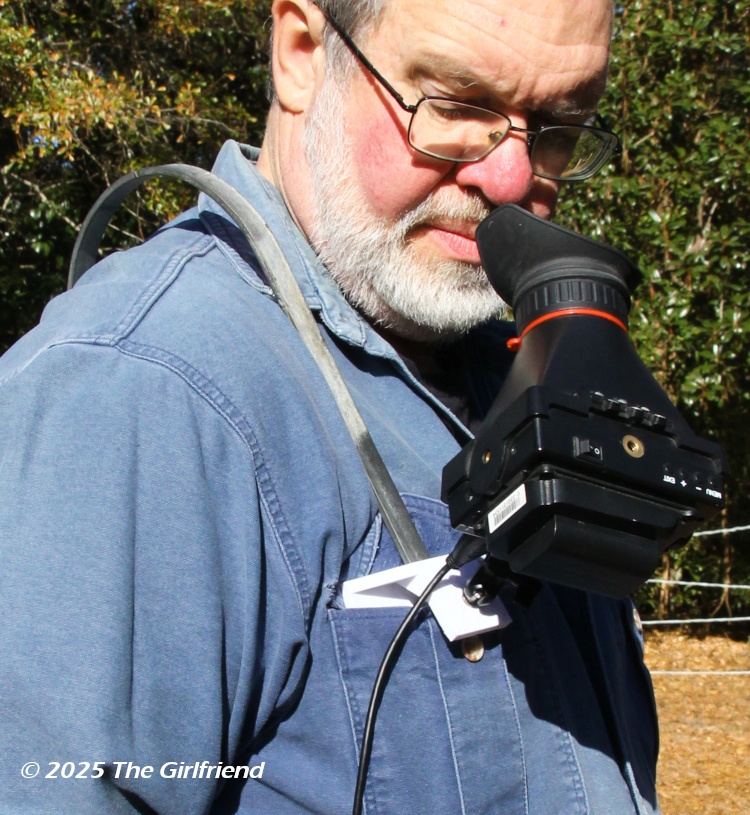
This would put the monitor right at my shoulder where it would be out of the way but I could drop my eye down to it easily, using the magnifying eyepiece for fine focus as needed.
Then, for over a year, I never had the opportunity to put it to the test – or to be more specific, I didn’t bother getting it out because I wasn’t expecting to need it. But with the nutria bebbies now coming around most nights, plus strong indications that the beavers were active, I got the rig back together.
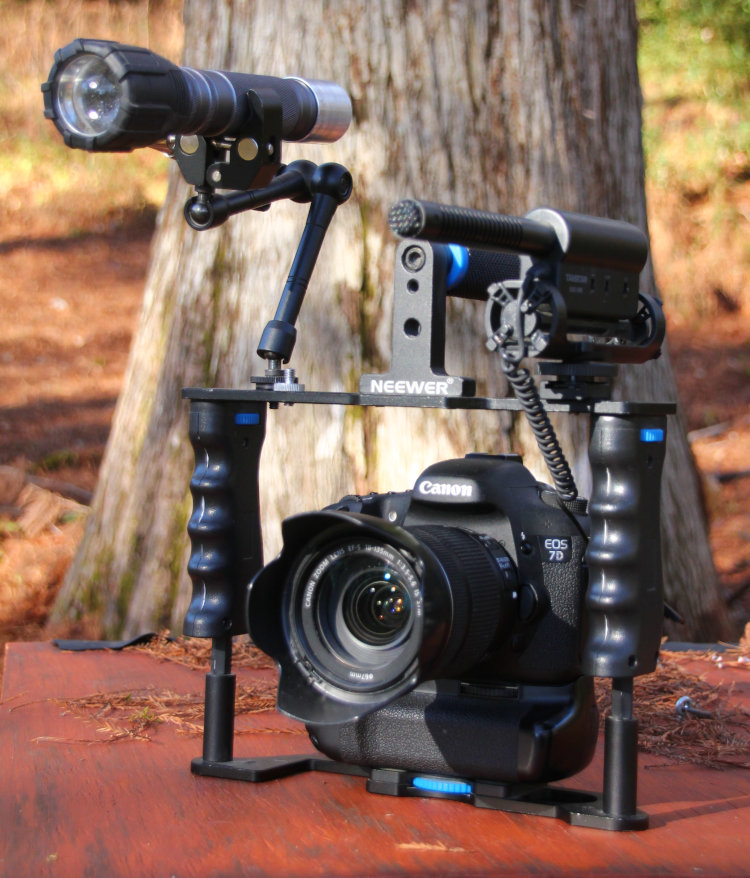
I was in the process of trying to find an appropriately bright flashlight to use when I remembered the one we kept in the car for emergencies. Like any such flashlight, the batteries were long dead, but I replaced them and found it was adequately bright enough, and so this got mounted to the video cage.
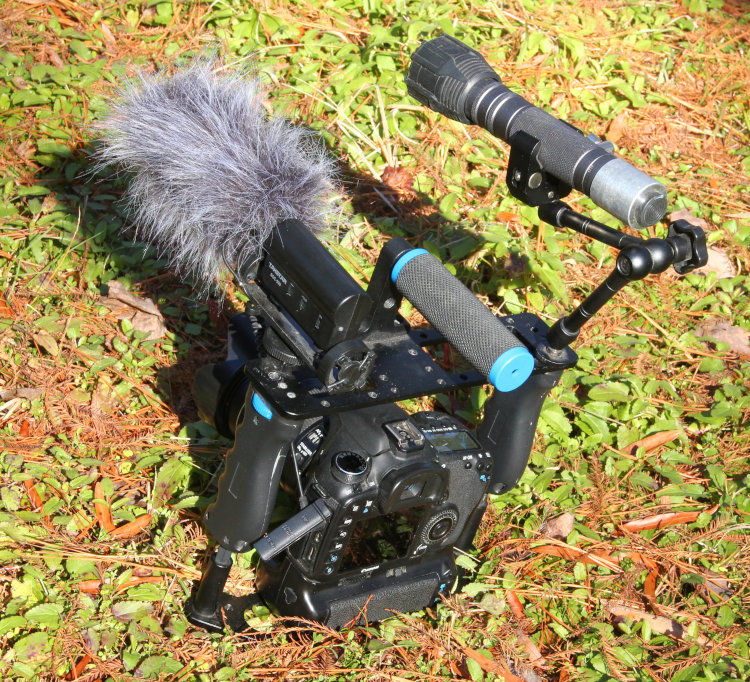
Another view, showing the arm that the flashlight mounts to for precise aiming, though for the first night’s clips, I had rushed out there and not finely adjusted the beam, so it was aimed a little low. I did better on the second night, but then the nutria were so close at times that it was almost overpowering.
All together, it looks like this:
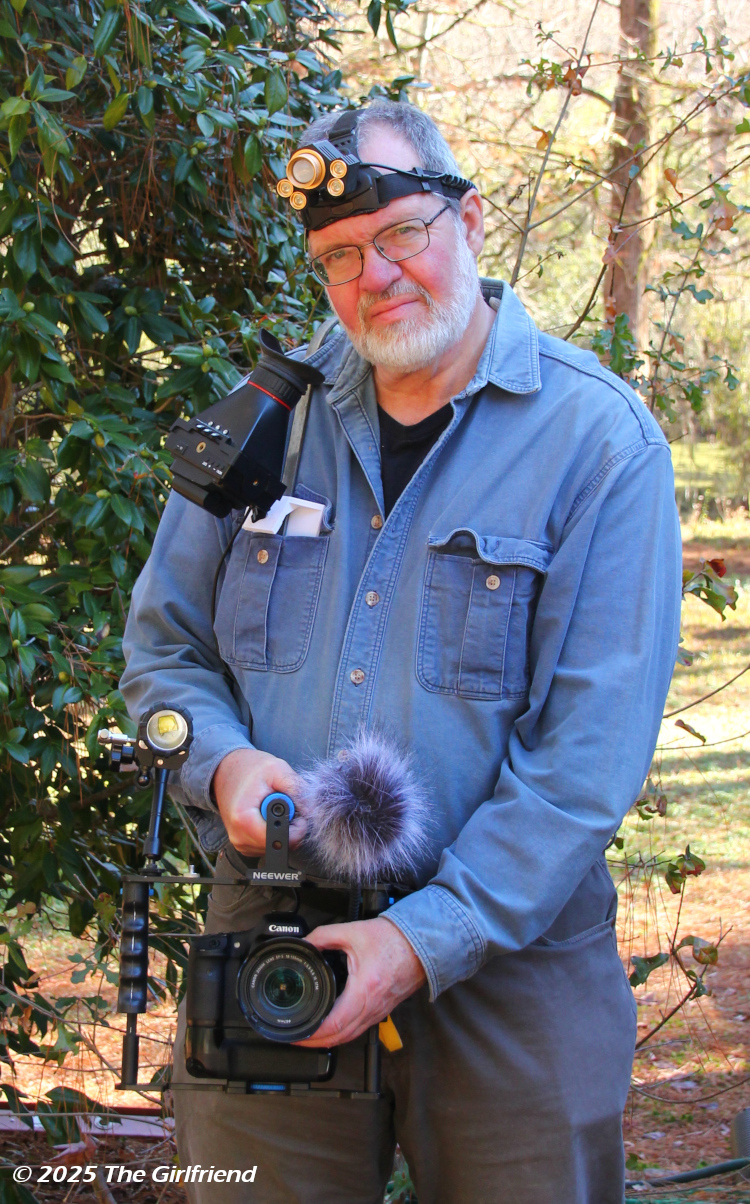
A long enough HDMI cord to permit moving the rig around without snagging. One hand to hold the cage, the other free to adjust focus and zoom since the 7D doesn’t allow autofocus during video – that’s the value of the external monitor, since holding the rig up to eye level, with microphone and light attached, to see the LCD screen and focus is just stupid.
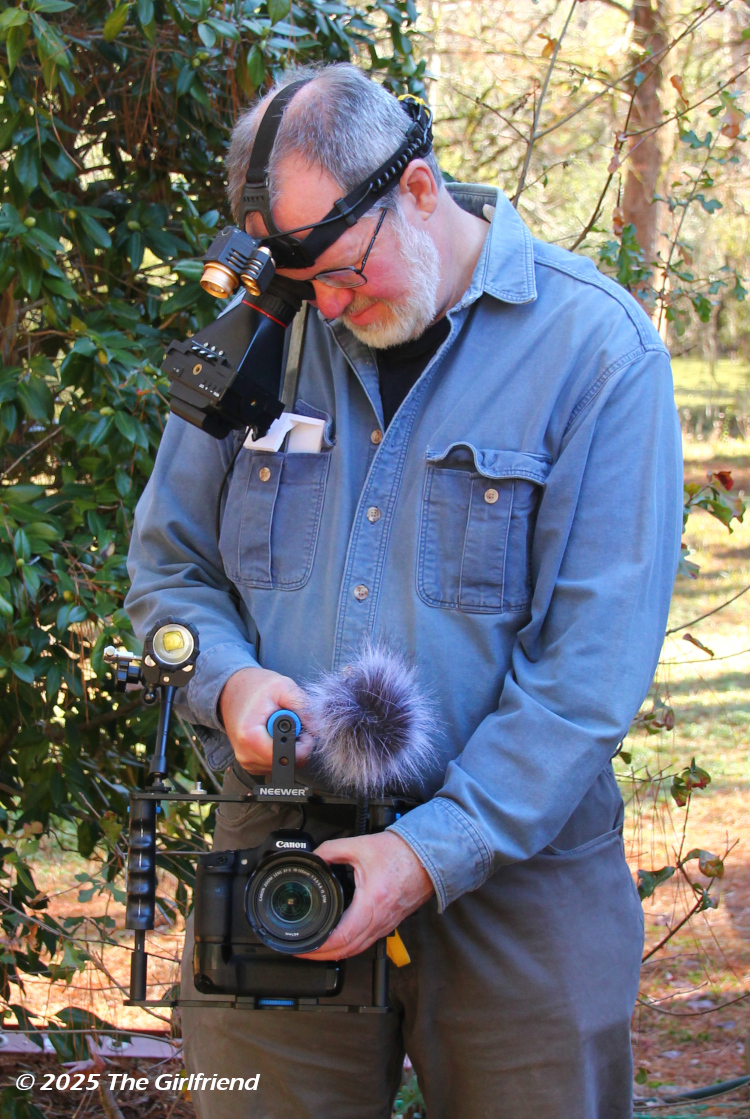
With the monitor right there, I can easily put my eye down to use the magnifying eyepiece and get a sharper focus – the only problem with this is, the resolution of the HDMI monitor that I purchased is slightly low for critical focusing, though as you can see from the clips, it’s not that bad, especially considering how dark the conditions were.
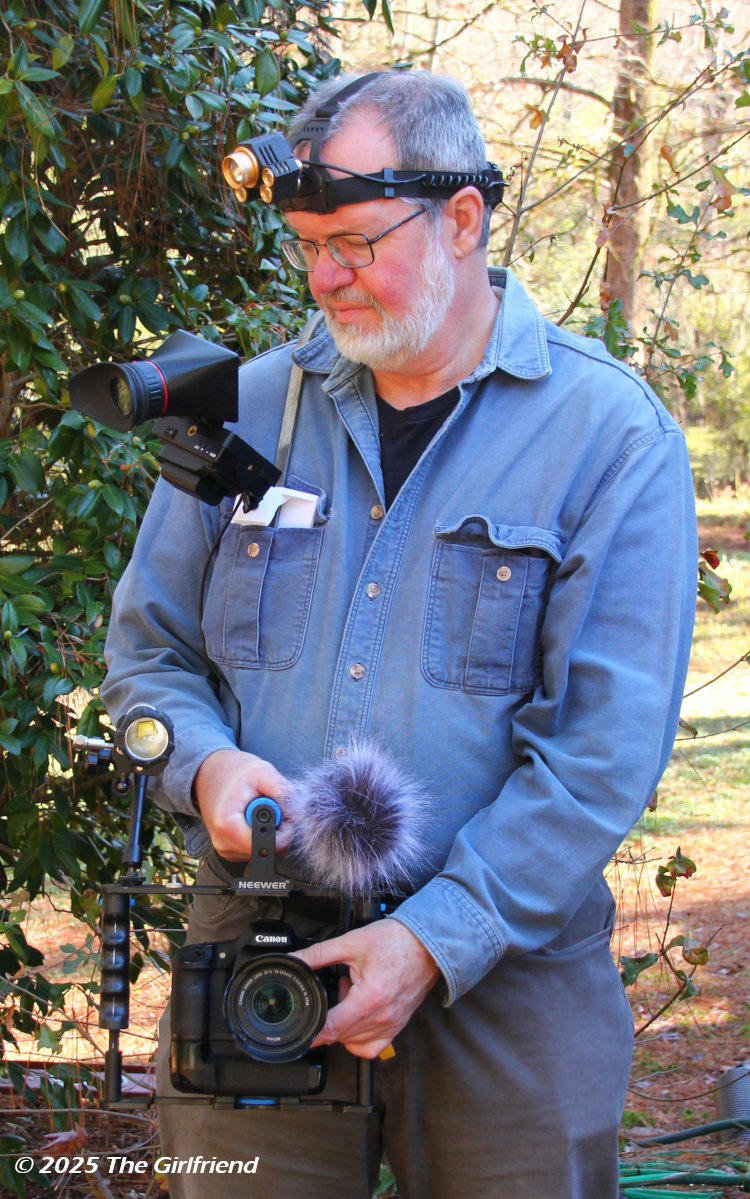
Or, I can simply flip the magnifying eyepiece out of the way and use the monitor directly, though I avoid this for night shooting since this throws a bit of light on my face. The flashlight does a lot for disguising my presence in the glare, but if I get anything into the light beam the subject will often spook, realizing that something is a lot closer than suspected.
One drawback right now is that the flashlight I’m using has a very stiff zoom head – it can make the light quite bright where needed, but adjusting it usually takes one hand on the zoom head and one on the flashlight barrel, which doesn’t leave any to actually hold the video rig, much less make adjustments to the camera. Thankfully, I shouldn’t have to adjust this often, once I find the sweet spot to maximize the light without reducing the field of view too far.
And one other thing, which I might be in the process of correcting. To start and stop the video requires hitting a button on the back of the camera alongside the viewfinder, an awkward location given where my hands have to be otherwise, and for some godawful stupid reason, using a standard wired remote release does not work for video. The infra-red remote does, however; not a useful thing as is, since it requires palming the remote in a location in front of the camera – again, using the third or fourth hand – but I may be on the verge of a workaround.
Yes, I could be using a dedicated video body for this – send me a couple of grand and I’ll be happy to oblige; those damn things are expensive. Or, as I realized after getting these clips, I could switch over to the camcorder for uses such as these – I kind of put it out of my mind because the built-in zoom lens doesn’t have the reach of the Tamron 150-600mm lens that I often use for wildlife work. That’s not necessary here, though, so we may see what happens.
At some point, I’ll be back and list/illustrate the various modifications that I’ve made to accommodate my ‘style’ and approach to photography – I’ve had it on the docket for a while now, I just have to sit down and get a lot of photographs. Meanwhile, you can go back to the end of the video and pay close attention to the part where the geese fly over, since the microphone actually captured the whirring of their wings as they passed overhead – I just now realized that.