
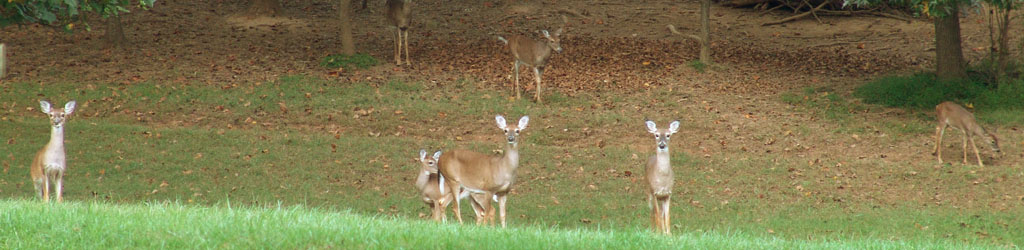






Listen – we haven’t seen a single bunny rabbit in the yard since we moved here. There have been a handful of fawns, and you’ve seen them all. No lambs, no kittens, certainly no red pandas or meerkats or bushbabies or quokkas. Assuredly, if there were, I’d be photographing them, but I can only snag what I see, and the cute ones are few and far between. It’s not my doing.
The other night when the supermoon was stunning the entire world, for some reason, the wolf spiders were heavily in evidence, emphasis on the ‘heavily.’ Spotting the eyes in the headlamp, I sidled up to the largest wolf spider I’ve ever seen – and then another, and another. Within four minutes I’d found four monsters, three of comparable size and one just a wee bit smaller. Between the moonlight and the nice temperature, I’m guessing they were taking advantage of prime hunting conditions, but that’s only a guess. We’ll start with one in its habitat.
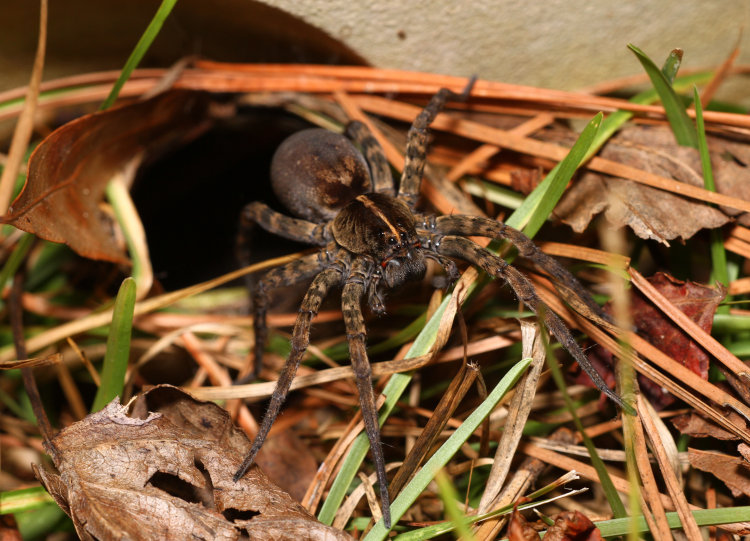
Since the eyes reflect extremely well, little blue-green stars within the grasses, I was able to spot them all from several meters off and stalk them, two of which were standing guard just outside their burrows. The ‘burrow’ of this one, however, was actually the reservoir of a planter pot, one that I’ve had for years and first appearing here. The spider (I’m presuming) had used leaves and grasses to fashion more of a restricted opening just its size. There’s too little for scale here; for that, we go to the first that I found, and caught for the studio shots.
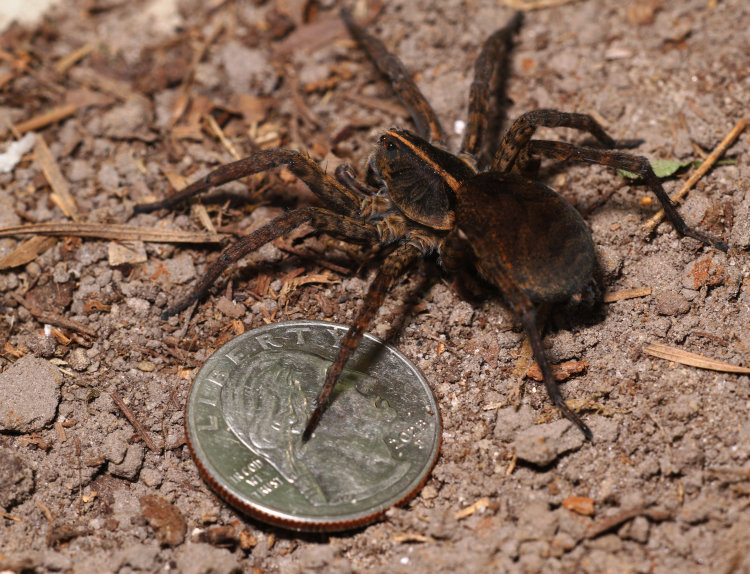
Capturing this one was remarkably easy, just scooting her into a small tub, and she also behaved well in the shallow dish I use for such sessions even though she could probably have stepped out without scraping her belly. That’s a quarter in the dish with her. I’m not even attempting to determine the species, since there are “Approx. 240 species in 21 genera in North America north of Mexico,” according to BugGuide.net, so we’re just going with Family Lycosidae. To her credit, this one moved very little in the dish and allowed me some closeups.

I cropped this one a little too tight to see, but the pedipalps are narrow and pointed, signifying a female, though the size is probably enough; for most spider species, the females are the bulkiest to have the nourishment to produce a few hundred eggs, while the males are leaner and often magnitudes smaller. What are the chances that these can still produce an egg sac before winter? I can’t say, but I’ve been surprised by how cold hardy spiders can be, popping out after a freeze that I would have thought would kill them.
The Sigma 180mm macro and the custom softbox brought out a curious detail that we’re going to go in even closer to see. You’ve made it this far, you’re good.

Think she’s fearsome? Look at those eyes – she’s terrified, and only wants a hug! Though what we’re actually seeing here is the reflection of the walls of the small dish that she was resting within, combined with the angle of the softbox light source for those white spots. But it’s a good illustration of the Lycosidae eye pattern, one of the better ways to distinguish spiders: four low in front, two main eyes centered above, and two side-facing eyes higher up and almost on the sides of the cephalothorax (‘head/body’.) The fishing spiders, which can get bigger than this, have those last two eyes more in a horizontal line with the two main ones, even when they can appear almost identical to some of the wolf species.
I soon released this one without ever having to try and recapture it within my bathroom ‘studio,’ but made several attempts to snag another near her burrow, to no avail – she always ducked back down before I got close enough for a decent frame. Which was probably for the better, because just over a meter away, this little spud was lying in wait:

That’s an eastern spadefoot (Scaphiopus holbrookii,) a toad large enough to make a meal out of wolf spiders even this large, and whether it knew the spider was about or not, I can’t offer any opinion. I know that when we established a little pond liner in the back yard of the old place, the green frogs wasted little time in moving in, and soon afterward, not a single wolf spider could be found in the back yard, though the front yard still had plenty. Even a few fishing spiders set up residence in the pond, but never for very long.
By the way, this is still late at night, but shot with the custom softbox – I can’t complain about its lighting ability.
Two days later I was out around the upper pond edge and went to step between a couple of saplings, only to be pushed back by what I thought was a twig. It wasn’t – it was a web, which I discovered almost simultaneously with finding this one a little too close to my ear:

Nothing for scale here either, but the leg span of this golden silk orbweaver (Trichonephila clavipes) would have come close to covering my palm, and while I’m probably exaggerating in memory, the abdomen wasn’t far from the size of my thumb – I’ll get some specific measurements later. [EDIT: I did. Not quite the size of my thumb, but very close to the top two joints of my little finger, a body length of 35mm. The leg spread account was accurate, though.] This one was a surprise though; the property had been littered with them several weeks back, but they rapidly disappeared as soon as the temperature dropped just a bit overnight. While possibly from the cold, it’s more likely that they had passed the laying stage and thus fulfilled their life cycles, living only a year. I have yet to find any of the newborns, or even an egg sac (old or current,) so I can’t vouch for how successful any of them were in reproducing, but this one was still game, it seems.
I have to stress how much resistance the web gave as I tried to pass through it: it’s not exactly fishing line or thread but it feels like it, remarkably tough, and I didn’t actually break through it before I backed off to see what I was missing. I could possibly have ended up as another meal for the spider had I been a little less alert, but then again, had that happened we wouldn’t even have this post, would we? I’ll let you stew on that…