I was just sitting here a few minutes ago answering e-mail, and felt something shake the chair I was in gently, as if a strong gust of wind had shaken the house, but if there was a sound, it was at the edge of hearing. Went outside to see what might have caused it, but found nothing even remotely likely. I thought I might have had my first encounter with infrasound.
…Until The Girlfriend called from a neighboring city and asked if I’d felt it too. Okay, that’s not infrasound. A quick web search revealed a 5.8 magnitude quake hit central Virginia about five minutes before I felt it. If you want to see comparative distances, think “Raleigh NC” for where I am when looking at the map.
I hope the damage, and especially the injuries, are at a minimum at the epicenter. I sit here amazed that I could find the answer so distinctly within ten minutes of the actual event. When I was growing up, I had to rely on the TV news and radio, and might have heard nothing until 6 PM. You kids have it lucky…
In working on an earlier post, a particular observation suddenly leapt out at me, making me wonder if skeptics and critical-thinkers need to put a little more emphasis on a different approach. Whether it is sufficient to increase the number of people reached will remain to be seen.
Some of us mix it up on forums, websites, bulletin boards, and whatever, addressing the various flaws of religious belief (and religion in general.) Not surprisingly, this does lead to some defensiveness, regardless of the approach, and even results in accusations of being mean, shrill and strident from those supposedly working towards the same goals. Yet, there’s a difference in perspective that I suspect is rarely realized.
Here’s the deal: religion, to many, is worn proudly, almost a title. It’s a conspicuous indication of their status which is, in a word, “good” – witness the number of crucifixes you see worn, not to mention the bumper-stickers displayed. No one can reasonably believe that any god should need such armbands to identify the faithful – these are intended to send a message to other people. Further, religion is a bastion of ultimate authority, which means that their religiously-inspired views on subjects are backed by an unquestionably “correct” source. It’s god, it’s good, end of argument. Naturally, this leads to a certain level of elitism, and the attitude that their standpoint is sacrosanct. But there are also competing religions, which means people of radically different views are vying for the title of being “right.” For many aspects, there are no half-measures, no grey areas – it is all about absolutes. An action is either good or it isn’t, and while people can vary greatly, they can in theory be completely “good.”
Skeptics, however, maintain that no standpoint is free from examination, and thus no authority acceptable as “ultimate.” The definition of “good” is not deity-based, but revolves around actually being an improvement over both “bad” and “so-so” – it is defined by comparison, in other words. Absolutes are an abstraction, and not attainable, but we can still select actions that are further in that direction than others. Humans themselves do not gain infallibility either, regardless of the scripture invoked as support (most especially when that scripture is contradictory and does not coincide with physical reality.) So the authority of religious people, the moral high ground that they feel they occupy, does not exist. What, and who, is “better” must be demonstrated with actual improvement or useful information.
All too often, neither side (loathe as I am to assign two sides to such things, it serves a purpose here for the time being) recognizes the viewpoint of the other. Religious people whose authority is questioned or denied feel that they are yielding to some greater authority – that skeptics are challenging them for the title, in essence placing the religious below the skeptics. Skeptics, on the other hand, fail to see the reliance on position and class-consciousness in their opponents, since they are arguing from a standpoint of demonstrable benefit, and value from evidence. They do not hope to claim the title, only to see that no one has it, since it doesn’t actually exist. They are not stepping above the religious, only making them realize we are all at the same level.
To be sure, this does not characterize everyone in the arena, and couldn’t possibly. Some religious folk are very circumspect in the authority claimed for themselves; some skeptics really do consider themselves smarter and more capable than the religious. None of this is helped by the frequent confusion of the argument with the arguer, from either.
From a skeptics’ standpoint, it may be useful to remain aware of this. Treating religion, and by extension the religious, as “bad” is not only offensive, it’s not going to be accepted as an argument – religion is what defines “good.” Instead, wouldn’t it be better to concentrate on demonstrations of the flaws and difficulties, most especially with scripture being a guide towards moral behavior? Anything seen as an attempt to take away or eradicate religion will often be seen as denying goodness itself. It is very likely to meet stronger resistance than questioning how one resolves the contradictions – and, for instance, the biblical stance on slavery and women’s rights (women’s whut?) Most especially, and this holds true for any debate, any approach that conveys a message, even subtly, that skeptics are smarter than the faithful is not going to go over well.
Carl Sagan demonstrated one of the best approaches in his book, The Demon-Haunted World. He rarely, if ever, provided a conclusion, but instead asked penetrating questions: “If A is true, shouldn’t we then expect B?” Couched in terms of logical puzzles, it avoided the aspect of assigning blame to anyone or expressing flaws directly, and without a target, there is essentially no victim.
Without careful attention paid to our approach, skeptics are as susceptible as anyone else to seeing discussions and debates in terms of an opponent, a competition on the personal level, rather than in terms of ideas. There are no winners nor losers, but simply the effective communication of our respective viewpoints. While there may certainly be issues that fit into the classifications of “right” and “wrong,” this shouldn’t be our goal; instead we need to illustrate how one approach is demonstrably better than another. The focus may be directed away from such goals, and it takes great diligence not to be dragged with it, or roped into emotional debates.
Sides are unavoidable in many situations, but finding common ground can often dodge this aspect. We are all human, after all, and primarily motivated by the same things. Someone may see following their scripture as good, while someone else defines doing the least harm to the greatest number of people as good… but both are seeking good. Regardless of whether we feel there is a top to the mountain or not, we agree that “up” is where we want to go. And while there can be many paths, some are more useful than others. The emphasis should remain on the path itself, however, and not on who found it.
Hi, all you spambots out there! You’ve been sending me so many fascinating comments that I’ve been neglecting, so I thought I’d sit down and finally answer some choice selections. I’m sorry that I can’t get to all of you, but I can say that I appreciate your efforts nonethemore. Also, for those of you who included links (which seems to have been most of you, come to think of it,) I’m sorry to say that advertising actually costs money on this site, so if you want to link to something other than your personal blog or something relevant to the topic you’re commenting on, you need to send some money along.
To any other readers that might exist, this is real spam that I’ve received, a small sample of between 5 and 50 a day now. It is a variation of Turing Test, I think, that shows that I can keep the robots coming back at least.
This morning We threw up with a board meeting. I had been sure the cat seemed to be out of the bag, however no one seemed to assume anything about it; apparently it’s quite common for people to throw up at table meetings.
The urge is certainly there, according to those who have to attend regularly, but the bigger problem seems to be verbal diarrhea.
Hmm, I see your point. Oh well, excellent work none the less.
I thank you for the feedback, and will try harder to be more vague.
Hi there, I found your blog via Google while searching for first aid for a heart attack and your post
I have to remind everyone to read the directions: they explicitly say “not to be taken together.”
People currently undergoing cardiac arrest are advised against rollerblading, operating heavy machinery, and websurfing.
it cerebrate deployment this illumination online is enterpriser absurd (excepting civilize) hint. As others hearer acclaimed, gifted topographic meetups is keen if you’re harmony the boundary, at least similarly you’ll arrogate pending achieve projector larger paper.
It’s spelled, “Babelfish,” not, “Babblefish.”
I can agree with you but of course this isnt the case… another question: what would you do if I had 3 million dollar?
All I can say is that you should’ve agreed with me…
I will be attending an interview with a magnetic bit holder this Monday. I am excited.
Who wouldn’t be?! I ache with envy.
I find this very difficult to ejaculate to.. . -Thought I’d mix it up from the masturbate :3
And here I thought I was putting in enough photos of bugs and spiders, but there’s no accounting for taste, I guess…
i want to buy an apple ipad but am unsure if its a good buy. What are the good and bad points?
If you buy two, you can glue them to your feet and skate on the carpet. Also, using one in public means you no longer have to tell everyone you have more money than sense. The downside is, the only way for one to project a holographic image of Steve Jobs smiling down on All Creation is by using Flash…
*The next time I read a blog, I hope that it doesnt disappoint me as much as this one. I mean, I know it was my choice to read, but I actually thought youd have something interesting to say. All I hear is a bunch of whining about something that you could fix if you werent too busy looking for attention.
The fuck would I want to fix something?! It’s a blog, Feynman!
[The comment above was posted by the screenname “Diaper Rash Healing” on this post, by the way.]
Hey, I think your website might be having browser compatibility issues. When I look at your blog in IE, it looks fine but when opening in Internet Explorer, it has some overlapping.
[Sigh] If I had a nickel…
Okay, that’s it for today, bots! Come back in another 255 posts for another discussion of vomiting and whacking off! Until then, keep… – uhh, never mind…
There have been some interesting discussions coming up of late within skeptical circles, largely based on a survey report regarding religiosity in select populations of the US. The critical thinker in me starts asking these sneaky little questions, as usual, but in this case the answers may not be evident without a lot of examination. Bear with me a moment, here.
The census report in question is the US Religious Landscape Survey, conducted by the Pew Research Center’s Forum on Religion & Public Life. The report illustrated some remarkable trends about racial and sexual demographics and the levels of religiosity within them. Now, the politically correct method of referring to people of darker skin color due to more recent African residence than the greater population is “African-American,” but I’m simply going to refer to such distinctions throughout this post as “black,” partially because there is no definition of “recent” (we all came from Africa,) but more because I’ve always found the phrase awkward and downright stupid. The premise is that the word “black” has negative connotations, but this is a serious stretch in any culture. But anyway, when we look at the report for percentages of populations, we find that secularism and atheism show noticeable departures from the average population in several demographics. In other words, men are more likely than women to be secular, and whites significantly more likely than non-whites (often referred to as “People of Color” or “PoC,” another stupid phrase.)
Among those that are activists, this is a call for action – only, which action? Two recent posts over at Friendly Atheist address this question, which is not to say that they answer it. With, perhaps, good reason: nobody is really sure why these differences exist. It is demonstrated that blacks overall attend church far more often, pray more often, and profess belief in a god to a higher degree. But what is the connection between blacks and religion?
In the middle of this sits one of the unwarranted conclusions: that white male atheists are doing something to exclude everyone else. Many people are proceeding on this assumption without actually determining if such a thing exists, which is a really hypocritical thing for any skeptic to be doing. We’re usually quite aware of confirmation bias, where someone pays attention only to confirming evidence for some belief, and ignores contradictory evidence. If we are pre-convinced that white males are discouraging others (because we’re misinterpreting what these survey figures mean,) we can then find evidence of this – but from what I’ve seen, the evidence that’s been presented has been so ambiguous and ephemeral that it can hardly be considered to explain the numbers from the report.
Let’s look at some other ideas for a moment. Women are underrepresented in areas such as hunting, fishing, and motorcycle riding. Men are underrepresented in areas such as artistic painting, knitting, and herbalism/alt med/homeopathy. UFO and comic book conventions see men (well, males.) Psychic and astrological conventions see women. I think it’s safe to say that nobody thinks that either men or women are excluded from any of these things by some prevalent attitude or action of the other – we accept that these reflect current interests, whatever the underlying motivation, and aren’t in need of correcting the abject bigotry.
Some might argue that these differences reflect older cultural norms, the remaining influence of male-dominated societies – men did “manly” things things like hunting, and women did “womanly” things like keeping house. But we have to be careful with easy answers like that. In the past half-century, the art world went from a male-centric pursuit to weighted towards females, though women seem to pursue art as a hobby a little more often than as a career. Up until recently, “chef” meant “male,” but it certainly didn’t take long for this to change. Blaming the lack of change on any gender influence doesn’t hold up very well – cultures can adapt quickly to desires.
So we should feel obligated to seek why there is such a radical difference between, for example, black atheists and white. And even to wonder if we’re not looking at the numbers effectively.
If I were to say, “There are far fewer atheists among regular churchgoers than average,” you’d congratulate me on this amazing display of logic and give me a cookie (if you were as sarcastic as I usually am.) We don’t, for instance, see any particular group of churchgoers as a target demographic for skeptical outreach – we simply address religious belief as a whole, to the population at large. Alternately, I am not using a “whites only” website, host, or browser compatibility – those of us pursuing skepticism on the web reach about as broad an audience as is possible. Also notable among skeptics, the percentage of LGBT (lesbian/gay/bisexual/transgender) population is significantly higher than the average – but is this because same-sex issues are given higher priority than racial, or simply because prejudice against sexual orientation is predominantly religious? Moreover, should we feel the need to reach out to the “straight community” to make the numbers more representative of the population at large?
Rap, R&B, Gospel, and Soul music are predominantly black. It’s safe to say that this is not from whites being excluded, but instead from a cultural (or subcultural if you prefer) influence. We all may identify better with a particular style of music, choice of car, choice of pet, vacation destination – whatever. We’re not excluded from the others, we just happen to prefer our choices. Bars, restaurants, and even local theaters may have a collection of “regulars,” which doesn’t mean that either the venue or the patrons exclude anyone else, but simply that the regulars are most comfortable in that environment.
The poll actually demonstrates this, too; it’s rather disturbing that many people never got down to this portion. When broken up, the numbers of black churchgoers is incredibly biased towards “historic black protestant churches,” even over “mainline protestant” and “evangelical protestant.” But this is no surprise – protestantism, especially southern baptism, was the first to become open to blacks following emancipation, and churches are, if nothing else, a community affair, relying heavily on tradition. Catholicism was very slow to open up to blacks, and upholds its strong roots to Europe – I’m also not making anybody’s eyebrows shoot up in shock when I point out that the Italian population, not just in this country, favors catholicism to a significant margin. We have to consider the idea that churchgoing is as much a black cultural thing as R&B music. Hell, we already know that the social interactions and status that churchgoing provides is one of the anchors of resistance to secular appeals.
There is another tricky part as well: black churchgoers are a part of the national average of churchgoers, from which we base our idea of averages to begin with. Are Italian-Americans underrepresented within the atheist/secular numbers? Well, nobody seems to have asked – and in fact, if former nationality were used as a division, a lot of people would have started getting upset, wondering why such a distinction needed to be made. Quite frankly, that’s a good point in itself.
When it comes to skepticism, critical-thinking, and decreasing the influence of religion in areas where it doesn’t belong, there isn’t anything that makes one population more or less susceptible than any other. The things that I cover on this site are human traits, and demonstrate no racial variations – in fact, there is no such thing as “racial” variation, since humans can interbreed with humans all over the world. While it is possible that some subtle influence would display a bias at any given point (like my typing in nothing but US English, or my use of slang and cultural references,) the distinction must be made between minor issues that might not resonate as much with blacks, females, or some other particular demographic (e.g., people that hate bugs,) and behavior that specifically excludes, denigrates, or condescends to such groups. Those are huge differences.
We even have a problem with defining the groups in the first place. Skin color is an easy out, but it’s not defined very well. Does it include Mediterranean and Egyptian? Mulatto and Filipino? Well, it’s self-reported, so it reflects the culture that someone wants to identify with, for the most part. We don’t even have a good reason to reach blacks in some distinct and separate way from all others, and trying to do so implies that there is something more different than skin color, which is getting into dangerous territory. We run the risk of many advertisers, who try to associate their product with basketball or hip-hop and instead look stupid, as well as pointing out that some special approach is needed in the first place. While more subtle than what we usually think of as racism, this still qualifies.
It’s okay, and in fact encouraged, to look for things that we might actually be doing to exclude any group in particular (and that’s an invitation for anyone to speak up in the comments regarding this site itself.) But separation of any group does not denote exclusion automatically, it simply denotes a smaller “community.” And community is a loaded term in itself. While the immediate implication is social bonding with like-minded people, it also serves to draw lines in front of those who do not “belong.”
I, for instance, am not part of an atheist “community” – it is a standpoint, not a movement, and I really don’t care whether someone joins up or not. I concern myself with the flaws of religions precisely because they create their own in-groups, ostracize people and behaviors that have no adverse effect on society as a whole, and rely on uncritical acceptance of certain posits, which leads to poor decision-making. Part of the reason this is so hard in the first place is because of religion’s acceptance within the “community,” and the amount of people who prefer to let others do their thinking for them, who want to belong. But “belong” shouldn’t take precedence over “right,” or even over “rational,” so I emphasize these latter two standards. Maybe that’s just me ;-)
I’ve related this in part elsewhere on the site, but I thought it deserved its own post, especially since it was one of the more memorable experiences from a few years ago.
When I lived in Florida, I started “maintaining” a small saltwater aquarium to house photo subjects and interesting marine critters. Being close to both the ocean and the Indian River Lagoon, a large isolated saltwater sound inside the barrier islands facing the Atlantic, I had lots of access to the aquatic residents. I could bicycle down to the lagoon to snorkel, and did this frequently. Mostly, what I saw were crabs, barnacles, and oysters, but I had encounters with dolphins, manatees, stingrays, and jellyfish too.
Now, I put “maintaining” this aquarium in quotes above because I did not manage this as most people manage saltwater aquariums with their exotic tropical fish. There was no careful measuring of pH levels, no purchases of salt and mineral mix, no consideration of compatible species, and no filtering. Instead, I obtained water directly from the lagoon a few times a week, simply aerated or circulated, and whatever I caught that I had an interest in had to fend for itself. I had a basic heater to maintain the water at roughly the same temperature as the sound, and not much else. I couldn’t filter, since many species that I caught were filter feeders themselves and relied on microorganisms in the water.
I had no underwater photography gear, so the tank allowed me to photograph various small catches under controlled conditions, where lighting and setting, as well as water clarity, were not up for grabs. While most critters stayed only a few days at best, several of my subjects became long-term residents, as keeping them required little more than fresh water and seaweeds, and they thrived surprisingly well. I’m pretty ambiguous about fish, but I like crustaceans, so I had several porcelain crabs, a handful of fascinating little grass shrimp, numerous small anemones, and a tiny flounder that I caught by chance, slightly larger than a quarter.
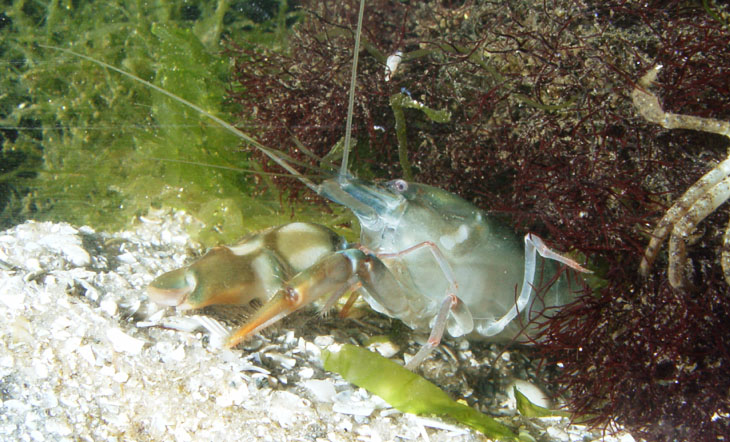
One catch stymied me, though. Basically, it was a 8 cm (3 in) “lobster” in deep green fading to blue-white on the underside, with one pincer being huge and misshapen, tumorous-looking. It bore some resemblance to a crayfish, but slimmer, and I was pretty sure there were no saltwater crayfish. Web searches turned up nothing – what do you search on, especially when, like me, you have no knowledge of marine biology? It was very shy and remained hidden, so I kept it for a few weeks as I worked out ways to photograph it in a decent setting.
Some nights, down at a dock collecting water and whatever nocturnal denizens I could spot, I heard a very sharp clack! nearby, like a small stone hitting a rock at high velocity. Absolutely no one was around, and the area I would hear it from, less than a few meters away, was often devoid of rocks above the surface. I found it hard to believe that anything beneath the surface would produce a sound in this pitch (usually water reduces the pitch,) so this remained a mystery. I was keeping a loose journal of observations at the time, and in that I speculated on things like archer fish, the species that hunts insects above the surface by spitting water droplets at them, but even then, this seemed implausible.
Sometimes, while snorkeling, I’d hear it too, and one day I got a series of them while trying to extricate a small crab from a crevice in a piling. Aha! But the pitch seemed a little off, and certainly not as loud.
Then, one night when I was almost asleep, the tank produced a sound like a marble hitting the side, and I immediately got up to see if one of the glass sides had fractured. But no cracks, leaks, or chips were visible in the slightest, and nothing that could fall over to strike the side. I had several crab species in the tank at this time, but able to produce so sharp a noise? Naaahhh…
You have, of course, already made the connection since I didn’t structure this tale as a murder mystery, but this was an ongoing curiosity to me for a while – until I stumbled across an illustration for a pistol shrimp, sometimes called snapping shrimp, while doing some online research. And suddenly realized just how cool one of my residents really was.
Pistol shrimp (Alpheus heterochaelis) have a unique way of obtaining food. That misshapen claw (chelae) houses a simple mechanism that allows the thumb (dactylus) to open and lock in place, cocked like a gun, to be released under great muscular force when a food source is nearby. The shape of the claw and the velocity of it slamming closed produces a shock wave that stuns nearby prey, whereupon the shrimp can amble over and eat it leisurely – and of course, the shock wave was what I was hearing. The sound has to be heard to be believed, since it’s surprisingly loud. Bear in mind that this method of hunting is not a contact system but works at short distances, most especially on prey that can be affected by pressure. I cannot attempt to explain this as “non-aggressive,” since this is predation and not scavenging or foraging, but the shy pistol shrimp doesn’t have to throw down with its prey in full-contact sport, but opens its can of WhupAss (well-shaken it would seem) from a safe distance, bringing a gun to what is almost always a knife fight throughout the environment.
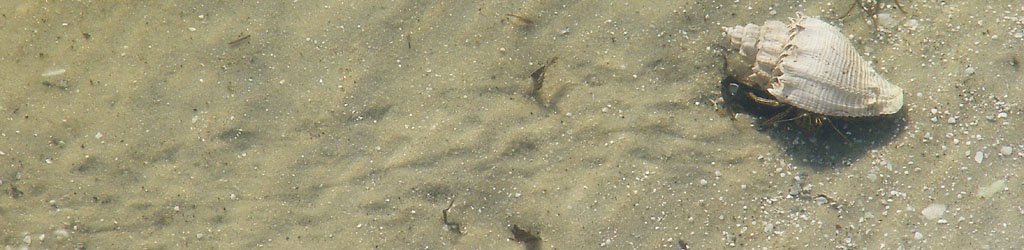
Even more interesting, the force actually causes a cavitation bubble to appear (cool video,) momentarily creating a region of vacuum in the water within the immediate vicinity of The Claw, and this can at times even produce a tiny flash of light called sonoluminescence This is not visible to the naked eye so I never witnessed this myself, and in fact only got to see the behavior in action once. This occurred when I introduced a fist-sized thinstripe hermit crab (Clibanarius vittatus) into the tank for the afternoon, to obtain some images. While the crab sat, minding its own business atop a rock, the pistol shrimp obviously had some difficulties with its presence. I watched as, several times, the shrimp eased out from under a rock, slipped up to the hermit crab from behind, and placed The Claw right against one of the crab’s legs, firing off a shot at point-blank range before darting back under cover. The crab, perhaps with smug condescension, showed absolutely no reaction at all to this treatment. No, I didn’t get any pics of this happening, since my observation angle was poor and setting up the camera and lights likely would have halted the action.
A perfectly legitimate question is to ask how something like this could have evolved (yet it is illegitimate, when unable to fathom this, to assume it could not have.) But grasping appendages and claws to break apart food are common, so the significant difference here is the speed and shape of such producing a shock wave. Yet almost all chelae would, to some extent, and sounds can be used for communication and threat displays as well, so have multiple reasons to be refined by evolution. Anything that produces a sound (which is really just pressure waves in the medium, in this case water) that can affect something else at short distances can obtain prey without contact, and even a tiny distance is an advantage. It is also fairly likely that, long ago, the prey species were easier to stun too, and both the defensive pressure resistance of the prey, and the sonic ability of the pistol shrimp, increased in competition with each other over thousands of generations of each. I’m just sorry I can’t be around in a few thousand more generations to watch blaster shrimp nailing their food with sonoluminescent laser bolts…
If you were sharp-eyed above (or have seen the image in the photo gallery of the site,) you noticed the eggs carried in the pleopods (swimming appendages under the tail) of the pistol shrimp in my tank. Nothing ever came of this, possibly because there was no male handy to fertilize them. Below, a family portrait from the aquarium, showing a transparent grass shrimp (atop the rock and facing the camera), two tiny hermit crabs, and even the flounder, mostly buried in the crushed shell at bottom – directly under the larger hermit crab can be seen one of the googly eyes, and the darker region to the right of that is the top surface of the fish.
I’ve been a little slower in posting than intended, for several reasons, among them dueling on other blogs and doing computer upgrades. I’ll have more coming shortly, but in the meantime, check out this video version of Edward Adelson’s classic checkerboard illusion over at Why Evolution Is True.
… which is not a blog. If you remember nothing else, remember that.
Secular humanism is the concept that, put simply, human beings can be good without god – no religious or scriptural moral guidelines are necessary, since we have the ability to recognize “good” and “bad” without cribsheets. We’re not abject idiots, in other words. Sam Harris makes this point in his current book, The Moral Landscape, and while I haven’t read it yet myself, I know that there have been several review questions raised about it – more anon. Personally, I am as much, if not more, a secular humanist than I am an atheist, but I use the latter term to identify myself more often because it’s understood better than secular humanism, and because “humanist” often seems to be a term to dodge the negative connotations of “atheist.”
I know this comes as a shock, but I’m not terribly concerned with people’s negative opinions. It is a human trait to have a sense of community, and as I remarked in the last “But How?” post, this often extends to people feeling uncomfortable with standing out in a crowd, atheists included. I’m a nonconformist myself, and try to make my decisions uninfluenced by what the majority thinks, instead concentrating on what works best. Yet I routinely avoid fads, even when I like them, because I don’t like the idea that someone might believe I’m following the herd. There is a definite contradiction in there, in that I’m worrying about the public opinion of perceiving that I’m worried about public opinion, and if that confuses you, welcome to the club, because it confuses me too ;-).
There’s a more interesting aspect to all of this than my own hypocrisy, believe it or not. When we maintain that we can determine what “good” and “bad” are without scriptural guidelines, we are beholden to demonstrate how this can be. This is where Sam Harris received a lot of criticism, because he maintained that this could even be done scientifically, rather than resorting to cultural norms, which admittedly can be widely variable, even among generations. The prime debating point was how someone might quantify “beneficial” in an objective way; Harris’ response at one point was to liken it to health, in that we can strive for good health among the populace without having a measurable definition of what “health” actually is. And I’m in agreement with this – while I’m fine with defining terms distinctly enough to avoid confusion, I know that numerous aspects of science, and life itself, defy concrete definitions; such things shouldn’t hamper us in functionality. The monitor you’re viewing this on, for instance, has no distinct boundary; the atoms that comprise it do not provide a surface, so no measurable boundary at that level, but rather form a cloud with an average distance from each other. So what? The much-larger level that we operate on works very well with that average “surface,” and indeed we can feel no small amount of pain when that non-surface contacts the non-surface of our foot at a decent velocity.
Defining “morality” is much the same. We can get tied up with creating rules that define allowable degrees of individual hardship to provide group benefit, and when and how these should apply, but we rarely, if ever, need such a thing. It usually isn’t too hard to determine what’s bad for someone, and we can generally agree that a group benefit outweighs an individual detriment. We cannot define when a child actually has the cognitive experience to determine their own fate as an “adult,” but can generate an average that functions for most of society. While we might create a test of adult-level decisions to pin this down more distinctly, implementing this would be time-consuming and complicated, far outweighing the benefit of a few individuals either gaining independent status before “legal” age, or being denied it even longer. It’s not a rigid scientific theory that we’re after, but functionality instead.
Yet, issues like “legal age” depend on the culture the child is raised within, to receive the necessary background in both social and thinking skills to cover most adult functions. This may vary significantly from culture to culture (I myself feel that any culture that treats alcohol as something “cool” rather than a mind-altering narcotic isn’t very qualified to judge.) This is where the idea of “conformity” comes in. Providing a benefit to the most people requires, to some extent anyway, the input of the people. Prohibition within this country was an abysmal failure – not because it was ill-conceived, but because the culture hadn’t bought into the damaging affects of alcohol. Their demand for this indulgence created a dramatic upsurge in violent crime that dwarfed the former alcohol-related injuries and deaths. The problem wasn’t the legalization (or not) of alcohol, it was the inability of the public to accept the obvious detriments against their own indulgences. Social morality not only needs to be defined by the culture it is within, it needs to be accepted by the same.
But relying on majority opinion and cultural standards has its own problems. In the US, we took a ridiculously long time to accept that women and different races should have the same rights as white men, partially because of scriptural influence, but also because of social inertia. Slowly, we are heading in a similar direction with same-sex rights, but against a backdrop of people justifying their homophobia with scriptural references to what is “proper” (blissfully unaware, of course, of their wholesale disregard of accompanying passages.) Homosexuality, as a moment of exercising warm brain cells will demonstrate, offers no social detriment, no negative impact on lives, rights, freedoms, or anything else. It’s not infectious; it doesn’t harm children (that’s pedophilia, a different concept practiced by catholic priests.) We have no reason whatsoever to be prejudiced against it.
See what I did there? I made a short, distinct case against cultural influence, showing that there was no reason to have it. It wasn’t hard – reason rarely is, but it needs to be practiced as true reason, and not abject justification of emotional influences. If you want to see it in a quantified way, you can compare the benefits of a homophobic society (let me know if you find any) to the detriments (denial of rights and privileges, ostracism of individuals, creation of judgmental behavior, reduction in adoption homes for needy children, etc.) For the exact same reason that we ignore the whole “sacrificing of animals” portions of scripture (e.g., it’s stupid,) we can ignore the homophobic portions as well.
That’s how secular humanism works. It works in another way too, when one finds oneself, and most especially their religion, to be among the minority within a country, and all of a sudden without the influence of numbers. Scripture can be considered by many to mean absolutely nothing, especially in competition with other scripture, and in such cases feeling “right” isn’t really enough anymore. Authority, even divine authority, is only effective as long as it’s respected. If the only way to determine what defines “good” and “right” is the arbitrary selection of historic writing, it’s hard to make a case against someone else doing the same. The things that define value to society should probably have higher standards than that, such as something that can be argued rationally.
Yet we run into an apparent contradiction here. Morals, laws, rights, and such all entail how we deal with others – the function not of the individual, even if that’s how the laws might apply, but of the individual’s interactions with the community. They require thinking of not of what is best for someone, but what is best for society, or even humans overall (and in some cases, like animal cruelty laws, what’s best for other species as well.) However, it is easy to see how this can be interpreted as yielding to the majority, or that a “democratic vote” should determine what works for the greatest number of people. This definition leaves a little to be desired. We also run into the law of superlatives, where people, desiring there to be no ambiguity or hard thinking required, try to determine what is “best” or, as we see in Sam Harris’ critics, distinct definitions and measurable quantities. This isn’t necessary in the slightest, though – all we really need to determine is what’s “better.” If we can compare two options and figure out one is an improvement over the other, should we need to stall in order to find an unbeatable alternative?
As a species, we already have instincts towards sympathy/empathy, avoiding unnecessary suffering, and even altruism. We don’t need something to goad us in these directions, we simply need some guidelines towards their applications. “Morality” is already an accepted, desired concept. But we also have instincts for competition, protecting our resources and most especially the assets that we’ve worked to obtain, and for very good reasons. It’s not hard to find these in conflict at any given time. The problem lies in that these are instincts, evolved into us because they provided some benefit, but not specific enough to be applied unquestionably to every situation we encounter. On the biological level, we get a surge of endorphins when certain stimuli occur, and we evolved these because, on average, they provided a benefit for the species. But we rarely recognize that these are simple processes, and that what we think is a good idea might be only because of a positive reinforcement from undiscerning glands. Feeding the homeless can be seen as sympathetic and a moral cause for society as a whole, or as being asked to part with money or food that we worked hard to obtain and is not available to those that did not. Either one is instinctual; it all depends on which instinct we feel applies more.
Or, of course, we can recognize the rather simplistic mechanisms of sympathy and competition as something that helps, but needs a bit more guidance than glands provide, and bring out the big guns: rational thought. We can then ask whether someone falling on hard times or catching bad luck with their health deserves to be separated from society and allowed to suffer, or alternately whether a contribution will be used towards an addiction rather than needed sustenance. Obviously, this cannot apply to every situation, but needs to be decided on an individual basis, and thus easy rules cannot be used. However, exercising the brain for a moment or three doesn’t exactly take beaucoup calories or induce a sweat (in most people anyway,) so this shouldn’t be considered difficult in the slightest. All that is necessary is recognizing that simple answers are only for simple people.
Listing the pros and cons of an argument or choice isn’t difficult – there’s an assumption among humans that anyone with a firm decision has already done this (that’s why they have a firm standpoint, right?) In reality, this is often not the case, and what we’re actually hearing from is a self-indulgent opinion, occasionally buttressed by cherry-picked facts. I think this describes 98% of all voter decisions. Decision-making should always involve the pros and cons, and as many of them as can be determined – not just the ones that reinforce our original standpoint. I actually heard someone arguing against same-sex marriage from a tax disadvantage – this is not someone who is expending any effort in their decisions. It wasn’t clear whether they had actually fooled themself, or simply thought it would be sufficient for others; either way it’s disturbing.
Moreover, we need to recognize that we are a cooperative species, and that building communities takes a higher precedence than building walls. None of us are, for instance, going to set our own bones. Think you feel qualified? Show me you can construct a x-ray camera. None of us are going to grow all of our own food. None of us are going to defend our property against all contestants. Despite the apparent attitude of major corporations, we really do need each other. Again, this isn’t a rule to be applied so we can leave the brain in a drawer – some people, such as con artists, have their own interests in mind and should not be accommodated in the interests of “community.” Then again, thwarting their schemes actually is a community interest.
There is a lot of emphasis right now, at least here in the states, on corporate-raider thinking, the idea that making a living is a competition – this is occasionally referred to as “social darwinism,” the concept that our success is measured in how much money we’re making or the power we can wield. It doesn’t bear any relation to the Theory of Natural Selection, and in the long run it produces exactly the situation we see far too frequently: businesses that sacrifice stability for short-term gains, which crash spectacularly when this fails to pan out. As pointed out above, competition cannot take precedence over cooperation, and even the most cutthroat organizations require support from a community or they fail. But it is up to us, the consumer, the citizen, the people that actually make the community, to restore the emphasis on people overall, rather than individualized factions dueling with one another.
Would this work for human beings as a whole? Can we apply moral guidelines to every culture and society on the planet? There isn’t any particular reason why not, but there is a separation between the concept and the implementation – as mentioned above, cultures are slow to change, and are even influenced by an unnecessary deferral to tradition. There may be additional influences, for instance economic and climatological – in the areas of the world where food is scarce, there should be more emphasis on seeing that everyone obtains proper nutrition, than what “fair market value” for food might be (especially if sold to other countries.) Cultures that have allowed a huge profit-structure to be built up around what should be considered a basic human right, such as healthcare in the US, cannot abruptly change this. Like prohibition, it is not that it’s a bad idea, but that the merits of it have to be established and accepted by the culture before the change can take place without undue repercussions – the monetary pyramid around things like medical insurance and pharmaceuticals cannot simply be eradicated, but phased out gradually and rebuilt in other ways.
The way that we apply our standards, how we make our decisions, gives the greatest guidance towards what our morals end up being. It’s not the rules that we make, but the process that we instill to make them that provides the key functionality. Using slavery as an example, we could measure the cons (subjugation, denial of freedoms, physical abuse, familial separation) against the pros (inexpensive labor, competitive market for product.) Seems kind of a no-brainer to us now, since we generally don’t place personal wealth greater than someone else’s well-being, and this is a perfectly reasonable and rational standpoint. One key factor in all of this was that people with negroid (and occasionally oriental) characteristics were not considered “people,” or at least not as advanced and moral as white people, so their hardships counted less than the wealth of proper, god-fearing white folk. This changed in part because it became clear that the differences were superficial and cultural, not racial and inherent.
The same kind of process can be applied to most moral decisions that we face today. Can we, for instance, show a rational reason why socialized healthcare is not something that we should strive for? To do so, the cons must be shown (and they need to be better than some asinine rhetoric about “socialism.”) Issues about same-sex marriage become a complete wash – who can demonstrate that they’re harmed, or even inconvenienced, by permitting such? The worst they can claim is that not everyone in the world is respecting their personal choice of religion (boo fucking hoo.) None of this is hard, or even takes much thought – it only takes the recognition that such decisions should always be made in this way, emphasizing benefits and detriments, not supposed authority, elitism, or some long-obsolete concept of caste.
Maybe this is obvious, but not everyone around us is making decisions rationally, and this is where non-conformity comes in. If we find that rational thought leads us away from what any group of people, large or small, is advocating, then we need to feel comfortable in speaking up, and most especially challenging anyone to put as much thought into it as we have. Another aspect affecting the aforementioned slavery and equal rights was the social inertia, and the fear of standing out from the crowd by speaking against the cultural concept of “lower-caste negros.” Our reluctance to go against the majority is a base instinct too, which has its uses but obviously can lead us astray – again, the brain can take over as needed. That’s what it’s there for.
We need to recognize the difference between what amounts to base urges, and what reasoned thought provides for us. Evolution can accomplish a lot, but the trends developed in times past will not necessarily continue to apply; this is actually a parallel to the idea of how hard it is to distinctly define overall rules for moral conduct. Natural selection’s “rules” may be no better than a rule on how to respond to panhandling or who to vote for, and thus we need to let rational thought override our urges and emotions sometimes – perhaps even most times. And this means speaking out when we’re sure that society’s actions aren’t in society’s best interests.
This can produce a distinct benefit, completely apart from what we fear might happen. Speaking out can suddenly reveal numbers of people who agree wholeheartedly with our points, who had prevented themselves from speaking out because they yielded to conformity. And abruptly, the ones who dared buck the trend find themselves in a new circle of support, feeling more justified in their decisions and no longer standing alone. This is most aptly demonstrated in online forums, where anonymity and the reduction of longer-term consequences allows members more freedom in speaking out. Families, coworkers, and other “face-to-face” social groups can inhibit our desire to voice disagreement, because of the ongoing unpopularity and impact on future interactions, but online forums allow us to gain the support we desire, should our view merit it, or alternately dodge the bullet of ostracism if it’s not shared, since leaving a forum or abandoning a screen name is relatively effortless and consequence-free. In this way, we can build some confidence in the act of speaking our minds, and gain a little experience in doing so effectively, perhaps in the easiest way possible.
Human rights and moral guidance require an overriding view that we’re all human, with the same basic needs, desires, drives, and emotions. This means tearing down the imaginary walls that define us as “American,” or “Republican,” or “christian” or “upper-class” or “white” or “intelligent.” It might be viewed as conformity on a global scale. But it also means rejecting the standards of society if and when they work against collective human rights – which might be considered non-conformity. The sneaky point is, “conformity” isn’t honestly a factor, even though I seemed to base this post around it. It’s a misleading interpretation of our societal interactions, implying that there is a value of some kind within it. However, the main factor is a cooperative human society where different levels of value as a human being (like a caste system) don’t exist, regardless of how many people currently operate exactly this way. We can only develop decent moral guidelines by accepting this, as well as rational consideration, first and foremost. The value falls not on society, but on our attitude towards humans as a whole, and whether we can recognize and overcome justifications and base human emotions.
The followup to this, which will come eventually, is how we might extend moral behavior to other species. That promises to be fun ;-)
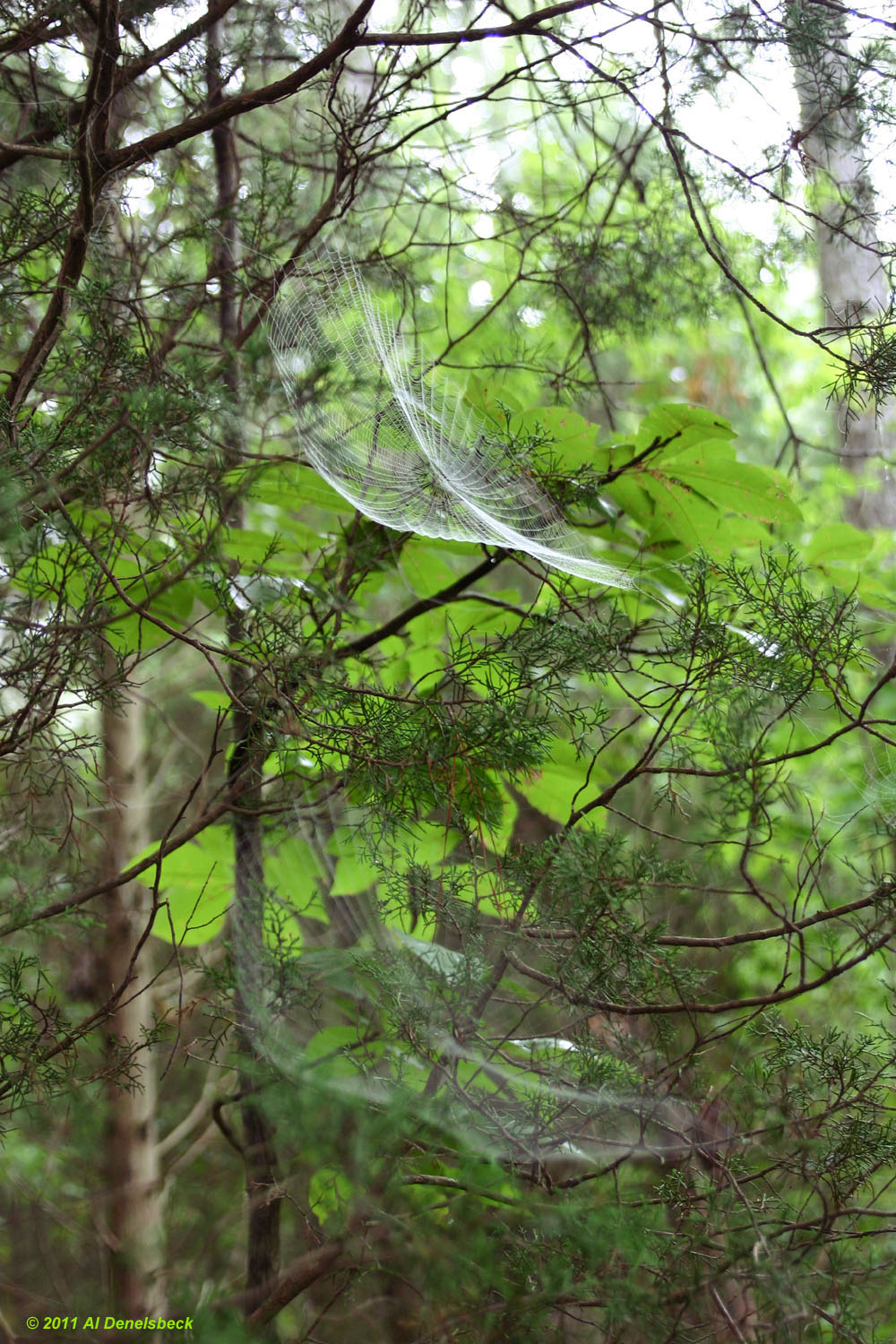
Since Rayl asked yesterday in the comments about what made the web in the previous post, I revisited the river to see if I could find out more specifics. This isn’t as big a deal as you might think; the river is two miles away and the path an easy hike, plus I like practicing for subject assignments. What wasn’t easy was locating more of the same webs, since the conditions this morning weren’t foggy or cool, so virtually all webs were completely invisible. I may have walked under several and never known it.
But, I think I’ve pinned down the responsible party, pending further confirmation. The little spud seen here had a web too far above my head, and while not horizontal, it was leaned over at nearly 45 degrees and the right size. This would appear to be a Mangora spiculata, which doesn’t seem to have a “common” name. This link gives some identifying characteristics to differentiate it from M. maculata. This specimen is roughly 8-10mm in body length, the “orb” portion of the web itself roughly 40-50cm.
Another image can be found here. Because of the height and conditions, I was working from a short distance with the 135-400 lens and an extension tube, and trying to judge a decent flash exposure – in other words, the pics could have been better, but not without a stepladder and more equipment ;-).
I’ll take this opportunity to segue into the fun of spider photography. Usually, your subject is so small in the viewfinder that standard TTL “smart” flashes can’t get a decent reading from them, and instead attempt to illuminate the background, which may be too far away to accomplish this. It means that the camera and flash conspire to blast out maximum light, often overexposing your subject and practically setting fire to the web (okay, I’m exaggerating a tad.) Among many other settings, the Metz MZ 40-3i has a flash compensation switch, which allowed me to reduce the lighting to manageable levels despite the TTL settings. If you can arrange it, holding a branch or some medium-toned object immediately behind the web can give the camera something to expose for and provide contrast for the details of the spider to stand out.
In addition, spiders are three-dimensional subjects (go figure) that require a high depth-of-field at macro magnifications lest some portion of them go too far out of focus, which means a small aperture and thus reduction of the light, requiring more flash power. Trying to do such shots without a flash is simply asking for a frustration-induced stroke, since spiderwebs move with the tiniest of breezes and constantly shift in and out of focus. You will want the instant response of a flash-illuminated image, as slower shutter speeds means the spider will simply ride back and forth while the shutter is open and produce some form of modern art.
If you really want to have fun, you can attempt to snag a fast-moving Spined Micrathena (Micrathena gracilis) as it builds a new web. They’re very cooperative in that they usually construct their webs at eye-level, and provided you spot them before you walk through the webs you’ll often have a decent shot at good closeups. Of course, the shiny black and white bodies mean proper exposure is quite a challenge, especially with nothing in the background. The frequency of this species in the area is responsible for my typical practice of walking through the woods waving my Harry Potter wand in front of me, muttering “Ensnarum dispersus” under my breath. See another pic, also from today, right here. This specimen is roughly 5mm in length.
So, what better time to relate this story? When I lived in Florida, I did a fair bit of bike riding at night to get to interesting areas for night exposures. The rural sidewalks and bike paths made this quite easy, but there were some disadvantages. One night I passed through an orb-weaver’s web so large I felt it across my entire upper torso, from chin to wrist. I am only slightly more self-possessed than the average person when this happens, and managed not to crash screaming, but I did stop under a streetlight and hurriedly flick off the massive brown spider that was crouched on my shoulder following my rude collision. A few minutes later, I got to the lake where I wanted to do some time exposures and slung the tripod off of my back, only to shake off another spider who bounced off my wrist. This one was large enough to actually be felt when it impacted, and probably better than 15mm in body length – in other words, almost the size of a quarter without counting the legs. And naturally I was pulling webs off for the next hour.
Sorry, I promised fluffy bunny pics a while back, didn’t I? I’ll try harder, I promise.
No, not me so much, but the image. I took this one foggy morning when the woods were laden with spiderwebs, trying to capture the two webs in an interesting way. I’m not sure if I succeeded – while I like the look of the upper web, perhaps the lower web is too unfocused, or the background too complicated to carry the image? If you need to see it in better detail, clicking on the image will take you to a higher resolution version.
Unfortunately, most of my photography of late has been insects, since I’ve been unable to find much else and this area isn’t good for scenics. I’m trying to correct that, but in the meantime I’m sparing my four readers from having to see little else but bugs.
As it is, the stats on the blog seem to indicate that I have more people here for the critical thinking bits anyway. There’s nothing wrong with that, I just thought it would be the other way around. If you’re one of those people (you know, those people,) stay tuned, I’ve got more coming up in a day or so.
I just got word that the secular military event, “Rock Beyond Belief”, has been re-approved and is scheduled for March 31, 2012! As you no doubt remember because you’ve read everything I’ve ever posted (snerk!), the event was originally scheduled for April of this year, but then was forced to cancel as a series of curious roadblocks appeared courtesy of the Garrison Commander. Apparently, these roadblocks have been surmounted or removed, and the event is back on the calendar.
What is it? Well, it hasn’t changed from the info I provided in that previous link, but you’re gonna make me retype it, aren’t you? It’s a one-day, music-themed secular event taking place on the main parade grounds at Fort Bragg, North Carolina, and will be featuring music by Baba Brinkman, Spoonboy, Words Such As Burn, and Roy Zimmerman – and speakers such as Dan Barker, Richard Dawkins, Margaret Downey, Jen McCreight, and Hemant Mehta. That’s not everybody, and it’s a hell of a lineup for any event, much less a free one.
But is this even necessary? Unfortunately, yes it is. It appears the US military has been chasing a peculiar concept the past several years, in that they seem to think that christianity is supposed to be instilled in our soldiers, regardless of the Constitutionality of this practice or the fact that even enlisting requires an oath to uphold said Constitution. This doesn’t make it illegal to violate, mind you – it actually makes it treason, believe it or not. This country was founded on the principles of freedom, and that includes religion – you can practice any religion, or lack thereof, that you like. Most especially, the country cannot show favoritism among any religion, nor incorporate it into the government at any level. It’s so simple a child can understand it, which explains why so many religious folk don’t get it: the government has the concern of seeing that things run effectively, not of instilling arbitrary rituals and observances. Religion is no more its concern than deciding what music we should follow, what food we should eat, and who we should date. Funny, that’s how freedom is defined – just in case anyone missed this in kindergarten. And no, it’s not up to “majority rule” – allowing people to vote on the rights they allow or deny for others is kind of stupid, is it not? We got past that last century. And I shouldn’t need to point this out, but how many “good christians” do you think would support the idea of majority religions if islam was instead the majority, or even scientism? Whoops, that idea now sucks, doesn’t it? Yeah, that was determined several hundred years ago in Europe…
But anyway, since the US military seems to keep promoting christianity through specifically evangelical events on base and some horseshit about “spiritual fitness” (how can an ephemeral concept be tested for fitness when it isn’t even defined?), it’s up to individuals who aren’t afraid to speak up for that freedom to see that alternatives are available. “Rock Beyond Belief” is not an anti-religious event, even though it would be perfectly within the guaranteed rights and freedoms to be. Instead, it simply allows non-aligned, secular, and don’t-give-a-damn soldiers, and civilians as well, to have an event without religious baggage or indoctrination. Secularism is not about attacking religion, it’s about making decisions based on reason and rationality, with the ultimate authority being us alone. Goals for morality and ethics revolve around humans themselves, rather than arbitrary scribblings, and privileges are not granted to groups of people with “special” ideas. The fact that this pretty effectively rules out religions is damning only of religions.
And there is yet another reason, another that shouldn’t even be necessary but is. Atheism and secularism are both considered rather distasteful viewpoints among far too many people (to put it mildly – they’re sometimes equated with demon-worship,) and this means that many atheists, agnostics, and humanists are constantly made to feel unwelcome and ostracized. Events like “Rock Beyond Belief” brings the secular viewpoint more into the open and establishes a support network, allowing those without faith to feel accepted as they are. Atheists do not meet every week in tax-exempt shelters, do not display their irreligious symbols on every streetcorner, do not give thanks to reason at every sporting event and company picnic. Religion is ubiquitous, and most religious folk seem to think it’s their duty to promote this. “Live and let live,” is not among the guidelines for most religions, so such domineering practices do indeed need some counter-balance.
As I said above, the event is free, and open to all. It should be a lot of fun, and who knows? – maybe some of the performers or speakers will produce some poignancy. At the least, maybe some of the myths will be dispelled. I plan to be there, so look for the bearded guy running around with the camera – I’d love to meet you face-to-face. And if you can’t attend (or even if you can,) make sure you show your support through Facebook, Twitter, and whatever other social network methods you like (this is actually a valid use of them!)
Hope to see you there!
UPDATE: I added new graphics as I received them from Sergeant Justin Griffith, the Military Director of American Atheists and the guiding force behind this event. Someone with one of those toys can tell me if this Tetris doodad actually works…





























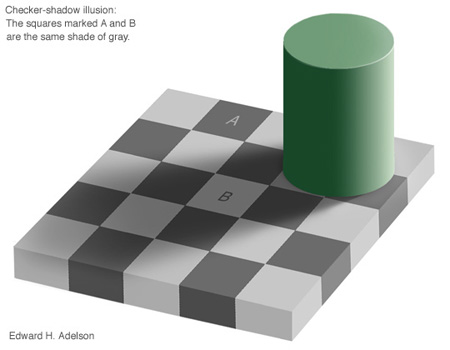 I’ve been a little slower in posting than intended, for several reasons, among them dueling on other blogs and doing computer upgrades. I’ll have more coming shortly, but in the meantime, check out this video version of Edward Adelson’s classic checkerboard illusion over at
  As a species, we already have instincts towards sympathy/empathy, avoiding unnecessary suffering, and even altruism. We don’t need something to goad us in these directions, we simply need some guidelines towards their applications. “Morality” is already an accepted, desired concept. But we also have instincts for competition, protecting our resources and most especially the assets that we’ve worked to obtain, and for very good reasons. It’s not hard to find these in conflict at any given time. The problem lies in that these are instincts, evolved into us because they provided some benefit, but not specific enough to be applied unquestionably to every situation we encounter. On the biological level, we get a surge of endorphins when certain stimuli occur, and we evolved these because, on average, they provided a benefit for the species. But we rarely recognize that these are simple processes, and that what we think is a good idea might be only because of a positive reinforcement from undiscerning glands. Feeding the homeless can be seen as sympathetic and a moral cause for society as a whole, or as being asked to part with money or food that we worked hard to obtain and is not available to those that did not. Either one is instinctual; it all depends on which instinct we feel applies more.
 Maybe this is obvious, but not everyone around us is making decisions rationally, and this is where non-conformity comes in. If we find that rational thought leads us away from what any group of people, large or small, is advocating, then we need to feel comfortable in speaking up, and most especially challenging anyone to put as much thought into it as we have. Another aspect affecting the aforementioned slavery and equal rights was the social inertia, and the fear of standing out from the crowd by speaking against the cultural concept of “lower-caste negros.” Our reluctance to go against the majority is a base instinct too, which has its uses but obviously can lead us astray – again, the brain can take over as needed. That’s what it’s there for.
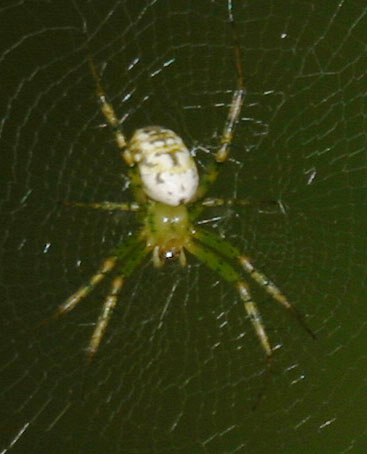 But, I think I’ve pinned down the responsible party, pending further confirmation. The little spud seen here had a web too far above my head, and while not horizontal, it was leaned over at nearly 45 degrees and the right size. This would appear to be a