

And then the rains came
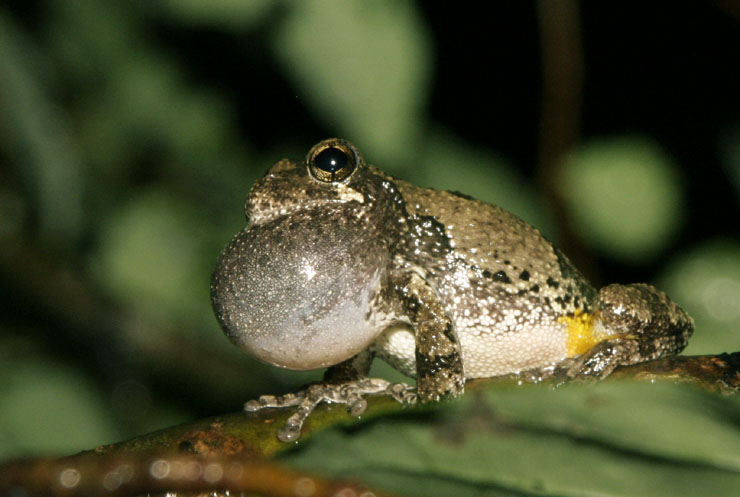
After a long period of ridiculously hot weather with only mild breaks, the storm front rolled in this evening right at sundown. I have to admit that, even after living in Florida, I have never driven in rain that fierce before. We needed it badly, but spreading it out a bit would have been much better, you know?
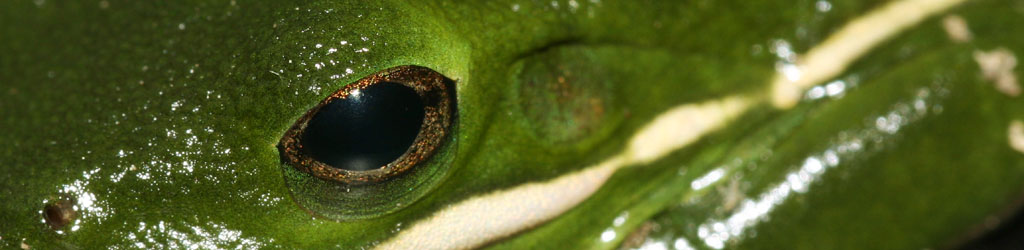
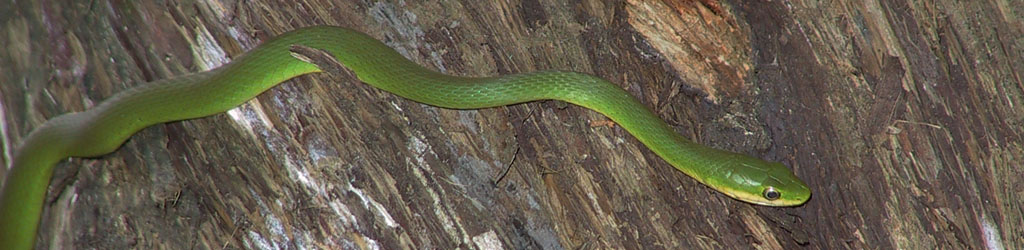
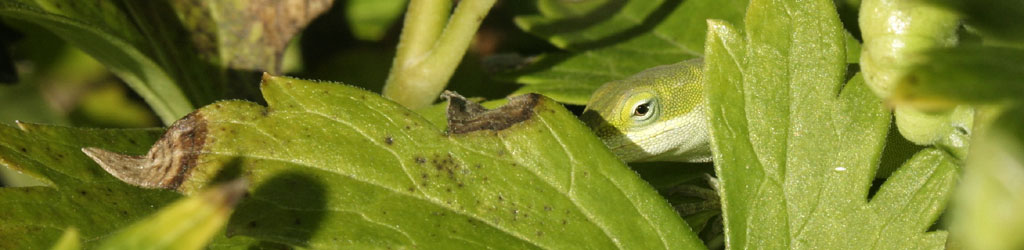
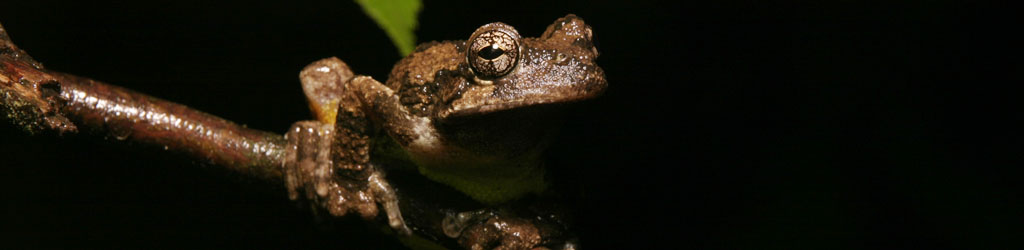
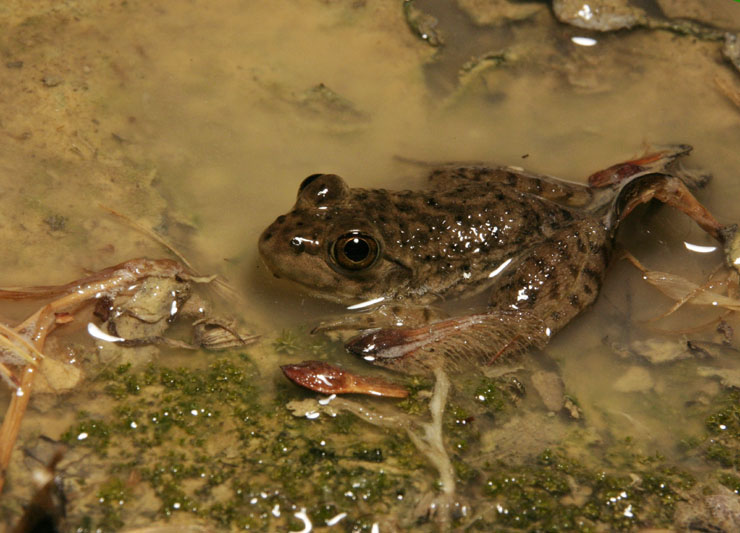
Lots of critters are going to be very happy with all this, but the first to show their appreciation have been the frogs. Even as I type this, the dude above is still calling from its perch in a tree alongside my driveway, and I took the one below only minutes ago. Getting these images required getting soaked, and having quite a difficult time in trying to keep the camera dry enough – the Cope’s grey treefrog (Hyla chrysoscelis) at top proved to be the toughest. Not because it wasn’t holding still or in a bad position – actually it was extremely cooperative. Rather, it was pouring like mad when I was trying for this image, and the camera viewfinder and lens continued to either fog up or get fouled with water drops as I attempted to focus by flashlight. Fun!
The capture below has been tough to identify, mostly because I’ve never developed the habit of keeping my photo subjects until I can positively identify them, but instead let them go their merry way. Which means I can’t check belly markings or length of webbing on hind feet. So for now, I’m just going to say this is a juvenile crawfish frog (Rana areolata) with the possibility it’s the Carolina subspecies. This one was less cooperative, but once it had gotten to a shallow puddle it hunkered down and pretended to be submerged. It had moved on when I came back out (in the rain, again) to try and see the other markings – yes, I agree, that was quite rude.
And right this second, I think I have another calling on the window to my right, on the deck…
Making light work
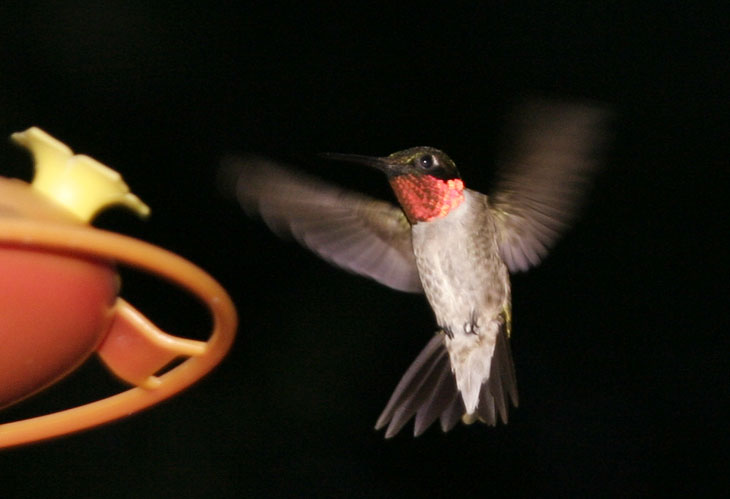
Just a peek at one of the male hummingbirds that visit my feeder. I still haven’t set up some natural feeder plants for a better prop than my plastic feeder – it’s been low on the priority list.
No, this wasn’t taken at night – this actually shows the nature of photographing some types of subjects. In order to try for some sharpness on a fast moving and jittery subject like a hummingbird, I was shooting at 1/1000 of a second with a high-speed strobe. The strobe provided light for the subject, but this was much brighter than the ambient background light, early evening with light overcast. What happened is, the brief moment that the shutter was open didn’t allow enough light from the distant background trees to come in, so they’re underexposed almost to black. This gives a very unnatural look to the image, so a better time to try for this is when the sun is brightly illuminating the background.
This happens often in closeup/macro work as well, for a different reason that still has the same result. At high magnifications, depth of field drops way down, meaning that sharp focus does not extend very far – the eyes of the bug might be sharp, but the wings or hindbody are well out of focus. To try and combat this, a small aperture is used, which increases the depth of field but admits much less light. So the same thing happens – the strobe can illuminate the subject adequately, but won’t carry to the background, which then remains dark.
In some cases, a second strobe can be used to illuminate the background, but this can be tricky – too much, too little, or poorly-aimed light causes this to fail. When you’re shooting tiny subjects while trying to keep what’s exactly behind them properly lit, aiming isn’t as simple as you might think, especially when the second strobe is probably mounted on a bracket attached to your camera, which you are then moving around for the best framing (and quite possibly trying to keep your moving subject in sharp focus.) You can also try to use natural light, which would mean leaving the shutter open for a longer exposure to compensate for the reduced light through the aperture. Fine in theory, provided your camera is locked on a tripod, your subject isn’t deciding to wander about, and the wind is completely dead.
Ah, the wind! The macro photographer’s sworn enemy. You never realize how often there’s even a tiny breeze until you’re focused on a bug on a leaf that continually drifts in and out of focus. Is it any wonder that I’ve done detailed shots of insects (such as here) while they perched on a leaf or twig that was then held in a set of tiny clamps on my desk, indoors away from the wind and under a balanced set of lights? Yes, we’re talking cheating yet again, which would imply that this was easier, wouldn’t it? And not requiring lots of camera repositioning as the subject wanders up and down the setting, across the clamps, facing the wrong way, and generally behaving like a hyperactive toddler. Actually, much worse – you can jingle your keys and get a toddler’s attention for 1.8 seconds…
It wouldn’t seem like photos of bugs, or even birds at a feeder, should be even remotely challenging, but there you have it. It’s all about the light, and how you make use of it.
Proverbial thinking
All right, I’ve been meaning to do this post for a while now, and since it’s come up again in my personal life, I think it’s about time.
Very frequently, when I’ve been present on blogs and forums debating about the existence of one thing or another, a common proverb is set forth: “Absence of evidence is not evidence of absence.” On the face of it, this sounds good. I can’t sense something, for instance, living in my walls, but that doesn’t mean there definitely isn’t something living in my walls. I’d be silly to say, “There’s nothing in there,” right?
Let’s try a little experiment. Look around the room you’re in right now, closely. No, this isn’t a thought exercise, quit reading and look.
Back now? Good. How many Peruvian alpacas did you see? None? I’m surprised, but okay. So you’re comfortable with saying there’s no Peruvian alpacas in the room? Aha! Absence of evidence is not evidence of absence! You can’t definitively say there’s no alpacas in the room!
Yes, it’s a damn silly argument. Evidence for certain distinct things is readily detectable, and the parameters for their existence can rule out, for instance, alpacas hiding under a stack or papers or behind the bookshelf. In fact, you’re comfortable with saying that there are no alpacas in the room only because of the lack of evidence.
So we’ve proven that proverb wrong? Good. You’ll find that you can do this with damn near every proverb you can find. Don’t think in proverbs – they’re crutches on proper thinking. And don’t fall for them. They’re quite often intended to sway arguments through popularity, brevity, and the bias we have towards quick and simple solutions. In fact, when someone spouts a proverb or cute saying at you, it’s a good habit to immediately stop and think if this is an attempt to get you to fall for bullshit.
If you haven’t already (numerous times,) at some point in your life you’ll have someone challenge you to proving a negative. This one is so prevalent I’m liable to start harassing grade-school teachers to include it in their lesson plan. How do you prove a negative? You don’t – you can only establish a lack of evidence for it. But even establishing a lack of evidence can be a ridiculous task, depending on the nature of the subject you’re debating. The alpaca above is easy – they’re fairly big, noisy, smelly, and tend not to hold very still in the closet. But, for instance, extra-terrestrial life? Cold fusion? You’d be attempting to show what the entire universe contains to demonstrate the lack of evidence. Which is the only reason you’ll find this tactic is used at all.
We, however, operate on a basic assumption. You’ve almost certainly heard some saying about making assumptions, and now I’m going to spike that one too. The basic assumption is, it doesn’t exist until some evidence has been established that it can exist. Flying purple wombats? Space trees 4,000 light years tall? Invisible rocks? If I told you I believe in them, you’d think I was wobbly. And, you’d be right. You’d at least be perfectly within your rational mind to say, “Show me.”
Even scientists that deal with theoretical particles and astronomical bodies are careful to show how the physical laws that we use every day can extend out to support the idea of their theory. Now, here’s the kicker: They don’t ever say they’ve proven it. Black holes, for instance, were first worked out on paper in ridiculous amounts of math, based on General Relativity. Einstein, who formulated the theory of General Relativity, admitted to not actually liking the idea of black holes, of something so gravitationally strong that it would collapse into a singularity. And, he also admitted the math showed no flaws. Over the years, the theory of black holes has been gone over by countless astrophysicists and refined but again, never discarded due to flaws. And now, with the discovery of certain kinds of radiation in prime circumstances for their formation, black holes are considered better than 90% certain. But not “proven.”
What’s funny is, at certain times you may be expected to formulate your thoughts in terms like this – probabilities, but not definitive statements. First off, this can be extended to anything at all in our base of knowledge, thermodynamics for instance. Can you prove that the pot on the stove will absorb heat from the burner beneath it? No, actually I don’t ever worry about it until it fails.
There have been numerous things that I have challenged the existence of to the people who promote them, and when pointing out the lack of evidence, I have been told I haven’t disproven them. I haven’t disproved [SPOILER ALERT] Santa Claus either, but I have no issues whatsoever with saying he does not exist. I’ll be more than happy to retract that, too – once someone actually delivers some nice, clean evidence. Until that time, I’m fine with relegating Santa, Bigfoot, extra-terrestrial intelligent life, and great-tasting diet food to the bin of “doesn’t exist.” Call it a shortcut if you want – if we treated everything we ever do or discuss in terms of probability, our conversations would get pretty annoying.
The thing is, there is no actual difference between “Chupacabra does not exist” and “There is no evidence for Chupacabra.” You may get challenged on making a definitive statement, but correcting this for scientific accuracy does not advance the argument. It simply means that your opponent is desperate for an opening, anything that can present a crack to wedge their argument into. In some cases, your opponent may want to establish that you’re not providing a dismissive answer automatically, such as, “All baseball players suck.” But basically, who cares? The onus still remains on them to provide positive evidence, regardless of whether their debate opponent is dismissive or extremely fair.
Another example: Gnomes do not exist, therefore there is no evidence for gnomes. Hard to argue, right? Reverse it: There is no evidence for gnomes, therefore gnomes do not exist. Ah, that’s not necessarily the case! True, but so what? Such an argument is about logic within the statement, not about establishing the viability of gnomes. Even a grossly illogical statement does not admit to the existence of gnomes by default. If gnomes do not exist, the latter example above, while not logical, still reaches the correct result. Whoops! Relying on logical equations doesn’t solve our problems.
Stick with positive evidence, and remember that proof is an abstract. And don’t let yourself fall for the negative proof or logical statement fallacies.
Stars around this planet
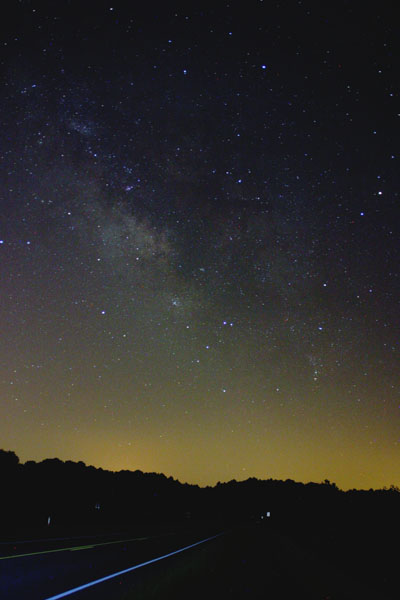 Tonight, the sky was exceptionally clear, especially for summer, and I trekked (well, drove) down to Jordan Lake to see what I could capture. Jordan Lake is about the only place in the area with largely unobstructed views and relatively dark skies, and that “relatively” is key – there are too many cities nearby pumping light up into the sky for really good night views.
Nevertheless, I managed to capture a first for me, believe it or not: a detailed stretch of the Milky Way. This picture has been enhanced slightly from the original, correcting the color cast a bit and increasing contrast, because digital doesn’t work as well as film on the night sky. This was also taking a chance, because I’m aiming mostly south here, which is not the best move from the Northern Hemisphere – the stars to the south show the most apparent movement, and smear across your photo frame more. This is a mere 26 second exposure and movement is still visible in the full res version. For further specs, this is ISO 800 at f2.8.
The stars at the bottom of the photo, curling around and upwards to the right, are the constellation Scorpius – look for the two pairs of close stars. The pair towards the middle of the frame are the “stinger,” and the other pair is the base of the tail leading into the scorpion body facing towards upper right. Portions of Sagittarius are peeking in from the left, which would make, I believe, the center of the Milky Way Galaxy appearing towards the top left of the frame. It isn’t apparent from our position, because too much dust obscures our view. And somewhere in there is a massive black hole.
One of these days, I’ll do a beach trip during good weather and get out on the shore during really clear nights. The Outer Banks has lots of areas well away from city lights, and of course, half of the horizon is ocean and free from light pollution. When I do this, I now know I’ll need some decent high speed film to get results like this. Alternately, I could construct a tracking platform that counteracts the rotation of the earth, tilting the camera slowly to keep the sky “unmoving,” which allows for very long exposures without star streaks. This plays hell with the horizon, of course, and for most of those shots you’ve seen where the horizon is sharp and the sky is intricately detailed, the horizon has been patched in digitally afterwards. Film and digital sensors just don’t handle the sparse light from the night sky in short exposures, and most especially without grain or noise. ISO 800 is far from ideal – I usually shoot 100 for detail and color rendition, and some films I use are rated at ISO 40 – that’s less than 1/16th as sensitive to light as ISO 800, and so the exposure time would have to be much longer: seven minutes! Yeah, you get some pretty heavy star streaks then.
At some point later on I’ll go into the trials of long exposures, pushing film, and reciprocity failures. Dim light photography has all its own body of knowledge, almost making it a specialty in itself. I’ll warn you adequately so you can skip it if you like ;-)
Planets around other stars
In a series of posts earlier, I talked about the possibilities of extra-terrestrial life, and in Part Three, I mentioned our findings of planets around other stars, usually referred to as “exoplanets.” Now, in that post, I was a bit misleading in the progress we’ve made, and while not exactly incorrect in what I said (which referred to finding Earth-like planets in the Habitable Zone,) it is accurate to say that I gave the wrong impression.
So I’m correcting that now. We have found a handful of planets around other suns by direct visual observation, instead of only (as I implied) by changes in the light levels of the star itself. This is quite impressive, and shows off just how quickly our astronomical knowledge is changing – only a few years ago this was not the case, and some of the planets we know of had been seen a few years ago, but not confirmed.
Bad Astronomy has more details, most especially if you read through the comments (yes, some blogs get comments, imagine that.) We’re still finding planets by the method I mentioned, more than by direct visual observation, but it’s neat to know that we can, on occasion, actually see them directly.
Right now, only two exoplanets are considered candidates for life, Gliese 581 C and Gliese 581 D, and we have not seen those directly despite being much closer. The one that BA is talking about is far, far too young and hot, and would probably never be a candidate in its entire lifespan – it actually appears to lie somewhere in the grey area between planet and star, according to some of the comments. What I said about the proximity of the Habitable Zone still holds true, too – while you can distinctly see the planet well away from the star (it took some time to determine that it was not a faint background star that only appeared close,) it’s a tremendous distance away from the star itself, about 300 Astronomical Units. Since an AU is the mean distance between Earth and our sun, and should roughly correspond to the Habitable Zone for any star remotely like ours (this one is not, not by a long shot,) you can start getting the impression of how close the zone might be, swallowed up in the diffraction around the star itself.
There are lots of variables in observing stars, and it’s not clear if we’ll be able to see an Earth-like planet soon, or ever – one would have to be fairly close to us in astronomical terms, and we’re whittling down the candidates steadily. Considering, however, that at least three moons around planets within our own solar system (Enceladus, Europa, and Titan) may have the ability to support life in niche conditions, it may not require planets in specific zones at all. We’re still working it all out., so keep your eye on the astronomical websites, because our media sure as hell can’t get it straight.
Sometimes I startle myself
 I have been considering, for a while now, having a page on the main website that features recent photographs, just a showcase of pics. But there are times when I want to mention some small detail about the image or the process of obtaining it – nothing deep, just items of interest. So I really didn’t want to start adding pages formatted like the rest of the site, but idly wondered what I wanted to do.
And then, like the blinding flash of a firefly, I said to myself, “Myself, that’s called a photoblog.”
No, really, I was that slow on the uptake. I got it into my head that this blog was more for illustrations of topics that I examine in greater detail, and not simply showing off photos. Sigh.
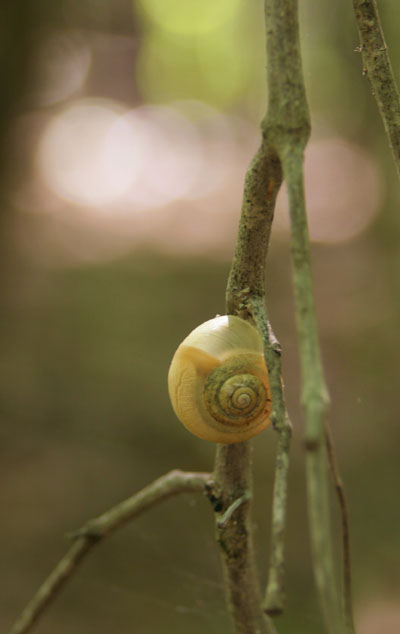
Anyway, here’s a snail avoiding the heat during the day. It’s closed off the opening of the shell with a gossamer membrane that they can extrude, which I suspect also helps it remains stuck to the vine while keeping moisture inside. You can see where the snail itself has retracted back into the shell a short distance.
Hot weather tips
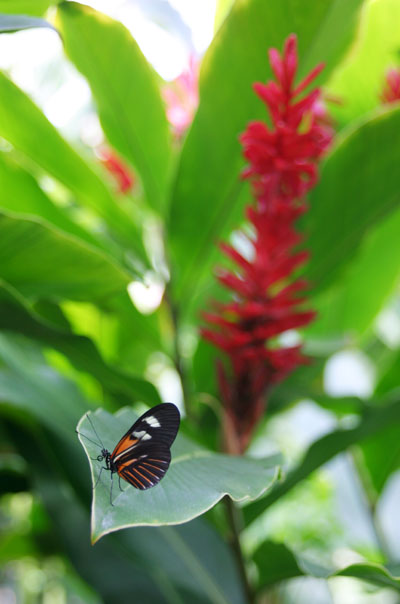 We just broke a run of over two weeks of temperatures exceeding 100 degrees F during the day here, so of course, now I’ll bring you a tip about shooting in hot weather.
Don’t do it. Seriously, just stay indoors.
Okay, if you’re dedicated or stupid, I suppose I can give something more useful. I’ve run into this problem quite a few times now, from shooting in Florida, butterfly houses and rainforest exhibits, and now for a couple of weeks in abnormal conditions for North Carolina. Your camera, of course, should be kept cool – film doesn’t handle heat well, and starts to decay towards color-shifting, but much worse, your lenses can be really messed up with heat. Many have a lubricant inside to keep the zoom and/or focus rings operating smoothly, and this can get a lot thinner as it gets hot. This can make it run onto the lens surfaces themselves, but much worse, onto the aperture blades. These are very light thin pieces of metal that have to snap open and closed very quickly, and getting gummed up with any kind of moisture, even when it’s supposed to be a lubricant, can cause your aperture to become erratic or stuck fast. That’s called a minimum $100 lens repair.
But keeping the camera cool, such as remaining in air-conditioning, leads to a problem when you take it out in hot, humid conditions – it acts like a nice cold glass of lemonade, especially the glass. The lens glass, and sometimes even the camera body, will attract condensation and fog up. Your best bet is to leave the camera in the bag out of contact with the humid air until it warms up closer to ambient temperature, but if you have a properly padded and closed bag, this acts like insulation, so warming up can take a while. Whatever you do, however, don’t uncap your lens, and most especially don’t switch lenses, which lets moist air into the insides of the lens and can cause fogging on interior elements. I did this once and it takes forever to clear. Bright sunlight can help bring the camera and lens up in temperature faster, and a faint breeze helps too.
Don’t try to rush things, but instead try to plan your shooting around such conditions. This doesn’t always work – several times these past two weeks I found a photo subject and fetched the camera, only to have to wait until it could be used. Don’t count on microfiber lens cleaning cloths to dry off the surfaces, either – they’re usually not very absorbent and only distribute humidity around in droplets. A small towel in your camerabag can help dry off the body, if you need it (and you should have one in case of wet weather and splashing water,) but don’t use it on your lens, because they’re bad about retaining grit and using that to scratch the glass. Patience can save you a few hundred dollars in replacing a favorite lens.
The other issue I encounter frequently is viewfinder fogging. This is made much worse because I wear glasses, so the extra glass surface cuts air circulation right around the eyepiece, and contributes to heat buildup. So does a hat brim, and while I recommend a good shady hat for outdoor shooting, they can contribute to fogging in rough conditions. I have yet to try those pith helmets with a fan built into the brim (I don’t mind looking a little goofy, but there’s a limit,) though this strikes me as probably an effective solution. Battery-powered little fans can be found in most department stores, but this leads to the problem of how to hold it and the camera, and adjust the lens at the same time. A simple sweatband, believe it or not, has proven most effective, if only because it absorbs some of the humidity from your own sweat that would be present near your eye.
Finally, a little tip to keep your camera looking good. With hot weather comes insect repellent, which is fine and often necessary. Just be aware that anything containing DEET will eat into the plastic of your camera body, lenses, binoculars, and so on. Even wiping your repellent-treated forehead and grabbing the camera can mark it. Keep that towel handy.
Perceptions
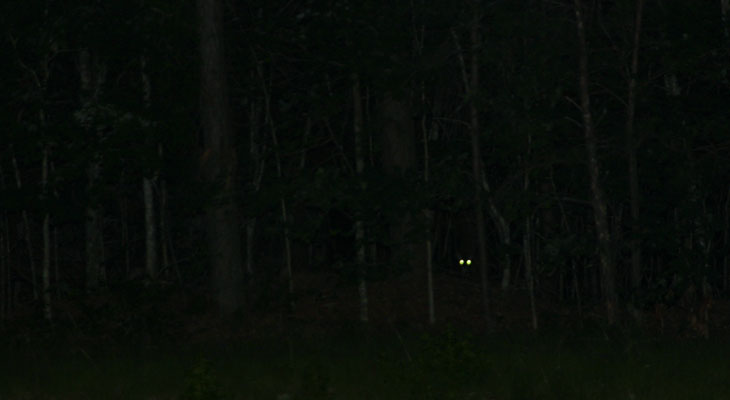
All right, it took me a couple of nights to get the image that I wanted, mentioned in the last post, but one of those nights was spent over at The Girlfriend’s place, so it doesn’t count ;-)
As you might have determined from previous posts (of course you’ve read them all,) I do a fair amount of poking around at night. I’ve been doing this for a long time now. It’s quieter, cooler, with no traffic, and the sky can get much more interesting. Social people might not identify with it so much, but for a hermit like me it’s a great time to be out. I’ve gotten reactions from people when I tell them I often hike down the roads at night, along the lines of, “Is that safe?” Night, to many, represents the time when things are dangerous, when villains are out and no one is around to help you. Alternately, others will say that there’s nothing in the dark that isn’t there in the light.
Both are wrong. I’ve never been the least harassed, or even felt on-edge, by anyone I’ve met on the roads at night – I usually don’t encounter anyone. Muggers have better places to lie in wait for people, of course. But nighttime definitely shows a distinct difference from daytime. You might be amazed at how much you hear moving around, and on occasion see, if you’re paying attention. I tend to carry a flashlight, not to see my way (my night vision is usually sufficient,) but to get a better idea of what I hear moving in the woods and underbrush. And fairly often, what I’m greeted with while I shine the light about is exactly what you see in the photo up there.
The first time this happened, it was even more dramatic looking than that. I was on a lonely, deeply wooded stretch of road close to a kilometer from the nearest house, and the flashlight only went so far into the woods. The trees got fainter and fainter with the distance, and at the limits of its range, deep in the darkness, shone two eyes, right at my own eye level.
I’m not superstitious, and I’m well aware of the critters in the areas I’ve lived, but I still couldn’t get past how creepy this was, a very powerful feeling. The rational part of my mind could not completely overrule the reactive part, which I find interesting. What I also find interesting is the fact that eyes reflecting at my own eye level are far more chill-inducing than eyes at lower levels. You could argue that eyes down low mean things like raccoons and opossums, which aren’t threatening, but that fails the rational test – eyes at eye level are invariably deer, and the most threatening animals around here, wolves and coyotes, are lower too.
That’s not to say that wolves and coyotes are threatening – they’re not, and while the media makes big deals out of any dangerous encounters, they’re few and far between. I’ve heard a pack of coyotes calling at night too, once again on a lonely road and only a few hundred meters away. I can only describe it as a delightfully spooky sound, just like the movies but awesome to hear nearby. Less than a week ago, as a jet passed overhead and produced a distant howl of changing pitch, a coyote answered it, confirming to me that I have some not too far away, so maybe some photos will be forthcoming soon.
The scariest encounter I’ve ever had at night, believe it or not, was hearing a fox calling. Go to this link, click on “call.wav” and tell me that doesn’t sound like a woman being beaten. Which is a really bad thing to hear a few hundred meters away in dense woods. Two close encounters with skunks and nearly being run down by a deer don’t compare at all.
 The big point is, there’s a lot going on at night, and encounters to be had that you’re not likely to have during the day. The quiet and darkness only add to the effect. There is a whole other world of activity, and if you have any interest in nature, you need to be wandering in the dark. It doesn’t make photography any easier, true enough, but there are still opportunities. In the past week, I’ve had encounters with umpteen deer, opossum territorial disputes, a family of raccoons, owls conversing, and the coyote calling the jet. And who knows how many insects and spiders? And last night, my photo subject was curious enough to stay put as I crept closer to let the camera flash have better effect. To this whitetail, I was no doubt the creepy one.
Prediction (or obligation)
I’ve been wanting to do a post on nighttime encounters, but feel this would be better illustrated with some specific photos – which I don’t have. So, tonight I’m going to get them. Stay tuned.
(I’d have been smarter to post this after I got the photos, and it would look like I just went out and shot the photos I wanted on demand, la de da. Now I stand the chance of failing and looking like a doofus. I gotta work on my marketing skills…)