










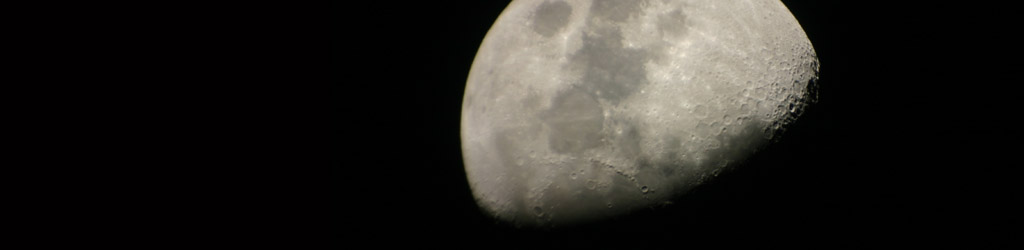





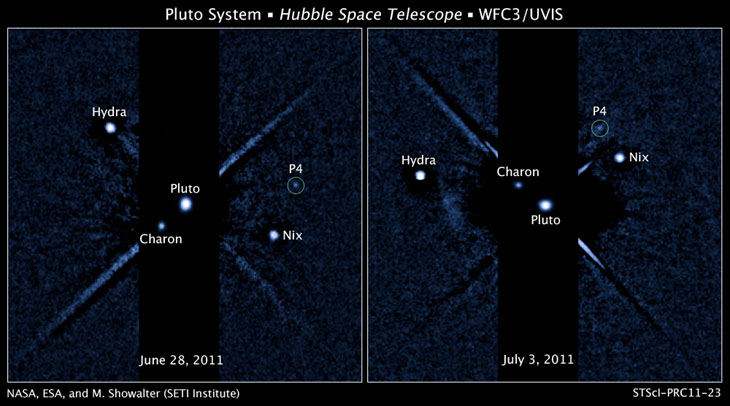
I’m not following the latest breaking astronomical websites like I used to, so this news is a little old to those that do. But recently, astronomers confirmed that Pluto has another moon, bringing its total to four (counting Charon, known since 1978, and Nix and Hydra discovered in 2005.) For the time being, this one is simply called “P4” until a name is agreed upon.
It was found when the Hubble Space Telescope was doing survey images of Pluto to map out the area as best we can, since we have a planetary probe on its way there, the New Horizons probe (definitely a cool site there.) Pluto is so remote that we have only smidgens of information about it, and New Horizons is going to expand that by thousands of times. Launched in 2006, it will not be making its rendezvous until 2015.
Now, a quick illustration. P4 is estimated to be between 13 to 34 kilometers (8 to 21 miles) across, the size of a moderate city, or Atlanta’s airport. Being able to spot it from Hubble’s orbit around Earth is much the same as sitting here in central North Carolina and being able to see a penny – in Chicago. The best resolution images we have of Pluto itself, which is about 2,390 km, are only a few dozen pixels across themselves. We’re actually kind of vague on P4’s size not just from the smudge it makes on the image sensors, but because we don’t know how reflective it really is. If it’s highly reflective, it’s among the smaller measurements, but if it’s low in reflectance it can be at the larger end. It is supposed to be much the same reflectance as Pluto and the other moons, since they’re all assumed to be from a collision many millions of years back, and thus composed of the same elements. But this isn’t known by any stretch, and P4 could be an extraneous body from the Kuiper Belt captured into Pluto’s gravitational field. That’s part of the fun of working at this kind of distance from a subject.
There are tricks, however. We had a few guesses at how much light Pluto itself reflects, which would make its diameter different depending on each, but then pinned down its size pretty accurately by watching Charon eclipse it, as well as watching it eclipse a distant star. Corroborating methods like this help a lot, but New Horizons is going to make all of that look like scraps of paper.
The probe is taking so long to get there since it is limited on the fuel it can carry, as well as what its mission is. New Horizons used an orbital pass around Jupiter to serve as a free slingshot, accelerating it without fuel, and will be coasting most of the way to Pluto now. The mechanics of launching probes and such is responsible; Earth’s gravity has to be defeated for every milligram we send into space, and this includes fuel as well. The more fuel, the more fuel is needed just to move the fuel, and a process of diminishing returns comes into play. It doesn’t take much before you’re looking at a bigger launch vehicle, of which our options are limited, and it can actually reach a point (with something much larger than a probe, anyway) where the fuel is not efficient enough to boost a certain quantity out of earth’s orbit. In other words, one can’t just keep building bigger rockets, at least until we discover a fuel source that provides more bang for the gram.
Once in space and at a sufficient speed to reach a target before the batteries run down or mankind turns into another species, such probes can coast – there is too little in space to provide drag and slow them down, of course. But this works a little against the goals, too, and it shaped the profile of New Horizon’s mission. Fuel would also be needed to slow the spacecraft and put it into orbit, like Cassini is in around Saturn, and this wasn’t available, either, so New Horizons is instead doing a flyby, passing Pluto only once before continuing onward to study other Kuiper Belt Objects. This is part of the reason that Hubble is scouting the territory: the more we know ahead of time, the better we can plan activities for its brief time up close.
There’s another reason, too. Light, and by extension radio waves, takes over four hours to reach Pluto from Earth, and the same amount back, so “real time” instructions to the probe just ain’t happening. The instructions need to be planned in advance and sent to the probe, and there’s a distinct limit on how many changes can be made based on new information from the probe itself. For safety’s sake, there also needs to be enough time to get confirmation signals from the probe, so we’re sure it received everything without dropping out portions (and there’s no cell towers around.)
There’s yet more planning involved. In order to use that orbital assist trick around Jupiter, the locations of Jupiter, Pluto, and Earth in their orbital paths had to coincide so that the probe could be aimed correctly and not have to waste fuel and time zig-zagging across the solar system. While we tend to think of the planets lining up like they’re diagrammed in astronomy textbooks, in truth they’re all tracing their own orbits and can be widely varying in both distance and direction. Our window of opportunity to use these mission parameters was pretty narrow, and we would not have had the opportunity to do this again for three hundred years. When I first heard that Congress had voted down funding the mission, I was livid at the stupidity – you don’t put off exploratory missions for three centuries. Apparently, wiser heads prevailed, because funding was restored and New Horizons was able to be launched before the window closed.
I mentioned “Kuiper Belt” a few times and you may be wondering what that is. Basically, it’s the sawdust left over when you make a planetary system. Clouds of interstellar dust form into disks, and ever so slowly, mutual gravity causes a star to form at the center while planets form further out. The larger planets attract nearby bits of matter and incorporate them, sweeping clean the space in their orbital area, but at the outer edges of the system disk, things are too spread out to attract each other well, so they tend to stay scattered and small. The Kuiper Belt is very much like what the original disk that eventually formed the planets was like, except with fewer gases (more easily attracted to the larger bodies) and with more ice, because of its distance from the sun. The Belt serves as the source of most of the comets we see here from Earth, “dirty snowballs” of ice and grit that had been orbiting happily way out there until some other body passing nearby dragged it by mutual gravitational pull, like two magnetic balls passing close to one another. With the angle of momentum altered, the comet now progresses on an elongated elliptical orbit deeper into the solar system, generally getting realigned as it gets closer to one of the larger bodies, which isn’t always the sun – some comets actually whip around Jupiter instead (or crash into it.) Of course, far more get re-aimed in virtually any other direction and trundle off into deep space…
In four years, we’re going to be getting fantastic images of the distant edge of our planetary system, which is going to add a lot to our knowledge about how the solar system formed, no doubt confirming a few theories as well as trashing a few. That is, if the probe can find it. When New Horizons was launched, Pluto was still a full planet, but in the intervening time it has been demoted to dwarf planet, which might defeat the probe’s programming. I wonder if Neil deGrasse Tyson thought this through carefully…?
 So, you find yourself (wait, isn’t that a goofy phrase? Like you might have lost yourself, or perhaps been paying no attention, look down, and whoops, there you are?) in a scenic location, faced with a gorgeous view, great lighting, and a cooperative sky. The photo is made for you, isn’t it? All you have to do is take it. And this is the thinking of countless people when they travel to common locations.

 Your digital camera renders color by having a teeny little bit of colored plastic over each individual “pixel” sensor, in a standard pattern just like a TV screen. Digital sensors can only read light intensity (or brightness if you prefer,) not color, so each pixel has to be dedicated towards a particular color by filter. What this means, however, is that red pixels only represent 1/4 the resolution of the camera. The camera software, once the image is captured, interpolates the color of each pixel in the finished image by comparing the intensity of each color in the pattern against one another, and then changing them to try and represent “true” color. Of course, it matters a bit just what color filter is over the pixel in the first place, and what settings for images the user has chosen – high contrast, more saturated colors, and so on. The long and short of it is, there is no particular way to tell what the most accurate rendition of an image is.
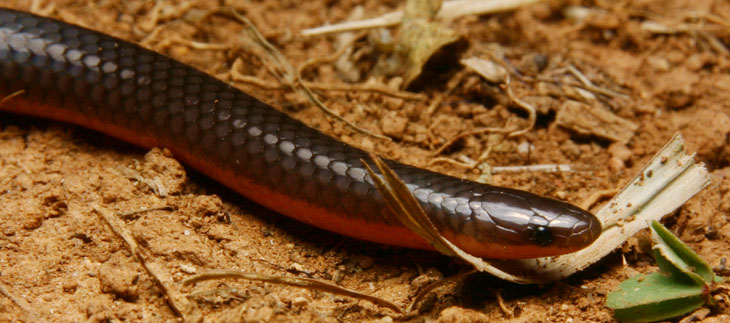
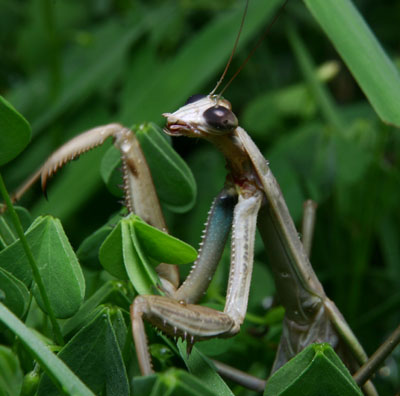 Did you ever wonder, since alien visitors seem to have this thing for sexually examining humans and cutting out cow tongues (because, of all the organs that prove interesting to study, the tongue certainly tops the list,) do they ever abduct insects as well? You’d think they’d have to, wouldn’t you?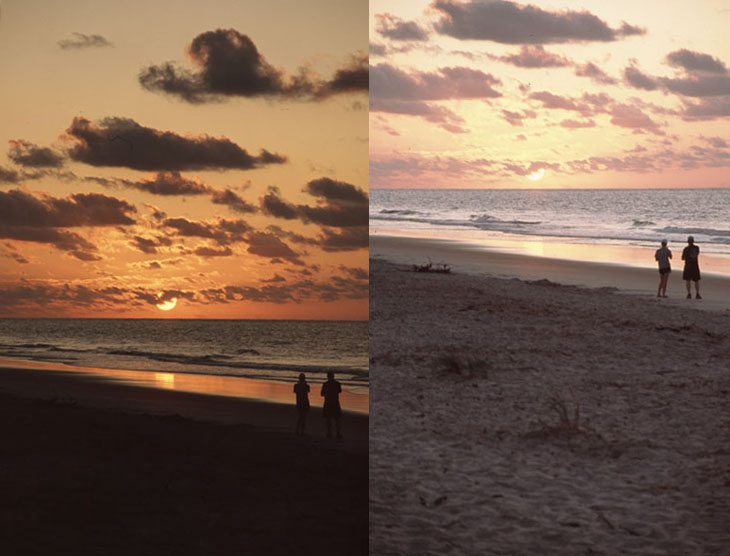
 There are tricks that can be used to help alleviate this, but often the result is unnatural-looking and awkward. There are lens filters called graduated neutral density, which are basically tinted through half of the glass, the remainder being clear – the tinted half goes over the brighter portion of the image and is used to reduce the light level closer to that of the darker portions. The problem with these is that one rarely has a nice straight horizon, and when it is present, the fuzzy line between the tint and clear portions of the filter would show unnatural transitions in the resulting image. Most photographers left such filters alone and simply avoided the situations that suffered from too much contrast, watching for conditions that alleviated the problem.
 Now, I’m torn on the issue, personally. Generally, the resulting image represents something not seen in nature, presenting light conditions that really don’t exist, and often cannot. In these times when removing people, trash, or distractions from a scene can cost a photojournalist their career (not just their job,) it seems hypocritical to freely accept a blatant technique of selective imaging. And one of the skills that I’ve learned, and teach, is to work with the light that’s there, or find ways around it. The really good images from the top photographers are often the result of careful planning and being on location for just the right moments – it’s what makes those images special. The prevalence of altered images makes these accomplishments cheaper, and indeed hurts all really good images. It takes virtually nothing anymore for someone to cry “Photoshop!” at an image, even one that saw no such editing, because the media is saturated with alterations, and this makes those special efforts barely worth it anymore.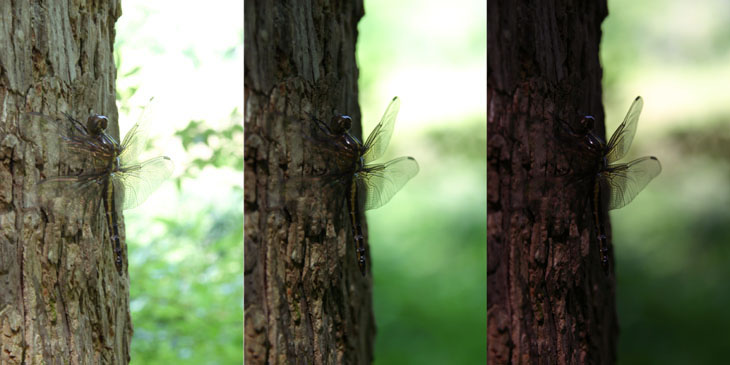
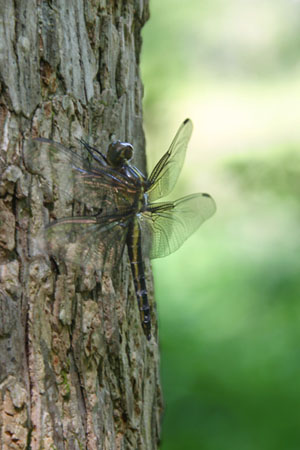 So with those, you can see what got used from each in the resulting image here. Notice how the background blends easily and, while there’s still a blowout of detail into pure white, it’s much less noticeable and harsh. The wing details remain present and sharp, and nothing has gone too dark. Now, in these conditions, I would have been unlikely to get the depth-of-field looking this way, since the depth needed to get the wings on both sides would have rendered more detail from the background, but this is hardly something that jumps out even at experienced photographers and editors. Capturing lighting like this in nature is difficult, since bright sunlight falling on the dragonfly would be necessary to keep it so close in level to the background, but such light would increase the contrast and the shadows of the bark. I could accomplish it easily with a strobe unit and softbox (I had the strobe, and even used it for one image in the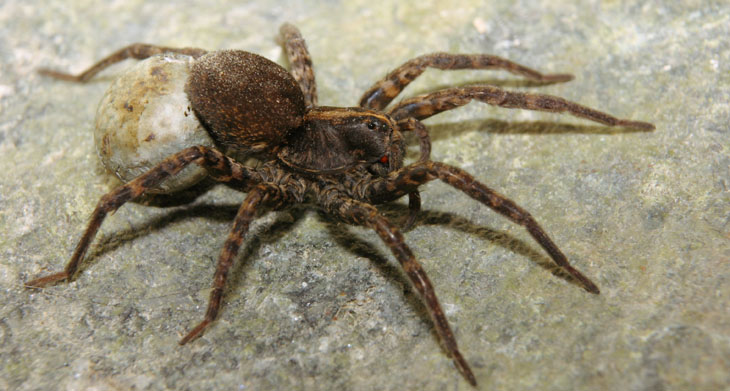
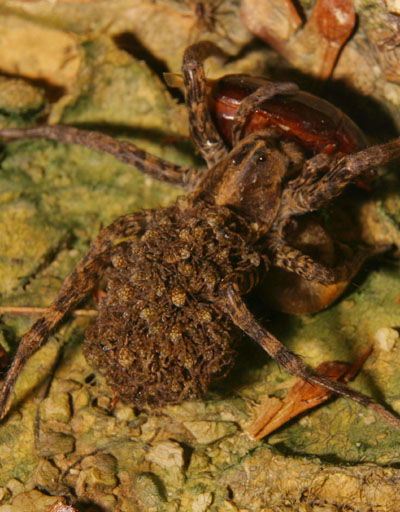 We know that birds can imprint readily on whoever feeds them from birth, and spiders have much teenier brains, so it’s safe to assume that their “pile on mom” instinct is extremely primitive.