
















It’s plastic, with cheap gold-ish plating that’s already wearing off, but it’s the thought that counts, right?
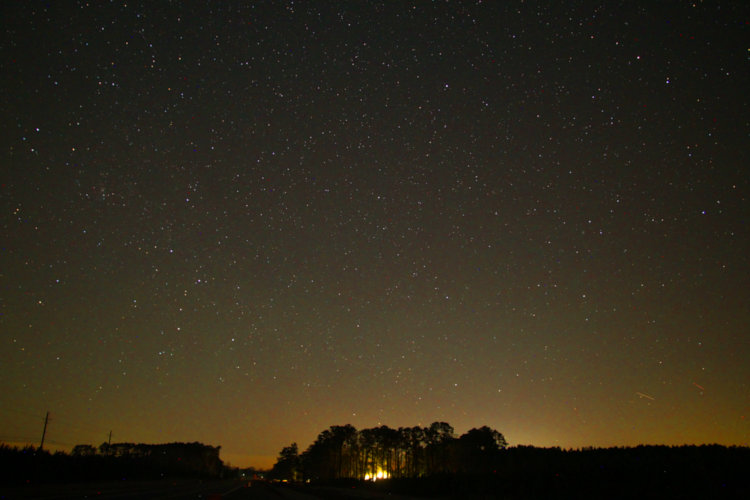
This means I responded to the forecasts that there might be a decent aurora borealis display early this morning, and went out to try my hand. The temperature was near freezing and the LCD display wasn’t showing a lot, so I wrapped it up after 45 minutes at the most.
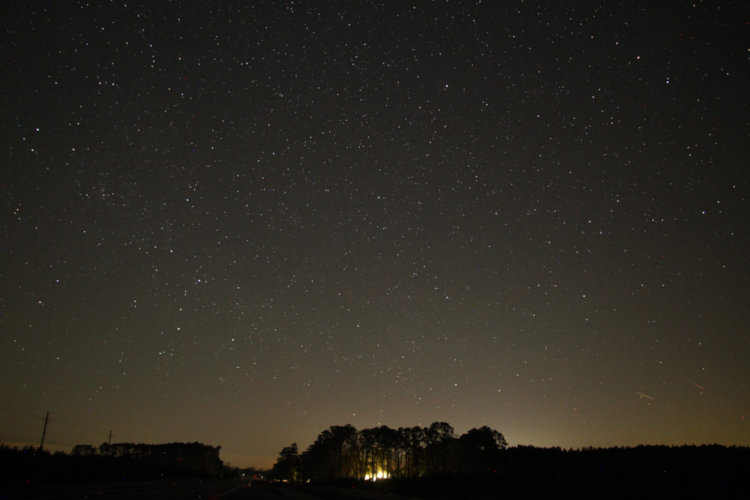
I was a few kilometers north of my previous attempts and thus might have been getting more residual light pollution from the town I was now closer to, or this might have been from someone’s lights even closer – that’s what the sharper white glow is from, I suspect. Really, far too many people have lights on everywhere now. Anyway, if there’s aurora light coming through in this 29-second exposure, it’s not impressive.
I took the same frame and increased saturation by 100%, just to see what appeared, and again, not much:
It’s possible this display was mostly green, and I have more in here than I suspect – I haven’t seen anyone else’s attempts yet. But if you look close, you may see some faint bands of pink in there, which I’m not convinced is not simply a residual of the color borders from the town lights. Basic answer: not worth the effort.
You might also have noticed the streak from an airplane in there, down low to the right, of which there were far too many to be found for 1:30 AM. Seriously.
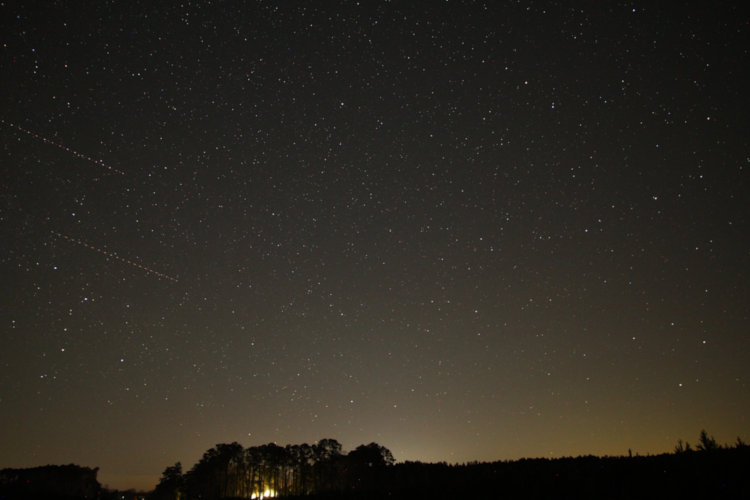
I waited out several of them, which can take a while – in fact, that’s why the initial frames of this post have one in there in the first place: I didn’t wait long enough. It was too dim for me to make out by eye, but 29 seconds at f3.5, ISO 1600 captured it.
And it really is a little more pinkish down there below them, though that could also be some residual taillight glow from cars that had recently passed. Still not enough to care about.
While waiting for both planes and cars, I turned to the west to do the sky in that direction, which was considerably darker, even though the trees bordering the road blocked the view close to the horizon.
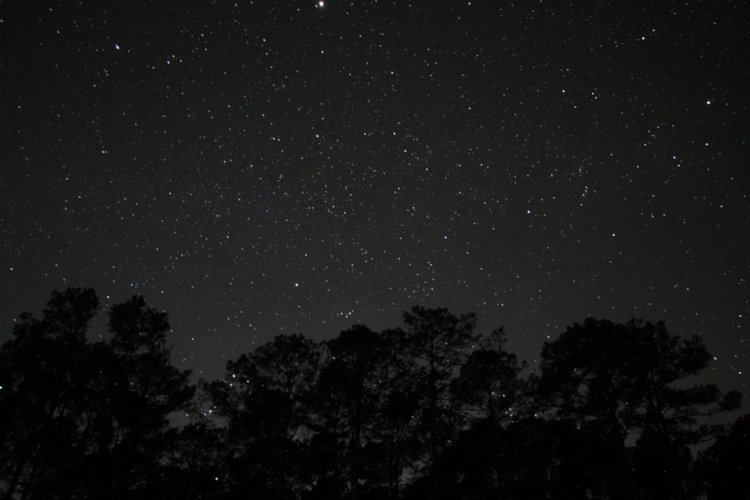
Orion is just disappearing into the trees, but still semi-discernible in there – that’s Betelgeuse, one of the ‘shoulder’ stars, showing up brightly just below and left of frame center. Meanwhile the bright one right at the upper edge is Jupiter, cruising through Gemini. Really, it was pretty good viewing condtions once you avoided the light pollution.
Perhaps the best one, overall-fartsy-wise, was this:
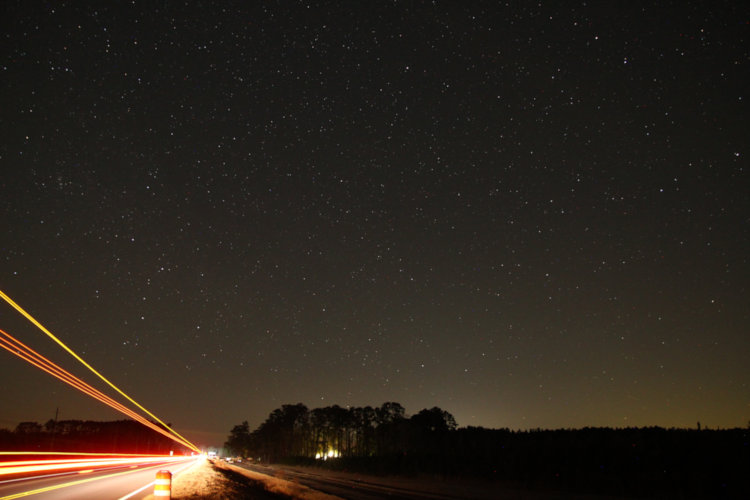
I quickly re-aimed the camera as a truck blew past, capturing the running lights on the trailer rather nicely – it could do without that damn barrel in there though. I should have waited at least until the headlights passed it, or simply dubbed it out and never told you about it. Still, it seems to say, “Lonely Road” fairly well, and the exposure was short enough not to get any noticeable streaks from the stars. Not that it could have had a lot, anyway; Polaris, the axis of rotation for star streaks, sits high in the center of the frame, with Ursa Major cut off a little too much to easily spot.
Prompted by the aurora predictions (more than any actual evidence of it,) I went out later this morning, when it could actually be called ‘morning,’ and did some solar filter images, showing that we do indeed have a nice collection of sunspots up there:
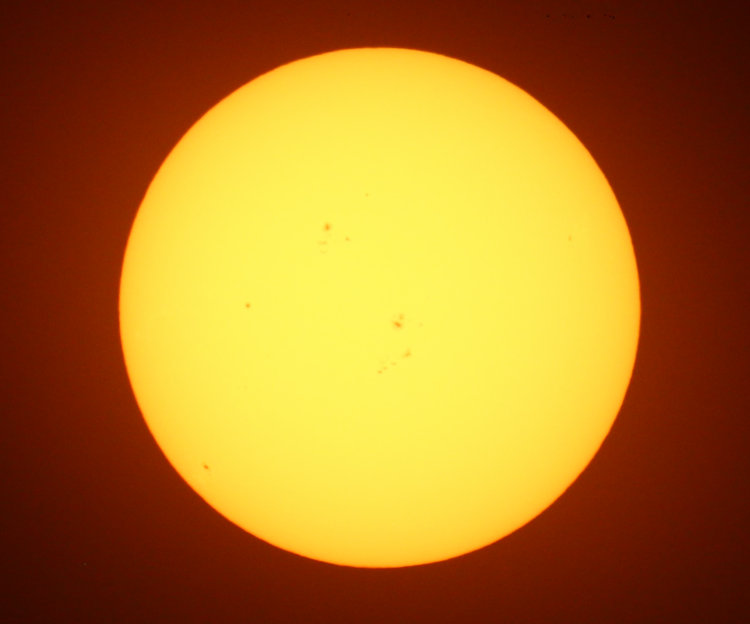
Sunspots by themselves don’t generate auroral displays, but they’re associated with solar flares pretty often, which do, so generally you’ll find some if there are auroral predictions. These are distinctive enough that you might see them without needing a solar filter, through a natural cloud haze or perhaps even at sunset.
Meanwhile, the pics and video from World Waterfowl Day are on their way – still processing, and as long as I’m not interrupted too often today, I’ll have them shortly. And there’s still another video to follow, too. We’re getting there…