It’s taking a little longer to get to this than intended, because other things keep happening, and I’ve decided that there are enough images to go along with it that I’m going to split it into two posts; this is the first. So let’s go out to Lake Mattamuskeet, North Carolina.
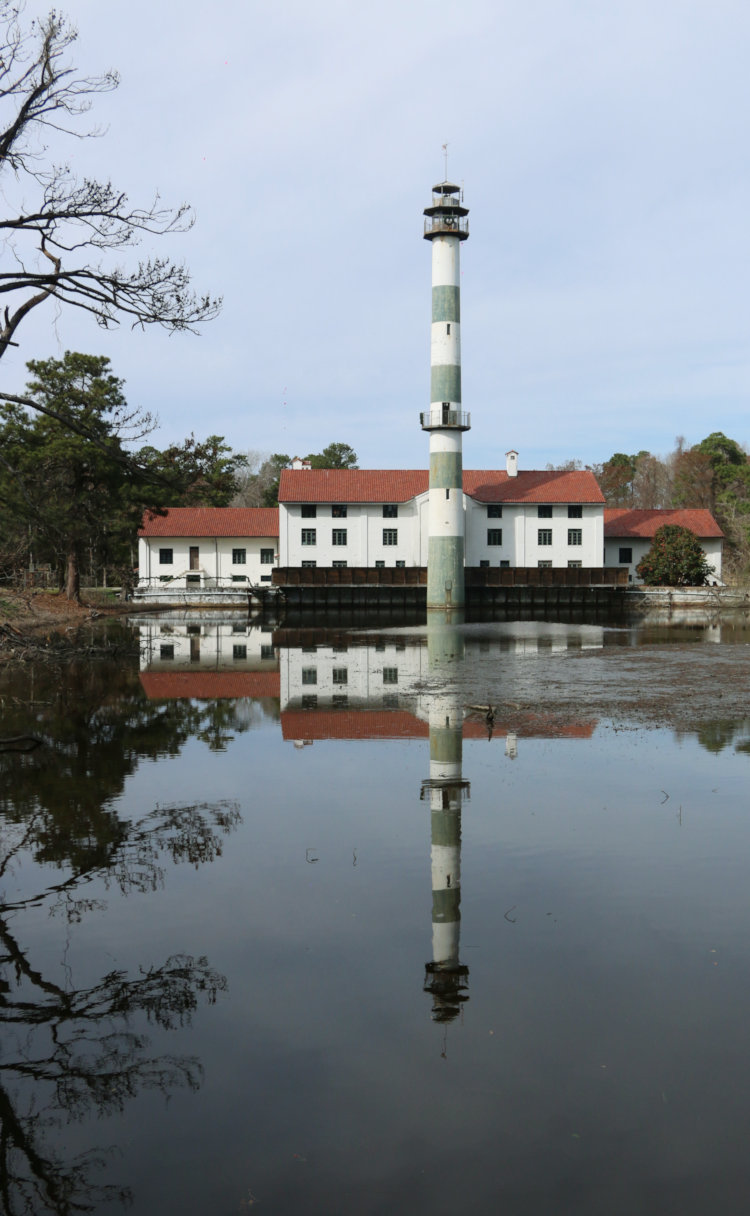
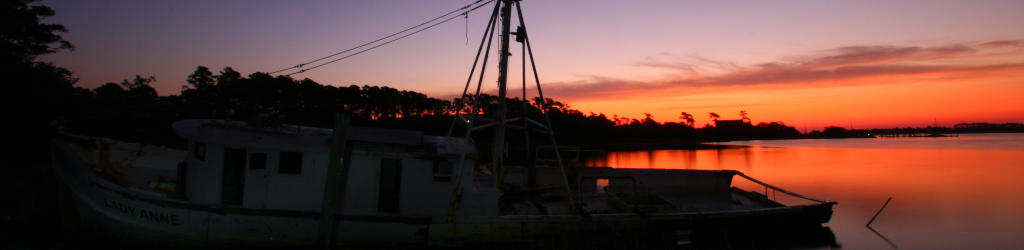
The Girlfriend and I have been planning to do this trip since we moved to the new location, because while we’re not close to it, we’re much closer than we’d been before. Lake Mattamuskeet is a large but very shallow lake in the coastal plains, now enclosed by the Mattamuskeet National Wildlife Refuge, and a favored spot of waterfowl. The lake is not that seen in the pic here, which shows the landmark pumping station, the remains of a project intended to drain the lake and turn it into farmland a little over a century ago, and so that’s not a lighthouse, but the smokestack of the coal-burning pumps. When this project failed, the station was turned into a hunting lodge for a few decades, with the smokestack converted to an observation tower; both structures are now too unstable to allow entry.
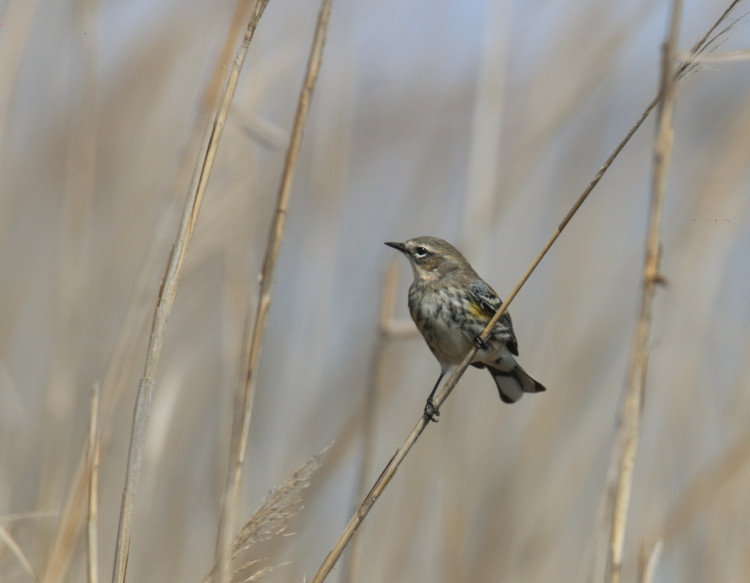
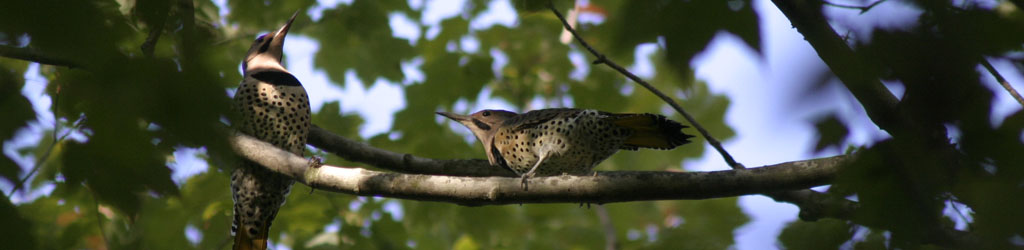
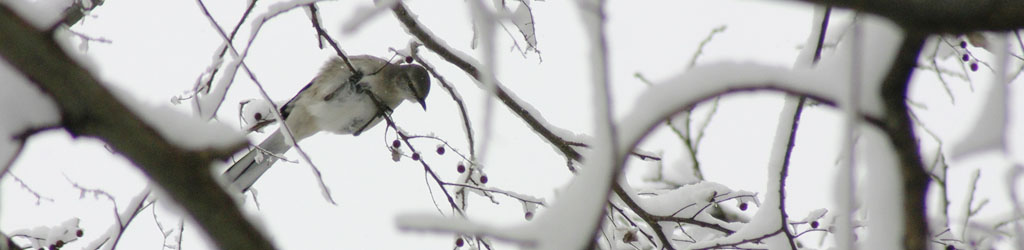
But it’s the birds we’re after, even when I can’t offer an identification of this one – some kind of warbler, but there’s so much variation in species colors among sexes and ages and seasons, and this looks to me like a mix of a couple, though I’m not songbirder and I’m relying on the illustrations in my Sibley Guide (like I says, I just takes picchers.) This was among the first birds seen, as we were out on the long causeway that crosses the lake, but we added to that in moments.
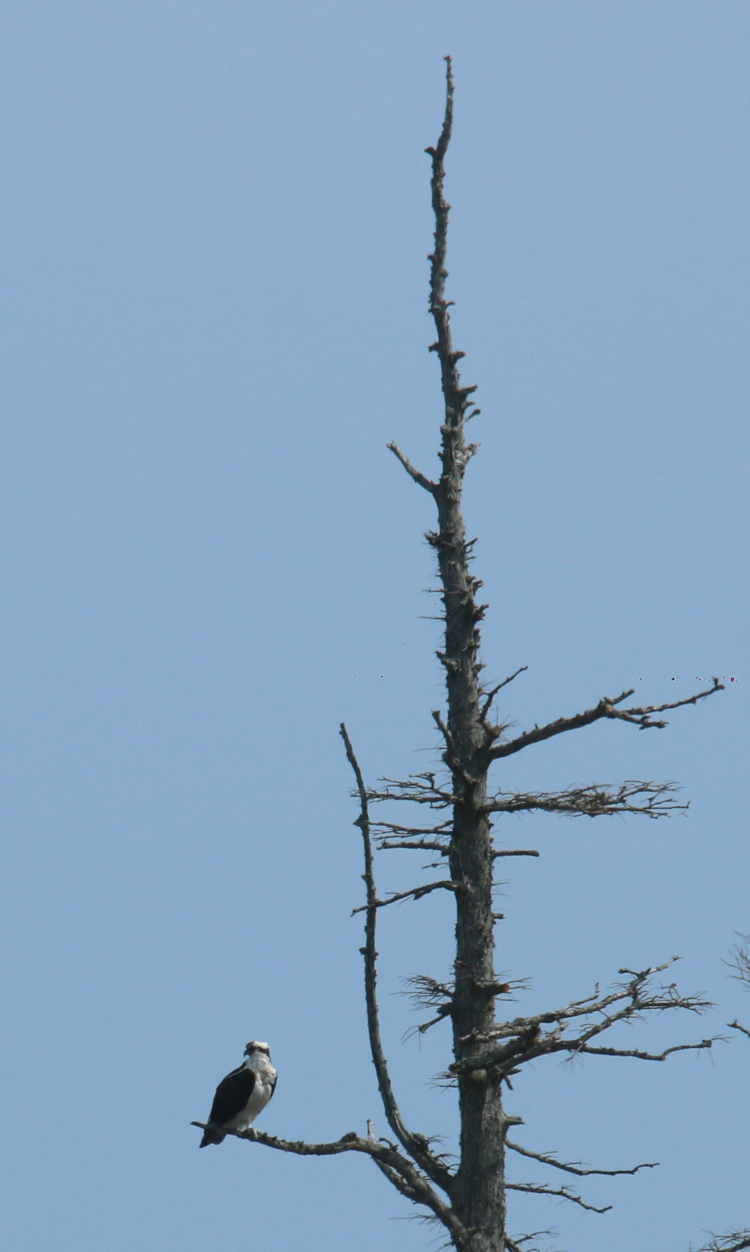
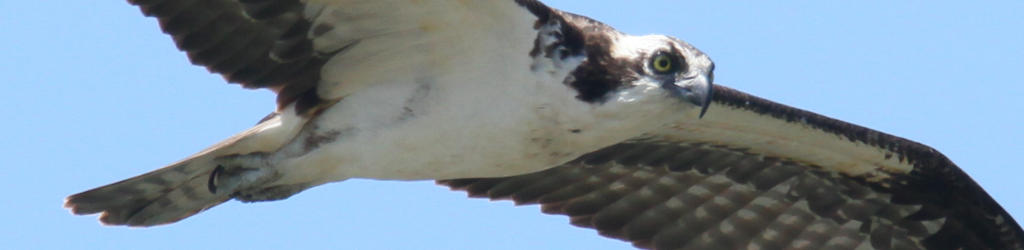
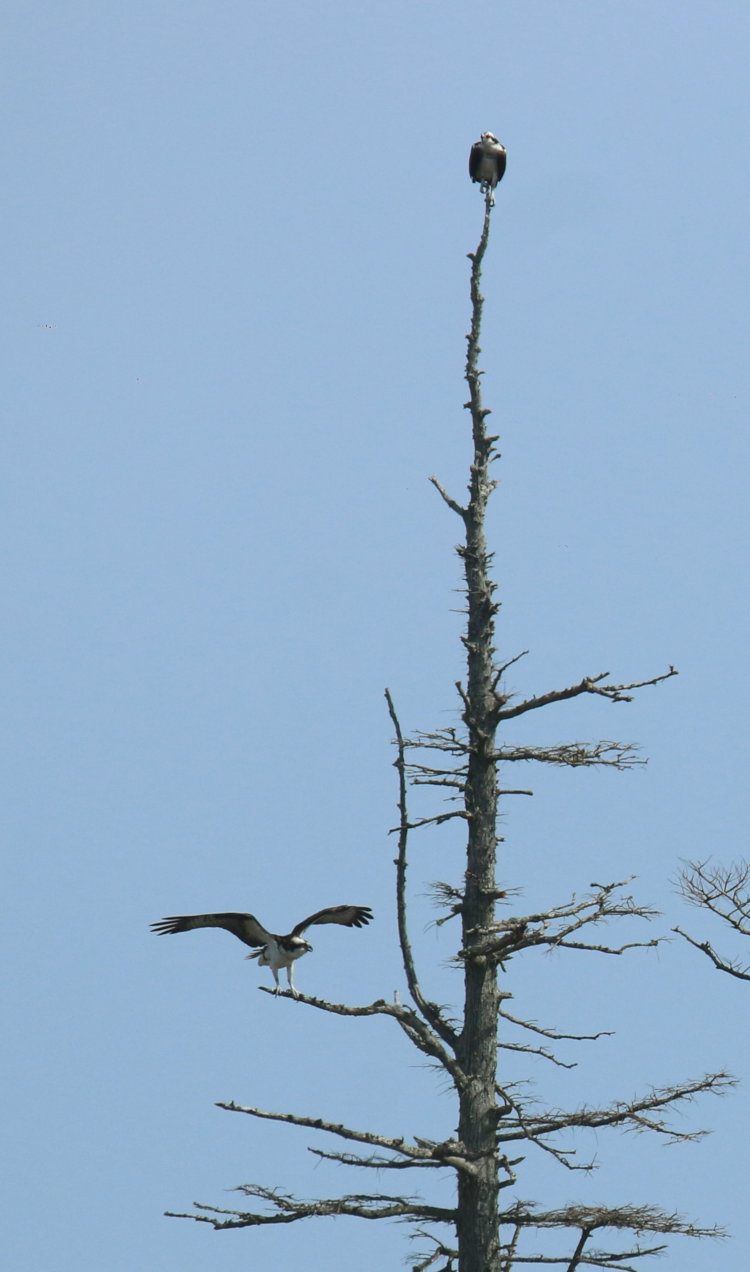
Visible from the main overlook on the causeway is a patch of trees on an island, which is where this osprey (Pandion haliaetus) sat – and then The Girlfriend spotted a bald eagle (Haliaeetus leucocephalus) nearby on the same island, though both were so distant that identifying them took the binoculars or the long lens. Nothing was happening, no one was moving, so we poked around a little and were about to leave that spot when this changed, and suddenly there were three ospreys, and they were all intent on convincing the eagle to get the hell out of Dodge, which it wasn’t buying.
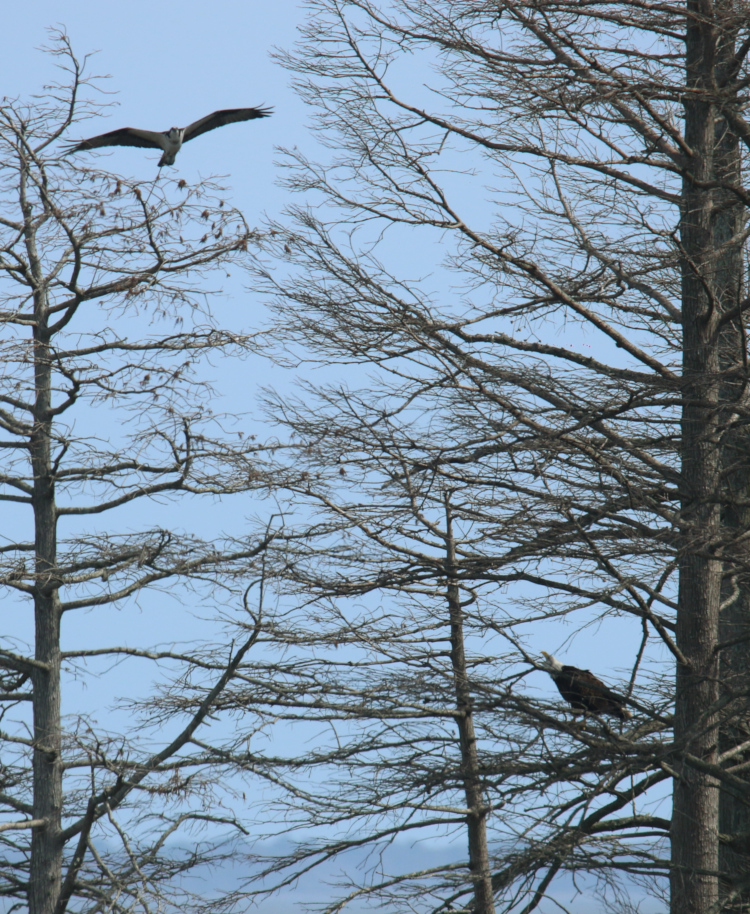
With the distance and intervening branches, this is as good as I got, and never a decent frame with all four birds together, especially when the ospreys knew the eagle was keeping an eye on them and thus didn’t veer too close. The cries of both were audible across the lake, but the eagle was making the most noise. In my experience, this is a little early for the ospreys to have returned, but my experience has been with Jordan Lake, further inland from the coast, so perhaps this is the normal timeframe around Mattamuskeet. Eventually, one osprey left and the other two resigned themselves to the presence of the eagle, perhaps because no nests were in evidence.
From there, we went down to the lakeshore near the pump station/lodge shown at top, and began following the skirting drive in both directions. I’d only been here once before, perhaps two decades ago [actually, I just checked the stock folders, since I had the first of my digital cameras with me then and so have timestamps, and it was March 18th, 2006, heh!] and made the mistake of following the same path as that time, though it was only a pass-through then. That direction was the quietest and most wildlife-free choice, as we discovered this time around.
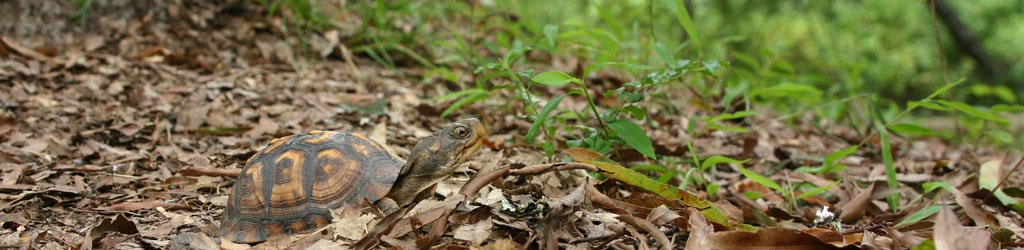
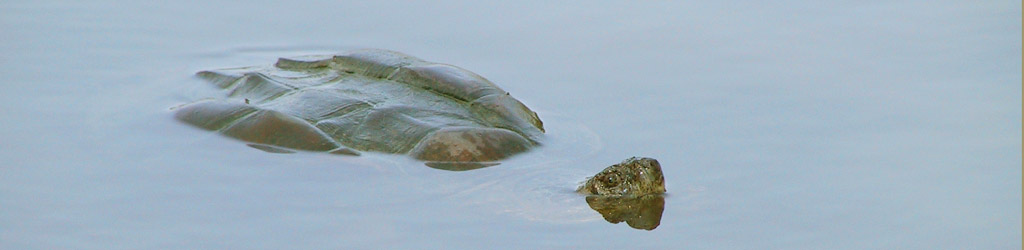
By the way, the weather was lovely and warm, and the turtles were all stirring, so much so that we moved four of them from the road while traveling there and back, or three if you don’t count this one actually within the refuge:
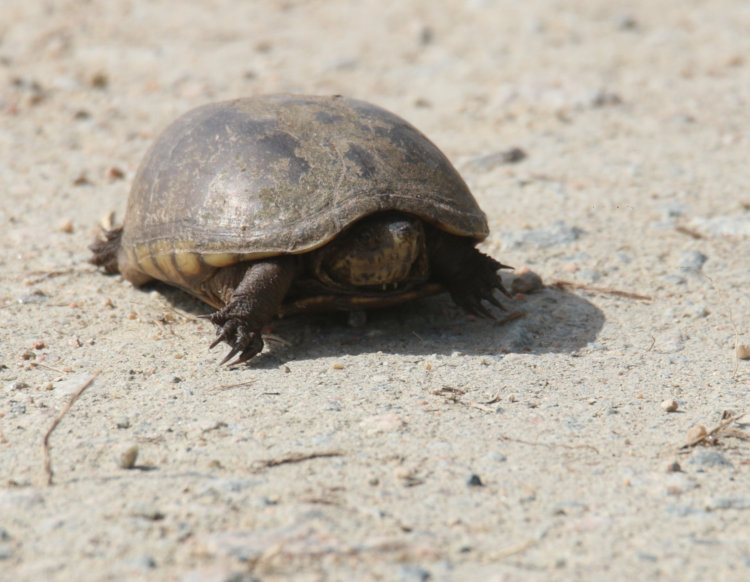
While the obvious markings don’t distinguish anything, especially when it refused to extend its head for a good look, I turned it over briefly as I carried it from the road and looked at the plastron, which was hinged front and back, making this likely an eastern mud turtle (Kinosternon subrubrum.) I also carried a yellow-bellied slider and two common snappers from the roads, one of which so covered with peat mud that it had clearly just emerged from its winter nap.
When we finally turned and began following the drive to the west, running between the lake proper and a vast floodplain, that’s when we started to see some real action. It’s amusing, in retrospect, how our expectations and reactions changed during the day.
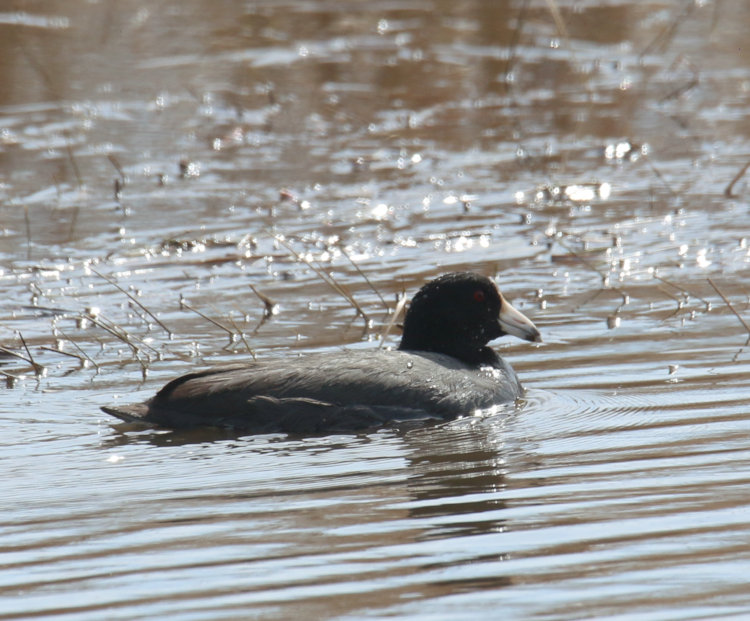
We spent some time trying to get a decent view of a few American coots (Fulica americana,) which turned out to be more and more numerous as we drove further, Now, a word about conditions, since it was bright haze the entire time, but on this section of the drive, we were facing almost entirely south, meaning everything was backlit unless we picked careful angles and timing. Moreover, there isn’t any time of the day or year where it would be a lot better, except for perhaps right at sunrise in high summer. That said, it’s also possible that sunset conditions at this time of year would produce lovely reflections from the water and potentially some nice silhouettes – we’ll have to see with further excursions. For now, this is what we have, and we can just barely make out the blood-red eyes of the coot in these conditions. It got slightly better later on:
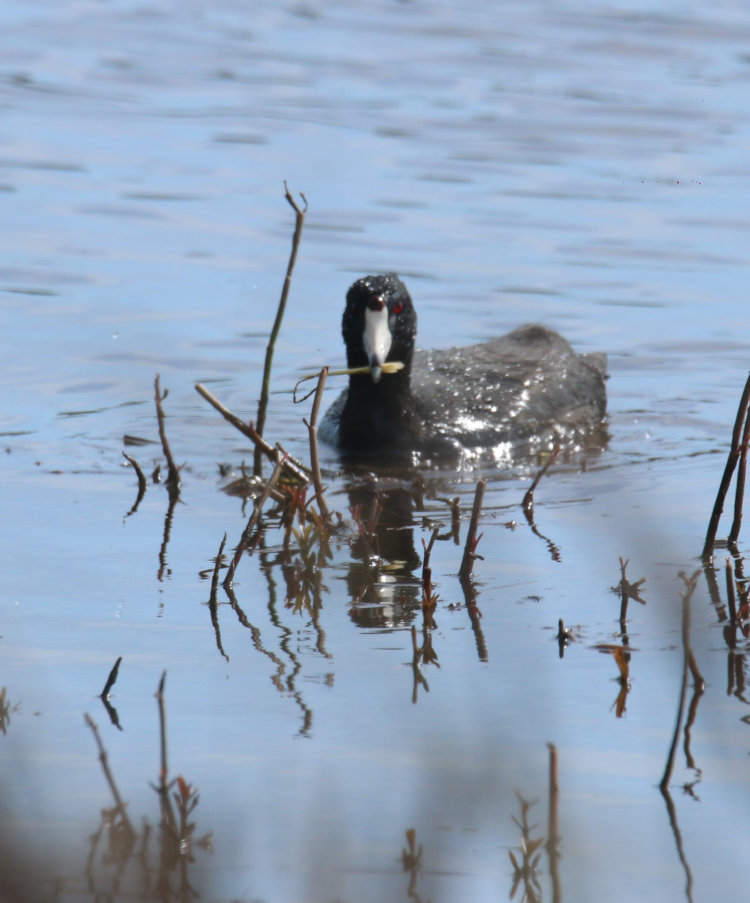
This one was pulling up plants from the bottom to munch on, though it looks like a shiv here, or perhaps Errol Flynn.
There were a lot of waterfowl species to be seen, though quite often at a distance, but I’m avoiding one in particular because all of those images (and probably some audio clips) will be found in a later post. Several flocks of ducks were only inclined to pass through well over a hundred meters off, allowing some wider flocks shots and little more.
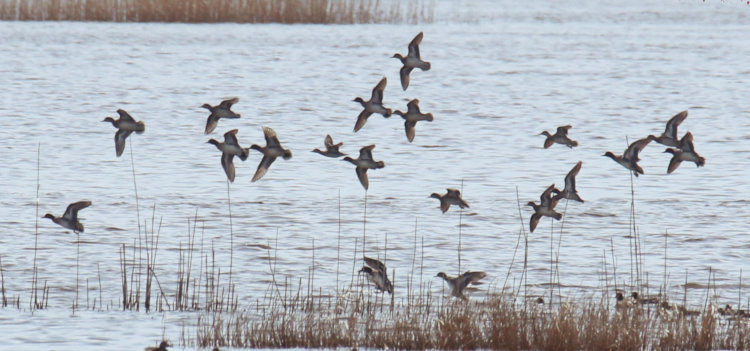
These were probably norther pintails (Anas acuta,) though it was hard to say, since the only sharp image I got at this distance had them all banking the same way and thus showing little of their upper plumage. I got slightly better at another time:
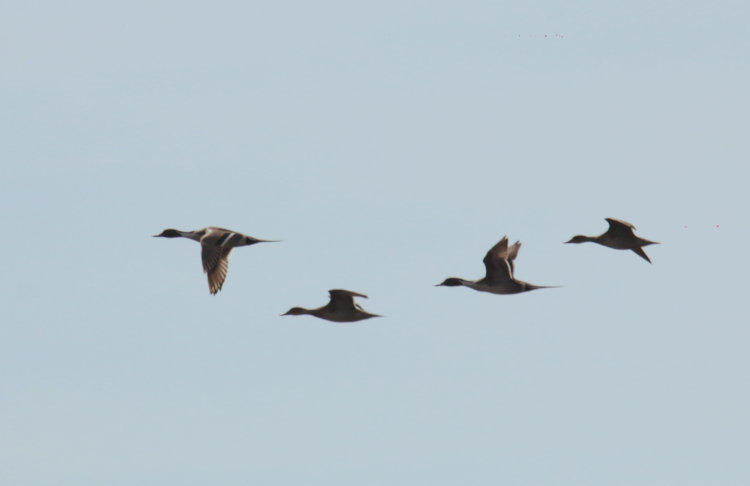
That’s enough to feel confident about them being pintails, but little else – it was more cataloging the different species; you can see them better in this post. Another species refused to show their faces, literally, though I’m fairly certain of these, too:
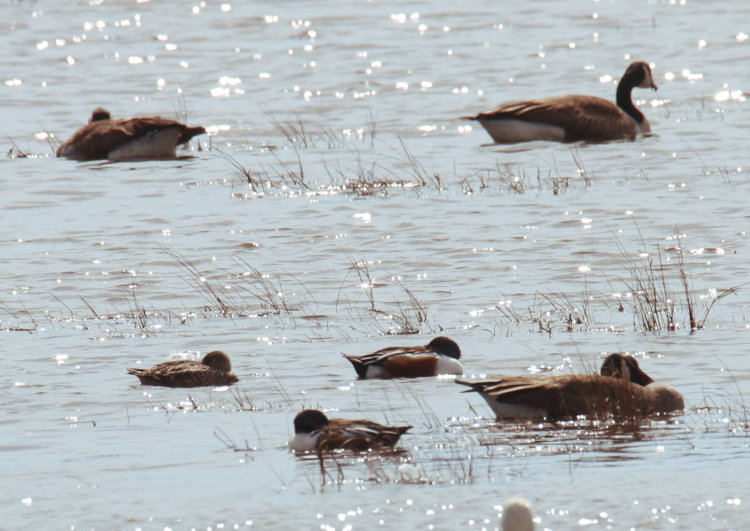
The larger ones to the right and behind are Canada geese (Branta canadensis,) but the smaller ones are northern shovelers (Spatula clypeata,) a duck species that I haven’t seen in the wild until now – and not really very well now, either, though the color pattern on the flanks seems to pin them down.
And then, another species, much closer this time.
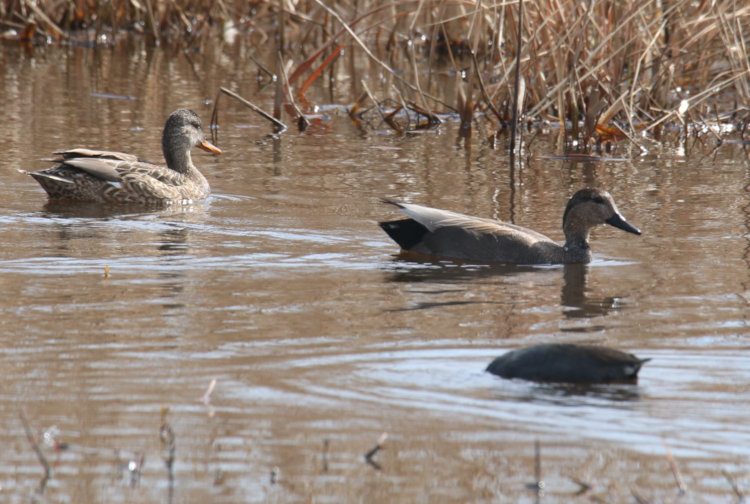
There’s a channel right alongside the drive, that gives way to the floodplain that, I imagine, gets a bit drier later in the year and turns into grassland; only a few species bothered being this close, and I didn’t recognize this one. We’ll go in for a closer look at the male on the right:
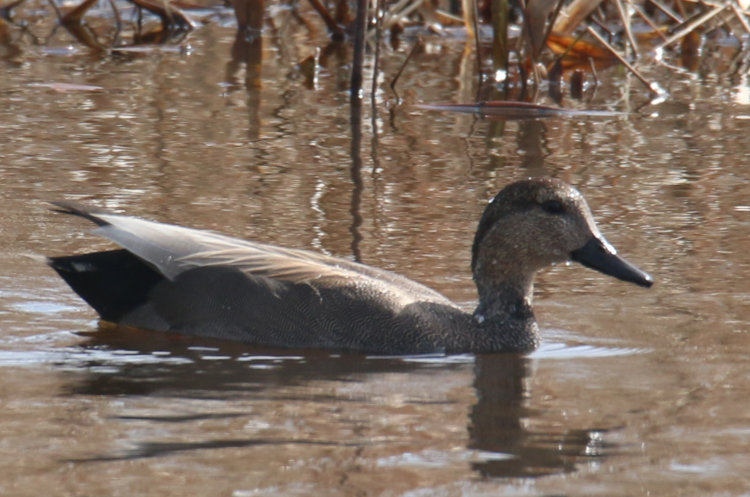
The head pattern and dark bill, stippled sides, and dark tail with lighter wing feathers above indicate this is a gadwall (Mareca strepera,) and I never would have determined that if it had only been the female – so many duck species have females that are practically identical, drab and mottled to disappear on the nests. A birder that we met told us there were also American wigeons and green-winged teals out there, though I never spotted those myself. To my credit, however, I spotted this one that I think he missed initially:
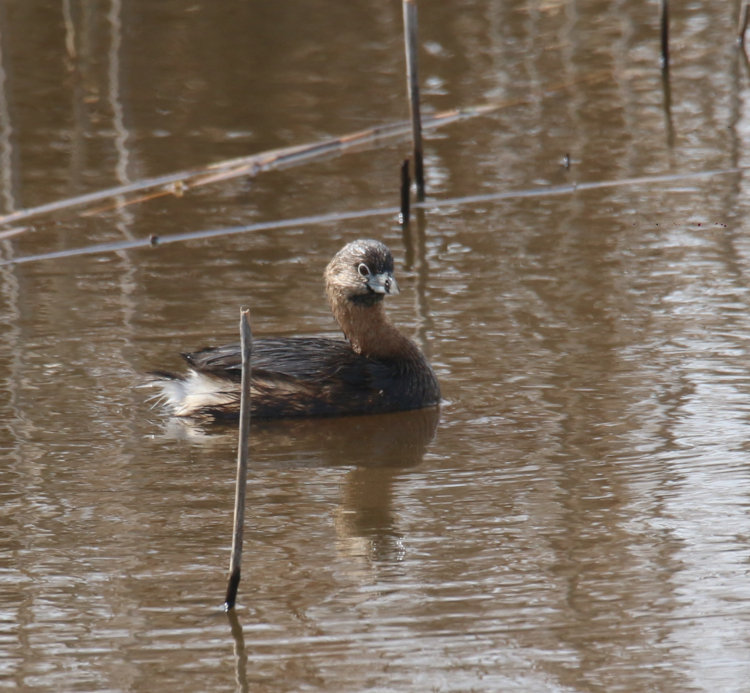
This is a pie-billed grebe (Podilymbus podiceps,) a species I’ve seen several times and never gotten a decent portrait of – this is so far the best. They’re tiny for waterfowl, smaller than the wood ducks and perhaps slightly larger than a pigeon, and pretty shy in my experience.
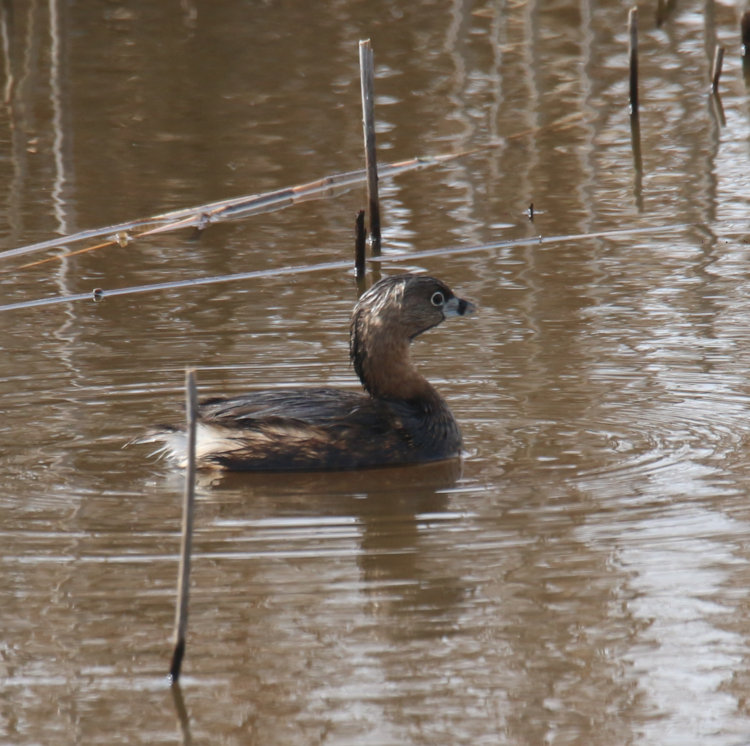
The males and the females look the same, so I can’t offer more than this, but at least the light wasn’t terrible.
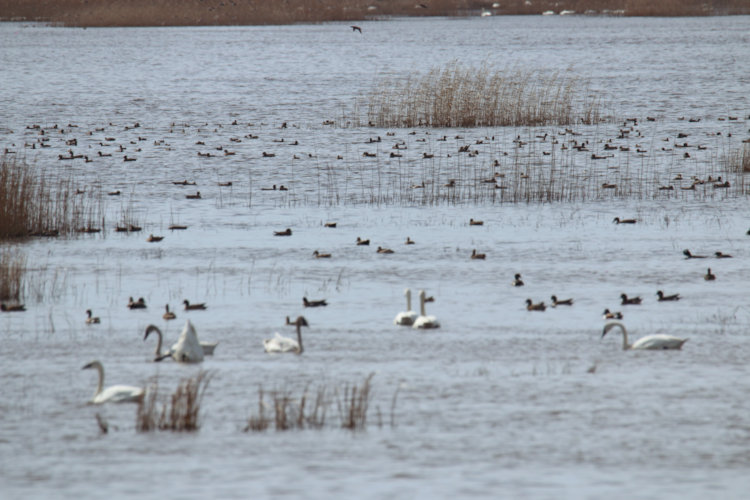
I made a small mistake in not bringing the tripod, which would have allowed me to snag some video of behaviors, though I did bring the shotgun mic and recorder, so I have audio clips (that I have yet to listen to – I told you I’ve been busy.) This pic gives more than a hint of the other species that will be featured in the next post on the refuge, coming soon, and yet shows only a small percentage of the birds therein (and don’t ask me why focus jumped to the background birds.) Right now I’ll leave you with a semi-abstract on the railing of a walkway, muddy footprints probably left by a great blue heron, and expressive in its own way. More to come.