


Another round of sorting finds, because I emptied out the folders (well, the image folders – the video folders still need ‘some work.’) Except, the image sort folders remained empty for less than a day, so I could do it again, but it’s not enough to worry about right now.
So let’s see, we’ll start with a sequence:
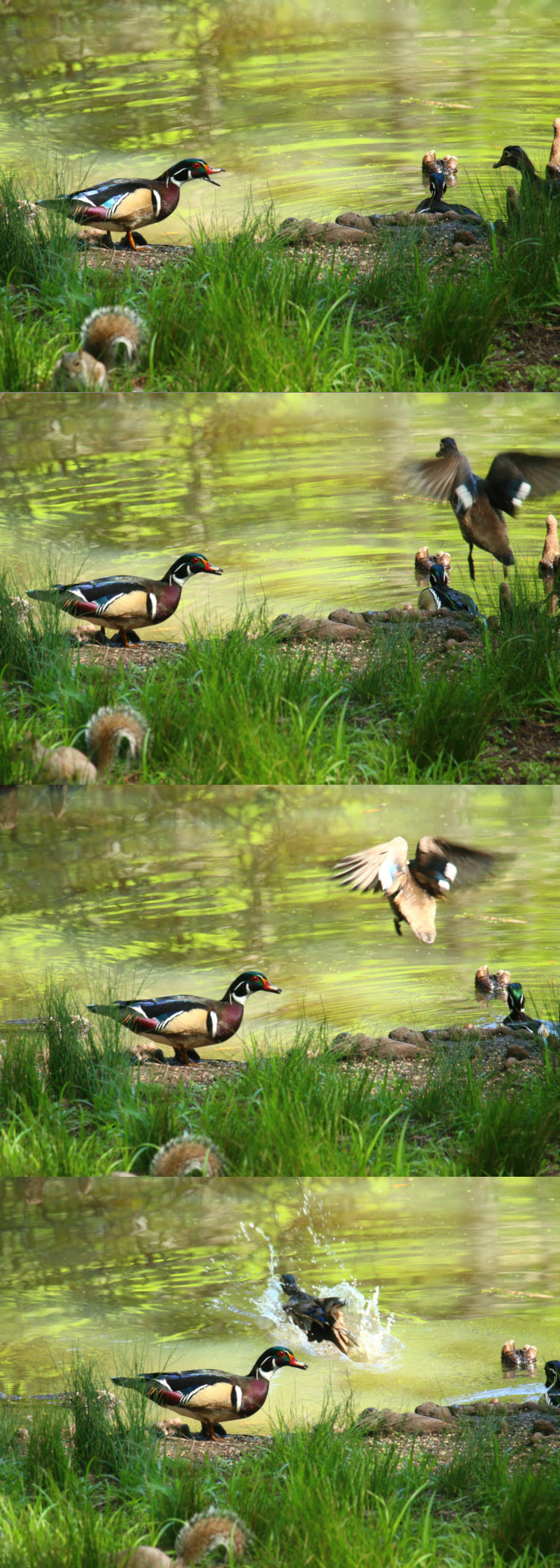
A bit earlier in the year (these are from April,) the wood ducks (Aix sponsa) were being seriously territorial, with one in particular being ‘boss,’ or at least that’s how it seemed to us – distinguishing individuals isn’t done by coloration or markings, so we usually use behavior, and this one stood out. Here, he chased a female into the water, despite the fact that we ensure there is enough food for everybody. Just your typical bully…
I have far too many video clips to compile into a whole narrative, but this hints at it, since we see here a female with her brood:
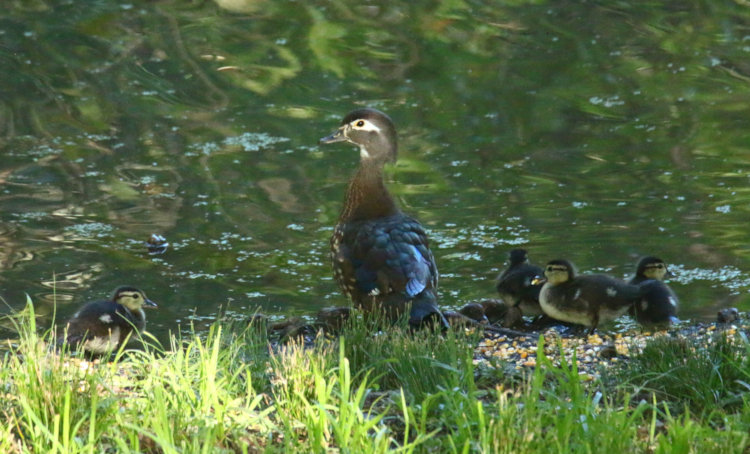
This is right around the time that the ducklings were now able to take the corn – you can see one with a kernel in its beak. We had a lot of broods this year, we’re not even sure how many, but too many to keep track – and on top of that, just yesterday I spotted what appeared to be a brand new collection. This is late, even for a second brood, and I’m not 100% sure it was a wood duck family.
This all resulted in some interesting collections at the pond edge, at times:
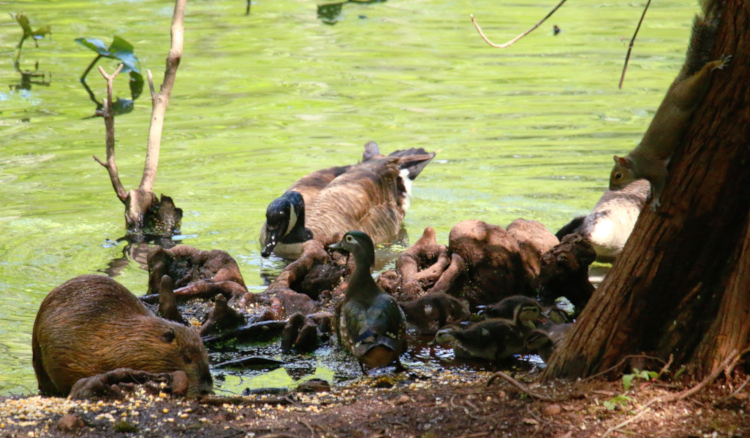
So let’s see, we have a mother wood duck and her ducklings, with two Canada geese (Branta canadensis) behind, a nutria (Myocastor coypus) alongside, and an eastern grey squirrel (Sciurus carolinensis) on the tree. The only thing missing are the turtles. We need a closer look at the ducklings:
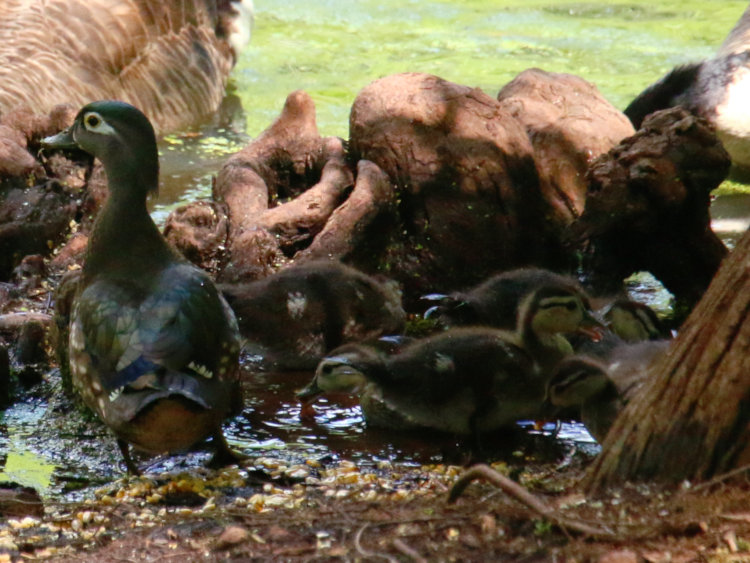
There’s five of them in there, and I can’t say if there were any more behind the tree. At present, nearly all of the broods are close to adult size and developing their adult coloration, though a few stragglers can be found at times. I still have no way of knowing when the nest box is in use, but I’m working on it.
I have to note, too, that the beaver dam is steadily raising the water levels, and this region you see here is now a pool ringed by the tops of the cypress knees – I will have some comparison images soon.