


















Even more of the backlog of photos that I have, trying to clear them out as I add still more to the stack.
On two non-successive night, I found a few mantids, which is about as many as I saw in total last year. Okay, there were probably more for last year, but not a lot – this location isn’t as liked by the mantids as the old place, as evidenced by ‘Chinese mantis’ being the second most-used tag on the blog, after ‘Carolina anole’ – it had led the count up until a few years ago when the latter species started appearing at the old place. Anyway, the first mantis found was actually larger than I expected.
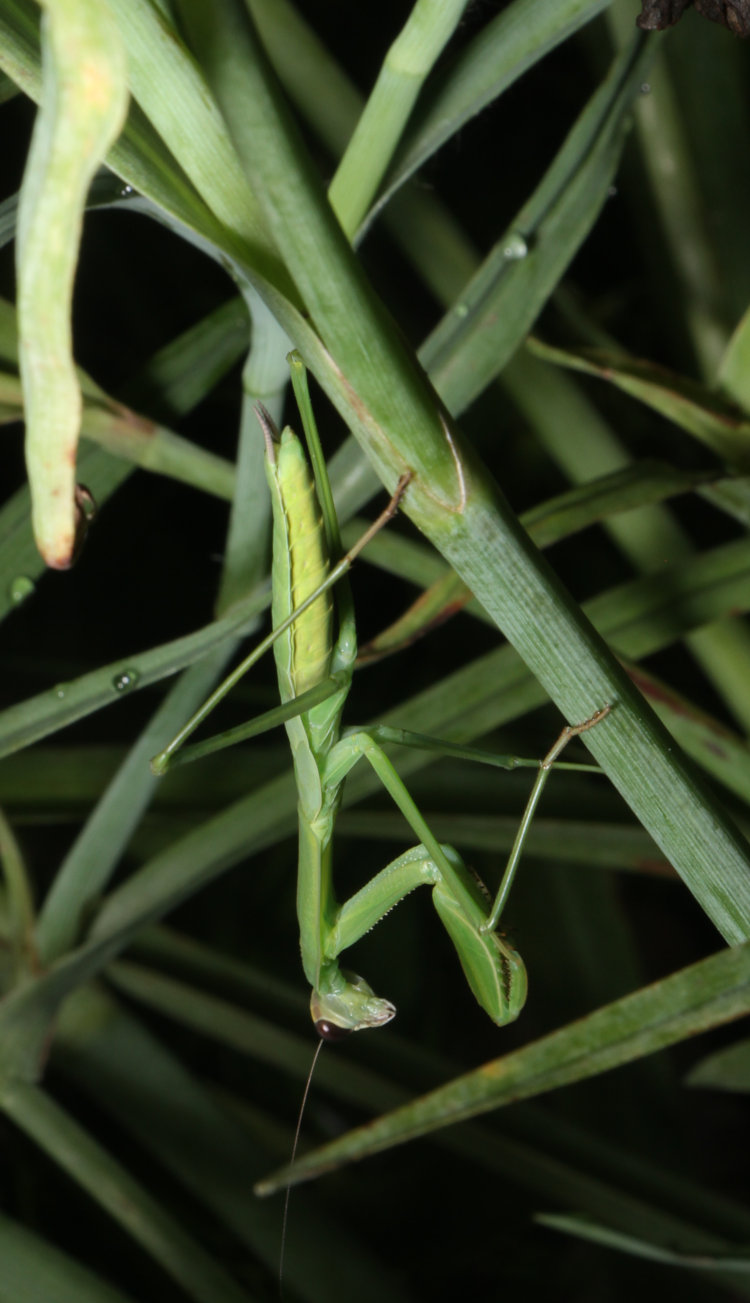
While I can’t see the detail that would distinguish this from a European mantis, which is a spot on the insides of the forelegs, I’m going to rashly consider this a Chinese mantis (Tenodera sinensis,) because I have yet to see a European. Mantis, that is – I think I saw a European human some time in the past, about when I was eight or so. This one (the mantis again) was spotted from a distance, despite it blending in quite well with the hairy-stem spiderwort (Tradescantia hirsuticaulis,) because its belly was to me and the paler underside of the abdomen made it stand out. It was about twice the size as expected, so, good.
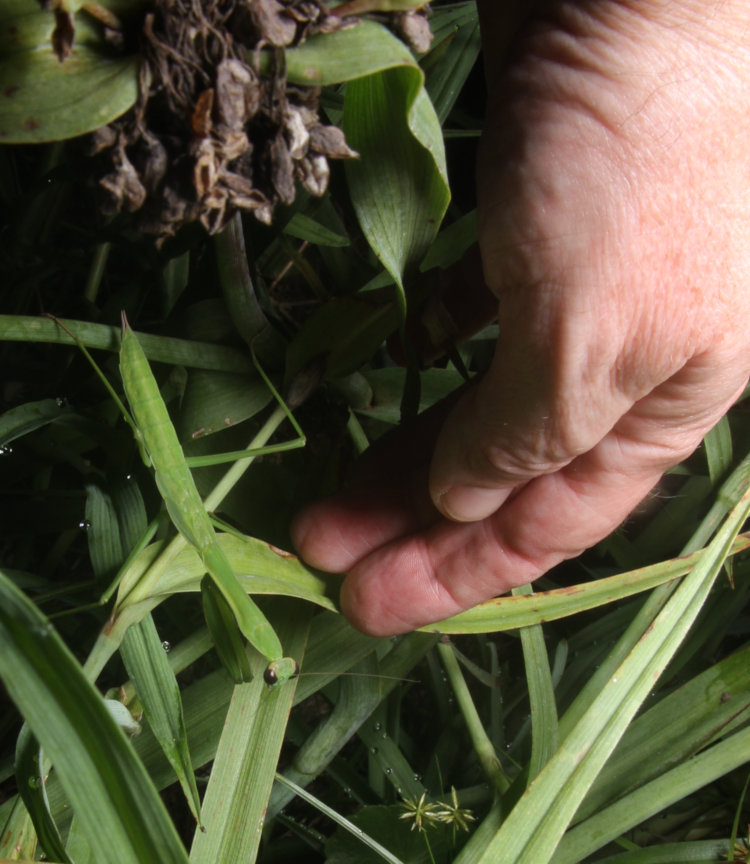
After a little juggling while the mantis was starting to get spooked and shift position, I managed to get my hand in the frame for scale, though rotating the camera to vertical switched the flash to the wrong side, but oh well. You can also tell this was taken at night by the dark eyes of the mantis.
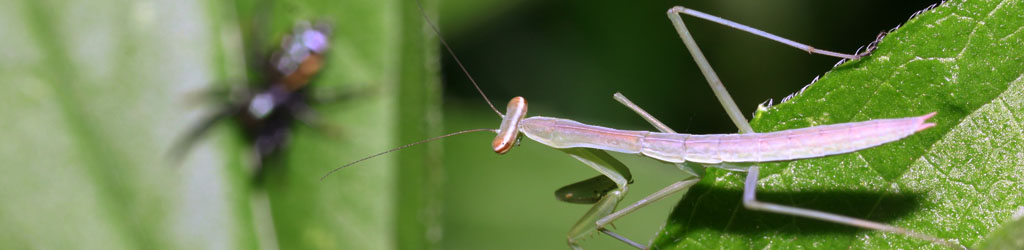
Perhaps three meters away, another was in evidence.
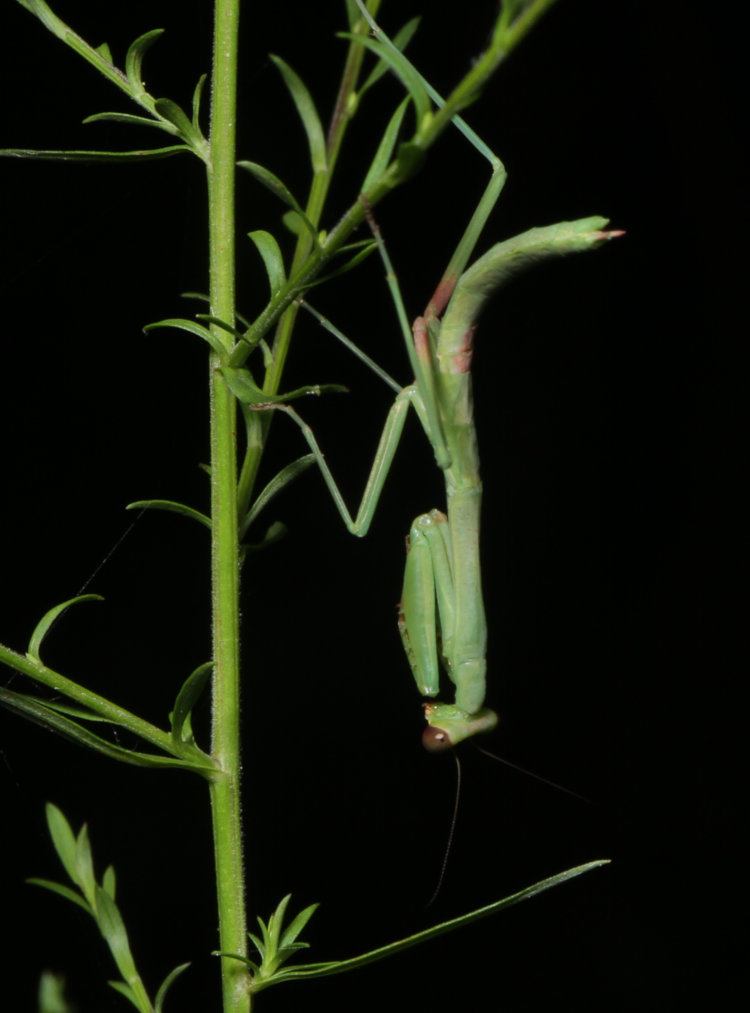
From the size and the upturned abdomen, I am considering this one a Carolina mantis (Stagmomantis carolina) instead, and from the green coloration, a female. Notice how both the abdomen and the hind legs have a patch of pinkish color at the same location; why is that? You’d think it would be camouflage, but it’s pretty generic in nature. Of course, we tend to view evolutionary traits as, ‘complete,’ things like camouflage being pretty good mimicry of the preferred habitats of the species, but it all had to start with something trivia and almost random, and gradually develop to be more specific and effective, so perhaps that’s what we’re seeing here. Or it could just be an accent piece, like a pocket square.
And scale, of course.
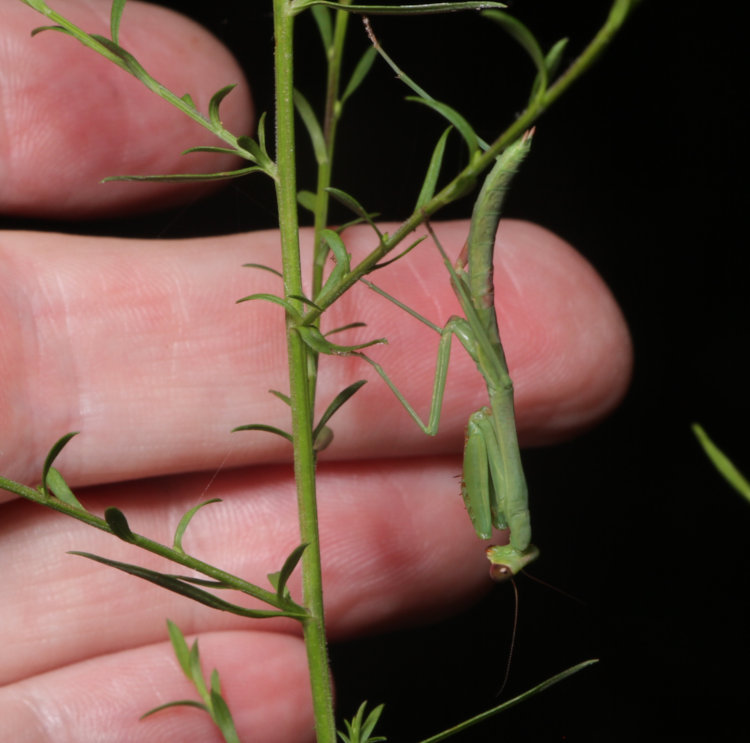
This one was a lot easier to get my hand behind – in fact, it looks like the mantis hasn’t even twitched, and I just shifted shooting angle slightly. Perhaps this was much better camouflage than I thought, in that this is simply a mockup mantis constructed by the real one to attract attention away from it, so that dash of pink is a subtle attention-grabber. I mean, I found it by shape, but perhaps I’m not the target of the mimicry.
Two nights later, I found another of the same species, roughly the same size yet markedly different in coloration.
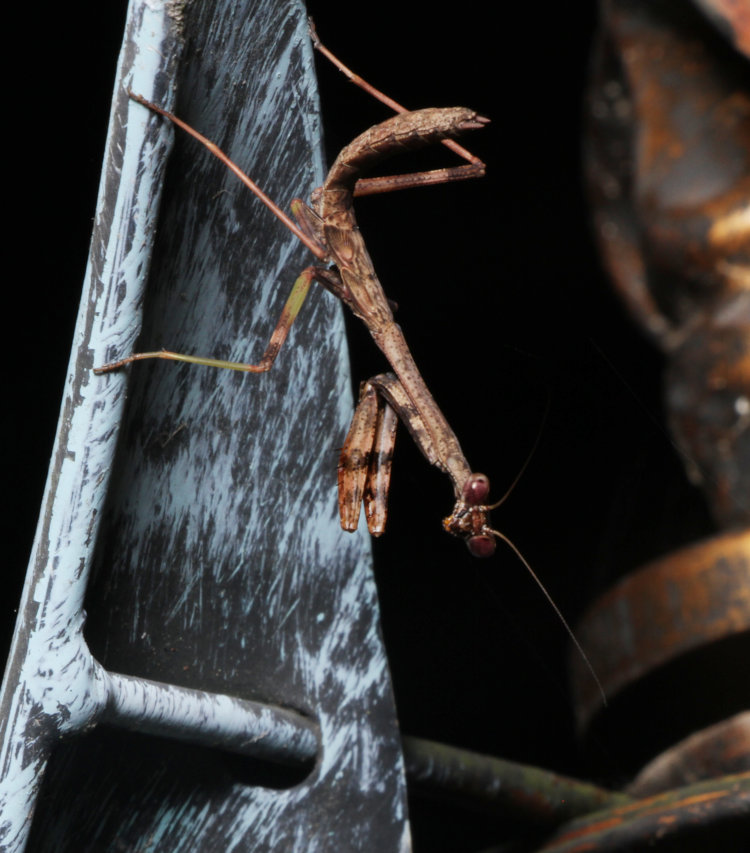
The brown ‘urban camouflage’ coloration pegs this as most likely male, though the females can exhibit this color. But yeah, compared to the dash of pink of the other, this is a bit more refined in adaptation, doncha think? Just, not for this particular perch, which is a wind-spinner on the deck.
A moment of trivia: Even though I recognize many species instantly, I occasionally check to confirm with a source like BugGuide.net – not from insecurity (I don’t think,) but because I’ve been burned numerous times on taxonomical changes that have taken place since I first learned the scientific name for a species – it certainly happened with the Chinese mantis. And indeed, BugGuide gave another possible species with this appearance, Stagmomantis conspurcata instead. Only when I searched, I found nothing but the one reference on the page for S. carolina – no images, no species page, no other mentions. But there was a link to a paper, so I checked that out; it turns out that specimens that look like this but range from Texas down into Mexico may be S. conspurcata, or at least, this was the suggested re-classification due to notable differences. That means that, here in NC, we’re still dealing with nothing but S. carolina. For the time being.
The misting bottle was near at hand, so I played it over the mantis, which caused a momentary panic and then a pause to take advantage of the moisture, this occurring on a pretty damn sultry night after a blistering day, several days after the rains had rolled through.
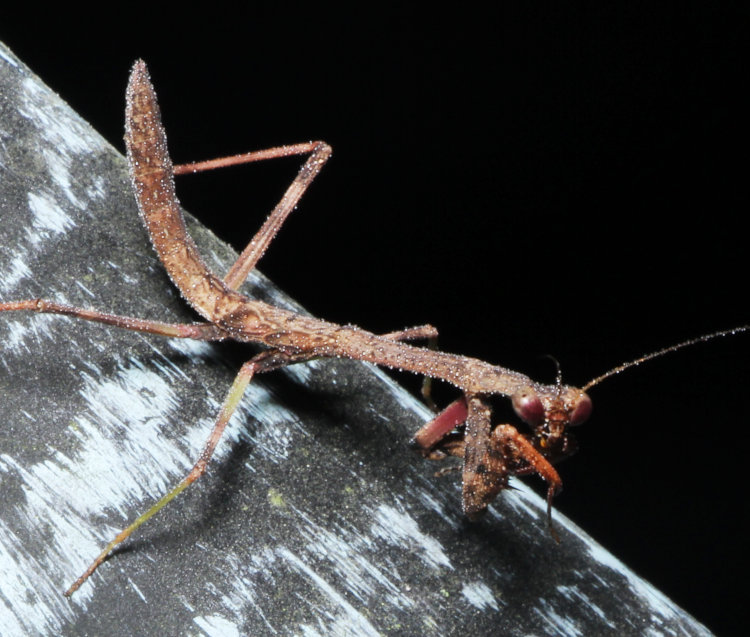
At the old place, my misting was fairly frequent, and the mantids were often delighted to receive it, at least if their springing from cover to bask in the drifting droplets, and then immediately drink it from their legs and eyes, was any indication. I mean, we have to be careful not to misinterpret behavior based on our own expectations, but I suspect I’m safe with this one.
So, we’ll see how much more often I find these guys, and whether I can locate an egg sac this fall. Or better, actually snag some frames of one being produced, still a major goal of mine.