

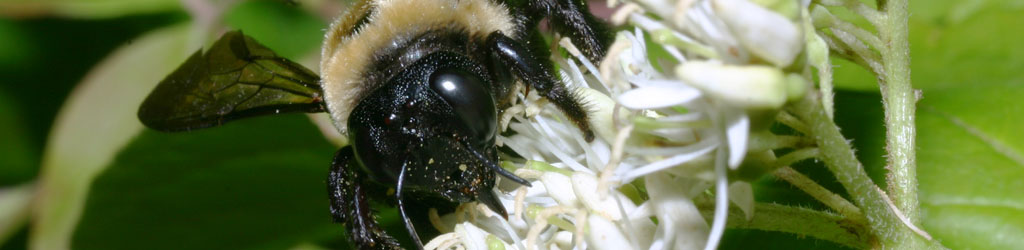
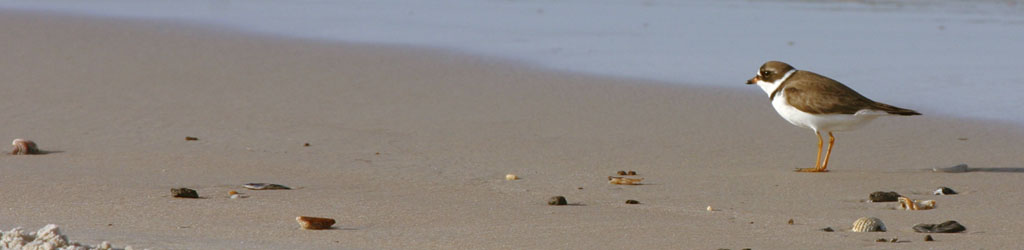
As intimated, I’ve been deeply involved in numerous projects here, keeping me away from blogging and not a lot of photography, either. So let’s catch up a little with pics from the past week or so.
We’ll start with an update on the bebbehs, the latest crop of nutria (Myocastor coypus) young, which have now expanded to five.
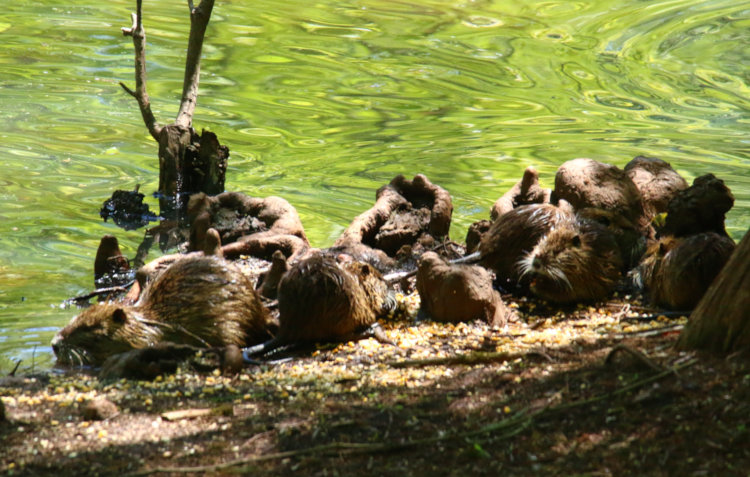
It’s rare to see them all at once, and even rarer to have a nice clean view – I think I have a couple of video clips, but quite often, as soon as I’m getting them all together, one or another decides to scamper off someplace else and at the very least remain out of the frame. So this isn’t great, but they’re there. And in case it isn’t clear enough at this resolution, I have an annotated version:
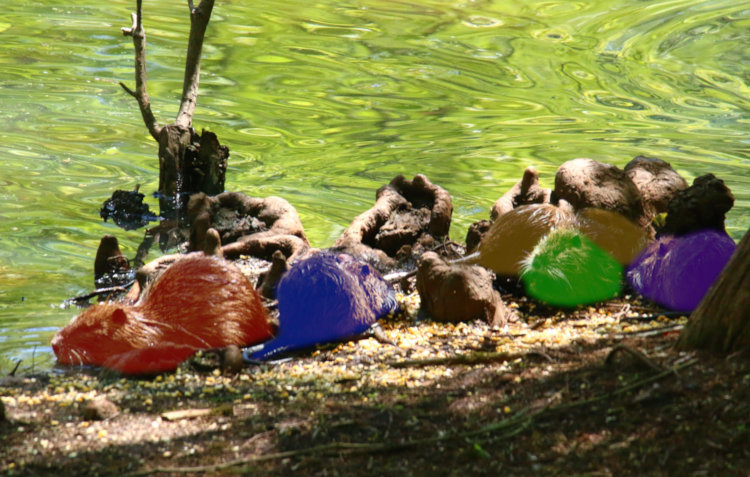
There – see them all now? We observe them often enough that we can slightly distinguish them now by behavior, though not by appearance. There’s a runt, which we can tell when compared to the others, as well as being slightly shyer and more hesitant, and a supremely bold one that seems to be bothered by almost nothing. Then two others seem to like playing together. That’s about it right now, until we microchip them and get them into the satellite network…
With the rise of water levels due to the beaver dam, Turtle Island and several other basking spots have been reduced or vanished altogether, so the numerous turtles in the pond are making do as they can (at least until I find a way to make them a new basking spot someplace.) This means the apron where we spread the corn becomes a crowded beach in the mornings when the sun gets high enough.
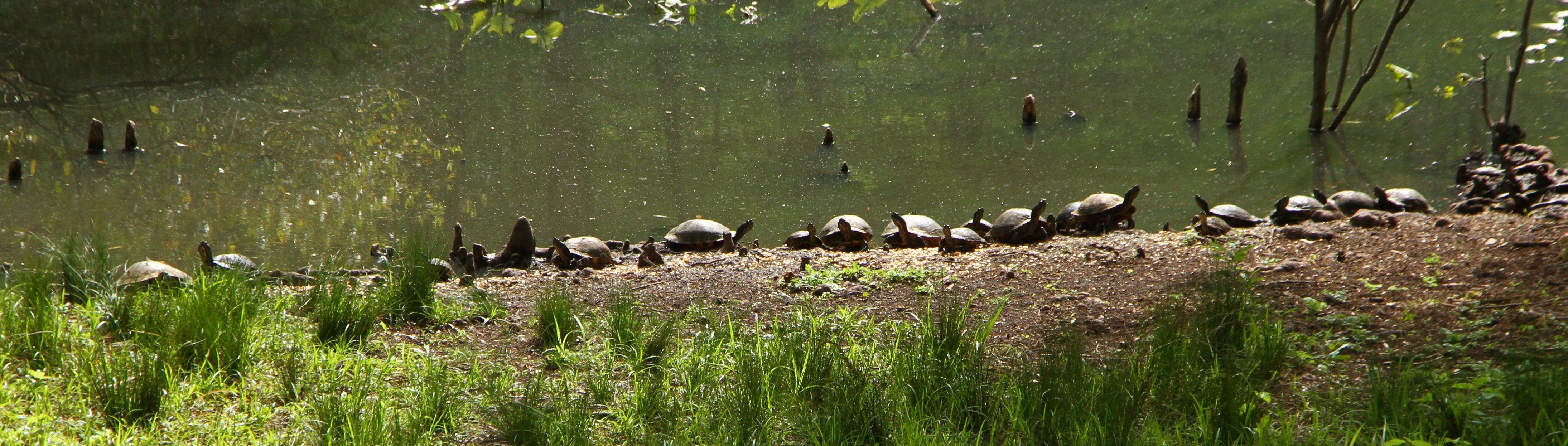
This is trimmed down to a panoramic to fit within the blog parameters, but clicking on it will take you to a full resolution version so you can see in detail. There are at least 20 turtles lined up here, primarily yellow-bellied sliders (Trachemys scripta scripta) with a few eastern painted turtles (Chrysemys picta picta) sprinkled in there for seasoning. When you go to the big version, note that the third one from the left is hiding behind a tuft of grass, but you can see the shell and a head peeking out. Also look at the eighth, which has something appearing above the dome of its shell – that’s possibly the head of one hiding behind, though I didn’t count that one. The last one on the right, nestled in among the cypress knees and roots at far right, is pretty blurry, I’m supposing from the aspherical nature of the lens used, but I did confirm that this shiny spot is indeed another turtle. And this doesn’t include the ones that were still using Turtle Island, as well as others in spots of opportunity. They’s a lotta tortles in the pond, is what I’m saying.
And now, the ducks. The other evening we’d been prevented from distributing more corn because the ducks were out there all day long, possibly because they were waiting for us to distribute more corn, but it seems self-defeating to scare them away to do it. So this resulted in a lot of activity as they scavenged for what little they could find.
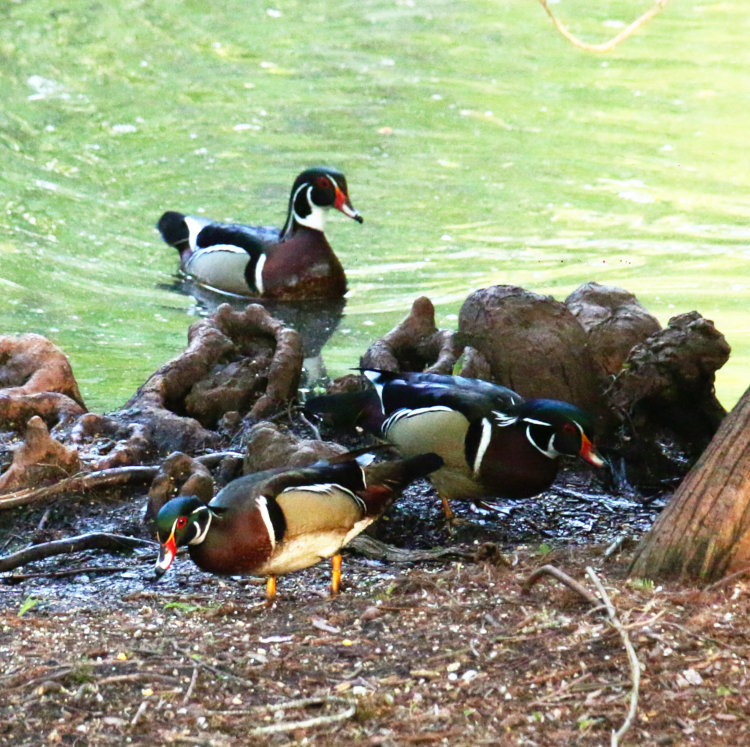
It might sound like we’re starving the poor things, and at times The Girlfriend frets about this, but they have a varied diet that the pond provides all on its own, so this is more a bonus dessert to them – they’ll cope. Here, three male wood ducks (Aix sponsa) are examining The Point, the same place we just saw the nutria bebbehs, for leftover morsels.
The males are appearing without females fairly often now, almost certainly because the females are on the nest or leading their progeny around – it was about this time last year that we first started seeing ducklings. But for some reason, the males seem more territorial now than before, and squabbles and chases are a routine occurrence.
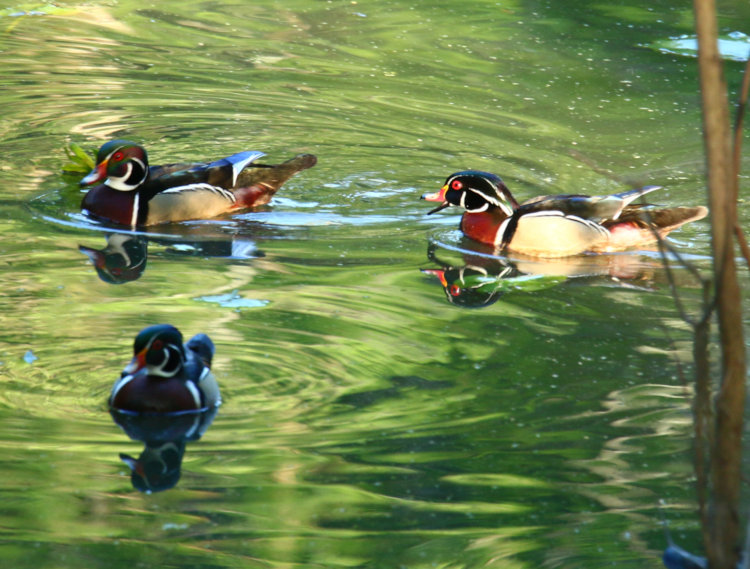
Yes, the one on the right is chasing off the other ahead of it. This rarely lasts more than a few seconds and a few meters of chasing, though occasionally it gets more energetic. They can’t hold a candle to the Canada geese, though, which will frequently chase one another around in circles or take flight to continue the pursuit down through The Bayou. I’ll feature them a little later on.
While the light was good, I fired off a few more portraits.
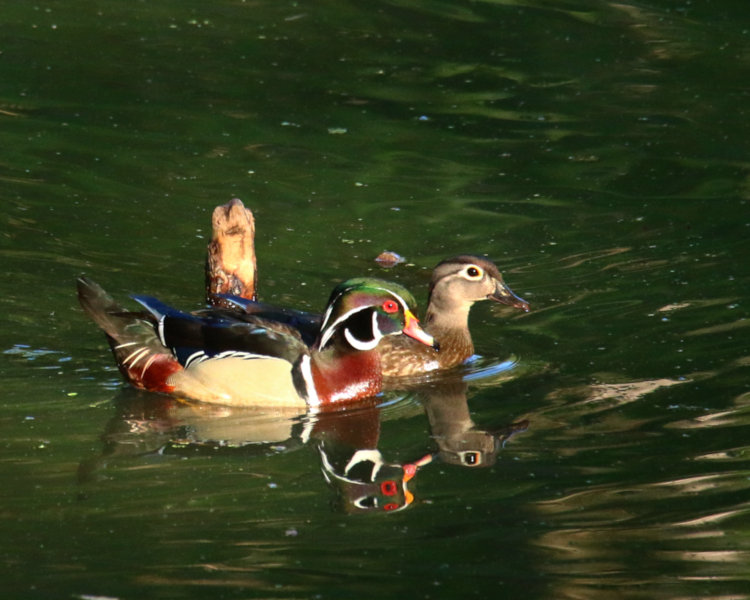
Still trying for the really slick portraits with the fetching background – they don’t congregate in good light very often or for very long, and I always have to be shooting from a significant distance (usually the upstairs bathroom, like here,) so it’s an ongoing quest. But I get a few keeprs here and there.
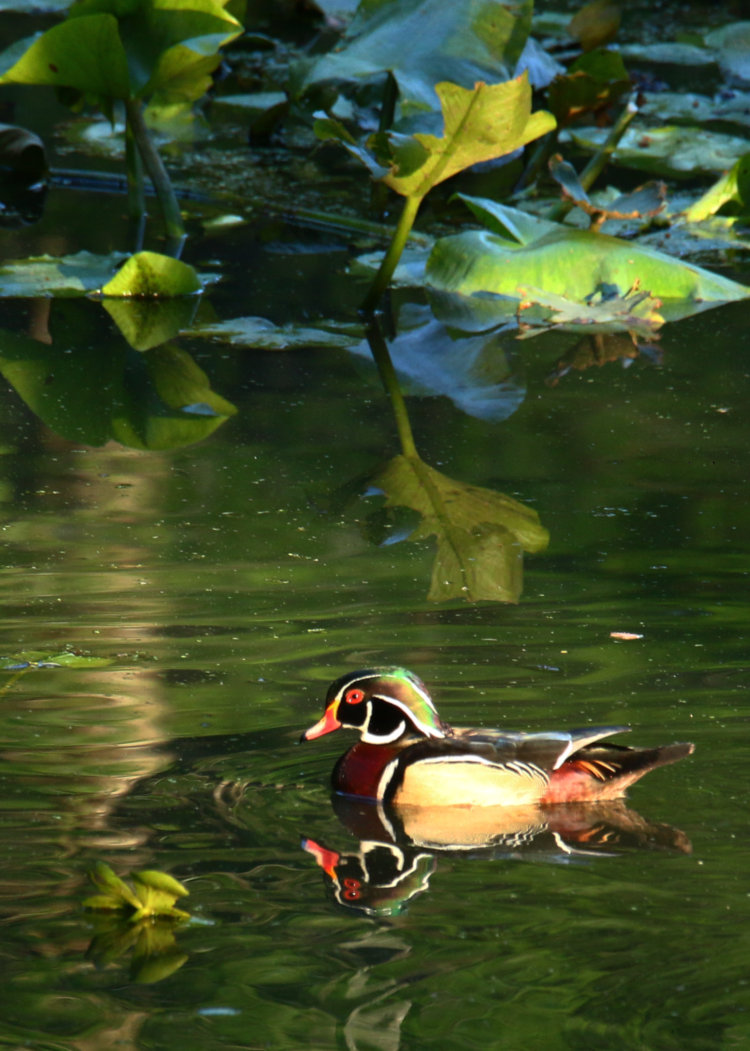
The yellow cow lilies (Nuphar lutea) seen in the background here are rapidly taking over the open water, though the activities of the nutrias and beavers seem to be keeping them down slightly. Meanwhile, I really want a portrait with a nice clear reflection, but the ducks are usually swimming through the patches of bright light and so the ripples are always present, doing things like doubling up the eyes.
For the past several weeks, we’ve been seeing just one pair of mallards (Anas platyrhynchos) hanging around at times, a little more complacent than the wood ducks so they’ll faintly tolerate us in the yard if we’re far enough off. Then the other evening, they were joined by another male, hanging around in close proximity like part of the family.
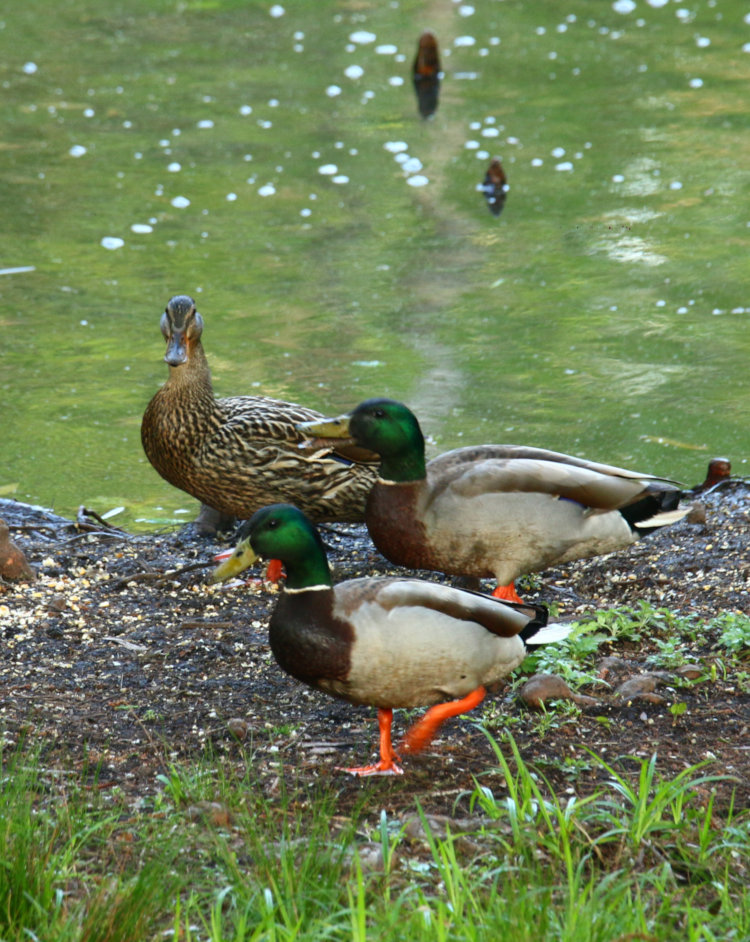
This illusion wasn’t quite complete, because every once in a while the male of the pair would chase the other male, but only for a meter or two, and otherwise they would be foraging together. And occasionally, with others as well.
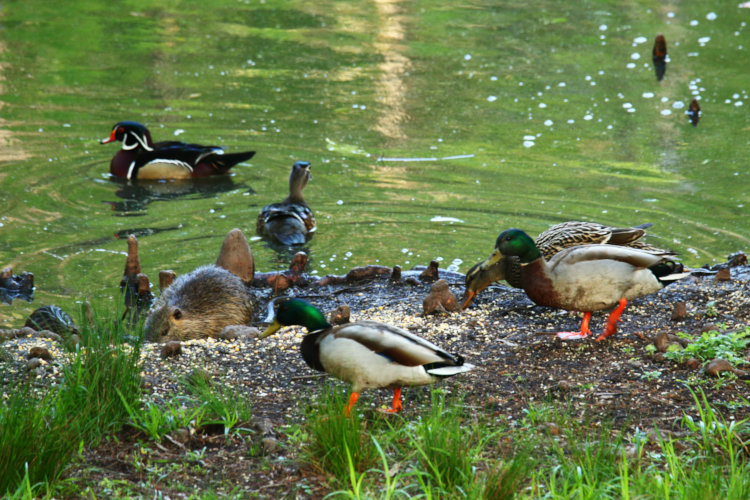
That’s the mallard trio, with a wood duck pair in the water, and last year’s juvenile with this year’s bebbeh nutrias all foraging together (the dark hump at far right is the bebbeh.) They’re largely quite tolerant of each other, only needing a little bit of personal space and otherwise not caring at all – even when the corn is scarce. The wood ducks tend to give the largest adult nutrias some space, waiting for them to finish and leave before descending on the shores themselves, but not always – I have a video clip to feature at some point.
I also snagged a rare moment, as a male wood duck goosed the larger male mallard to get out of the way.
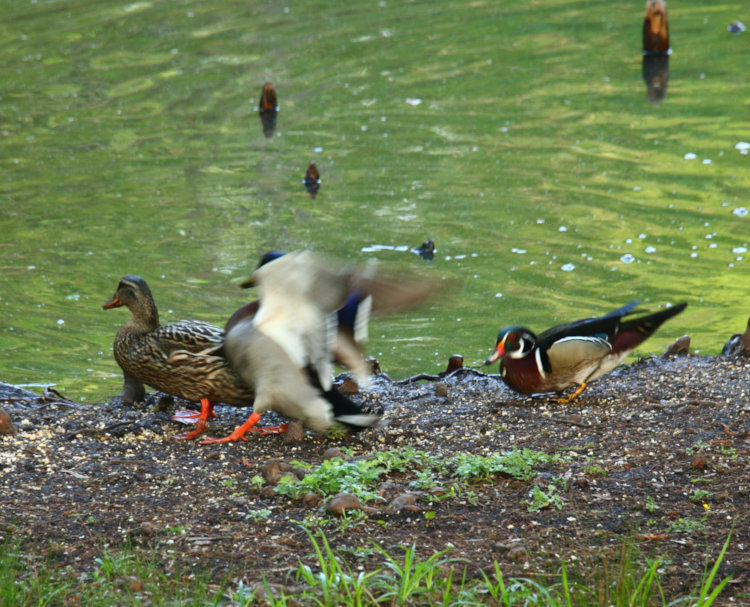
This was actually surprising – wood ducks are timid around the other species on the pond and virtually never dispute anything with the mallards, while the mallards won’t hesitate to chase off the wood ducks to a safe distance (again, about a meter – it’s not antagonistic at all.) I’m sorry I wasn’t shooting video at the time, The mallard didn’t turn around to retaliate, either.
Last subject, but in reverse order because I want to close with the portrait. While The Girlfriend was preparing a standing planter for new herbs yesterday, we discovered a large green treefrog (Dryophytes cinerea) had gotten inside, and we’d suspected it had trapped itself. I moved it to a ginkgo and got some pics, but by early evening it had made its way back to the planter. And by today, it had chosen a spot right alongside the back door to hole up for the day.
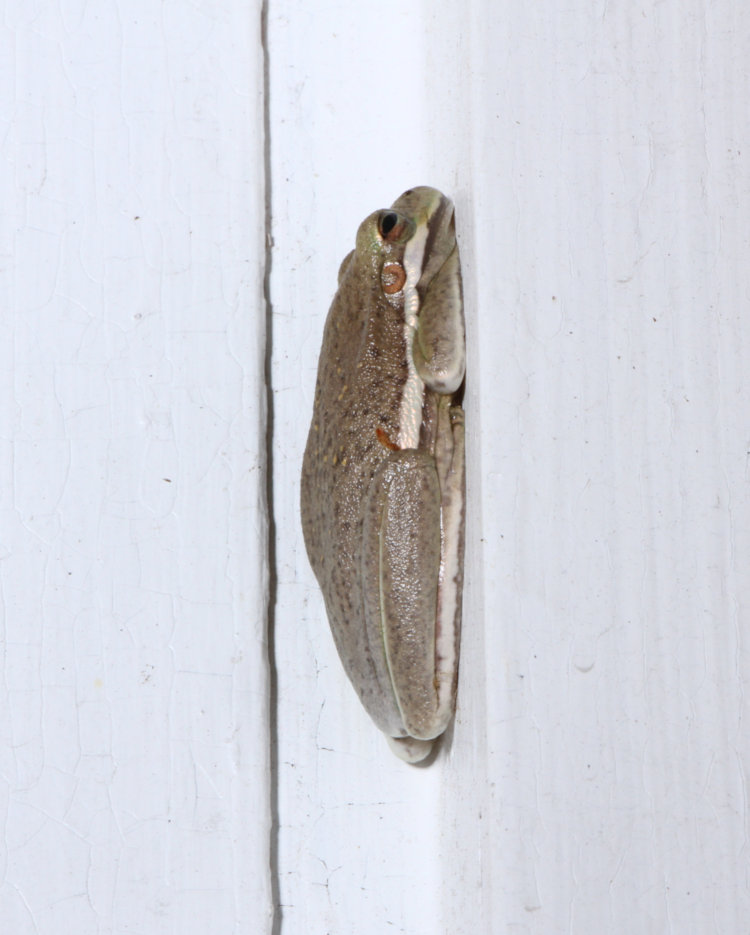
See that dark vertical line behind the frog? That’s the edge of the back door itself, a scant few millimeters from contacting its back, that I had already passed through several times before spotting the frog there. Yet it remained, totally unconcerned with the activity, sporting its nice little bronze color that’s an uncommon (but not too) variant in their coloration.
The portrait was much better, though.
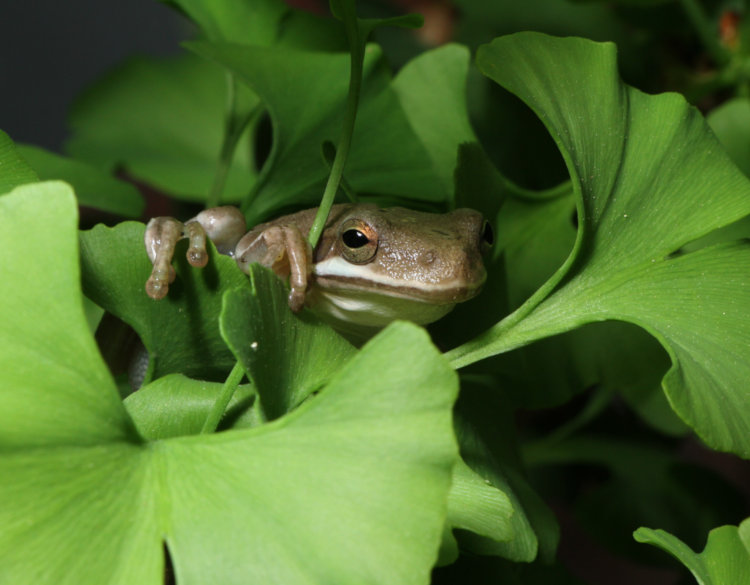
The frog hadn’t liked being handled and tried to squirt out of my hands several times, so it was with some effort that I got it to the ginkgo, a safe place with shelter from the sun. The pose here is all its own though, as it regarded me with some enmity for displacing it from its nice quiet little planter home. Or maybe not. But I like the portrait anyway, and yes, this particular ginkgo (we think it’s a dwarf variety) really is this thick.