




First off, I haven’t really determined where all my time is going, but I have at least three posts, maybe more, of photos to get to and they keep shifting farther back. The Illustrious Mr Bugg, at least, is going to wonder what the hell’s wrong with me. They’re coming, they’re coming… but not until after this.
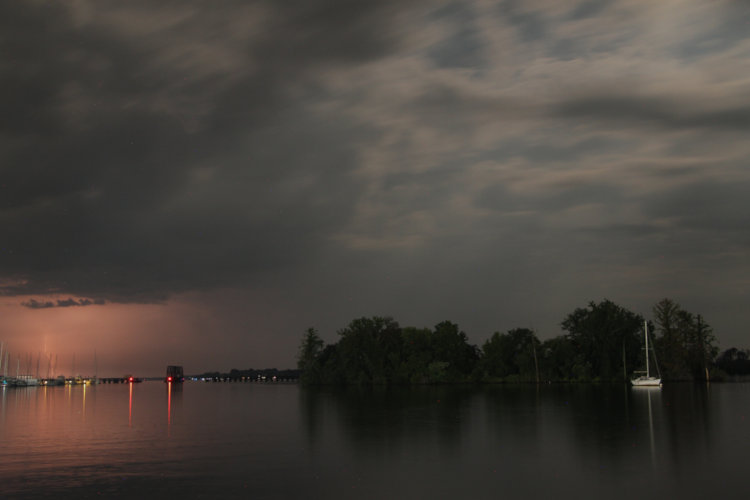
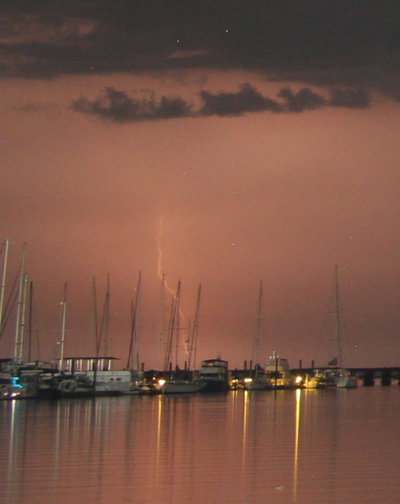 Last night we got a fierce set of thunderstorms, the kind that come with tornado warnings, which blipped our power here twice, preventing me from accomplishing too much on the computer. Soon after they’d passed, we could still see plenty of flashes lighting up the eastern sky, and I realized that the moon was also coming out while these were going on. That’s an opportunity I can’t let pass, so I drove down to the waterfront to see what was happening. That sunset pic up top there isn’t, since this was near 1 AM – you’re seeing a distant lightning strike instead, with supplementary light from the moon and the waterfront lights during an 11-second exposure. That’s a closeup of the strike to the right, many kilometers distant and almost obscured by the rain. It’s an ‘okay’ shot, but I would have been disappointed if this was all I had to show for the excursion. Luckily, it isn’t.
The serious activity that I’d been seeing from the house had petered out by the time I got to the waterfront, that cell having moved on very quickly, yet the second frame that I took snagged a nicely visible bolt, so that was encouragement at least.
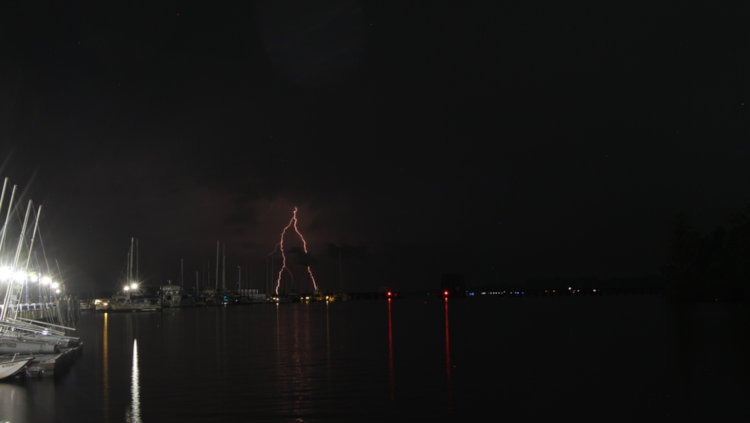
The waterfront lights are visible to the left there, which I largely had to try and keep out of the frames because of the glare, but you can understand how they played such a large role in the images to follow. Now, despite all of the thundercells that were almost literally surrounding me, the air was cool with a gentle breeze, no rain at all, an incredibly comfortable night after the heatwave that has blasted this area for weeks so, you know, no hardships being out there. At least for a while.
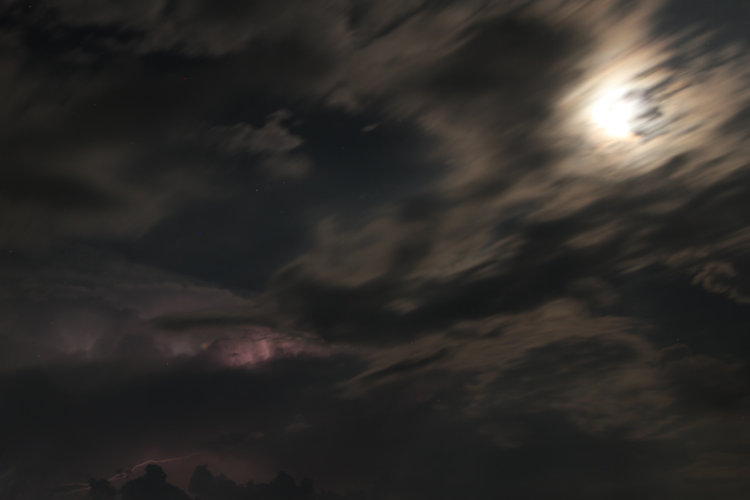
The moon was just before full, and the clouds routinely obscuring and revealing it countless times. I was happy to try and include it in the compositions, trying for a combined moon and lightning shot, but here’s the thing: A good moon exposure, showing details, is fractions of a second under ideal conditions, perhaps stretching out to a couple of seconds with scattered clouds acting as a filter. Meanwhile, capturing lightning requires either exceptional luck in tripping the shutter at exactly the right time, or (the typical method,) leaving the shutter open for several seconds at a time while waiting for a bolt to appear in the frame. The length of the exposure will be dictated by what other light is available, and with the moon and the waterfront, this was fairly significant. Most of my exposures were running in the 5-20 second range; this was a mere eight seconds, and not only is the moon blown out, the clouds were moving enough in that brief window to blur noticeably – except for those purple ones illuminated by the brief lightning strike instead.
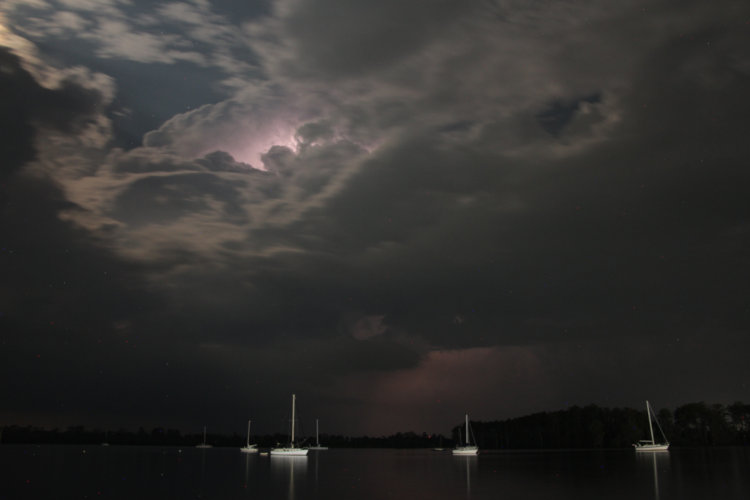
Here we have the waterfront lights illuminating the boats, the trees, and the undersides of the clouds to some extent, while the moon adds a lot of shaping from the upper left, and hidden lighting providing the accents in purple hues – a strike, but deep within the clouds and rain (that haze down near the horizon is rain obscuring the bolt that might have been visible down there otherwise.)
I’ve said before, lightning strikes follow a surprisingly regular ‘schedule’: you can actually count off the seconds between strikes and use this as a rough guideline of when the next will occur. It’s not precise, and exposures should be started well in advance, nor is it a guarantee that the strike will be visible or impressive – actually, in my experience, strikes seem to alternate weak and strong. The other problem with this technique is, it seems to apply for a single thunderhead, so if you have two or more in the immediate vicinity, your timing can be confused between them. Plus of course, it lasts for a couple of minutes at best before the cell shifts and/or dies out.
To give an example, I made an animated gif (pronounced, “JIM-oh-thee“) of nineteen successive frames, including the one above, all about eight seconds in exposure time, showing the activity in this particular head and how the clouds were moving.
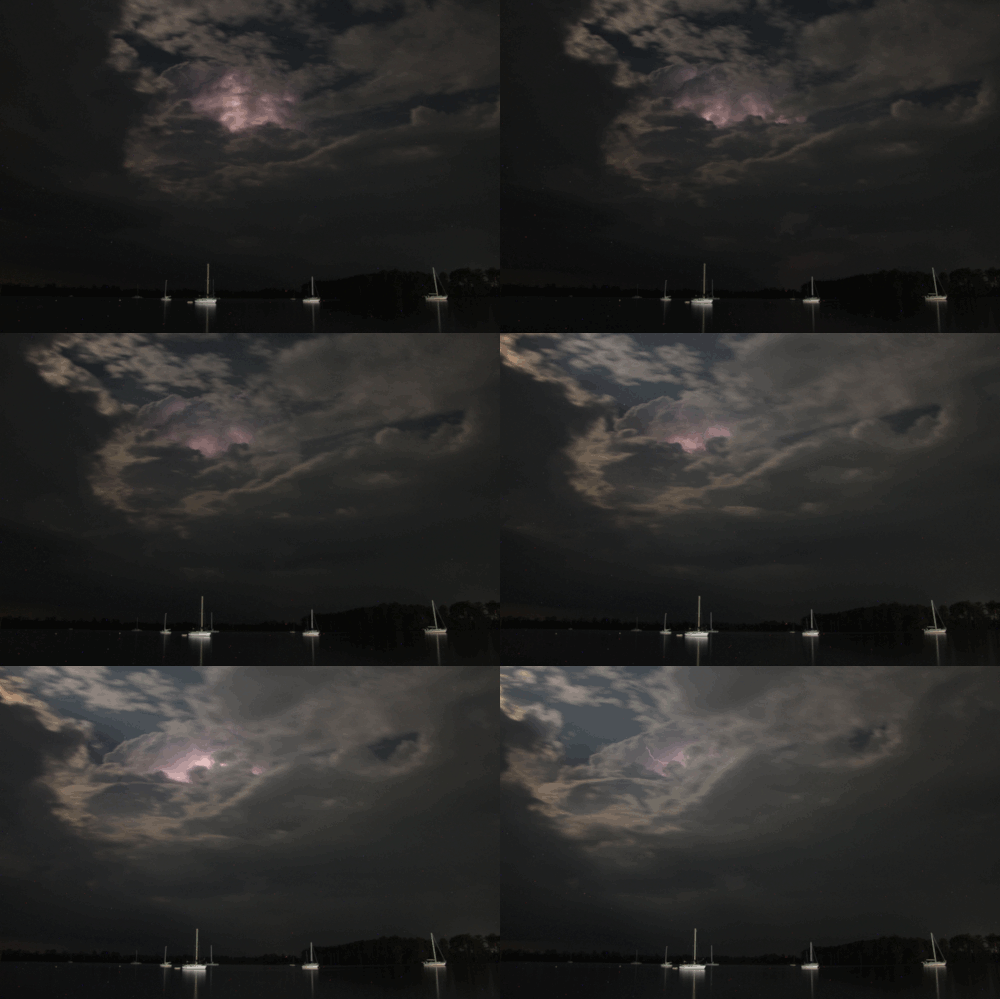
All told, that was a mere two-and-a-half minutes of activity – the clouds were moving that much, but also interesting is how one of the boats is drifting at anchor under the breeze. But yes, this is an exceptionally active cell to have lightning bursts in every frame, especially for exposures that brief.
What? You think I was going to let that one visible bolt just slide on by like that? For shame…
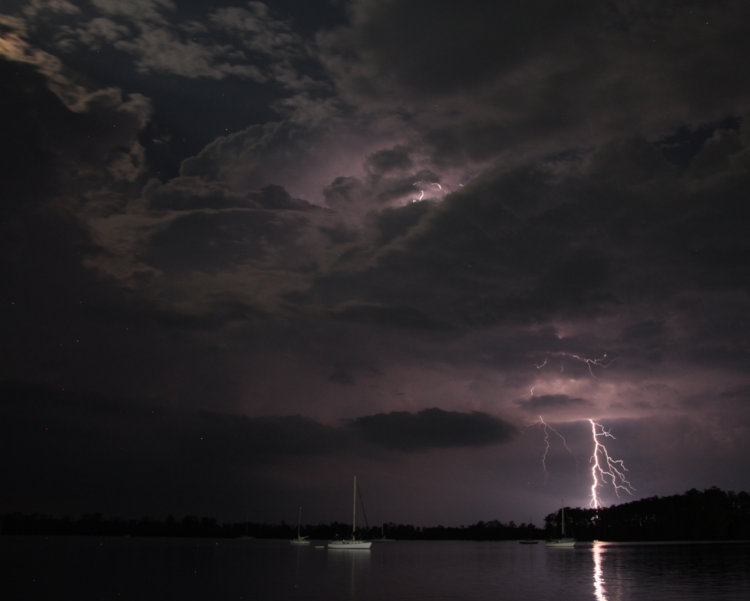
Actually, this exposure was only two seconds, since almost as soon as I opened the shutter the strike occurred, and I closed the shutter again to help reduce the cloud blurring. This meant it was noticeably darker when lined up in the gif, so I brightened it within the sequence, but left it as-is here.
By the way, nothing you see here is “on” the river – all strikes were kilometers distant, the vast majority not even producing thunder, and those few exceptions revealed from the time delay that they weren’t within five kilometers of me. And while, again, there were countless cells producing lightning, most of my decent captures aligned straight out like this. And I got plenty last night/this morning.
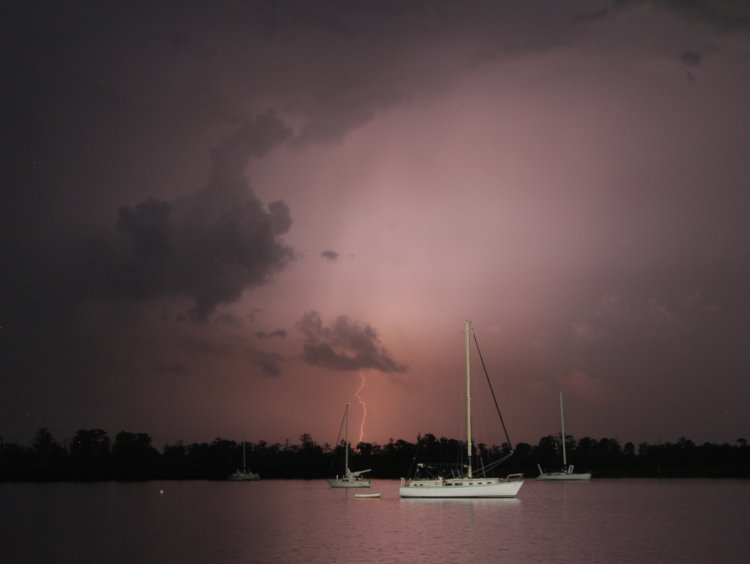
Distant and partially obscured by rain, but I like the color palette and the clouds. You know me: we’re building here.
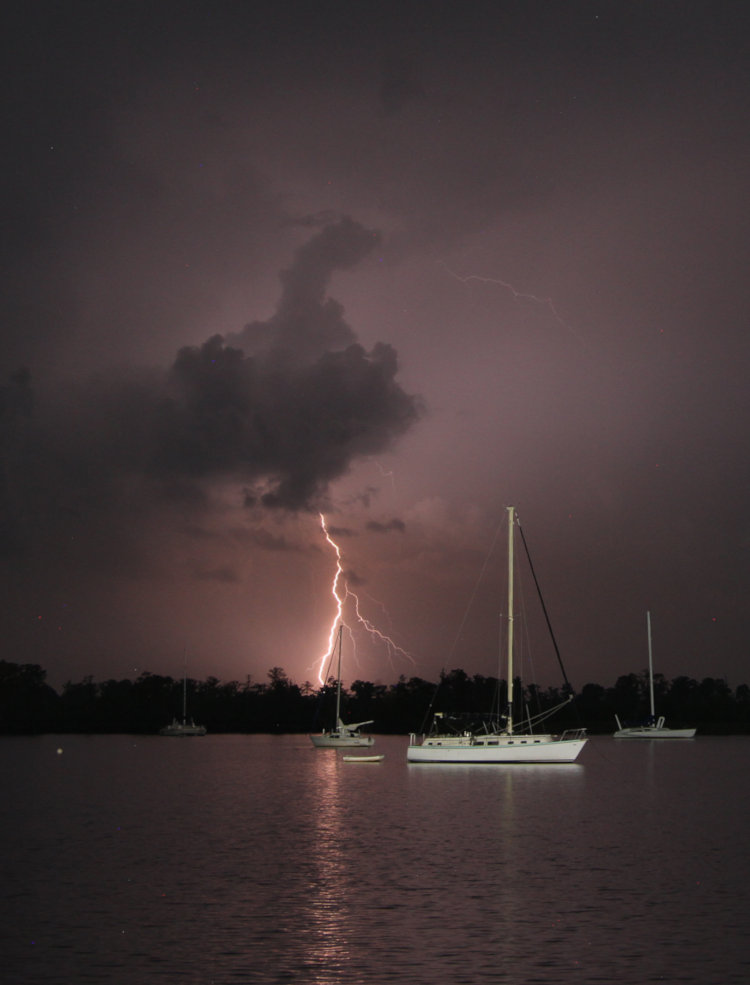
Yep, that same cloud – this was a little before of course, but a nice little branch. Notice the threads barely visible much higher in the clouds.
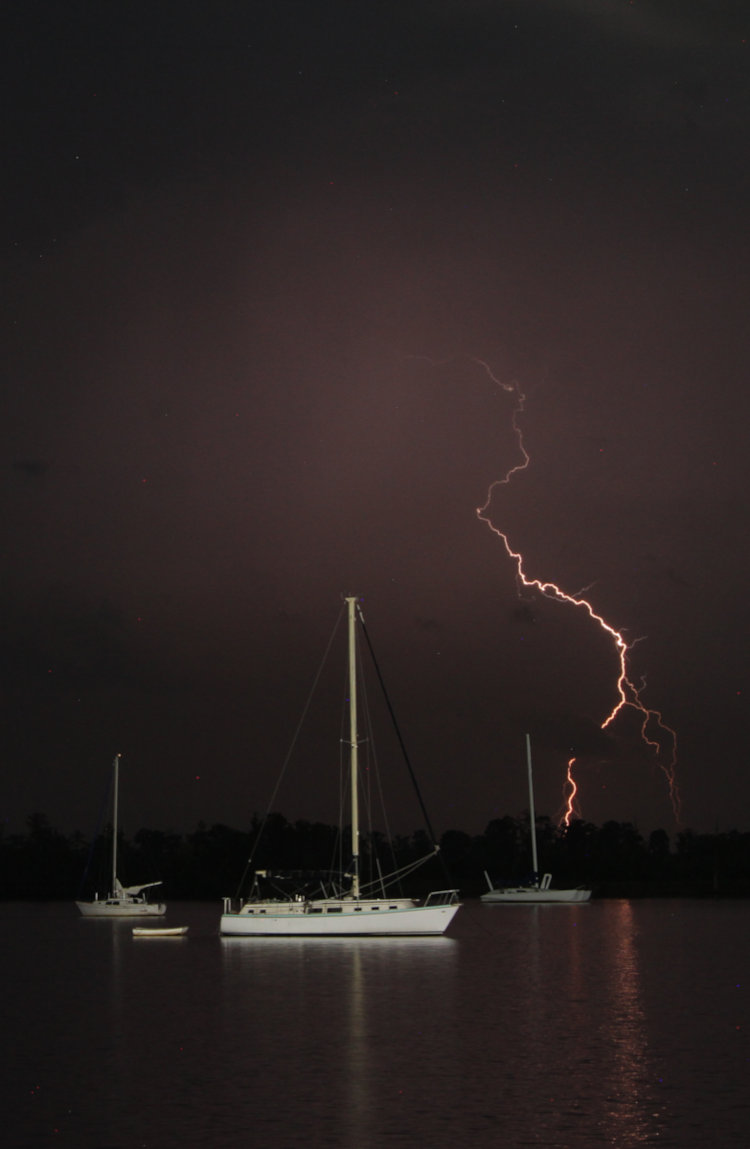
There we go – that’s the expressive print. Having the bolt appear in the right place in the frame is, of course, almost entirely random – you can occasionally shift position to try and compose an image, but that’s assuming (rashly) that the lightning will continue to be active in the same reasonably precise location. So a composition like this is mere luck – well, coupled with the patience and willingness to be out there firing off frames (my count for the night was over 300.)
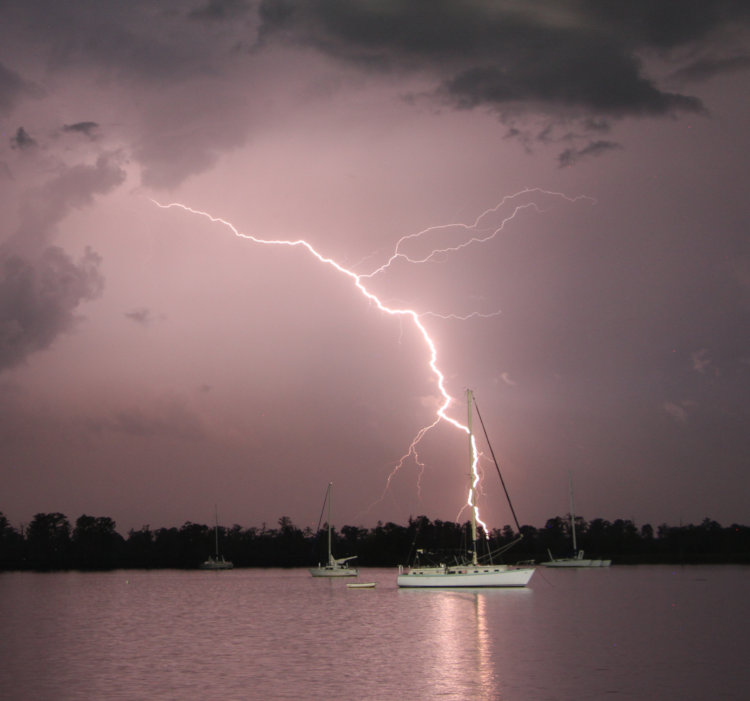
And this is where it doesn’t quite work; the bolt and mast overlapping almost confuses things – a shame, because the light was great with a good reflection in the water. If it had just moved over to the left a tad, like just between the masts of the two boats.
But then we have my favorite from the night, I think:
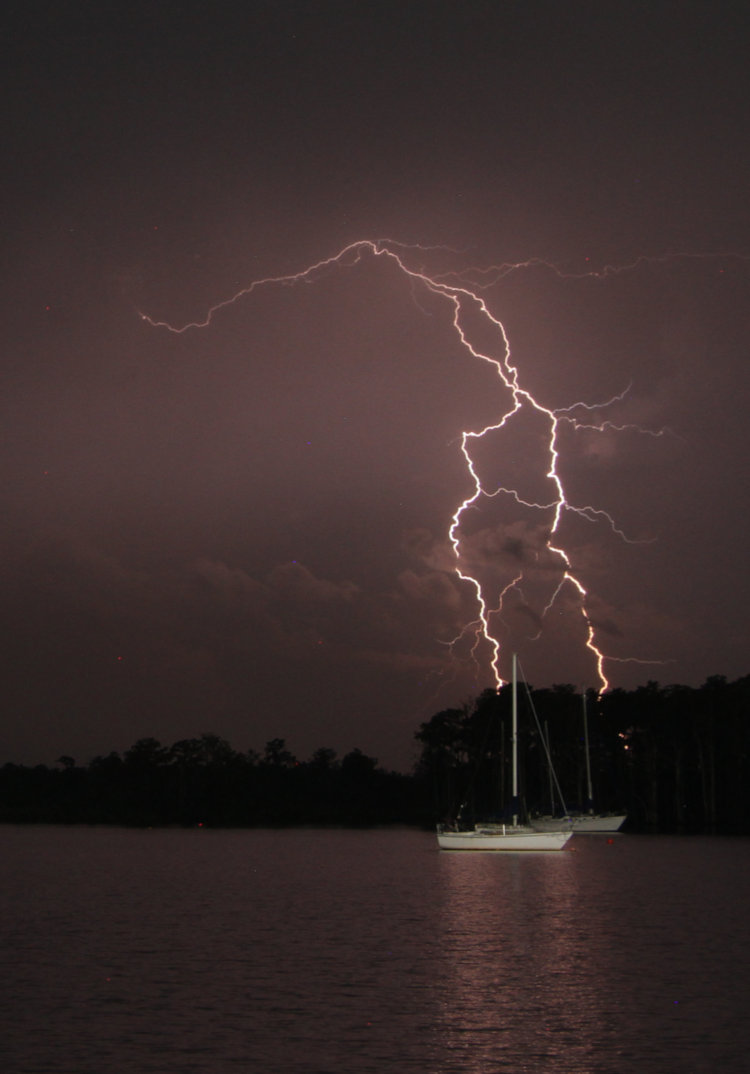
While looking forked at first glance, I’m almost certain this is a double-discharge, no connection between them, though they were certainly simultaneous. And lined up outside the two masts like that, just pointing to the sailboats – excellent! A little cloud detail way back there, someone cowering on the deck of the closest sailboat… no, okay, maybe that’s my imagination. Like I said, it was a gorgeous night to be out, and I feel sorry if any of the occupants of these boats slept through this.
I did another animated gif (pronounced, “GEE-dee-maw-pa-SONT“) showing the progression of the clouds and the moonbeams:
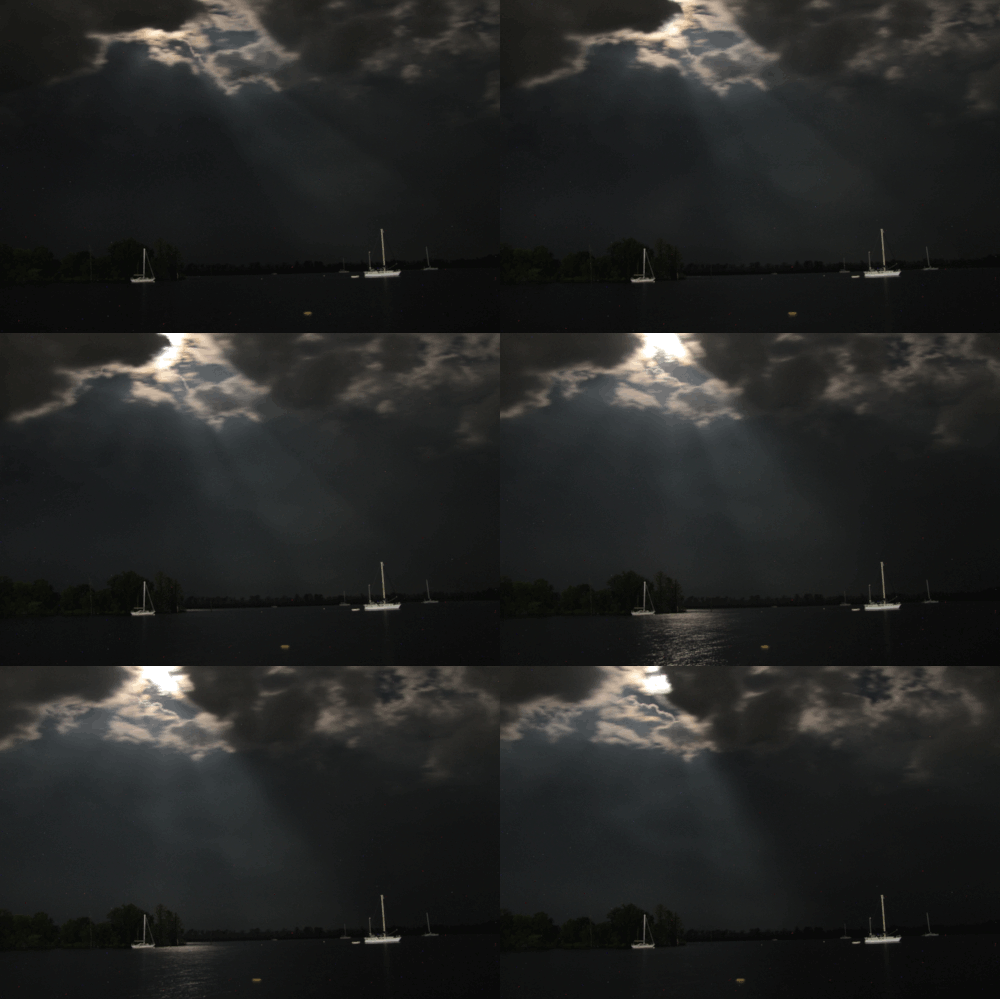
Nine frames, this time just the barest hint of activity back in there – a significant amount of the frames I took captured nothing, which is the way it goes. If you get one good frame, it’s worth it, and this storm produced several, so I’m caught up for a bit.
This took place in just under a minute, each a five-second exposure, and the moonbeams really were visible to the naked eye. I was just about to try and frame for the moon on the water, but I was still watching for visible lightning – I can do the moon on the water anytime (including as I’m writing this.) I did manage the moon and lightning composition that I was out there for – kinda.
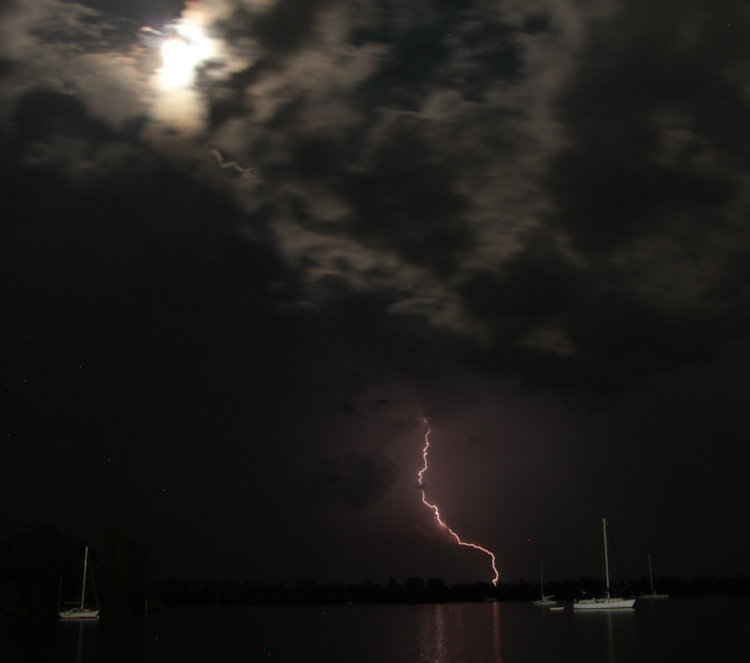
As you can see, the moon got bleached out and semi-obscured by the clouds, also bleached out, so not what I was trying for. It would have been better if the moon was lower too, so there wasn’t quite as much separation between them, but you take what comes along. Painters can do what they like – us photographers have to work with the hand we’re dealt.
One last one, among the last for the night.
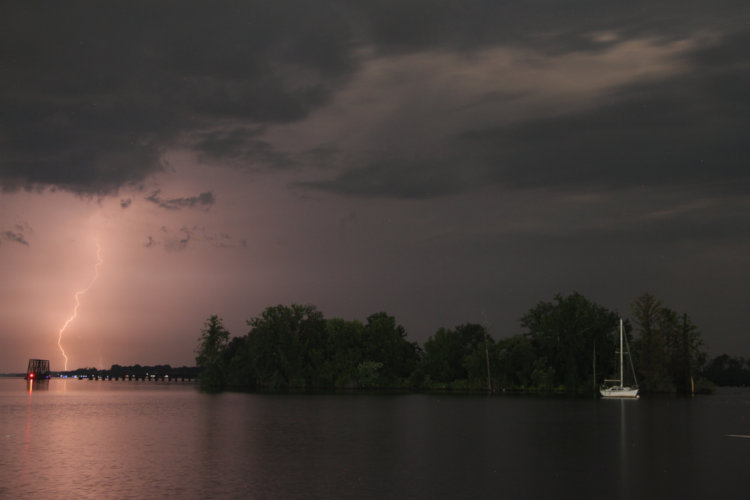
This is roughly 90° to the left of the others, downriver to the east instead of across it to the south. As I said, there were numerous cells in multiple directions, and I didn’t realize until I got back and unloaded that the vast majority of visible bolts that I captured were all in the same direction – it wasn’t through a lack of redirecting the camera, and at one point, I was literally alternating exposures between two different directions, rotating it on the pan axis of the tripod, but this failed to capture the activity I’d been seeing. And yes, there were more than a few brilliant strikes that I missed, which is the way it goes – annoying, especially when your hand is on the remote release about to trip the shutter, but what can you do? Barely any lingering, flickering bolts either – these were nearly all millisecond strikes.
Soon after this, knowing the cells in view were dying out, I was trying for one last visible bolt when I heard the hiss upriver, growing stronger. I’ve heard that before, and knew what it was: a downpour rapidly heading my way. I quickly shut down and stowed the camera in the bag (treated with waterproofing spray for exactly these conditions,) and was breaking down the tripod on the way back to the car when it hit. I got absolutely soaked in the thirty seconds remaining before I got within, but it wasn’t the first time, and I consider that the tradeoff. It was a good night overall.