
I can talk the, um, mouth sounds, but can I stroll the amble? Well, kinda…
I did indeed get out early this morning in pursuit of Jupiter and the moon and all that, but I never had time to get the telescope up to speed, between two days of rain/overcast and being gone all day yesterday, too exhausted after that to start driving my frustration up with the ‘scope. So I simply went out at 4AM with the long lens and 2x teleconverter and had a go.
Trees shrouded the moon from clear view at Walkabout Estates, so I went a few kilometers away to a clear sky location, and thankfully had those clear skies. I also had low-lying fog, which might have affected things slightly, but not terribly. Here’s the initial shot as Jupiter approached the moon, or the moon approached Jupiter, or the Earth started to align with the other two – take your pick.
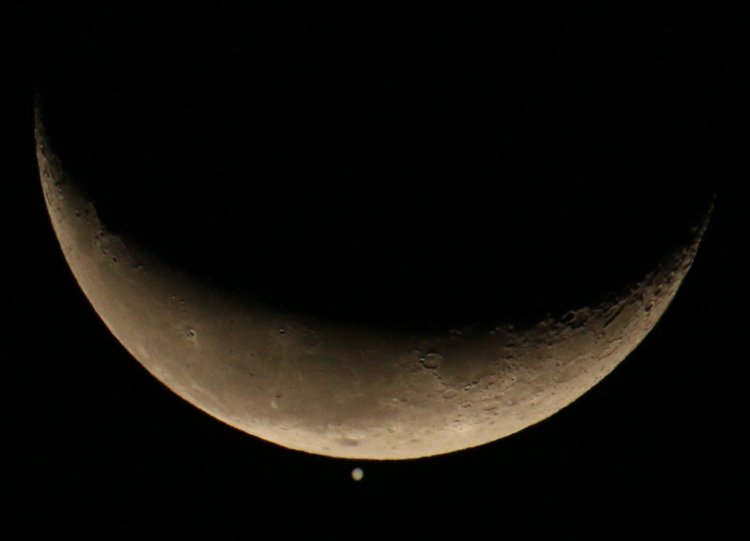
This is at 600mm, before affixing the teleconverter, but the crescent moon was dim enough that the exposure for both was in alignment – no Galilean moons visible at this exposure, though. Having learned my lesson on previous astronomical subjects, I was using the extra stabilizing arm to help quench vibration, as well as using mirror lock-up to let things die down before the shutter opened. Then I made the mistake of trying to attach the teleconverter right here, to catch Jupiter as it disappeared, but the fumbling with that in the dark and the stabilizing arm being fussy and not letting me re-aim effectively caused me to miss the disappearance.
Then it was hang around for an hour, wasting time until the reappearance was to commence, primarily playing Sudoku on the smutphone and poking around by the headlamp. As the time drew near, I started test shots to gauge exposure and watch for the first appearance of Europa, which would be leading the pack. I saw it in an exposure, earlier than expected and a little dim, quickly followed by brighter Callisto. Eventually I realized it was too early, and I was photographing two stars instead, especially when Io did not follow right behind. A few minutes later Europa did indeed make its appearance.
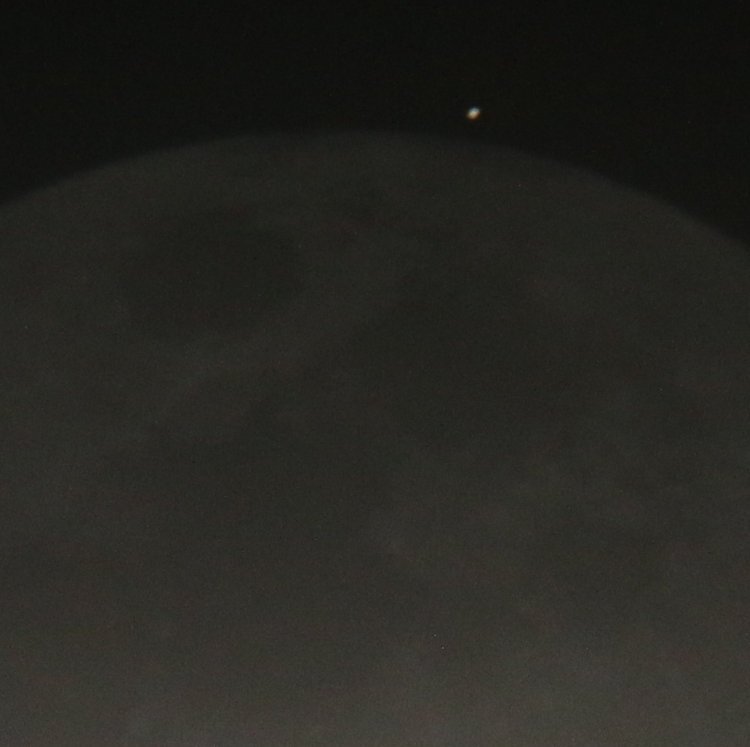
Yeah, this is crap, but c’mon, it’s one of the moons of Jupiter picked out by a telephoto lens and not a proper telescope. The teleconverter reduced light passing through by two stops as well, so this was at ISO 1600, f6.3 (maximum available,) and 0.8 seconds shutter speed, trying to reduce motion as much as possible. I was getting the earthshine on the dark side of the moon though, enough to pick out Mare Crisium to upper left (remember, the moon is not long after rising so it’s rotated counter-clockwise from ‘upright’ and all illustrations.) You can see that Europa is moving a little even at 0.8 seconds.
Then Callisto and Io followed – this is 3 minutes 32 seconds later, to give an idea of their motion:
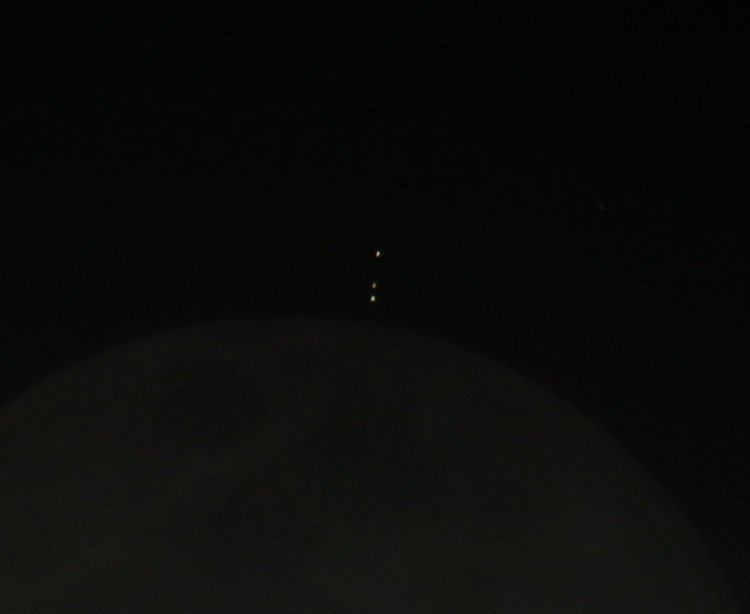
Nicely lined up, so no mistaking them this time – though if you look very closely, well to the right and just a little above them, you can barely see one of the stars that I mistook for the moons. I’d adjusted exposure to as minimal as I could and still get these, and that all but eradicated the star.
And then a fourth, marred by camera shake – I probably jumped the gun after locking up the mirror:
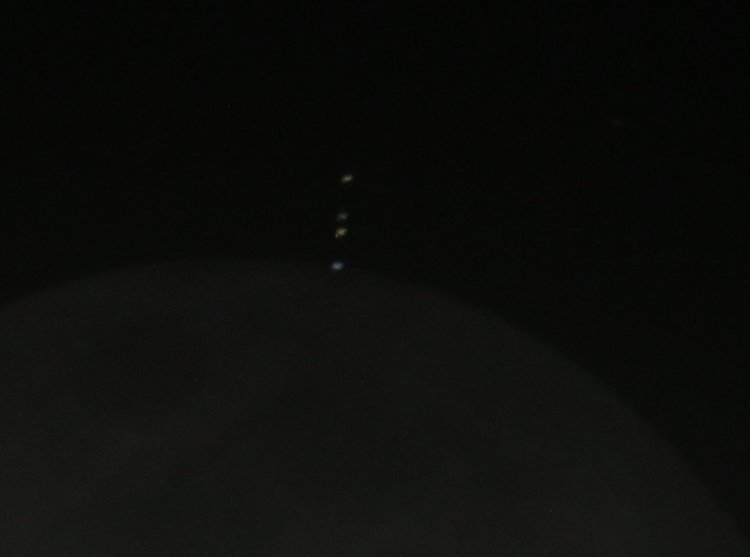
Wait a second – I thought Ganymede was following Jupiter at this time. Did they switch places while behind the moon?
No, of course not – it was the very first glimmer of Jupiter itself, so my timing was halfway decent for once.
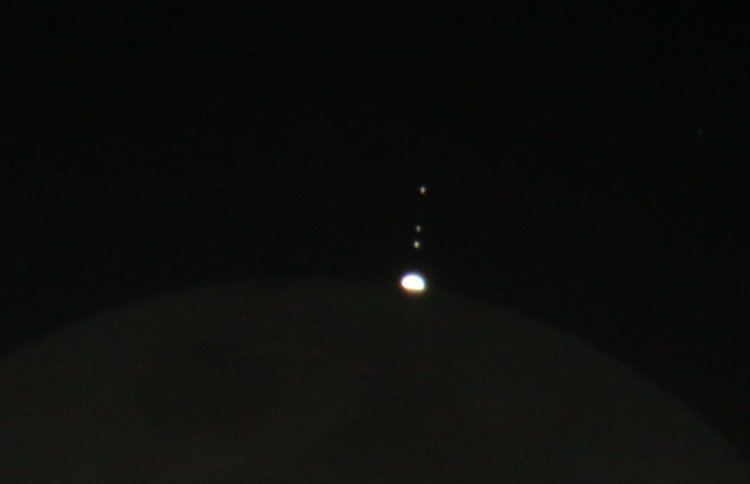
Now we get to see the exposure difference between Jupiter and its moons. While I doubt a telescope would help resolve them all at once with better exposure, the one thing it would do is reduce the glare significantly, because that’s mainly caused by light scatter from the lenses and the ‘scope doesn’t actually have any – just the main mirror. Well, normally, it does in the eyepieces, but if I had a camera attached, no eyepiece would be present.
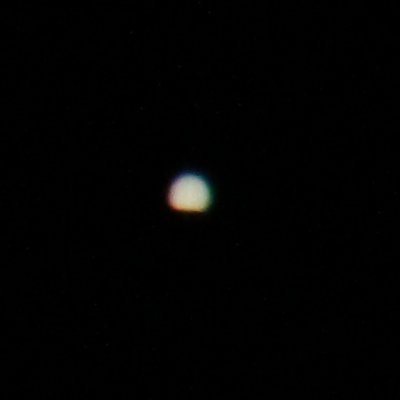 Here we have a full-resolution crop of Jupiter, with the exposure set to show just the faintest vestiges of the stripes. You’ll notice that this, and other images, have color fringing – reddish on the left and greenish on the right – and I suspect this is from the teleconverter, but it could be from the lens, or the combination. This is the other thing that the ‘scope should eliminate, because again, it’s a lens artifact – but then I’d have to make sure the thing was collimated correctly and hadn’t undergone a shift from being out in the chill air so long. The fog was still present, and all of the equipment had a light coating of moisture on it, enough that I had to take the camera and lenses out when I got home and let them dry thoroughly. I expected that from the metal tripod, but even the long lenshood, thin plastic as it is, was coated.
But yes, I’d like to get a much better view of the planets than this. Working on it, albeit glacially.
And now, a shameless editing job. I took all of the moons, and overlaid them with Jupiter and the sky from a shorter, dimmer exposure to cut the glare and noise/grain to show detail better:
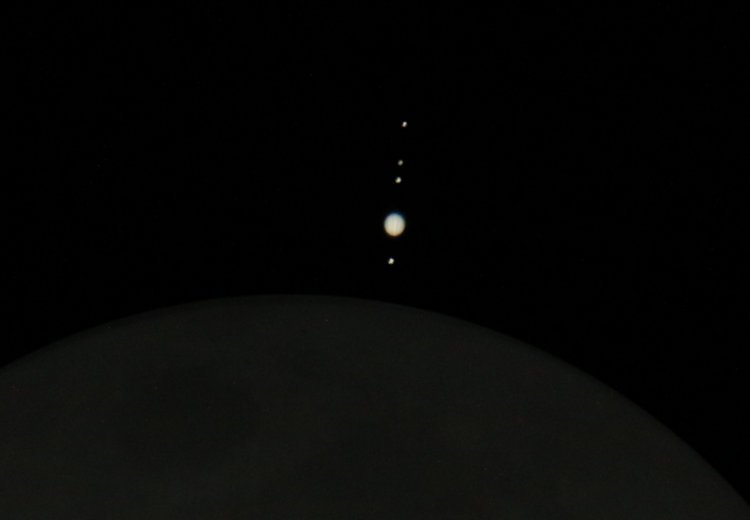
So you know, all of the moons (including ours, the big one) were shot at 0.4 seconds, f6.3, ISO 1600, while Jupiter itself was at 1/160 second, same f-stop and ISO – that’s six full stops dimmer, or 1/64th the amount of light. That exposure eliminated all of the moons from the image, though if I’d framed to catch the crescent side (which I was avoiding because that glare could spread throughout the frame,) it would have shown fairly well.
Also, this image was five minutes, sixteen seconds after the first glimmer of Jupiter, and nine minutes, three seconds after the image of Europa further up. Within that period, the aim was adjusted numerous times since they all would have left the frame if I hadn’t, and I was still trying to keep as much of the crescent edge out of the images as possible. Video through the Canon 70D and long lens would have resolved little, the shutter speed at 30 frames a second too short to capture much, but with a dedicated telescope camera it might have been worth it.
While out there, I did a few frames of the night sky before I wrapped up.
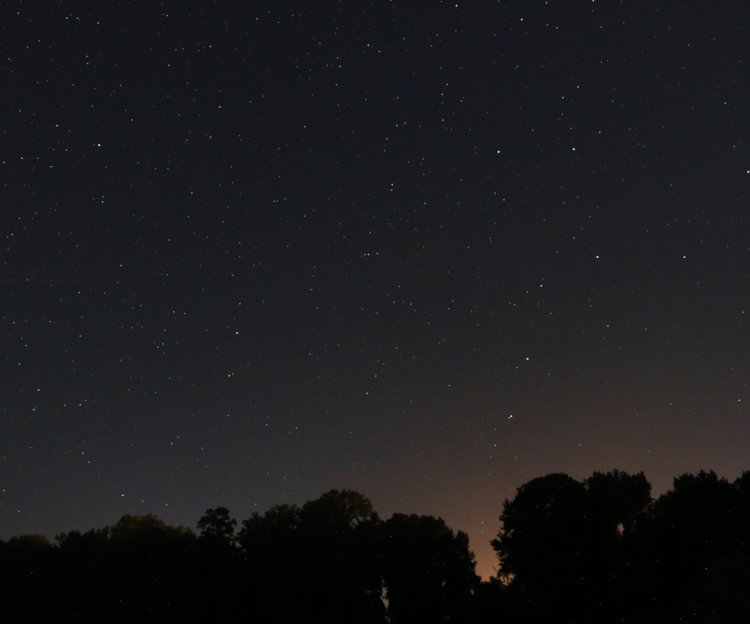
This is now with the 18-135 at 18mm, 20 seconds at f5.6, ISO 1600. Just above that gap in the trees is Ursa Major, or the Big Dipper, and that points over to Polaris, the brightest star at upper left. With the exception of shooting close to the horizon, that makes this a decent place to do telescope tests because, unlike Walkabout Estates, I can actually orient with Polaris for proper tracking. It’s also only a few kilometers away, so not hard to get to, and totally undisturbed. The horizon glow here is from a nearby business, but in several directions comes the glow from residual city lights.
Another, this one longer:
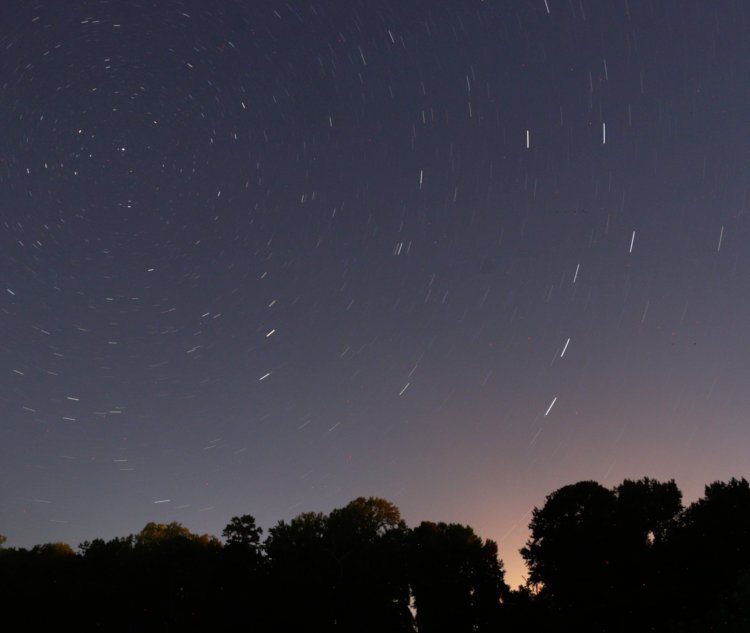
Ten minute exposure this time, f9, ISO 400 – otherwise it would have been far too bright. All the arcs are from the earth rotating, but Polaris sits almost exactly above the celestial north pole and axis of rotation, and to have a telescope track properly, the motorized axis has to align with this too and turn in the opposite direction – then, the sky doesn’t appear to move. That’s the goal, anyway – keep hounding me to make it happen.
Yesterday’s tasks also included getting a few photos, plus I had a number backlogged already, so more is on the way.