
Okay, first off, I apologize to those whose attention span will not be able to handle a 45 minute video – I know, this is the internet, the TL;DR Channel, where three minutes is a chore. Chill out, get a Pepsi or some tea, and stay on the same page for a bit (it’ll make me happier when looking at the site stats, too.)
Second, I’m really sorry they didn’t do this sooner, before the space shuttle orbiter was scheduled for retirement, because it adds a lot more interesting detail to the whole launch process. What I’m featuring here is a collection of clips during a couple of shuttle launches, taken by some of the 125+ cameras that keep track of various factors from very distinct vantage points, most of them at high-speed frame rates which provide excellent detail. You can watch the main engines ignite from front row, and actually see the explosive bolts that hold the solid rocket boosters in place on the pad fire off and release. And throughout it all are quite a few details about the cameras themselves and how they operate. Below, I include a short glossary of the abbreviations used by the narrators.
My one regret is that they didn’t either rehearse (and perhaps edit) the voice-overs, or perhaps obtain some professional voice actors. While it means a lot to have two NASA engineers explaining everything we can see, it comes off a tad unpolished. Still, I think most viewers can handle the video without the need for some infomercial-style enthusing.
Also note, there’s an HD version out there, but I had several issues with it pegging out, so I’m featuring the lower-res version here.
Glossary of abbreviations
FSS – Fixed Service Structure (“launch tower”)
KTM – Kineto Tracking Mount (great pic here)
LCC – Launch Control Complex (“mission control”)
MLP – Mobile Launcher Platform
RCS – Reaction Control System (maneuvering rockets)
SSME – Space Shuttle Main Engines
SRB – Solid Rocket Booster
TSM – Tail Service Mast
Here’s a couple of little bits of trivia. Throughout the video, you’ll notice the extensive use of water, not for cooling and protecting the launch area as one might expect, but for “sound suppression.” The thrust of the engines and boosters hitting the launch platform can actually send shock waves back up to the vehicle, potentially damaging it, so the water serves to dissipate the worst effects of the thrust. Also, note that when you see a launch producing huge gouts of smoke, bear in mind that the white clouds are not smoke, but steam (okay, pedants, water vapor) from this suppression system. The SRBs produce grey smoke, and the SSMEs produce none at all.
Also, the entire launch vehicle of shuttle, external tank, and solid rocket boosters are attached to the MLP (and transported) by just four bolts on the bottom of each SRB, the ones you see separating by small explosions as the boosters ignite. They boosters are placed onto the platform first and bolted down, then the external tank fitted between them, and the shuttle orbiter attached to that. The solid boosters are the only things not actually empty when this takes place – all other fueling and payload placement occurs after the launch platform has reached the FSS on the pad. For years, I thought the Tail Service Masts, those big blocks that sit at the base of the orbiter’s wings, served to hold the orbiter in place since it was so offset from the apparent center of gravity, but all they do is provide propellent and electrical connections to the SSMEs and RCS.
In the video, they mention the long-distance camera tracking stations situated miles away from the launch pad. When I lived in Florida, I was aware of one of them to the south, next to Patrick Air Force Base, so I went looking for the one to the north. Near as I can tell, it can be found by putting “28.702876 N 80.668605 W” into Google Maps, Bing, whatever. Thy look like miniature observatory domes. The one near Patrick is at “28.227168 N 80.599659 W”. Somewhere south of Cocoa is another, abandoned one that I have to try and find again.

By the way, the Fixed Service Structures on pads 39-A and 39-B, seen here in a pic from the wildlife refuge north of the Cape in 2004, are gone now, dismantled to be replaced by structures dedicated to the new Space Launch System, not unlike the old Saturn V system that carried astronauts to the moon (and Skylab into Low Earth Orbit.) And the Vehicle Assembly Building is going through a major overhaul inside for the same purpose – try to imagine that task. But if you really want something to imagine, there’s this:

Can you make out those faint wires stretching across the frame from the FSS? (Gimme a break – I was 3.5 kilometers away.) Those are one of the many crew escape options for shuttle launches. In the event that the crew could egress the shuttle by gantry but the FSS was compromised, for instance by a ground fire, they would have jumped into little baskets attached to those wires and slid down to the ground, whereupon they could then enter some modified M113 Armored Personnel Carriers and tool their way to safety (probably after pulling some donuts and trying to find an abandoned car to run over.) But hey, you don’t have to imagine it, because NASA was kind enough to take excellent video of the final release of these escape baskets. Trust me, I was grinning stupidly for the second half of this:
Yes, that’s the VAB you can see in the distance. Many thanks to NASA for such great perspectives!
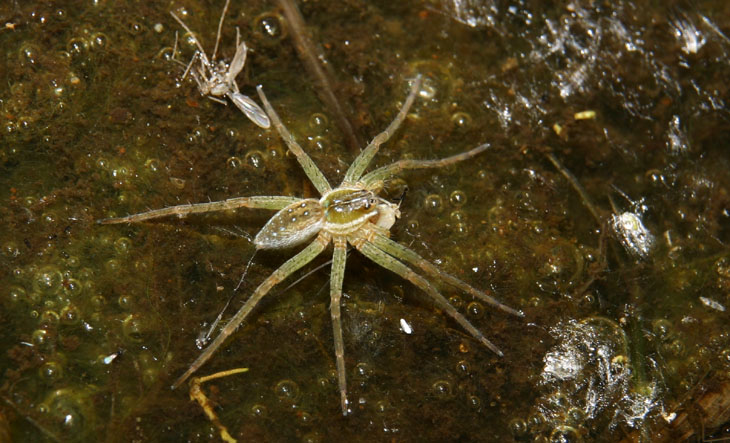
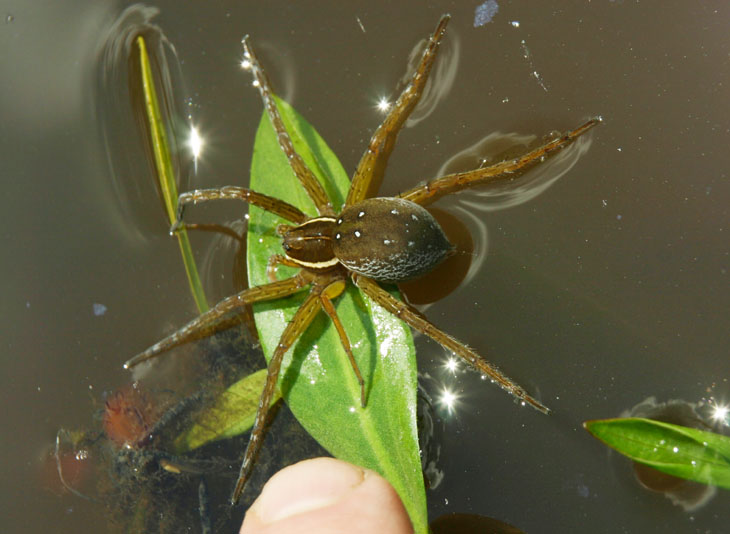
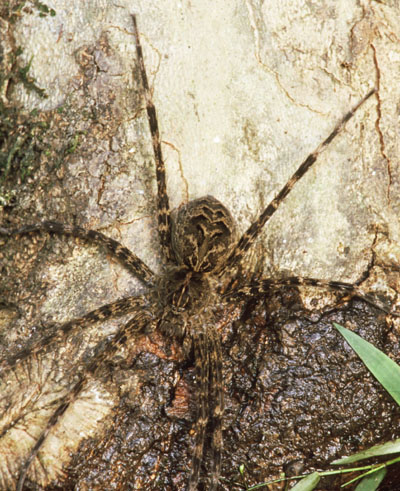 My first photo sale was of both a fishing spider and water striders, for an article in a water gardening magazine. The spider image, shown at right, was printed full page because, I’m guessing, they had too many readers. This is an example of one of the largest species, and almost certainly the largest species found in North Carolina – this one easily spanned my entire hand across the legs, tip to tip. They don’t spin webs, but instead capture their food by stalking like the various wolf spiders. In the case of the Dolomedes genus, they lie in wait on the edges of ponds and rivers, forelegs often resting on the water, and dart off across the water when an insect inadvertently splashes down, occasionally dining on small minnows and frogs as well. I suspect they also watch for species that hatch from an aquatic larval stage into a flying adult, emerging unprepared from beneath the surface.