But this one did

Not every project that I tackle comes to fruition, and I’m forced to abandon more than a couple (like the tracking motor to use with the eclipse, for instance.) But, as the title says, this one did.

For the record (Hah! I keel me!) this was the previous incarnation of it mentioned within the video. But here’s what I was dealing with this time around:

I have a decent audio recorder, and a decent lapel microphone. But the mic is intended for use with smutphones, and so has the quad-pole connector that those use, which allows for earphones and phone controls. This does not play well with the audio recorder designed before those were in constant use – that instead wants a tri-pole connector (stereo.)

I still have the little microphone seen in that linked post, but its audio quality is not very good and produced too much residual noise, more than I really wanted to edit out (especially since, with ongoing ambient sounds, there was no way to record a patch of ‘silence’ as a baseline to subtract this residual noise.)

So I switched to using the nice lapel mic with the smutphone as a recorder, but then went through three different audio recording apps before settling on the fourth, since the others wanted to do their own thing with auto-levels, essentially deciding what the base volume (okay, gain) should be. This produced some really terrible effects, given that the ambient sounds could get quite loud, especially in the height of cicada season, and quite variable, with the goddamn traffic too close by. What this produces is a lot of warbling and vague underwater-like sounds, very unrealistic and distracting.

Those ambient sounds were quite a chore in themselves, since at times the cicadas really started winding up, and diesel trucks were passing, and so on. The day I chose for the video above was the quietest of all my attempts, and you can hear how un-quiet it really was.

And then, once I got decent audio, it was time to synchronize it with the video – which came with its own audio track that was quite useful in itself, though it captured absolutely none of the nest sounds. Meanwhile, the nest mic captured too little of the ambient sounds, making the adults seem incredibly distant. That’s what they’re made for of course, to record the wearer and not everyone else, but it did mean that I wanted to keep both audio tracks.

Since I simply set the smutphone to record in its position underneath the nest and left it there, it produced one long recording track, while I was able to start and stop the video camera as appropriate to the action and lack thereof. This meant that I had four video tracks of two to five minutes and one audio that was eighteen minutes long, with ambient noise none too distinguishable throughout. You know those little clappers that you see right before they shoot a movie scene? That’s what those are for: syncing separate video and audio tracks. Without such a thing, I was forced to sync them by finding unique sound fragments that appeared in both recordings, such as some other birds and distinctive passing vehicles. Note, however, that these largely had to be down to fractions of a second, or curious ‘echoes’ would be produced by the sounds that carried onto both tracks but weren’t perfectly aligned. There may be methods to jog the track alignments by milliseconds in the editing program that I used, but if so, I didn’t know where it was, so I was doing it by twitching the mouse – a bit tedious.

screenshot of Kdenlive editing program showing the subject video
Once these were aligned, then I had to trim them down, ensuring that all tracks were cut in the same place and stayed aligned. Add in selecting the right gain for each (boosting the nest audio slightly, reducing the videocamera’s by an almost-equal amount.) Once satisfied with the running edit, then I had to record the voiceover track on another program while watching the video, clean that up, insert it into the video editing program, and then play with the gain and synchronization on that. Oh, yeah, and add in the title and close images.

And then, upload it to Vimeo and do all the little doodads that that requires. This means a five-minute video can take several hours to get together – be nice if it better reflected all this effort, right? Keep your commentary to yourself.

So while I like including video and know that this comes with its own learning curve, sometimes this drags on a bit, you know?

* * *

For the record, I am presently using Kdenlive for the video editing, and Audacity for the audio – both extremely capable programs for completely free software. For the nest recording, this was through ASR Voice Recorder from the Google Play Store (yes, Android.) But I also can’t stress enough how much easier it is when your microphones are decent. The lapel mic was a solid find from some generic source, far less expensive that its capability reflects, while the main recording mic on the desk (voiceovers and podcasts) is a Samson G-Track – expensive, but I picked it up used and it’s been superb.

Some isolated birds

male boat-tailed grackle Quiscalus major showing plumage in muted light
For this post, we’ll hit a handful of scattered birds captured during the beach trip, some of which I’d hoped to snag a wider variety of frames, but it was not to be. Above, however, we have a male boat-tailed grackle (Quiscalus major,) which were impossible to avoid, yet I wasn’t all that interested in capturing their behavior, but the muted light from the crummy weather at least showed the variety of feathers in their plumage, where they often just look black. Boat-tailed grackles are talkative birds with a wide repertoire, some of which you may hear in later video clips. At this time, alas, I did not have recording equipment with me, so when he voiced his soliloquy below, all I could do was capture still photos.

male boat-tailed grackle Quiscalus major in mid-call
While a lot of people consider grackles to be pests, I find their calls to be far more interesting than most birds, and not as raucous as some of their relatives, but I’ll admit they’re a bit domineering in their territories. We don’t have them where I live in central NC, so I only see them at the beach or in Florida (where they have dark eyes instead.)

Below, one was foraging in a tidal pool at sunrise, captured as I was pursuing other species in the same pool, but I liked the droplets as it withdrew its beak from the water while backlit.

male boat-tailed grackle Quiscalus major splashing in a tidal pool at sunrise
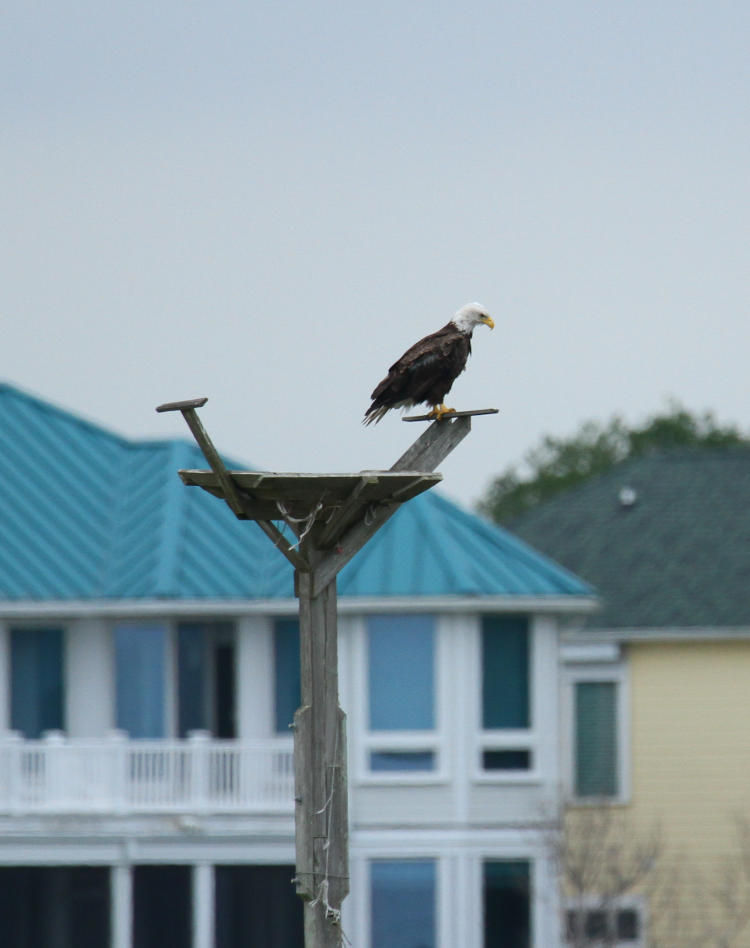
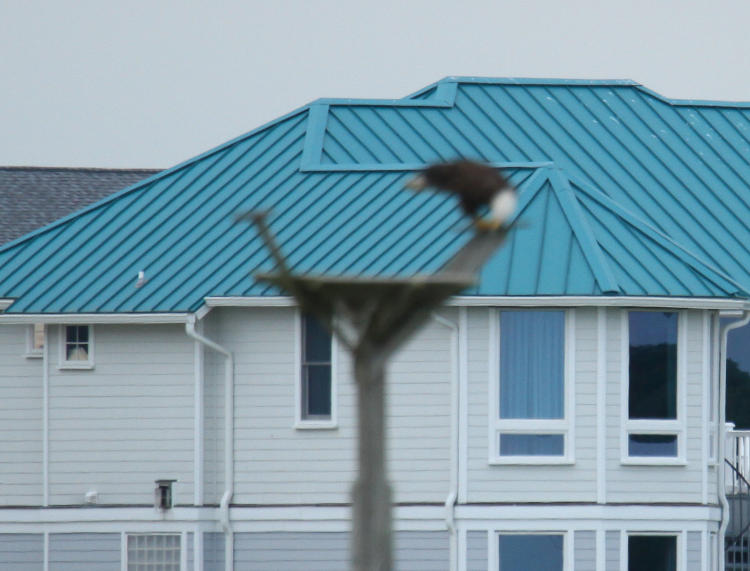
The osprey nest that we observed during previous visits was gone this year, the platform provided for them completely bare, even though osprey were active in the area. At different times, we observed a bald eagle (Haliaeetus luecocephalus) using it as an eating and spotting perch to monitor the waters below.

adult bald eagle Haliaeetus leucocephalus perched on osprey platform over sound
Seen from shore, the platform was over 200 meters off, so tight closeups were out of the question. Once, the eagle was present as we were putting the kayaks in, and we made the attempt to get in a bit closer, fostered a bit by the neighbor’s shot of an eagle in a tree taken from their phone, which likely required quite a close approach. That eagle was not this one, apparently, or it recognized us as the shallow touristas that we were, because it took flight before we got within even 75 meters, too far for the waterproof Ricoh to gain any detail.

One evening, the eagle was perched there while I dug out a jellyfish kite, taking it out onto the walkway to the gazebo and dock. I didn’t get much altitude from it in the evening breeze, but the until-then silent eagle began voicing its displeasure over an aerial intruder, which I found fascinating. I mean, I was way off, and nowhere near getting ‘up in the air,’ yet the orange kite with its trailing tentacles was apparently cause for concern.

But while I’m here, I’ll demonstrate why trusting autofocus for wildlife photography is often a big mistake, or at the very least wasting time and frames:

bald eagle Haliaeetus leucocephalus lost by autofocus
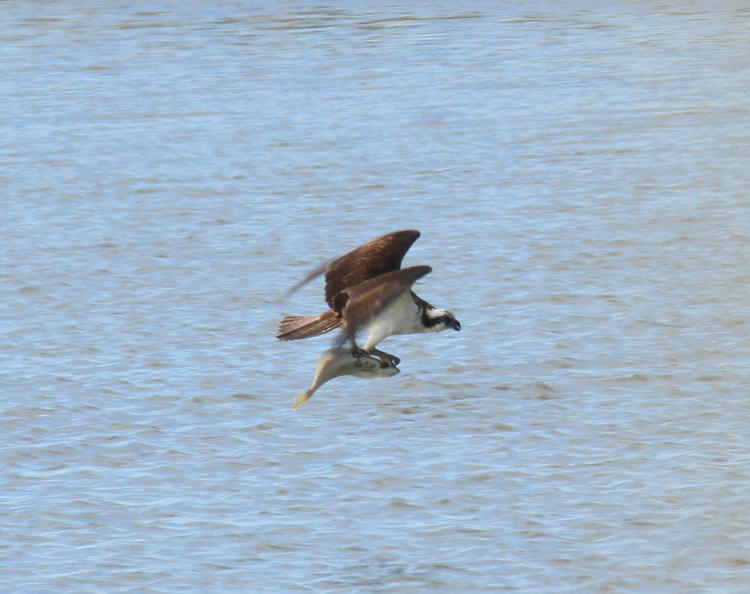
As I said, the osprey (Pandion haliaetus) were present, but not as cooperative, and I wasted numerous frames and a few video clips, both from on land and within the kayak, tracking one as it hunted unsuccessfully above – wheeling, backing, near-hovering, starting a dive but abandoning it almost immediately, and so on. When I finally saw one doing something interesting, it was well over 250 meters off (don’t get the impression I can spit out these distances easily – I used Google Earth to measure them once back home.) This is where trusting manual focus doesn’t always work, either, but autofocus would have kept snagging the changing background, so I was more accurate using manual. Just, not as accurate as I would have liked.

osprey Pandion haliaetus climbing with a large flounder in its talons
This was the sharpest frame, and the prey, it quickly became evident, was a sizable flounder. I really hope there was a nestful of young-uns awaiting this back home, otherwise the bird was in for a tummyache. But let’s back off to the full frame to show what it looked like even at 600mm.

osprey Pandion haliaetus in full frame
That greenish-beige blur is the column supporting the stacked decks that I was shooting from, out the back of the condo; really, a decent observation spot, but only with the long lens or binoculars. We’ll see more from it later on.

And finally, something that I haven’t seen in years, and have yet to get any really nice frames of:

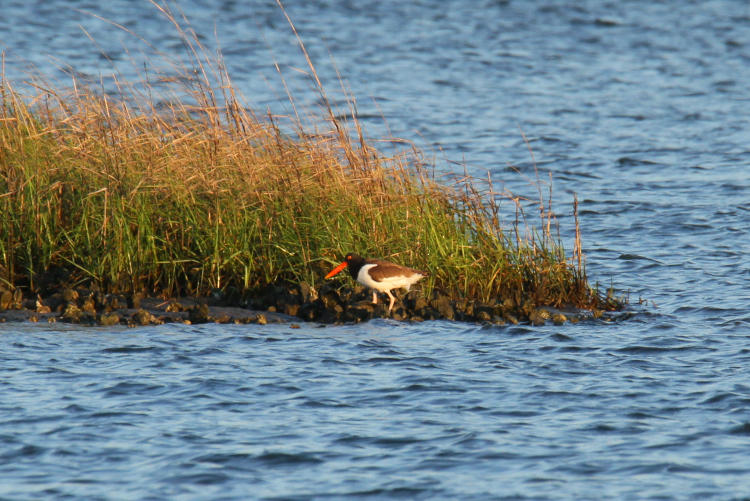
American oystercatcher Haematopus palliatus foraging along tussock island
That’s an American oystercatcher (Haematopus palliatus), which I’ve seen only a handful of times before, and always at a fair distance – not as great as this time, though, because it was about 160 meters off (I’d estimated 100, so we see how good my estimates are.) All I could see by naked eye was a white blob against the tussock island, though, so I’m glad that I decided to get the long lens on it, and at least could show the brilliant red bill and eye. And it’s hunting in a great location, since these many islands in the shallow sound were primarily oyster beds that had collected enough silt and peat to grow grasses and remain just above the tides – in the kayaks, we’d passed numerous semi-exposed oysters during lower tides that were still feeding, squirting little fountains into the air as they expelled the filtered water.

I have plenty more birds to come; these were just the singular captures. We’re whittling them away.

In local news…

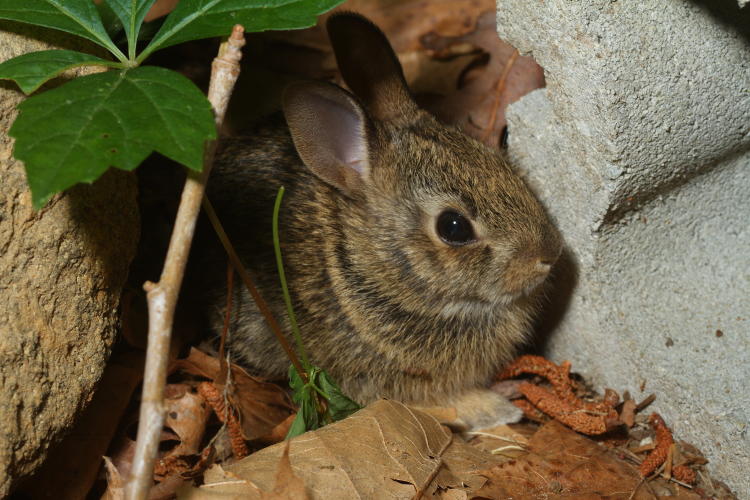
juvenile eastern cottontail Sylvilagus floridanus sitting motionless at night
I finally got out and did a couple of shooting sessions, all local (meaning the front and back yards and the pond nearby,) so I have a few photos to post – no real theme, so these will be all over the place. The most recent is above, a very young eastern cottontail (Sylvilagus floridanus) sitting motionless in the back yard as I did a little nighttime exploring, about an hour ago as I type this initial draft; I hadn’t planned on doing any photography tonight, but this guy made me go in and get the camera. I’d heard a commotion from the neighbor’s yard a bit earlier, something ripping through the leaves, but never spotted anything by flashlight. It was enough noise to sound like squirrels chasing one another, but well after sunset when squirrels aren’t active, and not the sound that deer typically make. I suspected either rabbits in mating/cavorting behavior, or a fox on the chase, and finding this palm-sized spud (and sibling) in the yard not long afterward supports this idea a little – their grass nest may have been disturbed and they scattered. I didn’t heard any squealing, which would have been a definite sign of a fox successfully catching one.

I have to do a brief update on the mantids, of course.

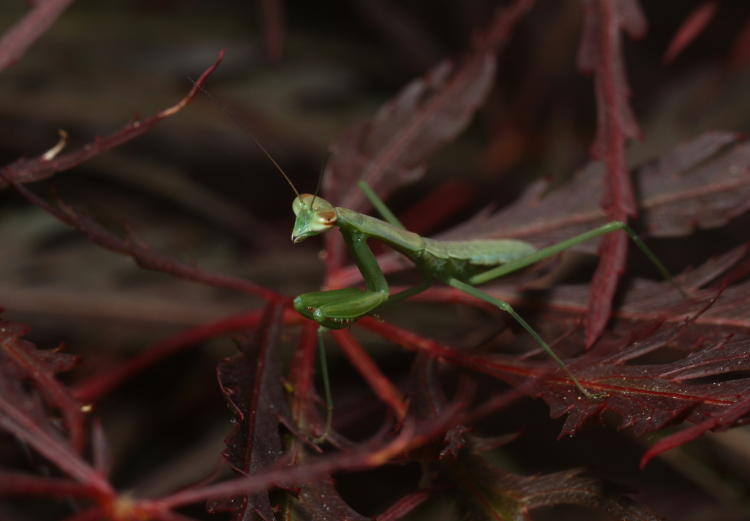
juvenile Chinese mantis Tenodera sinensis on red-brown Japanese maple leaves
I’ve had, like, five hatchings in the yard now, but they’ve largely scattered in all directions; the best I can say is they seem to always like the big Japanese maple near the door, and some of them are presently residing on another in a pot nearby. This one was likely from the last hatching featured, and no more than 15mm in length, so I backed off a bit to do more of a scale and fartsy shot. Nearby, one twice its size and notably green was within easy camera reach.
slightly larger Chinese mantis Tenodera sinensis on Japanese maple
The maple will turn green a little later in the year and the mantids will be able to blend in better then – this kind of reddish-brown is not among their repertoire. One of these days, I’ll either figure out how to tell one specific mantid from another and thus track their coloration changes, or get together a decent terrarium to house a couple within. I think they can only change color between molts, but haven’t confirmed that yet.

If the mantids abandoned the vicinity of their hatchings quickly, the wheel bugs are exactly the opposite.

wheel bug Arilus cristatus egg cluster with hatched wheel bugs still hanging around weeks later
These wheel bugs (Arilus cristatus) hatched six weeks ago, and every time I’ve checked there’s been a few still hanging out directly on the egg cluster. And yet, from the size, they’re apparently finding food so, good for them I suppose? There are no parents around to annoy, anyway.

A couple more from the yard, and then we’ll go visit the pond.
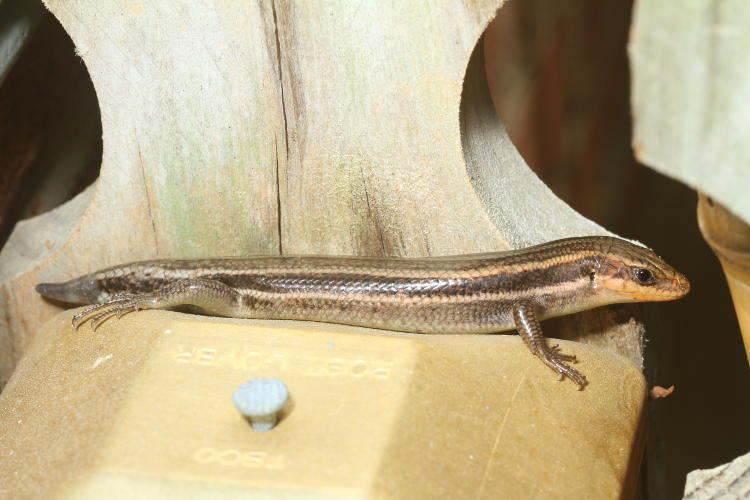
likely female American five-lined skink Plestiodon fasciatus basking atop fence post with regrowing tail
Don’t ask me why I find the Carolina anoles more interesting than the five-lined skinks, even when we have several of the latter that live within easy reach – actually, I can tell you that, because the anoles have cooler skin and look more like Komodo monitors. All that aside, this is an American five-lined skink (Plestiodon fasciatus,) likely female from the coloration, having lost its tail at some point in the past. Don’t ask me, because this is the first I’ve seen of it, but it seems to be growing back, as they will.
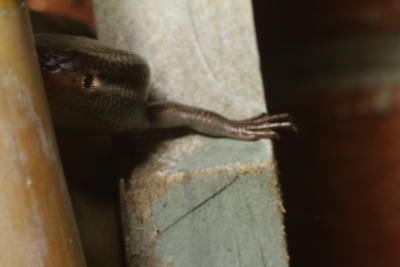
American five-lined skink Plestiodon fasciatus bolting as shutter tripsShe was being fairly mellow in her basking spot right alongside a gate we were using, but proved she wasn’t stupid by seeking shelter if we drew too close, returning when it seemed safe. A little after the detail shot above, I decided to go for the portrait angle, and maneuvered around to head-on, slowly closing in. Curiously, as I tripped the shutter and the viewfinder blacked out for that fraction of a second, she was gone when my view returned; whether she actually heard the slap of the mirror and shot away that quickly, or her decision to bolt was merely coincidental (I had stopped moving entirely at that point,) I’ll never know, but the resulting image wasn’t quite as intended.

Now we go to the big pond – no, not the Atlantic ocean, a hair smaller than that. While it has an overflow drain engineered into it, that was done before several housing developments nearby all changed the stormwater management for the area, and the pond frequently overflows during heavy rains. This has created a new channel, and when the heavy flow subsides, it leaves behind a few mini-ponds, or deep semi-permanent puddles, and the wildlife have adopted these as legitimate. A few days back, The Girlfriend’s Sprog had spotted numerous tiny frogs hanging out on the banks, and I carefully collected two for a studio session, but they weren’t having it: my photography set wasn’t to their liking and they immediately abandoned it as soon as they were introduced, causing me to pursue them across my desk. So I returned them and tackled some pics right at their home instead.

unidentified tiny frog on muddy bank
Now, a few notes. Some idea of the size can be garnered from the surroundings, including the strands of pine straw cutting through the frame, or I can simply tell you that the frogs would fit comfortably on your pinky fingernail. I’m quite sure they’re juvenile, having emerged from tadpole stage within the past couple of weeks, so this is little indication of what the adult will look like, and they remain unidentified, though I’m trying – most guides only show adults, and juveniles often look entirely different. I can tell you from experience that the Copes grey treefrogs look different at this stage, including being twice the size, so I’m sure this is a small species, perhaps a spring peeper or little grass frog, or one of the narrowmouth toads that I’ve definitely found in the exact same area; the head shape doesn’t seem to be indicating that, but who knows? However, I carry little paper scales in my wallet for a reason.

unidentified juvenile frog next to millimeter scale
That’s a millimeter scale, so we’re talking 7mm – there isn’t even a full inch visible on the scale within the frame. I was hanging over the edge of the bank by a tiny ‘cliff’ for this perspective, aiming down from above, and was having a hard time breathing since all my weight was directly on my chest, my shoulders and arms hanging out into open space. The things I do for three readers…

At the edge of the pond proper, several different species of frog were alternating sessions of mating calls. I’m never sure what the criteria is, but any species will be silent for a while, then erupt into a chorus of sound among individuals spread out dozens of meters apart, then after 30-60 seconds fall silent again for several minutes; this is most often the various treefrogs, but the green (aquatic) frogs and the bullfrogs also seem to run in waves, the bullfrogs the least erratic of them. I got lucky in tracking down one in particular during a jam.
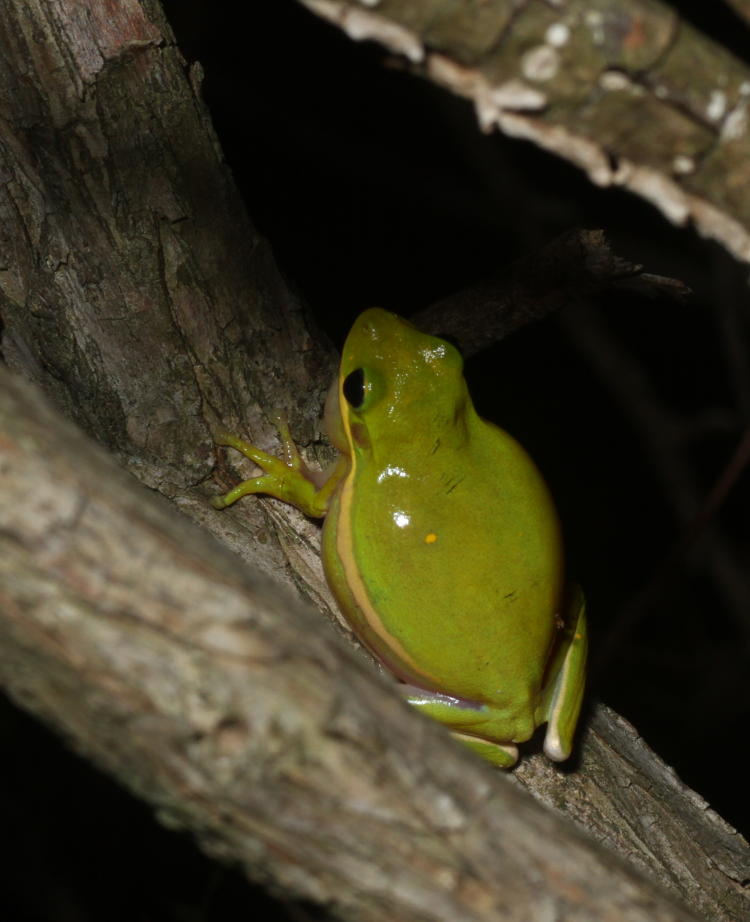
green treefrog Hyla cinerea inflated between calls
This is a green treefrog (Hyla cinerea,) inflated during a calling session but between actual solos. And then…
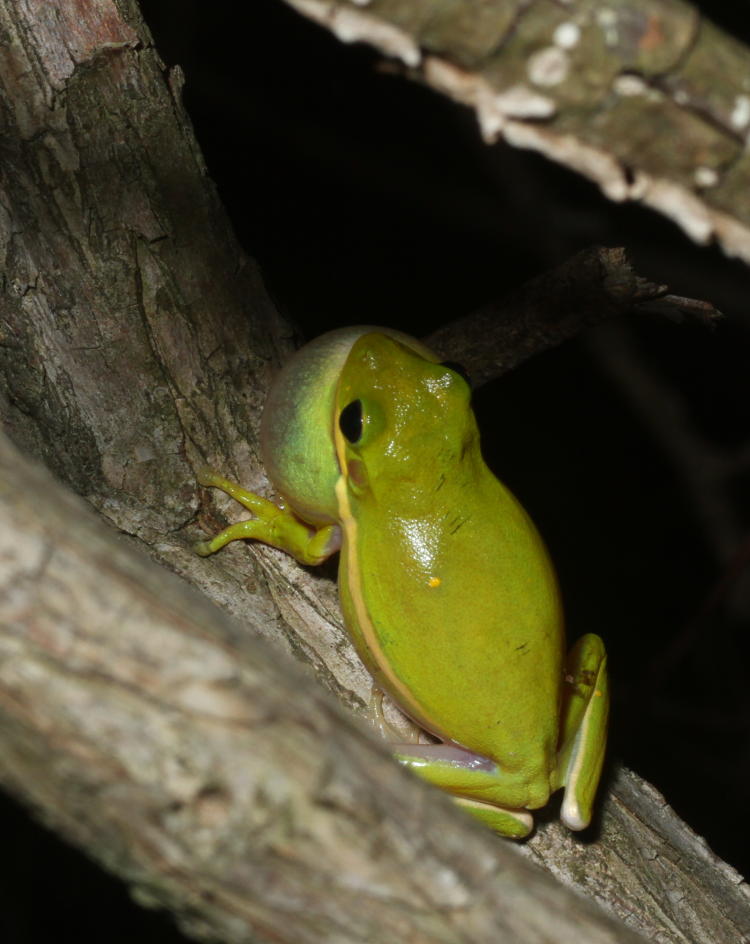
green treefrog Hyla cinerea in mid-call
… this is in mid-call, producing the curiously electronic sound that they do. I was not set up to do either video or audio for this session, which I may rectify soon, because attempting to describe their call is a waste of time; it just sounds alien. And the best I can say about their timing is that it seems like they remain silent until one of them in the area gets up enough nerve to sound off, and immediately everyone else, glad that someone had the guts, will chime in and the night will ring with the babble of frogs. Then they quickly peter out, like how audiences decide that the clapping has gone on long enough. This may not be very far from the truth; certainly just one treefrog can be found by sound quickly, but a bunch of them is disorienting. Or I could be talking out of my ass.

We need a profile.
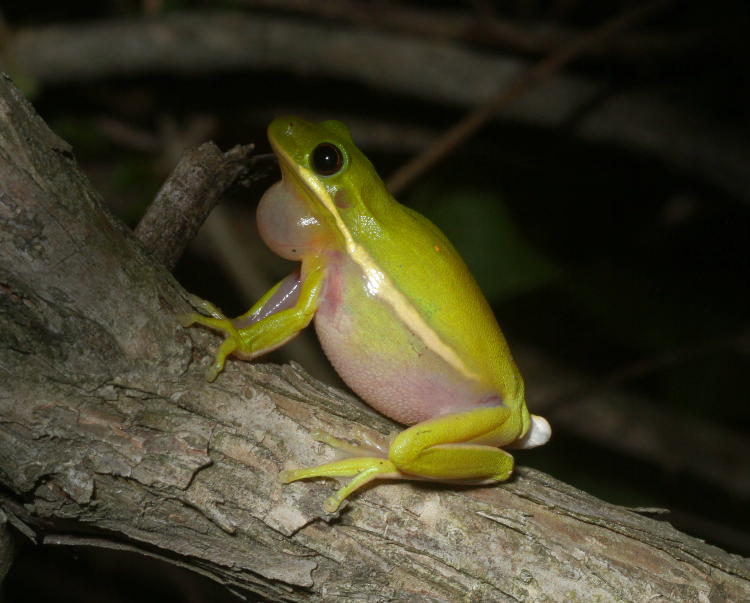
green treefrog Hyla cinerea in profile, between calls
This was just as this individual decided the calling had gone on long enough, though my presence and attempts to get a good angle (by the light of a headlamp) probably had something to do with it. It remained half-inflated in this manner for a few seconds, then abruptly went down to normal proportions and resettled onto the branch.

I have a couple other finds, from earlier that evening as the sun was setting.
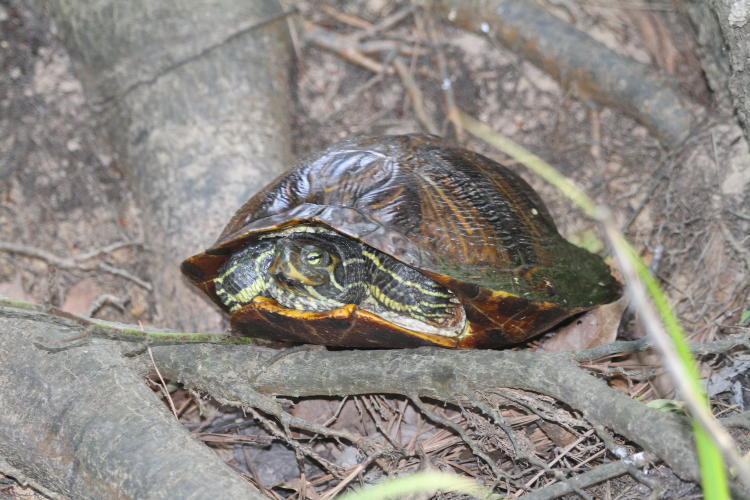
yellow-bellied slider Trachemys scripta scripta out of water
I’m not sure the exact intentions of this yellow-bellied slider (Trachemys scripta scripta) – it wasn’t far from the water, but in an odd location perched on some tree roots. From the shine on the carapace, it hadn’t been out long, but there was no wet trail up to it either. It moved on quickly once I got out of sight, and wasn’t there when I tried to show it to The Girlfriend a couple minutes later.
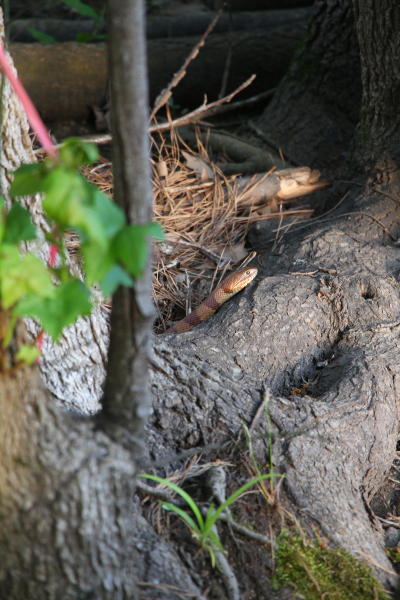
northern water snake Nerodia sipedon peeking out from debris at pond's edgeVery close by, however, something else remained put for a few photos. The photo at left is how I first spotted it as I went to the water’s edge to see what might be about, and I was pleased, because this is the first I’ve seen this year – I include the full frame to show you exactly how subtle it was, and it might have been even harder to spot, but the colors were bright and I suspect it had shed its skin very recently. This is a northern water snake (Nerodia sipedon,) which average about a meter in length but thick, like 5 to 8cm in width. I always like to see them because they’re impressive – and harmless, though far too many people can’t identify common snakes in their area and mistake these for either copperheads or cottonmouths, which they do not resemble very closely at all. Now, granted, if you grab one it will bite the hell out of you, unlike some other species, but you have to make the first aggressive move by, you know, grabbing them in the first place. Given their choice, they’ll simply flee.

No, that’s not the best photo that I obtained.

closer look at northern water snake Nerodia sipedon
For this, I had switched from the stabilized 18-135 to the non-stabilized, 20-year-old 100-300 L, a risky move in the fading light, but boosting the ISO and firing off several frames while trying to remain perfectly still produced a usable pic, even at 1/50 second shutter speed (a few times slower than recommended.) I know all my readers are sharp-eyed, and didn’t miss the apparent hook protruding from its back; this is not a normal part of the anatomy, nor is it even protruding, but just a trick of perspective. I was fooled for a bit too, but another frame makes it clearer.
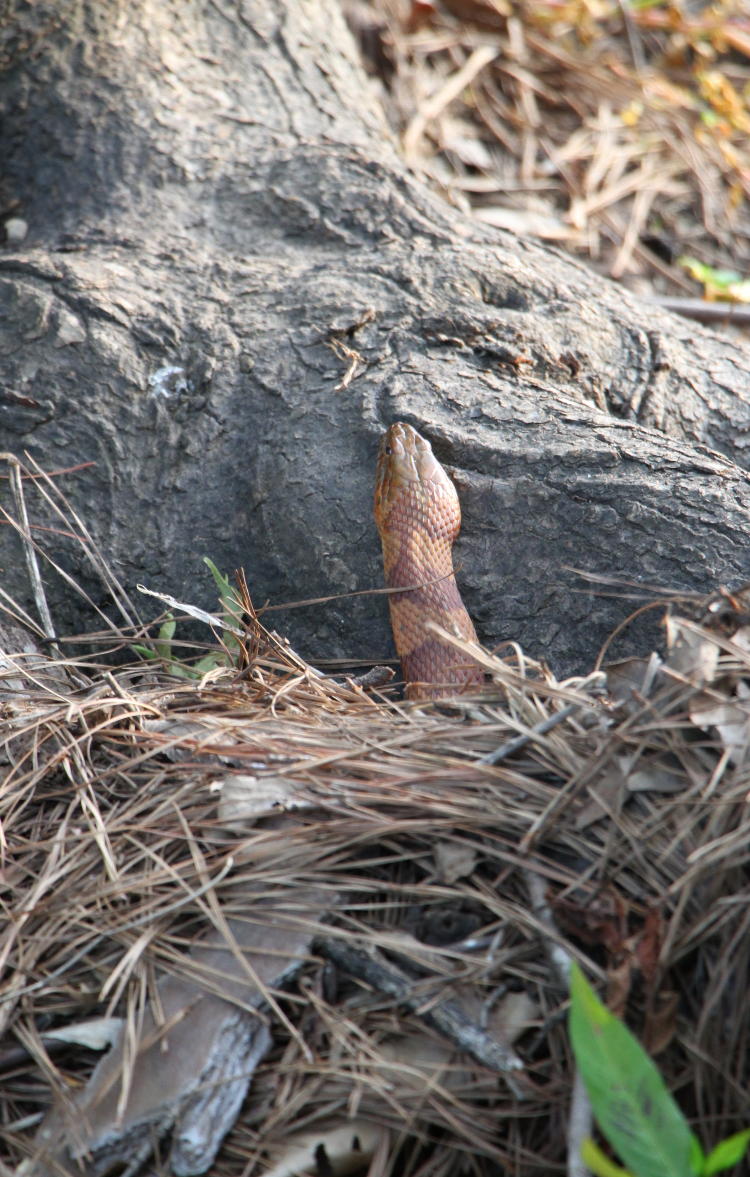
northern water snake Nerodia sipedon mostly hidden under debris
See? Just a bit of the damnable pine straw seen almost end-on. And don’t think I missed the curious shape from this perspective: I named this photo “ThrobbingPython” for a reason, but if you don’t recognize the reference I’ll let you puzzle it out. By this time The Girlfriend had joined me and could see the snake for herself, and I was creeping closer to see just what kind of detail I could get, but the snake revealed that it was not asleep as suspected – another half-step and it launched itself from this spot and sped for the water.
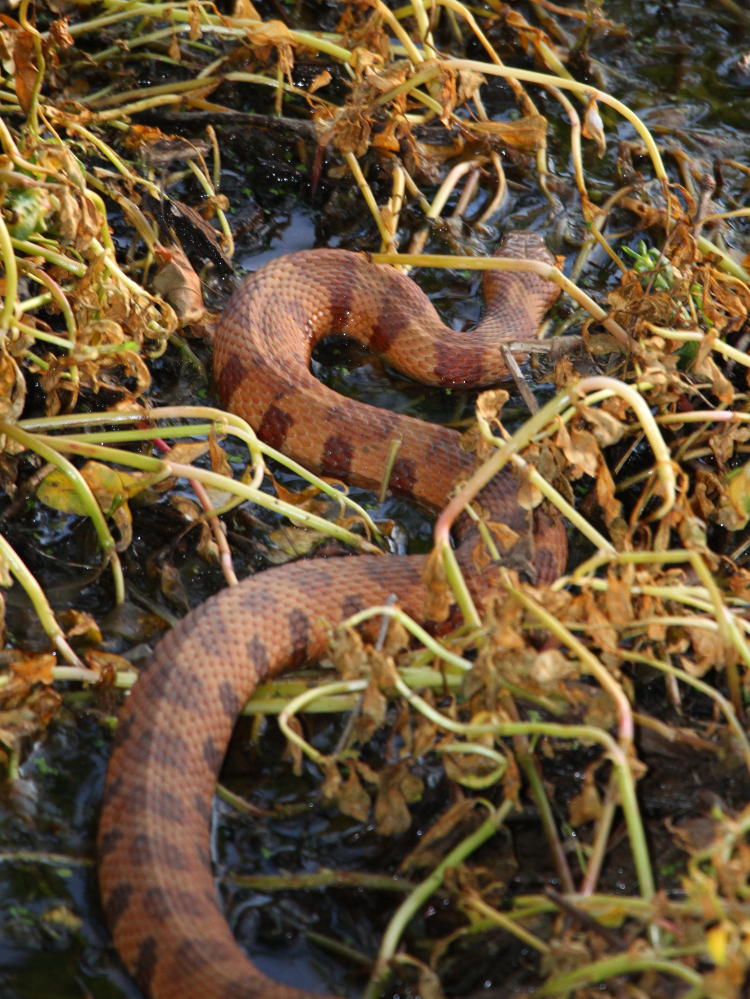
northern water snake Nerodia sipedon heading for safety in the water
Had it kept going at its original pace, I wouldn’t have had this photo, but it paused at the weeds (poisoned by the HOA in the area to prevent them from “taking over the pond,”) to debate its best course, and I could get a few more frames. Displayed now are the markings which distinguish it from the near-identical banded water snake, which are the broken bands towards the tail; the banded water snake has intact crosswise stripes. Some nice colors, though.

Okay, two more, and then you can go. I expect to see you back within a few days, though.
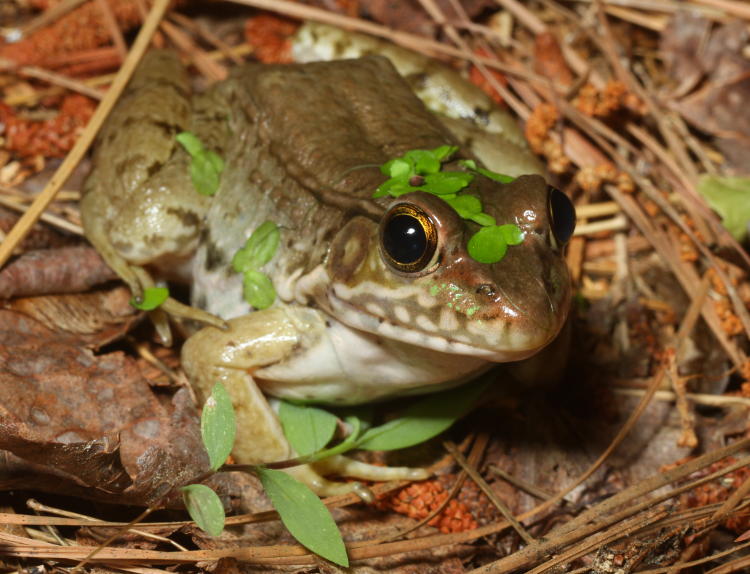
green frog Lithobates clamitans sporting duckweed on head
We return to the backyard for the last two. I’d brought back some aquatic species and shells from last year’s trip to New York, and dumped them into the backyard pond when I was done with them; this included a few leaves of genuine NY duckweed, which this spring took a firm hold and completely shielded the water’s surface. Which is evidenced by this green frog (Lithobates clamitans,) one of the three or four residents in the pond, at this point out foraging in the yard. I don’t know if this is accidental or intentional, but it’s a dashing look, don’t you think? Sets off the nostril speckles nicely.

And another, quite-common-now resident of the yard.

Copes grey treefrog Hyla chrysoscelis perched on lawn chair
I believe this Copes grey treefrog (Hyla chrysoscelis) had been sheltering under the grill cover when I removed it to use the grill the other evening, and extricated itself to perch on top, whereupon I moved it to a lawn chair, a maneuver it treated with aplomb. Just had to show off those eyes.

Crap, but amusing crap

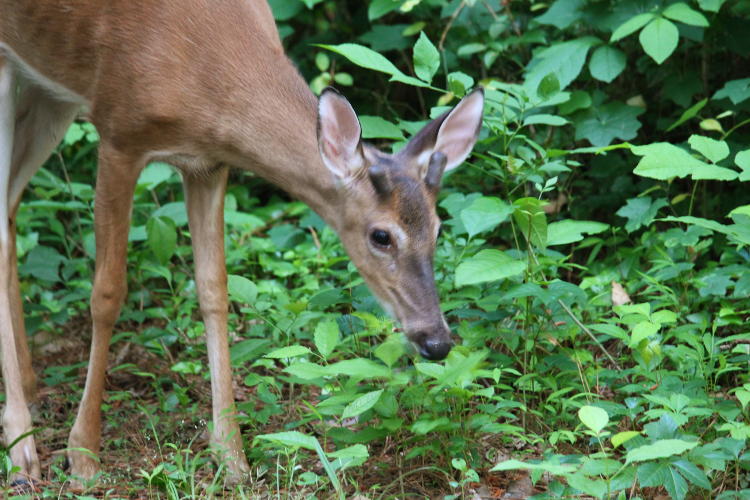
immature white-tailed deer Odocoileus virginianus buck foraging at dusk
Earlier this evening, as I was working on something in the backyard, I heard some rustling not far off and noticed a trio (at least) of young white-tailed deer foraging just beyond the fenceline, which put them no more than 12 meters from me. I drew out the smutphone and attempted to call The Girlfriend, who I believed was inside the house somewhere, but this failed because she was actually coming up behind me. The deer were aware of our presence and a little wary, but not scared off. This occurred at dusk, and the number of trees behind the property effectively rendered this twilight even though the sun barely peeked through in random patches, and as one of the deer paused in one such patch, I went inside to get the camera and long lens. Naturally enough, it did not remain in the better light long enough for me to take advantage of this.

A tripod was out of the question – just trying to set it up would at best have taken too long, but might also have scared the deer off, between the various metallic noises and the sight of the extending silvery legs. So I was shooting handheld at long focal lengths in twilight under a canopy of trees, a distinct recipe for blurry pics, and that’s primarily what I got. Boosting the ISO to 1600 helped a little, as did bracing against the fence when I could, but nothing that I got was worthy of publication (except here, of course.)

One of the deer started heading back the way they’d come, which meant towards a busy road, and The Girlfriend ducked around the house to try and head it off discreetly. Meanwhile, I stood in the middle of the backyard and tried for decent pics. The result was interesting.

female immature white-tailed deer Odocoileus virginianus watching The Girlfriend
With the imminent arrival of a new shed, I had removed two portions of the fence along the back of the property line, which meant it was wide open to the deer, and the one that had started towards the road was essentially standing in the opening, and aware of me – had I not been there, I have no doubt that it would have come into the backyard. But it was also intent on heading back towards the road, and this drew it ever closer to The Girlfriend, who was taking her cue from things that I’d said in the past and not staring at the deer, but glancing around casually while remaining unobtrusive. The result was the deer walking up to within five or six meters of her, which was slightly frustrating to me because I wasn’t carrying a lens that could get both in the frame to demonstrate this. It was starting to look like she was about to hand-feed a new friend. Naturally, I’ve been calling her ‘Snow White’ since this.

immature white-tailed deer Odocoileus virginianus doe looking dead into cameraThe first image at top was a buck, as can be determined by the stubby little horns – obviously, we’re talking pretty young here, and none of them were fully adult. The Girlfriend’s pet was a doe, seen here looking curiously at the source of the shutter sounds for a moment before resuming its stalking. Eventually, The Girlfriend waved her arms a little to spook off the deer, since it didn’t seem inclined to stop approaching the road despite her presence, and it (with some reluctance) hastened to join its departing siblings. I had thought that was the end of it, and resumed making noise in the back yard, but about 45 minutes later while I was grilling burgers on the deck, I realized that not only had they returned, one of them had entered the backyard and was foraging near the little pond – not quite as close as it had been to The Girlfriend, but then again I wasn’t standing silently by any stretch.

If this is going to become a habit (the fence seen at this link is the same section that is presently removed,) I may have to stake out the backyard more often, with the tripod and some supplemental lights, and see what I might capture when prepared. And I will note that all of these images here are full-frame as captured, not cropped at all, though I will admit to tweaking away the bluish twilight colors.

Per the ancient lore, part 10

male brown anole Anolis sagrei displaying dewlap
After a brief jaunt into the future with last week’s post, we return to the earliest days of digital photos (for me, anyway) and of course Florida. The subject here is the lovely textures of a Caribbean sycamore tree, rudely blocked by an impertinent anole. Okay, I lie, I have no idea what kind of tree it is, and was instead after the anole itself, hard as that may be to believe. This is a male brown anole (Anolis sagrei,) doing his territorial/mating display thing. Typically, if you see this it’s a signal to look around carefully, since it virtually always indicates another within visual range, though I admit I don’t think I ever saw the beneficiary of this display. I doubt it was for me, but cannot vouch for the sexual proclivity of any individual lizard.

We’ve made it to the Reptiles/Amphibians folder, of course. The brown anoles weren’t originally native to Florida and are thus considered an invasive species, but the definition of this can be debated if one is so inclined. Right now the browns outnumber the native green anoles significantly, and are probably the easiest reptile species to spot in Florida, small as they are (roughly 14cm in overall length.) Which reflects a little on my changed approach to nature photography in the intervening years (this was taken in May of 2004.) The anoles, both green and brown, in Florida are abundant, and I even had a resident within the tree right outside my window, but I never sat down and did a detailed photo-examination of them. They were certainly easier to find than the Chinese mantids that I’ve been chasing the past several years, if a bit spookier, but I have far fewer images of them. Nowadays, with such easily available models, I’d probably have a full selection of portraits and behaviors, eggs and newly-hatched young and so on, within my stock folders, and this is at least partially due to writing blog posts, realizing that I had a good subject to feature and trying for more illustrating images. Certainly I’d have better-lit versions than this (and do,) but when you spot a wild and rather shy reptile displaying, you get what you can without thinking about how to coax it into a different position, or whether you can get a fill-reflector in place. And as the theme goes, these are the early digitals shots, so this is not an example of the best that I’ve ever gotten.
Color week Thursday

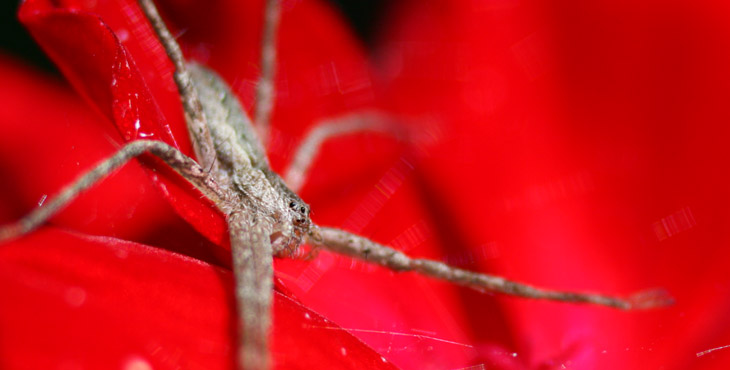
slender crab spider Tibellus maritimus on geranium blossom
I’m fairly certain this is a slender crab spider (Tibellus maritimus) being as subtle as a teenage girl on her first beach trip after reaching puberty. Don’t ask me why this is considered a crab spider, since I would expect them to look, you know, crabby, but that’s entomology for you.

By the way, the depth-of-field is so short because I was actually shooting at night by the light of a flashlight, so the aperture stayed wide open to allow a fast enough shutter speed. Not the ideal method, but I was experimenting, and it worked better than expected.

From octal to heximal

While I have a ridiculous number of images to sort through, mostly due to the hawks (I fire off a lot of frames to try and capture specifics of behavior as well as ‘something cute’) and I am behind on posting several photos of interest, this one jumped ahead of the stack for no good reason. I know, if I had to do this I could have gone with something much more appealing, but I’m me…

Fishing spider Dolomedes tenebrosus missing left middle legsRemember when I said that it would be interesting to see if the fishing spider managed to live peacefully in close proximity to the frogs? Of course you do – forget I asked that. Well, checking it out late last night, I found that something had changed since my last sighting a few nights before. I didn’t see this happen, so I can only speculate, but when I got this photo, a green frog was sitting not two meters away.

I see similar physical states among spiders frequently, and even watched one specimen lose a couple, and another with only three legs. Most don’t seem too affected by the loss, showing no visible reduction in mobility or dexterity (save for the three-legged one.) I would like to say I have the opportunity to observe this one’s behavior rather easily, but I have seen just two types of behavior from my resident here: sitting motionless in the flashlight beam at night, and hurtling under cover at first glimpse by day. So I wouldn’t be able to tell much, I suspect.
I’m curious as to whether this affects the spider’s ability to walk on water, but I’ve never seen this one close to the water, much less using it, and most times it’s on the opposite side of its rock-mound ‘home’ (what will eventually be a small waterfall, if I ever finish the damn thing) from the pond itself – they don’t need to be near water, but they tend to be.

Do they learn anything from such experiences? Does the spider feel pain? We honestly don’t know. But let’s think about it for a second. Obviously there’s a sense of touch that helps them find prey and avoid danger. But pain, to us, is a signal that something’s wrong, telling us that we’re bleeding or that we need to allow an injury to heal. For spiders, once the limb is gone, nothing’s going to happen – they don’t bleed, they won’t be waiting for it to heal, there’s no benefit to feeling pain in such circumstances, so our best guess answer to the question is, “Not as such.” Obviously, the loss of the limbs is not as life-threatening to them as it would be for us, so our instinctual reaction is probably quite inaccurate.

Fishing spider Dolomedes tenebrosus showing stumps of missing legs
(The spider was actually vertical, like the above pic, but it’s easier to look at this way.)

Monday color 15

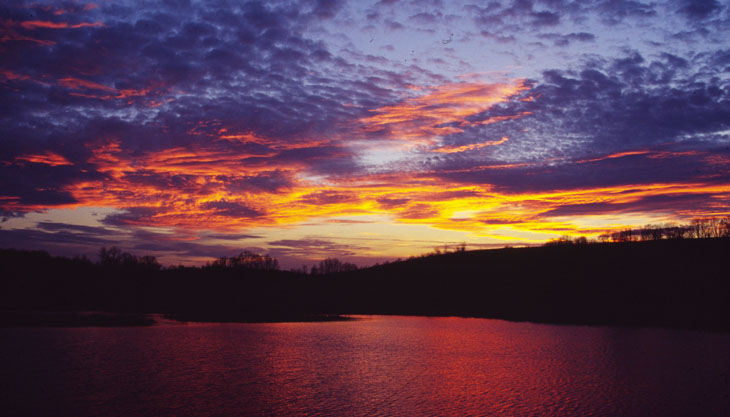
sunset over small lake in Weedsport, NY
Taken years ago while visiting the area where I grew up, this was a grab shot, seeing the sunset colors and hastening out to a spot where I could take advantage of them; a small lake just down the road from where my dad used to live fit the bill perfectly. Had I gone much farther in my quest, I might have missed out – when the colors come up in the sky like this, they don’t last, and ten minutes is usually too long to spend trying to find the right foreground.

For some reason, we don’t get many sunsets like this in North Carolina. I’m guessing it’s the humidity. The result is that my sunrise/sunset image folder is the weakest one in my stock, often only added to when we take trips elsewhere.

There’s a reason for this particular shot right now, which I’ll explain a little later on, perhaps in next Monday’s color post. Stay tuned.

Not deep

I’m still here, and still largely busy – it’s going to be a lean posting month, but I’ll still try to put something up from time to time.

[“From time to time” – isn’t that a stupid phrase? Who makes these things up, and did they have any think what word good is?]

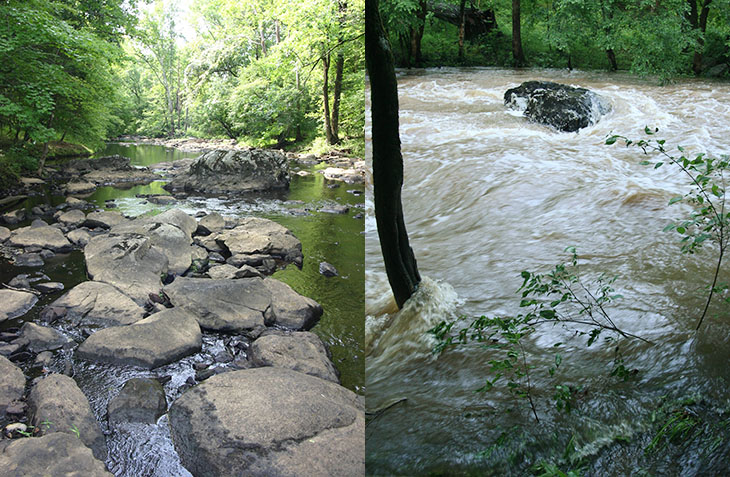
A few days back we received torrential rain, which is not to say this is any more remarkable than the rest of the country, but only as a lead-in, since it spurred me to go down to the river. I’ve seen plenty of evidence that it rises dramatically, yet never been down there to witness it firsthand, so I stopped down briefly the morning after the deluge. Below is a comparison composite image, the left side taken a few years ago but representative of typical conditions, while the right is the level Friday morning.

river depth comparison
It’s the same boulder in the middle of both pics, except one is seen aiming downstream while the other shooting across from the small point seen in the former. I wasn’t going to go wading in the river that day.

You can see how the river is flooding the banks in the right image, and as I stood there, a largish snapping turtle appeared between the tree and I, struggling desperately to gain a foothold on the flooded bank before vanishing back into the torrent; I had barely raised the camera and didn’t even lock focus before it was gone.

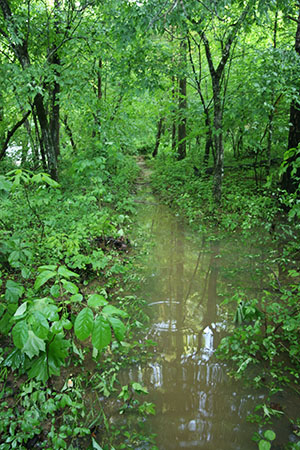
flooded footpathThis is part of the path that winds alongside the river, only about 20 cm under water at this point so I was still able to follow it – I spend the non-winter months in waterproof sandals specifically for conditions like this, because I think it’s silly to let a little water block me from something interesting. My feet are so used to this that I rarely notice the water temperature at all, unless it gets really extreme. [An example of this was when my dad visited one winter and we went out to the Outer Banks. He snagged a favorite and expensive fishing lure on something not far offshore, while casting in Croatan Sound off Roanoke Island, and I waded in barefoot to try and retrieve it – the water temperature did not exceed 4°c (40°f.) It took two attempts and became pretty painful, turning my lower legs beet red, but I got the lure and recovered quickly. I still find the people who go swimming in freezing weather to be morons, though.]
New, untouched silt and debris were distributed onto the path at higher elevations than this as well, indicating that the water level had been at least a half-meter higher, and probably more like a meter, sometime the previous night. It’s difficult to predict how hard this is on the local animal life; I know beavers often live in hollows in the banks, and water snakes are common, but both of these need air and can be drowned in their dens if the water level traps them within. Animals such as deer than venture into the rapids can easily be swept away, and the debris that is carried can be pretty dangerous even to animals that can handle the turbulent water.

There’s not much else going on. I haven’t been tackling any philosophical ideas recently, and I have a number of posts in draft form but nothing I feel too motivated to finish. It goes that way sometimes, and while I occasionally feel bad for not putting up new content, I also made up my mind long ago not to post for the sake of posting (whether I’m succeeding in that resolve remains to be seen, I suppose.)

Even the arthropods have been fairly scarce. The mantids dispersed quickly throughout the yard, and I occasionally spot one but they’re still shy about close contact; at their size, anything that shows detail at all is close contact, so good shots are tricky.

One exception is a variety of treehopper that has descended on the erupting dog fennel plants. I had to check just now to determine what the difference was between treehopper and leafhopper; basically, treehoppers look like thorns while leafhoppers look like buds or seeds. I also had to add both words to my computer’s dictionary so it would stop highlighting them as misspelled; it seems to think either should be two separate words, or hyphenated at least.

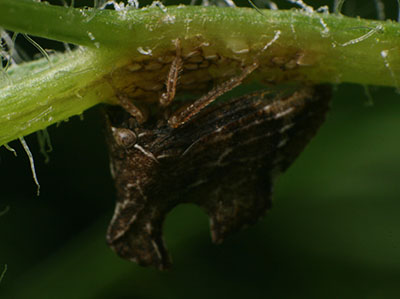
Entylia carinata
Entylia carinata and stem damageThis is an Entylia carinata, no apparent common name, and a significant number appeared on the plants overnight it seems. They run about 5mm in length, and have a tendency (like all ‘hoppers) to scuttle around to the back side of the stem when someone leans close, so it took quite a few tries to get a nice shot. The pic at right, in fact, is one I consider a ‘miss’ except for one thing: I’m pretty sure the discoloration of the plant stem beneath the treehopper is from the damage that they do while sucking out the sap. The amount of nutrients they extract from the sap is minimal, so they draw a lot and process it through their systems pretty quickly, excreting the rest as ‘dew’ that is often harvested by ants. No ants were taking advantage of these, however, even though the species is known as a favorite of them. I’ll keep my eyes open, since while I have a few images of ants farming leafhoppers and aphids, I’d still like some more detailed examples.
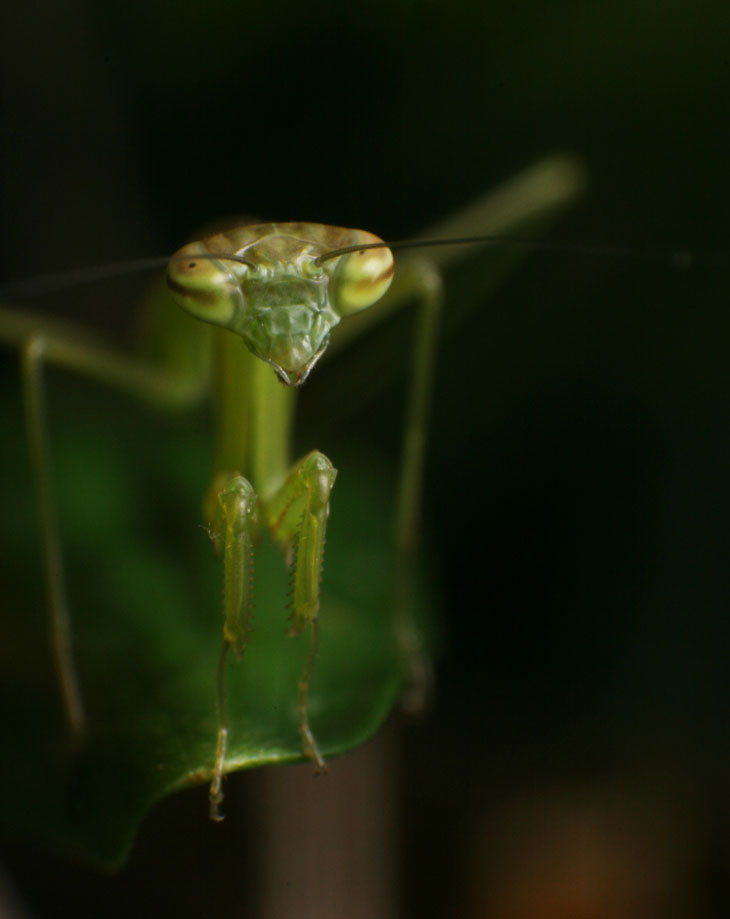
I’ll close, despite my disparaging comments above, with a mantis image. It might seem strange, but different individual insects can display different ‘personalities,’ or to be more accurate, varying responses to the same stimulus. What this means is some of the mantids from the same hatching are quite spooky and go for cover if I make the wrong move, while at least one other seems pretty tolerant of me leaning close with the camera and flash/softbox rig. Since this one has moved to a patch of some ornamental grass next to the rosemary bush, I am confident that I’m encountering the same individual, who has now taken on a more distinctive green hue. While larger, this one is still only 20 mm in overall length, so you can imagine how small the head is. In contrast, the sibling who has moved to the dog fennel plants is far more circumspect, and hasn’t allowed any decent images at all, much less a menacing portrait of this nature.
Chinese mantis portrait

Drama

We’ll start with the artsy-fartsy one.

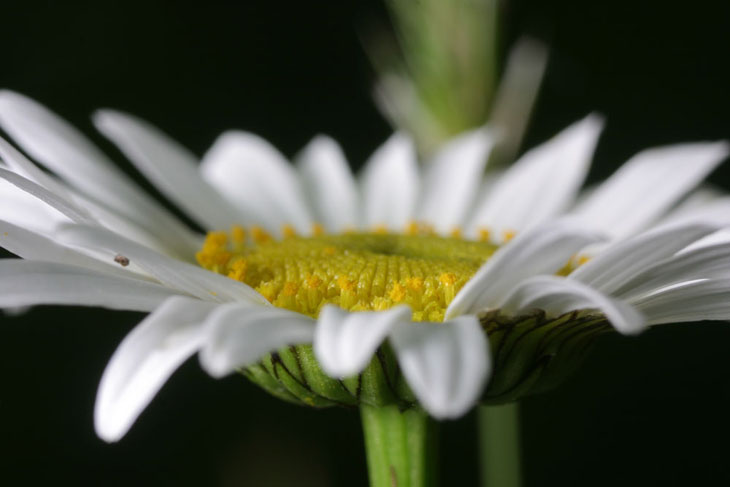
EdgeOn
This came from a patch of wild daisies down near the river, many of which served as eyries for crab spiders (I think I’m mixing metaphors without goggles again) that were making a serious dent on the hymenoptera population in the area – every one I found either had a meal in chelicerae, or soon obtained one. They tended to be shy and sidled from the center of the bloom to the edges and underneath as I approached, meaning some of my shots were taken from flat on the ground aiming against the sky as the spiders tried to hide. But in the middle of it all, I just nabbed a quick perspective from a sitting position.

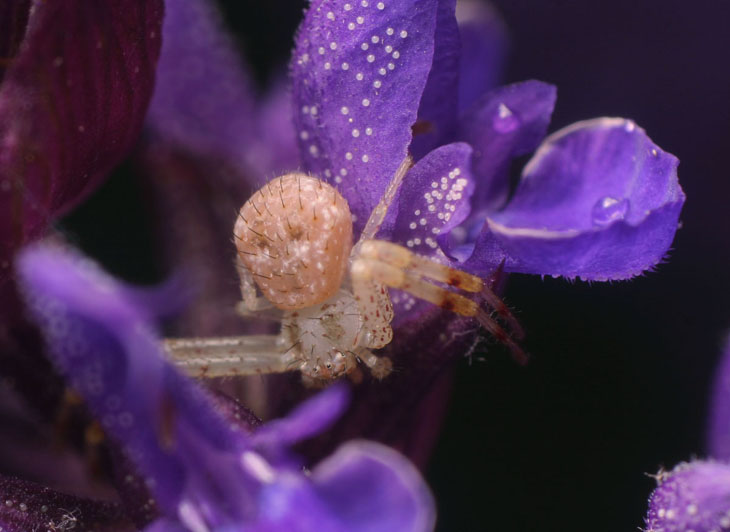
Back home, I found another crab spider occupying the salvia plant I’ve had for a while now, which has undergone two transplantings – the first almost killed it, but it recovered nicely with the second and is now blooming madly.

SalviaCrab
This guy was hiding not so much from me, but from the collection of small red ants that had taken over the stalk for a short while – don’t ask me what defines the difference between food sources and deadly threats to spiders, because I don’t know, but the spider certainly wasn’t viewing the ants as an easy meal. Possibly it was idea that capturing one would have triggered a defensive odor that brought others swarming to attack.

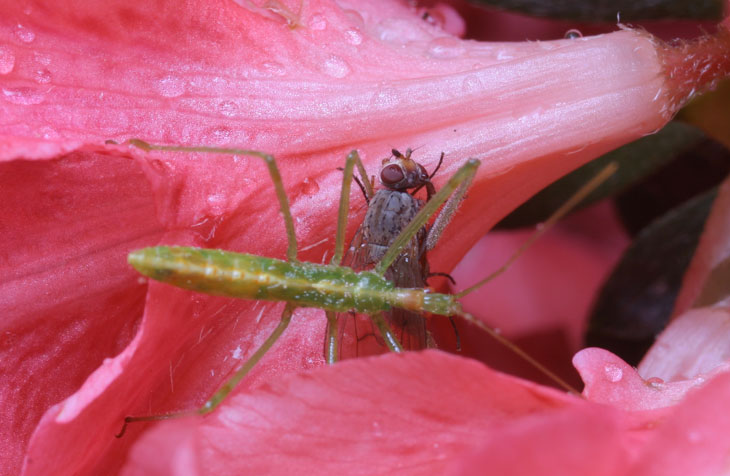
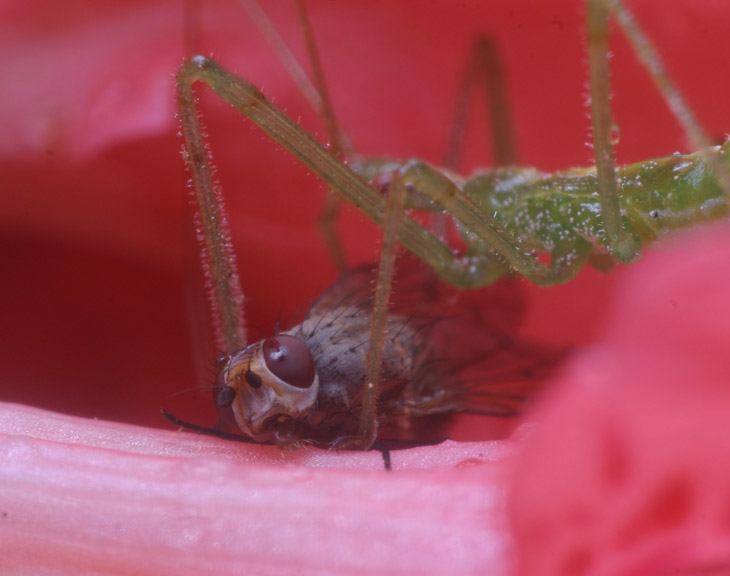
I’ve mentioned that some images are vastly improved by choosing the right angle to shoot from, and this illustrates one example. On the same bushes housing the mantids have been a few assassin bugs, and typically what you might see in examining the bush would be something like this:

SatelliteView
But a little effort in maneuvering and positioning can change the image dramatically, and even produce a faux look of despair from the captured housefly:

HelpMe
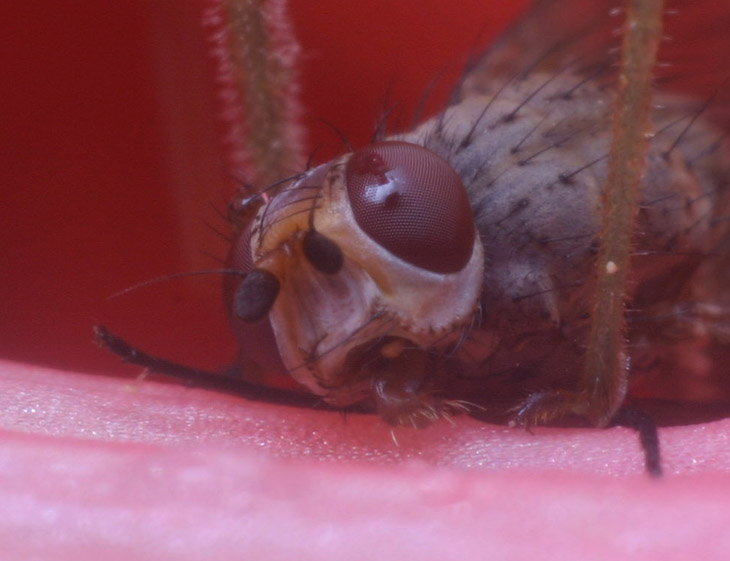
There’s so much at work here: the raindrop that produced a reflection from the flash, making the compound eyes appear to have a frantic wide-eyed look; the open-mouthed illusion; the fact that we never see flies not perched on their hexapod of legs; and even the peculiar angle of the head. All of it produces something we expect to see from people, not from insects, and makes us relate a bit more to what is strictly an imaginary emotion. It helps illustrate how we can be manipulated by inherent social reactions.

And a tighter crop of the same image, because I’m pleased with the detail captured:

BeyondHelp
If you see a goatee and perhaps even a tongue, shame on you – you’re not detaching yourself in a professional manner. But now you can’t unsee it, can you? ;-)

1 2