






I used to think the column “The Straight Dope” was pretty good, and well researched. I was first introduced to it about twenty years ago, when it was carried in the local independent newspaper called, for some unknown reason, The Independent (this is a local publication, not the British one.) Many years later, I found it online, and made a habit of stopping by semi-regularly to see what was new, and even reading past columns. Still do. The no-nonsense style of the column tended to succinctly skewer some of the weirder claims left untouched by mainstream media, and be a voice of reason among ads proclaiming the wondrous properties of Vitamin B complexes for stress reduction (remember those?)
But it seems the head honcho, Cecil Adams (which may be a pseudonym) has been slipping from such standards recently. I’ve already briefly dealt with his take on nuclear power, which completely dodged the largest issues and made some claims worthy of industry shills (look for the third highlighted link in that rather long post, if it helps.) Just a few days back, he gave his indications of wishing to rejoin lame-duck mainstream media with his slippery answer to the question, “Does god exist?”
For someone who claims to do research, Adams somehow never mentioned that his potential “proof” of god’s existence is widely known under another name, the Cosmological Argument (which I’ve also dealt with.) This is a shame, because anyone wanting to know more would find a wealth of information using that term in a search engine, most of it showing the Cosmological Argument to be the sophomoric failure that it is. Adams’ entire reason to trot this trope out is that, if we assume ‘first’ cause to mean ‘underlying’ cause, then there certainly could be something like that for the universe as we know it, and if you want to call that god, then you’re all set. As the message repeated from so many religious folk goes: stop there and don’t ask any more questions!
Because, of course, in the guise of an underlying cause, such a force is indistinguishable from the four fundamental forces, or ‘interactions’ if you prefer, that we already know and deal with constantly, two of which being gravity and electromagnetism (the other two deal with the binding of atoms.) Now, please note that Adams is not saying that something akin to gravity is created by god – he’s saying that it is god. Or could be considered that, if we found it, and we might, because there must be something.
Not a mention of how this really doesn’t represent any god that anyone invokes, ever, and even stretching like a child’s toy to elevate the mystery to supernatural status, still only constitutes a weak form of deism, unlike the monotheism that is sought in its place. Not a word about how theology is simply a method of finding a reason for an answer already decided upon. No exploiting of the perfect opportunity to demonstrate how learning, and science itself, really works, by bringing up the idea of using facts to lead towards a conclusion, and the actual existence of something (like electromagnetism) to lead into the investigations of the cause. No consideration that ‘proof’ is interchangeable with ‘preponderance of evidence,’ and doesn’t have anything to do with philosophy. Not even the simple analogy of Santa Claus and the Sandman, cultural concepts that are rampant yet, curiously enough, not supported in any way* – the reader may draw their own parallels.
I’ll be fair: Adams might have shied away (or been chased away by his editor) from simply saying, “No.” Even most atheists have been far too accommodating in allowing how a definitive statement of god’s non-existence is logically impossible, though we have no trouble whatsoever with saying the exact same thing about Santa and the Easter Bunny. We do this because the lack of evidence, and the historical sources of such stories, is enough to make the simple statement that they do not exist, and fretting about this being a definitive absolute truth statement is what we get to see instead of a decent argument for actual existence (much less evidence.) Most of the people on the planet do the exact same thing with god – just not the god they believe in, but each and every one of the other gods throughout history and cultures which they examined just as closely as their own (which is, “not at all.”)
But let’s be real, Adams’ answer is not dodging the issue; it’s actually paying lip-service to a puerile concept that is logically, rationally, and scientifically corrupt. It not only has absolutely no reason to be invoked, it doesn’t even work as intended. And in an age when fundamentalists are trying every trick in the book to get accepted, and with elections rolling around, what we really need is some straight-forward, hard-hitting commentary, and even just a simple demonstration that critical thinking is a good thing. Instead, we get Cecil Adams’ featherbrained sellout. And he gets paid for it, too.
* Yes, I know there is historical evidence for Saint Nicholas. That’s not who children think is supposed to be coming down the chimney, is it? Plus, I’m sure we can all agree that he’s gone now, right?


 One of the aspects convincing to her of a god, she admitted, was the behavior of some animals. Mother bears protect their cubs, and salmon swim upstream to spawn, where they die, and their bodies nourish the young (I’m just reporting what she told me – I know the current takes away whatever nutrients they might have contributed long before the eggs hatch.) I hadn’t told her that I was a nature photographer and science enthusiast, so she didn’t realize the opening she left me, but I was happy to fill it anyway, with a brief rundown of natural selection.
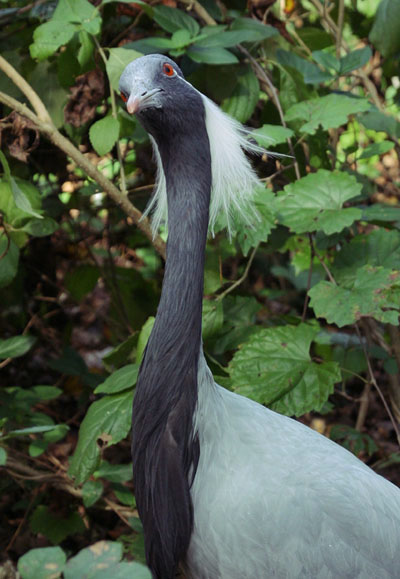 And so, our saga resumes where it left off, with our heroes trapped within the confines of a completely non-treacherous and non-threatening bird park…
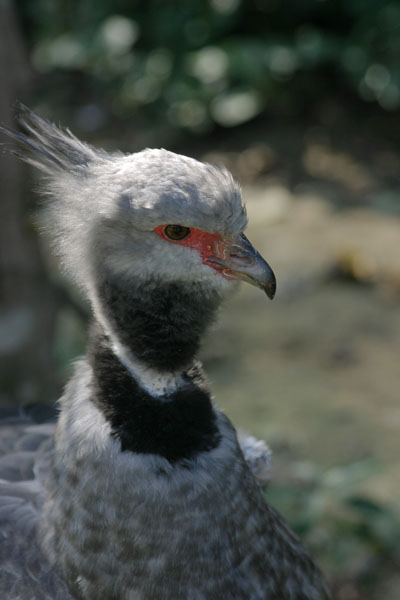 I’ve spoken before about
 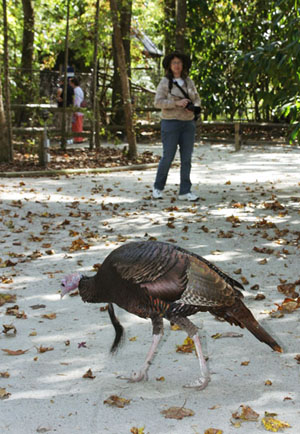 At one point we noticed a local native Wild Turkey (Meleagris gallopavo) hanging out on the outside of the peacock cage, who was only mildly anxious at our approach. A little later we questioned a park worker, who informed us that it was actually a wild fowl, not a park resident, who had taken a shine to the peacocks and turned stalker. I admit to being a little curious over this, since both the peacock and the turkey were males, but I’ve seen territorial disputes between caged and wild birds before, and this situation didn’t have that appearance. (I digress for a brief anecdote: Many years ago while visiting a wildlife refuge in Florida, I saw my first Pileated Woodpeckers, surprisingly large birds, and then checked out the nearby rehabilitation clinic. There, an unreleasable captive who’d had a wing amputation would get apoplectic over a wild visitor, who would periodically sit on the timbers right outside the captive’s fence and beat a territorial drumming, well aware that the resident inside could do nothing about it. And you thought only humans could be sadistic…)
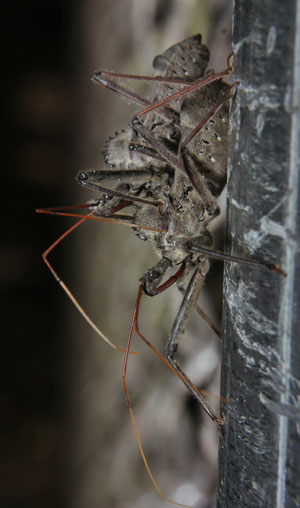 Despite my desire for some different subject matter on this trip, I yielded to temptation when I found a pair of Wheel Bugs (Arilus cristatus,) a variety of assassin bug, mating on a fence post. Their piercing proboscises, for draining the insides from the other insects that make up their food, are plainly visible from this angle. This past year has been almost entirely dedicated to bug shots, without my intentions – I’ve simply been unable to do enough traveling to provide opportunities for other subjects, and have been milking the local area for everything I can. I probably should begin a bobcat or fox portfolio project…
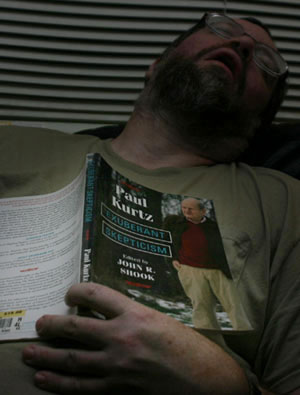 Exuberant Skepticism is a book that I picked up out of interest in the topic, and the reputation of author Paul Kurtz, who is the founder of the Center for Skeptical Inquiry, the Council of Secular Humanism, a fellow of the American Association for the Advancement of Science, and a longtime contributor to Skeptical Inquirer magazine – seemed like just my cup of tea. Yet, it defeated me, and after numerous attempts over an extended period of time, I could not finish this book; thus the post title. While I have avoided chastising certain publishers of reviewed books regarding their cover art choices (mostly the complete lack thereof,) this one might have held a hint, as Kurtz looks out from the cover in undisguised contempt of those damn kids on his lawn, daring the potential reader to make any connection to the book’s title.
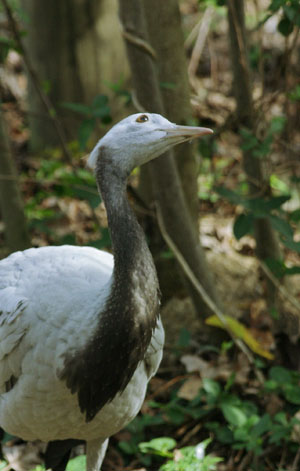
 The first indication of what kind of a day it would be came early on, having entered the park and started out on the deck observing the first pond. While comparing the number of birds, mostly ducks, that were coming up for morning chow, The Girlfriend began making excited attention-getting sounds while being unable to create any actual words. I was trying to remember the procedure for the Heimlich maneuver when I saw what had her attention, which was a young crane eagerly following a park worker up the path like a puppy. The worker heard us, and on return helpfully came over to allow us a closer look. Her companion was a nine-week-old Sarus Crane (Grus antigone), about 80 cm (2 ft) tall and still in the needy stage. That alone probably would have sealed the deal, at least as far as The Girlfriend was concerned, but it was only the start.
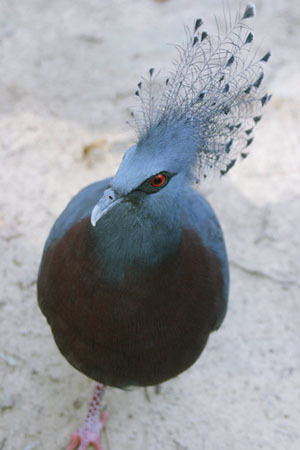 The other side of this coin was the pair of Victoria Crowned Pigeons (Goura victoria) who came up to the fence at our feet and hung out for portraits, then hopped onto the railing to really mug it up, even nibbling on The Girlfriend’s lenshood in the vague hope that Canon had finally made one that was edible (we’ve all been waiting.) There’s always a part of me that’s prepared for the defensive peck or bite, since what appears friendly to us is often intended as a menacing warning sign from birds, but the Vics were totally blasé about our presence. Another Crowned Pigeon, this one alone in a cage nearby, began producing a remarkable call, so bass that it was hard to trace and almost disturbing – I can recommend bringing either a sound recording device or video camera to capture the full range of experience within the park. Also, when shooting digital, be sure to snap the identification signs as you go so you have a record of the species later on.
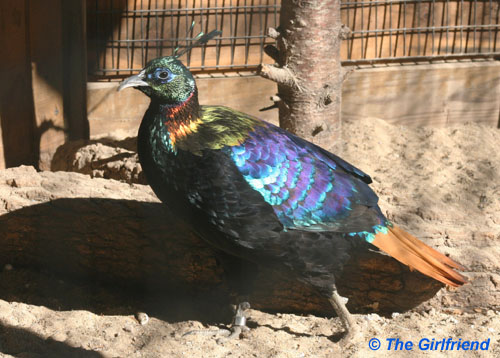 It also provides the opportunity to see some rare and endangered species up close and personal, as well as some really vivid ones, like this startlingly iridescent Himalayan Monal Pheasant (Lophophorus impejanus,) also known as an Impeyan Monal or Danphe. The difference between the male and female (the male shown here) is so drastic as to convince virtually anyone that they are completely separate species. And the nice thing about two people shooting is that one of you can save the ass of the other when they fail to get a decent image, as happened here.

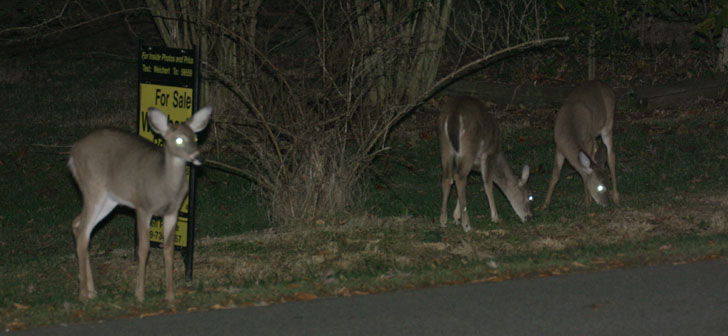
 At left, a visitor just across the road late one night, who knew I was there but wasn’t too concerned – it’s possible to exploit this if you try. Just move slowly but casually, since animals respond more to actions than appearance. Let me put it this way: if you were auditioning for a part in a play and asked to “creep up on somebody,” what would it look like? Usually, exactly what most people do when trying to photograph animals. But the animals recognize this too. If instead, you were asked to “blend in with the crowd and not attract attention,” you’d be heading in the right direction. You’d look off into the distance and seem bored or preoccupied, wander aimlessly, and do anything significant only when no one was looking. You got it.