










While troubleshooting the 3D printer the other day, I flipped the entire chassis up and discovered that, in a hollow under the main deck, a tiny spider had made its home. This is not particularly surprising, since plenty of species seek out little undisturbed dark spaces like that to make their webs, intent on capturing, I dunno, dust and ghosts it seems – it’s hard to say what kind of insects can be found there, but enough spiders use such areas that something must be edible therein. This one, however, was a proud mother, or at least a successful one.
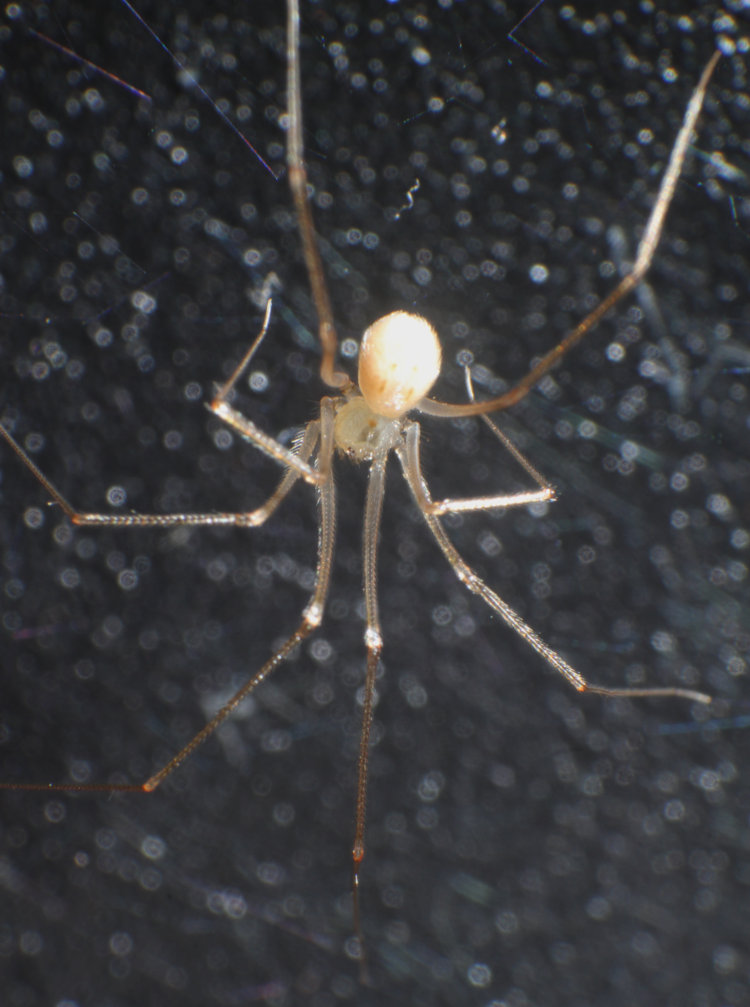
I never got scale for the mamma, but I suspect the abdomen there is less than 2mm long, overall body length under 5mm – it was not a big space, and she had lots of room. I was using the reversed 28-105 just to get any detail at all, but what I got was enough to point me in the right direction in regards to identification.
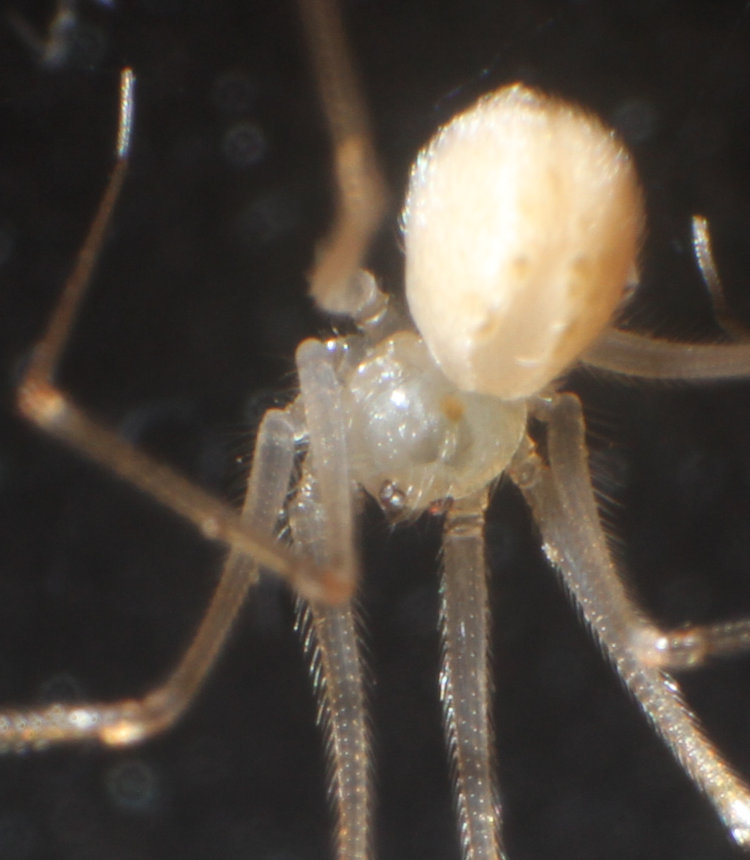
To identify any spider, you start with the eyes, and while I didn’t have a very good angle on her, this is just enough to make out what seems to be two clusters of three eyes. That, and the body length, suggested that this was a shortbodied cellar spider (Spermophora senoculata.) This certainly fits with the location found – to a degree. They’re not native to this state, or indeed this continent, having been introduced from Europe. “Introduce” is perhaps a misleading term, since it probably wasn’t intentional or at a party or anything, but simply riding along underneath someone’s furniture while it was shipped over – cellar spiders (Family Pholcidae) are the typical spindly, often semi-translucent species that leave behind little white egg case balls under dressers or that old chair in the garage.
Now let’s see the newborns. Bear in mind that, from my examination at a standard viewing distance, they were mere specks that I wasn’t sure weren’t just the empty eggshells from the hatching – I had to poke gently with a needle to provoke some movement from them and confirm they were the actual bebbies.
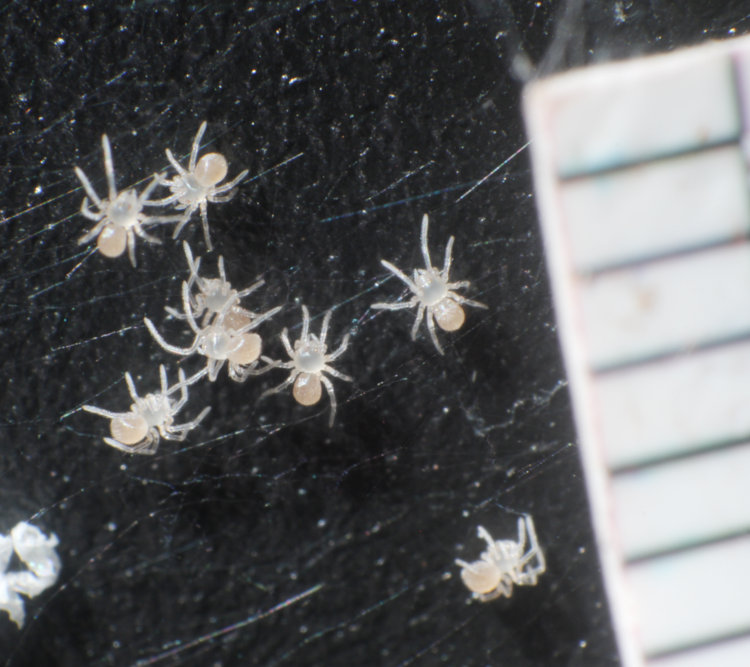
I also got a paper millimeter scale in there, suspended from the web and thus slightly closer to the camera than the spiderlings, but it was enough to confirm that their body length was less than a millimeter. Get out your own ruler and look at that – and then, again, ponder just what the hell they were feeding on.
Aw, hell, here’s another scale shot I just did:
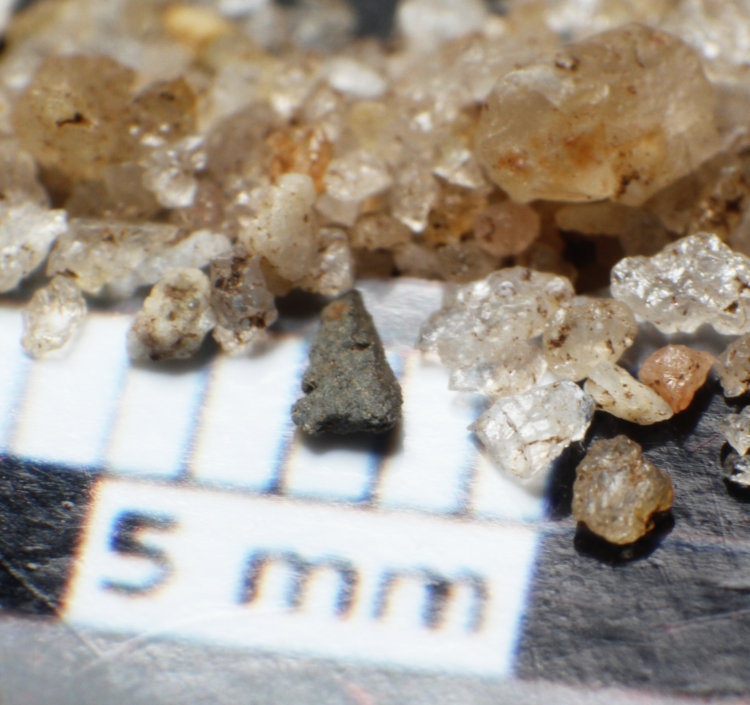
That’s just sand on the same scale – granted, it’s the coarser North Carolina quartzite sand, but still sand. You could roll some of these at all those little Indys, send them fleeing in terror from the temple…
And closer to a newborn, for detail:
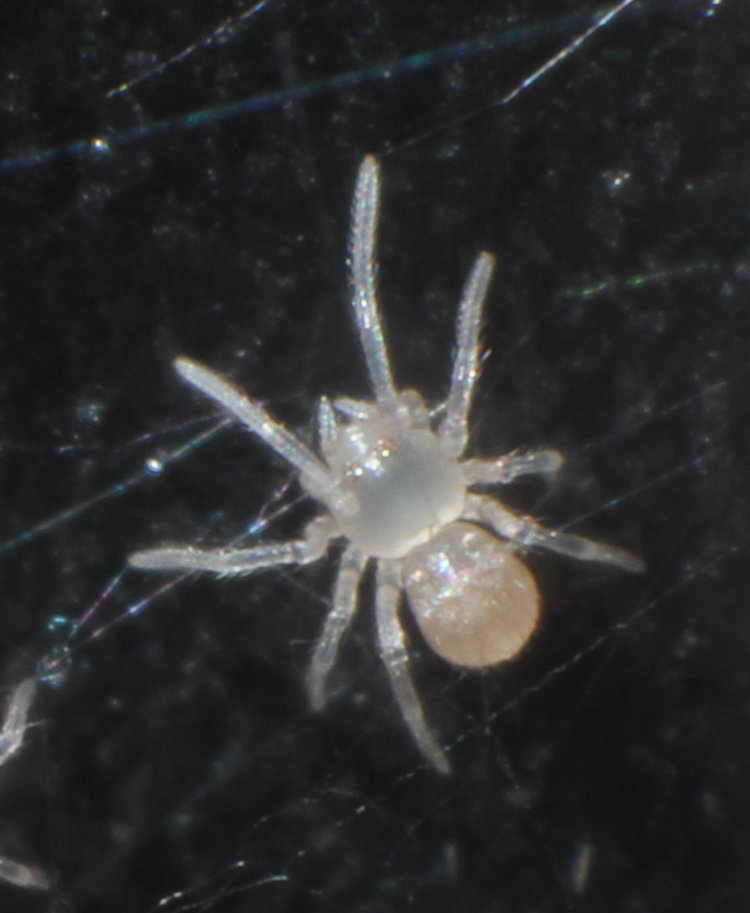
I’m playing around with getting sharper, more consistent results at this magnification, so we’ll see what happens, but for now, this is what we have, with eye reflections anyway. Those hairs on the legs are just a few microns in diameter, if that – perhaps less than 1 µm. I’d still like them to be sharper, but that’s what macro photographers do. “I just want to see the electron orbits…”