






Another quiet week, so we’ll make up for it with a video – how’s that sound?
While the wood ducks (Aix sponsa) had thinned throughout the summer, they were still making appearances, albeit mostly the juveniles. Abruptly, the Canada geese (Branta canadensis) joined them, a couple weeks ago I believe, and then a very large number of adult wood ducks. And now, a pair of mallards (Anas platyrhynchos,) which we believe are the same pair that had been visiting together in the spring, even when others were scarce. We don’t pretend to understand what motivates the waterfowl and their schedules, but we do have to provide updates from time to time.
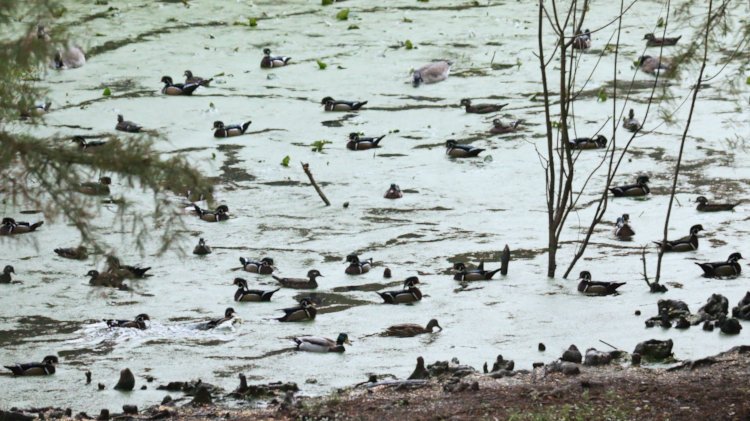
The numbers have simply exploded, and we’re going through corn like gangbusters. It’s impossible to get a decent count, but I can tell you that, in the top image, there are 41 wood ducks, four geese, and the pair of mallards. What’s most interesting is seeing the change in how bold the wood ducks have become, since until very recently, they would wait a little anxiously for the geese and nutrias to clear out before beginning their raid, which would last somewhere between one and four minutes before something would spook them and they’d fly in a mad panic down to safer areas in The Bayou. At best, it wouldn’t be a full panic, and most would simply make it to midpond to reassess the situation. I haven’t seen a full panic now for days, and as the video shows, at least a couple (I realized after narration that a female was participating too) were being quite forward with one of the geese. We also used to witness the nutrias having their fun when the ducks were feeding nearby, by popping up in a brief feint to watch the ducks scatter, either just trying to maintain a little personal space or, we suspect, actually doing this in a playful manner – we’ve seen other examples, and it really doesn’t look territorial at all. But now, it’s fallen flat for them, since the wood ducks just dodge a little but don’t bother flying off or even running for the water.
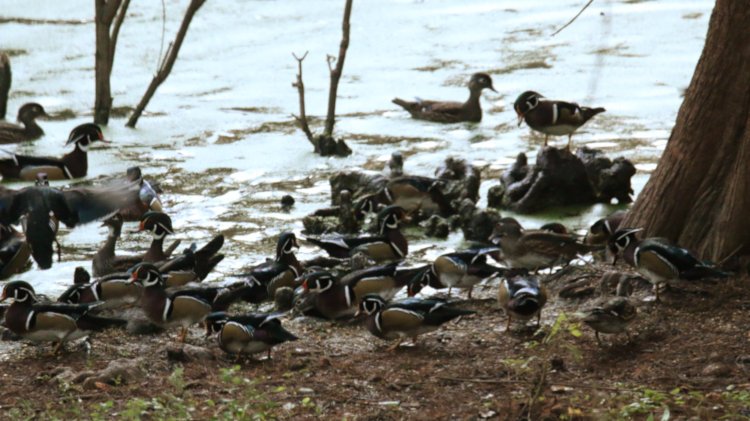
Curiously, too, last year it was virtually always the females that led the raids, being the first onshore before everyone else followed suit – perhaps it was only the same one or two, we have no way of knowing. This year it’s certainly the males, and there does appear to be a noticeably larger male that often stands lookout on a cypress knee. This might, in fact, be the difference in their behavior, if they really do have one specific ‘lookout’ that they all pay attention to, and the one for this year is a lot less spooky.
For a short while, most of them were confining their raids, especially in the afternoon, to a spot semi-shielded from view in the house, especially from the upstairs window that the video is shot from, permitting only a peek through the gaps between trees that we call the keyholes.
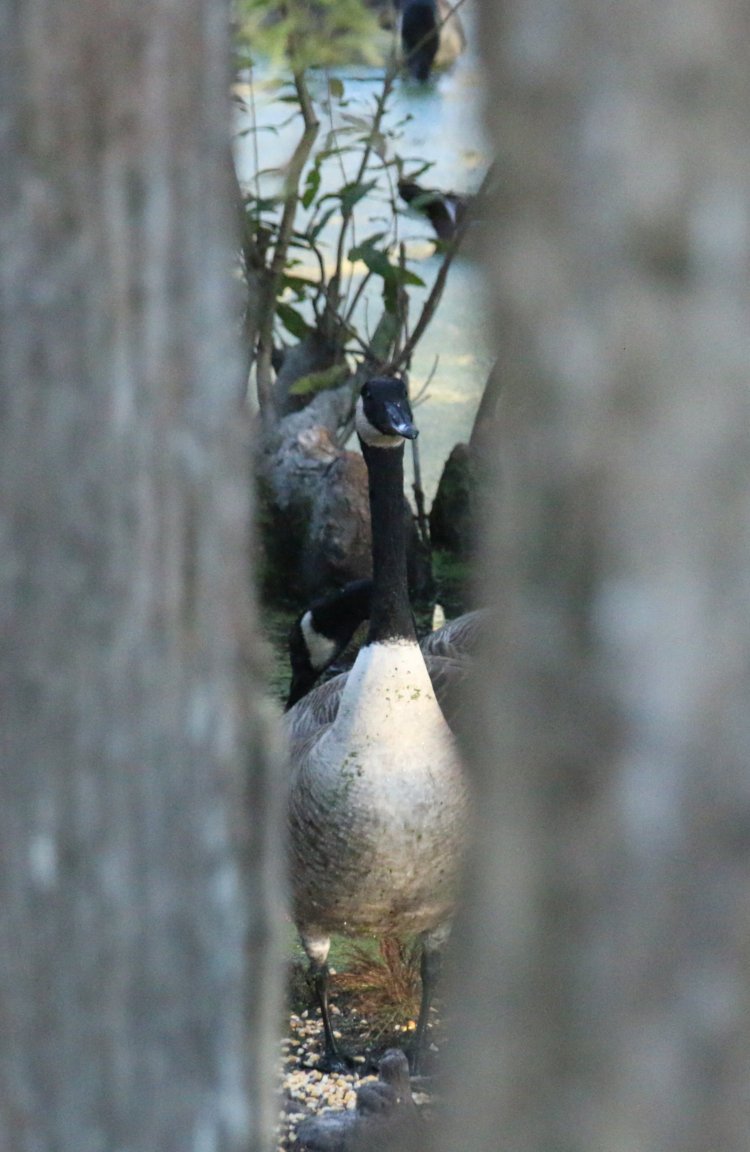
The geese quite often come along much later in the morning and are far more casual about eating, usually staying for a few hours and just hanging out, even waiting as we distributed the morning corn. The Girlfriend was quite pleased one morning when one not only came onshore while she stood there, but sidled up within two meters to eat; after a few minutes, the territoriality of others caused her friend to come so close it brushed against her legs. I’d woken up a little later than The Girlfriend, spotted her out the window, and watched her standing motionless with the goose in front of her, snacking on corn and even taking a brief nap. It’s a hoot.

By the time the sun is hitting the water in the morning, most of the wood ducks have left, though there may be a handful of stragglers that hang out with the geese, who may remain until close to midday, and occasionally return in mid-afternoon. By late afternoon the ducks start appearing, gathering quite slowly, but early enough that the late afternoon sun can illuminate their plumage nicely.
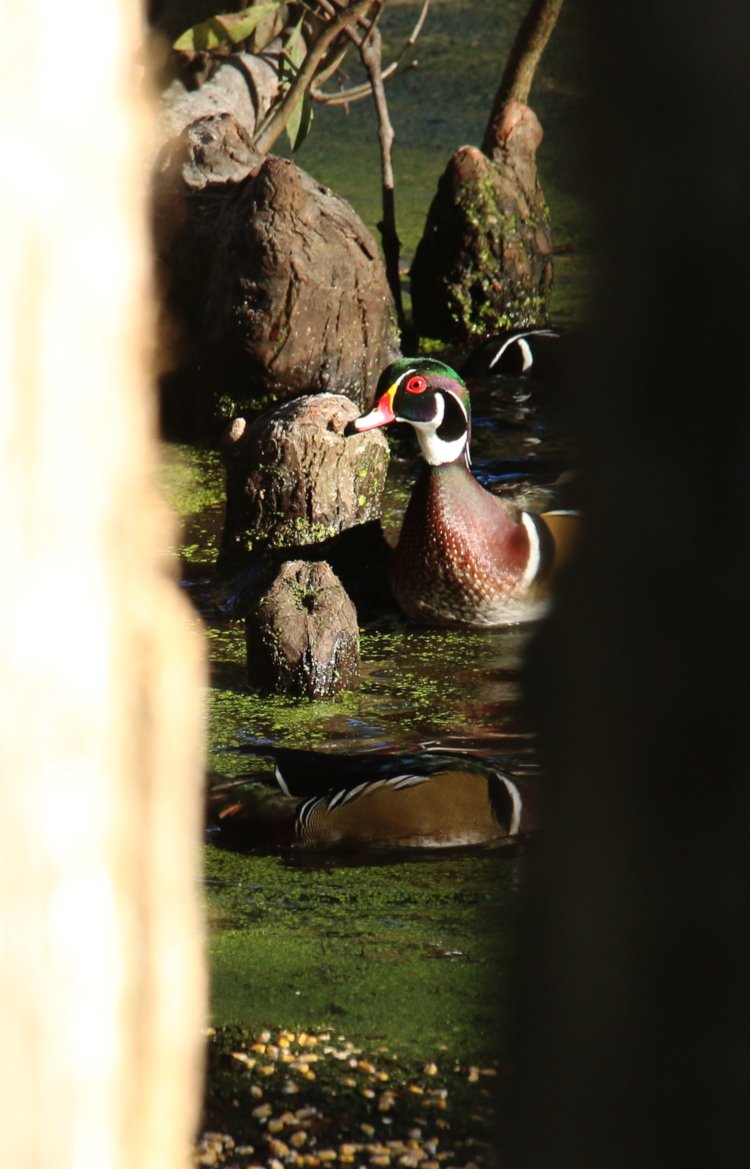
The activity visible through the keyholes is often almost frantic, and the timing of portraits like this is very crucial, since they’ll be in and out of view in less than a second. These afternoon raids are a lot more variable than the morning ones, sometimes vigorous, sometimes very thin and casual, sometimes never taking place at all. Generally, if I have gotten my timing down and have opened the bathroom window beforehand, they don’t perform well, only doing so when I’ve neglected to be prepared and can’t possibly chance opening the window because they’ll spook and fly off – it’s a new vinyl window, it has no reason to make so much noise opening, but so it goes.
I’m in the process of planning a duck blind to go on the deck, which will be slightly closer but have a better overall view then the upstairs window – as long as I’m in it before the ducks start to arrive. We’ll see how that goes. In the meantime, corn donations are appreciated…