








Hang onto it, because you’ll need it in a moment.
Towards dusk, The Girlfriend and I were next to the liriope patches alongside the walk when I spotted movement. Expecting an anole, because of course (they do own the property,) instead I found a micro-subject that The Girlfriend was astonished by. I went to get something to capture it within while she kept her eyes on it, and luckily it remained in place and actually wasn’t too hard to capture. Well, I mean, for someone as experienced as I…
The photos proved a little harder, since my subject was disinclined to use the plant that I gathered for a natural setting, instead hopping around several portions of the bathroom. I always do small active subjects in the bathroom, since it’s small and relatively clean and uncluttered, making it easier to spot and recapture escaping subjects. But this means we only have shots of it on the acrylic sheet covering the sink, or my finger:
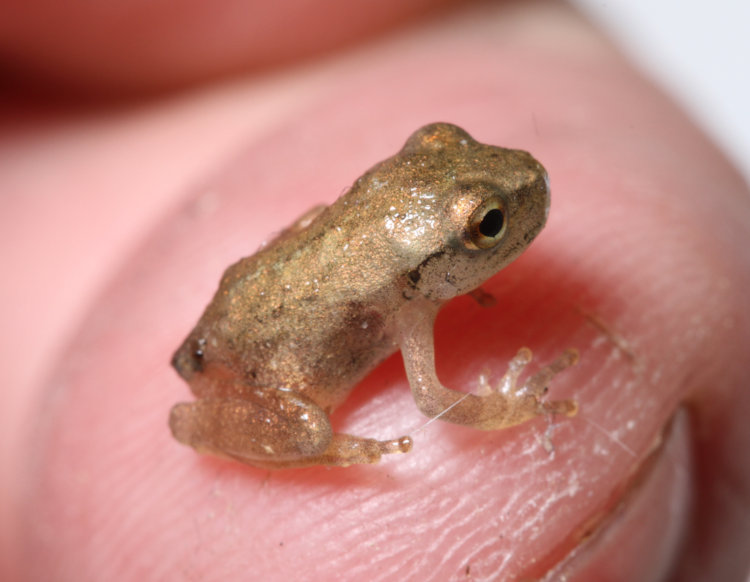
This is among the smallest of the frogs that I’ve seen and photographed, about half the size of your pinky nail. It clearly seems to be a juvenile, perhaps only days away from tadpoledom, which means identifying it is next to impossible, since none of the adult characteristics have developed yet. I think I’ve narrowed it down to two possible species, based on what few markings there are. Note the faint stripe passing through the eye but not continuing past the shoulder, no visible eardrum, and the lack of back markings, which we see better here:
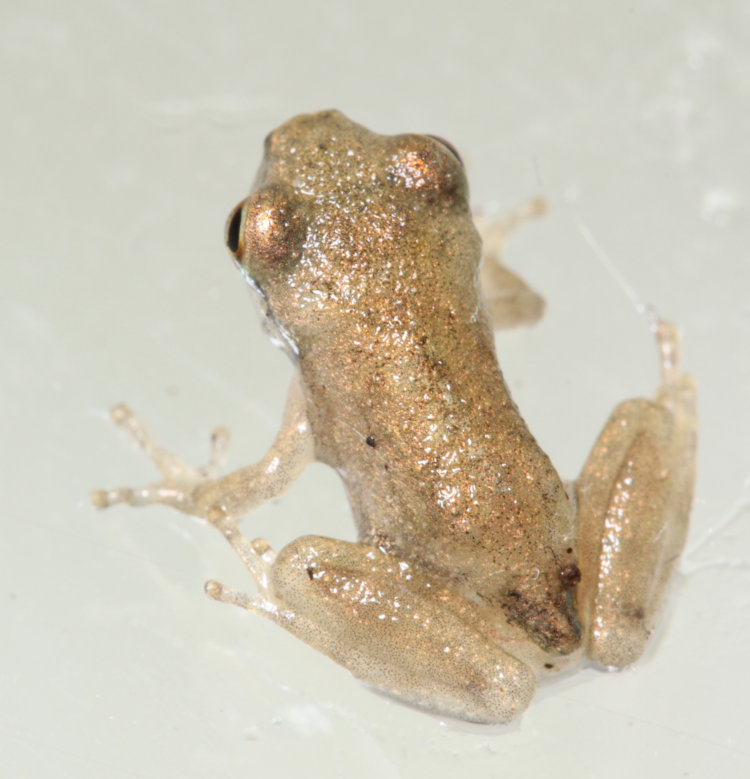
So my choices right now are the ubiquitous spring peeper (Pseudacris crucifer,) or the never-before-spotted little grass frog (Pseudacris ocularis.) While I’m favoring the peeper solely because we have oodles of them here, there are a few reasons to suspect the little grass frog. Peepers have distinctive back markings, though I can’t vouch for how quickly they develop. But peepers are also quite a bit larger than this, and twice the length of the grass frogs. Again, this one was tiny:
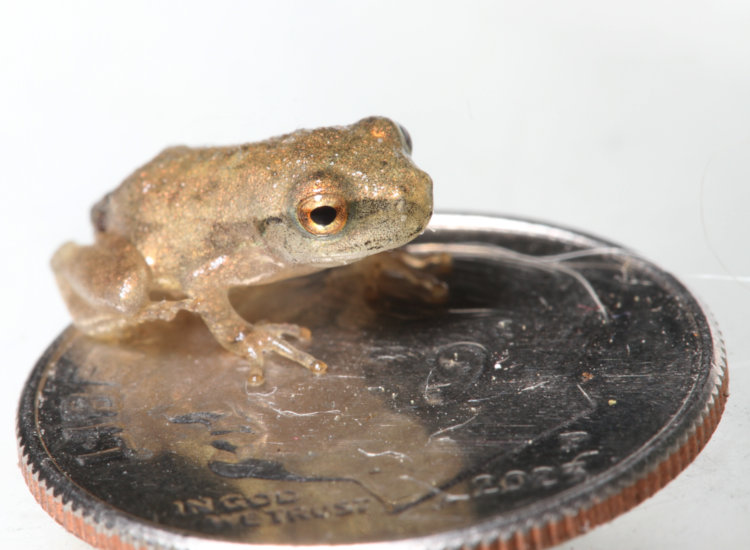
This is why you needed the dime, so you could directly see the scale. Eentsy. But the other thing that makes me lean away from the grass frog is that their noses are pointier than this – again, maybe not at this age.
I snuck the millimeter scale into the shot too, for a more universal comparison.
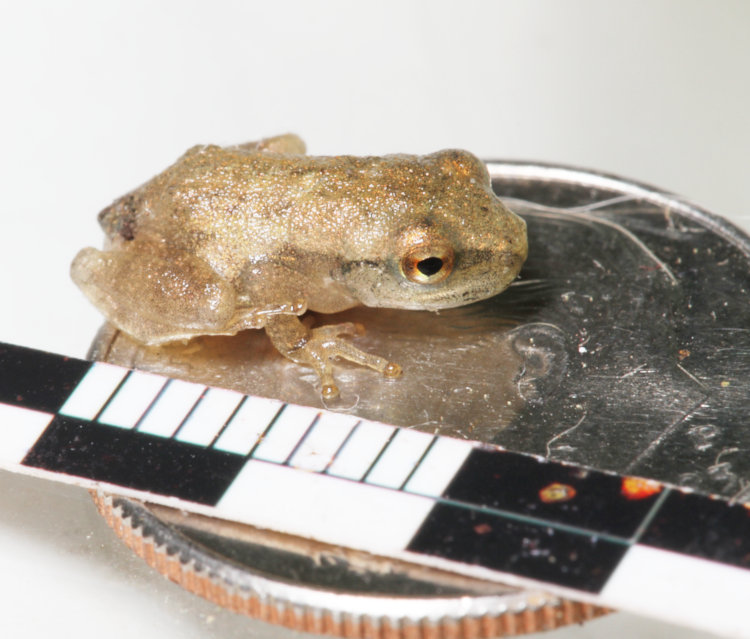
Under 10mm in body length; an adult grass frog would be a few millimeters longer, but a peeper close to three times this. Any herpetologists that want to chime in, I’m not stopping you.
I returned my subject to the liriope, but dinner was ready so I couldn’t try any shots there. When I returned later, I couldn’t find it again – not surprising, though for a moment I mistook a beetle for my subject. While out, however, I wandered around checking for other subjects.
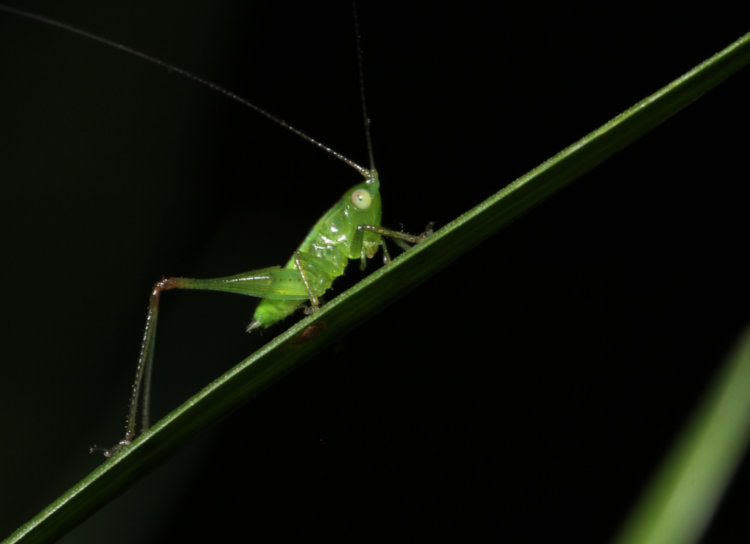
This unidentified katydid nymph was perched on a blade of liriope, and might have made a meal for the tiny frog except I honestly think it was too big, perhaps 3/4 (or more) the length of the frog itself – not counting those antennae of course. The cropping was intentional – I like working the corners…
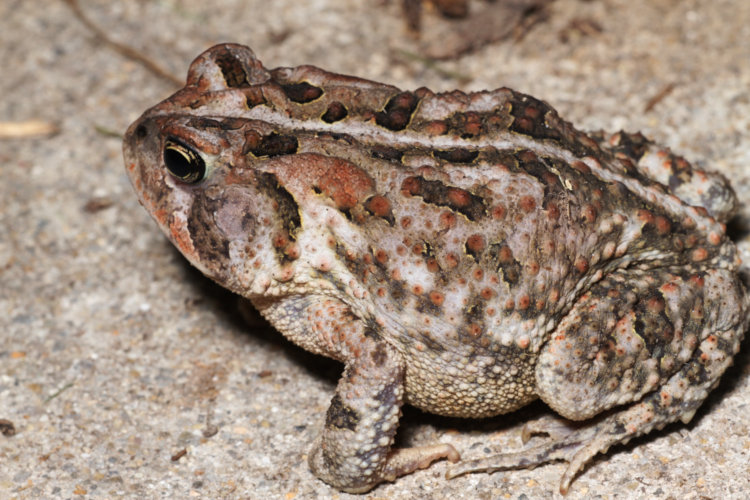
This is a southern toad (Anaxyrus terrestris,) a pale and large specimen, and as such probably massing a hundred times the tiny frog – I’m not exaggerating. This one was hanging out near the greenhouse where I was hearing (among many other things) a Copes grey treefrog calling – it’s actually a huge night for amphibian calls out there right now. The treefrog wouldn’t let me get any pics, and even this one hopped away quickly while I was trying for the portrait. I suppose word that I’m liable to capture them and restrict them to a bathroom for a bit gets around quickly…
The butterfly bush has been in full bloom, and I’ve been checking carefully since the flowers are a favorite haunt of crab spiders. No sign of those, but I did see another type suspended near a bloom cluster.
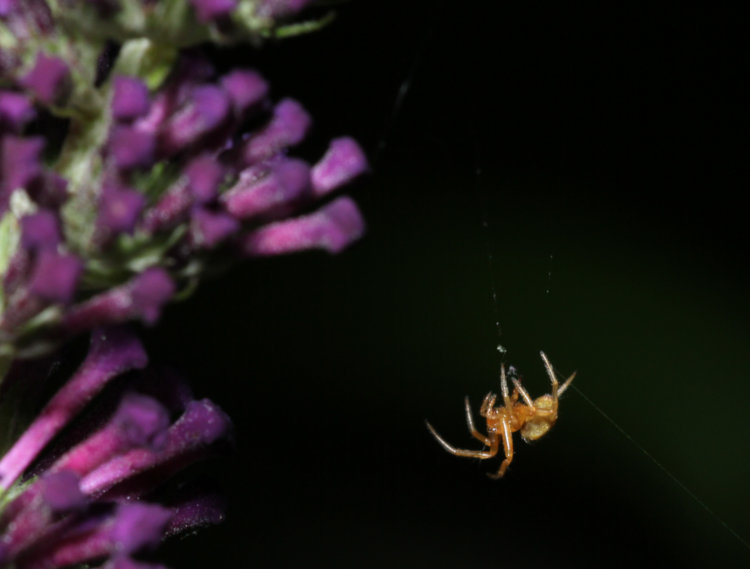
Another unidentified specimen, but likely an orb weaver at least, and this one would have been a decent meal for the tiny frog, and probably ignored entirely by the toad, being smaller than its eye. Speaking of eyes, there’s the barest hint of a white reflection from one of the spider’s own, if you look closely. I even captured that from my next subject too.
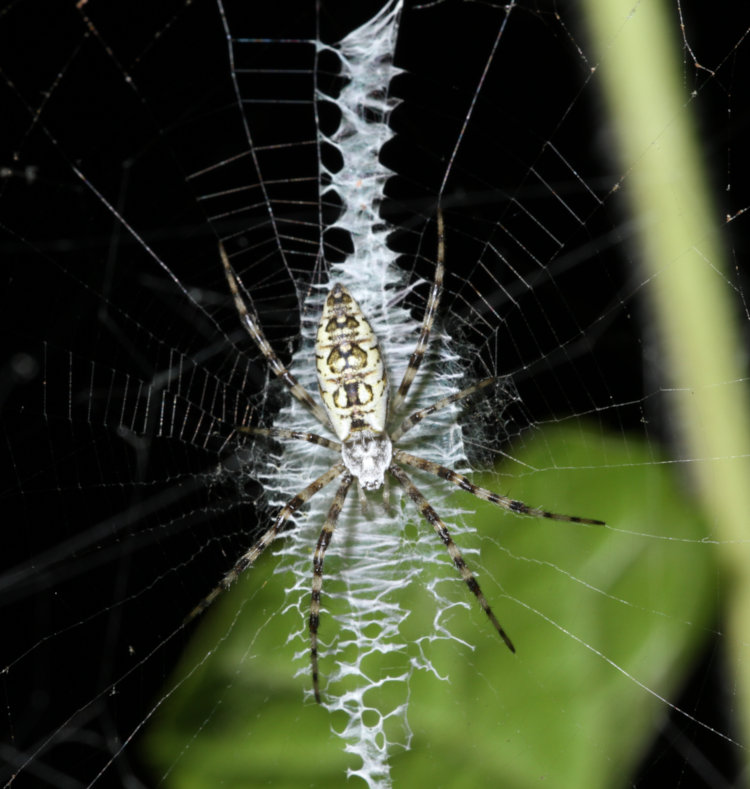
The spiders are still small yet, so this black-and-yellow argiope (Argiope aurantia) was nowhere near the impressive size it could reach in late summer, as long as it escapes the attention of predators. Probably about 10mm in body length, but quite obvious with the typical ‘scribbling’ in the web. This was on the porcelain berry vine (Ampelopsis glandulosa,) that we provided with a trellis late last year and it took to it this spring with enthusiasm, so hopefully I’ll have some colorful subjects to work with later in the year.
Okay, back to sorting…