
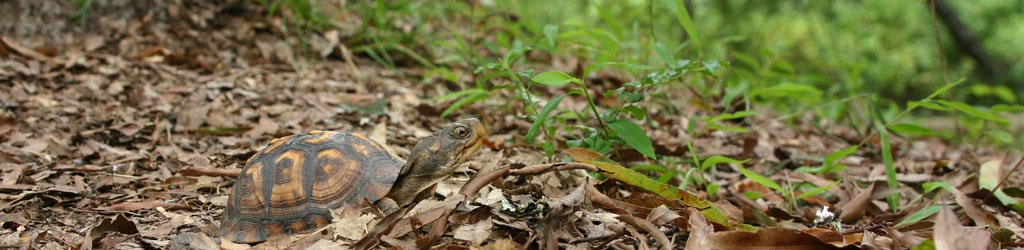
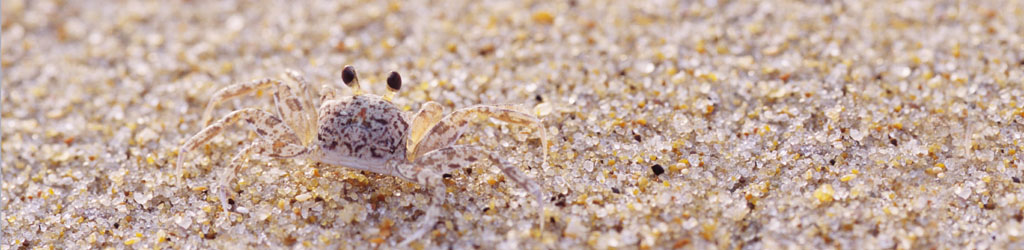
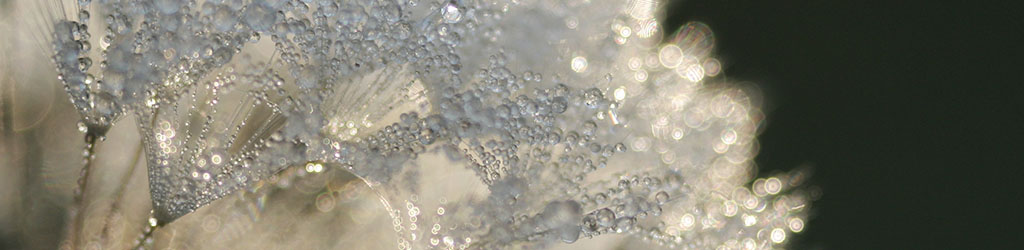
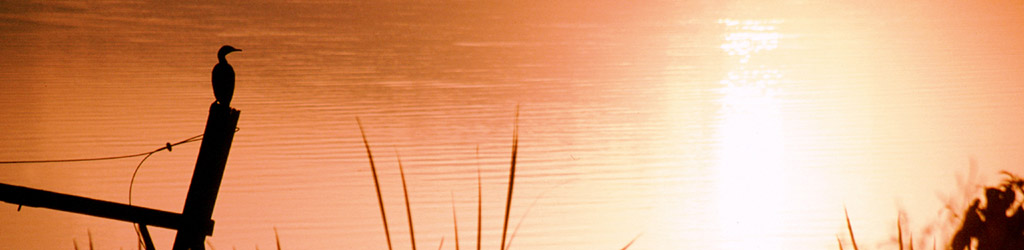
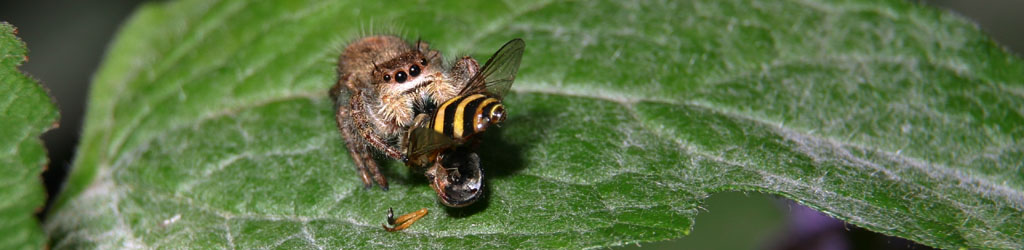
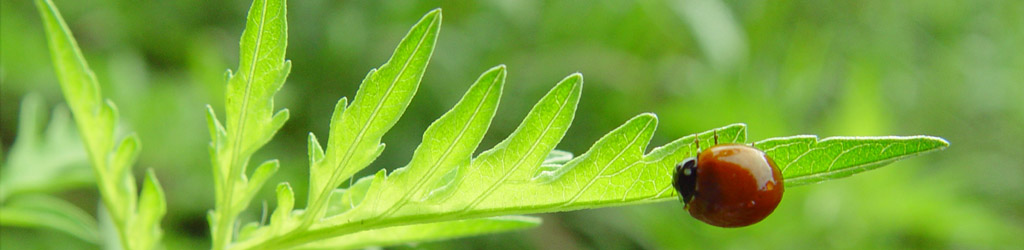
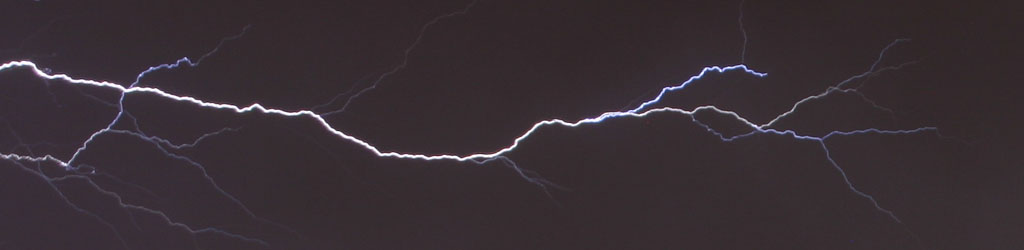
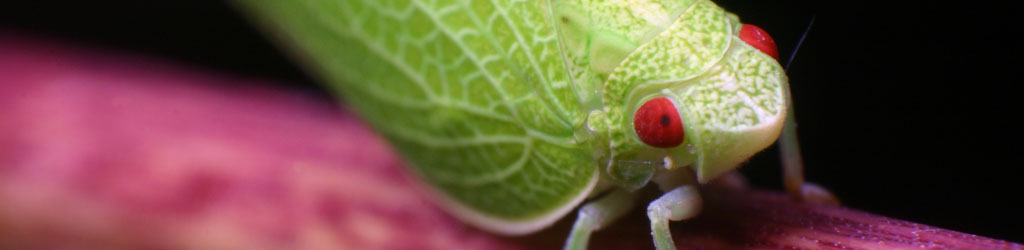
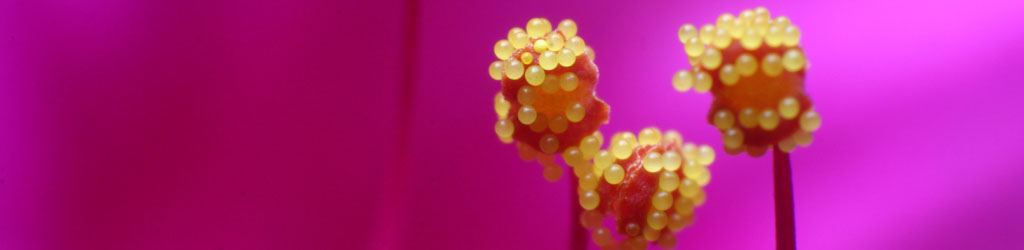
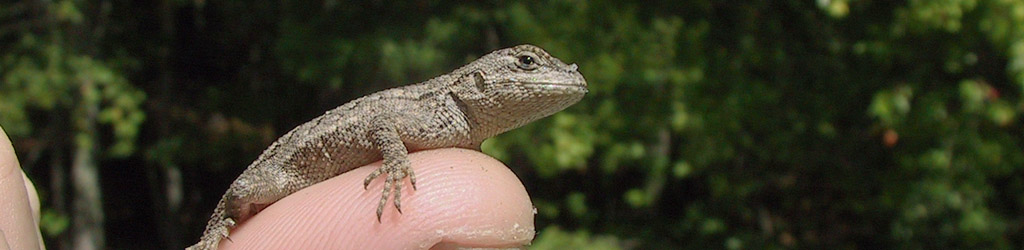
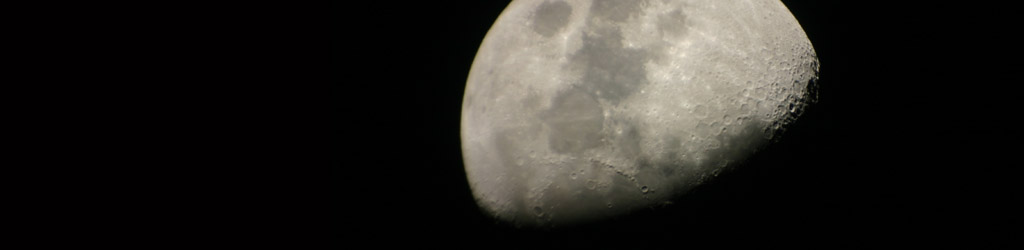

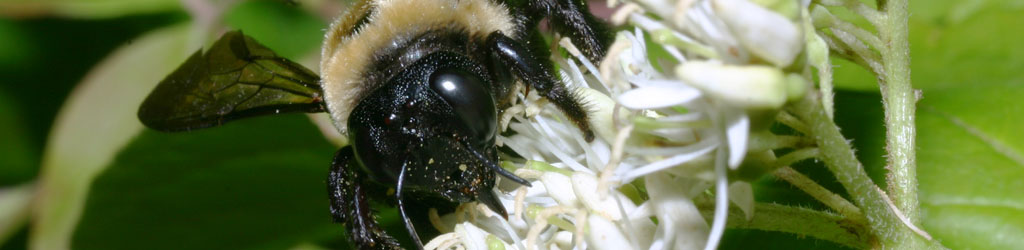
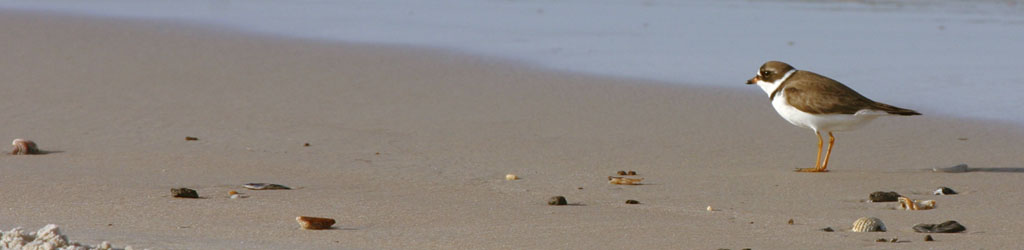

And so August goes its merry way, but not without firing off its parting shot of an abstract image. And just to show you what kind of guy I am, I’m not going to jump right in and blurt out what this is an image of, but I’m going to let you figure it out for yourself instead. If you get stumped, I’ll be along eventually (before the decade is out, most likely) and fill you in as needed, but I’m confident that won’t be necessary.
What?
A few days back, the Missing Mr Bugg had finally finished with all his summer chores and we had another outing, the first since early May; it was moderately productive but not as much as either of us would have liked. Nonetheless, we both have a selection of useful photos, and I gave him plenty of time to rectify the horrible neglect he’s been showing his blog, but as of this writing he still hasn’t posted anything, so I guess it’s up to me. Yet again.
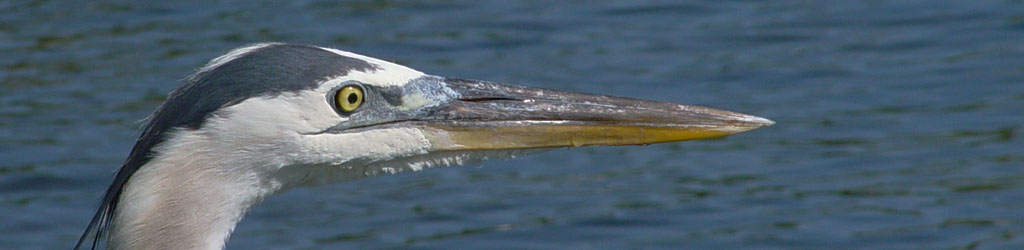
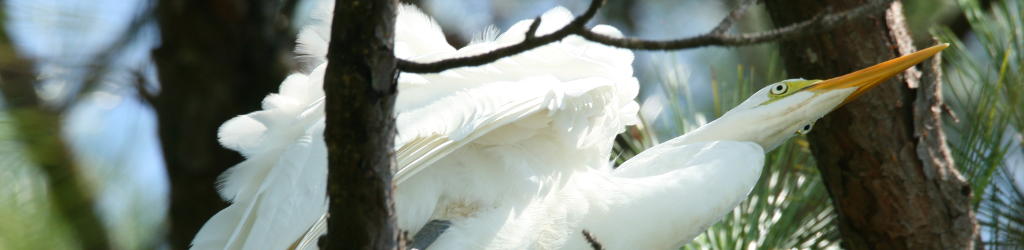
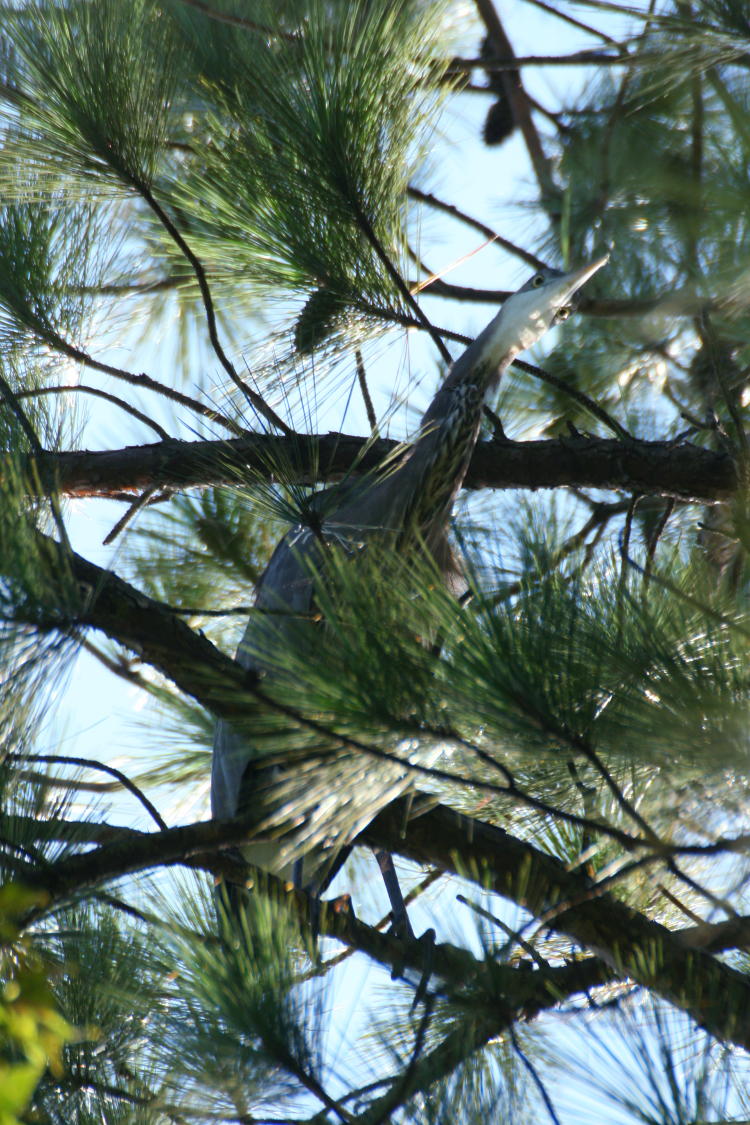
More will be coming, but I had to post this one just for the expression and odd angle. While we watched, a territorial dispute between two great blue herons (Ardea herodias) resulted in one cruising across the lake and alighting in a tree almost directly over our heads. I had lost sight of it among the branches just as it touched down, but knew it had to be within a very small area, not to mention that it was gurking softly to itself as we quietly shifted back and forth beneath it trying for a glimpse – and it still took two minutes to spot the bulky bird. It wasn’t as horrified by our presence as it appears here, spending time looking out over the water and carefully watching an unleashed (of course) dog that was shambling through the immediate vicinity. The owner none-too-quietly informed us of the number of birds that could be seen in the area, blissfully unaware of us both pointing long lenses into the tree canopy directly overhead and speaking in hushed tones. There’s a reason that I don’t like popular parks…
By the way, this is a good example of why you should know how to shut off autofocus quickly and without looking at the switch. In such conditions, the camera is likely to lock onto anything except the eyes of the bird, which is the primary point of attention for the image, and you’ll need to get focus back where it belongs quickly. Meanwhile, this shows the useful eye-alignment of herons (and many other waders,) able to see straight down under its chin – its beak is aimed slightly downwards here, but far from directly towards us. For birds like the American bittern, this placement allows the bird to view its entire surroundings while its beak is pointed straight up in camouflage mode, making it appear like water reeds – plus it permits watching the ground underneath its perch for predators, and probably even assists in spotting food in the very water the bird is wading within. This probably means that thousands of years in the future, nature photographers will have big protruding eyes that allow them to see all of the potential subjects that might be around them.*
* Assuming, of course, that nature photographers gain preferential mating privileges through their activities, which is a highly debatable factor…
I am about to outdo myself
It’s 3 AM, and I’ve just come back inside from filming/videoing something in the backyard, and all I can say right now is, it will likely remain the most bizarre thing that I’ve captured on video for quite a long time to come. It all started when I just took the headlamp out and poked around a little bit to see what could be found, and stumbled across (well, not literally, thank dog) something that, you know, boded. Thinking I should get video of it if I was correct, I came inside and got the camera and light unit, taking only a couple of minutes to do so, and when I came back out I found that my suspicions were well-founded.
I’m being vague because I’m not going to spoil it, while it isn’t appearing yet because I still have the post-processing to do, and it’s late and I’m going to get some sleep. Which might be a mistake, considering what I’ve just seen. The worst part (so far) is, I might have to wait a week because I nearly reached my weekly upload limit on Vimeo with yesterday’s video – it all depends on how long this one is, though I suspect I can slip it in under the wire. Don’t get too anxious though, because you may very well regret it. The only other thing I’ll say right now is, think of the most disgusting thing that you’ve seen here, because I now have the same, but in living motion.
Podcast: Hybridcast
Today is Highly Debatable Humor Day, when we celebrate those examples of humor where the appeal could be wildly subjective; if you don’t find it amusing, well, you’re in accordance with a certain percentage of victims listeners/viewers, so just take heart in the idea that you’re not alone.
I kinda jammed it all together with this one. What started out as an idea for a longish photo post soon revealed itself to be way too long for a written and illustrated page (yeah, even for me, so you know that’s saying something.) Plus I had a couple of other incidentals to mention, and hadn’t done a podcast recently. So we get this podcast/slideshow/video clip compilation that probably doesn’t do justice to any format. And yet, I’m still not shooting vertical video on a smutphone…
Further details on schtuff therein:
The Original Ceylon Tea Company – Best Earl Grey that I’ve found yet.
Tardis Tea from Adagio Teas – Also very good – the tin is cool, but The Girlfriend’s Sprog stole that from me. Also check out the IngenuiTEA infuser, because screw tea bags (there’s an off-color joke in the making there, but I think we’ve had our fill of those for the time being.)
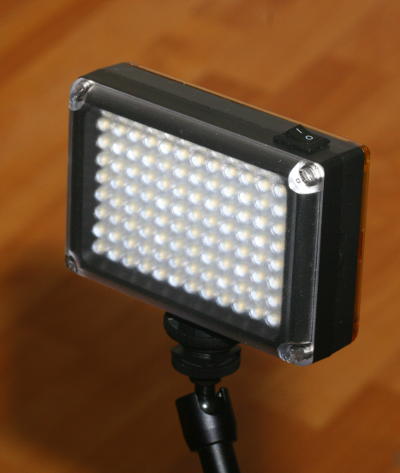 Two things that I neglected to mention regarding the video clips – they made it into the first attempt that was thwarted by post-nasal drip, and I forgot them the second time around. I obtained a little 96-LED portable light source that runs on 4 AA batteries or a USB powerbank, and that’s what was used for the two clips seen here – it’s light enough to be supported on an articulated arm (on its shoe mount or 1/4-20 tripod socket,) works fabulously for macro video, is reasonably diffuse, and is even dimmable. There are lots of versions on Ebay, and I have to say it was well worth the trivial price.
The second bit is, I’m still using the off-camera monitor, which helps with macro work significantly, but it has one effect that you can see in the video: aiming the camera is no longer an intuitive thing. For instance, holding it in a bracket down below waist level and framing with the monitor means that tracking a moving subject, or simply pointing the camera in the right direction, is a lot more challenging. Yes, I need more practice, thank you Captain Obvious, but I’m offering this as a warning to those getting started in it like I am.
Now, the part where I mentioned that the camera had some kind of tracking error that led to weird lines towards the bottom of the frame? Yeah, maybe you didn’t see that effect at all – it might actually be the fault of the video player that I’m using in Linux, and/or the screen resolution of the same. I also had some weird issues with the first rendering of this hybridcast, stray frames appearing at the very end of fade effects, and that is a known issue with the OpenShot editing program; a little websearch provided a simple solution, so never neglect your Google-Fu when you run into an issue (the solution, should you encounter the problem yourself, is to move the offending clip to an extra track, which seems to eradicate the frame blip for some reason.)
Did you notice that I had the directions reversed on Bar Sinister and Bar Dexter? Good – keep it to yourself, hotshot.
And finally, a reiterated public service message:
Per the ancient lore, part 24

Okay, no cheating now by looking at the image tags, page tags, or past Ancient Lore posts: what’s the topic here?
I’ll provide a little hint: This was taken on the same evening as two Lore posts back, with the help of the same function of the camera. Ah ah! No scrolling now – you have to rely on memory. It was only two weeks ago.
Figure it out yet? Don’t you hate it when people challenge you to trivial little bullshit like this, as if it’s a reflection of your comparative cleverness?
So the first bit is, we’re down to the Reptiles/Amphibians folder again. Do you want me to pause here while you give it another go?
More specifically, our subject is that bright pinkish spot down towards the bottom and slightly left, which is the reflection of the camera flash from the dilated eyes of a Cuban treefrog (Osteopilus septentrionalis,) perched up there in the fronds of what I believe is a date palm. I was scoping out the area using the infra-red function of the camera, and believe me, frogs’ eyes reflect infra-red at least as much as they do visible light, possibly more.
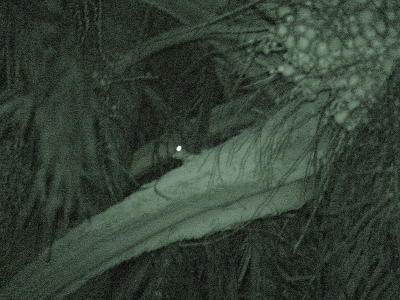 But you don’t have to believe me though, because I can show you – trust me, I’ll never require you to trust me. It’s easy to see why I exclaimed, “Whoa!” when the lens pointed in this critter’s direction. In fact, it made me regret that we (remember, I was out there with my brother that evening) never saw something that I’ve caught a few times in the same park, which was an alligator floating in the water. Their eyes are super-reflective, shining back brilliantly orange as brightly as a road reflector, better than any other animal that I’ve seen. One night, from a moderate distance, I caught the reflection in a water channel, and slowly crept closer to try and see more of the gator. I was fairly certain, from the size of the channel and the bare fact that I never did make out any aspect of its head, that it was a pretty small specimen, but before I could determine this for sure, it was spooked by my approach and dipped out of sight beneath the surface. Alligators generally have different reputations, depending on whether you live in Florida and have firsthand experience of them, or elsewhere and rely on the stories and folklore. Bluntly, they’re pretty shy unless it’s an area where they’re habituated to close contact, and then they’re largely blasé. This was not such an area.
A more indicative encounter, if you can call it that, occurred another night when I bicycled down to the park. Most of the ride could take place near streetlights and adequate illumination that made a headlamp unnecessary, so I arrived at the park riding dark, as it were. The entrance was better than sixty meters from the water’s edge and I was coasting as silently as it’s possible to get, but the moment I came into the pool of light from the first of the parking lot streetlamps, there came a frenetic splashing from the vicinity of the boat ramps, where at least one alligator (which sounded sizable) beat a hasty retreat into the water to avoid any potential contact. Just remember that if you’re thinking of starting trouble with me.
Totally tubular
It’s been a while since I featured something from Ze Frank (or is it zefrank?) and I’m happy to rectify that with this latest offering:
I was originally going to leave it at that and be happy, but two things intervened:
1) I haven’t been posting enough anyway;
2) I’ve had some images kicking around for years and have never written about them, even though I’ve been meaning to.
And so, reminded of this, I present a couple of organisms that may be related. Or may not.
When living in Florida, on one of the Atlantic beaches I noticed some odd rock formations. First off, this was notable because very little of the Atlantic seaboard shows any rock at all; it’s sand as far as you care to dig. But on closer inspection, it turns out it wasn’t actually rock anyway.

From the right angle, the myriad openings could be seen, revealing that the rocks were actually large colonies of some tubeworm or similar organisms, all aligned the same way. I imagine (because I honestly couldn’t tell you what the facts are) this was for two reasons: because building onto your neighbors’ structures was easier and sturdier than creating a freestanding one, and because one direction was optimum for feeding. These ‘rocks’ were pretty damn strong, able to be walked on, and close inspection showed them to be mostly sand cemented together. I never saw any indication of occupancy, so they might have been old and abandoned, but I also discovered them at low tide and it’s pretty likely that the occupants wouldn’t be seen until they were completely submerged at high tide anyway.

From other angles, the structures could be taken to be simply rougher rock or sand accretions, since the tubular shapes, made from sand and shell fragments, were hard to distinguish from any side that didn’t show the openings. Now, at this time I had been working on something to allow me to shoot macro photos underwater without submerging the camera (I might feature this later on,) but this project wasn’t completed yet and so I had no way of seeing what happened at high tide. And at no point since have I ever encountered anyone who could tell me more about what I found. But as you can likely surmise from the photos, there were perhaps hundreds of thousands of these unidentified critters living in these beachfront condos.
On another trip, I found something else washed up on shore, almost certainly long-abandoned, but much more distinctive in material and structure.
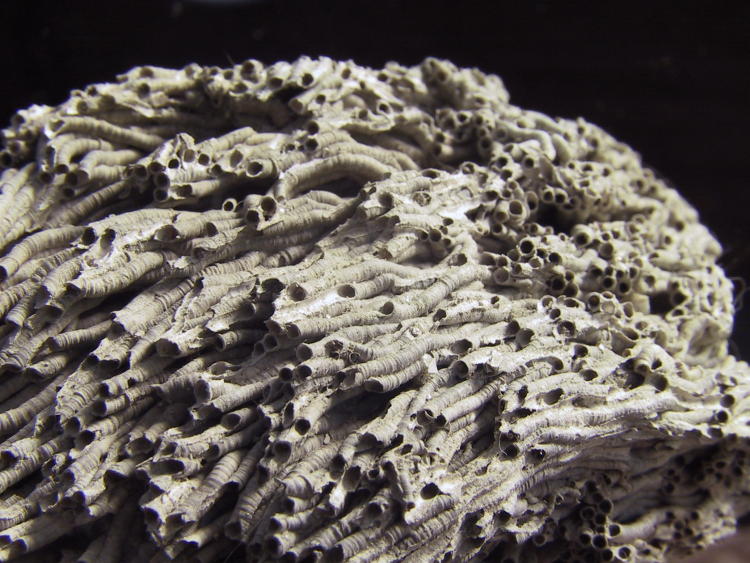
These tubes definitely appear to be calcium-based at least, and are quite tough for their thin structure. I took these to be a form of ‘feather duster,’ a common name for the Family Sabellidae of the polychaetes, because I’d seen something very similar before in a friend’s aquarium. However, those were individualistic, and only one species forms a tube from calcium carbonate and they’re off Australia. Not to mention that, had they possessed the fanlike appendages like those shown in the video, colonies this tightly-packed would have been actively interfering with one another constantly, so I doubt they were the same type of organism.
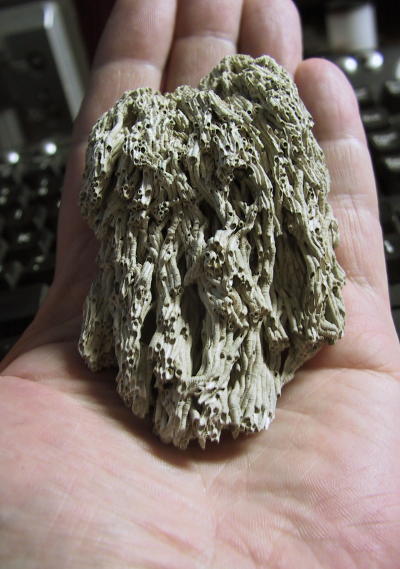 This photo shows scale a little better, and I can simply tell you that the tube openings are right around 1mm in diameter because I still have this specimen – anyone that wants to see it in person should drop me an e-mail; I’ll tell you how to get here and we’ll make a party of it. Perhaps I’ll hold a contest to see who can guess closest to the actual number of tubes in this small specimen, the winner getting… ummmm… something appropriate, anyway. I’ll need to charge a decent entry fee to compensate me for counting all those motherfuckers. Maybe, if I get bored, I’ll saw one end off cleanly and make a really cool set of pan pipes from this cluster…
And one more, because I’m on the subject and have the photos handy.
Several years ago during a beach trip, I collected a recently-washed-ashore cluster of weeds and debris, all tangled in fishing line, and with it came a handful of the tiniest hermit crabs that you’ve ever seen. This meant that I had to do a macro aquarium session.
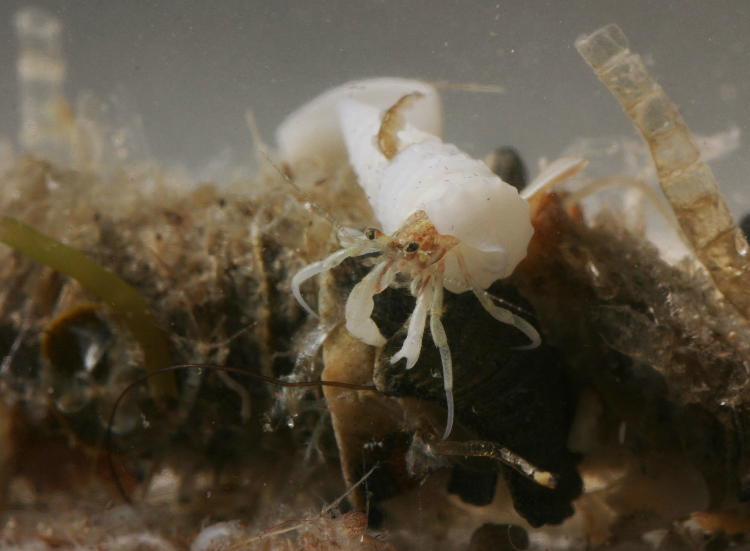
What brings this into the same post is the very thing that the hermit crab is clambering upon, which is another tube of an unknown and unseen marine denizen; it’s so well camouflaged here that it’s hard to make out, but it’s laying horizontally and stretching across the frame (and well beyond.) This one was definitely very flexible, probably a little smaller in diameter than a pencil, and liberally festooned with dead vegetation and bits of shell – it seems likely this wasn’t a buried tube but existed above the sand surface, and could probably sway in the current. And this also gives you a good idea of how small the crab was; while we’re here, we’ll have a closer look.
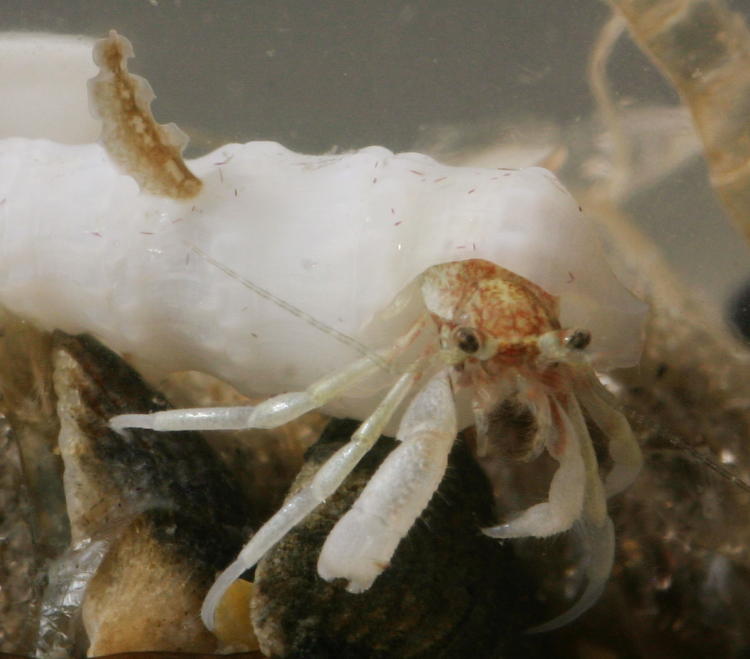
Don’t ask me to try and identify this species, because I wouldn’t even know where to begin – it seems obvious this is a very young one and possibly bears few characteristics of an adult. But I am impressed that it can still find a cone shell to match – it seems these come in a huge variety of sizes too. And yes, there’s something attached to the crab’s shell and riding along, but I’m not trying to identify that either. It might be related to the little membranous thing that I video’d many years ago, but the shape is different, so all bets are off.
One of these days, I’ll come across some live specimens of such finds, in a manner where they can be photographed effectively, and do a follow-up post. This is naturally going to mean more beach trips but, you know, I’ll just have to make that sacrifice for my voluminous readership. You all mean that much to me.
Lost at sea on this one
There are a lot of blogs out there that focus on personal hardships, the emotional experience, and the kind of common neuroses that most humans are prone to, and I’ve made it a point not to get involved in such things. Which is not to say that I don’t think they have their place sometimes (The Bloggess is one of those that I follow semi-regularly,) but that it’s just not my approach, and you will rarely hear about the personal events going on in my life, and especially not the things that I dither about.
Except for one. I have occasionally mentioned this before, but not too often, I don’t think. The very nature of this neurosis is that it’s somewhat self-referential, kind of a “Am I being too paranoid?” thing.
Here’s the deal: I would like to be more popular and more recognized through my web presence. Not famous in any way, because I don’t think I’d like that, but having my images and even some of my writing published elsewhere a lot more often. Certainly to the point where I could get paid closer to a living wage for doing something that I liked, anyway. The problem is, I have no idea how to go about it.
Or maybe I do, and I’m simply not good enough to garner the attention. While I like a lot of my images, and the writing in more than a couple of posts here, this could simply be a manifestation of the Dunning-Kruger effect (PDF link,) where failing to recognize one’s shortcomings can sometimes lead to overestimating one’s abilities; people that think they did really good on a test are often incorrect about it. You see what I’m saying about neuroses now? Should I keep plugging away until I hate my own work? Somehow I don’t think that’s a viable game plan…
[I have to note here that, as I was preparing to write this post, I couldn’t remember ‘Dunning-Kruger effect’ and did a web search. The first several links that I turned up were all along the lines of “You’re smarter than you think!”, which was exactly the opposite of the search term I’d entered – but undoubtedly click-bait headlines and a lot more popular. I saved a few links for later.]
Don’t get the impression that I haven’t been trying to find the way to make this happen. I’ve gone through more than a few sources regarding gaining recognition and popularity, and have been following a certain amount of the advice provided. Now, social media long ago convinced me of its own worthlessness, and my personal experience with it merely confirmed this finding. But I’ve listened to many of the people who became known for their work before social media was even a thing, and much of this entire site is predicated on that advice. So far, it hasn’t really worked. So again, do I suck? Am I missing something subtle but damaging?
Or, is it simply a mistaken impression? You can ask a lottery winner what they did to strike it rich, but their routine or lucky numbers or faith in veganism is meaningless – it was strictly random. And for perhaps a lot of those successful people, I suspect that this is the case. Not to denigrate the accomplishments of anyone out there, because obviously their skills are maintaining their popularity and such, but there are a ridiculous number of websites to be found, and perhaps it’s just a matter of happenstance that brings attention to them and starts the ball rolling. Useful information isn’t about what happened once, but what worked for the majority of people who tried it. And who’s even tallying that number?
There then are the other aspects. A few years back I was active on both newsgroups, for photography, and a few websites devoted to critical thinking. All of my comments, where I could, were appended with a link back to my own site, with a very basic premise in mind: if I struck you with whatever I posted there, you would be able to find more by following the link. Low-key, admittedly, but respectful and not at all intrusive. And truth be told, occasionally it worked, as I could tell from the site statistics.
But then a few things happened. Newsgroups died, partially from internet providers halting free access to the servers, requiring users to pay outside sources. And partially from human nature, becoming the playground of the socially incompetent (which is what makes social media the hypocritical joke that it is.) More and more sites, unable to figure out a few simple rules for commenting or not bothering to devote any time or money to moderation, abolished their commenting systems. And, interest in the kind of sites that I frequented just died out – which I can’t disparage, given how few I’m visiting myself anymore. So I am no longer actively drawing attention to this site, and have no good method of reinstating this either.
Smutphones, of course, deserve their own recognition here, since the tiny screens and the brief periods of time which can be devoted to them makes them the worst possible way to view a site like mine, which has a lot to do with why I spend no time accommodating them (the remainder is simply because they’re stupid.) Too many people virtually abandoned their desktop or laptop computers in favor of their phones, and so every site with content above the level of memes suffered, I’m sure.
Perhaps I was too late, starting blogging well after it became popular and missing the heyday when there were fewer, and could thus gain more attention – now, I think the general reaction is, “Oh, you’re blogging too? Cute.” The same may be said for podcasting and my forays into video, though the former is admittedly not aimed at serious public attention, and the latter even less so – video is a function of showing what still photos may miss, and so no, I won’t have a ‘channel’ any time soon, if ever. Meanwhile, the blog remains someplace to examine the subjects and approaches that make up my nature photography, as well as some philosophical musings, with a minimal dose of minutia and superficiality. [Clears throat, whistles in the dark…]
Then comes personality, perhaps. I have recognized, at times past, that I should be ‘networking’ more, making more connections with people in related fields to expand my opportunities and options – and this has never worked. In some cases it was notably a matter of bad luck, getting involved with people or organizations that had a negative effect, bad reputations, or just too few outside connections. But I’m also not a ‘people person,’ not exactly a networker to begin with – not really asocial, but I have no desire to seek out interactions with others most times, and while I can get along just fine with most people, I’m fairly straightforward and perhaps just don’t quite make the connections that I should. Is this contributing to my lack of success in this endeavor, or only a trivial factor? I have no way of knowing. Hopefully it’s not a serious hindrance, because it isn’t something that I could change easily, if at all.
And finally, I find the vast majority of marketing to be utter horseshit, in most cases condescending or pandering, and never want to be involved in anything of the sort. The fact that some of it might work better than what I’m presently doing doesn’t matter; it’s still bullshit that isn’t me. In which case, perhaps, I’m getting what I deserve.
Now I admit that I can’t even read this and not hear, someplace in the background, a plea for attention, trolling for compliments, but that’s not at all what I’m up to. I just wonder sometimes if I should be going about things differently, and if so, how? There is certainly no shortage of sources that want to answer this question, often at a fee – and no way to determine which ones aren’t simply full of shit.
Again, all of this might sound a bit neurotic, and probably is to a degree, but obviously I want something to improve here, and all advice has it that I have to work hard and make it happen, which I’m not arguing with at all. I’m just trying to determine how to make it happen – what works, and what doesn’t? What do I need to be changing? Or is it still mostly up to the whims of fate?
Per the ancient lore, part 23

This is one of those images that might hit different people in different ways, and by that I mean, some might be puzzling over what they’re looking at, and some might know right away – with a distinct possibility that this is “all” and “no one.” Only in reversed order. While choosing the photo for this week’s Ancient Lore post, I noticed that a different crop made it more, ummmm, let’s settle for ‘enigmatic’ and leave it at that.
So if you’re paying far more attention than is warranted from anyone with a life, you know that we’ve reached the Mountains folder again, and since there are no mountains in Florida (and in fact, the highest elevation barely counts as a “hill” in most states,) we must be someplace else. This was, in fact, the first trip that prompted me to create a Mountains folder in the first place, and it’s still rather sparsely populated with images. We’re also not using the Sony F717, which had long since gone to its new owner, but the Canon Pro 90 instead, the first digital that I owned all by myself. I took a weekend to finally visit the mountains of North Carolina, in May of 2005 which puts it, oh, not quite fifteen years since I’d first moved into the state. And while this was the time I had to make the brief trip, it wasn’t quite properly timed, since the full spring bloom was yet a couple of weeks away and the landscapes still had bare trees in places, making for a faintly threadbare appearance – I had judged the trip by what was happening in central NC, knowing the mountains would be a little behind that in development, but they were farther behind than I thought. Still, I had my handy book, North Carolina Waterfalls by Kevin Adams, and a decent list of spots to check out, so I had other subjects to pursue.
Which, if you were one of the none people who were puzzled over the image above, now explains what you were looking at. This is, to the best of my recollection, Moore Cove Falls; I seemed to remember that it was harder to get to than the book (which I just referred back to) describes, but I’m probably conflating two together. This seems to match Adams’ illustration reasonably closely, anyway. I mean, not this image, but the wider one that you’re about to see. I went for this crop because of the faint details that were showing behind the veil of falling water, and wanted to see the effect if I omitted all other establishing details. Of course, since I already knew what I’d photographed, no such effect would have any impact on me.
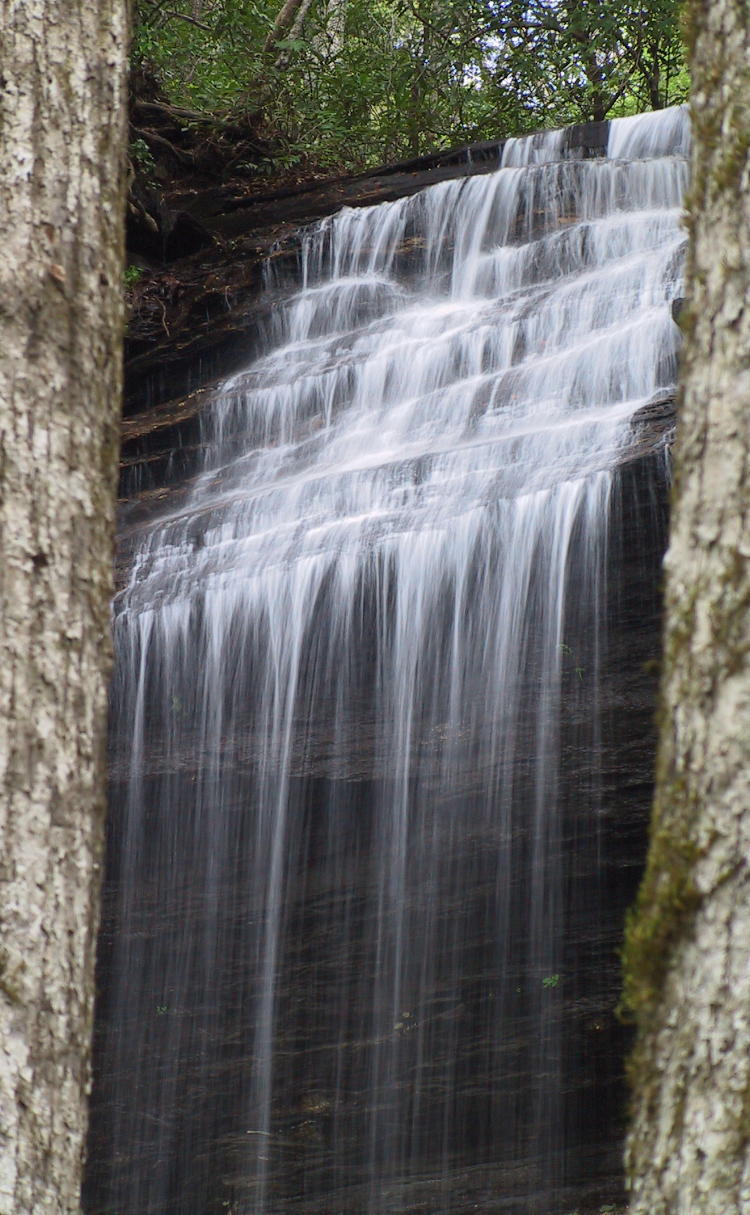
Moore Cove Falls isn’t a high-volume cataract and isn’t especially tall, so I was playing around with different perspectives and liked this one the best – there’s a kind of anachronism between the blur of the falling water and the distinction of each individual stream and trickle, lending more of an impression of strands of cotton or webbing, and these lines are mimicked to a degree by the layers of rock behind them. I might have had a lot more options had I been there a few weeks later when the rhododendrons were in bloom, but timing such can be a lot harder than it seems. The temperatures and humidity in the mountains are widely variable, and even if, for instance, I had a source that told me that the flowers were in bloom in the populated regions of Brevard County, they might still be several days away from that point up at this waterfall. This is probably where some kind of app comes in handy, but back in those ancient times we could only rely on Googling a webpage before we left home. And Google back then didn’t even autocorrcet our search terms.
Hey, man, got any change?
When and how, exactly, did coins begin to be called, “change?” I’m guessing it had something to do with the only thing you could change a paper bill into.
But that’s not what I’m here to type about. I haven’t done a philosophical/existential post in a long time, mostly because I wasn’t coming across any subject that struck my thinking processes in that way, but that’s changed now. Whether this one was actually worth the effort remains to be seen – because you haven’t read that far yet. Hah! And you thought I might be doubting my own judgment in topic values; that comes later on, trust me.
To properly set the stage, we’re going to have to go back to the beginning. No, wait – there were actually events that set other things in motion before then, so we’ll have to go even further back. But then, if you really wanted to know why this all happened, we’re probably going to have to know how those came about…
Everything has to start somewhere. I mean, right? There’s always a beginning? If you’re religious, you’ll usually maintain that everything started when a god poofed it into existence, and conveniently ignore the question of where this god arose from, or claim that it was exempt from the very rule that you just said has to exist (which was used to prove the existence of that god in the first place.) Yet there are lots of other aspects too, such as when life begins (either on the individual scale, such as a fetus, or when Life itself fired up on the planet,) or maybe at what point humans first appeared, or perhaps when the troubles all started that fomented a war or revolution, and so on. Chicken or egg and all that jazz. And it doesn’t take much time to realize that we would actually need to create some arbitrary distinction, some randomly defined ‘moment’ with a special title, because the process of cause-and-effect just keeps going back.
Which is where science has it all over religion, because we can see that change in state requires energy exchange, and not only can we see this, we use it all the time, dependably and predictably and with enormous, exacting precision. We can have reasonably stable states that are more-or-less inert, like gunpowder, but introduce change rapidly and drastically with the kinetic energy of the firing pin that ignites the gunpowder through a sudden increase in local energy by friction/compression. We heat food through the application of high electrical potential meeting resistance from the medium of the coil, which produces heat (high molecular activity,) which quickly distributes among neighboring molecules (metal, air) to warm up our Spaghetti-Os. Did it start when we turned on the stove? No, because we input our own muscle energy to do that. So it started with our own decision to have neon pasta for lunch, then?
That, of course, is the old free will argument, which quickly falls apart when you realize that our brains work in the same damn universe as everything else, made up of the same basic matter and thus beholden to the same rules of physics – somewhere down the line comes the exchange of energy, and in fact, it’s constant, because without it we’d be dead; that’s pretty much the definition of death, and even then, we have arbitrary distinctions which are often argued. Where I used to live, there was a lawyer serving a life sentence (no, it was not a utopia, he was sentenced for something other than being a lawyer,) and in New York the definition of death was the cessation of heart activity for a specified period of time. This attorney had undergone open-heart surgery during his sentence, which required stopping his heart for longer than this necessary period, so he was arguing, in court mind you, that he had ‘died’ and thus had fulfilled his sentence. Technicalities, you know? If I remember right, the judge pointed out that wards of the state were all cremated, so he could either drop the case or report immediately to the crematorium. And there’s also the occasionally-referenced bit about lime Jell-O being ‘alive,’ because in the right circumstances it can demonstrate the same wave response from an electro-encephalogram that we often consider ‘brain wave activity,’ for another competing definition of life. This was not a demonstration that Jell-O thinks in any way, merely that it shows enough electrical response, stimulated by both its surroundings and the nature of its own molecules, to register a wave pattern on the equipment, something that we were taking to indicate a still-functioning brain in a human being. Sooner or later, we find exceptions to every demarcation that we try to instill or introduce.
Ah, but the Big Bang! That’s where it all started – even astrophysicists have said so! But if you notice, they generally say that the universe that we inhabit started then, or more specifically traces back to something in that general region of time. In the same way that we might see a water balloon impact and trace back the apparent path to discover who threw it, we can use those super-dependable rules of physics to trace back current trends and realize that there was once a state of very dense matter/energy that has since been expanding. And there’s more than a little bit of evidence that some of these rules of physics were introduced by this state. It’s very easy to believe that we’re going outside of empirical science and into the realm of mere speculation, and this accusation is leveled constantly, yet physicists have delved into this more than superficially and have demonstrated the reasoning and evidence a lot more than merely speculatively. But don’t take my word for it, and check it out yourself – this isn’t a bad start, and there’s plenty more out there.
If we continue to follow that path backwards, however, we come to a dilemma if we’re still wrapped up in thinking about beginnings. If we assume that the Singularity is a stable state, then, what made it change from that, what input of energy provoked the sudden expansion? Again, more than a few people say, “god,” at this point, ignoring the idea of where god got the energy, or how it produces it from nothing, or in what way the idea of an intelligence or even a deliberate “will” is supposed to have existed for all time – and why, at this point, it decided to change all of that. Meanwhile, physicists and the like don’t actually say that the Singularity was the beginning of it all, simply the point that we can trace back with the evidence available to us, and certainly something was going on before that, but now we really are into the realm of mere speculation – there’s nothing more (yet, anyway) that we can work with. And even those speculations abound, such as whether a collapsing super black hole, the ones that outright rend the fabric of space/time and all that, can introduce a new explosion of matter/energy into a whole other realm of existence – and whether this is what happened here.
But when it comes right down to it, there’s no such thing as a stable state – there’s always energy, always activity, always electrons circling and all that. And if there were a stable state, then it would have to remain that way forever – unless there was an energy exchange from something else. And where did that come from? We pretty much come to the idea that change is constant, and would have to be. There is no beginning of anything, much less everything, there are only states that may be relatively slow in changing until something else happens, and we can say that only if we limit ourselves to setting specific demarcations again. Our universe, to all evidence so far, traces back to a singularity or something very close to it – but there’s very likely something much more than that ‘outside’ of it or preceding it or whatever. In fact, the very word “change” seems to imply that there is something that is stable, that is not changing – yet we have no evidence of that whatsoever, and logically this can’t even exist.
I’ve said this before, but it appears that the idea of the start of anything arises (hah!) solely from our own very narrow perspective, from the idea that not only do we identify a ‘personhood’ from ourselves, a temporary (eighty years, give or take) collection of interacting atoms, we have a point where we can no longer trace back our own experience, our memories and all that – and we think this has to apply to everything. Pretty egotistical, when you think about it. But when we die, all that matter goes someplace else – except, no, it’s been exchanging constantly the entire time, producing babies and shit and skin flakes and, geez, well, it’s just going all over the place perpetually. “We,” the self, the soul, the free will, is just a matrix of experience that helps the genes along – which in itself is just a pattern of energy exchange that arises due to the rules immediately present. It’s freaky.
No, I’m not stoned right now.
* * * * *
Something else, vaguely related. It almost stands to reason that, in the same manner that we say, “There is no beginning,” we could also say there is no end as well – things have to keep happening. Except, given the current evidence, this does not appear to be the case. The expansion of the universe is not only ongoing, it’s accelerating, and there appears to be some energy that is promoting this (“dark energy,” if you want to look it up.) Given this, at some point in the future matter will be so scattered that there can be no energy exchange – entropy, or the laws of thermodynamics if you prefer, pretty much point to a “heat death” of the universe, a point where the matter/energy have dissipated so much that all activity ceases. So, there can be no beginning, but there can be an end, or at least a point where all change and exchange halts, except perhaps for continued expansion? This seems to defy both logic and comprehension – but at present, that’s what we have evidence of. Which makes me a little conflicted, because I’m in favor of the idea of a cyclic universe/multiverse scenario, where something happens to reverse this trend and prevent perpetual expansion – but there’s no evidence for this, and I have to face the idea that this is dictated by what I consider logical and nothing else. It remains possible that something really does reverse the expansion – but that’s only speculation. It’s also possible that physics is a one-way trip, once the process gets ‘started’ – and now you see the dilemma. How could there be no beginning but an end, how could there be constant change… until there isn’t? That’s freaky. But if we’re honest with ourselves, we don’t resort to our own concepts of how things must work, our own ideas of logic (which, as I’ve said before, is merely the extrapolation of cause-and-effect in the first place,) but only what the evidence shows.
Missed a meaningless milestone
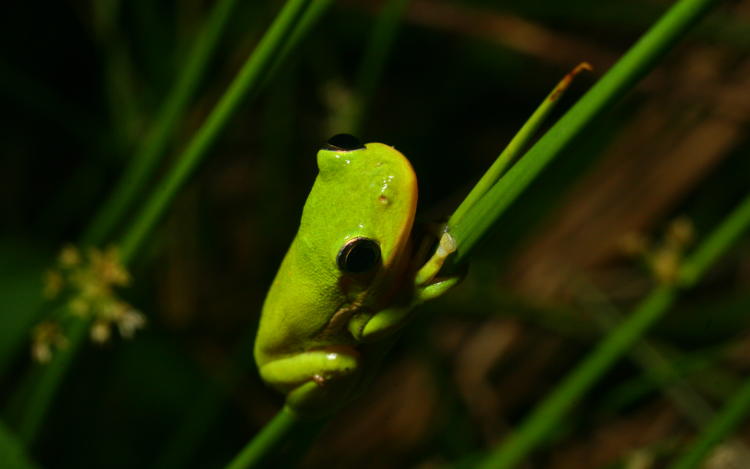
You know how you look down at the odometer of your car and realize that you just missed seeing it turn over some major rounded number, like 100,000 kilometers or something? Well, this is nothing at all like that.
Okay, no, it kinda is, because you’re looking at the 50,000 image that I shot on the Canon 30D. Five years ago I announced much the same thing on the old DReb, and it’s the same kind of circumstances too: camera that I bought used, so who knows how many actual frames it’s been used for, but here’s my count. And yes, I know that the counter resets and skips from 9999 to 0001 instead of 0000; this is actually frame number 50005 to compensate for this oversight on Canon’s part (I append an extra digit on the front to help keep my image numbering in reasonable order.)
Though we didn’t really just miss this, because it occurred a while ago now, but here’s the creepy part: this 50,000th image was shot on the fifth day of the fifth month of – … well, that’s as far as that goes.
But what are the chances?!?!?!
Oh, just a tad under 1 in 365, to be honest. Regardless, I missed bringing this to your attention when it actually happened, and for that I’m truly barely sorry at all. Postwise, May was a little slow, at least until later in the month, so I could have used the content I suppose. I suspect I didn’t even do the renumbering until a bit later on, and that’s when I would have noticed the change from 4 to 5, and it’s even possible that I was busy with other things at the time – not everything that I do is reflected here. I mean, I could potentially be leading this intriguing and exotic life, and I’m just not at liberty to discuss it here. You’ve heard of the people whose social media profile was all an elaborate ruse, painting them as far more interesting than they really were? So it doesn’t stretch the imagination to believe that the opposite exists, where nonsense blog posts and scores of the same kind of photos disguise a remarkably fascinating persona. Right?