
Macro photography, part two


Earlier I talked about some of the basics, so now I’m going to introduce you to a new form of cheating (but one that may make your life oh so easier and perhaps considerably longer because, you know, stress…): captive aquarium photography.

Aquatic subjects are something that takes considerable effort to capture in the wild, and much more so if you’re after small subjects that need high magnification. And if you’re approaching freshwater pond or bog denizens, you can practically write off such pursuits. Gear rated for underwater use is one thing (and a significant expense); macro lighting underwater is another; and trying to find things that live in shallow, murky, and above all mud-bottomed areas is a class all on its own. Just trying to get close will stir up obscuring sediment and likely send your subject scurrying under cover. The detritus on the bottom and the thickness of border plants will prevent you from ever achieving a camera angle that lets you get adequate lighting in there. I’ve even messed with reverse periscopes, finding that they simply don’t allow many opportunities. But you can do fantastic aquatic subject images with only the equipment you have now and a few additional inexpensive items. While it may take a bit of preparation, the results are well worth it.

First off, you need a macro aquarium, a small watertight enclosure to keep your subjects hydrated and natural-looking while still allowing you the visibility you need. This one is a small Betta tank I obtained from WalMart for five dollars, that I sliced one of the plastic sides from and replaced it with glass (in this case a sheet measuring 5×7 inches from a photo frame.) I angled it back as far as the tank design would allow, for three reasons: first, you want to try and shoot dead-on through the glass, and not at an angle, because glass will easily distort a macro shot, and angling back lets you work without your chin resting on the tabletop; second, your additional lights may bounce off of both the front and the back of your tank, so this angle helps reduce the occurrences; and third, it lets you use more of the bottom substrate as your background, meaning you won’t have to cover the back of the tank with something appropriate as often (but still have stuff handy.) When you do this, remember that you’ll have to wrangle subjects and arrange your “setting” within the tank, so don’t make the top opening too small. At the same time, restricting your subject’s movement as much as is reasonable means you spend less time waiting for it to wander into range, or shooting through suspended sediment.

As for sediment, I’ve found the best substrate is beach sand, which settles out of the water quickly when stirred up, and looks natural for most subjects. A few clean sticks and some leaves can round out a setting nicely, but if you use some aquatic plants, all the better. Just keep it limited, since it can block lights and provide too many places for your subject to hide behind or under. Also, be aware that leaves have to be presoaked or they’ll float – leaving a few in a bucket in the rain for a few days will give you some nice “props.” Behind the tank, all you really need is something green or brown and not too reflective – you actually want it remaining very low key. You might also notice that I used the curved side of the tank as the back, which reduces unwanted reflections even more.

I’m showing this rig in bright sunlight, which can help with natural light photos and tends to be more ambient and throw less shadows, believe it or not – the water helps scatter the sunlight in all directions, so you can see subject details on the undersides as well. However, there are reasons this is bad, too. For decent depth-of-field you’re likely to be using a small aperture, and this will often mean slower shutter speeds, which your subject is not likely to hold still for. Also, the small volume of water in such a tank will heat up quickly, and the brighter light often drives subjects under cover, so being able to shade the tank frequently is paramount. A separate strobe unit is recommended, but you may spend a lot of time adjusting for appropriate angles, and the light will reflect from suspended sediment and even from the glass surfaces themselves. Also, a strobe tends to be very contrasty, leaving dark shadows on your subject, so a second light or some bounce material can help.

Seen in the top shot is another necessity, a microfiber cloth for cleaning the front surface of your tank (and another reason I used glass for my viewing surface.) Do not scratch the surface you want to shoot through, and clean said surface meticulously because every last bit of dust and gunk will show in your images. Even facial tissue leaves behind lots of lint fiber. And a small squeegee, or a soft food spatula, is recommended for cleaning the inside wet surfaces. If you use tapwater (which I don’t recommend because of the chlorine and ammonia additives you’re likely to have,) you may find tiny bubbles forming on your glass surfaces.

And finally, a way to wrangle your subjects is necessary. I use small sticks and a small fine-mesh aquarium net, and a lot of patience – disturbing subjects too much can make them anxious and overactive, and will prevent feeding behavior or anything interesting like that. I don’t house my subjects in the macro tank, but keep them in a larger aquarium or outdoor tub and collect them individually (or a few at a time) for photo sessions. Once done, I set them loose back where I found them.

Does it work? You be the judge.

My model here is a giant water bug (genus Belostoma, possibly Belostoma flumineum) carrying eggs on his back. Yes, his – the female cements the eggs onto the male’s back for protection. He runs only about 20-23mm long (less than an inch,) which makes the newborn riding along about 4mm long, able to hide under a pea.

In my previous post on the subject, I didn’t talk about one method of macro photography because I didn’t have the equipment – now I do. Seen here is a macro bellows, which is much the same as an extension tube, but able to be extended much further, which means increased magnification. There are some distinct limitations to using them. They need to be rock-steady, because depth-of-field will drop down to levels where a tiny twitch will throw your subject well out of focus. They don’t usually work with automatic lenses, because the linkage or electronic contacts between the camera and lens aren’t maintained. And they’re bulky. But they make up for it in performance, if you’re after very small subjects. The variable extension provides lots of options in subject distance and focal length of lens used (here I’m using a Vivitar 135mm f2.8.) Magnification is a factor of lens focal length versus extension – the more extension you have over focal length, the greater the magnification. So while the 135mm provides some decent working distance, a shorter focal length will provide even higher magnification (stay tuned.) The extension also reduces light, not helped by the fact that you’ll typically be using f11 to f22, so you will needs lots of light, as shown by the very close Metz flash being used at full power at top. In most cases, you’ll have to close the aperture manually after you’ve focused and before you trip the shutter, and in some you may have to manually calculate exposure based on lighting and extension – luckily the Canon can do it without needing to communicate with the lens.

By the way, this model bellows (Vivitar’s t-mount version) features a second rail under the first, which allows the entire rig, with the camera mounted, to slide smoothly forward and back without moving the tripod – this is far more useful than I’d imagined. Without it, I’d recommend the separate macro rails that can be found. You don’t have to have either of these for aquatic work, as there are several macro options, but a bellows can add a lot to your repertoire.

Since another detail is visible in the top image and I’ve been meaning to mention is, I’ll throw it in now. While I have a DIY project for a basic Canon remote release (Canon eliminated the compatibility with a standard cable release in the EOS line,) I eventually ended up purchasing the Intervalometer, which can be programmed. But it comes only with the N3 connector, while a couple of my camera bodies sport the E3 connection (which is exactly the same as a 2.5mm micro stereo connection.) Both connections do exactly the same thing, and the power is provided entirely by the camera body, so all that is necessary is closing the contacts in the right order (a small aside: the Intervalometer has its own battery to run the logic circuits.) So, I cut the cord between the remote and N3 connection, and wired two adapters; one using the N3, the other an E3/2.5mm, both ended with a 3.5mm mini stereo connection. There are two benefits to this. One is that I can effortlessly switch the remote between cameras; and the second is that I can use a standard headphone extension cable (3.5mm connections) to extend the remote for the length of whatever cable I find.

You may note that the adapters I made are bound together but in opposite directions – this makes it impossible to mistake what connection I’m using, and I can even select them in the dark by feel. I do get clever every once in a while ;-)

Back to the trough


It’s funny. I grew up with a fear of spiders, and while it is maintained that this is a learned response, I have a very hard time pinning this down – I can think of no specific education I received that set spiders apart, aside from the idea that some were venomous. I knew the same about snakes, yet had no fear of them at all, perhaps because my father and brothers not only handled them frequently, they kept several as pets. I discourage such things now, mostly because it is unnecessary and often detrimental captivity, but also because snakes (like countless non-domesticated species) really aren’t all that interesting to have around.

But spiders! There was definitely something about their appearance, their way of moving, that simply creeped me out, and those urges remain even though I’m in my forties now. At the same time, my fascination has grown, and I can handle most species voluntarily, though I can still get a chill if I discover one walking on me. They have such a wide variety of habits that they bear closer examination, and these are a case in point: the fishing spiders.

My first photo sale was of both a fishing spider and water striders, for an article in a water gardening magazine. The spider image, shown at right, was printed full page because, I’m guessing, they had too many readers. This is an example of one of the largest species, and almost certainly the largest species found in North Carolina – this one easily spanned my entire hand across the legs, tip to tip. They don’t spin webs, but instead capture their food by stalking like the various wolf spiders. In the case of the Dolomedes genus, they lie in wait on the edges of ponds and rivers, forelegs often resting on the water, and dart off across the water when an insect inadvertently splashes down, occasionally dining on small minnows and frogs as well. I suspect they also watch for species that hatch from an aquatic larval stage into a flying adult, emerging unprepared from beneath the surface.

Many spiders can get away with walking on the surface of the water, for two distinct reasons. The first of which is that they don’t weigh very much, so they can displace their weight against the surface tension easily, but more important is the structure of their feet, which contains tiny hairs that spread out on the surface, distributing their weight over a greater area. This can be selective as well – if they so choose, they can dive beneath the surface to escape predators or capture their own prey, as I watched one demonstrate the other day. When this occurs, the hairs on their bodies serve another purpose, which is to trap air against their abdomens where the breathing spiracles are located. In this way they carry their oxygen supply with them, and the various species of diving spiders will actually construct a dome-shaped web underwater and shed the air from their abdomen underneath this, forming a captured bubble beneath the surface in which they can retire, as well as raise their young.

They are not confined to water, and can be found in wooded areas fairly distant from ponds and streams – there’s a chance that the monster seen here is a fishing spider species, but many of the Dolomedes genus are hard to tell apart, especially when their abdomen is obscured by tiny horrors.

Most spiders are very shy in reality, and despite our impressions of aggressive behavior, will vastly prefer to run and hide at any sign of trouble – compare that to mosquitoes ;-). But one of the larger species was responsible for the most aggressive act I’ve seen from a spider, though I am forced to admit it was probably a case of mistaken identity. When I first moved to NC in 1990, I soon found that the nearby creek played home to some of these monsters, and one day I saw one disappear under a branch at my approach. Wanting a closer look, I took a small (but long) stick and started to ease it under the branch to flush the spider back out. But as the tip of the stick approached the hiding spot, the spider leapt out and seized the stick fiercely in its fangs for a moment, almost certainly under the impression it was a choice tasty insect of some kind. Such a display, however, does induce a bit of caution in one’s approach thereafter. This memory naturally came right to the front, many years later, when I was opening a wellhead and removing a bat of fiberglass insulation, to find another massive example perched on the insulation right smack on the opposite side as my hand. Knowing that, if startled, the spider would immediately run to the reverse, my movements became excruciatingly slow and careful. The spider graciously held still, sparing the immediate neighborhood a manly display of screams and leaping about.

Below, the largest example of a six-spotted fishing spider (Dolomedes triton) that I’ve seen, showing the way the water bends under her weight but still supports her. You might also notice that she has an undersized leg, presumably growing back after an altercation. This is the same one I witnessed diving under the surface in an eyeblink, and from the size of the abdomen, I’m guessing she’s not far from laying her eggs. In two locations within the past couple of days, I spotted well over a dozen of this species, often three or four examples within a meter of one another. Since this is the hatching season for many insects and tadpoles, I imagine it’s a great time for the spiders too. The one at the top of the post, a typical specimen spanning a little over a large coin in size, was one of many ignoring me because they were busy feeding – you can just see the captured delicacy if you look closely.


And yes, that’s my own finger – I do this strictly for blog posts, so you get a good idea of the scale. See how much I care for my readers?

Gotta love it

For any of the four readers who might have been checking in vain for new posts, I apologize. It’s been a weird several days, and when I wasn’t involved with backups and system maintenance (backing up photo files takes more than a workday,) I was out trying to find photo subjects. And I did, so more will be along shortly. For now, I leave you with this.

Sometimes, the spam just seems so right that I’m tempted to let it go, sans links of course, but virtually all of what comes through the filter are on posts from long ago – apparently some ‘bot programmer reckons people will actually read posts from last year, instead of aiming for dates less than a week old. Go figure.

So instead of simply approving it for some old post no one will see, I’ll present it, with pride, in a current post:

Whoa. That was a great article. Please keep writing because I love your style.

… which tells me I’m definitely being too long-winded, since it was on this example of my erudition. Yeah, thanks.

On composition, part eight: Clean fill wanted

So now, let’s talk about another aspect of controlling your photography – well, actually, I’ll “talk,” you’ll “listen.” That’s how a blog works, unless of course you actually decide to comment (you are more than welcome to, you know.)

Anyway, the impression of many people is that nature photography means taking things as they are, capturing only what exists, rather than, for instance, staging an image. But there are many techniques available to control your image, without actually involving staged circumstances, and one of them is lighting.


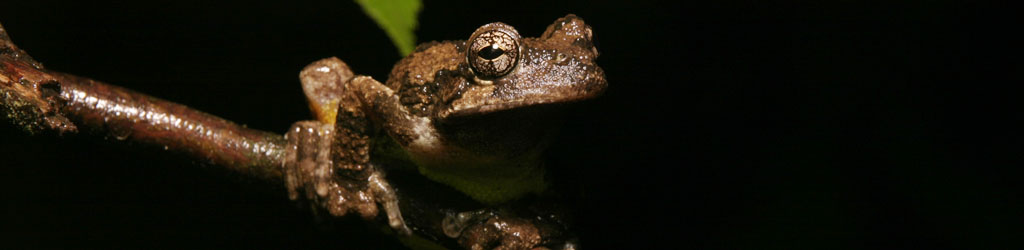
Natural light can be very useful, and it is perhaps the best thing to use to have your backgrounds showing up cleanly, but it’s arbitrary and capricious – haze and overcast change the colors of your image, as will ambient light reflected from nearby foliage or surfaces, and light levels don’t always allow you to capture the action (or even hold the camera still enough.) Too little light, and your shutter speed has to drag out to let enough in for a proper exposure, and there’s too much chance you will twitch the camera or your subject will move – these are the number one causes of blur and softness in photos. And the contrast may not work to your liking. My treefrog subject here is docile enough to let me both use the tripod, and play around a bit with options.


So the first option is to use a flash or strobe, getting adequate light onto your subject, color-balanced, and perhaps even from the direction that you want. But it is often harsh and very high contrast, which photography only increases – both film and digital almost always appear higher in contrast than our eyes see. This makes colors “pop,” but it also increases shadows and may drastically change your image. These images were taken only seconds apart, but as you can see, either night fell with extraordinary speed, or something funny happened with the light.

What was funny is that, even though both images used an aperture of f16 to maintain a certain depth in detail, one was done with natural light using a very slow shutter speed, and the other with a flash (and softbox) at 1/200 second shutter speed. The top one allowed the low light in the background to come through, the bottom one relied entirely on the flash – the background light was too sparse to even show up in the exposure. Yet, the detail from the frog isn’t necessarily better, most especially because the shadows that were introduced hide the eyes and make things a bit harsher. Enter the sneaky little trick of most serious photographers: the fill lighting.

Even see a model shoot, where photographers’ assistants are running around with large reflective panels or adjusting multiple light sources? These are used to balance the light levels in the shadows, so the shadows don’t become too dark and detract from the image, like my example above. It’s call fill lighting, and it’s always dimmer than the main lighting and usually from an opposing direction, giving soft illumination where the main lighting does not reach, yet not detracting from the impression of a single, perhaps natural, light source.


Now we can compare the difference. Look at the eyes, and the shadows on the bark – even at the highlighted sections of the frog’s shoulder. Far less harshness, less idea of a flash being used (also helped by the diffuser on the softbox,) and the eye becomes visible, which is good because we always look to the eyes. A little fill can help quite a bit, but there’s still the idea of the frog hiding under the leaf, and the eye becomes much more effective being almost hidden rather than completely invisible.

Fill lighting can also be accomplished using natural light, such as bright sunlight, as your main light source, and the camera strobe for the fill. A camera strobe is never a match for the light the sun puts out, but it can be sufficient to soften the shadows and throw a little light into hidden areas, like the first photo here. If you find yourself even doing casual portraiture in brighter sunlight, try firing off the flash – you may like the results a lot more, and get rid of some of the contrast and dark shadows.

Ideally, fill lighting should be accomplished by measuring light levels and using a variable light source, whether it’s an adjustable strobe or having your assistant angle the reflector differently. But such luxuries are rarely available to the nature photographer (the subject may not hang around for much in the way of shenanigans,) and there’s only so much equipment you may want to carry anyway – I know I have my limits. But in a pinch, you can make do with materials at hand. White surfaces will bounce a certain amount of light, aluminum foil and similar materials a bit more. Finding myself in need of the reflection and not having anything other than the camera and softboxed strobe, I cheated. One of those little pieces of plastic in my wallet turned out to be useful for something after all, when the white back, held just out of view, could be used to bounce some of the strobe’s light back into the underside of the frog. Here, you can see my fingertips intruding into the frame.

You may like any one of these images better than the others, and that’s fine – opinions vary, and your own artistic expression is part of your style. But if you’re planning on selling images, bear in mind that editors have their own goals for illustration, their own stories to accompany. The “daylight” shot is nice, but a bit low contrast and green, and treefrogs are primarily active at night, so the “night” shots have their own uses. Get a variety of images, and yes, more angles than I’ve shown here (which I did indeed get myself, I just stuck to a particular point for this post.)

Oh, the humility!

Sometimes I get a kick out of the arguments for religion, because they’re so entertaining. Whether this is actively fostered or simply a by-product of our media, the most common style that I see anymore is the sound bite. By that I mean, the brief and memorable, sum-it-all-up sayings that sound good, even though content-wise they’re rather deficient. The comments on any article at Scientific American dealing with evolution will provide many examples. Sound bites have the advantage that they’re quicker to snap off than a reasoned explanation, and that they can appeal to those who don’t want to make any effort whatsoever in considering a position. I’m refraining from comments about such a target audience…

Quite prevalent is the humility plea. Generally, it takes the shape of denigrating science because of what we have no answers for, and usually adds in some dig about the arrogance of assuming that we do. We mortals should be humble in the face of the deity, rather than curious or, god forbid, logical. Evolution is a favorite target, as is cosmology. Come on, say it with me: “Evolution is just a theory.” Very good – you got that nasally whine just right on the word “theory.” I’m not even going to go into the ignorance of what the arguers think “theory” means – it’s not worth it anymore. It’s just amusing, listening to someone wielding the statement as if they had made a major point instead of announcing their vapidity to the world.

The best part of these is the hypocrisy, though. Without fail, the arguer seeks to pour scorn on both science and secular education for daring to go with the evidence, but never, ever tumbles to the fact that religion attempts to define far more about the world, its beginnings, and whatever supernatural realm it proposes without the faintest shred of evidence (no, Caleb, a book is not evidence.) Science, somehow, is arrogant because it examines the real world and forms theories that support the facts, and predicts specific behavior or results. But religious folk, who usually couldn’t describe any portion of evolutionary theory or evidence accurately enough to pass a high-school biology exam, need to inform everyone else of how wrong science must be, of how much it’s based on dogma, and by golly how come my idea of six days and unchanging forms of animals isn’t taught right alongside this?

Because it’s fucking stupid – is that an adequate reason? While some may want to believe in magical realms all they want, others who actually want to know what works in the real world, will stick to knowledge obtained through empiricism. That’s the stuff that isn’t imaginary. Whether someone’s christian, muslim, buddhist, pastafarian, wiccan, or trekkie, it’s the stuff that works exactly the same regardless. That’s kind of – no, actually, that’s precisely – why its relied on and taught to children.

Especially entertaining is when someone actually uses the term “dogma.” When applied to science, this apparently is a corrupt and laughable concept, conveniently ignoring the fact that religion relies on dogma – it’s where the entire idea came from in the first place! So, Harvey Dent, which is it? Is dogma good, or bad? Doesn’t matter, actually – either way you just trashed your own argument.

In a way, you have to appreciate those who, in their haste to set those arrogant scientists straight, demonstrate both their own incredible ignorance and their distinct fear of ever finding out how wrong they might be. The arguments are ancient and long-rebutted, but like a child excitedly telling a decrepit joke about a horse walking into a bar, these helpful folk stand up on their soapboxes to show off their inability to perform even the most rudimentary of rational thoughts: that maybe somebody who’s making a living in the field might, just might, have caught the fundamental discrepancy that our helpful religious zealot trumpets. It is undeniably too much to expect that they actually type the term into a search engine. With so much information available to us right there on the machine you’re reading this upon, it astounds me that so few can ever make that logical leap into the abyss to see whether someone has indeed rebutted their insightful little proverb. I suppose that it has actually occurred to some, but there’s a little too much chance that the answer won’t be what they want it to be. So if they don’t ever learn it, it doesn’t exist. La la la la la la la…

To cap off the amusing portions, one of the surest ways to remain humble is to actually start learning about something – it’s safe to say that it takes humility to open oneself to learning in the first place. The amount of knowledge we have about myriad subjects is astounding sometimes, and it frequently results in finding some previously-held belief was mistaken – I’m not just talking about religion, because every subject can foster these results. If someone is concerned about never being found wrong, then the best thing they can possibly do is to dig a hole and fill it in on top of themselves. But if they harbor an honest interest in learning, in finding out new and fascinating facts and ideas, then discarding the anxiety over being “right” lets them absorb without filtering it through their ego. Every time someone finds out they were wrong about something, this is actually a very good thing, because they just moved forward.

Some people consider that a good thing.

New neighbors

It’s funny – a few weeks ago I had something like four or five ideas about posts, all having to do with religion, and no other topics coming to mind, nor was any other blog providing inspiration. I try to rotate and break up topics so I don’t appear obsessively obsessive, so I struggled with splitting them up and finding other things to insert between. Now, I have four nature-themed posts that I could put up right now. Where were these when I needed them? If this isn’t proof that there’s no god, I don’t know what is.

Yes, I called this pic "Tits n' ass" - wouldn't you?
In that time before when I needed other subjects, I had been observing the antics of a tufted titmouse (Baeolophus bicolor,) only it was a pair of them so it’s titmice. There are those who will disagree – they’re wrong. Language is not governed by rules, by the way, it’s a method of communication. All words are made up. While titmouse has nothing to do with mouse, every other usage of mouse is pluralized mice, and everyone knows exactly what I mean when I say titmice, so there’s no point in actually trying to figure out whether there is some other form of “proper” plural. If this is the way one has to display their higher intelligence, they have issues all their own. Save this post to link them to if you like. Or ask them what they’re doing about global warming – that works too.

[No, I’m not paid by the word] Titmice tend to be very subtle, not drawing attention to themselves with song and ostentatious displays (unlike Carolina wrens for instance,) but I did notice that they were interested in a hollow of the hickory tree in the yard. I’d peeked in there a few times when they weren’t around, but saw nothing of interest – I guess I wasn’t looking close enough. Just a few days ago, another peek revealed significant changes.


There are four in there – you can just see the corner of the fourth beak at lower left – and they keep mom and dad busy, going back and forth with insects. The young had remained silent at first, but in the past couple of days they have taken to cheeping when they feel food is imminent, and can frequently be heard any time I’m in the yard. The parents have a fairly set pattern of behavior, arriving nearby and scouting the area for danger before going into the nest cavity, and they have distinctive patterns.

The male will often perch on a branch in plain sight, and if the female is around, may chatter excitedly, though he is much quieter when alone. He often works towards the nest in stages, checking the area for danger so he doesn’t lead predators towards the nest. The female, on the other hand, stops on different branches, often in another tree, and remains deeper in the foliage, trying to stay hidden, and will disappear into the nest faster. The male often peeks out to check the environment, as seen below, but the female sticks right to the feeding business and thus spends about half as much time in the nest. Both will grab the drops of poop, that the young produce in huge quantities at this stage, and carry them out of the nest to deposit elsewhere – this is very common behavior among birds, and the neonates’ feces tends to be encapsulated in gelatinous “saliva” for just this purpose. Otherwise, they would be at the top of a mountain by the time they grow out their flight feathers…

I have been hampered in photographing them by three factors. The first is, the nest cavity is small and narrow, and while conveniently close to the ground, it’s hard to even aim the lens into. Second, the cavity remains in deep shade nearly all day long, dropping the light levels significantly even on a sunny day. And finally, titmice very active birds, constantly in motion, and this doesn’t combine with low light very well – to get a decent exposure, the shutter has to be slower, and this results in blurring if there’s the slightest movement from the bird at the time I trip the shutter.

However, I’m experimenting with several techniques, and will be back with followups, especially when the young fledge. I have been sitting nearby with the camera several times now, and the parents are fine with this as long as I’m a certain distance and remain relatively still. I have also augmented my light with both camera flash (only good for short distances) and a studio strobe, which works pretty well. The studio strobe can be triggered in slave function, which means it goes off when it detects the flash from another source, such as an on-camera unit, so I don’t need PC cords or radio syncs. Being in the backyard means I can power the strobe with an extension cord. I may even try to mount the camera higher in the tree, aiming downward into the nest cavity, and trigger it by remote cable or even infrared, both of which I use on occasion. I have to hand it to Canon – most of their cameras have inexpensive IR remote units, providing the ability to trigger the camera from moderate distances, provided you have a line-of-sight towards the front of the camera. I have also modified the wired releases, which are electronic, to utilize common stereo headphone extension cables available for only a few dollars. So as time goes on, I may feature both the birds and the successful techniques in photographing them. This is what’s known as a teaser, to keep you coming back to the blog – I’m not above such blatant manipulation. Worse, though, is I’m doing it for free, for some reason. Possibly because it doesn’t pay anyway – that might be it.

Rewriting history

Ah, Ronald Reagan! The guy that ended the Cold War, that brought the Iranian hostages home, that brought America back to world respect, that…

Wait a second… who?!

From someone who came of voting age during his administration, I’ve been dumbfounded at the accolades that Reagan receives nowadays. It was abundantly clear, right from the moment an aircraft carrier was named after him, that someone seems to be trying to create a legacy that never existed. And because most Americans get their history knowledge from sound bites and opinions it seems, it’s working to some extent.

Just pics


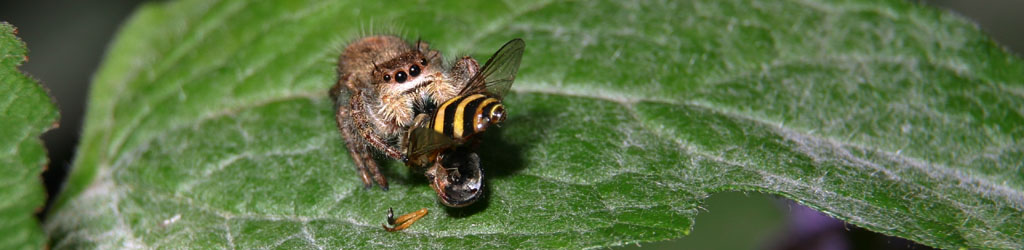
Nothing elaborate to say (for once,) just some pics from yesterday. I really liked the effect above – just the right light levels, I think. When I was a tiny little blogger, I used to be scared of jumping spiders, because of their menacing hairy appearance, near total fearlessness, and my mistaken belief that they were black widows (children get to hear the stories of horrendous reputations long before they get the facts, much less the photos.) Now, I happen to like them more than any other spider genus, for almost the exact same reasons. People that don’t like spiders get to watch me coax them onto my hand – I do have my fun sometimes.

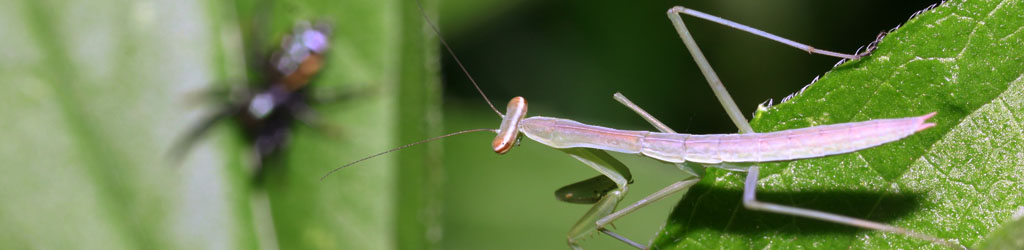
At right, a very young praying mantis, no more than 15mm long, poses on my salvia plant. I was hoping it would decide to stay there, since it would be nice to watch it grow larger and it should be able to obtain plenty of food, but since this photo I haven’t seen it again. This isn’t much of a loss, since the nearby pampas grass usually hosts one or two each year.

And below, a snail makes its hazardous way between leaves, ignoring the precipitous drop beneath promising certain death – well, probably not; maybe certain bounce. It occurs to me that I have no way of identifying an anxious snail, except for “withdrawn.” But that could just mean it’s tired…

Boo!

I’m of mixed feelings about this. The Freedom From Religion Foundation is now featuring a page where you can create your own “billboard,” much like the ones going up in various locations around the country espousing secularism. Upload your own pic and include your own sentiment to get your own billboard/banner, and who knows? You might even get chosen to be featured on a real billboard someplace! I went ahead and made mine, though nearby Raleigh already has a selection, I’m happy to say.

buillboard for FFRF campaignIf you want to make your own, just go here – it’s quite simple. And to view those that have already been made, click here. Which I’d recommend, because I’m going to talk about them a little bit ;-)

The reason I say I’m of mixed feelings is mostly because I was never “in the closet” in the first place. No, I have no issues with the parallel with homosexuality – I couldn’t care less who thinks I might be gay, and the people that count know me well enough already. But once I came down firmly on the aspect of atheism, I was never really concerned who knew it. I am, perhaps, more open about it on the blog here than in “real” life, because this is where I examine thoughts – I don’t hunt people down on the street and accost them, or parade around in my atheist or Darwin T-shirt – I don’t even own any. It’s a personal decision, and I’m more proud of it than, say, liking Duran Duran, but I don’t need recognition for it.

That’s not really the point, though. What’s intended with this is to remove the stigma of atheism in the first place, making it just another facet of life, rather than some kind of perversion (as many religious folk make it out to be.) Errruummmuuuhhh, yeah, okay, I’m cool with the idea that anyone should be accepted for who they are, and if it takes special effort to make people comfortable with this, sure. Alternately, I draw the line at turning it into a “fad” or encouraging it because that’s what other people do, you know what I mean? If it works for you, good! If it doesn’t, no problem!

My issues with religion, aside from the fact that it’s simply evidence of rotten decision-making, are that it spends much more of its time dictating how everyone should be, rather than simply providing something to the individual. It’s not a matter of “Hey, check this out, you might like it” – it’s far more, “Be this way or you’ll face retribution!” Not to mention the arrogant attempts to instill such lovely processes in schools and government where it really isn’t needed, and to repress science because nature doesn’t support mythologies.

That’s what I want people to notice. Take a look at the sentiments displayed on those billboards. Tell me how often you see any variation of “Join us,” “You’re right if you’re this way,” or “You’ll be sorry you didn’t listen.” Hemant Mehta’s is about the worst I’ve seen, and if you want to take that seriously, fine – it’s not much of a threat, and some of us have a sense of humor.

That’s one of the more interesting distinctions, I think. Appeals to religion, while certainly including some pleasant and friendly aspects, are never free of the threats or compulsions, some of which are quite open (one of my favorites being “Don’t make me come down there” signed by “god” on billboards I saw in Florida.) Many of the campaign billboards, my own included, might be viewed as smug if someone is so inclined, but compare this to the idea of someone claiming that they’re “saved.” It’s really hard to think that “I started thinking rationally,” is equivalent in any way to “I’m going to paradise and you aren’t.” Even the simple statement, “I’ll pray for you” has considerable undertones of condescension, caste, and hubris. Wow, gee thanks! I’m glad I have someone with clout acting on my behalf! That is, of course, if you’re not just doing it to win points for your own salvation…

After such incredibly manipulative and horrendous practices like classifying people as ultimately “good” or “bad” and promising eternal torment and such if they don’t kowtow properly (this is usually called “extortion”), many religious people then have the temerity to whine that they’re being persecuted when their belief system is criticized and logically dismantled. We’re already seeing plenty of it with the billboards that are on public display now. Oh deary me, another opinion! Right out here in the open where children can see it on their way to indoctrination! I’m not being respected!

There’s a difference between someone being attacked, even verbally, and their views being examined critically. It’s relatively easy to disagree with someone and not think this makes them bad or degenerate – at least, it is for most people. But there are those who follow their religion, not because it makes sense, not because it fulfills some “spiritual void” (you gotta love new age blather,) but because it simply means “good” and they hasten to stand on that side of the line. Question it, and you’re taking away their coin-toss mentality, blurring the very line they chose, and they’ll be damned if that’s going to happen. (Are you paying attention when I rip off these little zingers? Because I’m proud of them, but I don’t want them wasted…)

It’s worth remembering that, just because someone complains, doesn’t mean they have a legitimate reason to – the Republican party in this country is ample evidence of that. Some people are incapable of dealing with the details of any matter, and when that’s the case, the grownup table isn’t for them. It’s still possible to engage them, and let’s face it, they still have adult responsibilities like voting and pressuring school boards, so it can be worth it. But it requires a certain approach, and the recognition that it’s called for.

In part, that’s one of the useful aspects of efforts like this billboard campaign. It stirs up the status quo and highlights those who aren’t very good at thinking critically, where such can now be addressed. And yes, sometimes that will be with derision. Very few people really have an issue with derision or tone, in all honesty – they just feel it should be applied in different directions (like in calling atheism “immoral” and homosexuality a “sin”). But you’ll notice, one of the most prevalent themes on those billboards is how nothing is free from skepticism or examination. It’s hard to rationally argue against that.

The lucky ones


Through both Ophelia Benson and Jerry Coyne this morning, I found out that the mother eagle we’ve been watching raise her brood on the EagleCam at Norfolk Botanical Garden, collided with a plane and was killed yesterday morning. The father is still around, but three is a large brood for eagles, and usually both parents are kept busy cycling the food to the rapidly growing youngsters.

In light of this, wildlife biologists at the Department of Inland Fisheries and the US Department of Fish & Wildlife elected to remove the young from the nest and transport them to the Wildlife Center of Virginia to be raised by wildlife rehabilitators for later release. If left alone, the likelihood of the single parent keeping adequate food flowing would be very low, and developmental problems, including fratricide among the siblings, becomes very likely. So this morning, they removed the eaglets from the nest, and I captured several clips from the webcam with screen-capture software and put them up on YouTube:


[Note that when I originally edited the video, I thought the mother had been killed the same morning as the removal, but this was incorrect; it was the previous morning.]

I’ve been to the Wildlife Center of Virginia in Waynesboro, and it’s a great place, very progressive and exceptionally organized, unlike some wildlife efforts I’ve seen (and very unlike the one I was employed by.) They have a sophisticated hospital, and instruct veterinarians and local rehabilitators in the practice of effective wildlife rehabilitation – it’s one of the few places with a teaching hospital. Were it not four hours away, I’d be aiming to do more work with them.

I titled this “The lucky ones” because most nests that suffer from the loss of a parent simply would not survive, and this happens constantly where we remain unaware of it. Because of the webcam, as well as the accessibility of the nest, these young eagles got another chance – the vast majority (within any species) would not have. The transportation is traumatic, no doubt, and there are still chances for developmental problems and illnesses, but these guys are much better off no matter how you look at it. Accidents happen, and indeed, this particular female lost a previous mate to another aircraft collision a few years ago. Life is a struggle, but sometimes we can help out a bit, too.

Most wildlife rehabilitation efforts throughout the US are non-profit organizations or individuals, not financed in the slightest by local, state, or federal funds. They can always use your help, so take a moment to drop a donation to the center nearest you, and help raise awareness of wildlife issues at the same time. We’re a big species, we can spare some moola and time.

1 304 305 306 307 308 327