A few years back, I snagged what is sometimes called a “grab shot” of my cat Ben perched in the bathroom, and liked the effect of his glowing eyes in the depths. So I captioned it, a laLOLCats, but never bothered to submit it. More amusing to me is that Ben lacked any shred of threat or ominousness (you don’t think that’s a real word, do you?), being one of the most mellow and friendly cats I’ve known. Also one of the least bright, but those are stories for another day…
Unfortunately, I’m one of those people where half of my offline reading is done in the bathroom, and to the right of Ben’s pedestal (all cats have one, you know) sits my reading table. When I stumbled upon this image again recently, something there caught my eye, and I had to go in for a closer look. The original was shot much wider than this and cropped down, and done with a low-resolution digital camera yet, so the result isn’t exactly TV forensics quality, but it suffices.
As I suspected, the book is recognizable, and indicative of a skeptic’s bathroom for sure. In fact, I had a friend tell me that he’d picked up the book in my bathroom while visiting, became too engrossed, and ended up having to get his own copy – so now I even have a rough timeframe of when that occurred.
At this enhanced resolution, however, something that almost escaped attention now becomes obvious – there’s a sprite or orb or whatever in the shot! Don’t try telling me that it’s just a reflection of the flash, because reflections don’t have dark edges like that! Nor is there any reason for them to be purplish. No, the arcane processes that comprise photography served to capture the evidence of something not visible to the naked eye. I’d suspect the ghost of some past resident but the building was only about twenty years old, so perhaps the ghost of some previous structure on that location, though since I’m in North Carolina there’s a good chance this was a still. Then again, they do call liquor “spirits”…
Undoubtedly, it was locked in mortal combat (well, okay, immortal combat) with the spirit of the book. Which also explains why Ben was in there, because everyone knows cats are attuned to ghosts and such. He was probably refereeing.
I still have the book, but have noticed no arcane stacking behavior or anything. I’ll keep watching…
Going through a slow posting period right now, due to several factors, not the least of which was a nasty virus that masqueraded as a different illness each day, just for the variety it seems. But this also might continue for a little while longer while I leave on a trip, whereupon I should be back with lots to post (right?). So for now, let’s talk about what’s sometimes referred to as “dragging the shutter,” better known as long exposures.
If this is not something that you’ve ever tried, you need to, because it provides a whole world of photographic options on its own. The first real benefit is working with existing light, which might be very dim. But exposure is cumulative, which means that you can keep adding light until you have enough. Slow shutter speeds cannot really be done with a camera handheld, except in rare circumstances, so you will need to be using a tripod, preferably a sturdy one. You may also need some kind of remote release for the shutter, whether it be a strictly mechanical cable release, an electronic one (mostly for the newer cameras,) or even a wireless method such as an infra-red remote. The purpose behind this is to open and close the shutter without physically contacting the camera, because such contact can shake the camera and blur your exposure.
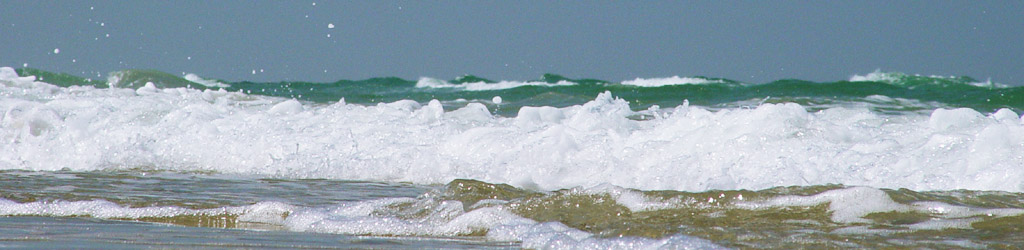
There is a wide variety of subject matter available, though. In the image at top, there were two reasons to use a long exposure: traffic motion; and the very limited light coming in with infra-red photography. At right, we see one of the more common uses: making moving water go soft and cottony. It can also be used for night photography, especially by moonlight, stroboscopic effects, and even time-lapse video. You’re limited only by your imagination, and I’ll even help with that from time to time.
Judging a proper exposure can be difficult, and sometimes it takes trial-and-error – this is another of the benefits of digital, in that you can at least get a general idea of exposure right after you’ve closed the shutter, with the preview image on the camera’s LCD. Don’t trust this, though, especially at night – the screen brightness often isn’t comparable to what the image will look like on your computer monitor. Bracket your exposures, which means shooting a few frames both brighter and darker than you think is “proper,” just to be safe. I’m betting you’ll find, at least occasionally, that one of the other exposures suits your needs better.
In cases of rapidly moving subjects such as waterfalls, you won’t need a particularly long exposure – you might get by with something as short as 1/10 second, but typically you’ll get nicer results in the 1 to 4 second range. It depends on how much motion across the frame there might be. It doesn’t matter how many centimeters-per-second something might be moving, because this produces entirely different results in the image depending on whether you are shooting very wide, like a landscape image, or zoomed in tight with a telephoto lens. In the latter case, the motion crosses the frame much faster, needing less time to produce a blur, so you can get by with fairly brief shutter speeds.
Often, you don’t need a lot of motion to make a decent image, and too much can produce a mess in the frame. When doing something like traffic or moving people, only a few cars or people are needed, and often only for short distances to convey the idea. Once they begin to overlap, they start getting muddled. For things like bird’s wings or moving wheels, even less time is needed. For star trails, though, it usually takes at least ten minutes for something noticeable, and an hour or more for really distinct trails. This even depends on where you’re facing. If you’re pointing towards one of the poles, for instance, you may need several hours for really good arcs – remember that the stars will produce a full circle by themselves in 24 hours, because you’re actually capturing the movement of the earth. Aiming towards the plane of the ecliptic, basically the equatorial regions, produces much more apparent motion, and you can get by with shorter exposures.
But how do we allow the shutter to remain open without making the image far too bright? The first two steps are by choosing the lowest ISO you can, and by closing down the aperture to a small opening, like f16, f22, and so on. Both of these limit the light coming in, so the shutter speed can go longer to compensate. You can also use lens filters such as a circular polarizer, or something called a neutral density filter. ND filters are named backwards, because they are high density filters (reducing light through the lens) which are neutral in color – basically, they’re sunglasses for your camera (as is the circular polarizer.) ND filters reduce light without changing the color cast or appearance of the image in any other way, and so can help reduce light so a longer shutter speed can be used, for instance in bright sunlight conditions. While these are available in threaded mounts to fit most lenses, you are probably better off finding the versions made for filter holders such as Lee and Cokin, which are large enough to use on all lenses and much less expensive. They have varying values, typically referring to the number of stops they reduce in light transmission. For very long exposures, such filters require a good holder, but for briefer ones like a second or so, you can simply hold the filter over the lens, taking care not to disturb the camera or leave a gap between the filter and the front of the lens.
Circular polarizers, by the way, can be used to cut reflections from water, not only reducing glare, but allowing you to see beneath the surface when used at the right angles. They can also cut reflections from non-metallic surfaces such as glass, and can deepen sky colors.
Also bear in mind that tripods are not the perfectly stable supports that they might seem. It’s easy to make a camera twitch atop one, and if this motion is a significant enough portion of the exposure time, it will show in the image. It will especially show if there are point light sources within, such as streetlamps or bright reflections. This is where the remote release should be used, and if your camera has a delay function among its repertoire, now is the best time to use it. In SLR cameras (including DSLRs,) there is a mirror inside that bounces the image from the lens path to the viewfinder, which slaps quickly out of the way just before the shutter opens, but this often produces vibrations on its own. If the shutter then remains open for periods from 1/15 second up to perhaps ten seconds, this vibration can show in the image. The delay function slaps the mirror up and lets the camera sit for a couple of seconds for that vibration to die down before opening the shutter.
The higher the tripod is extended, the more prone to vibration it is, and even things like a breeze can cause camera motion, something that may not be apparent until you see the resulting image. As a general rule, avoid extending the center column whenever you can, since this is the weakest point, and leg sections should be extended as thickest first, leaving the thin leg sections retracted if possible.
There are some experimental aspects you should try, when you start your forays into long exposures. Something that is present for perhaps half of the exposure will show up, but as a ghostly image that lets the background show through (because, for half of the exposure, the background was not blocked.) Firing off a flash or strobe unit during the exposure can illuminate and “freeze” a foreground subject, sharply overlaying it against the blur of its own motion. Some cameras have a flash setting called “rear-curtain sync,” which fires off the flash at the end of the long exposure, rather than the beginning, and this can be used to have a moving subject lead up to its sharply-defined flash-illuminated portion. A handheld flashlight can be used to illuminate select portions of your subject, or can be used to trace bright lines across the image if facing the camera. Be aware, however, that bright lights straight into the camera lens will produce glare, so flashlights that appear in the image should be minimized or hooded, and car headlights should be at an oblique angle, never directly towards the lens.
Exposure relies, naturally enough, on the light actually reaching the film or sensor. In the cases of either partial exposures (where the subject moves or leaves the frame) or multiple exposures (where the light hits the film/sensor multiple times in a single frame,) lighter-colored subjects will overcome darker colors. Note the differences here between the moonlit portions of my shirt, and the shadowed side, even of my face – the transparency shifts according to brightness. And now you know how many “ghost” photos are accomplished ;-)
Another thing you may want to try are multiple exposures – that is, overlaying more than one exposure on the same frame. Some film cameras have this built in, but this isn’t something that digital has been blessed with – or is it? “Exposure” doesn’t have to refer to opening and closing the shutter; that’s simply one method of doing it. What it refers to is capturing light, and this can be done different ways. In very dark conditions, you can provide light for the exposure by firing off a flash or strobe unit, and in fact, this is how those images of extremely fast subjects is typically done, since the shutter can only move so fast, and focal-plane shutters have a certain negative effect (that I’ll go into within another post.) But a flash may be exceptionally brief, perhaps 1/1,000 second down to 1/10,000 second. As long as there’s no other light reaching the sensor or film, the shutter can remain open, and the light for exposure comes only from the flash.
The second method is so simple it’s laughable. Leave the shutter open, and cover the lens with a thick black cloth. Uncover it to expose the film/sensor. Again, it works best if the environment is mostly dark, and you may want the light sensitivity reduced as much as possible, since I’m guessing you’re not that adept at removing a dark cloth for only 1/125 second. At night, I’ve covered the lens with a hat between exposures, so as not to shake the camera. If you’re really into experimenting, some people have taken lenses that have the shutter within them, such as Hasselblads and most large-format lenses, and mounted them via adapters to their SLRs. Then, the SLR shutter is locked open, but the lens shutter is opened as needed for the multiple exposures. A little creativity can add a lot to your photography.
So give it a shot or twelve, and use your imagination. It’s far too interesting to leave out of your stable of techniques.
When you examine the justifications and reasons given for religious belief, there are numerous common factors that come up regularly; at the same time, identical or similar factors are what are presented in the face of atheism, secularism, and even the “scientific model” of the universe – if [a] god does not exist, how does one explain this?
Given how often I see these, I have decided to outline some of the more common ones. To me, it was the realization that yes, such things could indeed work very well without guidance or influence by anything more than natural physics, that made a non-religious view of the universe not just viable, but the most supportable. Not everyone will agree, and that’s fine – discussion is welcome. The posts prefaced with “But how?” are my own attempt to explain, not how it could be, but why it is likely. Why something could be is a poor rationale, one that assumes an answer first and then looks for support – this can be done with any viewpoint you care to name. One valuable lesson that the scientific method provides is looking at what actually stands in the way, attempting to disprove a particular standpoint, in order to test its strength.
So with all that said, let’s talk about good and evil.
Many, many people profess that one of the strengths of religion is its moral guidance; a significant percentage of those believe that one cannot even know what morality is without religion – this is perhaps the most distasteful thing about atheism, if you were to ask those who recoil in horror at the mere thought. Yet, at the same time, when someone points out that countless aspects of religious scripture not only outline behavior we find abhorrent, they even contradict other portions and laws therein, you will immediately (and without fail) find people excusing such aspects, pointing out the “good” portions and the “real message.”
Unfortunately, this defeats their very argument. How can someone fathom what the real message is from the very source of their criteria, the books that tell them what right and wrong even are? How does one figure out what the “good” aspects of scripture are (such as prohibitions against homosexuality and bestiality) and what sections can/should be ignored (such as prohibitions against cutting hair and sowing two kinds of crop in the same field)? These examples are from the same book, by the way: leviticus. Of course it’s idiotic to stone blasphemers, or to whip children, or to keep slaves. We just didn’t get these ideas from scripture, which condones such acts. These aren’t even parables or metaphors that let the reader determine for themselves what the subtle message was supposed to be; these are distinct laws. So where did we get the ability to choose among these?
We judge people and actions all the time, not by referring to some particular list of rules, but by how they align with our own interests, and what we consider beneficial. “Good” is not an absolute value, but a variable that depends on how our society works, on how we interact with each other, and even sometimes based on arbitrary values. As I mentioned before, many of our ideas of “good,” like traffic laws, marriage laws, business obligations, citizenship, discrimination, child abuse, and so on, have no basis whatsoever in scriptural guidelines, even vaguely – we managed to come up with these all on our own. Some of these aren’t even common agreement, but widely variable across the world. How young is too young for someone to legally engage in sex, or vote, or drink alcohol, or serve in their country’s military? In this country alone, those are (almost) all different ages, but why? Can anyone name any source for this distinction based on calendar days since birth? Is there any reason whatsoever to believe, boom, on the morning of your nineteenth year, you now know how to vote properly, or are competent and mature enough to die in battle? These are just numbers picked almost at random, mostly because something was needed as a guideline.
But okay, let’s go back to the things most people think about when they get into the realm of moral behavior. Is it possible to be moral without referring to scriptural guidelines? First off, we need to define what morality really is, and since this is one of those things that relies more on personal ideas than a dictionary definition, I’ll urge you to pause for a moment and pin down your own concept of “moral” in your head before we go on.
a : of or relating to principles of right and wrong in behavior : ethical <moral judgments> b : expressing or teaching a conception of right behavior <a moral poem> c : conforming to a standard of right behavior d : sanctioned by or operative on one’s conscience or ethical judgment <a moral obligation> e : capable of right and wrong action <a moral agent>
… which is no help at all, because it relies solely on other definitions. If we refer to the long-winded and often ridiculously philosophical Wikipedia, we find it not a hell of a lot better, and very frequently coming back to the idea that we should know what “right” and “wrong” really are. That, naturally, is the opening that is filled by many with religious scripture. Did your own definition head in this direction?
Okay, how about this: “behavior or principles that result in the greatest benefit for the largest number of people.” Close, perhaps, but still open for things like majority slave-ownership. Perhaps we add in, “recognition of the equality of individuals,” and maybe, “valuing trust, fairness, and community.” Is it starting to look like what you defined, and are you seeing how hard it might be to define it distinctly for every situation?
You might have caught on to something in there, too: we actually want such things like this, and not simply from the standpoint that it’s convincing in its benefit, but that we respond very negatively when such principles are violated. Again, it’s easy to say that this is drilled into us by religion and/or parental ethics, but is it? Or is it possible that we have this as an innate drive?
Now, such vaguely-defined principles aren’t usually something that we have “instinctively,” but there are many things that can be. Empathy, for one. We really do feel bad when others feel bad, right from birth, as any parent who watches crying behavior spread among infants knows. We worry about causing pain, even to animals, and try to help when others are depressed. Scriptural guidelines? Not really – they tend to be quite vague on such things, and certainly not an influence on babies, or indeed other animals which also display similar traits.
When we start thinking in terms of animal behavior, we begin using terms other than right and wrong – benefit and detriment, for example. While these largely have the same meanings, such terms dodge the implication that right and wrong have some deeper moral division – these are strictly human traits. If we look at the end results, however, we find them to be indistinguishable; something that provides a benefit to an individual or species cannot by its nature be determined to be either the result of “morality” or simply an innate drive for improvement, or even survival. To determine morality, we need to ask what the motivating factors were, something we can pretty much do only with our own species. There is an assumption that such decisions must have been reached through conscious and reasoning thought, one not supported by the decision itself.
But let’s say that we, for a moment, argue that “good” behavior is inherent, a trait evolved into us and thus subconscious rather than learned – does this make sense? Is there a way that such behavior could be rewarded by selection, that it would provide enough of a benefit to propagate through a species? Certainly, and we have no problem seeing it within species other than H. sapiens. Group behavior, cooperative efforts, packs and hives and flocks and colonies, all provide a huge benefit, that of many individuals working towards a common goal, gaining survival strength through numbers. And it’s easy to apply this to humans, from millions of years ago right up to today, with farming, cooperative hunting, protective tribes, community child care, and on and on. Any individual might develop selective skills, learned over years and even handed down through generations, and trade such skills for the fruits of another’s skills, education, or efforts. In this manner we can develop beyond the “here and now” survival and reproduction of individualistic species, and gain benefit from shared efforts. We can only accomplish this because we like socializing, and want a cooperative society. While we’d like to think that this is different from the flock behavior of sparrows or the pack behavior of hyenas, we have to ask ourselves: in what part of our education did we learn how to favor society over individuality? If this is cultural, it should be radically different among cultures, rather than exceptionally common. We don’t view anti-social tendencies as simply other personality traits, similar to music tastes, but we consider them to be almost an illness, indicating that there’s something wrong with such individuals.
So, does this translate into “good” and “evil”? We can start with trying to define those, of course, or take an alternate route and try to determine some behavior which is always “good.” But there really is no such thing; good and evil are abstracts, and virtually require one another to contrast against, rather than being defined as some particular state of being or specific actions, meanings, or attitudes. To illustrate, many people, upon seeing images of Adolf Hitler with happy children, consider them staged and propaganda, refusing to believe that such an evil person could possibly like children, and they like him in return. But evil is not absolute, and even the most reprehensible human beings can be found to possess some trait most consider “good.” We have difficulties with recognizing this because we want decisions to be easy and distinct, so we can classify someone irrevocably into a category and never have to consider them again – they must be one of two choices. It’s a shame, because our minds (that we consider so advanced) can handle much more nuanced concepts, but we often ignore this entirely in favor of black/white categorization.
Even more interesting is our overall attitude towards ourselves, in that we often feel that if some individual is truly bad, it’s a product of mental illness, an imperfection in their native instincts towards community, fairness, and cooperation. Very often, we’re right.
But if people are inherently good, why, then do we find so much evil in the world? The abrahamic religions offer the explanation of satan’s influences, and/or that such things must exist to produce a willing decision for mankind – in order for there to be free will, there must be choices. Both of these fail to explain anything, however. We do not, for instance, have the ability to choose whether or not we obey gravity, or whether thermodynamics guides our actions; these are forced upon us. But simply being “good” must be a choice? This makes no sense, and serves only to highlight how little religion can explain. Could we not simply have been made without free will? Also note that, in a system that supposedly has ultimate arbitration on mortal behavior once all is said and done, we can’t sit still and wait for that to happen; we mete out our own punishments, we have our own laws, apparently feeling that the omniscient creator needs constant help.
The other argument fares no better, but provides some clue as to what may be going on. Being influenced by satan still means that our goodness is not absolute; certainly a valid point, but satan becomes extraneous in such a case, because the key factor is the variability of “good” behavior. It is not some kind of soul-altering magic that satan wields, but merely coercion, to which we’re already susceptible (otherwise we’d be innocent of being corrupted, since it would be outside of our ability to resist.)
Ask anyone that is guilty of doing bad actions, and find out what the reasoning is. “Retaliation” leads the way by a wide margin, whether it be for Bobby stealing our favorite Hot Wheels or for society denying the privileges it bestows on others. Everything from feuds to conflicts between countries and cultures very frequently runs back to some point in time where “we were done wrong,” where the guilty person was minding their own business, being good, and got shafted for it. This can only affect us if we have a sense of fairness in the first place, if we desire that antisocial or divisive action receives consequences. This goes right back to the idea of a cooperative species, one that needs community to thrive. Let’s be real, crime is often a lot easier than following the rules, certainly better than working for some giant corporation to put money in someone else’s pocket. But it ultimately results in chaos, the breakdown of community and the severe hampering of progress, as a species and as a culture. Even criminal organizations have rules, and levels of trust.
The nature of life, however, is competition, and with competition comes conflict – that’s kind of how it’s defined. I’ll pause for a moment here to point out that if we argue for a created, purposeful universe, there is no reason for it to be this way. Any being that could create the entire world in six days, or even put the process of evolution into motion, could certainly manage a system of balance, where populations maintain zero growth and resources are always adequate to the need. But that’s not at all what we see, is it? Life is not self-limited, but expands to take advantage of the resources, halting only when opposed by competition and/or the lack of adequate environment and food, whereupon it gets reined in, not by halting its own expansion, but by malnutrition, disease, and dying off. Because of this struggle and competition, all species survive only by coping with this adversity, and this means they also must have some drive to protect themselves, gain an edge over other species, and coerce or force an advantage. Of course, the process of natural selection means that those that do this best pass along their genetic heritage. So we, as a species, can indeed have a conflict, between traits that make us favor community cooperation, and traits that make us seek an advantage just to survive.
Contrast this with the idea of a learned moral system, one that espouses good behavior and punishes bad, often perpetually – our brief existence as mortals serves only to define where and how we spend eternity. One would think that, if this was not inherent but instead drilled into us by religion, there would be few, if any, bad actions or behavior – there really is no argument in favor of eternal torment, is there? One would also expect to find that the religiously devout were noticeably more “good” than average, but this is not only anecdotally unsupported, it’s denied by countless studies and statistics the world over. Prisons are not populated solely, or largely, by atheists and agnostics – quite the opposite, in fact. Churchgoers can not be determined by any method of moral measurement, and countries with a higher percentage of devout do not have substantially lower crime rates, even taking into account that what constitutes a “crime” is determined by such cultures themselves – what another culture might determine as “immoral” has nothing to do with it. If we have learned how to be good, we suck at it.
However, consider (again) that humans might instead have conflicting desires, internal systems such as endorphins that reward behavior fitting certain criteria. Such a system would not produce overall attitude patterns, it would simply respond to immediate stimuli. This could mean that we might respond positively to social constructive stimuli that could benefit our reproduction, such as returning the smile of an attractive person, and almost immediately curse out the idiot that cuts us off on the road. Neither one really has any guidance whatsoever from scriptural moral platitudes, but fit easily within the basic drives of cooperative survival – remember, we may also have drives for “fairness.”
Fairness is a particular aspect that we have difficulties with, as well. Misfortunes that befall us, such as fires, floods, cancer, and so on, frustrate us to no end. We feel we didn’t deserve any such treatment, and in times past, we actually believed we must have – such misfortunes must have had some explanation in a universe designed by a loving god, so someone must have done something wrong and was being punished for it. As noted above, it usually wasn’t hard to find something that someone did wrong – and of course, we have parasitic religious figures today who maintain that this really is the case, in a loathsome and perverted attempt to capitalize on tragedy. Seriously, if your religion needs that much help to gain converts, it must have fuck-all going for it.
The desire for “fairness” doesn’t seem to fit very well in such cases either, because we should expect fair treatment only from other humans, right? Except that evolved traits are usually not that precise – remember that it’s not what works ideally that is selected, but what works better from the small variations at hand. So we have instincts to protect and care for infants, regardless of species. We respond competitively to countless scenarios, whether there is active competition for needed resources or not. We can be well past reproductive age or status and still play that game. And we can expect “fairness” from everything we encounter, not just other people. It’s misplaced, perhaps, but religion completely fails to explain it.
Most notably, however, is that “good” and “evil,” while relative and inadequately defined, are still functioning concepts in a world not dictated by scripture, provided we see them from the standpoint of a cooperative society. We function only through community, and to be blunt, that’s really the most functional definition of “good” in the first place. We tend to forget that Asia, Africa, and the Americas had functioning, in fact thriving, communities and cultures long before any influence from judeo-christian-muslim scriptures, and still maintained very similar concepts of moral behavior. Religious apologists might maintain that these are still vestiges of the moral code retained after the dispersal of the seven tribes or whatever, but doesn’t it seem odd that the concepts of morality remain while every last other detail, from creation to judgment day, haven’t the faintest traces to be found? Or is it easier, and far more explanatory, to see it as simply a trait developed by natural selection, one that exists in countless other species at the same time?
So should we follow our instincts, then? Well, yes and no. As pointed out above, inherited traits can be functional, but not necessarily ideal, and they can remain in constant conflict. Yet the very aspect that we feel sets us apart from other animals, the rational part of our brains, also plays an important part, and always has – accepting natural selection does not mean acting like savages. Despite such drives as reproduction, we can keep our pants zipped long enough to recognize that child-rearing requires lots of time and effort, and demands a certain amount of external support, like a job and a place to live. Most of us, anyway. And the same goes for good behavior. We can (and do, every day) recognize that we have our greatest strength in cooperative community, recognizing the rights of others and maintaining constant concepts of fairness. At the same time, we realize that not everyone holds fairness to us as high as, for instance, their own personal gain, and we maintain a certain level of distrust, as protection against manipulation and being taken advantage of. Being good only requires that we think in terms of community being more valuable than individuality, cooperation holding higher esteem than competition. For a race that can handle income taxes and Microsoft operating systems, this isn’t exactly challenging.
Moreover, this is head-and-shoulders above the religious aspects of good and evil, which spends no small amount of time defining where divisions lie, mostly between “us good” people and “those bad” people; this often (see the part about simplistic, black/white decisions) consists of “those catholics” or “those muslims” or, really, anyone not within our particular church group. Such divisions aren’t for any purpose of establishing morality, and has nothing to do with it – they serve only to elevate “us” above others, feeding our desire to be better. Hint: that’s competition, not cooperation. You do not create community by building walls.
We are, undeniably, all the same species, which means our community should be defined solely as “human.” We all have the same drives, desires, and needs – provided that we do not introduce competition where none exists, or favor it above cooperation and group advancement, we can function as a species, which is much better than functioning as tiny tribes. But it does take the realization that we’re not perfectly designed in a carefully controlled world, and our improvements rely on our conscious decisions to be better.
Earlier I talked about some of the basics, so now I’m going to introduce you to a new form of cheating (but one that may make your life oh so easier and perhaps considerably longer because, you know, stress…): captive aquarium photography.
Aquatic subjects are something that takes considerable effort to capture in the wild, and much more so if you’re after small subjects that need high magnification. And if you’re approaching freshwater pond or bog denizens, you can practically write off such pursuits. Gear rated for underwater use is one thing (and a significant expense); macro lighting underwater is another; and trying to find things that live in shallow, murky, and above all mud-bottomed areas is a class all on its own. Just trying to get close will stir up obscuring sediment and likely send your subject scurrying under cover. The detritus on the bottom and the thickness of border plants will prevent you from ever achieving a camera angle that lets you get adequate lighting in there. I’ve even messed with reverse periscopes, finding that they simply don’t allow many opportunities. But you can do fantastic aquatic subject images with only the equipment you have now and a few additional inexpensive items. While it may take a bit of preparation, the results are well worth it.
First off, you need a macro aquarium, a small watertight enclosure to keep your subjects hydrated and natural-looking while still allowing you the visibility you need. This one is a small Betta tank I obtained from WalMart for five dollars, that I sliced one of the plastic sides from and replaced it with glass (in this case a sheet measuring 5×7 inches from a photo frame.) I angled it back as far as the tank design would allow, for three reasons: first, you want to try and shoot dead-on through the glass, and not at an angle, because glass will easily distort a macro shot, and angling back lets you work without your chin resting on the tabletop; second, your additional lights may bounce off of both the front and the back of your tank, so this angle helps reduce the occurrences; and third, it lets you use more of the bottom substrate as your background, meaning you won’t have to cover the back of the tank with something appropriate as often (but still have stuff handy.) When you do this, remember that you’ll have to wrangle subjects and arrange your “setting” within the tank, so don’t make the top opening too small. At the same time, restricting your subject’s movement as much as is reasonable means you spend less time waiting for it to wander into range, or shooting through suspended sediment.
As for sediment, I’ve found the best substrate is beach sand, which settles out of the water quickly when stirred up, and looks natural for most subjects. A few clean sticks and some leaves can round out a setting nicely, but if you use some aquatic plants, all the better. Just keep it limited, since it can block lights and provide too many places for your subject to hide behind or under. Also, be aware that leaves have to be presoaked or they’ll float – leaving a few in a bucket in the rain for a few days will give you some nice “props.” Behind the tank, all you really need is something green or brown and not too reflective – you actually want it remaining very low key. You might also notice that I used the curved side of the tank as the back, which reduces unwanted reflections even more.
I’m showing this rig in bright sunlight, which can help with natural light photos and tends to be more ambient and throw less shadows, believe it or not – the water helps scatter the sunlight in all directions, so you can see subject details on the undersides as well. However, there are reasons this is bad, too. For decent depth-of-field you’re likely to be using a small aperture, and this will often mean slower shutter speeds, which your subject is not likely to hold still for. Also, the small volume of water in such a tank will heat up quickly, and the brighter light often drives subjects under cover, so being able to shade the tank frequently is paramount. A separate strobe unit is recommended, but you may spend a lot of time adjusting for appropriate angles, and the light will reflect from suspended sediment and even from the glass surfaces themselves. Also, a strobe tends to be very contrasty, leaving dark shadows on your subject, so a second light or some bounce material can help.
Seen in the top shot is another necessity, a microfiber cloth for cleaning the front surface of your tank (and another reason I used glass for my viewing surface.) Do not scratch the surface you want to shoot through, and clean said surface meticulously because every last bit of dust and gunk will show in your images. Even facial tissue leaves behind lots of lint fiber. And a small squeegee, or a soft food spatula, is recommended for cleaning the inside wet surfaces. If you use tapwater (which I don’t recommend because of the chlorine and ammonia additives you’re likely to have,) you may find tiny bubbles forming on your glass surfaces.
And finally, a way to wrangle your subjects is necessary. I use small sticks and a small fine-mesh aquarium net, and a lot of patience – disturbing subjects too much can make them anxious and overactive, and will prevent feeding behavior or anything interesting like that. I don’t house my subjects in the macro tank, but keep them in a larger aquarium or outdoor tub and collect them individually (or a few at a time) for photo sessions. Once done, I set them loose back where I found them.
Does it work? You be the judge. My model here is a giant water bug (genus Belostoma, possibly Belostoma flumineum) carrying eggs on his back. Yes, his – the female cements the eggs onto the male’s back for protection. He runs only about 20-23mm long (less than an inch,) which makes the newborn riding along about 4mm long, able to hide under a pea.
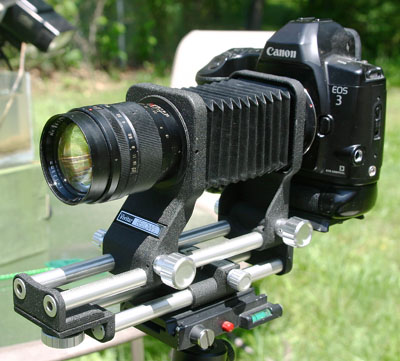
In my previous post on the subject, I didn’t talk about one method of macro photography because I didn’t have the equipment – now I do. Seen here is a macro bellows, which is much the same as an extension tube, but able to be extended much further, which means increased magnification. There are some distinct limitations to using them. They need to be rock-steady, because depth-of-field will drop down to levels where a tiny twitch will throw your subject well out of focus. They don’t usually work with automatic lenses, because the linkage or electronic contacts between the camera and lens aren’t maintained. And they’re bulky. But they make up for it in performance, if you’re after very small subjects. The variable extension provides lots of options in subject distance and focal length of lens used (here I’m using a Vivitar 135mm f2.8.) Magnification is a factor of lens focal length versus extension – the more extension you have over focal length, the greater the magnification. So while the 135mm provides some decent working distance, a shorter focal length will provide even higher magnification (stay tuned.) The extension also reduces light, not helped by the fact that you’ll typically be using f11 to f22, so you will needs lots of light, as shown by the very close Metz flash being used at full power at top. In most cases, you’ll have to close the aperture manually after you’ve focused and before you trip the shutter, and in some you may have to manually calculate exposure based on lighting and extension – luckily the Canon can do it without needing to communicate with the lens.
By the way, this model bellows (Vivitar’s t-mount version) features a second rail under the first, which allows the entire rig, with the camera mounted, to slide smoothly forward and back without moving the tripod – this is far more useful than I’d imagined. Without it, I’d recommend the separate macro rails that can be found. You don’t have to have either of these for aquatic work, as there are several macro options, but a bellows can add a lot to your repertoire.
Since another detail is visible in the top image and I’ve been meaning to mention is, I’ll throw it in now. While I have a DIY project for a basic Canon remote release (Canon eliminated the compatibility with a standard cable release in the EOS line,) I eventually ended up purchasing the Intervalometer, which can be programmed. But it comes only with the N3 connector, while a couple of my camera bodies sport the E3 connection (which is exactly the same as a 2.5mm micro stereo connection.) Both connections do exactly the same thing, and the power is provided entirely by the camera body, so all that is necessary is closing the contacts in the right order (a small aside: the Intervalometer has its own battery to run the logic circuits.) So, I cut the cord between the remote and N3 connection, and wired two adapters; one using the N3, the other an E3/2.5mm, both ended with a 3.5mm mini stereo connection. There are two benefits to this. One is that I can effortlessly switch the remote between cameras; and the second is that I can use a standard headphone extension cable (3.5mm connections) to extend the remote for the length of whatever cable I find.
You may note that the adapters I made are bound together but in opposite directions – this makes it impossible to mistake what connection I’m using, and I can even select them in the dark by feel. I do get clever every once in a while ;-)
It’s funny. I grew up with a fear of spiders, and while it is maintained that this is a learned response, I have a very hard time pinning this down – I can think of no specific education I received that set spiders apart, aside from the idea that some were venomous. I knew the same about snakes, yet had no fear of them at all, perhaps because my father and brothers not only handled them frequently, they kept several as pets. I discourage such things now, mostly because it is unnecessary and often detrimental captivity, but also because snakes (like countless non-domesticated species) really aren’t all that interesting to have around.
But spiders! There was definitely something about their appearance, their way of moving, that simply creeped me out, and those urges remain even though I’m in my forties now. At the same time, my fascination has grown, and I can handle most species voluntarily, though I can still get a chill if I discover one walking on me. They have such a wide variety of habits that they bear closer examination, and these are a case in point: the fishing spiders.
My first photo sale was of both a fishing spider and water striders, for an article in a water gardening magazine. The spider image, shown at right, was printed full page because, I’m guessing, they had too many readers. This is an example of one of the largest species, and almost certainly the largest species found in North Carolina – this one easily spanned my entire hand across the legs, tip to tip. They don’t spin webs, but instead capture their food by stalking like the various wolf spiders. In the case of the Dolomedes genus, they lie in wait on the edges of ponds and rivers, forelegs often resting on the water, and dart off across the water when an insect inadvertently splashes down, occasionally dining on small minnows and frogs as well. I suspect they also watch for species that hatch from an aquatic larval stage into a flying adult, emerging unprepared from beneath the surface.
Many spiders can get away with walking on the surface of the water, for two distinct reasons. The first of which is that they don’t weigh very much, so they can displace their weight against the surface tension easily, but more important is the structure of their feet, which contains tiny hairs that spread out on the surface, distributing their weight over a greater area. This can be selective as well – if they so choose, they can dive beneath the surface to escape predators or capture their own prey, as I watched one demonstrate the other day. When this occurs, the hairs on their bodies serve another purpose, which is to trap air against their abdomens where the breathing spiracles are located. In this way they carry their oxygen supply with them, and the various species of diving spiders will actually construct a dome-shaped web underwater and shed the air from their abdomen underneath this, forming a captured bubble beneath the surface in which they can retire, as well as raise their young.
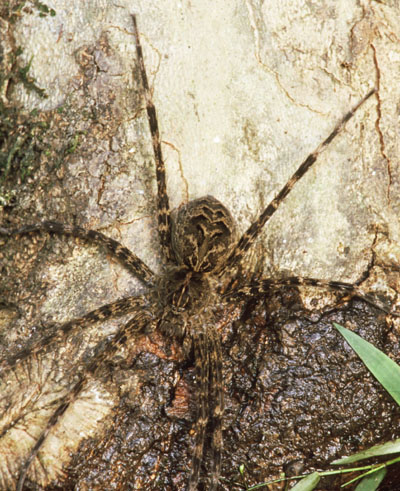
They are not confined to water, and can be found in wooded areas fairly distant from ponds and streams – there’s a chance that the monster seen here is a fishing spider species, but many of the Dolomedes genus are hard to tell apart, especially when their abdomen is obscured by tiny horrors.
Most spiders are very shy in reality, and despite our impressions of aggressive behavior, will vastly prefer to run and hide at any sign of trouble – compare that to mosquitoes ;-). But one of the larger species was responsible for the most aggressive act I’ve seen from a spider, though I am forced to admit it was probably a case of mistaken identity. When I first moved to NC in 1990, I soon found that the nearby creek played home to some of these monsters, and one day I saw one disappear under a branch at my approach. Wanting a closer look, I took a small (but long) stick and started to ease it under the branch to flush the spider back out. But as the tip of the stick approached the hiding spot, the spider leapt out and seized the stick fiercely in its fangs for a moment, almost certainly under the impression it was a choice tasty insect of some kind. Such a display, however, does induce a bit of caution in one’s approach thereafter. This memory naturally came right to the front, many years later, when I was opening a wellhead and removing a bat of fiberglass insulation, to find another massive example perched on the insulation right smack on the opposite side as my hand. Knowing that, if startled, the spider would immediately run to the reverse, my movements became excruciatingly slow and careful. The spider graciously held still, sparing the immediate neighborhood a manly display of screams and leaping about.
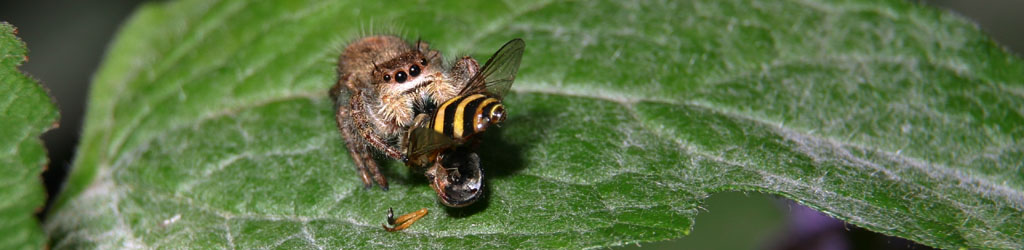
Below, the largest example of a six-spotted fishing spider (Dolomedes triton) that I’ve seen, showing the way the water bends under her weight but still supports her. You might also notice that she has an undersized leg, presumably growing back after an altercation. This is the same one I witnessed diving under the surface in an eyeblink, and from the size of the abdomen, I’m guessing she’s not far from laying her eggs. In two locations within the past couple of days, I spotted well over a dozen of this species, often three or four examples within a meter of one another. Since this is the hatching season for many insects and tadpoles, I imagine it’s a great time for the spiders too. The one at the top of the post, a typical specimen spanning a little over a large coin in size, was one of many ignoring me because they were busy feeding – you can just see the captured delicacy if you look closely.
And yes, that’s my own finger – I do this strictly for blog posts, so you get a good idea of the scale. See how much I care for my readers?
For any of the four readers who might have been checking in vain for new posts, I apologize. It’s been a weird several days, and when I wasn’t involved with backups and system maintenance (backing up photo files takes more than a workday,) I was out trying to find photo subjects. And I did, so more will be along shortly. For now, I leave you with this.
Sometimes, the spam just seems so right that I’m tempted to let it go, sans links of course, but virtually all of what comes through the filter are on posts from long ago – apparently some ‘bot programmer reckons people will actually read posts from last year, instead of aiming for dates less than a week old. Go figure.
So instead of simply approving it for some old post no one will see, I’ll present it, with pride, in a current post:
Whoa. That was a great article. Please keep writing because I love your style.
… which tells me I’m definitely being too long-winded, since it was on this example of my erudition. Yeah, thanks.
So now, let’s talk about another aspect of controlling your photography – well, actually, I’ll “talk,” you’ll “listen.” That’s how a blog works, unless of course you actually decide to comment (you are more than welcome to, you know.)
Anyway, the impression of many people is that nature photography means taking things as they are, capturing only what exists, rather than, for instance, staging an image. But there are many techniques available to control your image, without actually involving staged circumstances, and one of them is lighting.
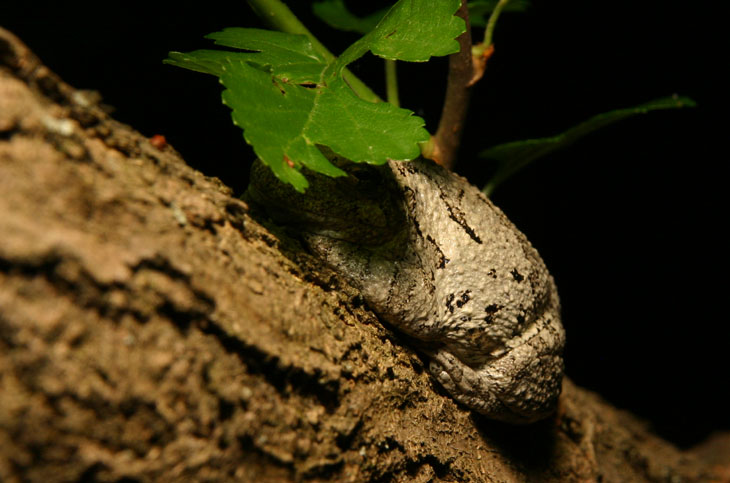
Natural light can be very useful, and it is perhaps the best thing to use to have your backgrounds showing up cleanly, but it’s arbitrary and capricious – haze and overcast change the colors of your image, as will ambient light reflected from nearby foliage or surfaces, and light levels don’t always allow you to capture the action (or even hold the camera still enough.) Too little light, and your shutter speed has to drag out to let enough in for a proper exposure, and there’s too much chance you will twitch the camera or your subject will move – these are the number one causes of blur and softness in photos. And the contrast may not work to your liking. My treefrog subject here is docile enough to let me both use the tripod, and play around a bit with options.
So the first option is to use a flash or strobe, getting adequate light onto your subject, color-balanced, and perhaps even from the direction that you want. But it is often harsh and very high contrast, which photography only increases – both film and digital almost always appear higher in contrast than our eyes see. This makes colors “pop,” but it also increases shadows and may drastically change your image. These images were taken only seconds apart, but as you can see, either night fell with extraordinary speed, or something funny happened with the light.
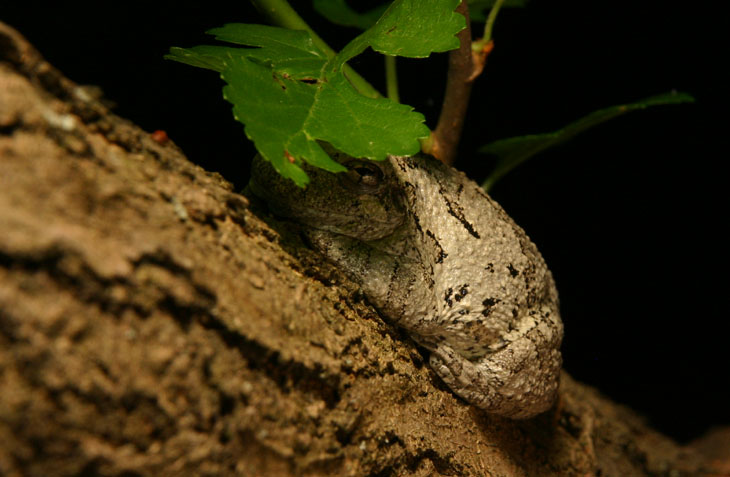
What was funny is that, even though both images used an aperture of f16 to maintain a certain depth in detail, one was done with natural light using a very slow shutter speed, and the other with a flash (and softbox) at 1/200 second shutter speed. The top one allowed the low light in the background to come through, the bottom one relied entirely on the flash – the background light was too sparse to even show up in the exposure. Yet, the detail from the frog isn’t necessarily better, most especially because the shadows that were introduced hide the eyes and make things a bit harsher. Enter the sneaky little trick of most serious photographers: the fill lighting.
Even see a model shoot, where photographers’ assistants are running around with large reflective panels or adjusting multiple light sources? These are used to balance the light levels in the shadows, so the shadows don’t become too dark and detract from the image, like my example above. It’s call fill lighting, and it’s always dimmer than the main lighting and usually from an opposing direction, giving soft illumination where the main lighting does not reach, yet not detracting from the impression of a single, perhaps natural, light source.
Now we can compare the difference. Look at the eyes, and the shadows on the bark – even at the highlighted sections of the frog’s shoulder. Far less harshness, less idea of a flash being used (also helped by the diffuser on the softbox,) and the eye becomes visible, which is good because we always look to the eyes. A little fill can help quite a bit, but there’s still the idea of the frog hiding under the leaf, and the eye becomes much more effective being almost hidden rather than completely invisible.
Fill lighting can also be accomplished using natural light, such as bright sunlight, as your main light source, and the camera strobe for the fill. A camera strobe is never a match for the light the sun puts out, but it can be sufficient to soften the shadows and throw a little light into hidden areas, like the first photo here. If you find yourself even doing casual portraiture in brighter sunlight, try firing off the flash – you may like the results a lot more, and get rid of some of the contrast and dark shadows.
Ideally, fill lighting should be accomplished by measuring light levels and using a variable light source, whether it’s an adjustable strobe or having your assistant angle the reflector differently. But such luxuries are rarely available to the nature photographer (the subject may not hang around for much in the way of shenanigans,) and there’s only so much equipment you may want to carry anyway – I know I have my limits. But in a pinch, you can make do with materials at hand. White surfaces will bounce a certain amount of light, aluminum foil and similar materials a bit more. Finding myself in need of the reflection and not having anything other than the camera and softboxed strobe, I cheated. One of those little pieces of plastic in my wallet turned out to be useful for something after all, when the white back, held just out of view, could be used to bounce some of the strobe’s light back into the underside of the frog. Here, you can see my fingertips intruding into the frame.
You may like any one of these images better than the others, and that’s fine – opinions vary, and your own artistic expression is part of your style. But if you’re planning on selling images, bear in mind that editors have their own goals for illustration, their own stories to accompany. The “daylight” shot is nice, but a bit low contrast and green, and treefrogs are primarily active at night, so the “night” shots have their own uses. Get a variety of images, and yes, more angles than I’ve shown here (which I did indeed get myself, I just stuck to a particular point for this post.)
Sometimes I get a kick out of the arguments for religion, because they’re so entertaining. Whether this is actively fostered or simply a by-product of our media, the most common style that I see anymore is the sound bite. By that I mean, the brief and memorable, sum-it-all-up sayings that sound good, even though content-wise they’re rather deficient. The comments on any article at Scientific American dealing with evolution will provide many examples. Sound bites have the advantage that they’re quicker to snap off than a reasoned explanation, and that they can appeal to those who don’t want to make any effort whatsoever in considering a position. I’m refraining from comments about such a target audience…
Quite prevalent is the humility plea. Generally, it takes the shape of denigrating science because of what we have no answers for, and usually adds in some dig about the arrogance of assuming that we do. We mortals should be humble in the face of the deity, rather than curious or, god forbid, logical. Evolution is a favorite target, as is cosmology. Come on, say it with me: “Evolution is just a theory.” Very good – you got that nasally whine just right on the word “theory.” I’m not even going to go into the ignorance of what the arguers think “theory” means – it’s not worth it anymore. It’s just amusing, listening to someone wielding the statement as if they had made a major point instead of announcing their vapidity to the world.
The best part of these is the hypocrisy, though. Without fail, the arguer seeks to pour scorn on both science and secular education for daring to go with the evidence, but never, ever tumbles to the fact that religion attempts to define far more about the world, its beginnings, and whatever supernatural realm it proposes without the faintest shred of evidence (no, Caleb, a book is not evidence.) Science, somehow, is arrogant because it examines the real world and forms theories that support the facts, and predicts specific behavior or results. But religious folk, who usually couldn’t describe any portion of evolutionary theory or evidence accurately enough to pass a high-school biology exam, need to inform everyone else of how wrong science must be, of how much it’s based on dogma, and by golly how come my idea of six days and unchanging forms of animals isn’t taught right alongside this?
Because it’s fucking stupid – is that an adequate reason? While some may want to believe in magical realms all they want, others who actually want to know what works in the real world, will stick to knowledge obtained through empiricism. That’s the stuff that isn’t imaginary. Whether someone’s christian, muslim, buddhist, pastafarian, wiccan, or trekkie, it’s the stuff that works exactly the same regardless. That’s kind of – no, actually, that’s precisely – why its relied on and taught to children.
Especially entertaining is when someone actually uses the term “dogma.” When applied to science, this apparently is a corrupt and laughable concept, conveniently ignoring the fact that religion relies on dogma – it’s where the entire idea came from in the first place! So, Harvey Dent, which is it? Is dogma good, or bad? Doesn’t matter, actually – either way you just trashed your own argument.
In a way, you have to appreciate those who, in their haste to set those arrogant scientists straight, demonstrate both their own incredible ignorance and their distinct fear of ever finding out how wrong they might be. The arguments are ancient and long-rebutted, but like a child excitedly telling a decrepit joke about a horse walking into a bar, these helpful folk stand up on their soapboxes to show off their inability to perform even the most rudimentary of rational thoughts: that maybe somebody who’s making a living in the field might, just might, have caught the fundamental discrepancy that our helpful religious zealot trumpets. It is undeniably too much to expect that they actually type the term into a search engine. With so much information available to us right there on the machine you’re reading this upon, it astounds me that so few can ever make that logical leap into the abyss to see whether someone has indeed rebutted their insightful little proverb. I suppose that it has actually occurred to some, but there’s a little too much chance that the answer won’t be what they want it to be. So if they don’t ever learn it, it doesn’t exist. La la la la la la la…
To cap off the amusing portions, one of the surest ways to remain humble is to actually start learning about something – it’s safe to say that it takes humility to open oneself to learning in the first place. The amount of knowledge we have about myriad subjects is astounding sometimes, and it frequently results in finding some previously-held belief was mistaken – I’m not just talking about religion, because every subject can foster these results. If someone is concerned about never being found wrong, then the best thing they can possibly do is to dig a hole and fill it in on top of themselves. But if they harbor an honest interest in learning, in finding out new and fascinating facts and ideas, then discarding the anxiety over being “right” lets them absorb without filtering it through their ego. Every time someone finds out they were wrong about something, this is actually a very good thing, because they just moved forward.
It’s funny – a few weeks ago I had something like four or five ideas about posts, all having to do with religion, and no other topics coming to mind, nor was any other blog providing inspiration. I try to rotate and break up topics so I don’t appear obsessively obsessive, so I struggled with splitting them up and finding other things to insert between. Now, I have four nature-themed posts that I could put up right now. Where were these when I needed them? If this isn’t proof that there’s no god, I don’t know what is.
Yes, I called this pic "Tits n' ass" - wouldn't you?In that time before when I needed other subjects, I had been observing the antics of a tufted titmouse (Baeolophus bicolor,) only it was a pair of them so it’s titmice. There are those who will disagree – they’re wrong. Language is not governed by rules, by the way, it’s a method of communication. All words are made up. While titmouse has nothing to do with mouse, every other usage of mouse is pluralized mice, and everyone knows exactly what I mean when I say titmice, so there’s no point in actually trying to figure out whether there is some other form of “proper” plural. If this is the way one has to display their higher intelligence, they have issues all their own. Save this post to link them to if you like. Or ask them what they’re doing about global warming – that works too.
[No, I’m not paid by the word] Titmice tend to be very subtle, not drawing attention to themselves with song and ostentatious displays (unlike Carolina wrens for instance,) but I did notice that they were interested in a hollow of the hickory tree in the yard. I’d peeked in there a few times when they weren’t around, but saw nothing of interest – I guess I wasn’t looking close enough. Just a few days ago, another peek revealed significant changes.
There are four in there – you can just see the corner of the fourth beak at lower left – and they keep mom and dad busy, going back and forth with insects. The young had remained silent at first, but in the past couple of days they have taken to cheeping when they feel food is imminent, and can frequently be heard any time I’m in the yard. The parents have a fairly set pattern of behavior, arriving nearby and scouting the area for danger before going into the nest cavity, and they have distinctive patterns.
The male will often perch on a branch in plain sight, and if the female is around, may chatter excitedly, though he is much quieter when alone. He often works towards the nest in stages, checking the area for danger so he doesn’t lead predators towards the nest. The female, on the other hand, stops on different branches, often in another tree, and remains deeper in the foliage, trying to stay hidden, and will disappear into the nest faster. The male often peeks out to check the environment, as seen below, but the female sticks right to the feeding business and thus spends about half as much time in the nest. Both will grab the drops of poop, that the young produce in huge quantities at this stage, and carry them out of the nest to deposit elsewhere – this is very common behavior among birds, and the neonates’ feces tends to be encapsulated in gelatinous “saliva” for just this purpose. Otherwise, they would be at the top of a mountain by the time they grow out their flight feathers…
I have been hampered in photographing them by three factors. The first is, the nest cavity is small and narrow, and while conveniently close to the ground, it’s hard to even aim the lens into. Second, the cavity remains in deep shade nearly all day long, dropping the light levels significantly even on a sunny day. And finally, titmice very active birds, constantly in motion, and this doesn’t combine with low light very well – to get a decent exposure, the shutter has to be slower, and this results in blurring if there’s the slightest movement from the bird at the time I trip the shutter.
However, I’m experimenting with several techniques, and will be back with followups, especially when the young fledge. I have been sitting nearby with the camera several times now, and the parents are fine with this as long as I’m a certain distance and remain relatively still. I have also augmented my light with both camera flash (only good for short distances) and a studio strobe, which works pretty well. The studio strobe can be triggered in slave function, which means it goes off when it detects the flash from another source, such as an on-camera unit, so I don’t need PC cords or radio syncs. Being in the backyard means I can power the strobe with an extension cord. I may even try to mount the camera higher in the tree, aiming downward into the nest cavity, and trigger it by remote cable or even infrared, both of which I use on occasion. I have to hand it to Canon – most of their cameras have inexpensive IR remote units, providing the ability to trigger the camera from moderate distances, provided you have a line-of-sight towards the front of the camera. I have also modified the wired releases, which are electronic, to utilize common stereo headphone extension cables available for only a few dollars. So as time goes on, I may feature both the birds and the successful techniques in photographing them. This is what’s known as a teaser, to keep you coming back to the blog – I’m not above such blatant manipulation. Worse, though, is I’m doing it for free, for some reason. Possibly because it doesn’t pay anyway – that might be it.
Ah, Ronald Reagan! The guy that ended the Cold War, that brought the Iranian hostages home, that brought America back to world respect, that…
Wait a second… who?!
From someone who came of voting age during his administration, I’ve been dumbfounded at the accolades that Reagan receives nowadays. It was abundantly clear, right from the moment an aircraft carrier was named after him, that someone seems to be trying to create a legacy that never existed. And because most Americans get their history knowledge from sound bites and opinions it seems, it’s working to some extent.


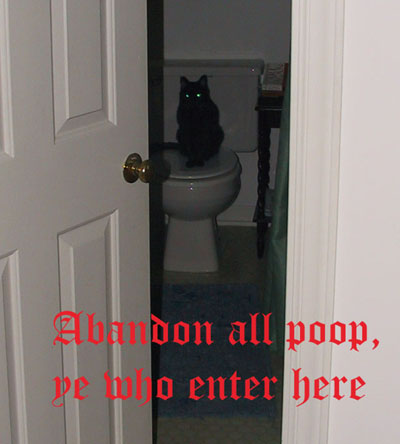 A few years back, I snagged what is sometimes called a “grab shot” of my cat Ben perched in the bathroom, and liked the effect of his glowing eyes in the depths. So I captioned it, a la LOLCats, but never bothered to submit it. More amusing to me is that Ben lacked any shred of threat or ominousness (you don’t think that’s a real word, do you?), being one of the most mellow and friendly cats I’ve known. Also one of the least bright, but those are stories for another day…
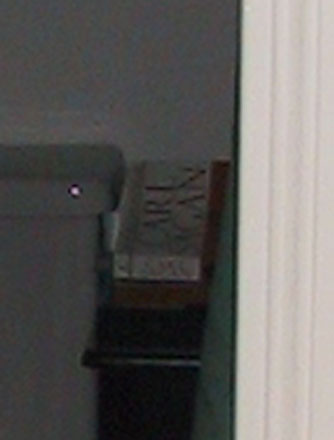 As I suspected, the book is recognizable, and indicative of a skeptic’s bathroom for sure. In fact, I had a friend tell me that he’d picked up the book in my bathroom while visiting, became too engrossed, and ended up having to get his own copy – so now I even have a rough timeframe of when that occurred.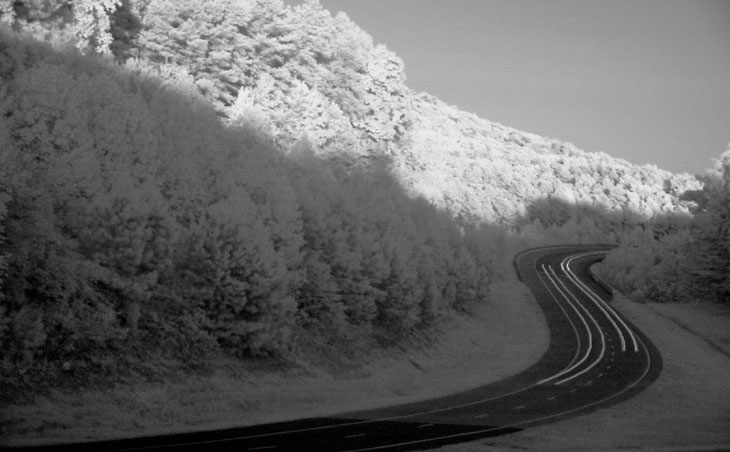
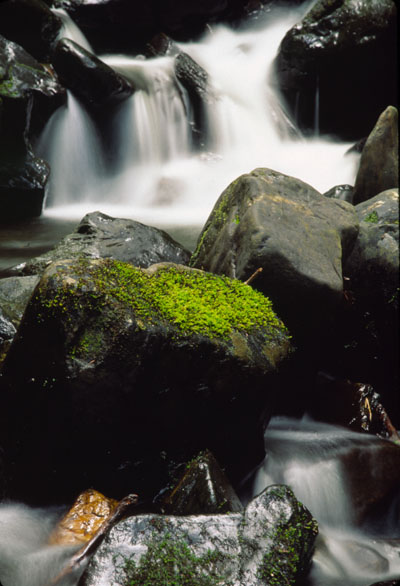 There is a wide variety of subject matter available, though. In the image at top, there were two reasons to use a long exposure: traffic motion; and the very limited light coming in with infra-red photography. At right, we see one of the more common uses: making moving water go soft and cottony. It can also be used for
 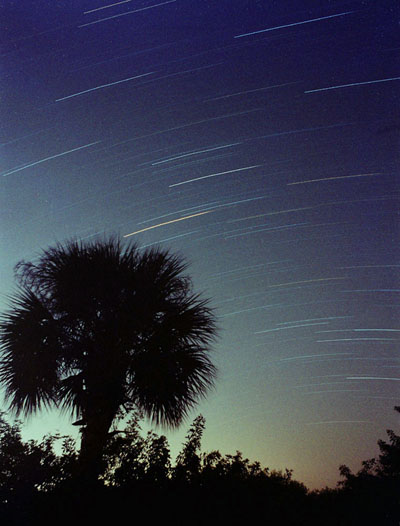 Often, you don’t need a lot of motion to make a decent image, and too much can produce a mess in the frame. When doing something like traffic or moving people, only a few cars or people are needed, and often only for short distances to convey the idea. Once they begin to overlap, they start getting muddled. For things like bird’s wings or moving wheels, even less time is needed. For star trails, though, it usually takes at least ten minutes for something noticeable, and an hour or more for really distinct trails. This even depends on where you’re facing. If you’re pointing towards one of the poles, for instance, you may need several hours for really good arcs – remember that the stars will produce a full circle by themselves in 24 hours, because you’re actually capturing the movement of the earth. Aiming towards the plane of the ecliptic, basically the equatorial regions, produces much more apparent motion, and you can get by with shorter exposures.
 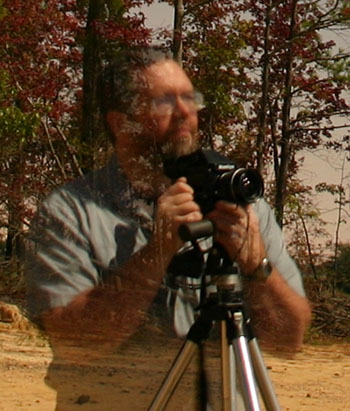 Exposure relies, naturally enough, on the light actually reaching the film or sensor. In the cases of either partial exposures (where the subject moves or leaves the frame) or multiple exposures (where the light hits the film/sensor multiple times in a single frame,) lighter-colored subjects will overcome darker colors. Note the differences here between the moonlit portions of my shirt, and the shadowed side, even of my face – the transparency shifts according to brightness. And now you know how many “ghost” photos are accomplished ;-)
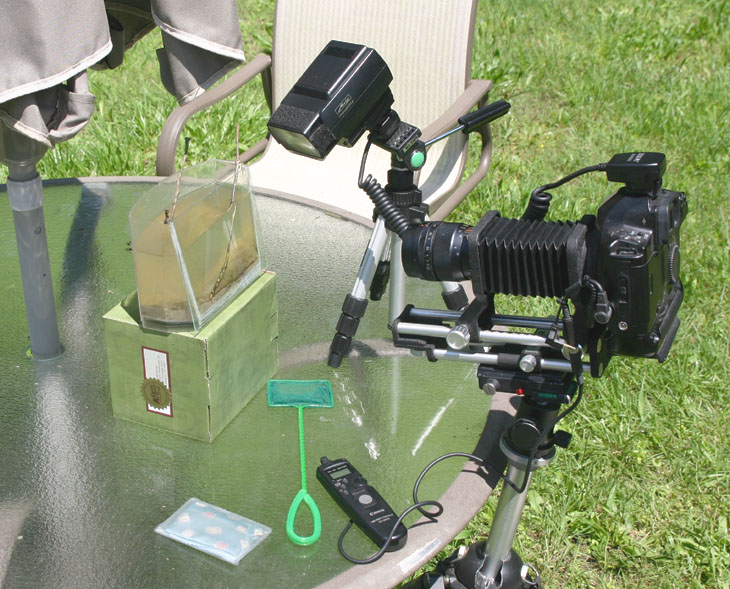
 First off, you need a macro aquarium, a small watertight enclosure to keep your subjects hydrated and natural-looking while still allowing you the visibility you need. This one is a small Betta tank I obtained from WalMart for five dollars, that I sliced one of the plastic sides from and replaced it with glass (in this case a sheet measuring 5×7 inches from a photo frame.) I angled it back as far as the tank design would allow, for three reasons: first, you want to try and shoot dead-on through the glass, and not at an angle, because glass will easily distort a macro shot, and angling back lets you work without your chin resting on the tabletop; second, your additional lights may bounce off of both the front and the back of your tank, so this angle helps reduce the occurrences; and third, it lets you use more of the bottom substrate as your background, meaning you won’t have to cover the back of the tank with something appropriate as often (but still have stuff handy.) When you do this, remember that you’ll have to wrangle subjects and arrange your “setting” within the tank, so don’t make the top opening too small. At the same time, restricting your subject’s movement as much as is reasonable means you spend less time waiting for it to wander into range, or shooting through suspended sediment.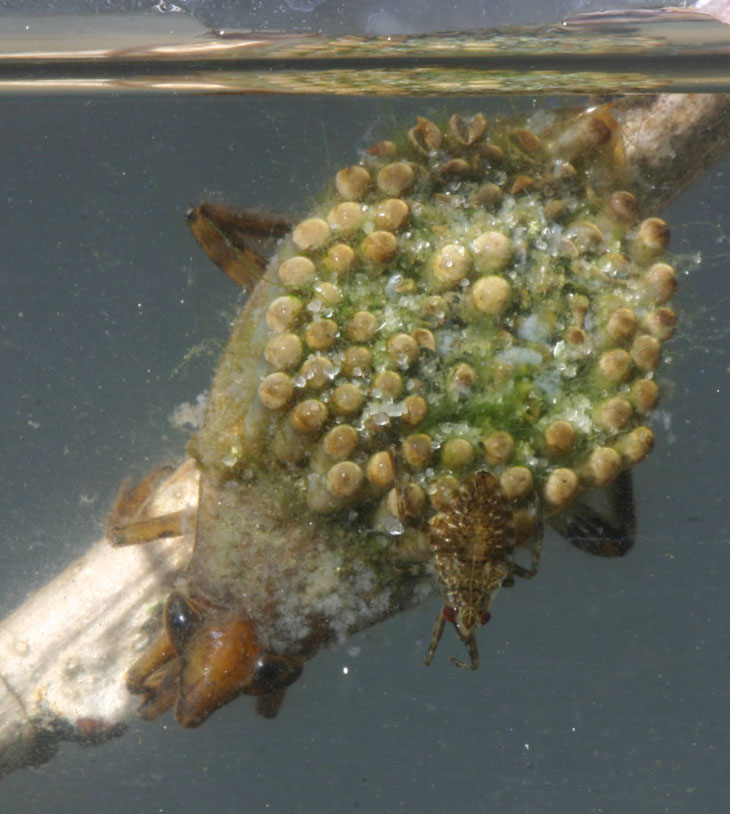
 In my
In my 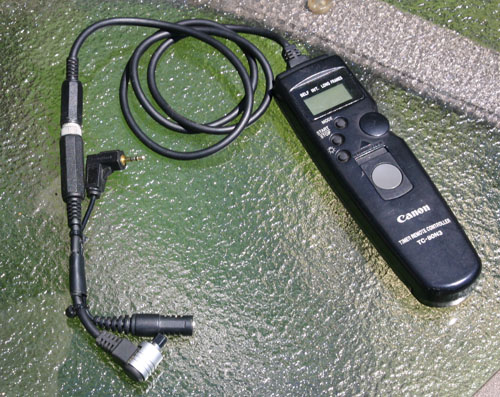 Since another detail is visible in the top image and I’ve been meaning to mention is, I’ll throw it in now. While I have a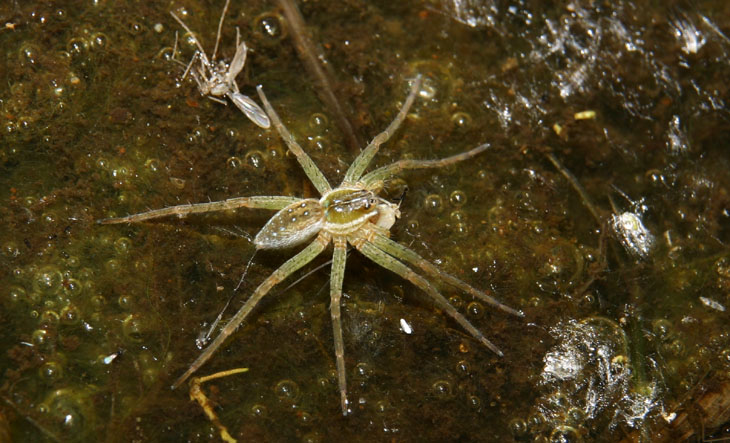
 My first photo sale was of both a fishing spider and water striders, for an article in a water gardening magazine. The spider image, shown at right, was printed full page because, I’m guessing, they had too many readers. This is an example of one of the largest species, and almost certainly the largest species found in North Carolina – this one easily spanned my entire hand across the legs, tip to tip. They don’t spin webs, but instead capture their food by stalking like the various wolf spiders. In the case of the Dolomedes genus, they lie in wait on the edges of ponds and rivers, forelegs often resting on the water, and dart off across the water when an insect inadvertently splashes down, occasionally dining on small minnows and frogs as well. I suspect they also watch for species that hatch from an aquatic larval stage into a flying adult, emerging unprepared from beneath the surface.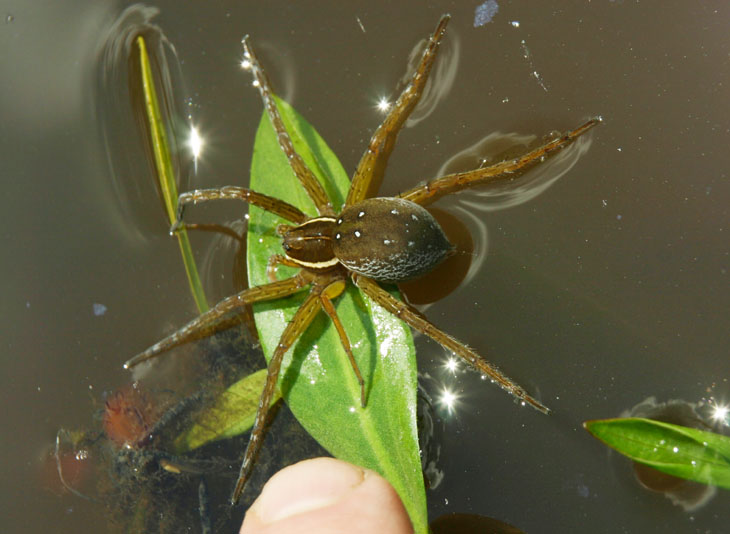
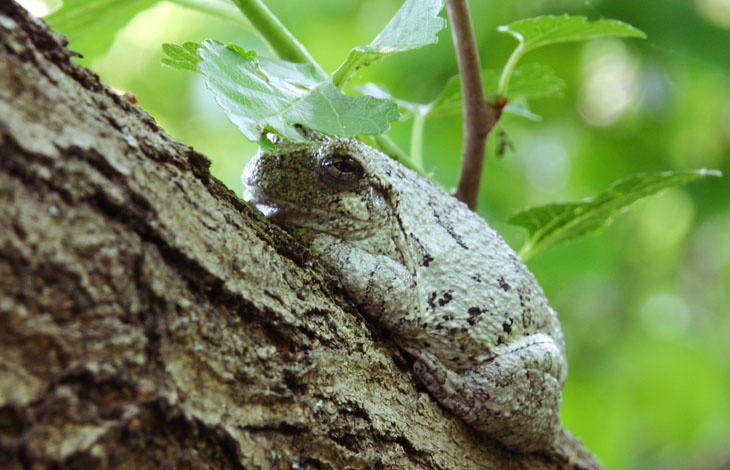
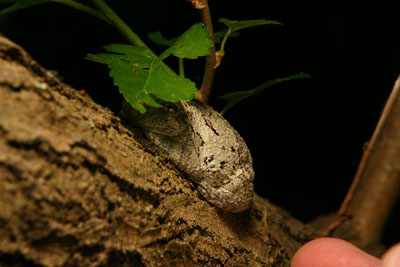 Ideally, fill lighting should be accomplished by measuring light levels and using a variable light source, whether it’s an adjustable strobe or having your assistant angle the reflector differently. But such luxuries are rarely available to the nature photographer (the subject may not hang around for much in the way of shenanigans,) and there’s only so much equipment you may want to carry anyway – I know I have my limits. But in a pinch, you can make do with materials at hand. White surfaces will bounce a certain amount of light, aluminum foil and similar materials a bit more. Finding myself in need of the reflection and not having anything other than the camera and softboxed strobe, I cheated. One of those little pieces of plastic in my wallet turned out to be useful for something after all, when the white back, held just out of view, could be used to bounce some of the strobe’s light back into the underside of the frog. Here, you can see my fingertips intruding into the frame.

 The male will often perch on a branch in plain sight, and if the female is around, may chatter excitedly, though he is much quieter when alone. He often works towards the nest in stages, checking the area for danger so he doesn’t lead predators towards the nest. The female, on the other hand, stops on different branches, often in another tree, and remains deeper in the foliage, trying to stay hidden, and will disappear into the nest faster. The male often peeks out to check the environment, as seen below, but the female sticks right to the feeding business and thus spends about half as much time in the nest. Both will grab the drops of poop, that the young produce in huge quantities at this stage, and carry them out of the nest to deposit elsewhere – this is very common behavior among birds, and the neonates’ feces tends to be encapsulated in gelatinous “saliva” for just this purpose. Otherwise, they would be at the top of a mountain by the time they grow out their flight feathers…
 However, I’m experimenting with several techniques, and will be back with followups, especially when the young fledge. I have been sitting nearby with the camera several times now, and the parents are fine with this as long as I’m a certain distance and remain relatively still. I have also augmented my light with both camera flash (only good for short distances) and a studio strobe, which works pretty well. The studio strobe can be triggered in slave function, which means it goes off when it detects the flash from another source, such as an on-camera unit, so I don’t need PC cords or radio syncs. Being in the backyard means I can power the strobe with an extension cord. I may even try to mount the camera higher in the tree, aiming downward into the nest cavity, and trigger it by remote cable or even infrared, both of which I use on occasion. I have to hand it to Canon – most of their cameras have inexpensive IR remote units, providing the ability to trigger the camera from moderate distances, provided you have a line-of-sight towards the front of the camera. I have also modified the wired releases, which are electronic, to utilize common stereo headphone extension cables available for only a few dollars. So as time goes on, I may feature both the birds and the successful techniques in photographing them. This is what’s known as a teaser, to keep you coming back to the blog – I’m not above such blatant manipulation. Worse, though, is I’m doing it for free, for some reason. Possibly because it doesn’t pay anyway – that might be it.