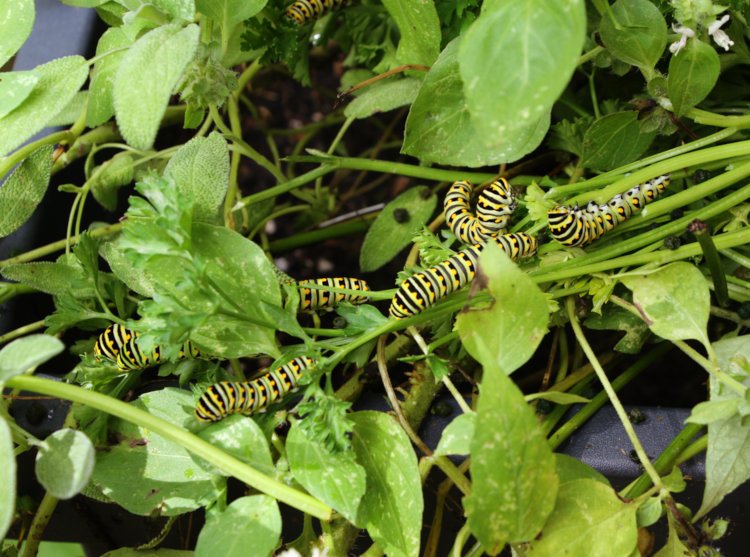
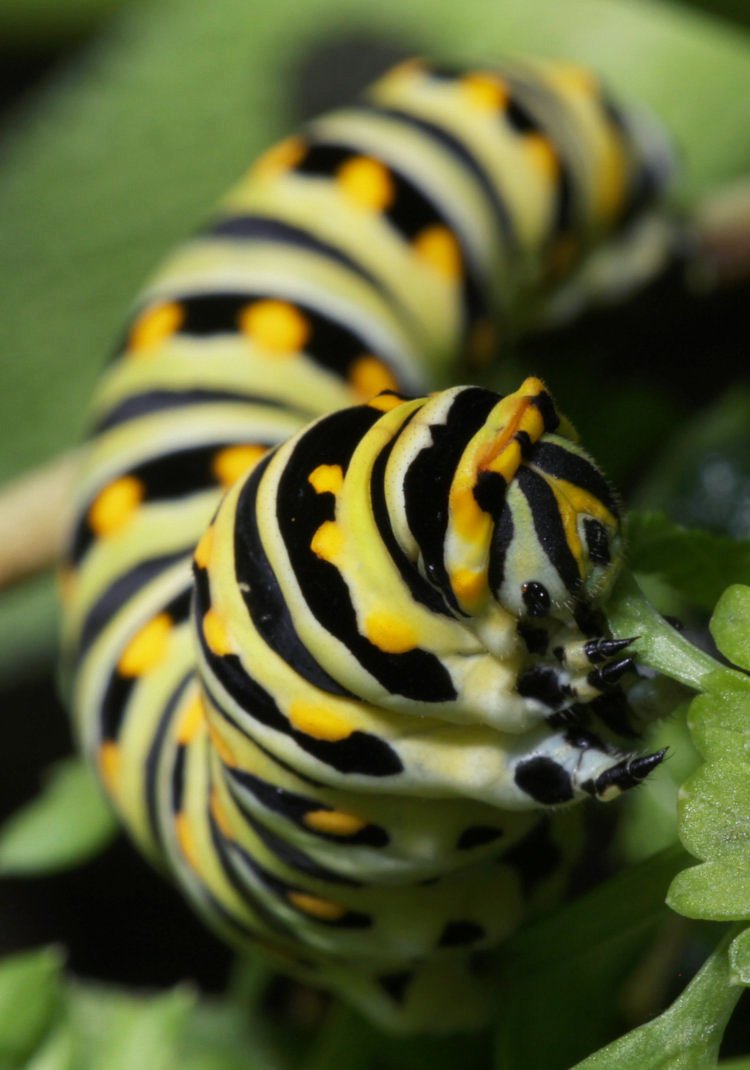
This is courtesy of The Girlfriend, who asked me to come out onto the deck to see something, which turned out to be in her overstuffed herb planter (that’s not a euphemism, shut up.) We were a little late to the game, and won’t be having any fresh parsley.
Those are the larvae of the eastern black swallowtail butterfly (Papilio polyxenes asterius,) and this was actually the intention – we don’t give a rat’s ass about parsley, considering it a tasteless herb or garnish, but this species of swallowtail adores it. The Girlfriend actually planted it just to attract them, and once they get big enough, they’ll produce chrysalides (chrysalises) to pupate into adult form. She used to do this each spring, but it’s been a while now – a few times the parsley just never took. Quite frankly, she should have planted much more, because it’s disappearing rapidly.
The good news is, they’ll eat fresh parsley from the grocery store, which is all they’ve been getting for the past two days, since they decimated what had been planted. The species also likes celery, carrots, and dill, though we have none of those in the herb garden, so if we want to keep them around for the full cycle, we need to keep them fed. Parsley’s cheap, and whether it harbors cyclospora or not probably doesn’t make any difference to the larvae, who cycle things through so quickly the parasite would probably be killed by friction burns. Yes, that’s caterpillar feces in the pic – it’s kind of hard to avoid it.
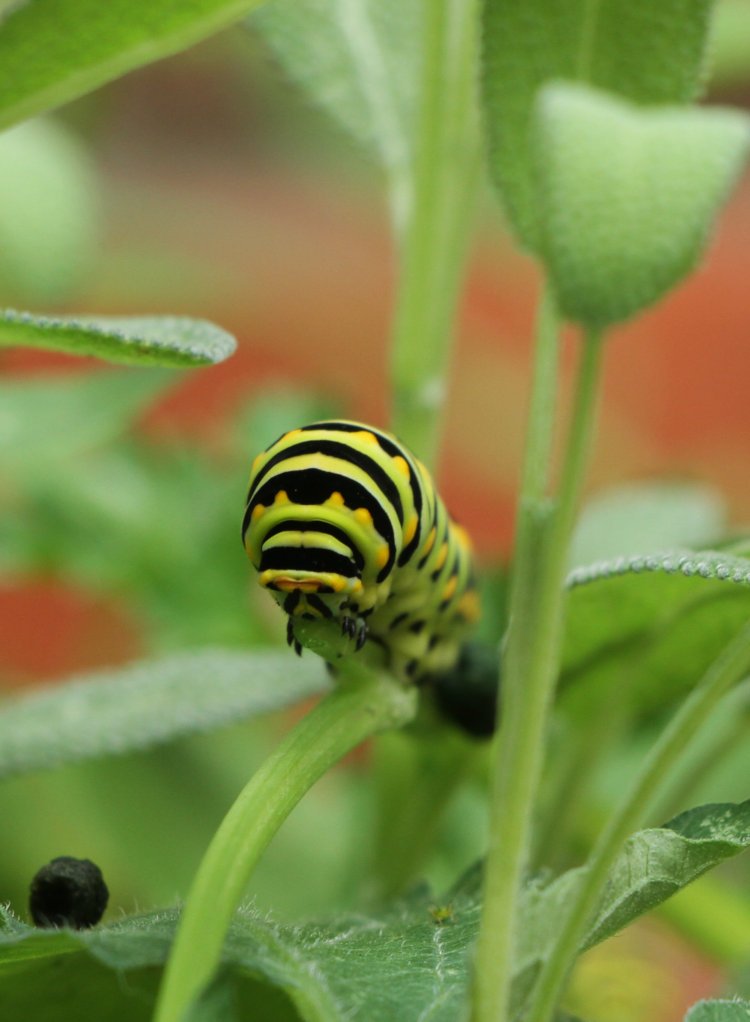
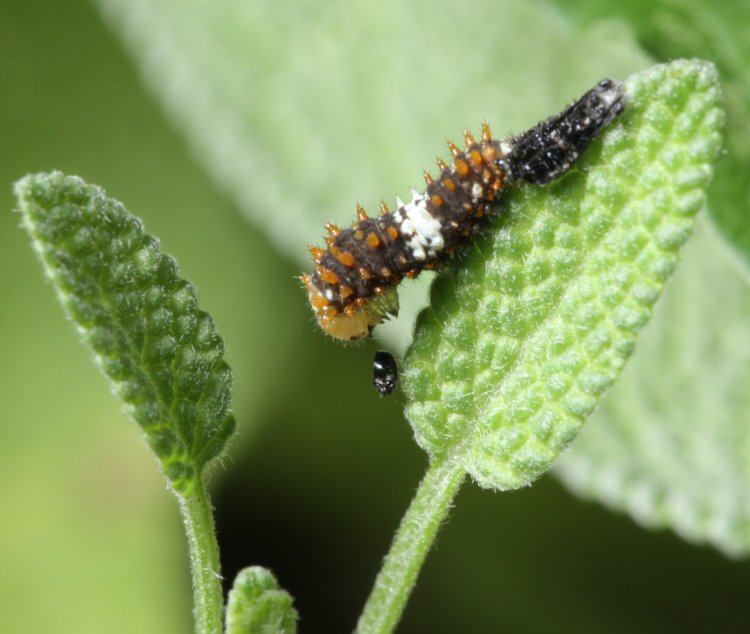
The appearance of the newborns is a little different, which is typical in my experience; at this age, they don’t have the defenses and must convince predators they’re a dead leaf. But as they get more of the age of the other pics here, they develop a little defense that is hinted at by their bright, contrasty coloration, that ol’ aposematic, ‘keepaway’ thing. When disturbed, they extrude their osmeteria, and I’m sure you know what that means.
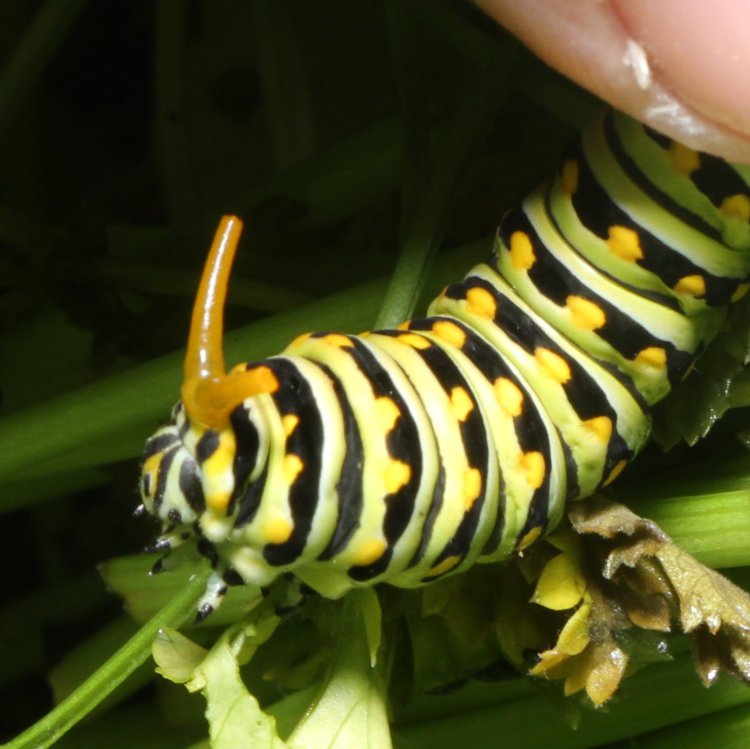
That’s them, the bright orange ‘horns,’ and these emit a pungent aroma [that’s too good a word for it] stank that repels birds and other predators, but only makes nature photographers have to wash their hands at least twice. This was uncalled for, since all I did was pinch a little of its chub. Don’t these guys have grandmas?
But that’s what the bright colors indicate, and this is true for many such adorned species. The defenses, whatever they may be, function quite well, and the distinct coloration makes them memorable so predators learn and never try again.
If you look very closely, you can see the three eyes at the edge of the dark spot about, well, about where you’d expect to find eyes. They really don’t need them for much at this stage, but I’ve remarked before on how drastically the eyes change between larva and adult for the lepidoptera. Thing is, everything changes drastically, a complete floor-to-ceiling remodeling more reminiscent of a mad scientist producing some bane of mankind from a petri dish of goo in a science-fiction cartoon; seriously, they pretty much dissolve into sludge in the chrysalis and rebuild a butterfly body, MacGyver-style. Well, without paperclips and hairspray…
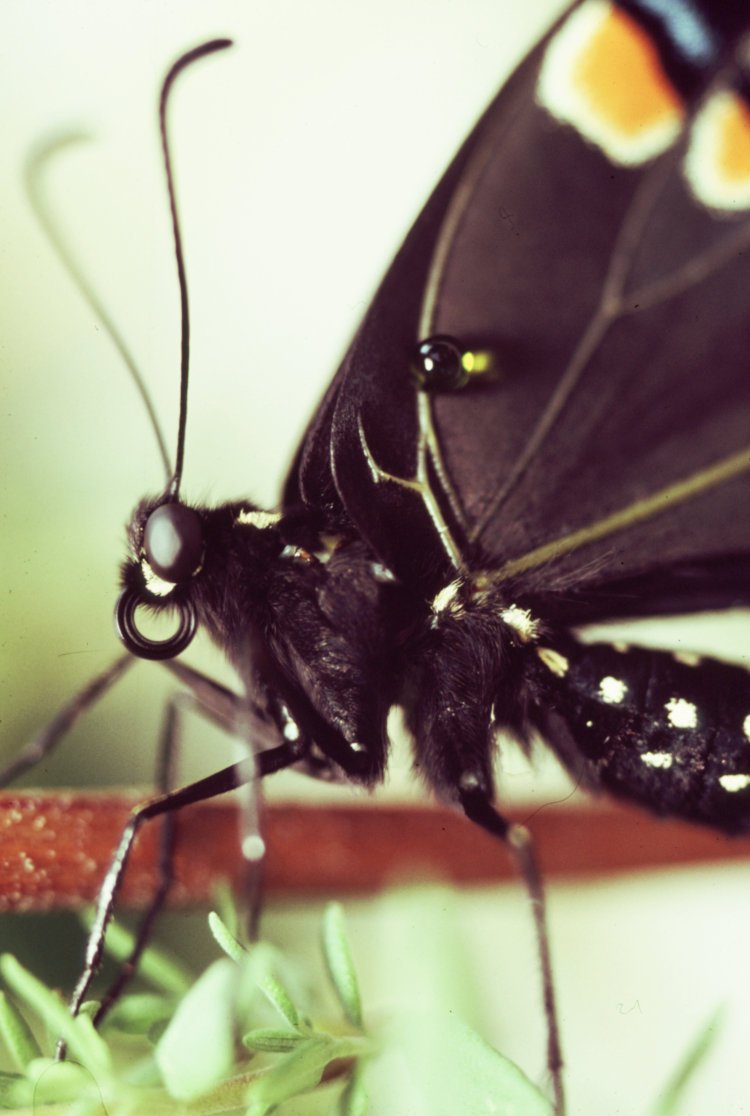
Should said chrysalides be forthcoming, you’ll get further pics, and hopefully some of the emergence, too, so look closely to see if you recognize any of these later on. Meanwhile, I leave you with an ancient slide scan back from the last time The Girlfriend was successful, and raised several to adulthood. This is from probably about 16 years ago, and the emerging butterfly had injured itself in the process, resulting in a blob of green hemolymph on one wing. I had to dig this one out – the lengths I go to for all you readers…
The rules* say they gotta fall in my/our** favor eventually, right? Because it’s getting to be about time to do so…***
The Perseids meteor shower is predicted to peak the night of August 12th and morning of the 13th, precise time about 03:00 UTC on the 13th, which places it as 11 PM on the 12th for those of us on the east coast of the US. ‘Peak’ is often a very broad term in meteorology, uh, meteoronomy, shootingstaragy, whatever – activity may be very strong or barely any noticeable difference during such showers, and may last from a half hour to a few days, and may not even be all that close to that time. On average, more meteors are visible at peak times – usually, often enough, though it only takes a couple of more meteors to skew an average in this manner. Math isn’t going to help us out much here.
What may help us out significantly is that there will be no moon in the sky at all during the night – in fact, it will be eclipsing the sun over in Europe not long before. Also, this peak time (for EDT timezone anyway) falls right before meteors tend to become more visible, which is after midnight. S’okay, the Earth rotates, right? And it also trundles in a big circle around the Sun, in a plane that largely coincides with the rotation. This means that, every day, any point on Earth is either facing into the wind of its orbit, turning against the orbital motion, or falling behind and thus moving in accordance with this motion. Since meteor showers come from passing through a trail of debris left behind by comets as they orbited the sun in their own manner, ‘facing into the wind’ means the path of the Earth and the rotation double up to increase the speed of intersecting dust, making meteors brighter and more frequent, but shorter. At any local midnight, the point on Earth where we stand starts ‘facing into the wind,’ so meteors increase, though we may not be in the thickest part of the debris trail just then. Conversely, before that time, meteors may be much fewer, but also last longer since their speed is slower relative to the Earth.
The debris trail is large enough that the shower may last several days, so whatever clear night you have surrounding that date, go for it. At least this one is during the summer for the northern hemisphere, so you shouldn’t have to bundle up, unlike far too many of the other showers.
Where to look? Seriously, any place the sky is dark enough – it’s a debris trail, it’s scattered and messy, so meteors might appear anywhere in the sky, but your better bet is someplace where other light is minimal and thus you can see more of the dimmer ones.
Now, the radiant is between the constellations Perseus and Camelopardis, just south of Cassiopeia, which at peak time will be medium low to the northeast for mid-latitudes US – lower for southerners, higher for northerners. But the radiant is another average thingy – it means that, if you traced all the trails of the meteors you see during a shower, they would favor lines that point towards the radiant – indeed, that’s about where the bulk of the debris trail lies. That doesn’t mean you’ll necessarily see more if you look there, only that most of the paths converge there – you might see them anywhere (well, in the sky at least,) and the slower ones more away from that point, so again, wherever you have the best visibility.
How to photograph them? Well, you’re asking the wrong guy, because my luck has been abysmal in this regard – up until this storm, right? Anyway, camera on tripod, focus on infinity (I often use the lights on radio towers to focus on when they’re available, since they’re bright enough and far enough away.) Turn autofocus off so it doesn’t keep trying to focus on those dark skies every time you trip the shutter. A remote release is recommended, and an intervalometer can help automate the shutter releases so you don’t have to do it manually. Shutter speed and aperture are going to be guided by the light in the sky, so test exposures are in order. The longer the shutter is open, the more chance you have of capturing a meteor, but also, the more residual light is admitted, brightening the sky, and the longer the star trails will become, making meteors harder to see. So start with ISO 400 or 800 (too high produces noise, especially in long exposures,) f5.6 to f8, 20 seconds shutter speed. Take a look at the resulting exposure – you should have plenty of stars visible but the background should not be very bright. Note, too, the closer you aim towards the North Star/Polaris, the shorter your star trails will be, and the longer your exposure before they get too streaky. Adjust as needed.
The more sky you can see, the better, but bear in mind, the shorter the focal length (the wider the view,) the shorter and less-noticeable the meteor trails become. I’d suggest 18-50mm (or equivalent.) Having a foreground interest makes for much better images, so pick a lake, find that dark old house or tree, that mountain peak – try for what would be scenic in daytime. You have a few days to think about this or scout locations, especially to see how dark it gets at night. Also, aiming away from commercial airline paths is much better, but these taper off seriously after 10-11 PM locally, in most locations (we sit directly under a major N/S route here, so I’m always ending exposures before aircraft enter the frame – red and white lines add absolutely nothing to the image.)
Don’t chase them. You may see a meteor or two in a particular direction, which is not where you’d aimed or the darkest sky. This doesn’t mean this is the spot to see them – they occur everywhere. Just be consistent, since the more time you’re adjusting the camera, the more time you’re not photographing. Believe me, you’re fairly likely to see one blaze outside the field of view of the camera, because the field of view is fairly small no matter what. This is the primary frustration of meteor storms: if you see nothing, well, bad night, but if you miss one, you’re more annoyed. It can happen easily, and there’s no good way to combat it except having a lot more cameras running simultaneously – which isn’t a bad idea, but it means more attending to them and less sky-watching. Better to at least witness that spectacular meteor.
Also, I’ve done a page explaining how to edit out the sensor noise from long exposures, those persistent pixels that occur because of small imperfections of the camera. This doesn’t remove all noise, but it gets those bright annoying pixels out of there.
So, good luck with it, should you decide to try your hand. As always, my brilliant successes will be available here.
* There are no ‘rules’ of averages, just statistics.
** You may have been having far better luck than I.
*** See asterisk one – there is no ‘due.’ Also, witnessing over 300 the night of the 2001 Leonids may have completely fucked my own personal averages, and I’m not due for any more…
There Will Come Soft Rains, by Ray Bradbury. It’s a quick read, and you’ll know why I chose it for today, even if you think it should have been yesterday.
I first read this in middle school I believe, and I’m almost certain it was a truncated version, ending when the poem does – which I think actually makes it better. It was written in 1950 and distinctly reflects the views at the time, though they carried into the 70s and early 80s pretty well – now, it might seem both overreaching and paranoid in its predictions for today, but that’s what science fiction is like. Still, very poignant.
Also, the poem of the same name, quoted in the story, was written during both World War I and the Spanish Flu epidemic
And here I add in another post that I’d started not too long ago, because it fits:
Every once in a while, you come across some online article that rehashes various predictions from times past, mostly to guffaw about how wrong they were, but occasionally to highlight some prescient tidbit. Science-fiction writers have an especially hard time of it when they’re trying to depict some future civilization and have to guess what kind of things may have changed – occasionally while missing the ones they didn’t think would. I’d re-read Fuzzy Sapiens by H. Beam Piper recently, and this one passage neatly illustrates what I’m referring to:
Of course, it was ending in a cocktail party. Wherever Terran humans went, they planted tobacco and coffee, to have coffee and cigarettes for breakfast, and wherever they went they found or introduced something that would ferment to produce C2H5OH, and around 17:30-ish each day, they had Cocktail Hour. The natives on planets like Loki and Gimli and Thor and even Shesha and Uller thought it was a religious observance.
Note that this is set five hundred years into the future, when we have colonized numerous other planets and have contragravity floating cars and so on. And yet, this passage by itself betrays the narrow timeframe that it was written within. Do you want to take a stab at it?
Elsewhere in the book, someone shoots a few movies of some particular subject, and has to go in to develop the film and make copies of it…
So, if you know just a little history, you know ‘cocktail hour,’ especially the event that took place before dinner, sprang up sometime after WWI, but by the late seventies had practically died out. Throughout the seventies and eighties, the dangers of smoking became well-known and the emphasis on smoking all the fucking time was disappearing rapidly, though it wasn’t until airline and restaurant bans (late 90’s and early 2000’s) that it began to, not really die out, but lose the majority of its social acceptance, going from that near-religious ritual to a bad habit that wasn’t publicly tolerated. And film became a fringe hobby by the 2010’s. This was following a growing popularity of cameras in general, in the boomer years following WWII, with movie/cine film starting to become popular in the 60’s as 8mm became more available to consumers.
So yes, the book was published in 1964, right around the peak of all of these, the author unaware that all three would vanish from prominence within a few decades. Coffee’s still going strong, however.
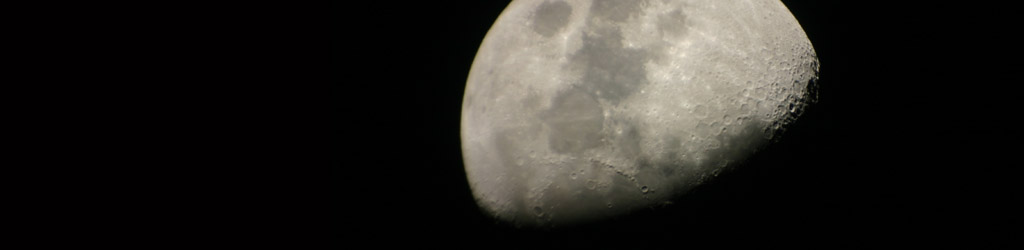
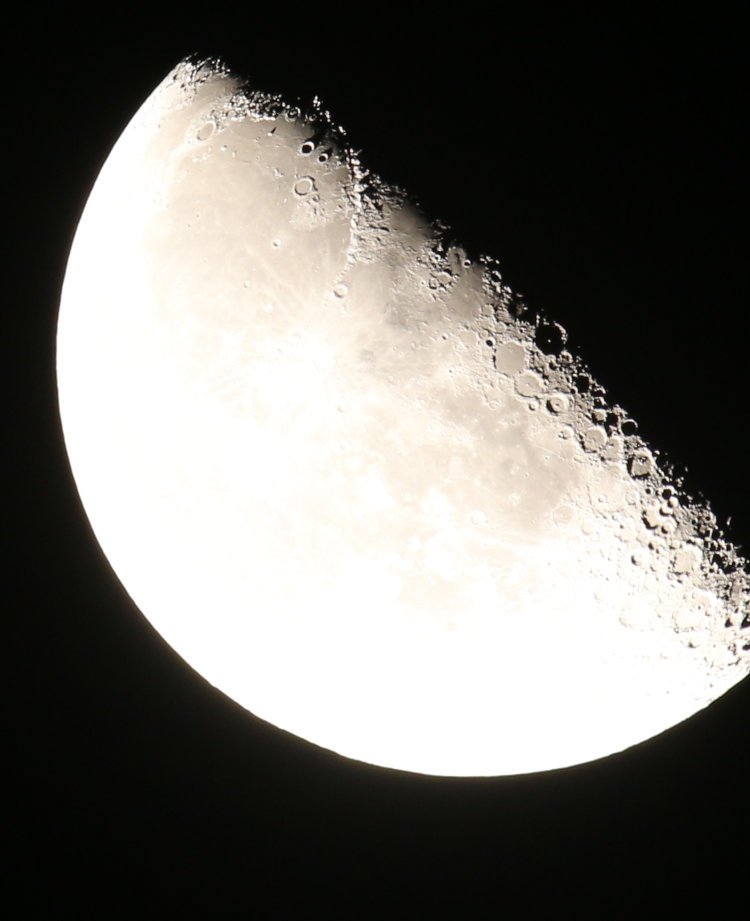
Despite many warning signs, including clouds just a wee bit too thick when I was setting up the tripod only ten minutes before the event, the skies were perfectly clear when the Falcon 9 stage impacted the moon, and I was indeed shooting video as it was supposed to happen. I’m not bothering to upload it, since there isn’t a damn thing to see – as predicted in the previous post. But I would have been quite annoyed with myself had I trusted those predictions and there had been a visible impact while I wasn’t bothering to shoot video. Can’t go back and redo that.
However, I also fired off several frames at different exposure levels to see if a dust and debris cloud was visible in these unique circumstances.
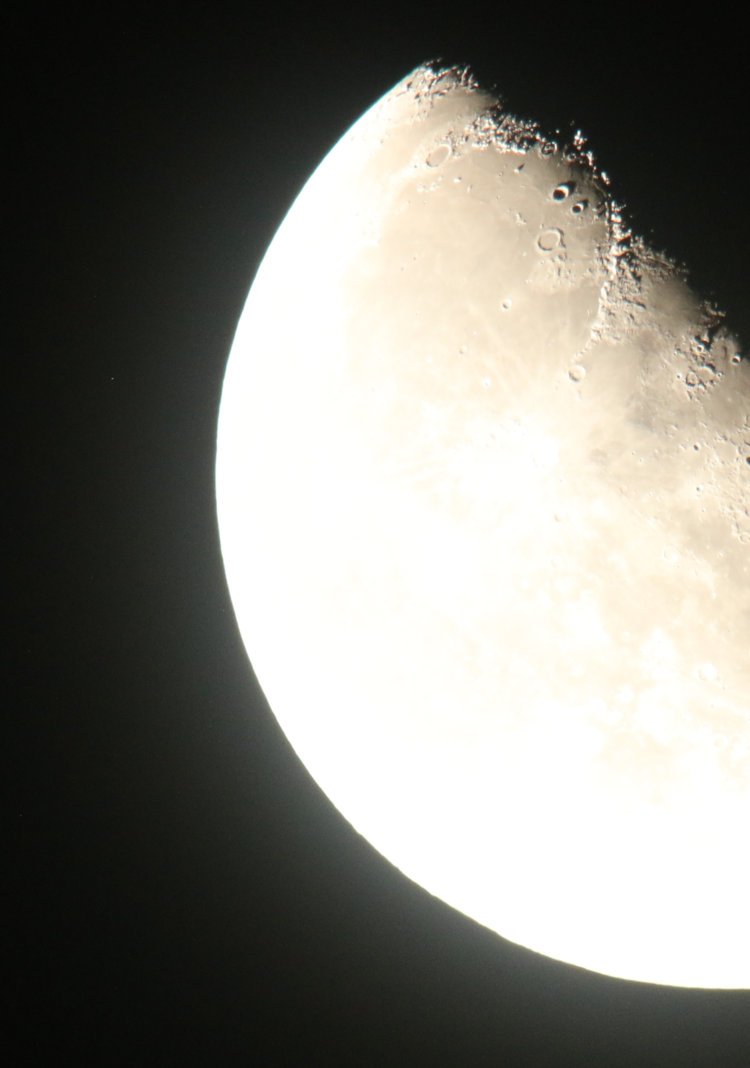
This is about 20 minutes past impact, when a dust cloud would have had time to rise far enough off the surface to be detected – maybe. We really don’t know, me least of all. If it were there, it would be just off the left edge (“limb”) just a little below the halfway mark, brighter against the dark background. Nada.
BUT… let’s take a look at things with the exposure blown out to highlight the fainter evidence.
Ah, there, we can see… nothing. This is about ten minutes after impact, picking up either the humidity in the atmosphere catching a little of the moon’s light, or internal scattering within the lens, possibly both. But far too uniform to even give a hint that any dust cloud is there.
I went back out after 90 minutes, just in case the rising cloud was now catching some light.
Aha! Still nothing! The exposure, by the way, was almost exactly the same – for the former shot, I was using the 2x teleconverter, and not for this one, though the ISO was adjusted to compensate (1600 top vs 400 bottom.) You’ll notice that haze around the moon is virtually gone, so was this humidity or the teleconverter? I’d have to do tests with a bright light a leetle closer than the moon was, to see if the teleconverter was the culprit – I just don’t see the trivial point right at the moment.
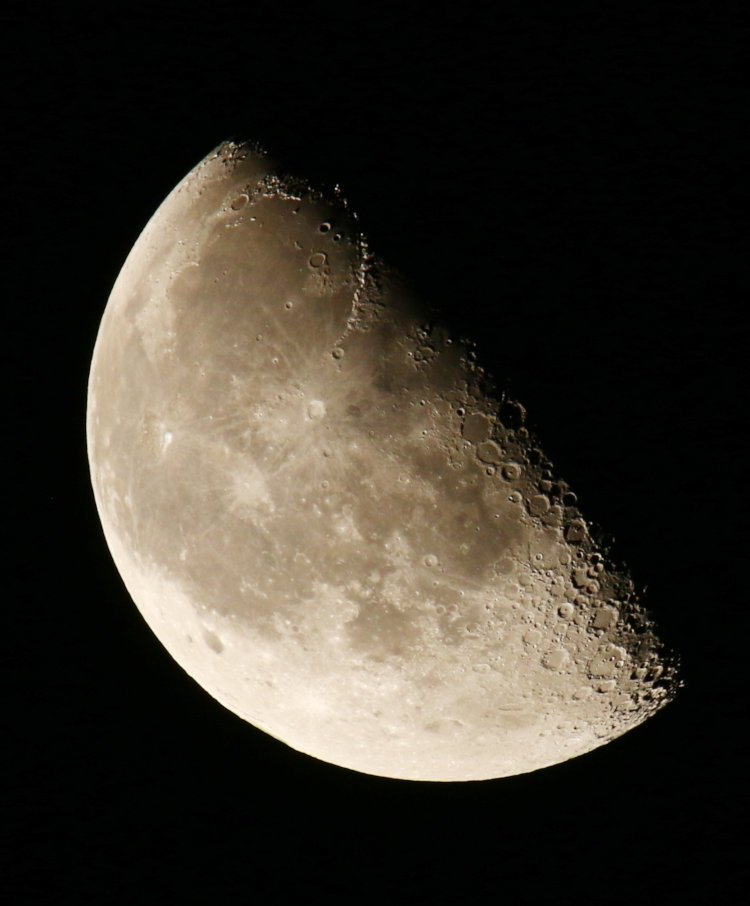
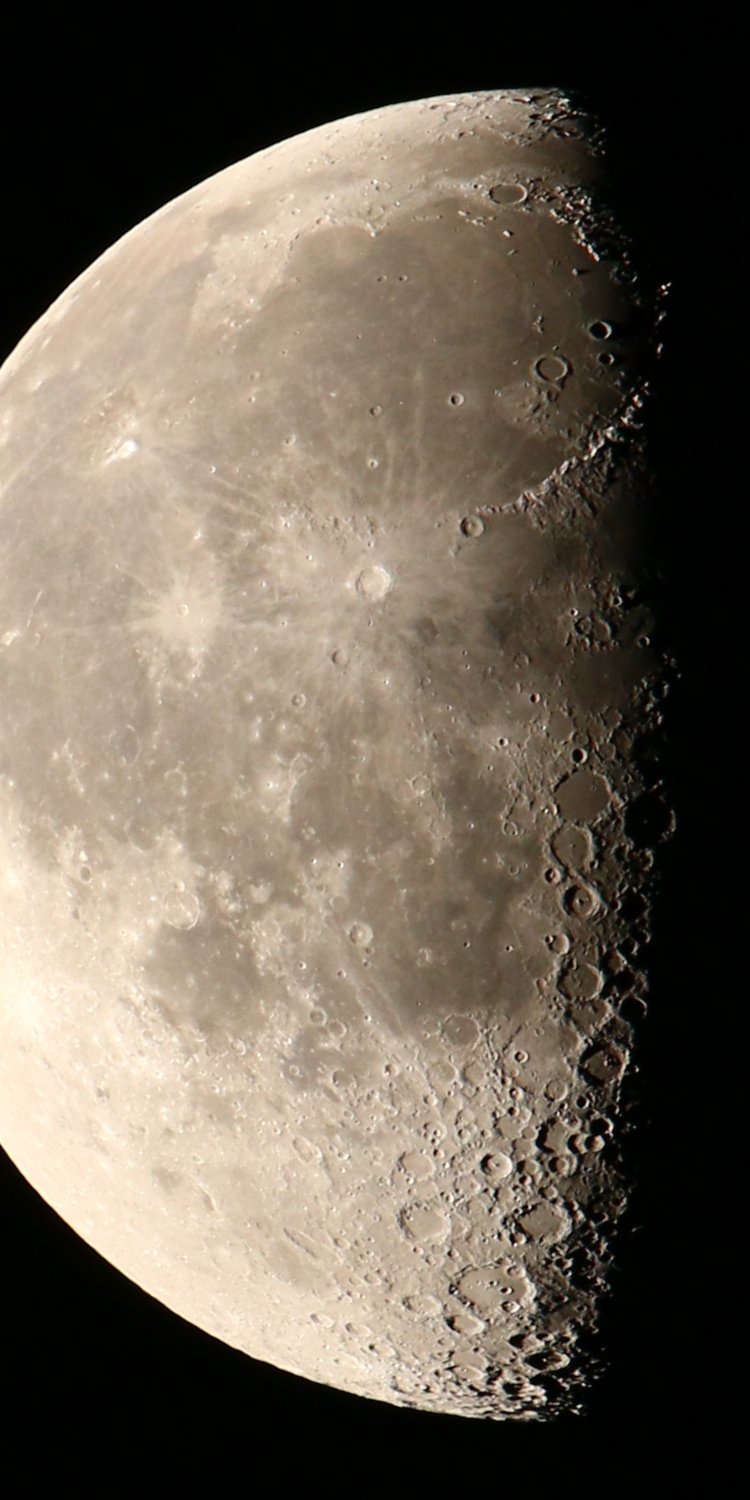
I include, instead, a full resolution crop of one of the normally exposed frames, because I’m pleased with the detail.
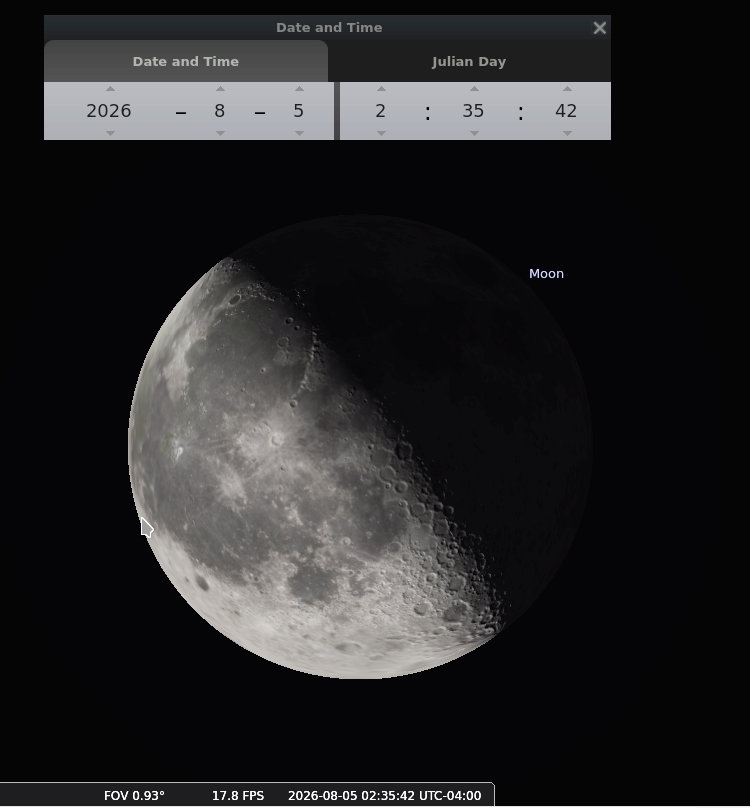
You can follow along with this lunar map, which I use frequently. Tycho is the nice, round, medium-sized crater with the darker edge close to the bottom – you can see one of the ejecta rays that always seems to be not-quite aimed at the crater coming in across the lunar mare from above. Copernicus is the larger crumbly-walled crater in the middle of the mare (Insularum) a little above the middle of the frame, with smaller and more distinct Erathosthenes sitting right at the end of the distinct ridge of Montes Appeninus. However, that ridge has become Montes Caucasus as the bases dip into shadow on the terminator. Also, if you look on the terminator right near the middle of the frame, you’ll see a larger crater with the central peak just barely catching the last rays of the sun (this is a waning gibbous phase, getting narrower each night now): This is Albategnius, and that peak is more distinct in the image above this one – use those three aligned craters to its left to orient yourself. Just a great night to catch a lot of detail.
And there’s something else. You’ll notice that there is a uniform brownish color cast just left of the terminator, visible through all sessions. Initially and without thinking, I put this down to the sunlight passing through the thicker atmosphere of Earth right at the edges, but that’s utter nonsense – that might apply to the shadow edge of a partial lunar eclipse, but the sunlight is passing nowhere near Earth for these shots and none of this light is passing through a thicker atmosphere than the rest. Right now, I’m inclined to say that the oblique light, a shallower angle as it gets close to the terminator, is reflecting from the surface material differently, if not evidence of the very very thin atmosphere, though this seems farfetched because it’s quite distinct here.
So I didn’t capture what I was out there for, which happens, but have a few nice frames to add to the folders, thus I can’t complain. Well, again, I can, and frequently do, but not justifiably in this case…
This news has been kicking around for a few days, but recent observations have narrowed down the time it might occur fairly tightly now: At 06:35:42.45 UTC, Wednesday August 5th, the upper stage of a Falcon 9 rocket (SpaceX) will impact the moon, just barely into the visible side. While this might present a visible flash, it is more likely to produce an expanding dust cloud that will have higher visibility because it’s so close to the edge, expanding outward from the curve of the moon rather than across the middle of it where we would be unlikely to see anything at all.
This time translates to 2:35 AM Eastern Daylight Time for the east coast of the US, specifically to 42.45 seconds past that time – adjustments should be made for other time zones. There’s a little bit of uncertainty because the stage is tumbling and this can affect its path slightly, but only slightly. The impact will occur within seconds of that time, and mere kilometers of the predicted location. You can go here for a map of the impact zone, and here for the further observations that refined the times.
While there is no such thing as a ‘typical’ impactor, this upper stage is relatively small and not moving very fast compared to most of the asteroids that we’d be tracking, and certainly meteors that we’d be concerned about with the Earth. This is why a visible flash is unlikely; as the first link says, we’d tracked a previous impactor that was much larger and slammed into a shadowed portion of the moon in plain sight, and we never witnessed a thing (“we” being “not me,” certainly, referring instead to astronomers with proper and powerful telescopes.) This hitting the sunlit side, especially as close to the edge as it is, isn’t likely to show a damn thing, and the crater might be smaller than an average house in footprint. However, it will stir up dust that may become visible outside the edge (‘limb’) of the moon, though probably very dimly – your better bet is to scour the search engines the next day to see if anyone with real equipment caught anything. I intend to make the attempt to see/photograph something personally, though my equipment isn’t as powerful as a proper telescope and astronomical camera, so I’m not holding out much expectation. The weather report is also calling for a better than 60% chance of cloud cover, so even seeing the moon will be lucky enough.
Some stages are intentionally aimed to re-enter Earth’s atmosphere – because it has an atmosphere, such stuff usually burns up or breaks in much smaller pieces when it does so, and it’s not particularly hard to aim them for open ocean where any danger is infinitesimal. The moon has no atmosphere and so the impact will not be slowed by such, and the stage will hit fully intact.
We tend to think in straight lines and direct paths, which is entirely wrong when talking about objects in space and potential impacts. Nearly everything up there is in orbit around the sun, including what we’ve launched, and only intersects other objects obliquely, crossing paths at shallow angles. This particular object has been orbiting in the immediate vicinity since its launch last year, and repeated observations by those who track asteroids have turned up its impact path. It could, with just a minor boost, have been sent out of range of both the moon and Earth and simply maintained an orbit around the sun (like we do, but farther away from us.) There are no regulations like this for anything launched into space, but given the huge number of objects now up there, there should be, most especially ways to safely de-orbit satellites once they’re past their effective life, but also to either de-orbit or greatly extend the orbit of ‘junk’ like this, the leftover trash of a launch that does absolutely nothing but stands a chance of intersecting with something that does. Such intersections (read: “collisions”) increase the risk of damage to other orbiting objects because the debris cloud has no place to fall or settle, and will continue expanding in unpredictable ways, potentially crossing over into orbit paths outside of the origin. This has already happened, and will happen again (you should definitely check out that link) – the risk is steadily increasing, and some of these collisions will be with satellites that we’d really prefer to keep intact, including things like the two space stations currently orbiting. Anything in orbit is generally moving pretty fast, so the relative impact velocities can be enormous – contacts are far more likely to be catastrophic than casual.
Most especially, if you have a decent telescope and clear skies, it might be worth being up in the wee hours to see if the rising haze of lunar dust becomes visible. Best of luck if you do, and if I capture anything at all, it’ll appear here of course, but don’t count on anything.
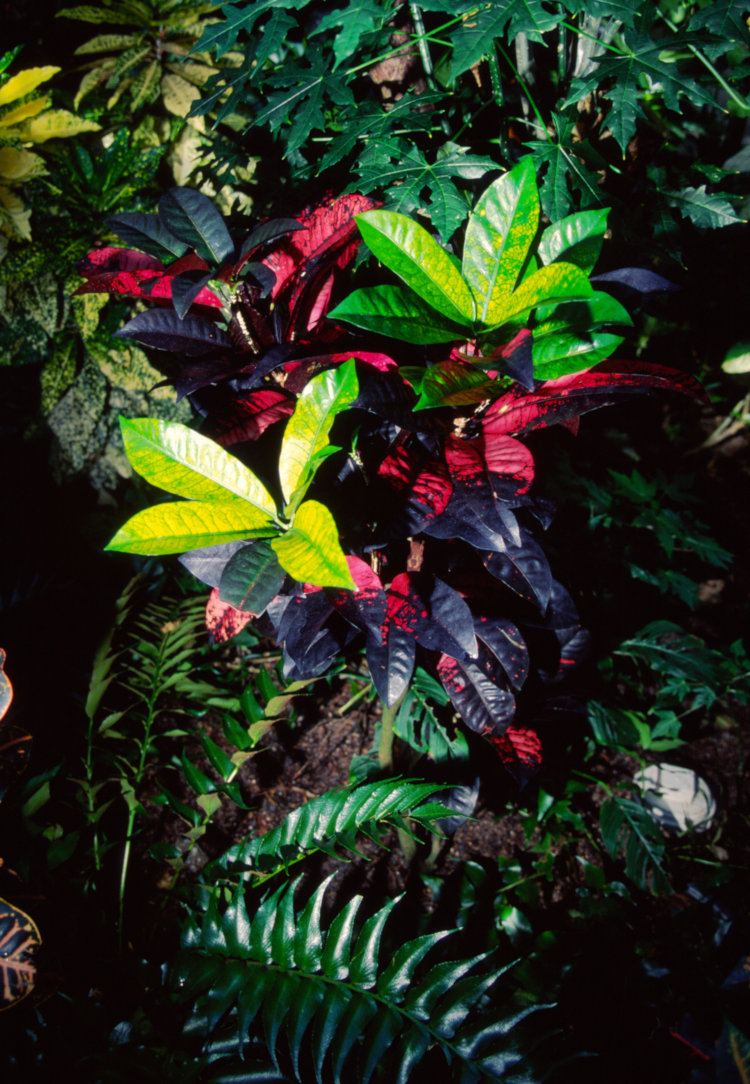
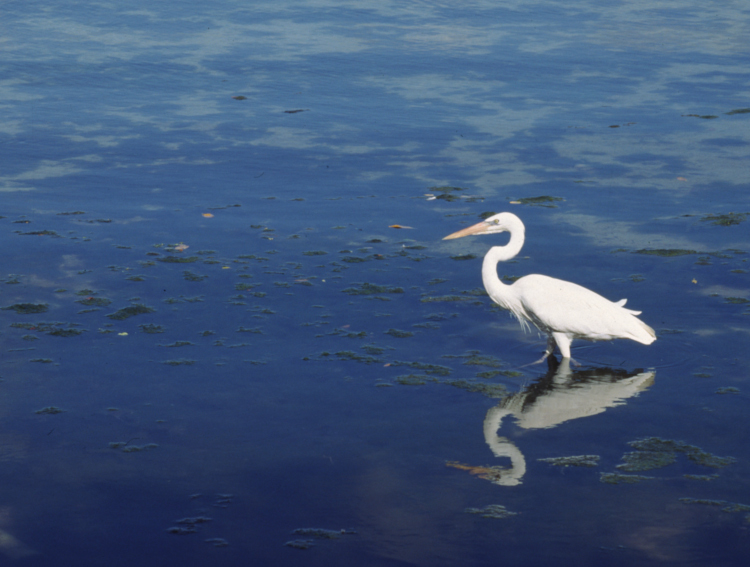
I’ve never seen digital produce this kind of depth in the blue hues – this is a scan of Fuji Provia 100F, and still lost a bit when converting to 36-bit color in the scan This is just a quick rundown on shooting film, should you decide to give it a try. I admit that I haven’t shot film in years – and still have several film cameras in good condition, numerous rolls of film, and a complete darkroom packed away that may get set up before too long, since I have an ideal space for it now. If all you’ve shot is digital, the good news is, damn near everything translates to film pretty well, and I’ll cover those few things that don’t.
Equipment. Because of digital, film cameras in good condition can be had for a fraction of what they once did – like, less than $50 easily. The collectible cameras still demand higher prices, but just something more-than-capable? If you put the word out among enough people, you’ll be given one. As a general rule, anything from the era just before digital came into regular use, so the 90’s through the early 00’s, generally can be obtained for a song, and new enough not to have issues most times. The bigger challenge may be getting batteries, since some of them took specialty batteries common to film cameras that dropped out of regular availability.
Knowing it’s in good shape? There’s no easy test (especially if there are no batteries handy,) but check the movement of the settings and the lens rings, look for excessive wear or evidence that it wasn’t stored well, like unclear glass or mildew residues, especially in the finer cracks of the body where people’s cleaning efforts often miss. If the camera is working, set for 1/2 second shutter speed, preferably with a lens attached and set to f16, and trip the shutter a few times. The double-click of the shutter opening and closing should be consistent and easy to time by ear, and you should see the aperture quickly close down and open again each time – these are the things that tend to stick if improperly stored.
Medium format equipment has dropped so drastically in price, given that it was always considered professional equipment, that now is the time to get into it if you’re interested, and it’s typically been stored and handled quite well. Typically, it is quality equipment, too – there were never any consumer or tourist lenses or bodies produced, so there’s almost no such thing as a bad buy.
What film? Depends on what you want to do. The common print films are not only the easiest to find, you’re more likely to find places to develop it and make prints. The quality, however, tended towards the lower end, and the longevity, even with proper storage, was never that good. One thing to know is, film not only ages, it’s susceptible to heat, so the rolls someone finds in an old camera bag are not going to produce the same results as new. Should you find someone clearing out their stock that they maintained in a refrigerator or freezer, however, go for it. And you can still buy it new.
The specialty portrait films, such as Fuji NPS/NPH and the Kodak Portra line, make digital portraiture look lackluster – I remember flipping through the first prints I took on NPH and being blown away by the color rendition. I still can’t believe these were virtually abandoned for the unchanging color palette of CMOS sensors…
Slide film still produces the best colors overall, and the longevity is many times better than print film – though some of this might be due to the labs processing it, since chemical changes, adequate fixing times, and precise temperatures help significantly, something the commonly-available labs like one-hour places in the mall did not typically engage in – I know, I worked in one, moreover one that prided itself on producing ‘quality’ results and yet had the cheapest chemicals and the least-maintained equipment (they definitely felt that calling it ‘quality’ would work on most people, and couldn’t be bothered to learn what the word actually meant.)
However, if you’re considering doing your own developing (and you should, if you’re this far,) monochrome “B&W” print film is the way to go, at least at the start. It’s also easy to obtain and still provides a decent variety of types available. Ilford HP5+ is a great place to start.
What you give up from digital. The first is, not only can you not immediately chimp at the image in the preview LCD, you’re going to wait to see the results. If you’re experimenting, keep written notes, because there will be no EXIF info to refer to. Also, learning how to calculate flash power and guide numbers will have to serve in lieu of test shots to see if the lighting is correct.
You will be locked in to a single ISO for the entire roll. Also, changing rolls may have to happen more often than you think – I always used 36-exposure rolls (in 35mm format anyway) just to avoid having to do this more frequently. When shooting weddings or events, I often unloaded a roll before it was finished to have a fresh set of 36 exposures awaiting me if some particular action was anticipated, like the cake cutting or first dance kind of thing – there’s nothing more annoying than missing some prime image because you’re trying to slap a new roll into the camera.
You will be locked into a particular color-palette and contrast for the entire roll, too. When shooting slide film, I would occasionally unload a roll partway through because I now had need of a greater saturation than what I was using; the partial roll would be put into a film can and the frame noted on top, so I could reload it later, something the Canon EOS line at least permitted, perfectly accurately too – aligning frames the exact same way could otherwise be hit or miss, and if it weren’t for the IR frame counters on those cameras, I would wind a few frames past the known last to avoid overlap.
Exposure metering can be wildly different. If you have a relatively recent body, things might not be too different – the Canon EOS line had most of the same metering options as their current digitals. The older you go, the more likely you are to find only center-weighted metering, or none at all, and this takes a little forethought to use effectively.
Film cameras tended to aim for more specific users. If you use exposure-bracketing or compensation, second-curtain sync, flash exposure compensation, or other specialty options, you would likely have to look for the higher-end film bodies to have these – it was with the advent of digital that manufacturers began including these on nearly all bodies. Finding an inexpensive Pentax or Minolta typically means doing without.
Getting film digitized. So, yes, we operate in a largely digital world now, especially since you’re reading this on a screen, and having your images available that way is certainly compelling. However, basic film scanners that can do 35mm negatives or slides can be found for under $50 anymore, certainly not the case when I began (and the scanners I still use, purchased many years ago, are all much higher-end models.) Some developing labs will offer digital copies as an option, while you might have to find a specialty service if yours does not. Let’s put it this way: If you get hooked and start shooting film even semi-regularly, you’ll save money in the long run by investing in a scanner, and probably have a lot more control over the results too.
Be warned, though: Every film has a different base color cast, though monochrome is the least variable. Getting good results from scans of a negative/print film can be tricky and require a lot of fiddling, and I have yet to find a software that makes this easy.
I have also just photographed, digitally, a print laid flat to the camera. You still have to account for color casts, especially from the lighting used, but if you use an 18% grey card as a background and shoot a little wide, you have an easy white-balance reference. The resolution is more than enough for any web work, and usually to get another print made. I’ve also done this with a glass plate negative.
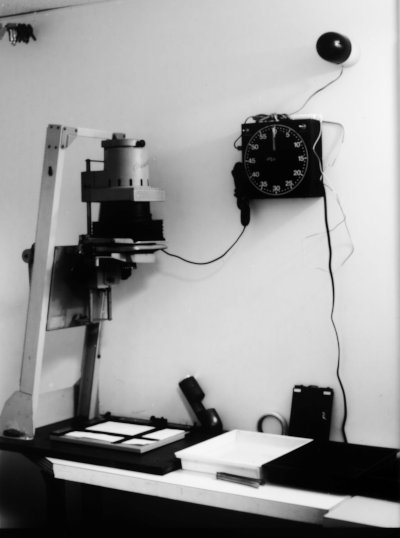
One of my old darkrooms, developed right there tooDeveloping your own. I’m not going to go into a step-by-step process on this here – there are plenty of resources for this online and in books. But I will say, getting to a monochrome negative is amazingly easy and requires a minimal investment in equipment and chemicals. Literally, a developing tank, a film reel that holds your format (typically 35mm,) a good thermometer that can get wet, and three chemicals: developer, stop bath, and fixer. Add a wetting agent for better results. You have to get the film from the can to the developing reel in total darkness, requiring a halfway decent grasp of doing this by feel, and then once this is in the developing tank, the rest can be done in daylight (though reduced light is more recommended, in case of small leaks.) One tank of film, be it one roll or four, can be done in roughly 30 minutes, add another 30-60 minutes until it’s dry enough to do something with. It’s stupidly easy, but follow the pointers that are provided, and monitor your chemical temperatures carefully, especially because developer temperature alters developing time. In less than an hour, you’ll be hanging negatives that you developed yourself in the shower stall to dry, and it’s fascinating to watch the little images unroll from the reel, with a surge of pride because you did it all.
Printing is more involved, but not a lot. For this you need the same three chemicals (only aimed for prints instead,) print paper, print trays, an easel, a timer, a safelight, and most especially, an enlarger. These can be found for as little as $40-50, if you’re not outright given one by a previous enthusiast, but the average cost for a used enlarger seems to run roughly $150, with a lot of variation. If you’re really getting into it, a condenser enlarger is better, since it distributes the light source more evenly, but these tend to be more expensive (and larger.) However, all this can be set up in a bathroom (you’ll want running water,) even temporarily – counter space for the three trays of chemicals, and of course the enlarger, is the demand, but doors as light-tight as you can get them help a lot. But again, it’s not hard.
Color work is more demanding and requires more chemicals, plus an enlarger with a color head to account for the different color casts of print films – I admit that I never went this far, because monochrome was enough fun for home developing. But seriously, look this up if you have the faintest interest, because home developing is probably easier than you imagined.
So if shooting film intrigues you, or you want a greater breadth of photographic experience, don’t hesitate – it’s not that involved, and can be a lot of fun, with some additional challenges thrown in. Have at it!
Again, I’ve never seen digital produce colors anything like Fuji Velvia
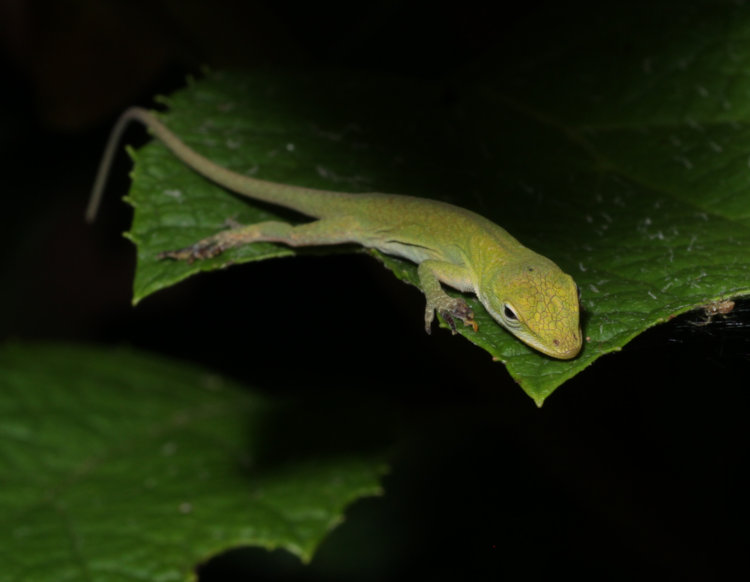
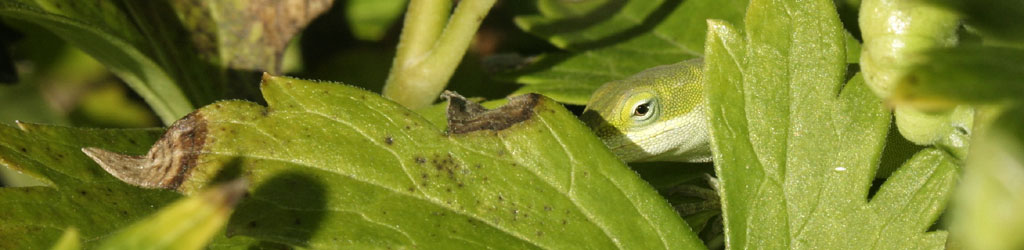
I’m not quite going to make this in July, but so be it. Late at night on the 31st, I found the first newborn Carolina anole (Anolis carolinensis) on the oak-leaf hydrangeas (Hydrangea quercifolia.)
Here’s the deal: At old Walkabout Estates, we’d planted a few oak-leaf hydrangeas, which became well-established and were a huge favorite of the anoles, and I have hundreds of photos of the two. We attempted to transplant some cuttings when we moved here, but they never took, and this spring we finally purchased a couple from a nursery and got them started in the yard. They’ve been getting established, and just now, I found the first anole snoozing on a leaf of one.
Last year, there were countless (meaning counted) anoles sleeping on various plants around the yard in late summer, chief among them a couple of Japanese maples right outside the door to Walkabout Studios. For some reason, this isn’t even remotely happening this year, and I have yet to find one on any maple, or indeed most of the plants in the backyard – I don’t get the impression we’re gonna set a new record this year, but it might still be too early.
Still, it’s a good sign, and I’m pleased – you know where to send congratulatory cards and checks…
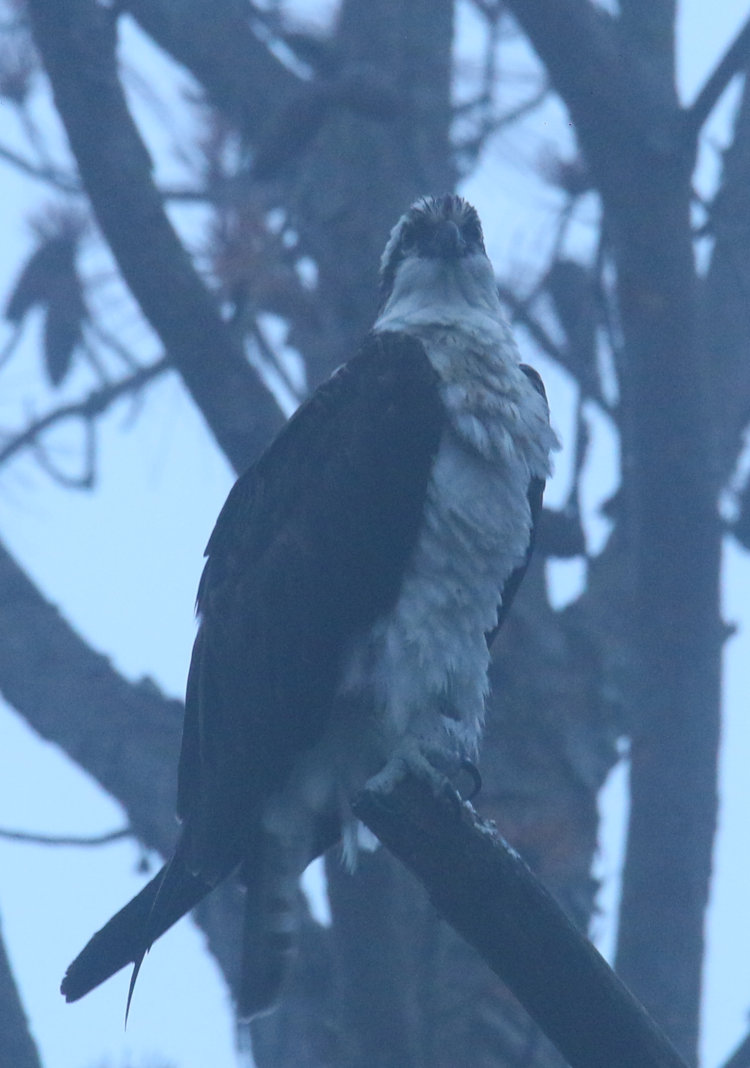
Finally cleaning out the pics from this past weekend’s two outings, this time concentrating on the birds on a foggy morning. We’ve already gotten a decent impression of how foggy from the previous post about it, so you understand why we have images that look like this:
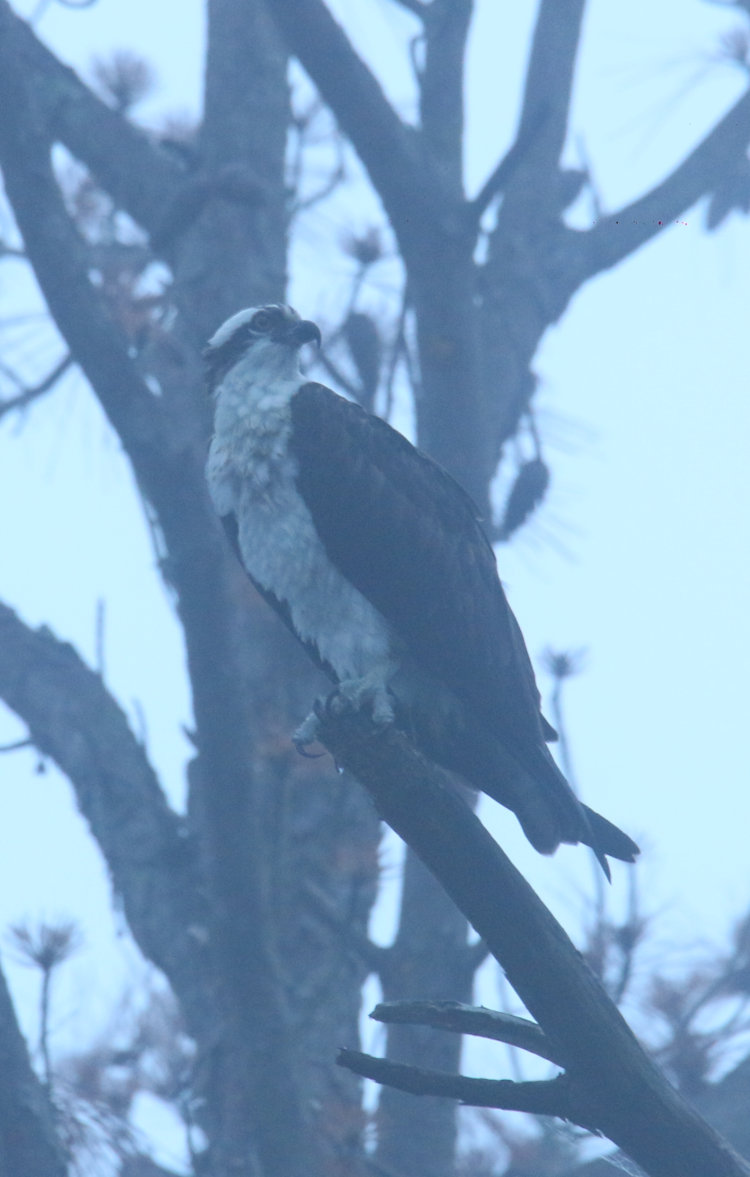
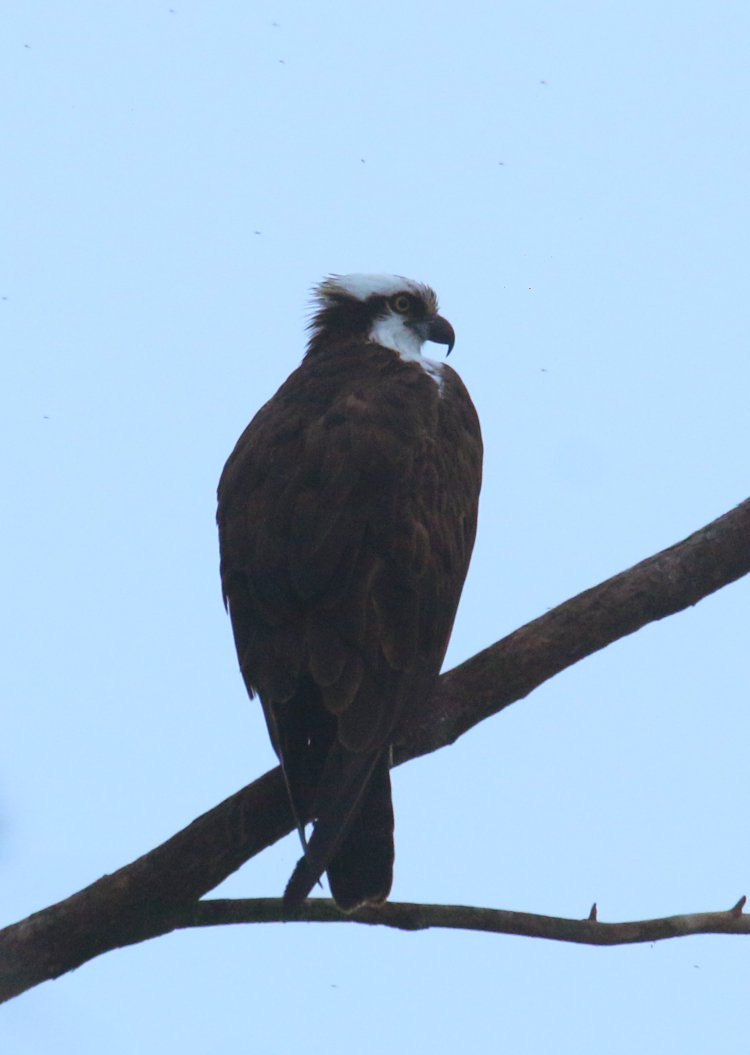
This osprey (Pandion haliaetus) had announced its presence earlier, when another flew overhead – osprey are vocal about their territory. So it wasn’t hard to find it, though we never would have if it had just kept its beak shut. This is roughly 20 meters off, so yeah, the fog was thick.
It remained there the entire time we were within sight, which was better than 30 minutes – and in fact, it might have been there for many hours, since we heard someone defending territory from the same general location the previous evening before sunset. Obviously, it knew we were there, but we were distant enough (and only visible through breaks in the trees) not to send it off elsewhere.
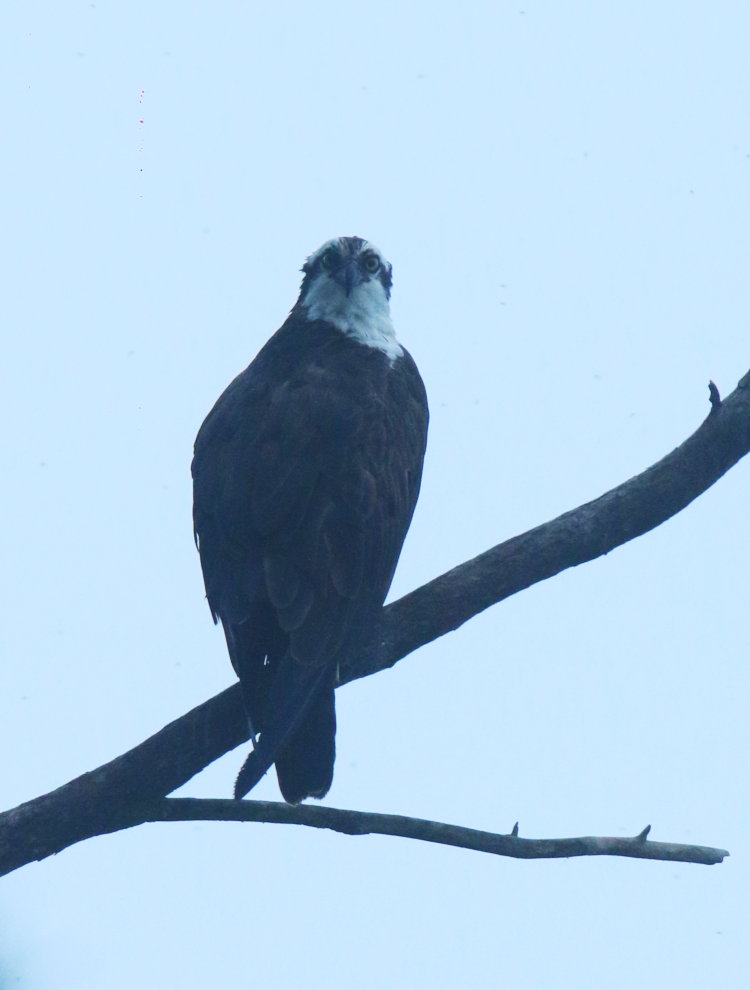
There was another, out towards the end of the point we were on, perched out on a very visible branch, also disinclined to fly off. And also aware of us.
We made it a point not to approach too closely, so we might catch it as it headed out to hunt when the light was better, or conversely, to photograph it in first light if the sun broke through, since it was in an ideal position for this. Neither actually happened. But someone else was out hunting already, quite successfully I might add.
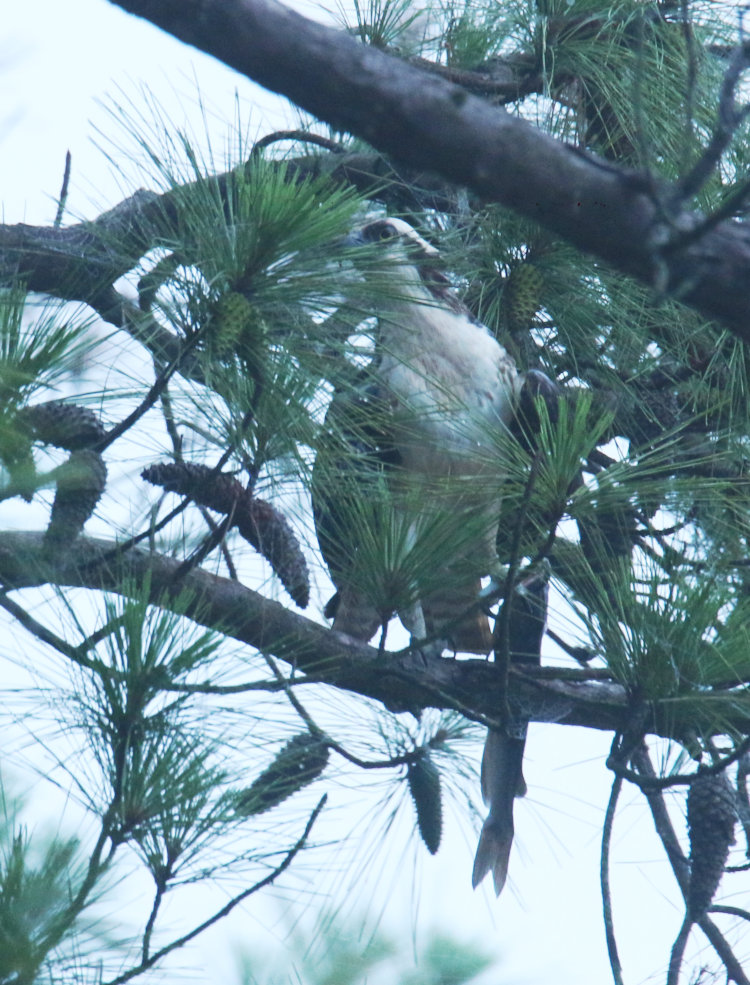
This one flew in and landed not very far away from the previous osprey, who appeared to take virtually no notice. While I liked this for the eye barely peeking past the pine needles, I hadn’t realized until editing it that the bird was only perched on one leg, the other held out awkwardly because of the size of the fish it had captured. I don’t think I’ve ever seen one standing like this – usually the fish is draped over the branch and the bird is standing on it.
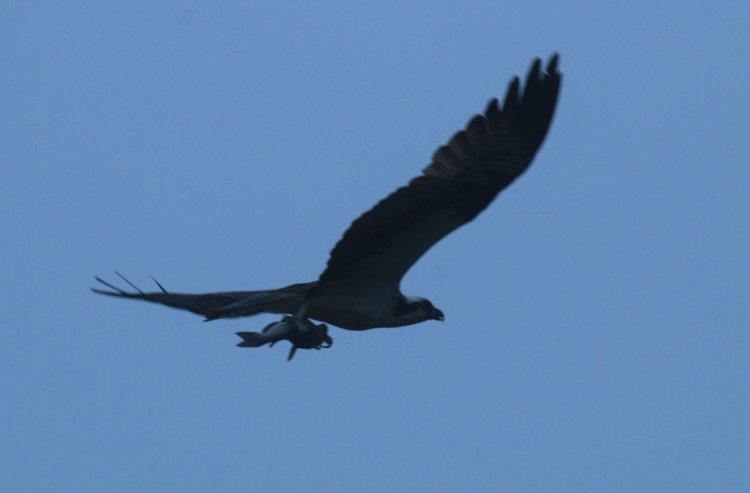
It took off and we followed it, but again, I wasn’t remembering that I’d switched off exposure compensation for shooting into the trees, so the resulting image was a bit dark, which I left as-is for the illustration because lightening it would add very little anyway.
It was about this point that it became obvious the osprey had captured a fish, because it wasn’t visible through the viewfinders before. Bear in mind, the portraits are usually cropped, though I think this one is full-frame, and what we see through the viewfinder is much smaller than this – even if you’re on a smutphone (why you would be doing that, I don’t know, but some people are weird.) Also note the difference in the area surrounding the bird, in both pics. Even with Evaluative Metering, the ‘focus zone’ where the bird sits only gets a portion of the bird, so that becomes averaged with the background color. In the tree, it was fine – the foliage was roughly average brightness. But the sky was much brighter, the bird too small against it, so to see the bird decently, you have to adjust for the metering system ‘thinking’ the sky is the target. I tell my students, “If it’s bright, make it brighter” – doesn’t seem to make sense, until you realize the camera’s going to make it darker to reach that mid-tone it’s programmed for; you’re just putting it back where it belongs.
Someone else was running around out there – for once, actually not too far away and remaining in view.
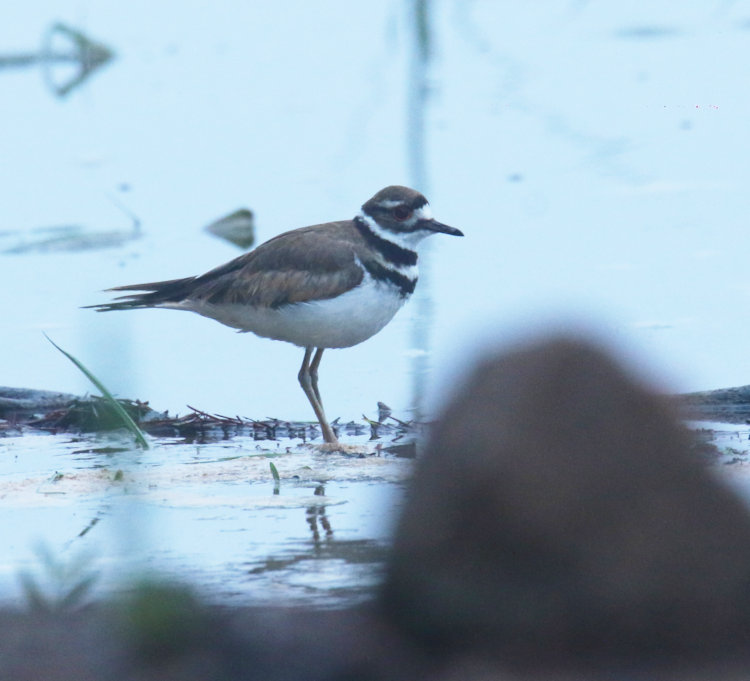
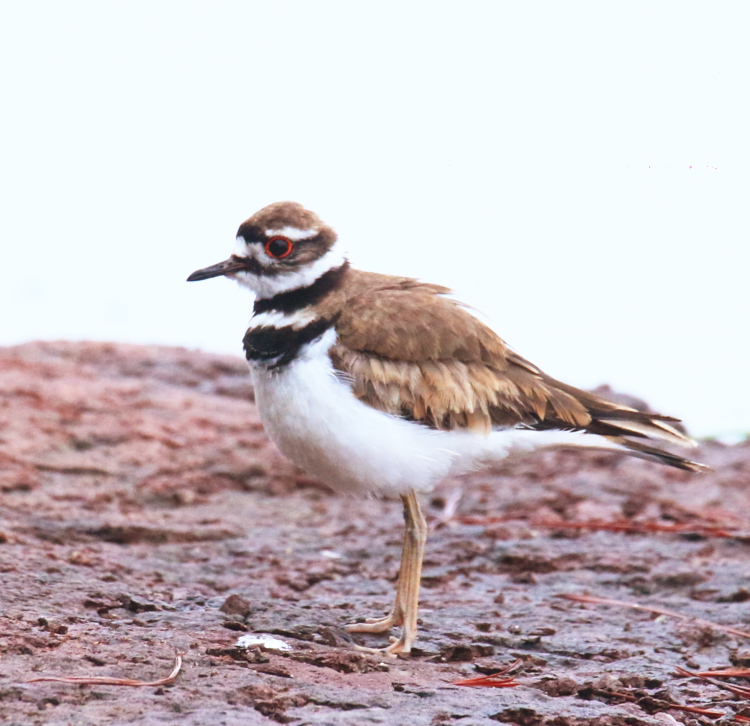
Killdeers (Charadrius vociferus) are notoriously shy and a bit hyperactive, and my experience with them at Jordan Lake has been seeing them briefly before they vacate the premises. so this one was being quite cooperative in running around in the shallows – not close, but obviously not too far away either. And when I say cooperative, this is ignoring how often it was running among the grasses or behind rocks and stumps, causing the autofocus to keep grabbing other things. My attempts to get it with its reflection in the water beneath were all thwarted, mostly by the foam and debris at the water’s edge, partially by the killdeer not getting alongside a large enough open patch. This view shows off the coloration decently, but now watch as we get more of a portrait angle.
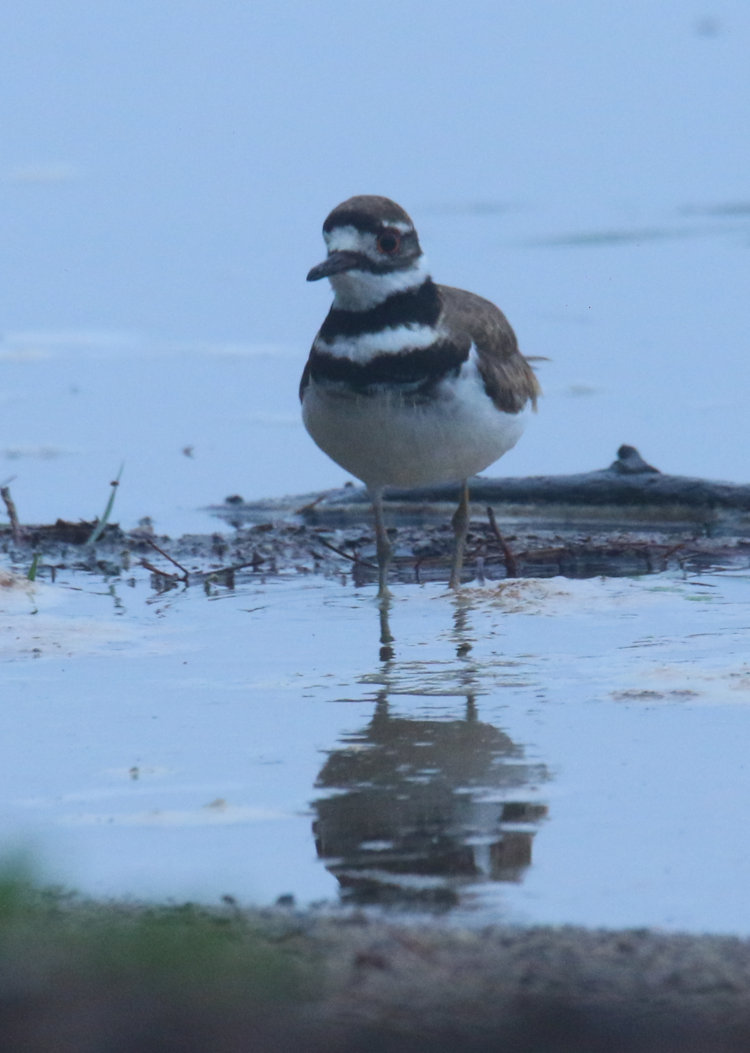
Suddenly looks worried about something, doesn’t it? But since birds really can’t change expression, all we have is a different perspective on those facial markings, a better view of the wide eyes and some patches that resemble eyebrows to us. I love when things like this happen…
We’ll return to this guy in a moment, but first, a peek at the only other birds to show that morning (not counting the herons we’ve already seen.)
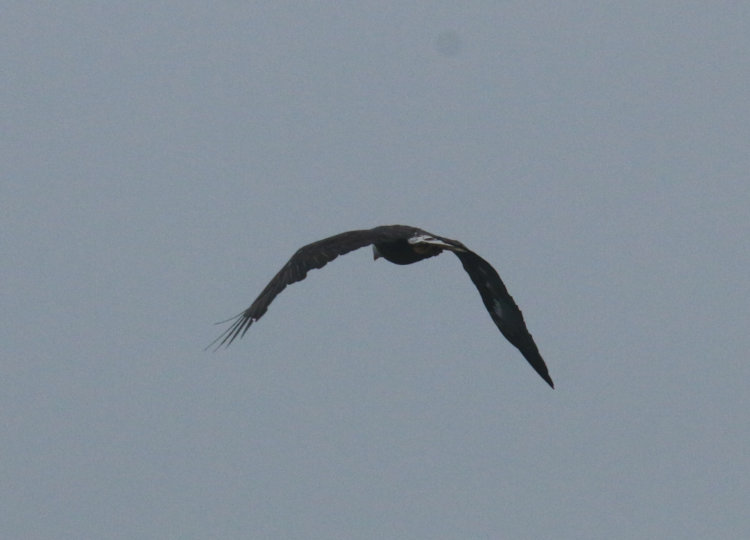
This was the only glimpse we got of a bald eagle (Haliaeetus leucocephalus) while down there – I was kind of counting on seeing more, since the area I’m now in doesn’t present many opportunities, but admittedly this wasn’t the best time of day. We even very carefully checked the tree which had held the vomit eagle, since we were right underneath it, but funny, the eagle was no longer there. I really have to make the effort to return during nesting and fledgling season, when the activity over the lake will be at peak.
And this guy:
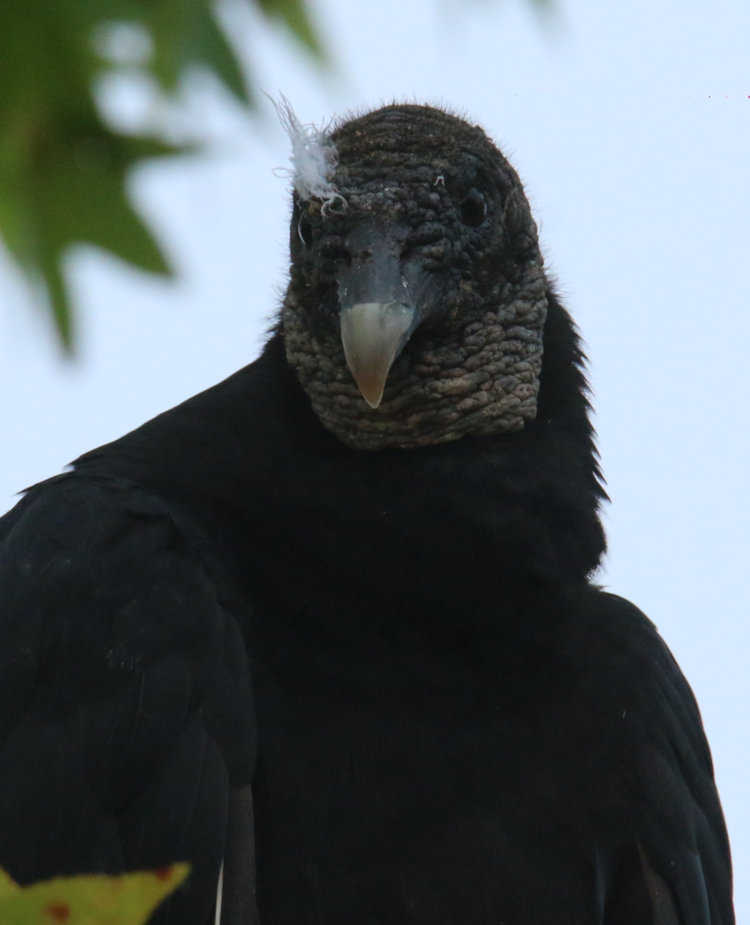
We discovered this black vulture (Coragyps atratus) very close by, less than half the distance than to the killdeer, and apparently it had been there the entire time as we walked past, but we would have had to turn around to see it past the intervening foliage. It flew off soon after this, but had been there for close to an hour earlier as we walked right past it, five meters up and ten or so away, so I’m guessing the sky wasn’t light enough for it to feel safe flying, or since we weren’t looking in its direction at the time it didn’t feel as anxious. That stray downy feather provides a certain roguish air, don’t you think?
And a couple of edits, tweaking the colors to reduce the fog-driven blue hues.
Same one as earlier, this time showing that it was largely ignoring us, as well as the swarm of small insects that it appeared to be within. Originally I had taken the color tweak too far and it had an unnatural reddish hue to me – it shouldn’t be perfectly white-balanced, because the light really was blue-grey and we expect to see it slightly off in such low-contrast, muted conditions, so such changes should be subtle, and never be afraid to come back to it later and re-evaluate it.
And the killdeer, as I promised:
This is pretty damn close to an accurate impression of their coloration – I think I replicated hazy/light overcast conditions reasonably well; really cool red eyes, if you get the chance to see them, which the species normally disallows. By the way, these are medium-small songbirds, about the size of some of the larger sandpipers, and larger than a sanderling, smaller than an American robin. cute birds when you can get a good look at them.
And that wraps up the outing photos, before the end of the month even – it’s going to be a lot of uploads this month, but that makes up for last month’s lack. And I still have a few more things targeted to appear, plus whatever I find when I’m sorting this now-backlog of images in the Sort folders. You know where to find them.
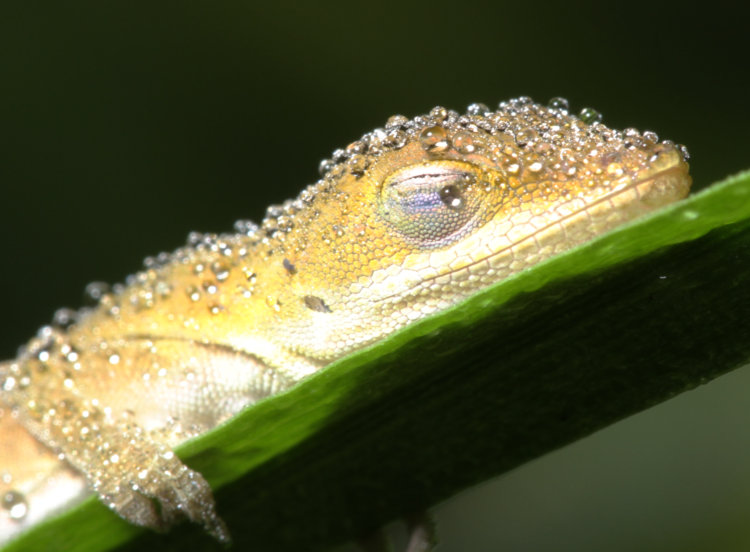
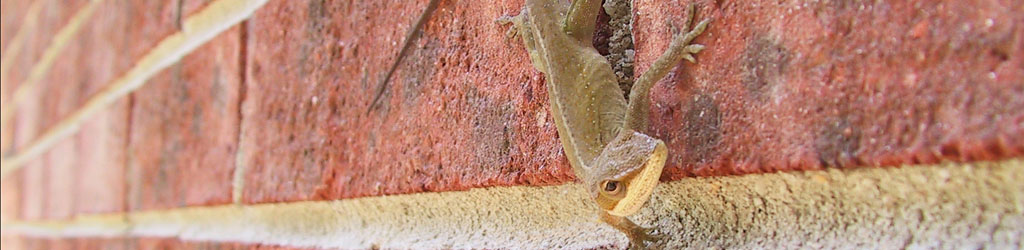
Just a brief interlude, and because c’mon. The other night we had a persistent drifting mist, and the sleeping young Carolina anoles (Anolis carolinensis) were recipients of this, as was about every flat surface. Naturally I couldn’t pass this up…
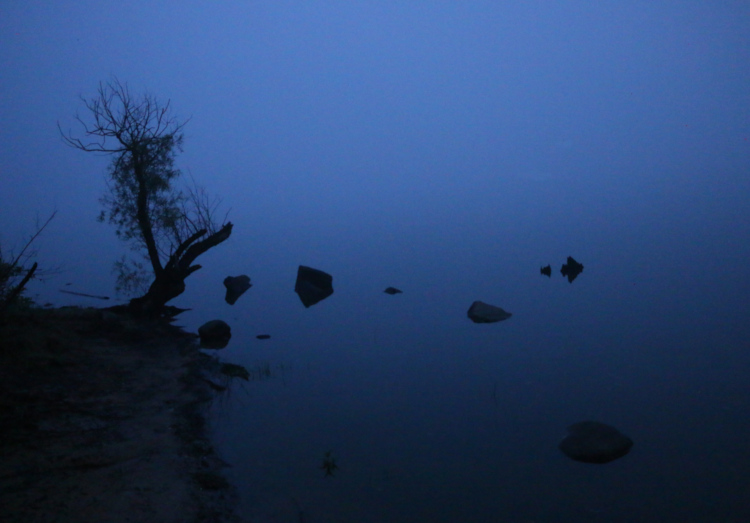
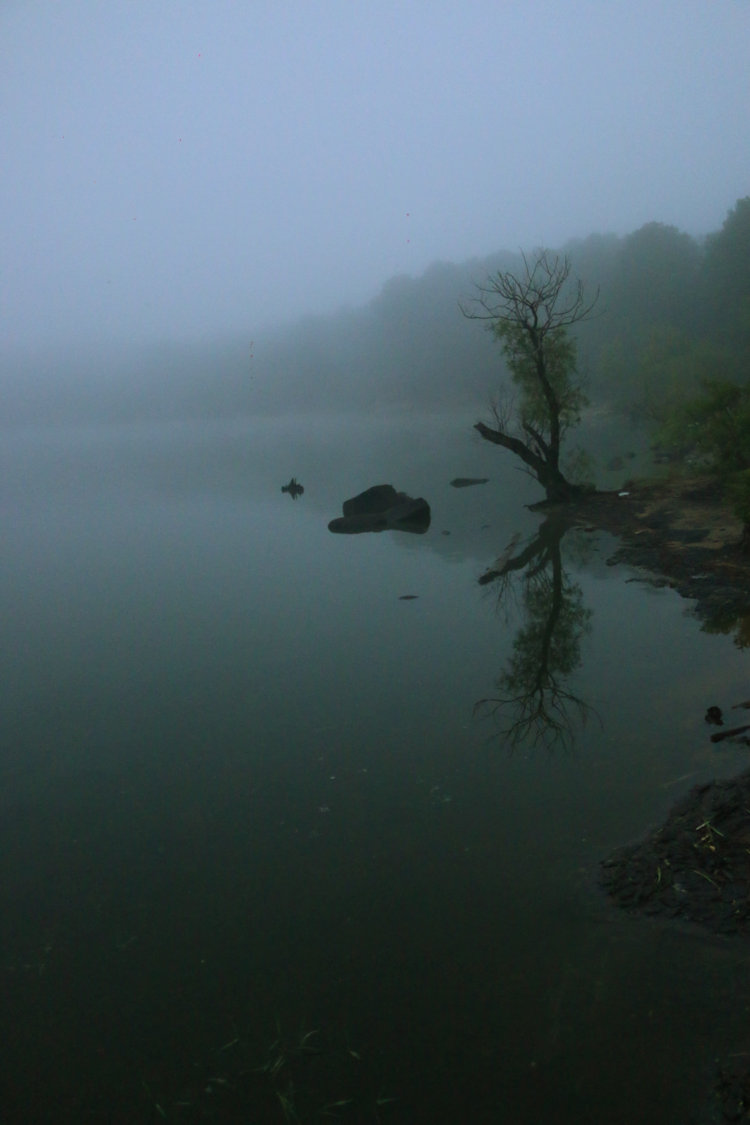
As we advance into our past weekend’s photos, there came the realization that they should be broken up even more, and so we’re going to have a ‘part three’ later on. Right now, we have what the environment was looking like, which is specific, because the day dawned (as predicted by meteorologists) in a dense fog.
When instructing students about ISO, my basic advice is, use the lowest value that still allows you to get the shot, but get the shot. Higher ISO values get progressively grainier and noise-laden, and the uppermost on any camera body is almost always next to worthless. However, it also depends on what you’re going to do with it. If you take the entire frame and reduce it down to web display size, like here, the reduction in detail may allow you to get away with something extreme like ISO 6400, like here. But it undoubtedly helps that there really isn’t much of anything to see from the image anyway, few subtleties in tone and little detail – we’re only getting general conditions and mood from it. Also, to keep it resembling what the conditions actually looked like while there, the exposure compensation was set for -2/3 stop, so the exposure metering wouldn’t drive it up too bright.
The blue hue was pretty much present, too, the thick humidity and the bare trait that it was before sunrise and the light all reflected from within the atmosphere greatly reducing the other colors. But for giggles, I tweaked the colors a little, trying for something more neutral, which wasn’t too hard. Others colors were there, just overwhelmed by the blue light.
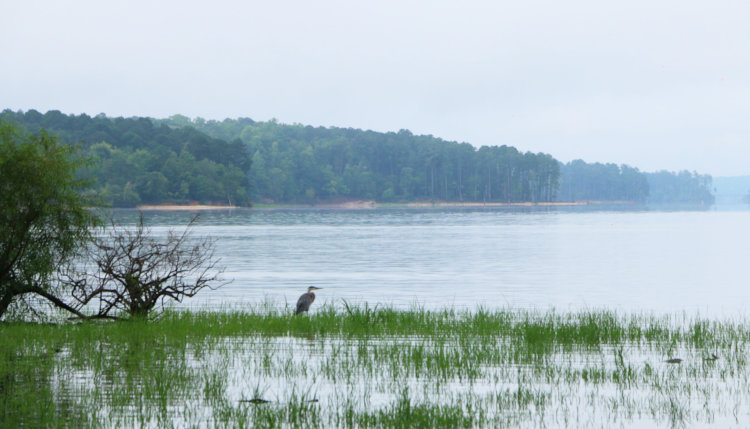
Yes, same tree/stump, opposite side. While the water level is certainly down from where it’s been before, it was also up from where it had been recently, as shown by the flooded grasses just barely appearing at the bottom of the frame.
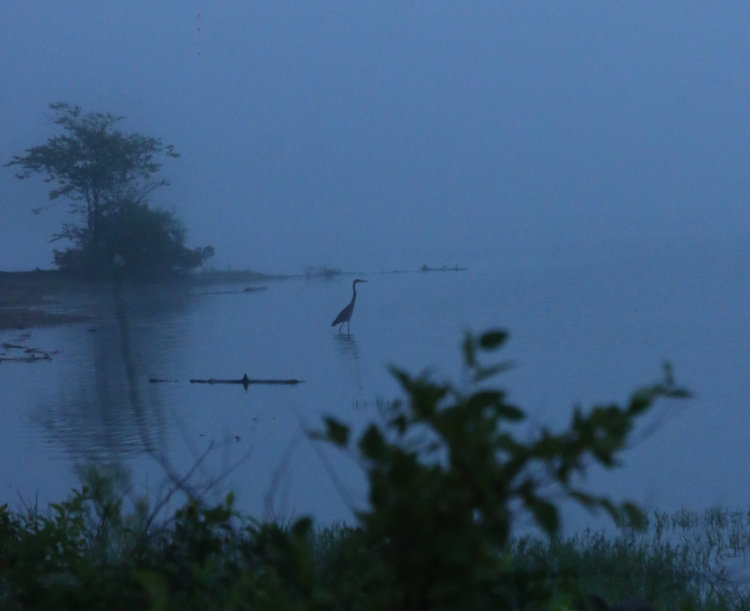
While we waited on imminent sunrise and the fog to lift, we watched for useful compositions, which a great blue heron (Ardea herodis) provided in a couple of instances.
Unlike many birds, herons have pretty decent night vision, I’m inclined to say better than ours, because I hear them getting spooked away from their night perches and flying croaking out over the water all the time. So this one might have spent the night in the immediate vicinity (we saw it some time before this image,) or it may have flown here at any point in time before we arrived. It provided a slightly better pose just a little later.
It had flown here shortly after the first image, and looks less distinct, not because the fog was thickening, but because it was almost twice as far away now; you can look at the water in both pics, seen from my standing position, and judge from that. I think I might have tweaked the colors slightly on this one to make the trees stand out better.
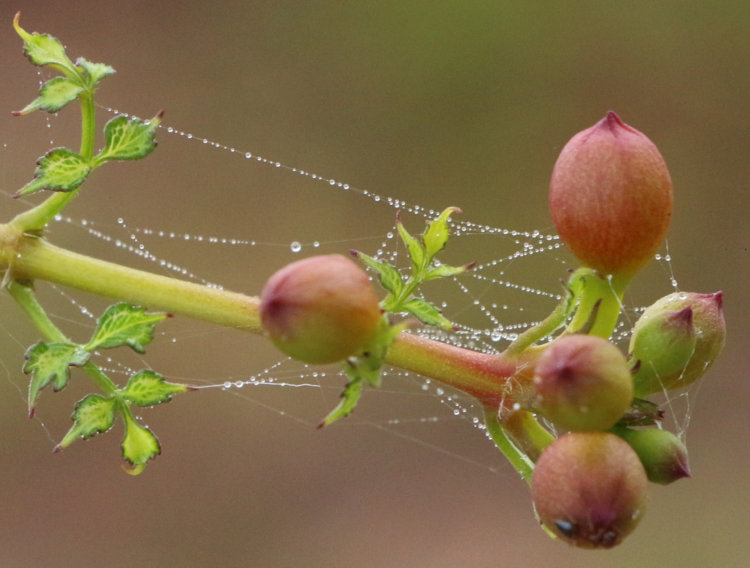
While the fog did eventually break, most of the way anyway, it wasn’t until after sunrise and so the sun never really made an appearance until after we decided to leave the area. It did get bright enough to snag a few other images though, most of which will be in part three, but I played around with some moisture-laden web strands on unidentified berries.
At this point I’d dropped the camera down to ISO 1600, but was still focusing manually because autofocus had too much of a tendency to try and grab the higher contrast from the background, and I wasn’t carrying any macro lens – this is just the 18-135 STM. I have another frame where the foremost berries were sharper but the dew soft, and I attempted to focus-stack the two together, but the shooting angle had changed just enough from my swaying that it wasn’t worth the effort. I’d chased a few other drop-laden orb webs too, of which there were plenty, but I never found one that I could frame decently and will probably discard all of them – I’ve done better.
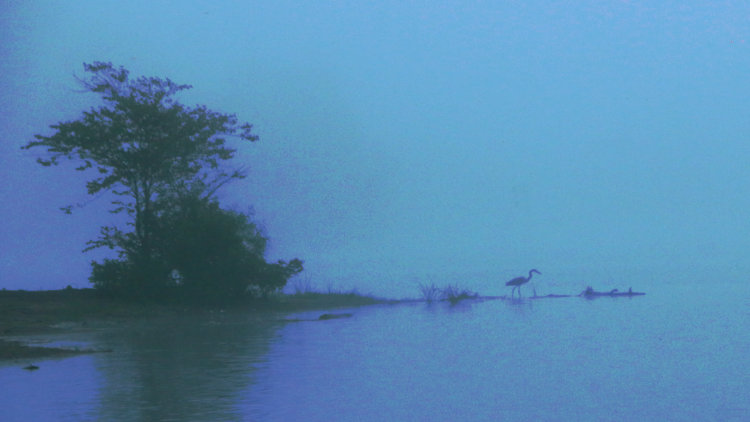
One last frame, with a curiosity, before we go to part three, which will be all birds. The fog had ‘cleared’ only not completely, and I used another heron as a focal point for the scene, with more grasses that show that the water had been lower before this, for a significant time.
While unloading and looking at these in thumbnail form, I thought I had a corrupt file or even a shutter issue, from the vertical banding that shows throughout the frame, stepping along brighter to the right, but this was just the fog, thicker in the distance and so making the small points along the shoreline show up much more distinctly than normal, also reflected in the water. This is almost exactly the same thing that gives the Blue Ridge mountains their name, because the increasing thickness of the humidity between successively farther peaks just turns everything more blue. Normally no such effect is visible on the lake, the distances being too small, but it make the meandering shoreline much more evident.
Soon, the foggy birds – can’t wait. (Say that to someone at work, and nothing else. They’ll probably think you’re talking about some app…)

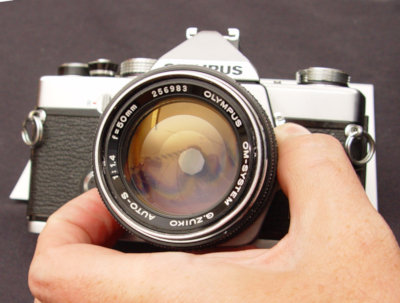 Knowing it’s in good shape? There’s no easy test (especially if there are no batteries handy,) but check the movement of the settings and the lens rings, look for excessive wear or evidence that it wasn’t stored well, like unclear glass or mildew residues, especially in the finer cracks of the body where people’s cleaning efforts often miss. If the camera is working, set for 1/2 second shutter speed, preferably with a lens attached and set to f16, and trip the shutter a few times. The double-click of the shutter opening and closing should be consistent and easy to time by ear, and you should see the aperture quickly close down and open again each time – these are the things that tend to stick if improperly stored.
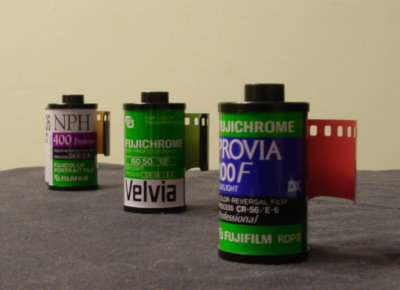 What film? Depends on what you want to do. The common print films are not only the easiest to find, you’re more likely to find places to develop it and make prints. The quality, however, tended towards the lower end, and the longevity, even with proper storage, was never that good. One thing to know is, film not only ages, it’s susceptible to heat, so the rolls someone finds in an old camera bag are not going to produce the same results as new. Should you find someone clearing out their stock that they maintained in a refrigerator or freezer, however, go for it. And you can still buy it new.