

Been building

This has been a while in the making, as will become evident, but it worked.

male and female wood duck Aix sponsa in small open water patch on pond during freezing rain storm
Most of the pics are old, because I was trying to accomplish a few things first, and so we see a pair of the wood ducks (Aix sponsa) hanging out on the pond back when it was nearly frozen, during the sleet and freezing rain storm last month. We’d already been distributing corn for the Canada geese, which the ducks had also discovered, and so they were starting to make routine visits to feed. We’ll go in a little closer to see that it was still raining as I took this:

tighter version of previous image with wood duck pair Aix sponsa showing still failing rain
There was only one section of the upper pond that remained open water after the storm, but the ducks navigated through that to the edge and then simply climbed onto the ice to walk the rest of the way to the yard, though we were being helpful in throwing corn out onto the ice as well.

wood duck Aix sponsa pair with male northern cardinal Cardinalis cardinalis on snow-pack of backyard
Here, the break in the terrain behind the male’s head marks the edge of land, with the frozen pond just beyond it, while I somehow got out far enough for a clear shot without spooking off the ducks, which has been exceptionally tricky.

male wood duck Aix sponsa snagging a kernel of corn
Yet I was still having difficulty nailing sharp focus and achieving a decent portrait, not helped by the lower light levels slowing the shutter speed down. Meanwhile, the ducks soon developed the habit of descending on the yard en masse at least once a day, usually twice, with their numbers steadily growing as the word got out. Yet while the geese and mallards began getting habituated to us quite readily and would approach within a few meters, the wood ducks wanted nothing to do with humans and would fly off at the merest hint that we were out and about. Attempts to photograph them from an upstairs window were often thwarted by them hearing or seeing the window opening – they have both excellent vision and hearing. But there was no way that we could watch an entire flock of them coming way up into the backyard without finding some way of capturing this. And eventually, it worked out.

What’s funny is, I tried a couple of different remote security cameras aimed from a good location, but the nature of those is that the wider viewing angle defeats the resolution, and so you can tell there’s something there, but not see it too clearly. Worse, the motion sensing function of the better of the two still couldn’t trigger on the ducks; too small in the frame and not enough contrast. So that meant that we’d have to start recording manually when we actually saw them out there. But while we were still trying to do this successfully, I managed to sneak upstairs to the window that I’d left open and finally get the footage that I was after.

A pair has been seen a couple of times hanging out at the end of the pond where the nest box is – we think it’s the mellow pair that doesn’t spook as easily as the others. Now, we’ve already seen mating behavior from the mallards, but not yet from the wood ducks, so it’s not clear yet whether the nest box will be used this year – we’re holding our breaths.

Meanwhile, I fretted mildly, when moving away from the previous area, that I might have no opportunity to photograph the bald eagles like we’d been doing down at Jordan Lake, and while I have spotted a solitary example here, there hasn’t yet been any indication of regular activity. But if I have to replace them with waterfowl like this, especially right in the backyard, I can probably cope.

This evening’s display

male northern cardinal Cardinalis cardinalis flying against rainbow as female watches from blooming crepe myrtle Lagerstroemia indica
Late this afternoon or early this evening – before sunset, anyway – we had some storms roll through, looking quite ominous for a bit, but what we ended up with were summer showers. The scattered nature of the thunderheads did let the sun poke through, and so we got a quite vivid rainbow for a decent amount of time, but granted, I boosted contrast on these for better display – in this case, as much to make the northern cardinals (Cardinalis cardinalis) stand out as to enhance the rainbow. The male didn’t want to pose out in the open like the female down there, but I snagged him as he crossed the bow, just not sharply.

The neighbor’s crepe myrtle tree (Lagerstroemia indica) was in the same direction as the bow, and so I didn’t even have to leave Walkabout Estates to frame a foreground element.

There were two items of note in the few minutes while the bow was visible, however.

both rainbow arcs against blooming crepe myrtle Lagerstroemia indica
The first was the second, meaning the secondary rainbow arc, seen here faintly above the first – this entered and left visibility in the space of two minutes or less. It was still raining lightly where I stood, and if you look at that higher arc, you can see a darker round shadow from a raindrop on the lens. This was better than the lens fogging up in the heat and humidity, which is what was happening when I first got out there since the camera had been sitting indoors in the air conditioning – it’s still hot as blazes around here, which the scattered showers have done little to alleviate.

I also suspected that I was seeing a hint of something else, and tweaking a few of the frames after I unloaded confirmed it.

contrast-enhanced rainbow arc showing faint supernumerary bow beneath
Significant contrast enhancement was used here, but it shows the ‘echo’ of a supernumerary arc underneath the primary Roy G. Biv pattern of the main bow – I go into them in more detail (with better illustrations) here, but what you’re looking for are the faint violet and teal bands repeating underneath the rainbow, which happens in certain conditions.

So it gave me something to shoot for a few minutes, which was about as long as I wanted to be outside anyway. Balanced out nicely.

female northern cardinal Cardinalis cardinalis in blooming crepe myrtle Lagerstroemia indica against background rainbow

Just because, part 38

I’m probably not going to get too many opportunities to post in the next week, and what will be posted probably won’t be… comprehensive, shall we say? “Hit and run” is closer to the mark.

I’ve had a lot of images saved in the blog folder, some for quite a while now – 260 total – and finally decided to sit down and weed out those that weren’t going to result in a post. Most of those were prepared with the idea that I’d write them up sometime, but I never felt that strongly about the subject; you may be looking at what I do post and wondering how badly a subject must suck not to clear that bar, and that’s fine, be that way. See if I care. But anyway, better than half are gone now, and that’s allowing for those that might still provoke a writeup. You know, in the winter months when there’s not that much to shoot.

I’ll also take the opportunity to put up a pair that remained, random images that I just never wrote up until now. Not like I’m lacking in images for this month, but hey, while I’m here…

Northern cardinal Cardinalis cardinalis showing loss of feathers on face
Taken back in July but pushed off by more distinctive subjects, this is what a northern cardinal (Cardinalis cardinalis) looks like without facial feathers – I know I always wondered. Now, why the feathers are missing is not something that I can accurately answer, but despite the name of both the species and the state, this is the south, so my guess is an incident having to do with alcohol and a grill…

And the other.

eastern pondhawk Erythemis simplicicollis partaking of a misting at night
We often have a handful of dragonflies that hang around the front garden areas, and this eastern pondhawk (Erythemis simplicicollis) got disturbed one evening in August and flew around my headlamp for a few moments before I convinced it to settle onto a plant; dragonflies have rotten night vision and always ‘roost’ for the night, but if they’re disturbed they’ll attempt to use what light is available to navigate to another safe spot. Once it had settled, I favored it with a misting, and since this was during the extremely hot and dry spell that we had, the dragonfly was visibly excited and eagerly sipped up all the water it could, wiping it from its head as the mantids will, as well as taking it directly off of the leaf. I was kind of sorry I didn’t have the video lamp handy to show this in action; I really should have it affixed more often. And now I’m thinking about whether a combined macro/video rig is viable.

[There’s more to this than you might think. First off, macro (still) photos are shot using the viewfinder eyepiece, strictly direct light through the lens, while video requires either the back LCD or an external monitor, which tends to work better. This generally means having the camera in a video rig, but that’s awkward to use when trying to make lens adjustments. The macro flash softbox and the video light are not interchangeable in purpose. I’m not thinking there’s an easy hybrid method that would work…]

All that glitters is not cold

… except, for this post, it really is.

backlit snowpack ice
True to North Carolina form, the day after the snowstorm is remarkably clear, even if it’s a tad chillier than it was during the storm (by like a degree.) My sinuses were protesting and I’d already spent time clearing off The Girlfriend’s car, so I intended to keep my outing brief, but I couldn’t pass on the opportunity of course. The snow had all partially melted due to the air temperature as it fell, then refroze during the night, so what we had was actually ice clusters, which sparkle a lot more than snow does.

It’s this kind of thing that makes me regret how slow our technology in digital photography has progressed in certain areas. Manufacturers are concentrating on cramming ever more megapixels into sensors, but the dynamic range remains largely the same, and the display on these LCD monitors falls into a really dismal scale. The bright sparkles here should just about hurt your eyes for an accurate impact, but they’ll be nowhere near that bright no matter how you view them. Hey, all you techie people, let’s get on this!

refraction from melting ice droplets on pine needles
It’s also pretty challenging to capture the rainbow refraction that produces starbursts of intense color from the melting ice when viewed at the right angle, but that’s the fault of lenses and apertures more than digital sensors. The orange shows up well enough, but you only get a hint of the teal from the drop to the left. If you ever tackle this, a larger aperture helps, and do a lot of shots because luck plays a large part.

I’m not about to drive up to Gold Park, where we shot the early blossoming trees a couple of posts back, so we’re going for this right now as seasonal commentary.

red bud blossoms under topping of snow ice
I don’t recall which trees these were and can’t identify them by the blossoms – I was initially going to say sweetgum, but the gumballs are still visible on the branches of those, so no. Not a lot of chance of them getting pollinated today, anyway.

And another, altered to show a trait of the morning.

tree branches and visible blowing ice and water in the air
I boosted contrast and adjusted saturation on this to make a detail more visible, but getting it beyond the subtle aspect seen here made it look incredibly unrealistic. The sun was warm enough to be melting off the ice, with the occasional breezy gust, and the air was actually full of misty droplets and falling ice bits anywhere near a tree, so getting gently pelted with these was par for the day. If you look closely at the clear blue sky areas, you’ll see they’re full of white spots of the ice and water drops.

I had no intention of chasing bird pics, but they seemed galvanized by the snow or sunshine or something to be active, so even with casual shooting I netted a handful of different species.

male northern cardinal Cardinalis cardinalis in bare tree with snow tufts
The northern cardinals (Cardinalis cardinalis) adore this stuff, of course, and this one was patient enough to let me shift slightly for a clearer view and better framing, then posed momentarily for posterity before flying off into more of a thicket where it was nigh invisible.

As I walked along I spooked a northern flicker (Colaptes auratus) from a tree where I hadn’t seen it at all, its pale rump flashing during its swooping flight, but it landed not far off in good light and I snagged a couple of frames.

male northern flicker Colaptes auratus on pine trunk
I don’t see enough flickers around here, which is a shame because they’re cool birds, but it’s possible that I’m just not searching hard enough – the other woodpeckers tend to draw more attention to themselves, at least. The dark ‘mustache’ mark denotes this as a male, like the cardinal above (which is indicated by the bright red color for that species.) The black bib is also a distinctive trait of the flicker, but my angle here shows only the barest hint of it.

I’d been hearing the semi-distant calls of the next one, but caught it out of the corner of my eye as it silently flew to a new perch. It, too, gave me just a few moments for a couple of frames before it flew off again.

red-bellied woodpecker Melanerpes carolinus also perched on trunk
This is a red-bellied woodpecker (Melanerpes carolinus,) which I see a lot more of, and hear even more often, though they’re comparable in size and habits to the flickers. Again, a male – the females lack red on top of the head though they still have it on the neck. Neither ever seems to show a red belly, to be honest, though I believe there’s a hint of it on the males during breeding season and no other time. I think ornithologists could have tried harder to name them something appropriate.

And I’ve said the same for this next one, too.

double-crested cormorant Phalacrocorax auritus perched on piling in pond
Here we have a double-crested cormorant (Phalacrocorax auritus,) so-named because during breeding season the males have two narrow stripes of paler feathers on their crowns – as much as I’ve seen and photographed these birds, I’ve never seen this at all myself, so I think it’s all bullshit and the few photo examples out there have all been Photoshopped. I tend to consider these warmer weather birds, seen more often at the coast though the numbers may be increasing here inland, and I wasn’t expecting to see one in this weather; a couple years back one spent some months in the summer in this pond, perching on the same pilings in fact, so we’ll just have to see what happens.

By the way, these pilings are a matter of slight frustration, because their position means they’re always backlit and too many species seem to like them. Maybe I need to erect some big reflectors on the bank nearby.

And for our last pic, I’ll go slightly fartsy with one of the ubiquitous Canada geese (Branta canadensis,) which I have more than enough photos of (as does everyone, I guess,) but I liked the sun’s reflection in the water alongside it. Plus it brings my photo uploads this month to 49, not too shabby for the winter and the slow start. And I still have at least another ‘On This Date’ photo coming.

Canada goose Branta canadensis with sun's glare

Eventually, something happens

I remarked in the podcast yesterday that we’d had some cold but boring weather recently, which is fairly typical for central North Carolina – it’s not a region that sees a lot of snow, but too far north for foliage to remain growing and green throughout the year. This means most of the winter sees grey and brown grasses and bare trees, and not a lot to photograph.

Only hours after that, however, the threatened winter storm finally rolled in and deposited roughly 5 cm of snow within about an hour. One small upshot of this was, with the bitter temperatures that we’d had leading up to it, the snow didn’t melt in contact with surfaces; this meant it swept off of cars effortlessly, and didn’t get that underlying layer of slush on the roads that makes them so slippery. I had to drive that evening but didn’t have to face either a long session clearing the car nor any real difficulty on the roads. Granted, I was still taking it slow.

So yesterday morning The Girlfriend and I got a brief chance to do some photos before a busy day, and checked out the nearby pond. We hadn’t seen it earlier, when I imagine the ice was nearly complete but clear; by this time, it had a healthy coating of snow, and the geese that were flying in seemed more than a little put-out that there was no water to be seen.

ice and snow on local pond
unidentified finch and bare limbs silhouetted against skyI’ve mentioned before, I’m not much of a songbird person, but there isn’t a lot else to photograph right now, and they were notably active around the pond. Most of them were reluctant to let me approach very closely, but I took what opportunities I could. Most of them were also trying their damnedest to remain within the thicket of branches at every opportunity, so nice portraits were difficult to obtain.

The sky was inordinately clear, the wind was gusty, and the snow could be dislodged instantly, so there was still a lot blowing around, and on occasion it would whip off of the ice in curling waves or even tiny tornadoes, ‘snow devils’ if you will, very cool to watch but too brief for me to capture with the camera. Because of these conditions, the scenic images of snow on branches or berries or pine cones weren’t really available, it all having blown off long before. And since the snow had rolled in during the night, I wasn’t going to get them when it was coming down, either. So it goes.

The sparrow below was one of many, but the only one out in the open enough to make a semi-decent image from. Like all of those that we saw, its feathers were fluffed out against the cold, creating nice insulating layers of air beneath. I’m tentatively identifying this as a chipping sparrow (Spizella passerina,) but there are several species that have similar markings and can at least pass through the area, so I’m not putting it in writing.

sparrow, possibly chipping sparrow Spizella passerina, on bare branches looking suspicious
Northern cardinal Cardinalis cardinalis  feeding on dried berriesMeanwhile, this Northern cardinal (Cardinalis cardinalis) absolutely refused to adopt a striking pose or even peek out from behind the branches, but it wasn’t until I downloaded the pics and had a nice close look that I realized this was because it was feeding on some diminutive unidentified berries. Like I said, the patches of snow on branches were virtually gone, so no opportunity for a nice composition with the red cardinal, blue sky, white snow, and perhaps deep green pine needles (about the only use they can be put to.) But at least the light angle was decent. That’s not really enough to save the image, is it? Fine – be that way.

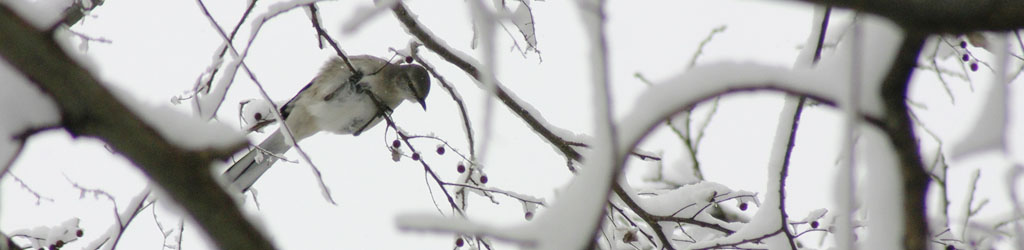
The best luck I had was with a northern mockingbird (Mimus polyglottos, which is perhaps the most expressive scientific name I’ve come across.) Clearly not concerned about my stealthy approach and more than accommodating about letting the sun hit its eye, I got a wide variety of shots and a few different poses, but settled on the one below both for the catchlight in the eye and for the flakes of blowing snow that can be seen in the air behind it. And yes, those are some really early buds on the branches back there – the weeping cherry in our yard has them too, don’t ask me why.

Northern mockingbird Mimus polyglottos giving nice profile with blowing snow behind
Examining this photo, I was struck by the negligible grip the feet seemed to have on the branch, not at all in tune with what I’d expect from such a gusty day. But as I was writing this post, a potential reason behind this occurred to me: the bird just might be minimizing its contact with the branch because the branch is so cold, and it’s thus conserving the heat in its toes. Someone with a greater knowledge of bird habits can tell me how (im)plausible this is…

And finally, a splash of brilliant color, with the barest hint of retained snow. I have no idea what kind of remarkably fecund berries these are, and they were in a neighbor’s yard so I was shooting from the road with a long lens, but I like the color and the shine. What I didn’t like was the telephone line cutting across the sky, out of focus in the background, so I crassly edited it out. Really, those damn things need to go.

unidentified brilliant red-orange berries against rich blue sky