








We had that tiny fragment of a solar eclipse two weeks ago, and true to form (in this case, orbital mechanics, though what they’re doing up there is anyone’s guess,) about ten hours ago we had a partial lunar eclipse. The weather forecast had called for rain developing in the evening and continuing on through into today, and before the penumbral portion was even due to start, we were socked in here starting to feel some light rain. I resolved to check periodically just to make sure we didn’t have a break in the clouds.
Peak was supposed to occur right around midnight, and at 11:45-ish (or 23:45-ish if you prefer) I went out and actually saw the moon: partially shrouded in clouds and thus quite indistinct, but it was there. Moreover, I could see a star far off to the west, which meant a complete break in the clouds could be coming, so I set up to keep an eye on things. As it got closer, there were patches of actual brightness, which a longer exposure brought out.
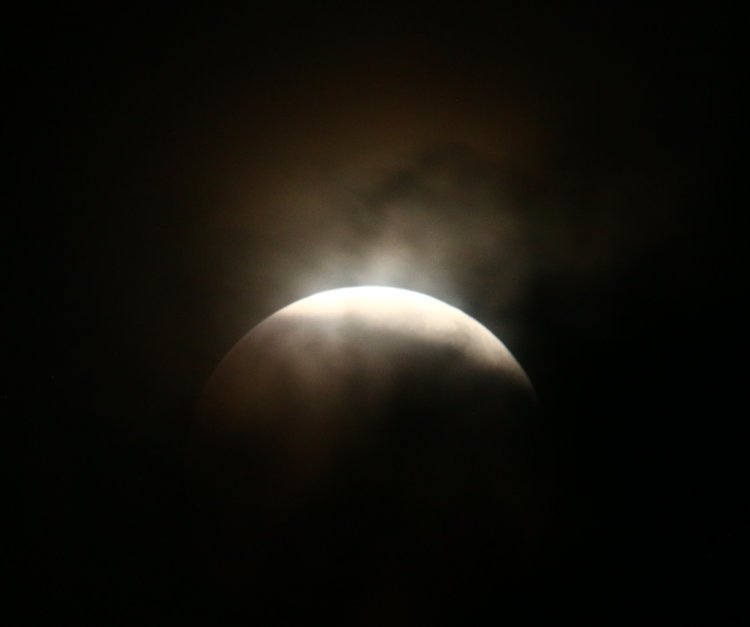
It went in and out, disappearing entirely just as I got the camera set up but returning for brief peeks – I would have done video but the light was too sparse and, if I got anything, it would have been grainy as hell. The clouds weren’t moving fast at all, but they were moving, and soon enough, things cleared enough for some decent pics.
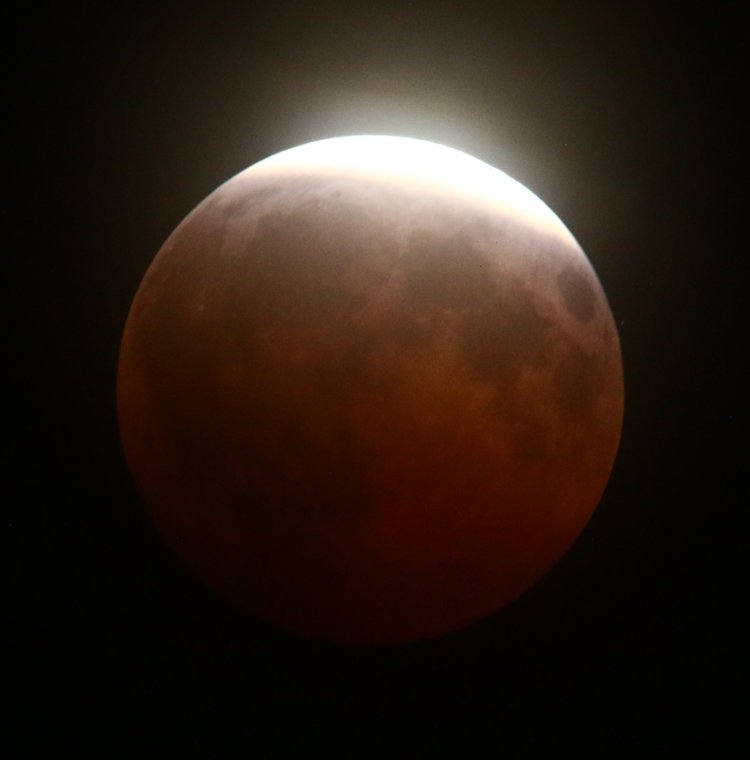
This is roughly 13 minutes before peak, with the shadow appearing to move right to left – it wouldn’t get a lot more noticeable than this. But I was bracketing exposures for different effect, as well as tweaking focus because all I could clearly see in the viewfinder was the bright portion and that was inadequate for the job. A longer exposure brought up an additional detail though:
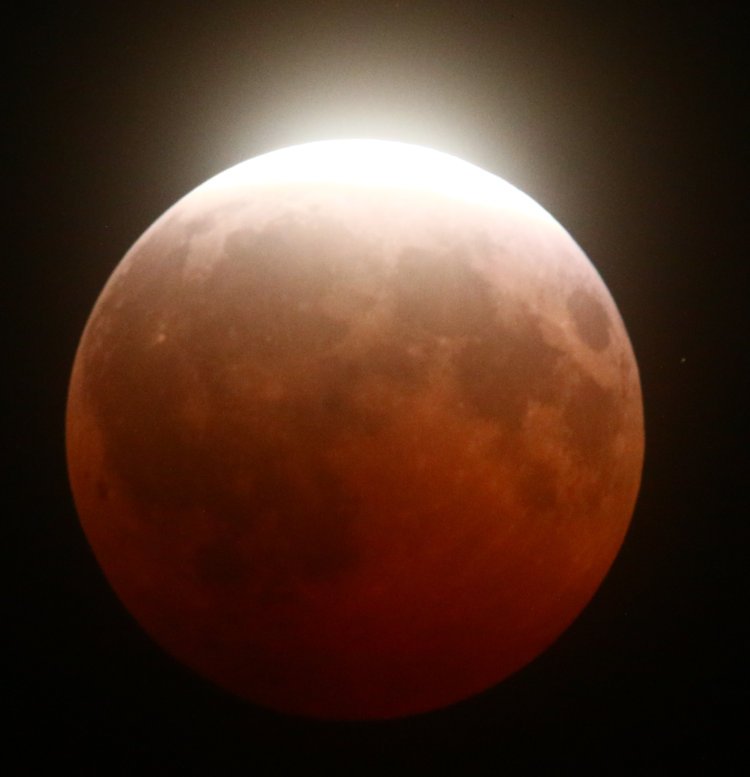
See it there to the right? I actually spotted this in a preview (“chimped”) image as I was checking focus, and re-aimed the camera to ensure myself that it appeared in the same place and was thus up there and not in the camera, i.e., sensor noise. But no, subsequent checks in Stellarium show this is actually a star, HIP 110580 to be exact (or HD 212396, or SAO 165042, depending on what catalog you prefer,) a 7th magnitude star in the constellation Aquarius. While the moon appears to move left to right in the sky, it does so slower than the stars do, so this one would have popped out from behind the moon, oh, let’s see… according to Stellarium, about 14 minutes before. In fact, there it is:
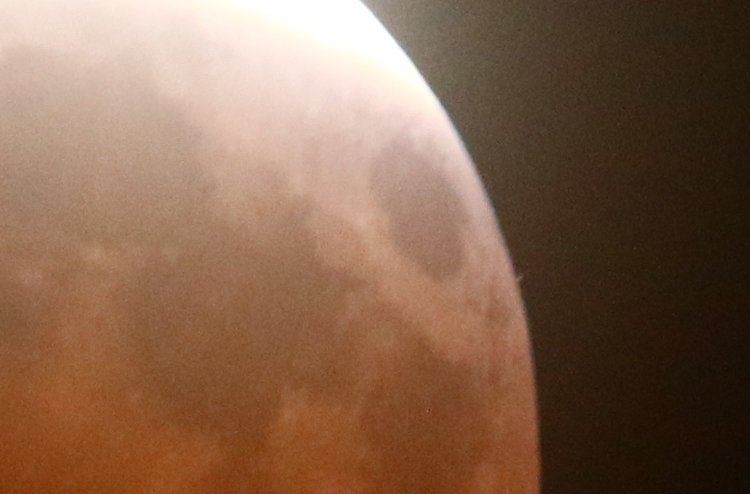
I didn’t think to check the motion until writing this post, and on finding that it appeared while I was firing off frames and not while the moon was obscured by clouds as I thought, I had to go back and re-examine my images – this is a full-resolution inset, and you can see the grain of ISO 1600 far too clearly. I even have a frame just as it broke the limb of the moon, but since it’s only a bump in a grainy photo you wouldn’t believe me anyway.
The Girlfriend came out to check things as it neared peak, and she was the one who spotted the plane approaching, so full credit to her, because I would have missed these:
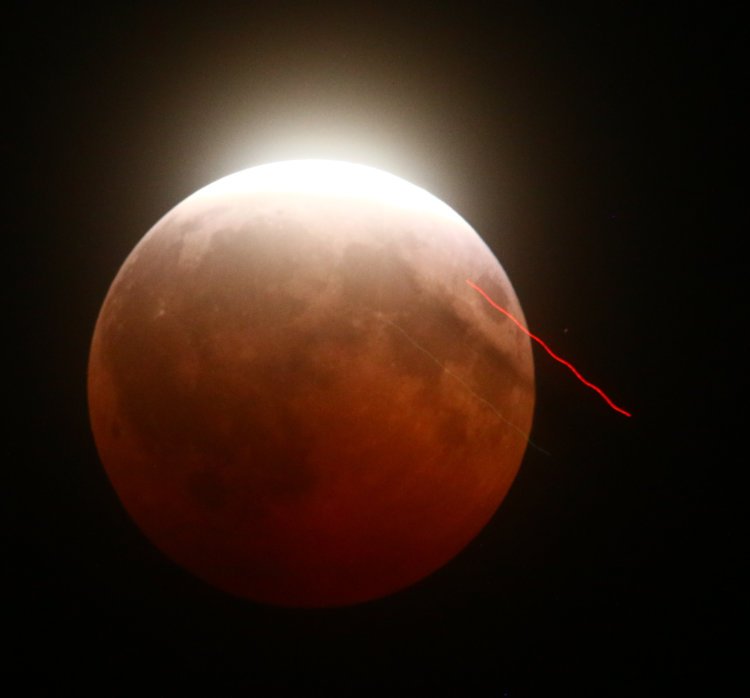
We both had little warning, so no time to adjust from the settings I was using at the time, and so I simply fired off a few frames as it passed. Now, I’ve watched countless times as planes approach the moon, and catching one actually crossing in front is extremely rare, since the moon is a ridiculously small target in the sky – usually they pass close and that’s the best you get. Here, at 0.4 second shutter speed, I was only going to catch the movement delineated by the navigation lights, and a faint shadow from the body blocking the moon through portions of the exposure. The wobbly lines, however, are courtesy of camera shake, all from the vibration of the shutter and the mirror initially slapping up. The following frame captured some more.
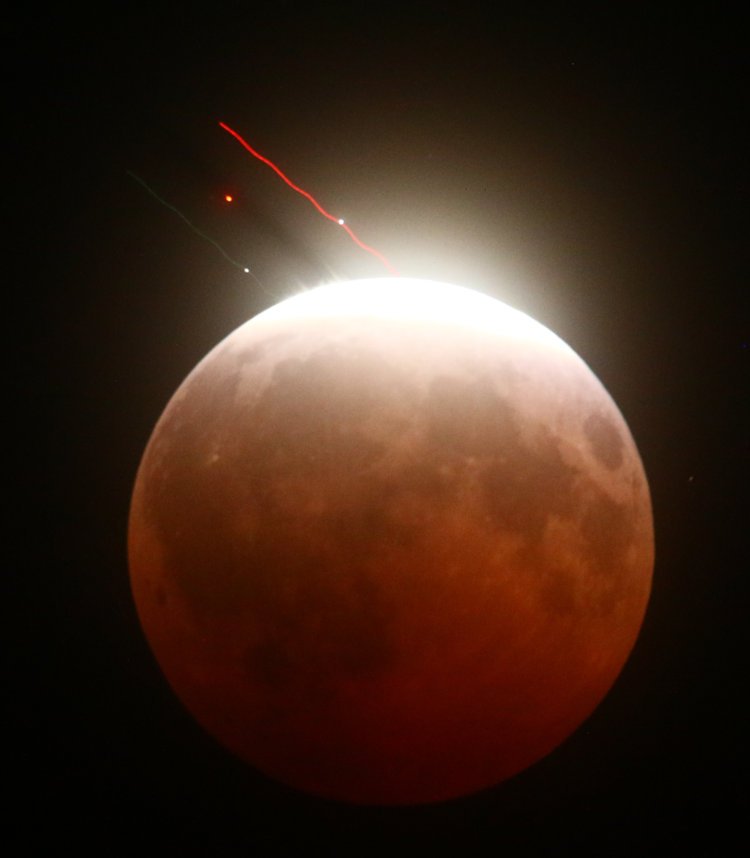
Now, we can see that the white paint used to make this image wasn’t quite dry yet and smeared with the plane’s passing. Well, okay, you’re actually seeing the contrails of the plane distorting the moon’s light at the edge – and something else. See the faint shadow between the nav lights? That’s the body of the plane blocking the atmospheric haze lit up by the moon, indicating that the humidity hadn’t totally cleared and that glare wasn’t solely in-camera. I was a little surprised when I realized that I’d actually caught this.
Now, could I have captured the plane sharply against the eclipse, like, properly outlined? Ye-ess, perhaps, but let’s lay it out. The shutter speed would have had to have been 1/100 second or faster (probably faster to get it really sharp,) which was 5 1/3 stops lower exposure than this. The aperture was already at maximum for the Tamron 150-600 lens (f6.3,) and ISO at 1600. What I might have gotten would only have been the sunlit sliver of the moon, and dimly at that, so only a portion of the plane anyway, and only if I nailed tripping the shutter at exactly the right moment. Getting the plane outlined against the reddish earthshine portion of the moon, sharply, would have required a camera and lens far in excess of the capabilities of mine.
Anyway, we’ll visit probably the sharpest image that I got of the eclipse.
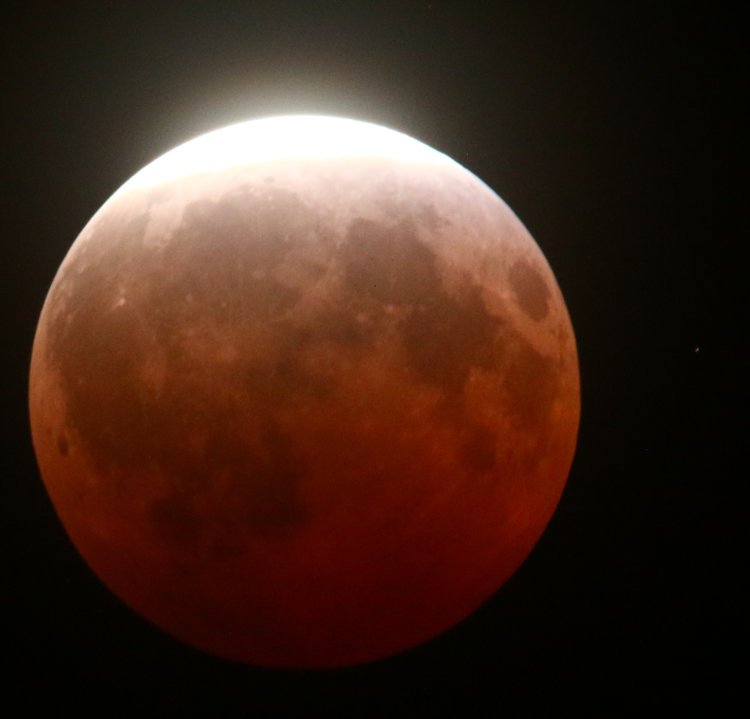
This is about six minutes past peak, and you can see that the moon’s yarmulke is sliding off to the left now. Tycho doesn’t quite show up, but Copernicus does, as does Aristarchus (of course – that always shows, being the brightest part of the visible moon.) To the naked eye, the outline of the moon was dimly visible with just a faint hint of this color – it looks much better in pics.
The Girlfriend, looking through binoculars, pointed out that another star was visible, much brighter than HIP 110580, so I reframed to capture that one too.
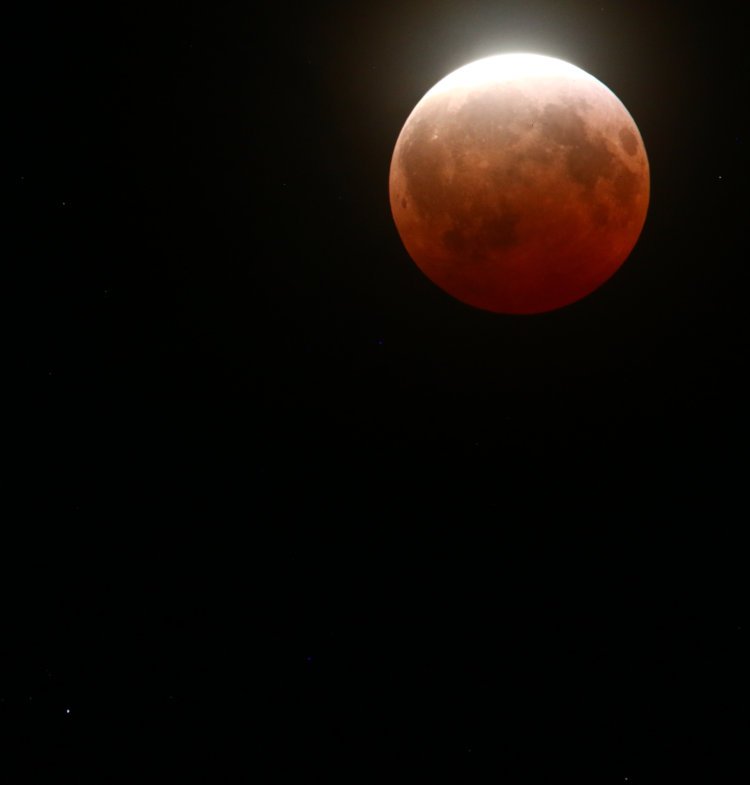
That would be HIP 111123A (HD 213320, SAO 165134,) also known as 57 Aquarius or σ Aqr, actually a double star with a combined magnitude of 5, thus visible unaided on a clear night, but would have been obscured by the moon’s glare on either side of this eclipse. I didn’t hang around out there to confirm this, or to even get further shots of the eclipse fading, because peak is far more interesting, plus I was tired. Overall, though, more success than I was expecting, and a nice follow-up to the fragment of solar eclipse a fortnight previously. I’m good with it.