




Went out to the car in the evening, just as it was getting fully dark, and on my return, right alongside the front door, I heard a sharp rustle in the leaves underneath the camellia flanking the door. I took out my pocket flashlight and tried tracking the noisemaker, going around the bush carefully since this was too reminiscent of an earlier encounter. Finally spotted a toad, figured that was the culprit (and this is very typical – several toads frequent the front area,) until I saw the thick dark body of a snake alongside the house. The snake realized it was busted and broke for cover exceedingly quickly, so I only got a glimpse of the head, but the size and darkness of the body and what markings I’d seen struck me more of a cottonmouth than anything else.
Now, the property here is ideal for the species, which is quite venomous, but I had yet to spot one at all – plenty of other species, including three different (harmless) types of water snakes, but not a cottonmouth. I was determined to try and prove this, because I’ve never even seen one in the wild, but some caution was needed of course, especially given that I was barefoot. In short order, I determined that it had gone to ground in the gap between the bricks that supported the rain barrel, so I put on some boots as a modicum of protection and gathered up the camera. Which, naturally, wanted to fog up immediately since it remains that kind of weather. Thus, my initial pics weren’t conclusive – or actually, they were, but not until closely examined.
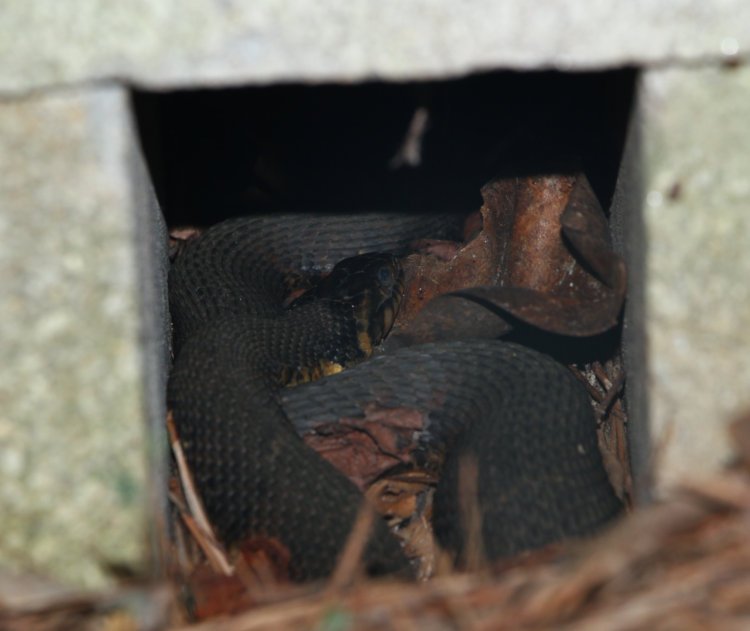
The head is turned away, though the on-camera flash illuminated it well enough – the macro flash rig I had attached just wouldn’t get into the narrow angle needed to shine into the hollow. In a short while, however, the snake had turned its head to see what I was doing better, and this time I used the (urk) smutphone, because the illuminating LED sits right alongside the lens. Since all I have on my cheapass little phone is a wider-angle lens, this meant I had to get damn close to the opening, far too close for safety, but by this point I had seen enough.
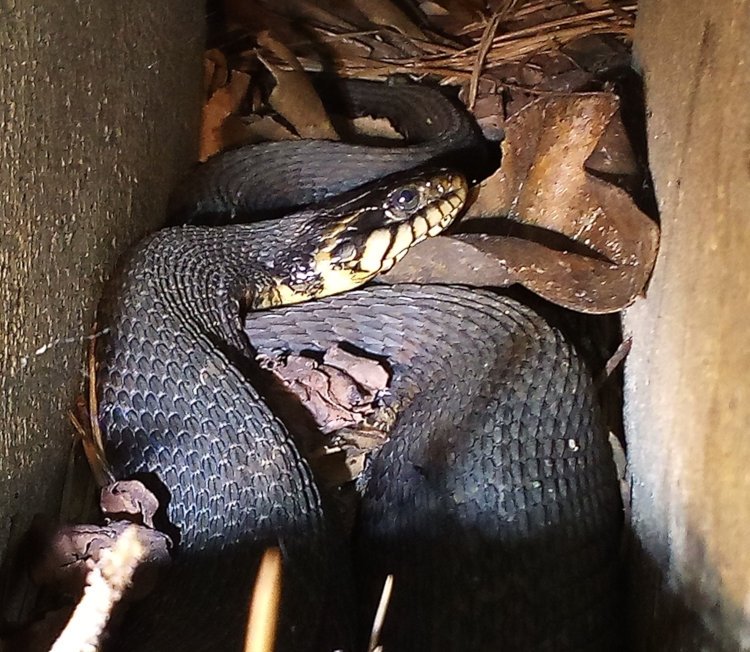
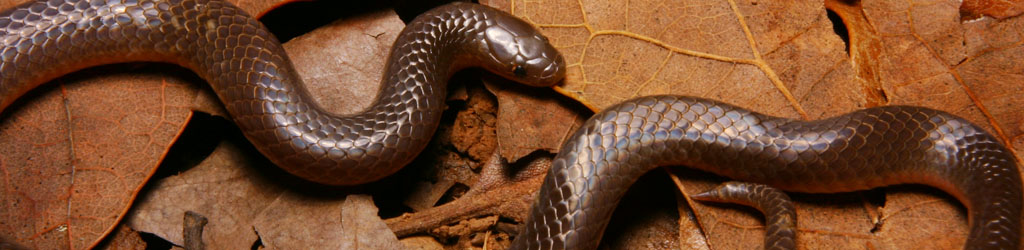
Smoother, less-angular head, distinct vertical stripes on upper and lower jaws, and round pupils instead of slitted – all traits that eliminate cottonmouth as an ID. Instead, this is another species of water snake, most likely a northern water snake (Nerodia sipedon,) though the details I’d need to see to confirm that – whether the bands near the tail are solid or broken – are hidden. No way to show scale for these, but the body was quite thick, and I got the impression it had either eaten recently or was perhaps pregnant. This is also quite dark for the species, with minimal distinctions in the markings – not out of line for the wide variations that occur, but more in line with the coloration of cottonmouths; it looked almost solid black at first, and a detail that registered in passing but only subconsciously, it looked very matte and dull, due to the rough scales. This immediately distinguished it from the other two black species in the area (eastern racer and eastern rat snake,) which both look slimmer and smoother/shinier. I also don’t think I’ve seen the black variant of the rat snake in this region – they’ve all been the grey variant.
Anyway, a false alarm, which is both good and bad. Bad in that I still haven’t actually seen a cottonmouth, much less photographed one, but also good in that a snake that was right alongside the front door was not actually venomous. It also reminded me that I get complacent at times, and need to remain alert for such potential hazards.