




I sat down this morning, literally, and tackled (not literally) a project that has been on my list for years, that even just laying the groundwork for has taken far too long, and I don’t consider it ‘completed’ yet, nor may I ever. But I certainly didn’t come close to it today, though I made progress and got some successes.
I’m referring to doing some natural photos of hummingbirds, specifically the ruby-throated hummingbirds (Archilochus colubris) that are the only species I’ve seen in person. “Natural’ means, “not at a feeder or other contrivance,” and of course, to accomplish this, you need flowers that hummingbirds like to feed upon. We’ve had butterfly bushes for years, but these don’t seem to attract much if any attention. We’ve planted (several times) cardinal flowers, which never germinated at all. And we’ve had some potted salvia, which started off nicely but then faded. Finally, late last summer we got two varieties of salvia, a blue and a purple, which settled in nicely and then exploded with activity this spring. This has finally worked as intended, and the hummers have been visiting them routinely – I just haven’t set up the camera nearby to photograph the activity, until now.
[To satisfy my habit of providing proper names, I will say that both salvias appear to be varieties of Salvia guaranitica – the blue was still tagged as such, while the purple appears closest to this hybrid, also a variety. That’s what I’m going with, anyway.]
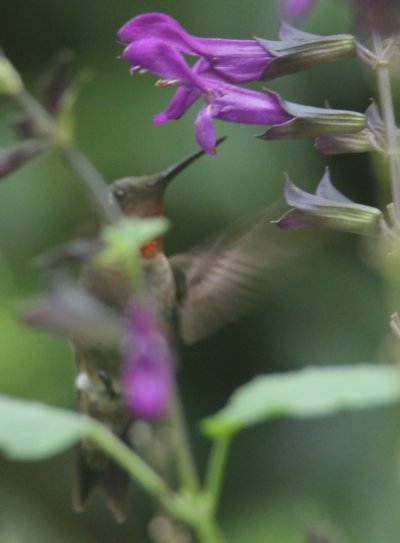 It was relatively early in the day when the sun was still on the other side of the house as well as partially-clouded, so the light was low, and my first attempts didn’t have a fast enough shutter speed to halt their movements well enough. This male, the ‘owner’ of the purple plant, was quite hyperactive and difficult enough to track even with autofocus, typically visiting a blossom for literally a fraction of a second, enough time for a tiny sip, before moving to another.
A note about hummers. They’re neurotic, or what we would consider to be so from their actions, though we can’t vouch for their actual mental state; they are fiercely territorial over their chosen feeding spots, often staking them out to keep watch and chase off any intruders the moment they’re spotted, which leads to frequent chases and occasional aerial battles, and they easily appear to spend far more time trying to fend off intruders than actually feeding – it’s hard to believe they get enough calories to function. The purple salvia was guarded by a male, while the blue was owned by a female, while at least two others made frequent attempts with varying success. There are also three feeders that we maintain, one within meters of the purple plant, so there’s more than enough food to go around, but it’s just not in their nature to share.
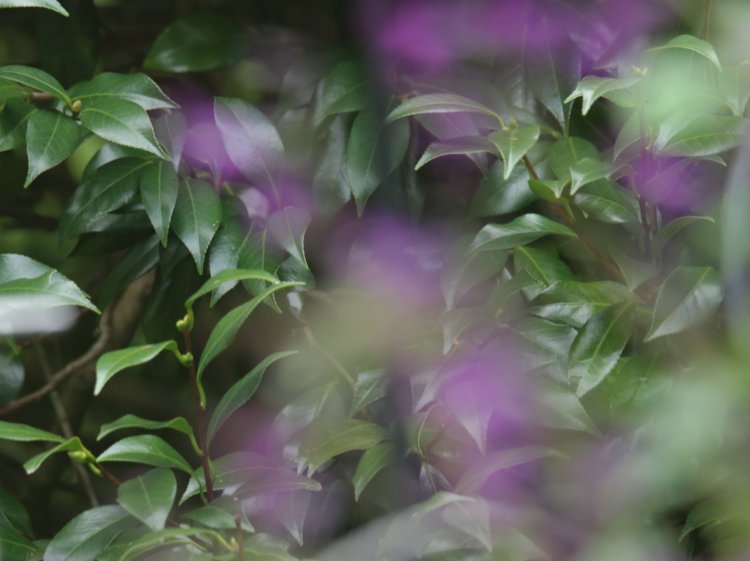
The salvia plants themselves are thick and deep, but the background is also cluttered, in this case with a camellia bush, so between this and trying to keep up with a twitchy subject, autofocus frequently just buggered off to the background or occasionally nothing at all. I tried switching it off and going manual, but that wasn’t any better, far too slow with the movements of the hummingbirds. I also tried staking out particular blossoms, locking focus thereon and waiting, but this didn’t work either, and I could tell that I was missing activity just outside of the field of view. The best process seemed to be, autofocus, watch the activity over top of the camera, and then attempt to snag it when the hummer was in an ideal position. Note that, “best,” doesn’t mean, “good,” and the hummers would often move on to another location in the moments while I was raising and aiming the camera.
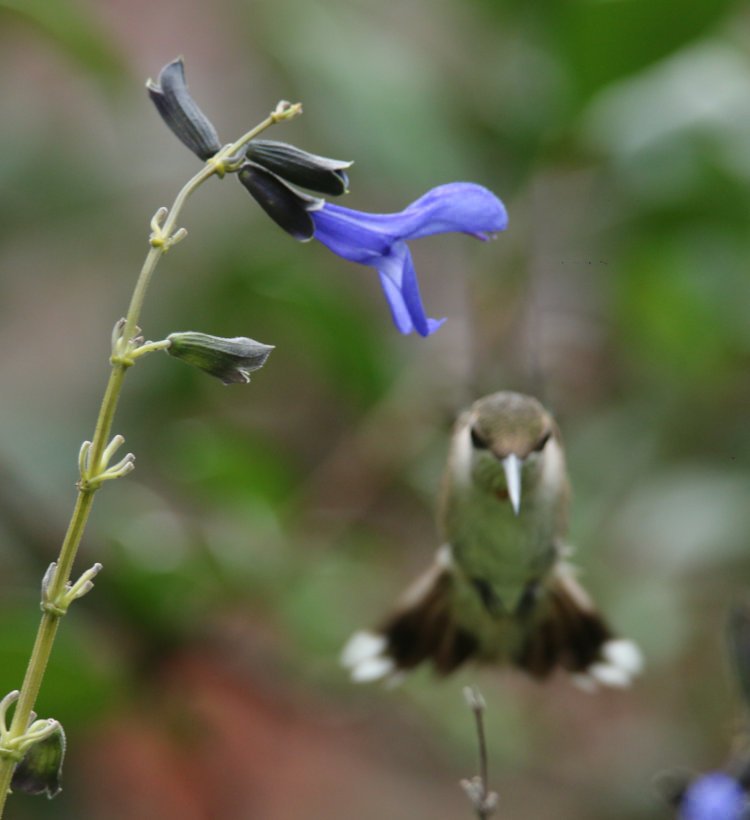
Or simply move off even as I had focus locked and framed nicely. But there’s something nicely ominous about how her eyes rendered here.
This is the female that ‘owns’ the blue salvia, and I will note that I tweaked the blue registers here to hew closer to the actual color of the blossoms, since the camera isn’t actually capable of capturing it.
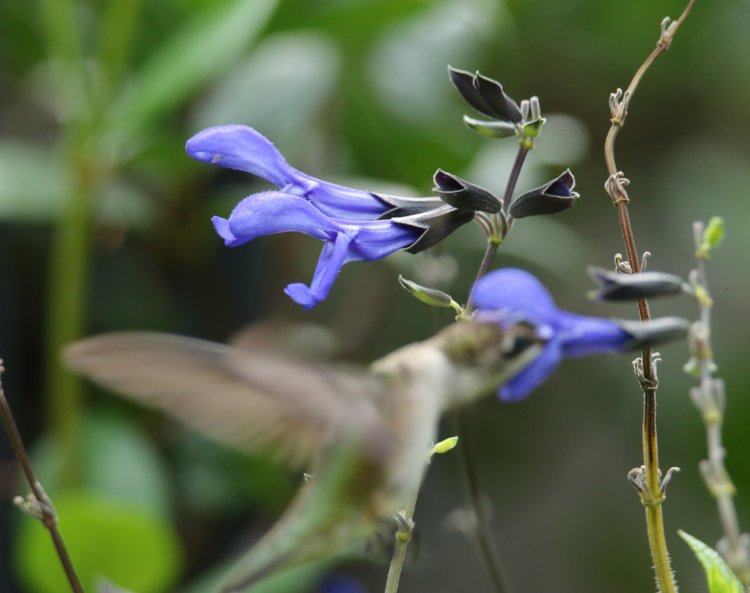
Another miss, but the background blossom was sharp, so let’s claim that was the intention. Just so you know, the linear separation of these two blooms might have been as high as 20 cm, but likely less – depth of field at this magnification just isn’t there. When I try again, I may sit back further to see if I can improve on this a little, at least to have autofocus not have to twitch as much.
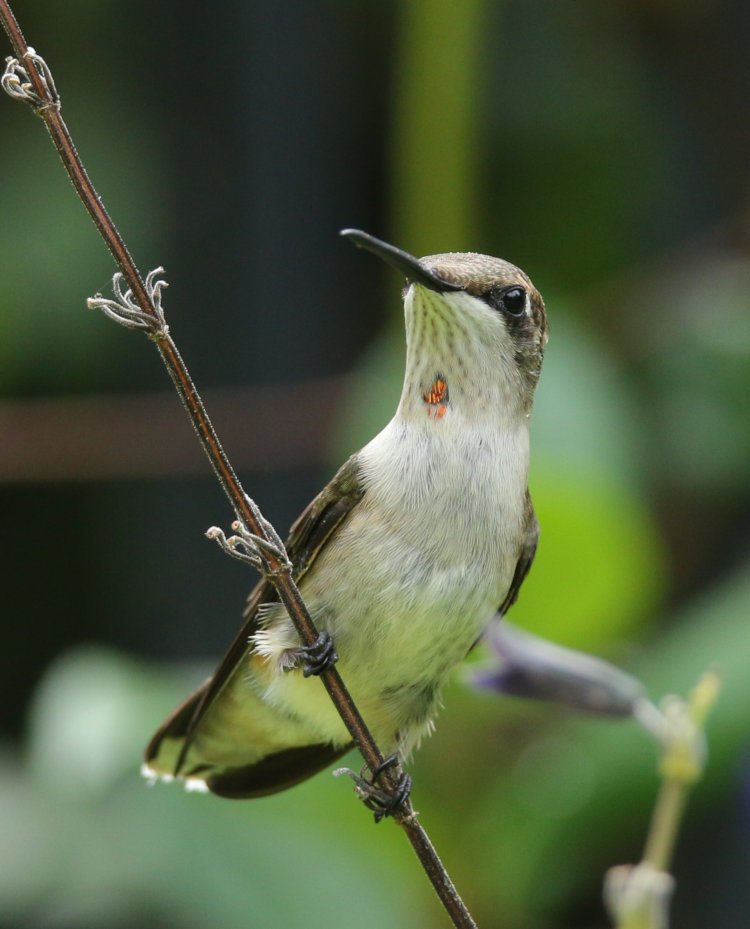
The female, at least, was cooperative several times over, in that she’d perch right on or near her claimed plant to guard it, as well as keep an eye on what I was doing. But it meant I could actually get some sharp photos, including of her bare patch of red feathers on the throat, in proper light too. The male almost never managed a light angle to show off the red iridescence, and his throat virtually always appeared dull brown.
Also, I’d boosted ISO to 800 here, and changed to my preset for low-contrast conditions, which boosts contrast and saturation a bit – visibly different here.
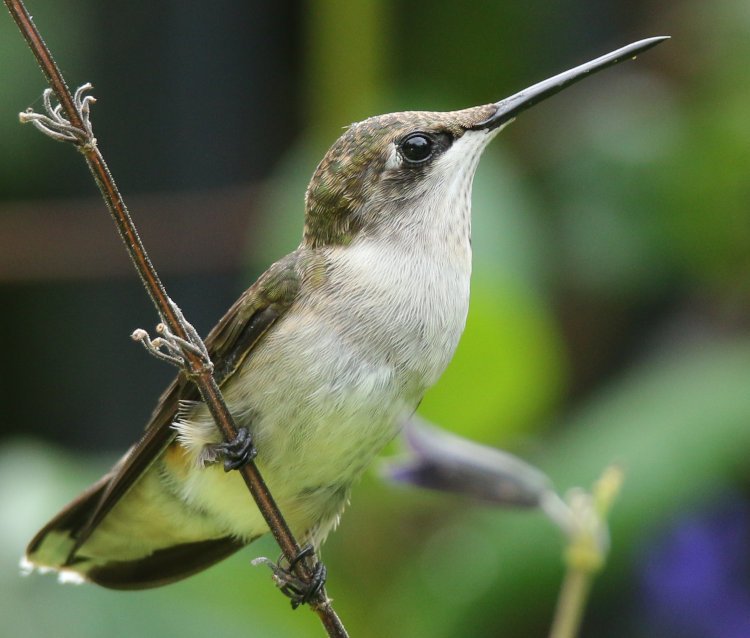
Nice profile. Can’t complain.
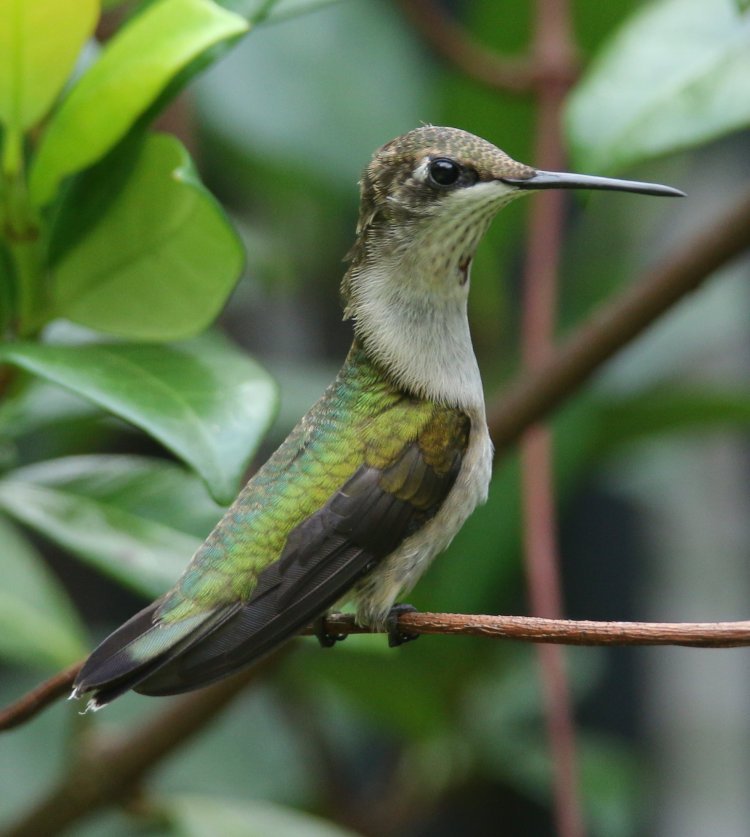
A curious effect here. You can see she’s stretched her neck longer, but the neck feathers looked splayed backwards – this is possibly a territorial display directed at an interloper, since she vanished from the frame immediately after this. I know I’ve seen them spread their tail feathers for the same reason, usually when facing off in flight.
By the way, sitting in a lawn chair with a view of both plants, I was treated to the frequent chittering that they make when chasing one another off, as well as being buzzed several times – when in pursuit, they don’t pay a lot of attention to trivial concerns like nature photographers. It was this very chittering that redirected my attention to particular birds, since my attention was being routinely split between the two bushes.
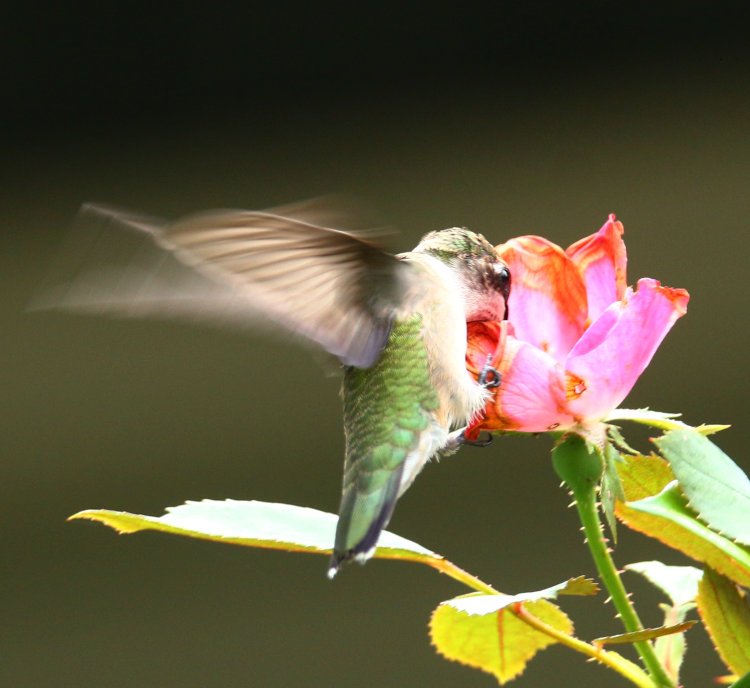
The blue salvia sits in front of a massive spread of roses that was here when we moved in, but this was the first I’d seen a hummingbird actually drinking from one.
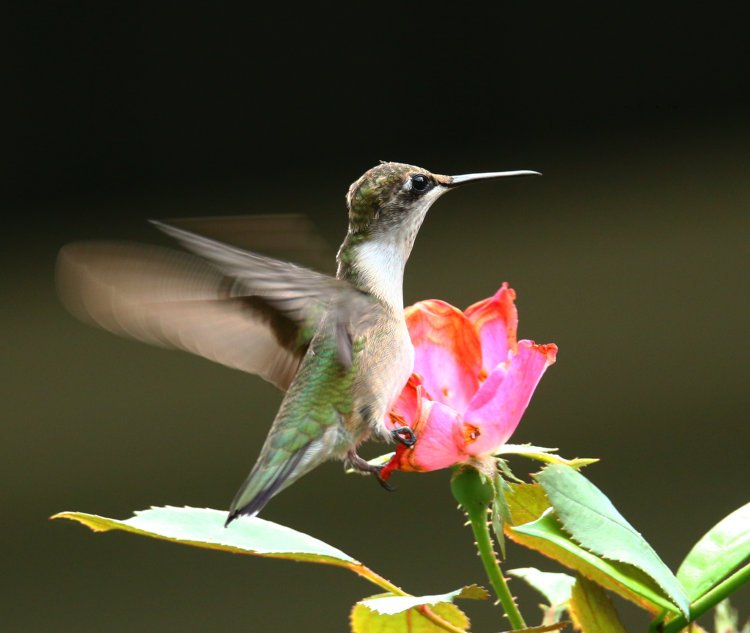
And a pause, since it sat the highest in the immediate vicinity and afforded a good view to protect her territory, though most often she sat lower and more camouflaged against the greenery.
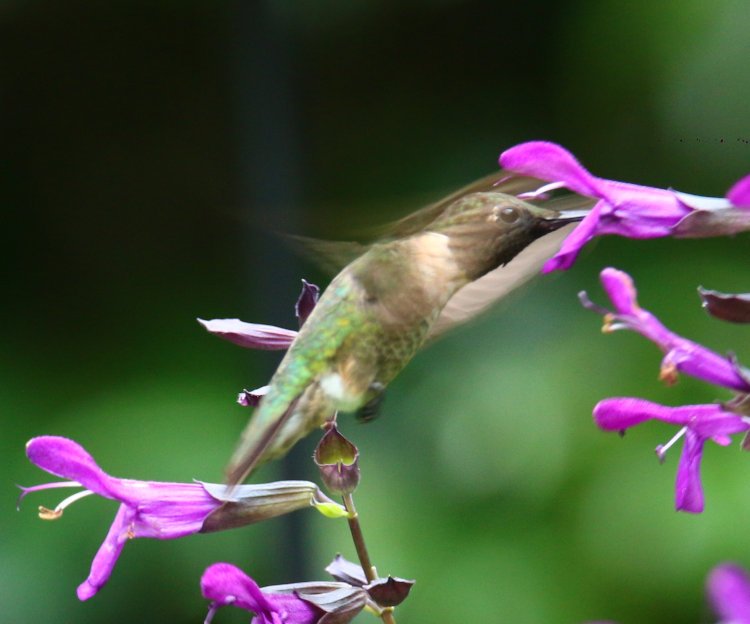
This is the clearest shot I managed of the male that owned the purple salvia, unfortunately partially obscured by its own wing. The shutter speed was only 1/160 second, nowhere near fast enough to freeze the wings. I’ve had them blurred at 1/800 second – the wingbeat of hummingbirds is astounding.
But yes, the goal is to not only get sharp photos of the male, who’s more hyperactive than the female, but also to get that red iridescence of the throat, which will take better light. I didn’t get a chance to get back out this afternoon when the sun had crossed the house, though I will eventually – the heat during the day is still horrendous, and dangerous even when just sitting on one’s ass, so you’d best appreciate it when it happens.
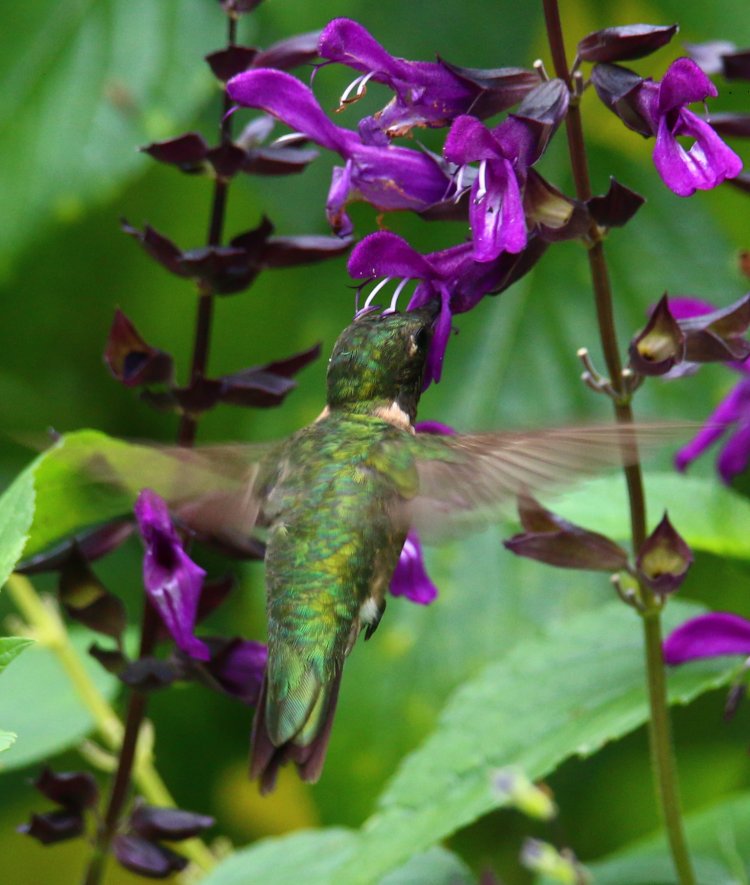
Now, another male was sneaking in to partake of the purple, and had learned that the ‘owner’ took a particular perch in an oak tree nearby, so this guy would slip in on the blind side of the bush, practically underneath, and get a few drinks in down there before being discovered. The average time this lasted seemed to be in the range of 2-8 seconds – hummers have good eyes.
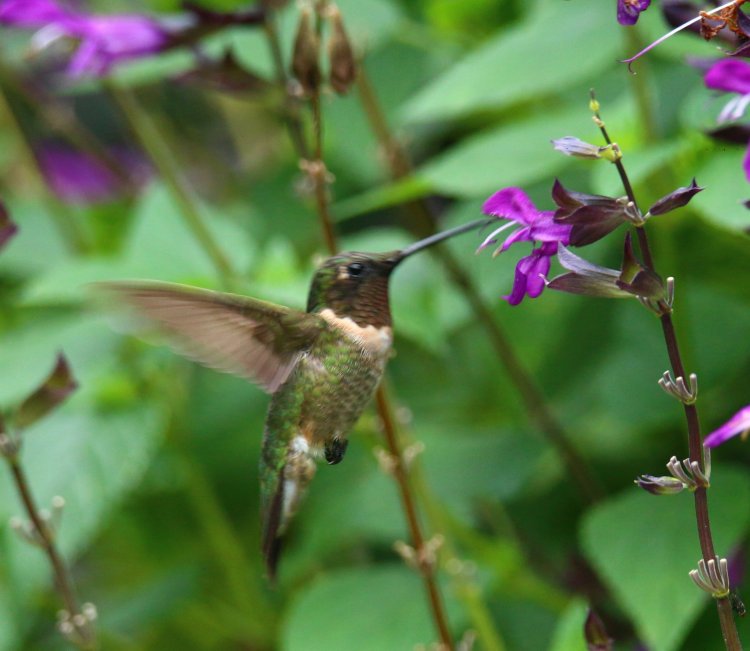
One last one of the possessive male – this would have been a better shot with focus on properly, and much better with the iridescence. But at least the plants are convenient and the hummers are visiting them routinely, so the opportunity is there to do better. I have about a month or so before they split and head south for the winter. Hopefully, more will follow soon.