






Several days back, I looked out towards the pond in the early morning and saw this strange-looking web, largely because it was backlit.
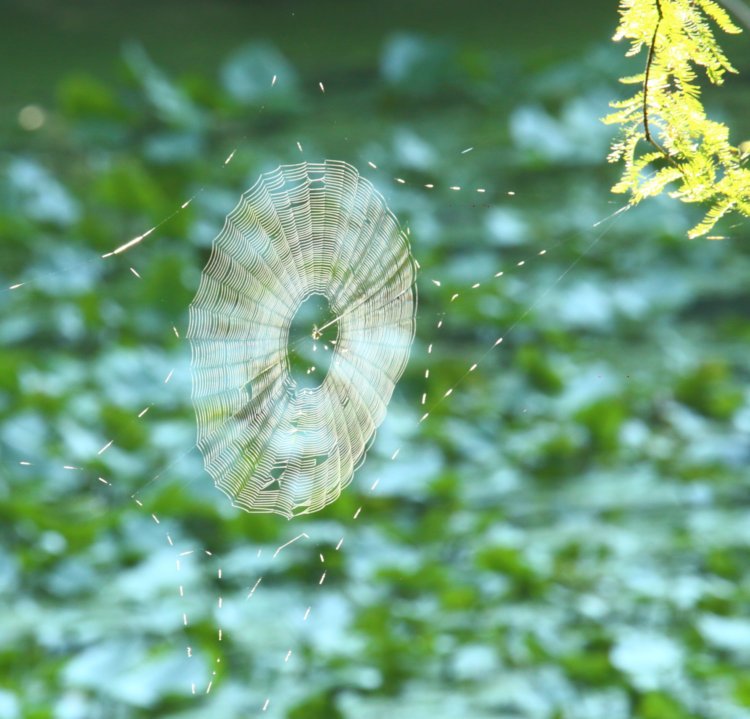
You have to admit, those ‘dotted’ support strands are distinctive – there really was only a narrow time of day that this would be so visible. Notice how tightly-spaced the orb portion of the web is, obviously targeted towards quite small insects, and how the support strands are curved, pulled tighter as the spider added more webbing in the orb. While it appears to be occupied in this image, it wasn’t when I walked closer for better images that would allow me to identify the species, and it was well over my head so even checking back wasn’t much of an option. I snagged the image as a curiosity but thought little more of it.
Until the next day, when another was found attached to the hosta plants alongside the back deck. I was busy then, so I vowed to return with the camera, but then forgot about it until after nightfall, when the web was not only unoccupied, it didn’t even exist – just the support strands. Ah, so a day hunter! I’m quite used to the various species that appear once it’s dark to spin a new web each night, dismantling it by day, but this appeared to be the opposite. So it wasn’t until the following day when I returned again to actually photograph the spider responsible.
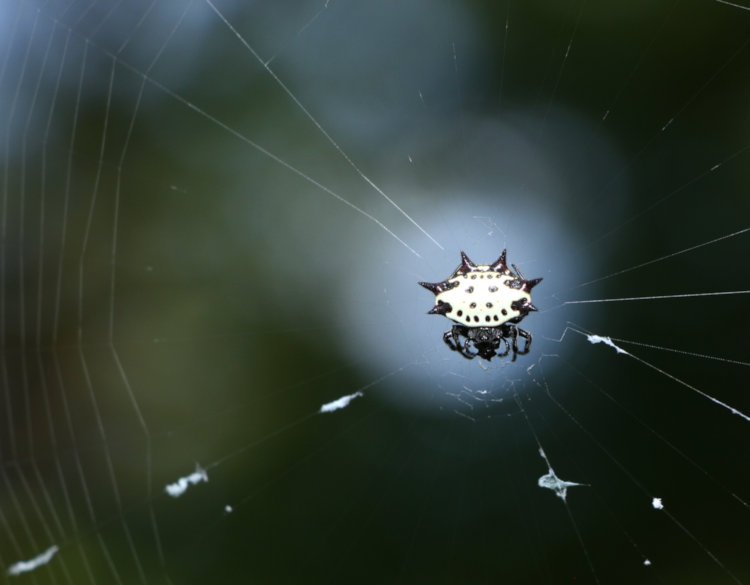
It was cooperative and remained in place as I maneuvered around and played with framing and lighting, producing a nice surrounding halo from a break in the background foliage. Only about 8mm across the widest of those spines, this was easy to identify as a spinybacked orbweaver (Gasteracantha cancriformis,) and they have a moderate variation in colors, often with a more yellow ‘frosted’ back and even reddish spines. The tufts that make up the dotted appearance of their webs is thought to help prevent birds from crashing through it, something that the coloration probably also assists with, while the spikes discourage those insectivorous avians that might consider this a treat instead.
Also curious is the large gap between the center where the spider waits and the crossbars of the orb portion that would catch their prey, meaning any captures are going to occur removed a certain distance from the spider. I can’t imagine what the purpose of this is, except to help highlight the spider in the center (birds again,) or perhaps to isolate it from the morning dew – though they create the webs in the morning, so there shouldn’t be much opportunity for it to form in the first place. Hmmm…
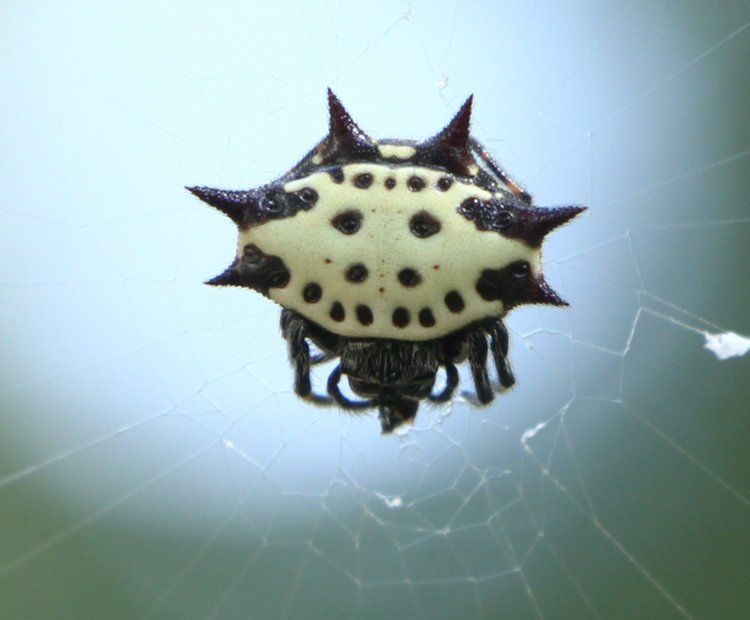
If you look very closely, you can see two of the eyes on top of the head, only because they have the barest of catchlight reflections. The species reminded me a lot of the common spined micrathena, but they appear distantly related, in separate genera. Its habit of disappearing at night prevented me from experimenting with UV light to see if it fluoresced like the micrathenas do – I suppose I could have captured one and done some tests in the dark, but I really had enough projects these past couple of weeks. Maybe later…