

… and usually do, without a filter even.
So I did go out this morning just before the peak of the Lyrids meteor shower (which was supposed to be around 4 AM locally,) and fired off a lot of frames. Stars were visible but not distinctly so, leading me to believe either the humidity was very high or a faint haze was obscuring the sky (which is the same thing I guess.) I was largely watching the area of sky I was aimed at the whole time, and wasn’t seeing anything happening, until a two-minute exposure close to when I was going to wrap it up. I saw the meteor clearly and was pretty certain that it was within the field of view of the camera, and sure enough, it was visible as a faint streak.
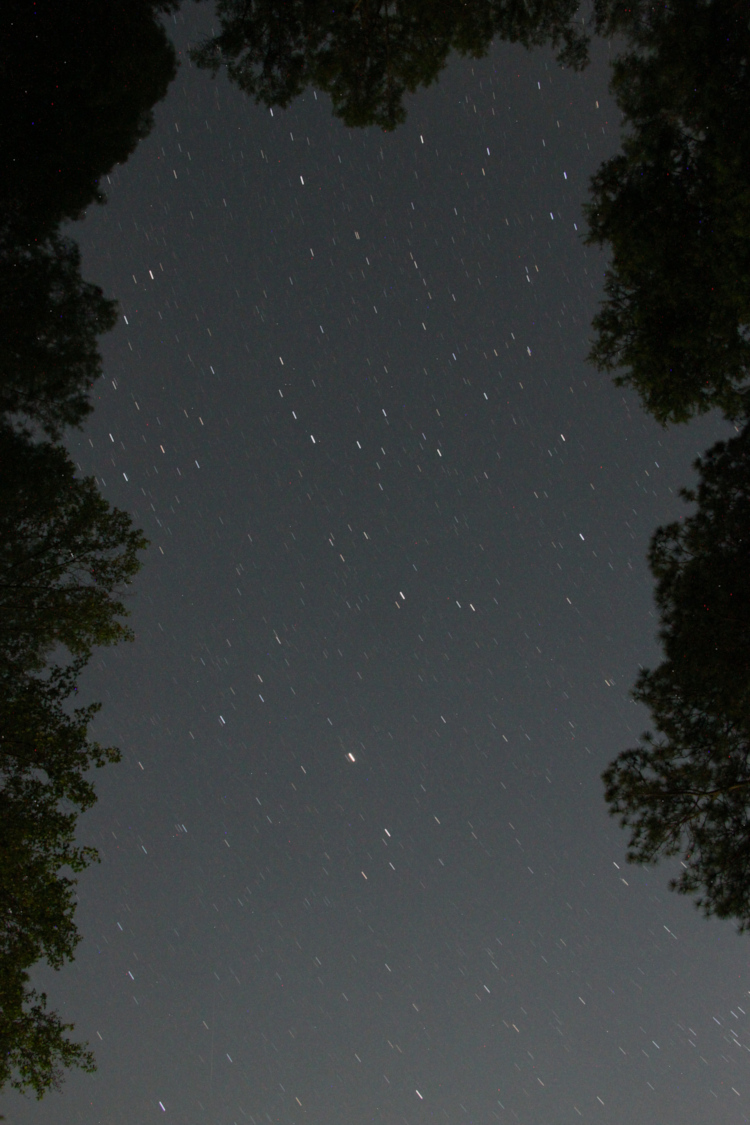
This is full-frame, and it just barely shows at this resolution. See it? No, not that dotted line near top center – that’s simply four stars nearly in a line along the plane of movement (likely the base of the constellation Corona Borealis, The Crown, just to the right of Bootes, The Fatass.) Try looking instead at the bottom of the frame to the left. This, by the way, constitutes about half of the visible sky from the backyard here, with straight up being at the top of the frame – I could shift below this and turn the camera to landscape instead to get the rest, but that also aims towards the town lights and so gets brighter and less distinct because of that. At full resolution though, the meteor looks like this:
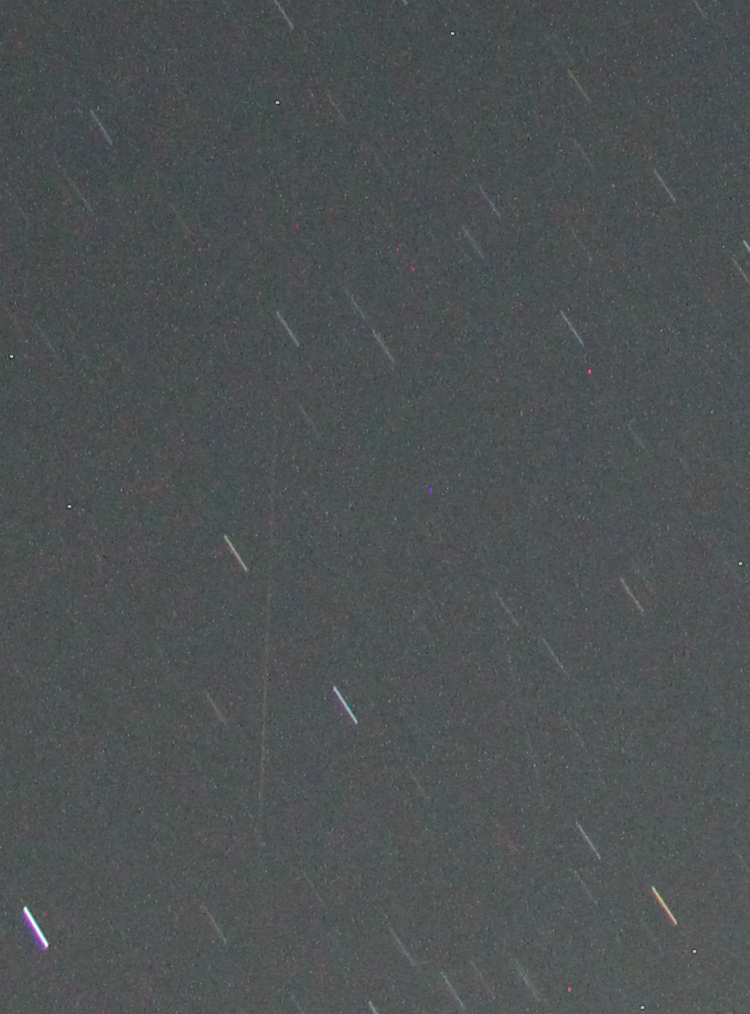
There it is, that vertical streak just left of center. Since this was aimed at longer exposures, the aperture was f8 (ISO 2000,) and so not ideal for capturing the faint ‘shooting star’ type meteors like this one. Like these, actually – there’s a second in there that I didn’t see at the time, to the right, just barely discernible because it’s not following the same star paths. I enhanced contrast significantly to bring them both out better:
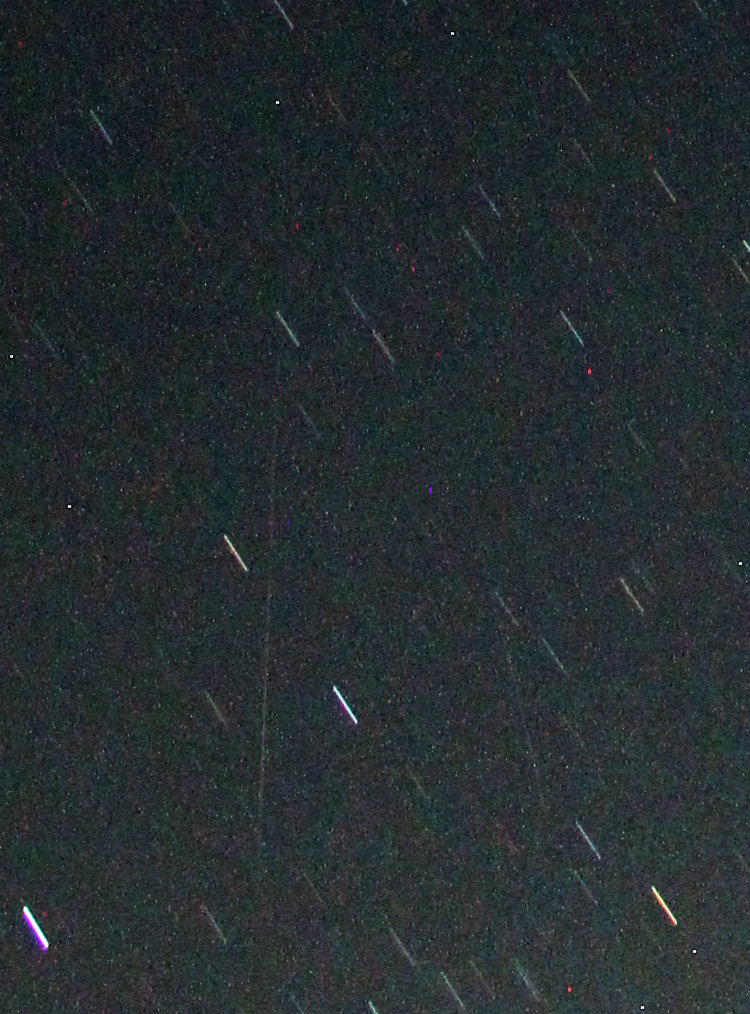
Really brings out the noise of ISO 2000, doesn’t it? I was normally firing off frames of 15 seconds, f3.5, to bring out the fainter and brief traces that might occur, so the higher ISO was intended to help with that, but I don’t think 2000 is useful, really – it’s certainly messy. But you should be able to see that second one anyway.
Immediately afterward, bolstered by the one I’d seen and a couple other suspicions of faint, quick ones, I switched back to 15-second exposures at f3.5, and captured some more streaks even when I was seeing nothing. Here are two of them in the same frame, opposite corners of the full-resolution inset:
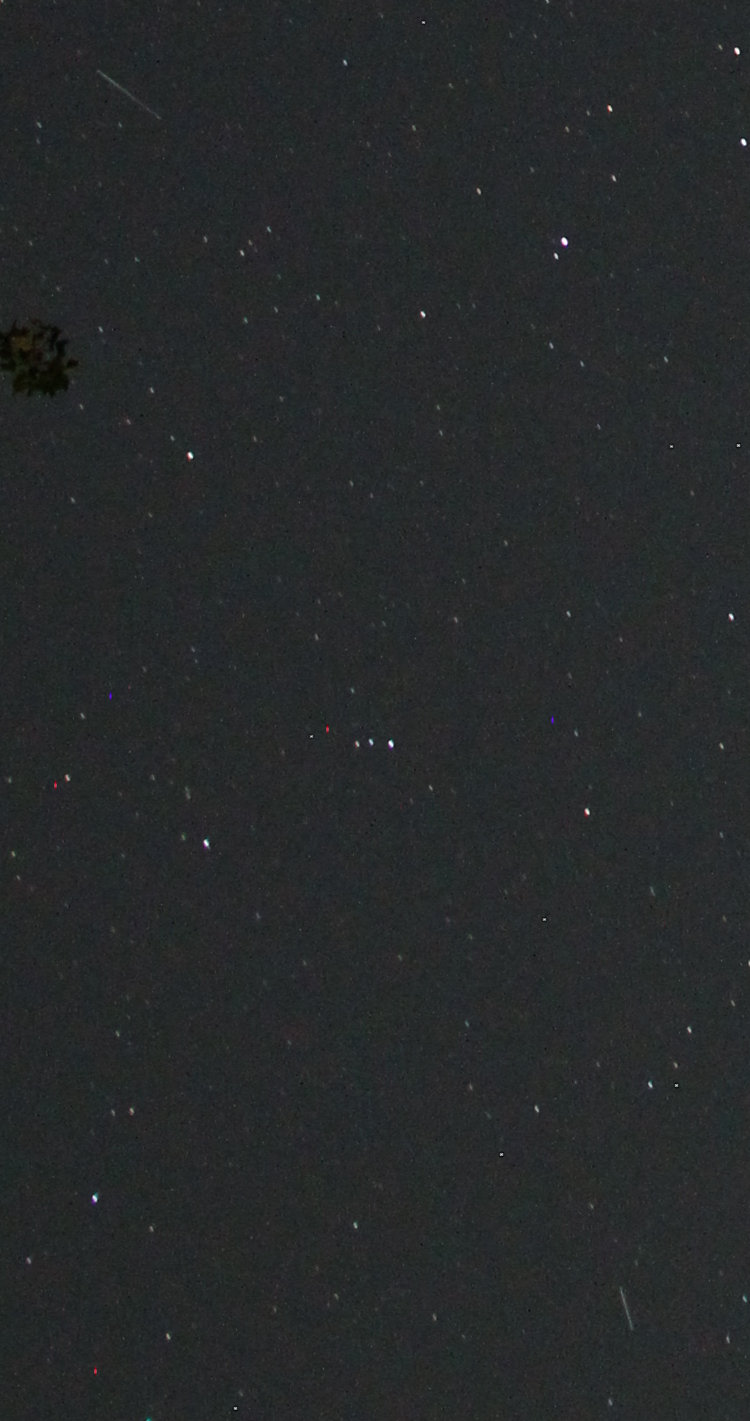
Except, these appear in subsequent frames as well, slightly further along their paths, indicating that these were both satellites and not meteors – it was getting closer to sunrise and so some of the satellites were able to catch sunlight again.
I have yet to examine all of the frames at full resolution, and might for giggles, but who cares about pissant little streaks like those above? I was after nice brilliant fireballs, and I haven’t seen one of those in years. So much for this storm.
Now, part two, of which I will tell you right now there are no images to illustrate, so we’re stuck with prose. Just as I was getting ready to detach the camera from the tripod, I heard a sharp crack from the direction of the pond, and thought, The beavers just took down a small tree. So leaving the camera where it was, I walked over there slowly since I was already wearing the headlamp. Initially, I just saw two heads with reflecting eyes slinking past, dark and low in the water, just inside the lily line. I wandered further, looking for stumps or fallen trunks and finding none, but on returning to the apron where we throw down the corn, I saw again a head cruising through the water (well, there was a body attached too, I just couldn’t see that.) In typical beaver style, it did a back-and-forth pass, ensuring that nothing dangerous seemed to lurk (only seeing the glare of the headlamp in my direction,) and came up to shore about four meters away. This was a big beaver, biggest I’ve seen since this one, and jet black – I’ve never spotted this one before.
Curiously, for the size of the body, the head was fairly small, and I’m slightly inclined to think it was a pregnant female, but that’s more an impression that an experienced naturalist’s opinion – I’ll stick with ‘she’ though. She began scarfing down corn from the shallows just offshore, quite nonchalantly, while not too far away, roughly the border of the pond and The Bayou (so, 20-30 meters,) another beaver slapped the water loudly, twice. She never even twitched. I had of course gone down without the camera or camcorder, so I was only observing.
Then she started working closer, and I was beginning to get concerned – not because beavers tend to be aggressive, because they’re not, but because anything can have a bad reaction if startled, and she was closing to about two meters, close enough for her to feel threatened if she suddenly detected that I was there looming overhead. This did give me a chance to measure her entire length against landmarks though, and it was in the realm of 70 cm nose to tail (having checked later on with a tape measure,) estimated weight at least 15 kilos. I waited until she had abandoned her one feeding spot and started edging to the side, and I gently moved one foot, a tiny scuffing sound. She became alert and moved off slightly, and I did it again a little louder. This was enough to send her into a turn and dive, not frantically, but playing the discretion card, and I was able to go back to the tripod and collect the camera.
This causes me to relate two anecdotes about beavers from the past. While I was working for a humane society, we had a moderately-sized beaver come in with a leg injury, largely superficial, but the vet recommended a warm compress twice a day to help with any potential infections, and since I was part of the Beaver Project at that time, it fell to me to administer this. Bearing in mind that this is a perfectly wild animal in a foreign environment, the beaver would allow me to pick it up and sit next to it on the floor of the kennel, one hand holding the warm towel around its injured forelimb – the worst reaction was to try and push my hand away. I’ve been in far more danger trying to clip the cats’ nails. However, by the end of the week, the noise of the dogs nearby was beginning to take its toll and the beaver was getting visibly agitated, so we halted the compresses and elected to release it back where it was found. Rather than taking off like a shot the moment its carrier was opened, it ambled out and over to the streambank nearby, slipping into the water with all casualness.
Then the other side of the coin. A few weeks later, a former employee heard her two Brittany spaniels kicking up a fuss on the back of her property at night, and went down to investigate. It turns out they had cornered a beaver, a big one, and it was very angry. She got too close without realizing the situation (given the darkness and likely a handheld flashlight in the pre-LED days, not hard at all,) and the beaver decided she was as much a threat as the dogs, attacking here viciously. Her legs got seriously torn up, requiring (if I recall correctly) over a hundred stitches, and she told us she couldn’t get away from the beaver and had to pick it up bodily to hurl it away. Thankfully, this was also before rabies had moved into the area, even though she probably received a booster anyway (we all had preventative rabies vaccines if we were handling wildlife.) So, overall, beavers are mellow and not prone to aggression, but can get that way if provoked – it’s always a bad idea to assume any lack of danger from wild species.
Though I am glad this attack occurred well after I was tasked with going into a kennel and handling one closely…