




Out the other evening, I found something that, in the back of my mind, I figured was about due to start showing up, if last year was any guide. That would be this:
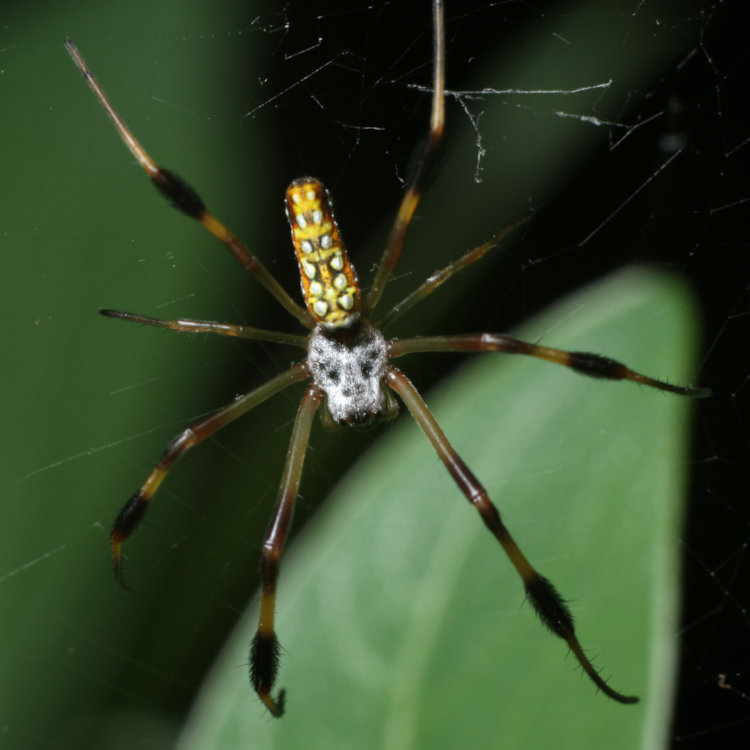
Yep, it’s a golden silk orbweaver (Trichonephila clavipes,) almost certainly female yet quite a young and small one, considering how big they usually get. I guess I should say was, since I just went back out there for an accurate measurement (silly me, I wasn’t carrying the calipers with me at the time) and did not find it again. Anyway, in the rough vicinity of 12mm body length, about the same as the specimen that I caught and featured last year at this time. If the pattern holds, we’ll see an explosion of them on the property over the next few weeks, lasting until perhaps even November.
This did mean that I failed in finding one much smaller than this, closer to the newly-hatched stage, and haven’t yet even seen an egg sac, much less had the opportunity to check for hatching. Maybe this is the year – something fun to look forward to!
Same night, there was also this little Sheila:
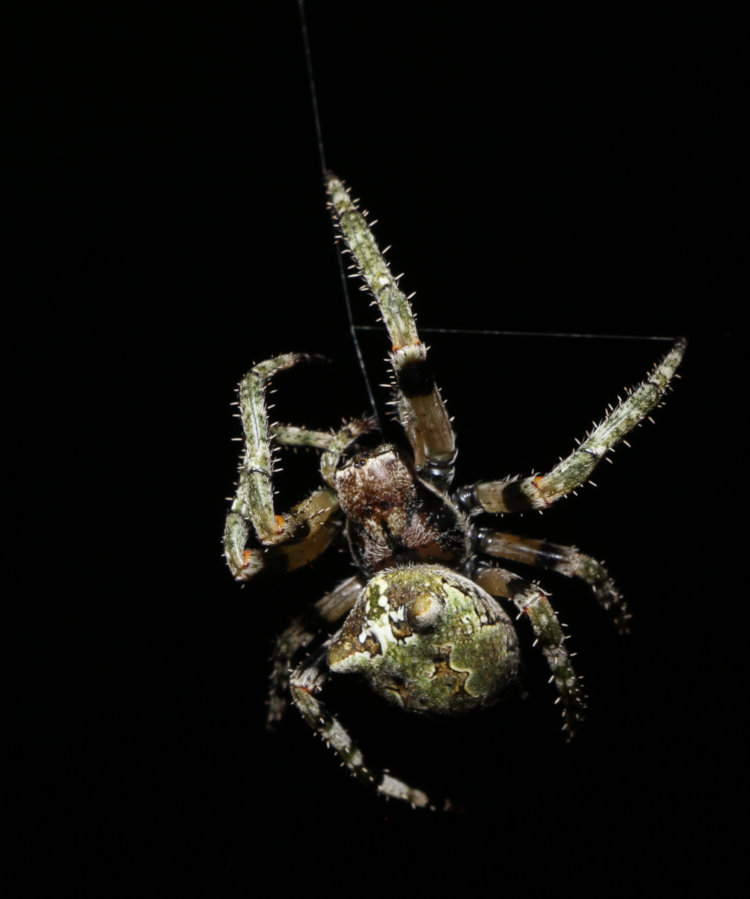
This is much earlier than expected, certainly for this size, which is again about 12mm in body length, which looks much more impressive with an abdomen this big – roughly marble-sized, or malted milk ball. This is a giant lichen orbweaver (Araneus bicentenarius) – great color pattern, which must be marvelous camouflage during the day when they’re likely holed up against one of the branches used for their web anchor. At night, they come down and make their orb webs to catch the nighttime insects, which is what this one was in the process of as I got my images. I would seriously have expected one less than a third this size, since this is usually how big they get right before creating an egg sac, which is often close to the end of their life cycle, at least to my knowledge. At this time of year, I’d expect to see the hatchlings from late last year that had overwintered and were now progressing towards the egg-producing stage, like the one above it. So, is this one that got an early start (and a lot of food,) or an adult from last year that overwintered and was starting another reproduction cycle? Not sure – I just takes picchers…
The other impressive thing is the size of their web, specifically the anchor strands, that might stretch several meters up to overhanging branches and across to other trees, making crossing the yard hazardous (or at least, icky) at night. I have yet to see them making these anchors, so I’m not sure if it’s by ‘ballooning,” catching a breeze and being carried bodily across to branches and trees, or if it’s simply by casting a webline in the same breeze. Even while I’ve watched this, I’m always impressed that their silk is sticky enough to anchor itself to another branch on casual contact when carried by the breeze, firmly enough that the spider can at least scamper along it to reinforce it before creating the orb portion of the web. I also know that I have been the anchor myself at times, wandering through the area while the spider is casting and thus getting caught in their web, and on occasion I’ve carried said spider along and even back inside with me, though never anything even half as large as this.
This is also the breeding season for several amphibian species, made clear by the overwhelming cacophony of calls that occurs each night – I can’t even have the door open some times. I’ve tracked and photographed plenty of these and so wasn’t trying, but did snag a shot in passing as I examined the pond by night.
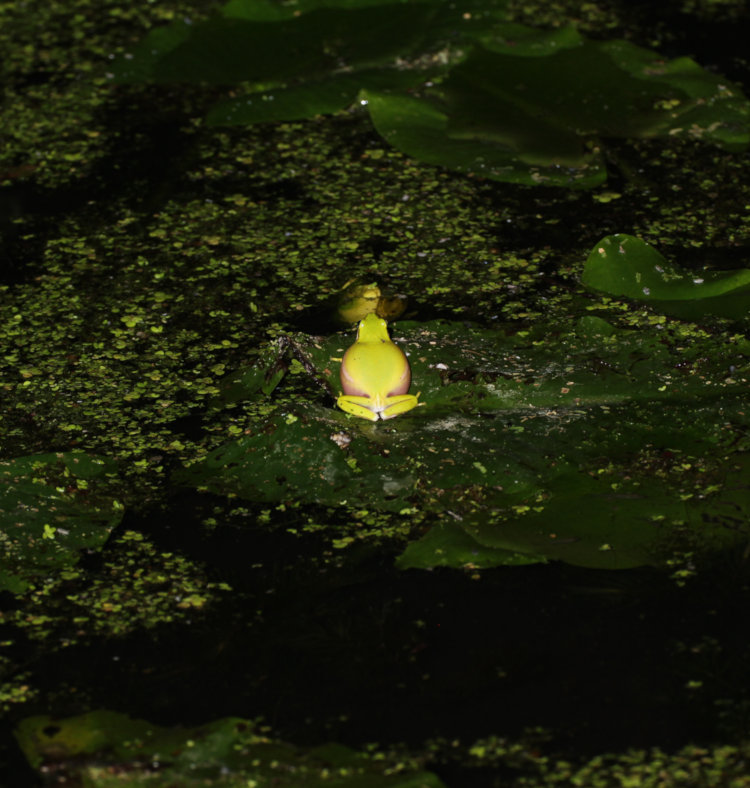
Just a green treefrog (Dryophytes cinereus) seen from the back, swollen with air as it made its booty-calls into the night. They’re really quite efficient at this, considering that they expel maybe a couple of cubic-centimeters of air with each call and it’s loud enough to actually hurt your ears.
And another, that would easily have escaped my attention had it simply held still.
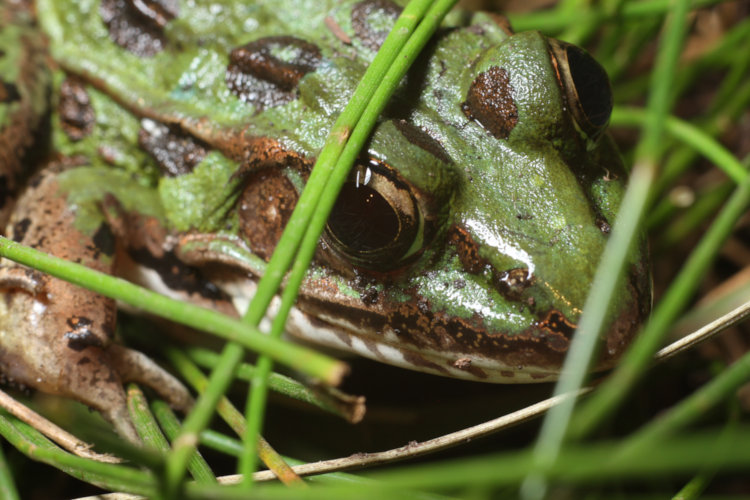
I had a macro lens attached when this one hopped over to a clump of grass and froze, so all we have is this closeup of a southern leopard frog (Lithobates sphenocephalus,) which seem to be the dominant aquatic frog species on the property – though perhaps not by much. While the safety of the pond was a little over a meter distant, this one seemed to feel it was safe enough behind these blades of grass – after, of course, attracting my attention with movement. Not winning any awards for cognition, is what I’m saying. Lucky I wasn’t a heron or a snake.
Okay, more sorting and editing awaits…