





The uploads for August still won’t compete with July (144) and March (126) of this year, but they will set a record for August uploads within the ol’ blogarooty, and to be honest, I have plenty of images to put up – I’m just remaining thematic right now, and saving some for a slower day. So what we have here are images from three sessions chasing Lepidoptera on the various flowers out front.
It started with noticing that some medium-sized, pale yellow butterflies were now frequent visitors to the two salvia plants, and attempting to get some sharp pics of them. The first session was evidence of my being absent-minded, because I was shooting in bright sunlight with the camera settings adjusted for shady conditions, and no compensation dialed in. It shows.
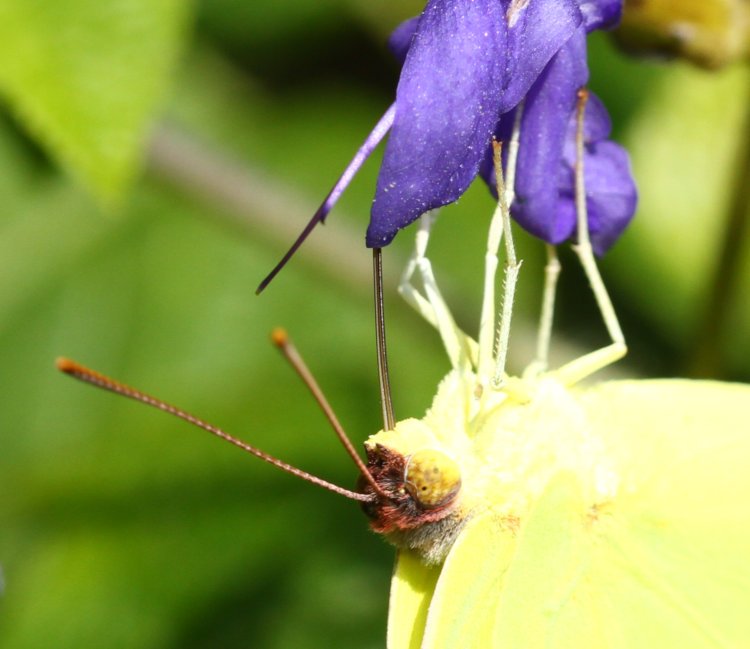
I should have warned you to squint before scrolling down, but too late now – you probably can’t even read this. For cloudy conditions, I have camera settings for boosting saturation and contrast a little, which should not be done for bright sunny conditions, like here – just the opposite. So the bright portions of the butterfly got blown off the scale. Plus, the background leaves were a little darker than midtones, so the exposure meter brought things up even higher. A shame, because the focus was bang on, something that’s extremely tricky to do with butterflies and the Sigma 180mm macro, which has a very short sharp focus range because of the focal length. After unloading these, I went back out to try again.
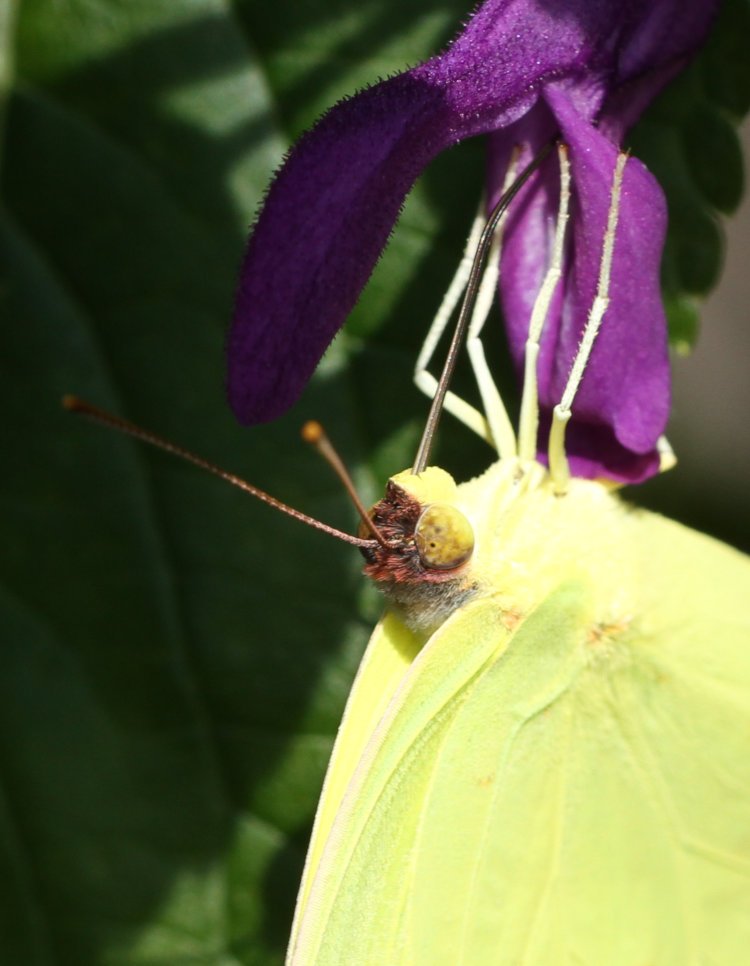
This is a little bit better, with the settings for ‘normal’ conditions but under-exposed (from what the camera thought it should be) by 2/3 of a stop. That shadowed leaf in the background still pushed things higher, so this is less than ideal. The next is right where the exposure should be.
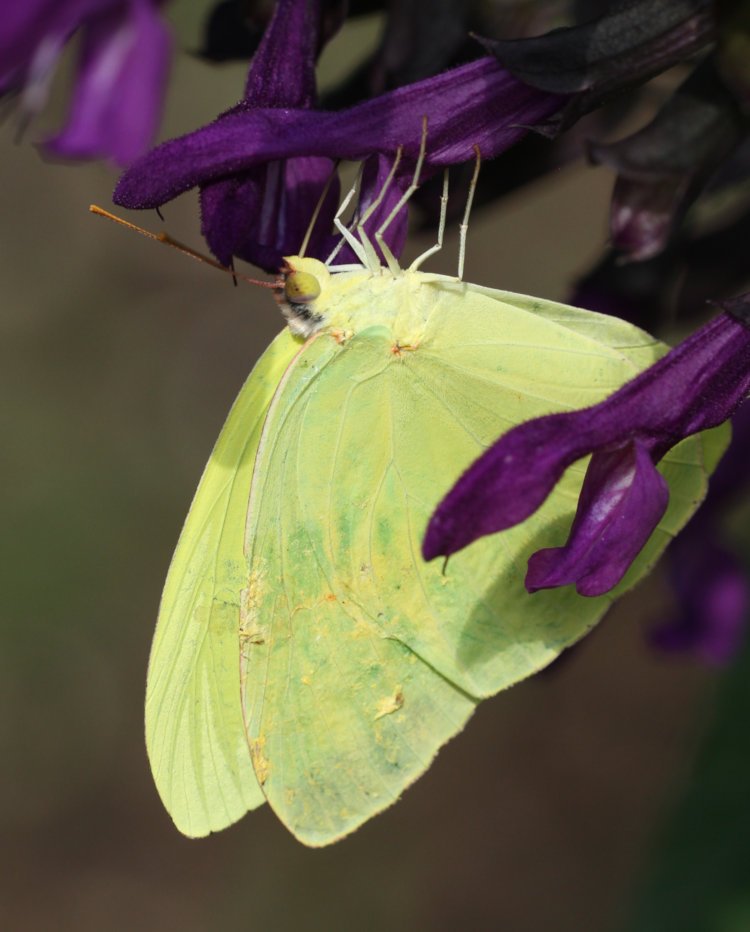
There! That’s the detail that should be coming up, even though, against the other two images, it looks a little under-saturated, but this is probably the closest to natural appearance that I could get. With the wings flat to the camera, in good light, with a nice accent from the salvia blossom. Naturally, I get one with damaged wings for this.
This is, most likely, a cloudless sulphur butterfly (Phoebis sennae,) one of many visiting the plants.
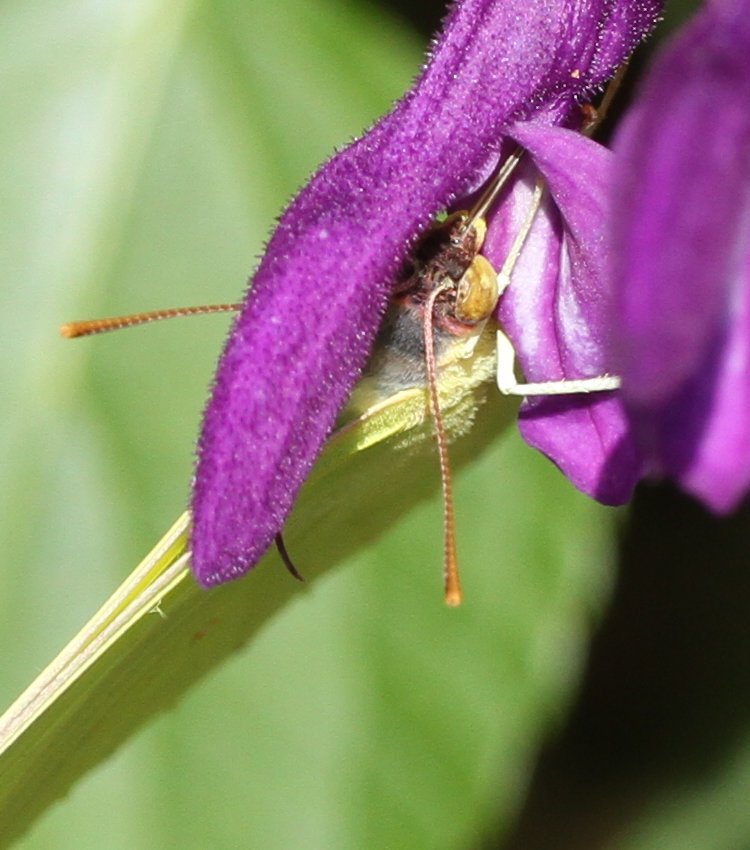
And buried deep within the blossom, with focus bang-on. I’d take credit for this and try to make sure you didn’t see all of the badly-focused frames hiding behind my back, but there’s so many they’re spilling from my hands. While the Sigma 180 has fast autofocus, that extremely short focus range means a lot of hunting usually takes place, so I typically set for manual, get close with the focus ring, and then achieve sharp focus by gently swaying into that perfect distance. Since the flowers are usually gently swaying as well, and the butterflies rarely holding still for longer than two seconds, this is no guarantee of anything, but it’s what works best.
By the way, when I say ‘short focus range,’ I don’t mean that the lens cannot focus through a wide range of distances; just the opposite, it can handle less than half-a-meter to infinity. The longer focal length (higher magnification) means depth-of-field is shorter, and so the range of sharp focus on either side of the focused distance is a few millimeters at best. If you look at the image above, you can see that the nearest portion of the blossom, and the ends of the antennae, are already defocused at f8. I could potentially have improved things by pushing to f16, but then the shutter speed takes a hit, perhaps enough for blurring from movement of either the butterfly or myself. There’s a sweet spot that you aim for with subjects like this.
A few days later (making it ‘today,’) I went out to try again, starting while the sun was behind a cloud, which is plainly visible in the contrast and color.
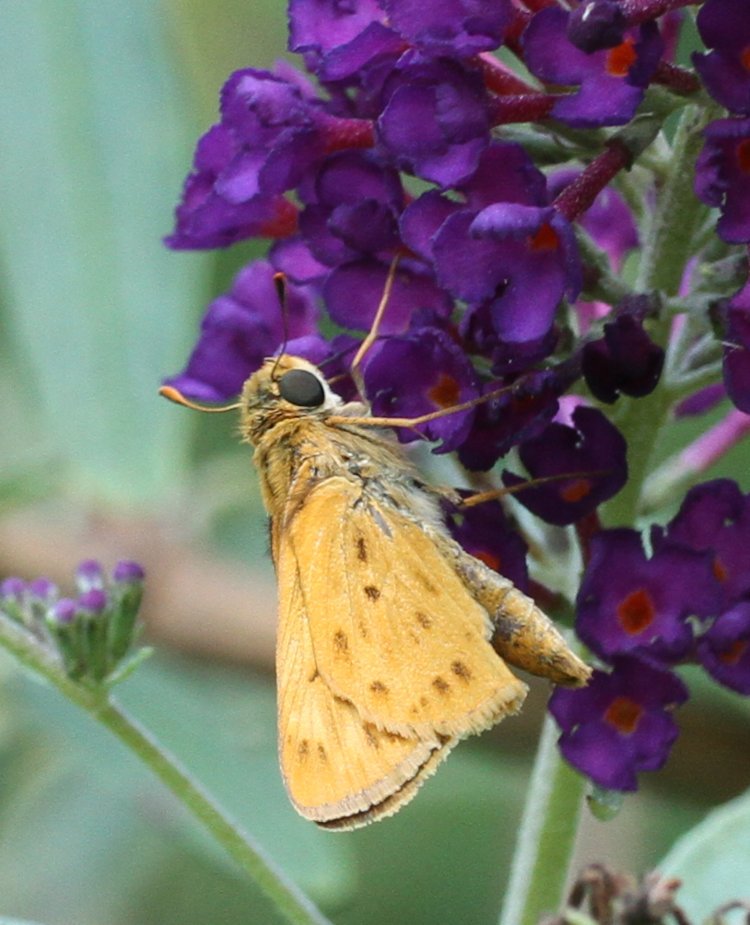
Over on the black knight butterfly bush now, this is, near as I can tell, a fiery skipper (Hylephila phyleus,) but it never dropped its wings in my sight so I could confirm the upper-surface coloration. It was gone in moments, and only returned for a brief cameo while I was chasing others.
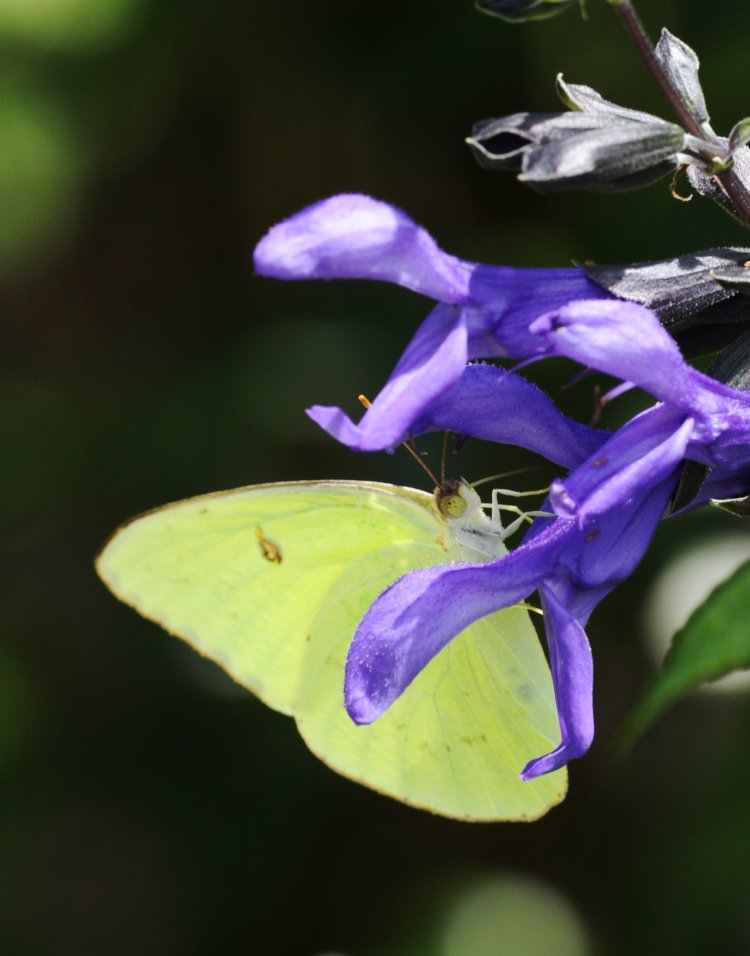
Back to the cloudless sulphurs. This is the kind of composition I can live with, though purely accidental: The petals of the blossoms accenting the butterfly’s wings in this manner, nice contrast in the colors, the gap with the head framed within, and a lovely smooth background. I could have done without the shadows overall, but butterflies don’t take instruction (shocking, I know) and far too many times, I had edge-on views of them as they visited the individual blossoms.
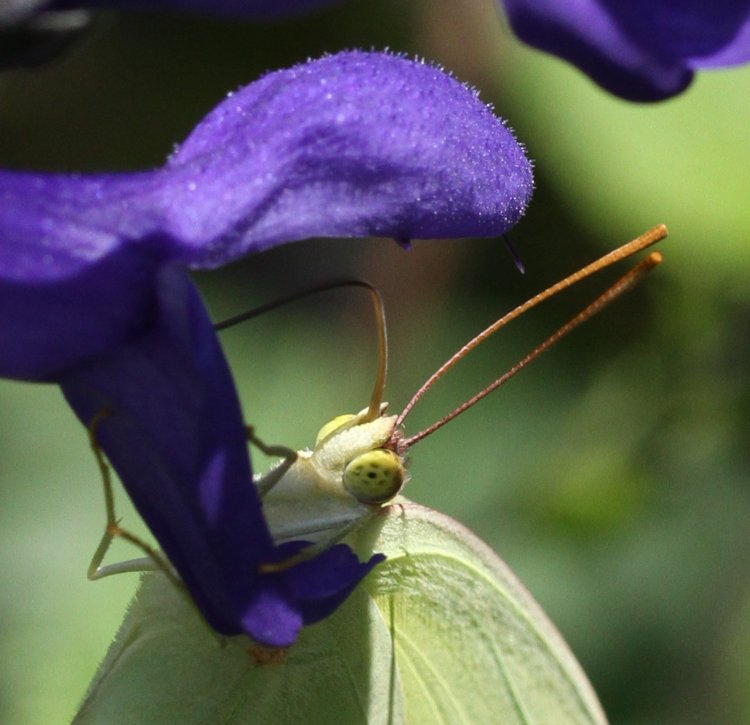
A nice closeup, illustrating the multiple ‘false pupils’ that butterfly eyes often show. This puts me in mind of a dentist though.
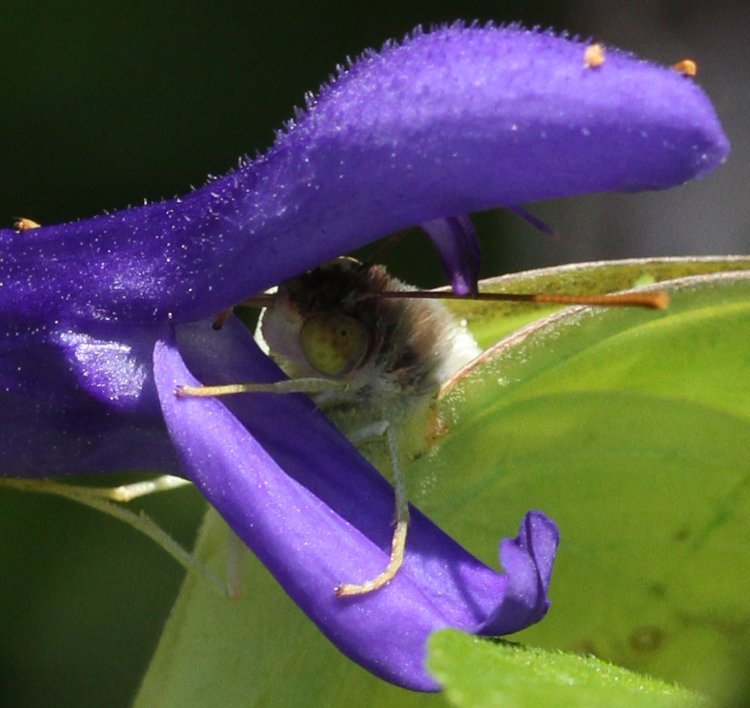
And buried deep within another, trying to get all that heady nectar. In their favor, the cloudless sulphurs at least tended to visit nearby blossoms as they worked around the bushes, so while their next stop couldn’t quite be predicted, it was often not terribly far from the focus range already dialed in. Other pollinators that I’ve tracked seemed to operate almost at random, so following them required lots of focus adjustment.
Also, when the sun was behind clouds, the activity was almost nil, but once the conditions were bright again the butterflies re-appeared immediately, like within 15 seconds. My best guess is that they identify nectar-producing blossoms by the reflected UV, which many insects can see well, so the sunlight was highlighting the ideal food sources better. I have a goal of illustrating how UV reflection differs for flowers, but it’s not an easy or cheap photographic project, so it hasn’t happened yet.
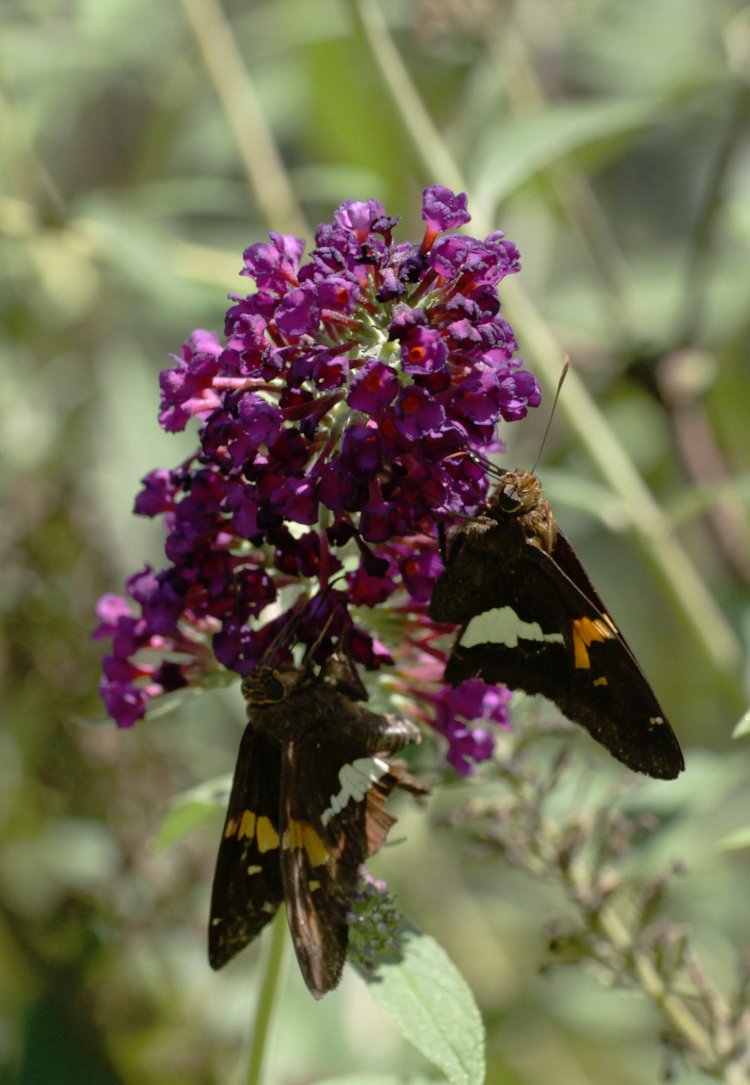
Back over to the butterfly bush, which the sulphurs never seemed to partake of, but the skippers were. This is (most likely) a pair of silver-spotted skippers (Epargyreus clarus) sharing the same cluster, which is rare; usually, they’re fairly territorial, and indeed, only seconds after this frame, they erupted into a brief dogfight in the immediate vicinity before the triumphant one returned. Meanwhile, the massive black knight butterfly bush seems to be feeling the heat and lack of rain, producing much smaller flower clusters, but I also haven’t dead-headed it recently, so maybe that’s on me.
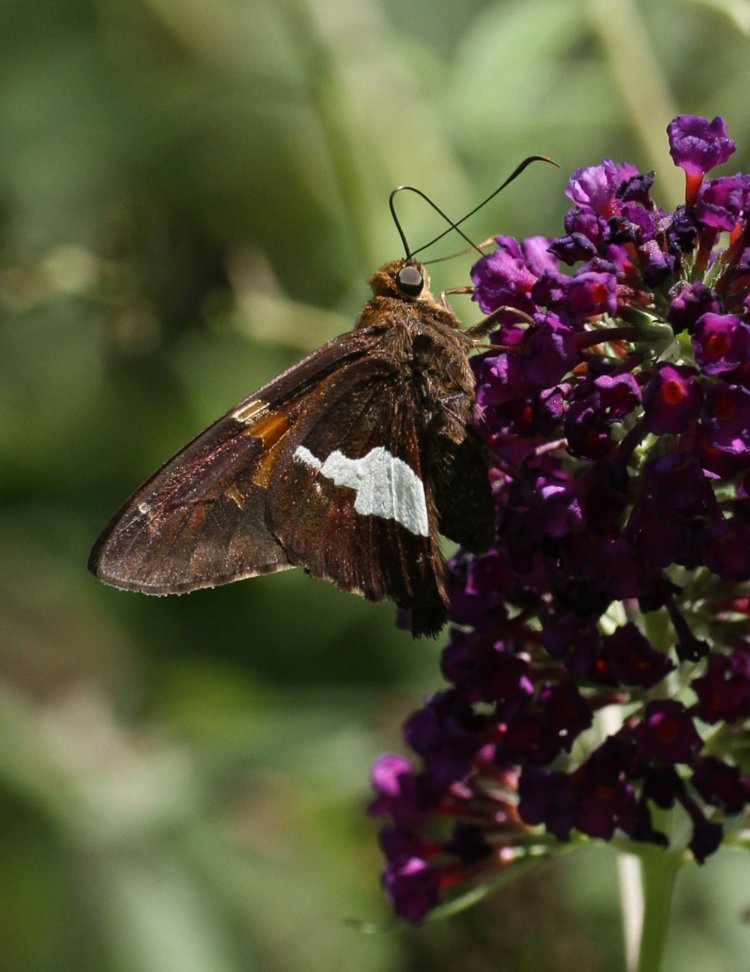
Eventually, I followed one of the skippers until it turned into the light decently and provided good detail from the markings, proboscis, antenna, and especially the textures – look at the shadows within the ‘sliver’ spot. I can live with it.
So, that’s a good number of images for the month. Will there be any more? I don’t know myself – check back before midnight, I may end on a creepy note…