

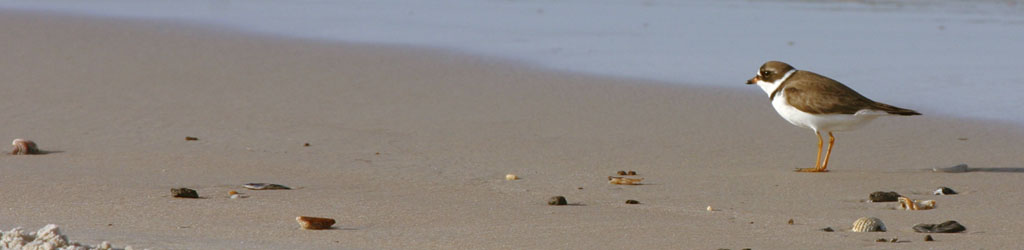
Rehab x 8

It’s that time of the year, the time when the critters are getting more active and birthing their bebbies and all that, so we revisit our now-annual post on the topic of wildlife rehabilitation, in the hopes that it helps someone out there handle their unexpected situation a little bit better. Below begins the content first written in 2013 and still quite topical.

I used to work in this field a fair amount, both in administration of wildlife organizations and as an active raptor [birds of prey] rehabilitator, plus I served as wildlife adviser in several different situations. So I’m familiar with most of the more common reactions people have when they find ‘orphaned,’ injured, and ill wildlife. It’s hard to give enough useful information without trying to cover every situation or alternative, so treat this as an overview. One thing that I especially want to emphasize here is that there is an immediate emotional response in most cases, which tries to override the advice given by those who work in the fields, so be aware of it. There isn’t an ‘instinct’ we might have that applies to wildlife, and the rational mind is the part that needs to take control.

Additionally, the amount of folklore regarding wildlife is not just abundant, in most cases it’s ridiculously wrong. I’m not even going to say, “If in doubt…,” because you should doubt right off the bat, and consider that most of what you’ve heard is highly suspect. This means, contact someone who is supposed to know, and go with their advice.

Number one rule, and I can’t repeat this enough: Don’t try to raise wildlife on your own. Their diets are specialized, their needs varied and specific to the species, and their adult behavior dependent on how they’re raised. This isn’t the place for guesswork or experimentation. Even if they seem to be ‘doing well’ (like the viral video of the guy raising a baby hummingbird,) they may have developmental issues from an improper diet or exercise, or simply have imprinted on the wrong species, and you are in essence just prolonging the death of the animal. In the US, it’s illegal to raise any species without a specific permit, and songbirds are federally protected. It’s possible to obtain these permits, and quite frankly encouraged, because there are few places with enough rehabbers, but if you’re going to do it, do it right. More further down.

So, we’re about to enter baby bird season, and this accounts for a large percentage of wildlife encounters. I’ll dispel the first myth that touching a baby bird will cause the mother to abandon it. Utter hogwash, pure and simple – yet, I don’t always discourage parents from teaching this to their children, because it’s one way to try and get kids to leave them alone, which is a good thing. Better, perhaps, to teach them to leave them alone for the right reasons, which is to avoid interrupting their feeding schedule, or injuring them, or thinking it would be neat to have a pet robin. But returning to the myth, baby birds will occasionally fall from the nest, and it’s perfectly fine to return them to it, and in fact this is recommended.

It doesn’t always work, however. Some species will discard young that are not doing well, and some even kick their own siblings out – this is nature’s method of selecting the most viable offspring, as ruthless as we find it, and we’re not going to change it. Basically, if it’s a baby bird not ready to leave the nest (not fledged; we’ll return to this,) put it back. If it keeps coming out, there may not be much you can do.

Can’t reach the nest? Try to find a way, first. If that’s not possible, occasionally the parents will accept a substitute nest, such as a plastic berry basket with soft tissue as bedding – this should be placed as close as possible to the original nest, firmly anchored so it doesn’t come down. Observe the nest carefully, but from a safe distance, for 30-60 minutes to see if the parents have indeed found the substitute. If not, seek out a rehabilitator or wildlife official.

Abandoned nest? Maybe, maybe not. Once the eggs hatch, the parent birds go into feeding mode, gathering food constantly during daylight hours and stopping at the nest for brief periods to jam it down the gullets of their ravenous progeny. The 30-60 minute rule above is because waiting less may mean you’ve simply missed the brief feeding period between the extended gathering periods. Observation has to be done at a distance that does not alarm the parents – minimum is six meters (yards,) and more is recommended. Also, being low key is paramount, so take a seat (with binoculars, for preference) and remain still and quiet. Yes, it’s boring, but it’s for the health of the offspring, and if you didn’t care about that you wouldn’t be reading ;-)
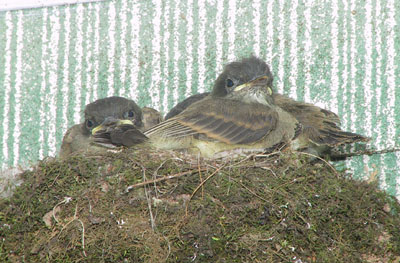
fledglingsAs the nestlings become fledglings, they abandon the nest on their own in learning how to fly. This does mean that they’ll be found unable to fly, fluttering around at low level and even just sitting there staring at you. This is normal, and they should remain undisturbed. The parents are nearby, providing food and encouraging the flight attempts. Most bird species know enough not to give away their progeny’s locations to predators, or draw attention to themselves by moving a lot, so your ability to approach, or not being attacked by angry parents when you do so, means nothing at all. Again, observation is good here, as is knowing the calls of the species in question – the parents may be coaching their young towards them.

Now, telling the difference in ‘nestlings’ and ‘fledglings.’ A nestling is a baby bird that must remain in the nest for a while; they will have few feathers, or perhaps even odd ‘quills,’ which is what the feathers look like as they are growing out. Unable to support itself? Eyes not open? Nestling. Fledglings are the babies that are ready to learn how to fly. Their feathers will have good coverage with little to no stragglers or ‘stuffing coming out’ (the baby down.) One rule I always used over the phone was to ask if there were tail feathers – if there are, they’re about ready to fly. These are fledglings and should only be observed.

If in doubt, contact a rehabber/official. This is before doing anything else, save for getting it out of immediate danger. No food, no water, nothing at all. I can’t tell you the number of times I’ve heard people say, “We’ve tried giving it water and worms” – birds can aspirate the water if it’s not given the way the parents do (you’ve noticed the beak getting jammed halfway down the throat, right?) and only one species in North America eats earthworms. Again, folklore – ignore it and be safe.

Also, bleeding in birds is serious, no matter what. Birds have very thin blood that doesn’t coagulate easily, and they can bleed out quickly. Also note that those ‘quills’ of new feathers mentioned above have a blood supply for a while, and these can be broken and start bleeding as well. Time is important in such situations.
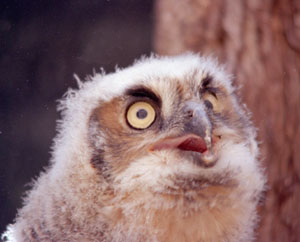
HappyOwletBaby raptors will tear you up – they know how to use the beak and talons very early (often on their siblings) and will not hesitate to protect themselves. And adult raptors will protect their young. This is where it’s best to leave it to the experienced.

And it may seem funny to have to say this, but baby birds do not look like their parents. Adult kestrels and screech owls, both diminutive raptors, are often considered “babies” when found by those not familiar with what a real juvenile looks like. Basic rule: if it has a smooth appearance and good coverage of feathers, it’s at least fledgling age, probably older.

What about mammals? This is a little different – mammals are generally not found away from their parents unless something has gone wrong. Most especially, if the youngster’s eyes aren’t open, they’re wet from the rain or dew, or if they’re cold or dehydrated, this is the time to contact someone. Test for dehydration by gently pinching up the skin over the shoulders or side in a ‘tent’ and releasing – if the skin takes more than a second to go back into position, this is dehydration.

Always use gloves. Juvenile mammals can certainly bite, and there’s an additional risk to this: rabies is active throughout much of North America. This is an invariably fatal disease once it passes a certain point (much more so than HIV,) so this needs to be taken seriously. It is not just the bite that can transmit it, but contact of an infected animal’s saliva with mucous membranes can introduce it as well, which means that picking up a damp animal and rubbing your eyes puts you at risk. Animals do not have to be showing symptoms to be infectious, and symptoms vary anyway. BE SAFE.

It’s not just rabies. Mammals are far more likely to introduce other zoonotic issues than birds – they’re enough like us that parasites (internal and external) and some viruses can be transmitted to us. Bringing them into the house may mean you just introduced fleas, lice, giardia, and so on into your home. You’ve been warned.

possumpeepingAlso, and it pains me to have to always say this, but cute does not mean safe. Any animal can defend itself. I have never been bitten by a raccoon, despite their aggressiveness, but I have a scar and a touch of nerve damage from a grey squirrel – one, moreover, that was raised in a house. Rabbits and mice can bite the hell out of you. Shrews even have a toxic saliva. Yes, I am trying to scare you – if you’re scared, you’re cautious, which is better than incautious.

In many cases, mammals about half of the adult size can be on their own without issues – they learn how to forage for their own food reasonably quickly. Again, the stillness thing doesn’t mean they’re lost – it may simply mean they’re trying not to attract attention. This is especially so for white-tailed deer fawns – they often curl up in the grass and conserve energy while mom forages, and will not move even when someone approaches – occasionally not even when picked up. Leave them be, and come back in a few hours. If they’re still there, that’s when you should contact someone.

Rabbits are notorious for abandoning the nest if it’s been disturbed, even with a full brood of young within. This is doubly hazardous because their nests are often in clumps of grass and can be inadvertently discovered by cleaning the yard. If it happens, immediately put everything back as it was, without touching the young, and place a few distinctive blades of grass across the nest opening (preferably something you can see from at least a short distance away,) then leave it entirely alone. Come back in a few hours and check to see if the grass has been moved. If it has, things are probably okay. If not, it may be time to check the warmth and hydration of the young. Contact a rehabilitator.

Again, trying to raise them yourself puts them at a high risk. This is especially true for rabbits, which are among the hardest mammals to raise in North America. I can’t count the number of people who have assured me that they did it once before, so “they know how to do it.” While this may be true, it ignores numerous things, such as how viable the released offspring were and whether they lasted longer than a month, whether they had developmental deficiencies because of improper nutrition, and even whether they had habituated to food or behavior that left them ill-prepared for their conditions. There is a shortage of rehabilitators, so believe me, if it was easy most people would be encouraged to tackle this on their own. The fact that not only is it discouraged, it is unlawful in most areas, should be a good indication that there’s something more to consider. And the welfare of the animal should take higher precedence than anyone’s ego.

Injured animals are extra dangerous. Yes, they may seem incapacitated or helpless, but you know what they say about appearances. One of my colleagues rashly checked an injured, near-comatose squirrel bare-handed, and it bit through her finger, joining its teeth together in the fleshy part of her index finger – I actually heard them grinding together. It then passed out without letting go. Animals in pain (even pets) often respond aggressively – they have no concept of your attempts to help them, and restraint can make them even more agitated. Deer can do vast amounts of damage by thrashing with their hooves, and the big waterfowl like herons and cranes can drive that beak into your face (and yes, they aim for effectiveness.) I really want to emphasize this, because the nurturing instincts are badly misplaced here, and extreme caution is necessary instead.

“There’s a nest of animals in my attic/crawlspace/walls and they need to be removed!” No. Most especially not when they’re raising young, which is most often when anyone notices them. Once the young are there, no further damage is going to be done to your house, because the parents are concentrating on raising their brood. Trying to relocate them is hazardous, both to the animals and to people in many cases, and pointless. Let them be, and in a few weeks the young will be old enough and move out on their own – about the only exception to this is bat colonies (more below.) Once there are no young to raise, the adult animals often leave on their own – nests are primarily for young – but they can also be encouraged to leave or stay out at that point. Squirrels are pretty bad about wanting to return to successful nest areas, and will even chew through wire mesh at times, but most others take the hint and find better places to live.

“But what about rabies?” Animals raising young, even in the eaves of your house, are not an especially high risk. Contrary to belief, rabies does not cause animals to leap suddenly out and attack people; those events are remarkably rare. While anyone should be quite cautious of any mammals that openly approach, living near them does not place anyone at special risk – you’re at greater risk of being killed by the tree near the house falling on you, and we won’t even talk about road risks. Like snake bites, most contacts with rabies vector wildlife occurs by people initiating the contact.
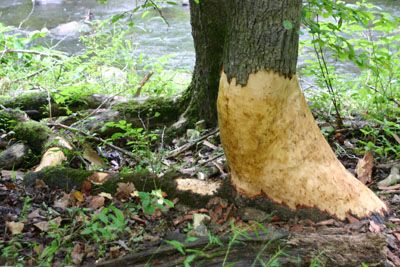
beaverspoor“Animals are doing damage to my property and need to be removed!” No. I can’t tell you how much this attitude annoys me, but that’s what a blog is for, right? Wildlife goes where the habitat is ideal, and pays no attention to humankind’s imaginary idea of “property.” First off, anyone should enjoy the opportunity to see behavior, something that is often hard to accomplish even when making the effort. If someone has wildlife around, chances are they aren’t in a high-rise apartment, which means they wanted to live with at least some vestige of nature visible; surprise surprise, it comes with other animals. While we might decry the damages to our gardens or landscaping, that’s part of the territory, just like road noise and power lines. Learn how to cope, and the ways to exclude animals from certain areas so we can have tomatoes. I’m sorry that a $500 tree was stripped, but no one should have planted something that was that appealing to the local species in the first place, and chances are, numerous appropriate trees had been cut down first so that the fancy landscaping could be put in its place (and I used to work for a landscaper, too.)

Trapping and removal is rarely effective. If there’s a habitat, someone else will move in. And wildlife populations have been shown through numerous studies to be fairly self-regulating; the issues come because habitat destruction by humans is not. We can put in housing developments much faster than the natural cycles of population reduction and management, and those displaced animals end up somewhere. They likely feel the same way about us – dread the point where they develop opposable thumbs.

But what about bats? Ah, the poor little guys! Much of our population considers them ugly and creepy, not at all helped by folklore and horror stories, yet bats are actually way cool mammals, and good to keep the insects down. But most species nest in colonies, and this does sometimes mean in attics, which can produce lots of guano (bat poop) and increases the risks of rabies exposure, primarily when one gets lost and ends up within the human spaces of the house. However, the damage that they can do is minuscule, since they do not dig or gnaw, and excluding them only takes 1/4″ hardware cloth (small-holed wire mesh.) Again, this should be done when no young are being raised, and should always be done with gloves and a breath mask (guano turns into dust easily and can be inhaled.) Should you find a bat in your house, contact your local animal control, since states differ on how they handle potential exposures.

I said I’d get to this: So you want to learn how to rehabilitate wildlife? Once again, this is actually encouraged, but like riding a motorcycle, it should be done properly and responsibly. If there isn’t a wildlife center or organization available in your area, contact your regional Wildlife Resource Commission office (for the US at least) to find out who in your area can train you, and most especially what permissions you need. In the US you’ll need at least one permit, possibly several. What you’ll mostly need is training, because any species requires a decent body of knowledge to tackle well – which also means pick a species, at least to start. Your local rehabbers can suggest a few, which might mean picking something you didn’t initially desire, but which is either easier to learn or presents the greatest needs within an area (and again, is this about you, or the animals?) Expect to spend a lot of time at it, since most animals need lots of attention – mammals may need feedings every four hours around the clock, and birds every 15-30 minutes during daylight (yes, I knew a songbird rehabilitator that kept baby birds in the desk drawers of her office.) And it’s almost certainly all coming out of your own pocket.
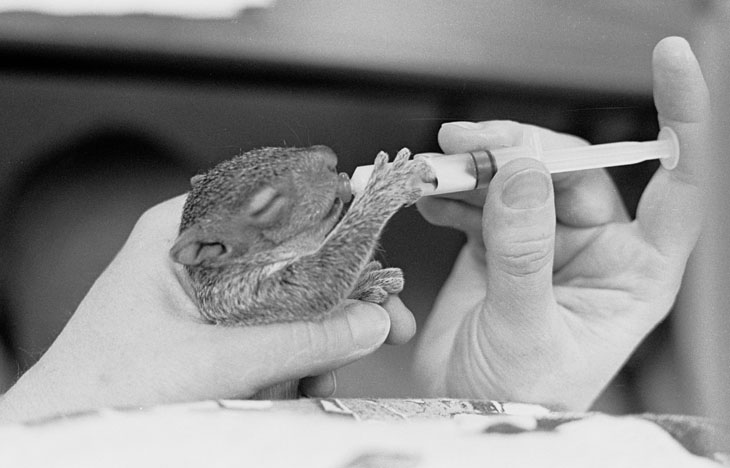
SquirrelFeeding
I feel obligated to say this, too: wild animals are not pets, and should not be raised as such. There are lots of reasons. The domesticated animals we have as pets, like cats and dogs and horses, have been bred that way for thousands of years and quite likely were chosen because they already had traits that assisted the process. Animals do not domesticate by simply raising them around people, and in many cases have behaviors that cause them to run afoul of our own (I mention once again the squirrel scar I bear – that story was posted a few years ago.) Many animals also do not have diets that are easy for humans to replicate, meaning that they’re unlikely to thrive and may develop serious disabilities. But most distinctly, what we might imagine them to be like is rarely ever the case – they are highly unlikely to bond with humans in the slightest, and aren’t going to make good companions, do tricks, or even exhibit any appealing personality. They belong in the wild, and that should be your only goal.

Now, if the demands of rehabilitation are too much to contemplate, you can always volunteer with a local organization, and do rehabilitation on a rotation as your schedule permits. This helps prevent burnout and lets you have vacations and family emergencies. This also allows you to get involved without necessarily requiring the permits, because you can operate under the aegis of the organization and its own permits (which is how I worked with raptors, since my apartment would not fit the 15-meter flight cages required.) Still, expect to be dedicated to the job, even when it’s unsavory – cleaning cages and wounds, and even euthanizing injured animals, is a requisite part of it all. Not to mention how many species expect live or fresh food. If you’re thinking of cuddling fluffy bunnies, you’re not ready; rehab requires lots of ugly stuff, and very little bonding – they’re not pets, but wildlife, and need to be wild.

Or, simply donate money or materials. That works too, and is just as necessary – the nice thing about the subject is how nearly everyone can find a niche (provided they accept the reasonable expectations.) Despite such things as Wildlife Resource Commissions and the US Fish & Wildlife Service, there really isn’t money being put into wildlife rehab, especially not from a state or federal level. The vast majority of organizations run solely on donations and grants, and often even have to have veterinary services donated. Experienced workers are great, but donors are just as important, if not more so. Even people who can promote greater donations are important. Just about everything is grass-roots level, all of the time – the few exceptions are great, and demonstrations of what can be done, but not what you can expect throughout the field. Your help, whatever it is, will be appreciated.

A final note: find out, now, how to contact your local wildlife people. Before you find yourself with an injured owl on your hands. In some areas, it’s not self-evident or easy to find, and if it’s not a registered organization, you can forget about searching any telephone listings. Local animal control usually knows, and the 24-hour emergency vets. Often, 911 operators do not, and even local law enforcement may be stumped. A few minutes to get prepared can save a lot of hassle later on, and as I said, we’re entering baby season.

Hope this helps!

Full circle?

mallard Anas platyrhynchos duckling looking skeptical on author's belly
Several days back we looked out and suddenly found mallards out there on the pond, after having them all disappear sometime in July I believe. This was noteworthy by itself, to a small degree, but there was an aspect that made us a little excited, in that, some of them might have been ‘ours.’

You see, over the summer we raised a trio of orphaned mallards and, well, no point in repeating everything that’s in the video…

So, some clarification that didn’t make it into the narration. The mother that we found was definitely killed by a predator of some kind, since she was missing her head, and we have no idea whether she only had a brood of three or if some of the siblings had fallen prey too. After having seen how the red-shouldered hawk decapitated one of the visiting wood ducks here before eventually making off with the carcass, we consider that supporting evidence for what happened to the mother of these, especially since this was right at a crossover path between a nicely sheltered wetland marsh and the river itself; it might have occurred on their very first day out of the nest.

Our biggest concern was that these orphans grew up healthy and without developmental problems, since they weren’t getting exactly what they would in the wild nor following their mother around, so we made sure to have a balanced diet and provide exercise. Another concern was how well they would fend for themselves without learning anything from their mother or a proper foster, but that proved to be unfounded: they appeared to have all the instincts that they needed right from the start. And finally there was the possibility that, with only being around people, they would ‘imprint’ and never become truly wild nor capable of fending for themselves, and we would end up with a set of habituated resident ducks, which we were prepared for even as we tried to ensure that it didn’t happen. All told, it went almost entirely without any issues at all and they seemed to thrive quite well until they left out on their own.

mallard Anas platyrhynchos ducklings refusing to get into pond in their own private enclosure
The most amusing bit, in retrospect, was that we went to a lot of effort to provide an enclosed section of yard and pond, complete with a ‘coop’ roosting box that I constructed for them to spend the night safe from predators – and they refused to have anything to do with it. We spent a few days trying to get them comfortable with both the coop and their enclosure, and it was stressing them out more than anything else. Curiously, they did the first couple of days foraging around half-heartedly in the enclosed section of pond, and then abruptly become almost terrified of it and couldn’t even be herded into the water – that’s what you’re seeing above. The best we can say is that something spooked them, whether it was a snake or a turtle or what – nothing sizable should have been able to get into the screening that I’d set up and we had no dangerous turtles in the pond regardless, plus we were out there with them a large portion of the time and saw absolutely nothing. They remained quite wary of the pond for weeks, insisting on overcrowding that little trough that you see in the video, before suddenly deciding the pond was okay after all, and after that they behaved a lot more like proper ducks – that’s them on Duck Island below.

trio of almost-grown mallards Anas platyrhynchos roosting on Duck Island
It’s funny – we know we’d like to see them again, just for the sake of it, but there’s one bit that we don’t miss, The Girlfriend especially, and that’s the amount of mess they made. Ducks shit constantly, everywhere, and cleaning their playpen, and later the entire porch, was a twice-daily routine, carrying all of their pans and the entire liner of the playpen out to be hosed off while they cavorted in their water trough or went exploring. It generally took the both of us, and on two occasions when one or the other of us had to travel overnight, the one left behind was juggling these tasks. But there was another little bit too, just a burning curiosity. Ducks get their adult plumage around September, and by this you can differentiate the sexes, but ours left before that happened, so the entire time we knew them only by their juvenile plumage and thus no idea what sex they might be, though we had guesses based on size and behavior; we just never got to find out if we were right.

trio of almost-grown mallards Anas platyrhynchos eyeing the skies
Now, the reason none of this appeared on the blog is that, technically, we weren’t supposed to be doing this; while I used to do wildlife rehabilitation years (decades!) back, I was licensed under the organization, but never on my own, and both state and federal permits are required for this. The park ranger was okay with it and admitted that the ducklings would simply be released on their own if we didn’t take them, a sure death sentence at their age in an area rife with predators, yet it still wasn’t legal and I wasn’t setting a good example for the behavior that I encourage. It’s well over now, and with a species that is domesticated in large numbers anyway, so I doubt there would be repercussions.

This was The Girlfriend’s first exposure to wildlife rehab, but honestly, these guys were easy. Most other birds are extremely high maintenance, often requiring feeding every half-hour throughout the daylight hours, while for mammals it’s every four hours, around the clock. Circumstances where the animals don’t survive (or develop serious problems) are fairly numerous, proper diets can be tricky and critical, and one has to be prepared to see all their efforts end up in vain. Monitoring their growth was rewarding and encouraging, but seeing them fly for the first time was a strong indication that everything was going quite well.

By the way, not too long after they learned how to fly, still not landing as agilely as they could, they were out with us for the morning exercise and cleaning session and, with no warning or provocation, abruptly took off, flying together in a straight line way down out of sight about three houses away. We had no idea what provoked this, and we ended up cruising around the neighborhood trying to find where they went, afraid they might run afoul of a dog or simply traffic (though there’s practically none in the immediate area.) We saw or heard absolutely no sign of them, and returned with The Girlfriend fretting that they were gone for good, but 45 minutes later I heard them quacking for attention outside my window, right alongside where they’d left from. For the next several days, they made it a point on their own to maintain visual contact with us regardless, which told us that the excursion stressed them out a little bit. This was well before they even met the wild mallard seen in the video.

So, if we ever determine to a reasonable extent that any of the mallards now visiting are our former charges, you’ll know about it. But as I said in the video, this was the goal and an ideal outcome for them, so we’re good with it. And I’ll close with my favorite photo, the one that I call the album cover:

pair of mallard Anas platyrhynchos ducklings perched on author's stomach
… and I’m sure you didn’t miss my foot in there…

You don’t say?

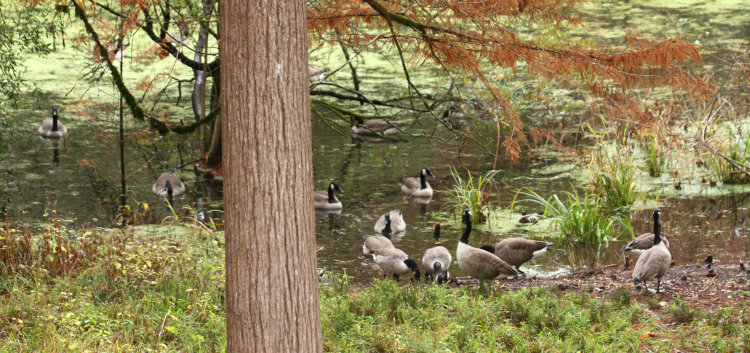
collection of over sixteen Canada geese Branta canadensis on edge of backyard pond
Last Friday, we featured a video of the return of the Canada geese (Branta canadensis) to the pond after their curious disappearance months previously; the count was always either six or eight geese at any given time. A few days after that, I was looking out the bedroom window just after waking up in the morning to see nothing out there, until a flash of movement through the trees drew my attention, and a small flock of four or five came in to land further up by Turtle Island, some on the water and some actually on shore.

By the time I got downstairs, however, the numbers had increased significantly. Being blocked by various cypress trunks made it hard to be precise, but I dependably got at least fourteen. After feeding the cats, I took a bucket of corn down to the water’s edge – we won’t do this while the ducks are present because they’ll scatter and we’d rather not scare them off too often, but the geese are relatively complacent, just giving us a little distance. At that time, I got a count of nineteen, twice, which is a big jump in the number, literally overnight.

Obviously, the word was getting out that this was a safe place with food – but that got me to thinking, since no words were getting out at all. How, exactly, was this idea being communicated? And forgive me, because from this point on it’s only going to be idle and unedumacated speculation.

We’re oriented towards sound/speech/vocalization, so the first direction we tend to turn is thinking that the honks that the geese use from time to time are a method, and to be sure, there are subtle variations that can be found in the pitch and spacing and volume. I am reminded of our (human) neighbors in central New York, when one of their sons was now old enough to obtain his hunting license. They grew corn to feed their dairy cows, and the geese often used these fields after the harvest because it was a safe stopover and always had some leftover cobs available to snack upon. I could see the neighbor out there on the edge of the treeline, waiting for the geese to arrive, and when a flock was cruising in low, he gave forth with his goose call – only, he was imitating an alarm cadence, and the geese veered off and never landed. It’s not simply the sounds they make that matter.

So perhaps the geese now visiting our ponds have honked out the charms of their destination, but from experience, I can tell you that honking isn’t used that often at all, more often in flight and in gathering the flock together as one for takeoff. Since we’ve had at least two different groups visiting, this doesn’t seem to be a collective flock circumstance (especially when a flight can be as few as four or five geese or as many as several dozen, which could not be entertained on our little pond.) Moreover, for three days or more we had no more than eight, and then suddenly that number better than doubled. And to add to that, quite a few of them don’t fly in at all, but simply swim through the channel from The Bayou (which is much larger and even better protected, at least from a gooseley standpoint, because no one has access to the shoreline at all.)

Nonverbal cues are often far more prevalent in the animal kingdom, and indeed, we use them a lot more than we give credit for ourselves. We (perhaps just ‘I’) might ask what kind of behavior clues the others in? Is it that the initial group tended to leave some common meeting ground together to come up to our pond, or maybe how long they stayed away? Did they show little interest in food when they returned, suggesting that they’d been eating well while they were gone?

There’s a possibility that it’s a time of day thing, too – maybe geese have certain times that they seek food, and leaving for another spot at these times was indicative? Morning, of course, is prime feeding time for just about any diurnal animal, so suddenly heading out to another locale at that time perhaps says all that it needs to.

I’ve watched several movements that are repeated, from both the geese and the wood ducks, and they certainly seem to mean certain things though I have yet to hash out a decent ‘vocabulary,’ and of course I’m not able to see them at all when they’re about to leave The Bayou (or anyplace else) to come up to the main pond here. There may be some subtle communications of that nature, head bobs or shakes, flapping just before heading out, things like that. I’ve seen one goose always on lookout when anyone is feeding, same with the mallards, and this might be carried to the wood ducks too but they’re in such a frenzy when they finally do come up on shore and I’ve never seen one that’s committed to being the lookout, though often there’s one seeming to temporarily fulfill that duty. With the geese it’s more obvious, as are their warnings once we got too close; this really applied to the previous collection visiting, who were semi-habituated to us, while these are far more wary and maintain a certain distance out on the water when we’re nearby.

I have no conclusion to offer, just trying to hash out something that’s outside of our normal perspective, and offering perhaps a little insight into what any animal observer should try to pay attention to. Decent and definitive answers likely only come from dozens to hundreds of hours observing, and I’m certainly not at that level yet with any individual species (I tend to treat it as a buffet of many species and not concentrate on any one, which stretches things out a hell of a lot longer.) Naturally, anyone that has greater info is welcome to jump in and tell me where I’m all wet.

six Canada geese Branta canadensis cruising past in backyard pond

Odd memories, part 29

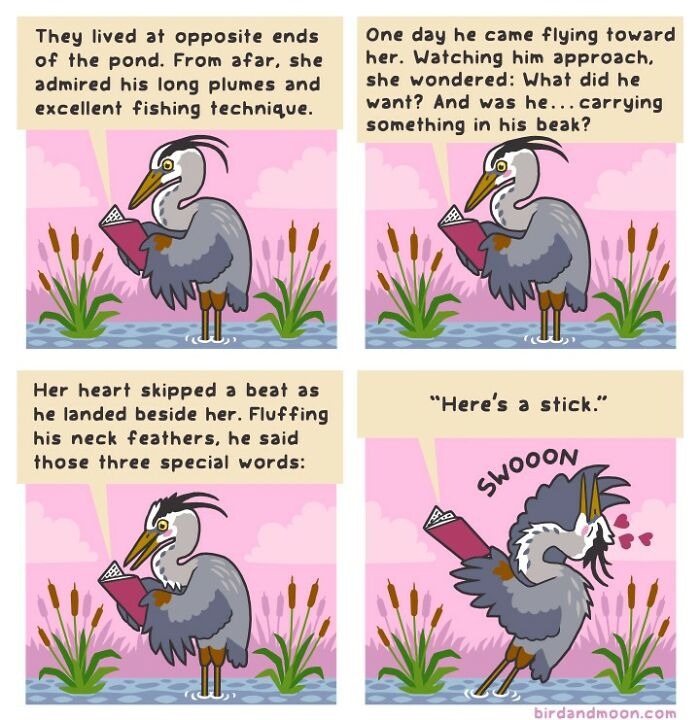
This one isn’t so much odd as appropriate, sparked by finding a comic gallery on Bored Panda the other day. On occasion, they feature a collection of webcomics from a single artist, and this time around it was Rosemary Mosco. I recognized the style quickly, because I’d been going to her site Bird and Moon for a while now – she’s a naturalist and educator and her comics present both useful information and wry humor. The one that sparked this post, however, was this one (used with permission) which I hadn’t seen before:

Bird and Moon GBHE comic by Rosemary Mosco
© Rosemary Mosco

It’s all relative, isn’t it? For instance, herons wouldn’t give the faintest shit about diamond rings (and neither should we, really,) but crows might like them. Some species of penguins also like rocks, but probably not diamonds – they’re impressed with the most round and perfect pebbles presented by suitors.

Now comes the odd memory part. Many years back I was firing off dozens of frames of the activities at Venice Audubon Society Rookery in Venice, Florida, one of the best birding spots in the world – this is not simply my opinion, since I haven’t been to enough to judge, but a broad consensus. Plainly visible in one tree was a great blue heron nest, a completed one since the female appeared to be actively sitting on eggs. Across the pond comes another heron, clasping in his beak a fairly large branch, and he alighted on the nest proudly with this new offering, even though the nest seemed perfectly complete and already in use. He proudly (so I’m assuming) attempted to place this in an ideal position in the nest walls, to be countermanded by a loud croak from the female. Chastened, he chose a different placement, with the same response. This went on for perhaps 15 seconds, a rather public argument accompanied by a bit of wing flapping, until the male resolutely took up the branch again and flew off, dropping it into the pond with a resigned air and continuing onward. The magic was gone.

[It’s easy to assign human emotions to other species, and most likely to be totally incorrect, though I think the altercation at least was hard to misinterpret: the branch was unwanted, for whatever reason – it might even have been because the male was supposed to be bringing back food. Of course, herons are one of the more harsh and noisy birds when they choose to be, and immediately before I started typing this, one chose to be right at the edge of the main pond, plainly audible through the open door to Walkabout Studios here. The Girlfriend’s Sprog could attest to this too, when she and her fiancé camped overnight on the edge of a lake and were awakened several times by herons loudly voicing their protests.]

I want you to note something subtle in the above comic, too: by the third panel, the feathers on top of the female’s head begin to rise, as well as her beak opening. It’s one thing to communicate emotions with trivial additions or changes to the drawing of humans, and quite another to do it with birds.

Thanks to Rosemary Mosco for permission to use this comic, and h/t to Bored Panda

Crikey stroppin’ beeah!

Today, so my calendar informs me, is National Wildlife Day, which is actually different from World Wildlife Day, found on March 3rd and yet somehow not on my calendar. In fact, this is only a National Wildlife Day, since it also falls in February – perhaps it depends on what nation we’re talking about (I seem to recall different hemispheres celebrating this on different days, early spring for either.) This one was created in honor of Steve Irwin, which means we celebrate it surrounded by a major camera and lighting team, animal wranglers, and controlled sets, running around pretending we’re in “the wild” while affecting a ridiculously stereotypical dialect and handling animals in a disrespectful and hazardous manner. Bonus points if you somehow manage not to be seen as an irretrievable assclown while doing so.

[As you might surmise, I’m not a fan of nature shows that aren’t the least bit natural, especially ones that foster (heh!) bad habits and entirely incorrect ideas about naturalism and zoology. The bare fact that most of them are like this doesn’t help at all, but for giggles, pay attention to the camera angles and ideal lighting to see how much staging is actually taking place. Now, at the risk of sounding like a hypocrite, I will readily admit that I resort to natural-looking sets on occasion, and of course I’m often controlling the lighting, but I never represent these as ‘natural’ and the purpose is almost always illustration, not ‘documentary.’ To say nothing of the large percentage of subjects that are actually captured in completely uncontrolled conditions.]

All that aside, feel free to celebrate this as you see fit; mere observation works just fine, and will tell you a hell of a lot more than trying to have any kind of encounter. Go someplace where the chances of seeing something are greatly increased: even just the local park, but national parks, wildlife refuges, forests, lakeshores… any natural area is usually capable of displaying some kind of wildlife, especially if we loosen our concept of what ‘wildlife’ is. It’s easy to get into the mindset that this means lions and camels and narwhals, but really, just think about the more common species in your area that you’re never actually seen – even for me, this is a long list. Don’t target anything, don’t have goals, just keep your eyes and ears open.

I have a few pics to throw up, not actually from today – I may get out a little later on and see what I can see, though I have several other things that have to be taken care of. It’s not like this isn’t a regular practice anyway…

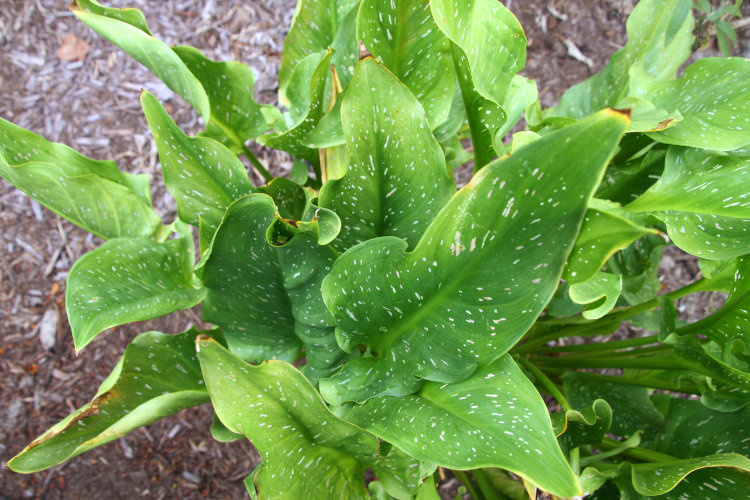
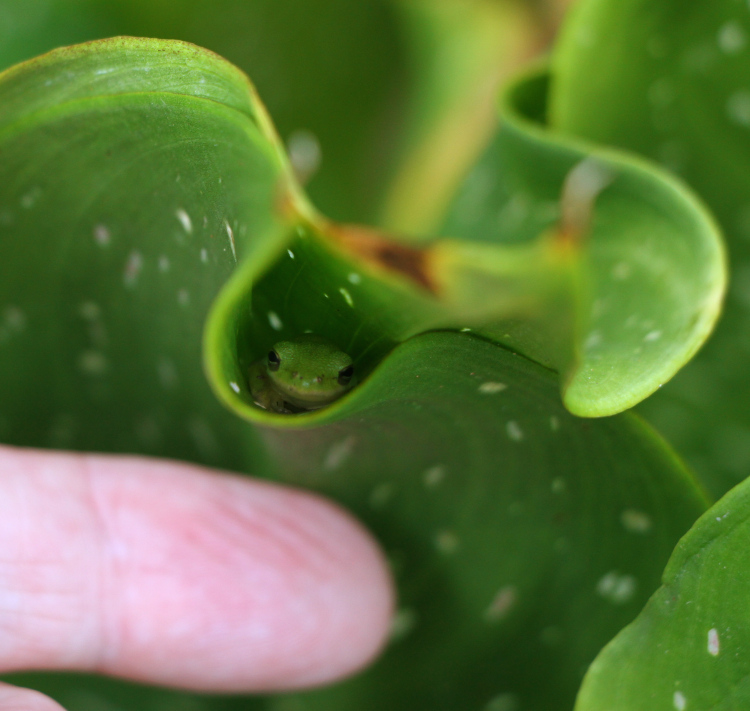
juvenile green treefrog Dryophytes cinereus hiding deep within leaves of calla lilies Zantedeschia aetheopica
A few days back on the 1st I found this particular subject, though this is purposefully shot wide to give context and perspective. Can you spot what I was seeing among these calla lilies (Zantedeschia aetheopica)? Granted, I suspected such a thing was there and was specifically looking for it.

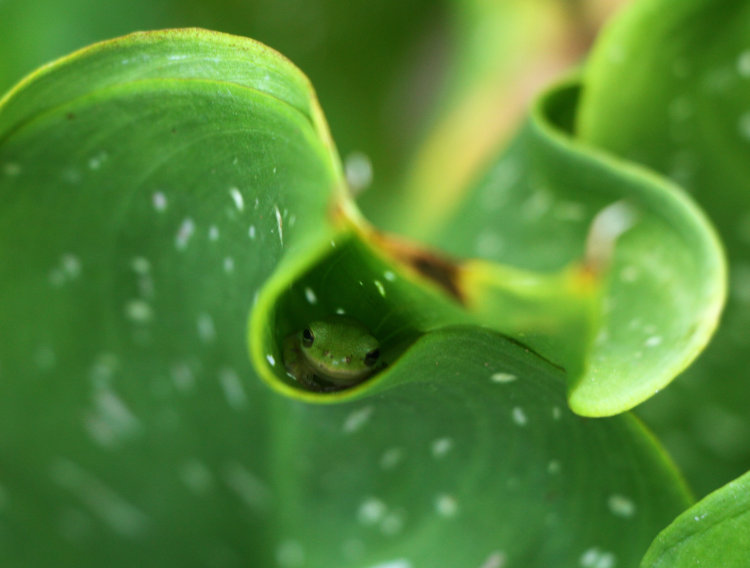
We’ll go in a lot closer.

juvenile green treefrog Dryophytes cinereus nestled between leaves of calla lily Zantedeschia aetheopica during daylight
Naturally, it’s a juvenile green treefrog (Dryophytes conereus,) sequestered during the day before going out to hunt at night – there are almost as many of these around as there are the Carolina anoles, and that’s saying something. This was shot ambient light in open shade, and suffered a little for it, but I did do a quick scale shot too.

juvenile green treefrog Dryophytes cinereus nestled between leaves of calla lily Zantedeschia aetheopica, with author's finger alongside for scale
Eentsy little thing, but it had found a perfectly-sized spot within the leaves, perpetually shaded and so cooler during the day.

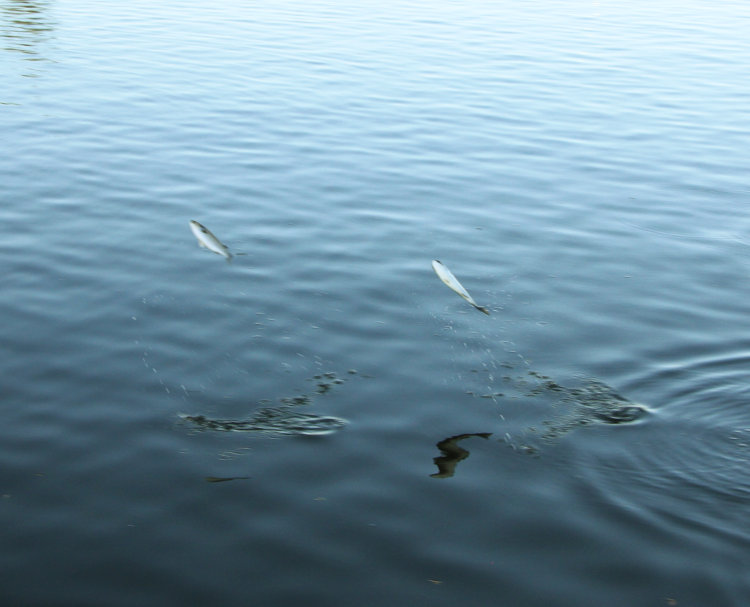
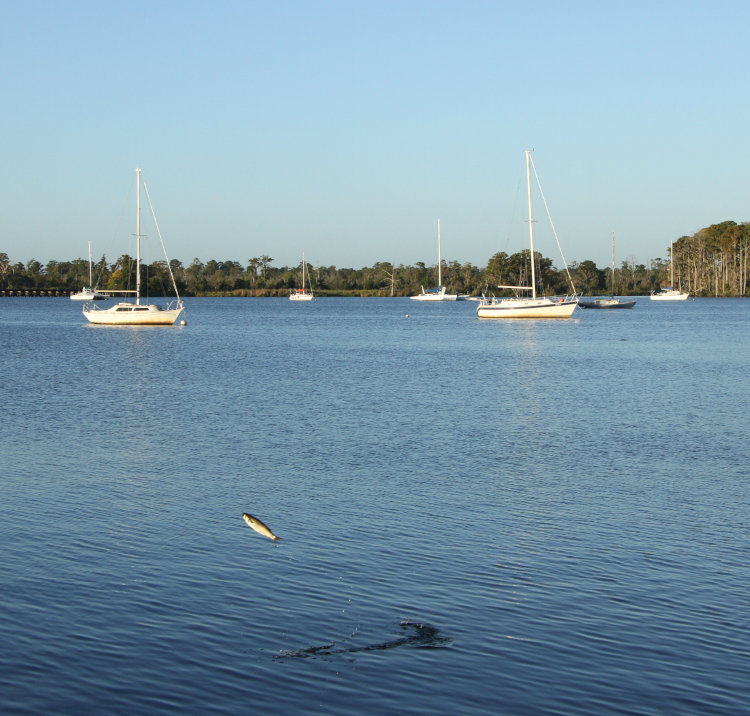
We had guests over for the holiday weekend (no, not this one, but Labor Day,) and went down to the waterfront to find that some species of fish was jumping from the water constantly and exuberantly, very similar to what we’d seen previously at North Topsail Beach and potentially the same species. I had not taken my camera on that outing, but I returned for sunrise the following day (this would be the 2nd,) and managed to snag a few shots of them in midair.

pair of fish, possibly mullets, jumping simultaneously from water
I got several photos, but most of them at a moderate distance at odd angles, and I was only working with the 18-135mm, so a positive ID was never pinned down (especially when the closest shot, here, was only seeing their bellies.) Nonetheless, based on both appearance and behavior, I suspect these are mullet; the average length seemed to be on the order of 25-30cm. But some of them were dependable enough that I could actually compose a few frames.

single fish, possibly mullet, leaping from water in front of cluster of sailboats
The sunrise was unimpressive, being far too clear and thus blinding almost from the moment of appearance, and none of the fish were cooperative enough to jump in front of it before the sun was too bright to make a decent pic. But this one works halfway decently, at least. If I were so inclined, I’d wax enthusiastically about the mood of rebellion and contrariness displayed by facing opposite the boats, but there’s such a thing as trying too hard…

And then, yesterday.

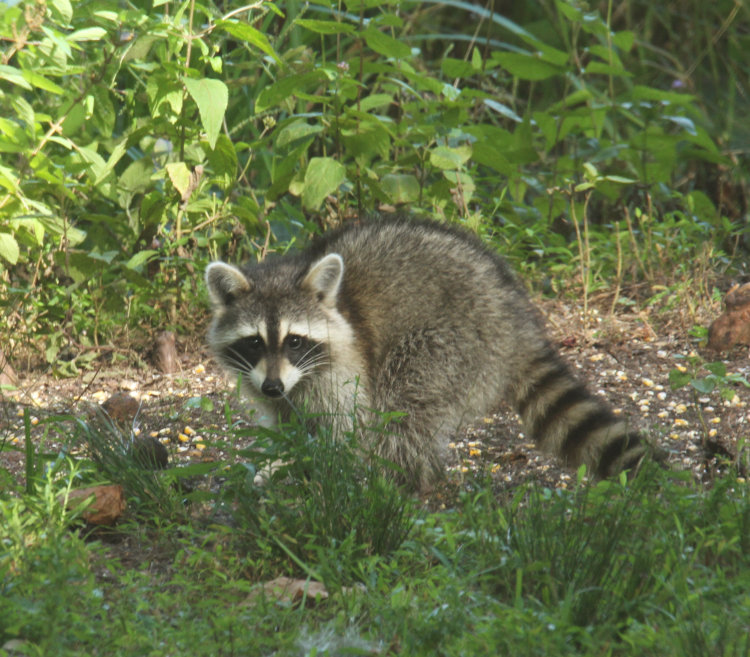
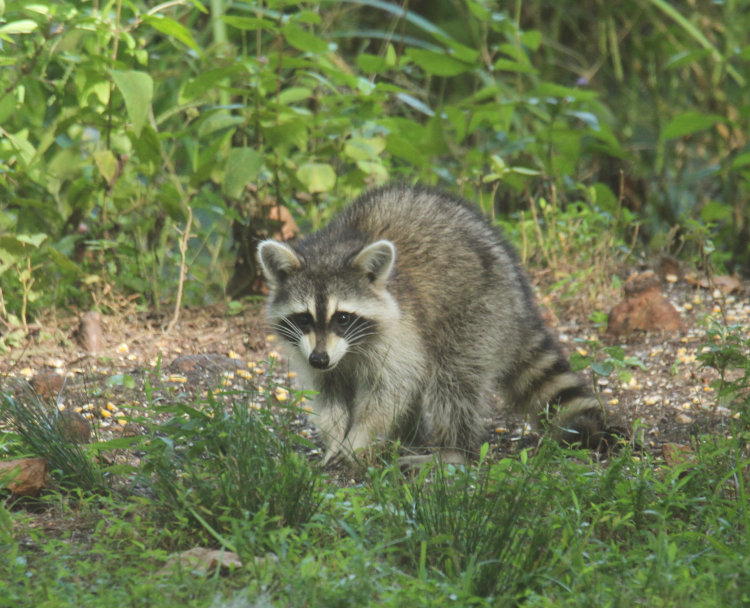
adult North American raccoon Procyon lotor foraging during afternoon on pond edge
Right where the nutria (well, and everything else) regularly forage, we found this adult North American raccoon (Procyon lotor,) in mid-afternoon, of all times. I was able to slip out onto the deck for a clearer view but did not otherwise push it; not only can raccoons be remarkably defensive, seeing one during the day is one of those warning signs of distemper or rabies, though no other evidence of this was forthcoming – both illnesses often display symptoms of sluggishness or being in a daze, aimless wandering and long pauses in confusion. Far more likely was that I spook it off by trying to get closer, so I maintained a little distance while this one was quite busy with its harvesting of already-harvested corn.

adult North American raccoon Procyon lotor foraging for corn on pond edge
I couldn’t be certain while looking through the viewfinder, but I fired off the frames when it seemed likely anyway, and did indeed get the catchlights in the raccoon’s eyes, which is almost a necessity for this species; otherwise the entire mask is simply a band of black most times. It didn’t want to sit up and give me a better pose, but you take what you can get (when you don’t have an entire crew and animal wranglers setting up your shots, I mean.)

So, go see what you can find – still plenty of time left in the day, and I’ll provide a written excuse for you to celebrate this tomorrow if you need it.

Rehab x 7

It’s time to talk about wildlife rehabilitation, since this has now become an annual thing, and with good reason: we’re entering the season where this has the most relevance, and the highest likelihood of being beneficial to someone out there. This was all written years ago, but still applies quite well, so without further introduction, let’s talk about injured and orphaned wildlife.

I used to work in this field a fair amount, both in administration of wildlife organizations and as an active raptor [birds of prey] rehabilitator, plus I served as wildlife adviser in several different situations. So I’m familiar with most of the more common reactions people have when they find ‘orphaned,’ injured, and ill wildlife. It’s hard to give enough useful information without trying to cover every situation or alternative, so treat this as an overview. One thing that I especially want to emphasize here is that there is an immediate emotional response in most cases, which tries to override the advice given by those who work in the fields, so be aware of it. There isn’t an ‘instinct’ we might have that applies to wildlife, and the rational mind is the part that needs to take control.

Additionally, the amount of folklore regarding wildlife is not just abundant, in most cases it’s ridiculously wrong. I’m not even going to say, “If in doubt…,” because you should doubt right off the bat, and consider that most of what you’ve heard is highly suspect. This means, contact someone who is supposed to know, and go with their advice.

Number one rule, and I can’t repeat this enough: Don’t try to raise wildlife on your own. Their diets are specialized, their needs varied and specific to the species, and their adult behavior dependent on how they’re raised. This isn’t the place for guesswork or experimentation. Even if they seem to be ‘doing well’ (like the viral video of the guy raising a baby hummingbird,) they may have developmental issues from an improper diet or exercise, or simply have imprinted on the wrong species, and you are in essence just prolonging the death of the animal. In the US, it’s illegal to raise any species without a specific permit, and songbirds are federally protected. It’s possible to obtain these permits, and quite frankly encouraged, because there are few places with enough rehabbers, but if you’re going to do it, do it right. More further down.

So, we’re about to enter baby bird season, and this accounts for a large percentage of wildlife encounters. I’ll dispel the first myth that touching a baby bird will cause the mother to abandon it. Utter hogwash, pure and simple – yet, I don’t always discourage parents from teaching this to their children, because it’s one way to try and get kids to leave them alone, which is a good thing. Better, perhaps, to teach them to leave them alone for the right reasons, which is to avoid interrupting their feeding schedule, or injuring them, or thinking it would be neat to have a pet robin. But returning to the myth, baby birds will occasionally fall from the nest, and it’s perfectly fine to return them to it, and in fact this is recommended.

It doesn’t always work, however. Some species will discard young that are not doing well, and some even kick their own siblings out – this is nature’s method of selecting the most viable offspring, as ruthless as we find it, and we’re not going to change it. Basically, if it’s a baby bird not ready to leave the nest (not fledged; we’ll return to this,) put it back. If it keeps coming out, there may not be much you can do.

Can’t reach the nest? Try to find a way, first. If that’s not possible, occasionally the parents will accept a substitute nest, such as a plastic berry basket with soft tissue as bedding – this should be placed as close as possible to the original nest, firmly anchored so it doesn’t come down. Observe the nest carefully, but from a safe distance, for 30-60 minutes to see if the parents have indeed found the substitute. If not, seek out a rehabilitator or wildlife official.

Abandoned nest? Maybe, maybe not. Once the eggs hatch, the parent birds go into feeding mode, gathering food constantly during daylight hours and stopping at the nest for brief periods to jam it down the gullets of their ravenous progeny. The 30-60 minute rule above is because waiting less may mean you’ve simply missed the brief feeding period between the extended gathering periods. Observation has to be done at a distance that does not alarm the parents – minimum is six meters (yards,) and more is recommended. Also, being low key is paramount, so take a seat (with binoculars, for preference) and remain still and quiet. Yes, it’s boring, but it’s for the health of the offspring, and if you didn’t care about that you wouldn’t be reading ;-)

fledglingsAs the nestlings become fledglings, they abandon the nest on their own in learning how to fly. This does mean that they’ll be found unable to fly, fluttering around at low level and even just sitting there staring at you. This is normal, and they should remain undisturbed. The parents are nearby, providing food and encouraging the flight attempts. Most bird species know enough not to give away their progeny’s locations to predators, or draw attention to themselves by moving a lot, so your ability to approach, or not being attacked by angry parents when you do so, means nothing at all. Again, observation is good here, as is knowing the calls of the species in question – the parents may be coaching their young towards them.

Now, telling the difference in ‘nestlings’ and ‘fledglings.’ A nestling is a baby bird that must remain in the nest for a while; they will have few feathers, or perhaps even odd ‘quills,’ which is what the feathers look like as they are growing out. Unable to support itself? Eyes not open? Nestling. Fledglings are the babies that are ready to learn how to fly. Their feathers will have good coverage with little to no stragglers or ‘stuffing coming out’ (the baby down.) One rule I always used over the phone was to ask if there were tail feathers – if there are, they’re about ready to fly. These are fledglings and should only be observed.

If in doubt, contact a rehabber/official. This is before doing anything else, save for getting it out of immediate danger. No food, no water, nothing at all. I can’t tell you the number of times I’ve heard people say, “We’ve tried giving it water and worms” – birds can aspirate the water if it’s not given the way the parents do (you’ve noticed the beak getting jammed halfway down the throat, right?) and only one species in North America eats earthworms. Again, folklore – ignore it and be safe.

Also, bleeding in birds is serious, no matter what. Birds have very thin blood that doesn’t coagulate easily, and they can bleed out quickly. Also note that those ‘quills’ of new feathers mentioned above have a blood supply for a while, and these can be broken and start bleeding as well. Time is important in such situations.

HappyOwletBaby raptors will tear you up – they know how to use the beak and talons very early (often on their siblings) and will not hesitate to protect themselves. And adult raptors will protect their young. This is where it’s best to leave it to the experienced.

And it may seem funny to have to say this, but baby birds do not look like their parents. Adult kestrels and screech owls, both diminutive raptors, are often considered “babies” when found by those not familiar with what a real juvenile looks like. Basic rule: if it has a smooth appearance and good coverage of feathers, it’s at least fledgling age, probably older.

What about mammals? This is a little different – mammals are generally not found away from their parents unless something has gone wrong. Most especially, if the youngster’s eyes aren’t open, they’re wet from the rain or dew, or if they’re cold or dehydrated, this is the time to contact someone. Test for dehydration by gently pinching up the skin over the shoulders or side in a ‘tent’ and releasing – if the skin takes more than a second to go back into position, this is dehydration.

Always use gloves. Juvenile mammals can certainly bite, and there’s an additional risk to this: rabies is active throughout much of North America. This is an invariably fatal disease once it passes a certain point (much more so than HIV,) so this needs to be taken seriously. It is not just the bite that can transmit it, but contact of an infected animal’s saliva with mucous membranes can introduce it as well, which means that picking up a damp animal and rubbing your eyes puts you at risk. Animals do not have to be showing symptoms to be infectious, and symptoms vary anyway. BE SAFE.

It’s not just rabies. Mammals are far more likely to introduce other zoonotic issues than birds – they’re enough like us that parasites (internal and external) and some viruses can be transmitted to us. Bringing them into the house may mean you just introduced fleas, lice, giardia, and so on into your home. You’ve been warned.

possumpeepingAlso, and it pains me to have to always say this, but cute does not mean safe. Any animal can defend itself. I have never been bitten by a raccoon, despite their aggressiveness, but I have a scar and a touch of nerve damage from a grey squirrel – one, moreover, that was raised in a house. Rabbits and mice can bite the hell out of you. Shrews even have a toxic saliva. Yes, I am trying to scare you – if you’re scared, you’re cautious, which is better than incautious.

In many cases, mammals about half of the adult size can be on their own without issues – they learn how to forage for their own food reasonably quickly. Again, the stillness thing doesn’t mean they’re lost – it may simply mean they’re trying not to attract attention. This is especially so for white-tailed deer fawns – they often curl up in the grass and conserve energy while mom forages, and will not move even when someone approaches – occasionally not even when picked up. Leave them be, and come back in a few hours. If they’re still there, that’s when you should contact someone.

Rabbits are notorious for abandoning the nest if it’s been disturbed, even with a full brood of young within. This is doubly hazardous because their nests are often in clumps of grass and can be inadvertently discovered by cleaning the yard. If it happens, immediately put everything back as it was, without touching the young, and place a few distinctive blades of grass across the nest opening (preferably something you can see from at least a short distance away,) then leave it entirely alone. Come back in a few hours and check to see if the grass has been moved. If it has, things are probably okay. If not, it may be time to check the warmth and hydration of the young. Contact a rehabilitator.

Again, trying to raise them yourself puts them at a high risk. This is especially true for rabbits, which are among the hardest mammals to raise in North America. I can’t count the number of people who have assured me that they did it once before, so “they know how to do it.” While this may be true, it ignores numerous things, such as how viable the released offspring were and whether they lasted longer than a month, whether they had developmental deficiencies because of improper nutrition, and even whether they had habituated to food or behavior that left them ill-prepared for their conditions. There is a shortage of rehabilitators, so believe me, if it was easy most people would be encouraged to tackle this on their own. The fact that not only is it discouraged, it is unlawful in most areas, should be a good indication that there’s something more to consider. And the welfare of the animal should take higher precedence than anyone’s ego.

Injured animals are extra dangerous. Yes, they may seem incapacitated or helpless, but you know what they say about appearances. One of my colleagues rashly checked an injured, near-comatose squirrel bare-handed, and it bit through her finger, joining its teeth together in the fleshy part of her index finger – I actually heard them grinding together. It then passed out without letting go. Animals in pain (even pets) often respond aggressively – they have no concept of your attempts to help them, and restraint can make them even more agitated. Deer can do vast amounts of damage by thrashing with their hooves, and the big waterfowl like herons and cranes can drive that beak into your face (and yes, they aim for effectiveness.) I really want to emphasize this, because the nurturing instincts are badly misplaced here, and extreme caution is necessary instead.

“There’s a nest of animals in my attic/crawlspace/walls and they need to be removed!” No. Most especially not when they’re raising young, which is most often when anyone notices them. Once the young are there, no further damage is going to be done to your house, because the parents are concentrating on raising their brood. Trying to relocate them is hazardous, both to the animals and to people in many cases, and pointless. Let them be, and in a few weeks the young will be old enough and move out on their own – about the only exception to this is bat colonies (more below.) Once there are no young to raise, the adult animals often leave on their own – nests are primarily for young – but they can also be encouraged to leave or stay out at that point. Squirrels are pretty bad about wanting to return to successful nest areas, and will even chew through wire mesh at times, but most others take the hint and find better places to live.

“But what about rabies?” Animals raising young, even in the eaves of your house, are not an especially high risk. Contrary to belief, rabies does not cause animals to leap suddenly out and attack people; those events are remarkably rare. While anyone should be quite cautious of any mammals that openly approach, living near them does not place anyone at special risk – you’re at greater risk of being killed by the tree near the house falling on you, and we won’t even talk about road risks. Like snake bites, most contacts with rabies vector wildlife occurs by people initiating the contact.

beaverspoor“Animals are doing damage to my property and need to be removed!” No. I can’t tell you how much this attitude annoys me, but that’s what a blog is for, right? Wildlife goes where the habitat is ideal, and pays no attention to humankind’s imaginary idea of “property.” First off, anyone should enjoy the opportunity to see behavior, something that is often hard to accomplish even when making the effort. If someone has wildlife around, chances are they aren’t in a high-rise apartment, which means they wanted to live with at least some vestige of nature visible; surprise surprise, it comes with other animals. While we might decry the damages to our gardens or landscaping, that’s part of the territory, just like road noise and power lines. Learn how to cope, and the ways to exclude animals from certain areas so we can have tomatoes. I’m sorry that a $500 tree was stripped, but no one should have planted something that was that appealing to the local species in the first place, and chances are, numerous appropriate trees had been cut down first so that the fancy landscaping could be put in its place (and I used to work for a landscaper, too.)

Trapping and removal is rarely effective. If there’s a habitat, someone else will move in. And wildlife populations have been shown through numerous studies to be fairly self-regulating; the issues come because habitat destruction by humans is not. We can put in housing developments much faster than the natural cycles of population reduction and management, and those displaced animals end up somewhere. They likely feel the same way about us – dread the point where they develop opposable thumbs.

But what about bats? Ah, the poor little guys! Much of our population considers them ugly and creepy, not at all helped by folklore and horror stories, yet bats are actually way cool mammals, and good to keep the insects down. But most species nest in colonies, and this does sometimes mean in attics, which can produce lots of guano (bat poop) and increases the risks of rabies exposure, primarily when one gets lost and ends up within the human spaces of the house. However, the damage that they can do is minuscule, since they do not dig or gnaw, and excluding them only takes 1/4″ hardware cloth (small-holed wire mesh.) Again, this should be done when no young are being raised, and should always be done with gloves and a breath mask (guano turns into dust easily and can be inhaled.) Should you find a bat in your house, contact your local animal control, since states differ on how they handle potential exposures.

I said I’d get to this: So you want to learn how to rehabilitate wildlife? Once again, this is actually encouraged, but like riding a motorcycle, it should be done properly and responsibly. If there isn’t a wildlife center or organization available in your area, contact your regional Wildlife Resource Commission office (for the US at least) to find out who in your area can train you, and most especially what permissions you need. In the US you’ll need at least one permit, possibly several. What you’ll mostly need is training, because any species requires a decent body of knowledge to tackle well – which also means pick a species, at least to start. Your local rehabbers can suggest a few, which might mean picking something you didn’t initially desire, but which is either easier to learn or presents the greatest needs within an area (and again, is this about you, or the animals?) Expect to spend a lot of time at it, since most animals need lots of attention – mammals may need feedings every four hours around the clock, and birds every 15-30 minutes during daylight (yes, I knew a songbird rehabilitator that kept baby birds in the desk drawers of her office.) And it’s almost certainly all coming out of your own pocket.

SquirrelFeeding
I feel obligated to say this, too: wild animals are not pets, and should not be raised as such. There are lots of reasons. The domesticated animals we have as pets, like cats and dogs and horses, have been bred that way for thousands of years and quite likely were chosen because they already had traits that assisted the process. Animals do not domesticate by simply raising them around people, and in many cases have behaviors that cause them to run afoul of our own (I mention once again the squirrel scar I bear – that story was posted a few years ago.) Many animals also do not have diets that are easy for humans to replicate, meaning that they’re unlikely to thrive and may develop serious disabilities. But most distinctly, what we might imagine them to be like is rarely ever the case – they are highly unlikely to bond with humans in the slightest, and aren’t going to make good companions, do tricks, or even exhibit any appealing personality. They belong in the wild, and that should be your only goal.

Now, if the demands of rehabilitation are too much to contemplate, you can always volunteer with a local organization, and do rehabilitation on a rotation as your schedule permits. This helps prevent burnout and lets you have vacations and family emergencies. This also allows you to get involved without necessarily requiring the permits, because you can operate under the aegis of the organization and its own permits (which is how I worked with raptors, since my apartment would not fit the 15-meter flight cages required.) Still, expect to be dedicated to the job, even when it’s unsavory – cleaning cages and wounds, and even euthanizing injured animals, is a requisite part of it all. Not to mention how many species expect live or fresh food. If you’re thinking of cuddling fluffy bunnies, you’re not ready; rehab requires lots of ugly stuff, and very little bonding – they’re not pets, but wildlife, and need to be wild.

Or, simply donate money or materials. That works too, and is just as necessary – the nice thing about the subject is how nearly everyone can find a niche (provided they accept the reasonable expectations.) Despite such things as Wildlife Resource Commissions and the US Fish & Wildlife Service, there really isn’t money being put into wildlife rehab, especially not from a state or federal level. The vast majority of organizations run solely on donations and grants, and often even have to have veterinary services donated. Experienced workers are great, but donors are just as important, if not more so. Even people who can promote greater donations are important. Just about everything is grass-roots level, all of the time – the few exceptions are great, and demonstrations of what can be done, but not what you can expect throughout the field. Your help, whatever it is, will be appreciated.

A final note: find out, now, how to contact your local wildlife people. Before you find yourself with an injured owl on your hands. In some areas, it’s not self-evident or easy to find, and if it’s not a registered organization, you can forget about searching any telephone listings. Local animal control usually knows, and the 24-hour emergency vets. Often, 911 operators do not, and even local law enforcement may be stumped. A few minutes to get prepared can save a lot of hassle later on, and as I said, we’re entering baby season.

Hope this helps!

Well, it’s something

Today is Darwin Day, and unlike last year, I actually have something for the day – just not much. Again, the reminders have been coming up in my calendar for the past week, and that hasn’t been enough to inspire something meaningful, but I do have a handful of observations that have provoked some speculation, if only because I’m not properly educated about the subject (or indeed, any.)

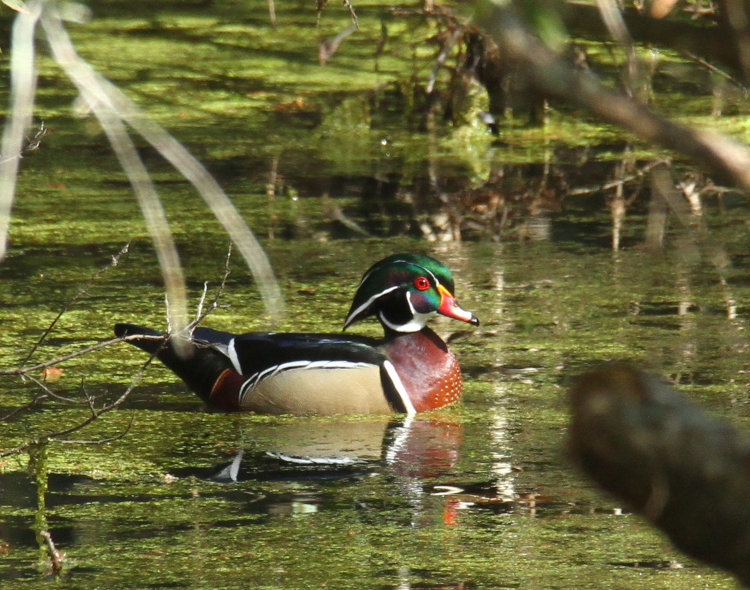
We’ve been keeping an eye on the visiting wood ducks (Aix sponsa,) which they’re doing their best to thwart – they’re secretive little waterfowl. And it’s all being done from a distance, usually through the back windows, because they won’t allow even moderately close approaches, and my presence up on the deck (50-70 meters distant) is usually enough to send them under cover, at least. But a few traits stand out regardless, and it makes me wonder about how they evolved.

male wood duck Aix sponsa venturing out into sunlight
First off, the males have remarkable coloration, as noted before, and it becomes even more appealing when they get into direct sunlight – but the females are distinctly drab (that’s a duck joke.) This holds true for many bird species, and the speculation is that the coloration of the males indicates their health and robustness, a message to the females that they’re good husband material. Songs also seem to fit this bill (just full of them, aren’t I?,) not only demonstrating healthy lungs, but their repertoire might indicate experience, a bird that has survived more travels than most. Yet the brilliant plumage, at least, comes at a cost, because it makes them exponentially more noticeable to predators as well, and this is especially so with birds that develop long and elaborate plumage during mating season, among them peacocks. The belief (because how could you possibly prove this?) is that the benefits of finding a mate and passing on their genes outweighs the hazards of making them more noticeable and perhaps hampering their flying agility.

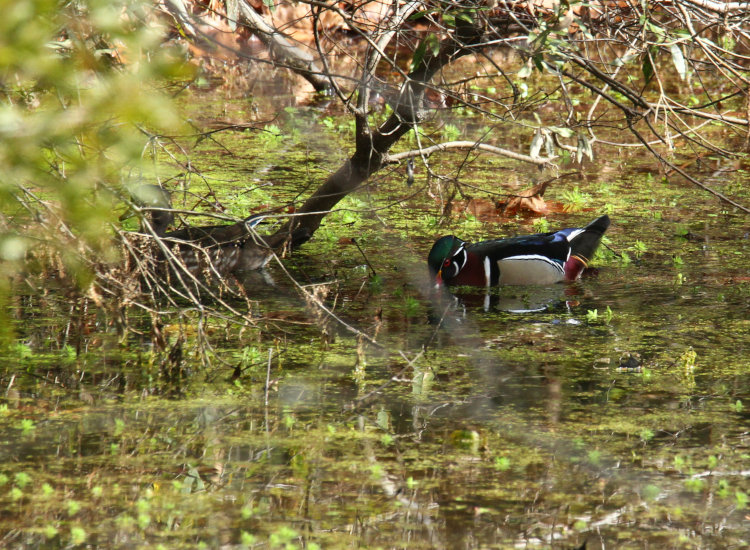
Wood ducks have iridescent feathers, meaning the colors really stand out in bright sunlight, but they have a tendency not to appear in bright sunlight very often – from what I’ve seen, they try to cross open water rather quickly and spend a lot more time in shadow where the iridescence fails and the feathers appear black.

male and female wood ducks Aix spoansa showing both coloration and habits
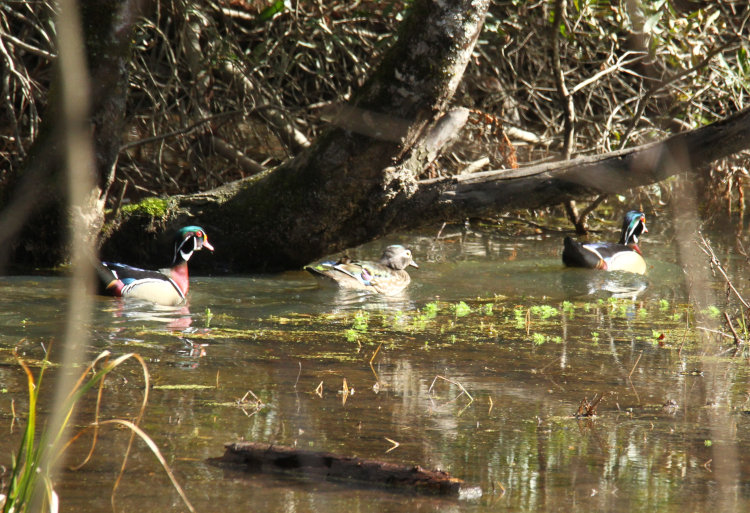
The females are a lot harder to notice, and yet, they also stay in shadowed overhangs a lot more than the males do; from initial observations, the males check out the surroundings first, with the females following many seconds later. What I think is happening here is that the males serve as the decoys (nonstop puns,) going first into potentially dangerous areas to see if they draw unwanted attention, with the females following only after nothing has happened for a little while – not long, but about five to fifteen seconds in my experience. It makes sense (but again, is hard to prove): without the females, no reproduction is going to take place, no matter how fit and wonderful the male might be. And males working to draw predators away from the females and/or young has been witnessed many, many times before. Even if they die while doing so, once they’re already mated, their genes are being passed on by protecting the females and young – and that’s what natural selection accomplishes. Keep the lineage going.

two male wood ducks Aix sponsa flanking a female as they head towards safer waters
Most of the wood duck visitors to the main pond are pairs, and as they retreat towards areas that they feel safer within (for instance, when I’ve been rash enough to let them see me,) the males always lead the way, with the females following or sandwiched between flanking males like seen here. As far as I’ve been able to see, even when they fly off in alarm, it’s the male in the lead. It’s usually not hard to see such details, you only have to be paying attention.

Now, as for why the males have that overhanging, rebel-scum helmet on their heads? I’m not even going to try and explain that one. Sometimes such things are only for display, and it’s possible that it helps differentiate them from the mallards that they hang out with; it might also provide some advantage to their flight. I have seen how the white stripes actually break up their profile when they’re in overhanging branches, but the coloration of the females (the mallards too) is much more effective: it can be easy to spot the males, but it often requires the binoculars to determine that the females are around too, even when they’re in open water right alongside the males. One would think that it could perhaps be better for the males to attract as little attention as the females, yet there remains the whole “I’m a good choice” message that needs to get across too, and this is highly present throughout the avian kingdom. It must be working.

However improbable

Another holiday is upon us, and while I could celebrate it most days with a little effort, this time I have a nice example picked up yesterday (well, not literally, that’d be gross) to use. Yes indeed, it’s Nature Boi Detective Day, when we sit down and try to determine what produced some particular tableau found out in the wild someplace. This has come under attack from the moment it was conceived of course, for being both gender and age specific as well as unfriendly to urban dwellers, until it was pointed out that “boi” isn’t a real word so the definition of it can’t be used for tirades, plus we still have Mothers’ Day so go fuck yourselves.

All that out of the way, let’s take a look at what we’re going to evaluate today, shall we?

unidentified scat found in wooded area near lake's edge, showing complete bones of unknown mammal, with scale inserted
This was found near the edge of Jordan Lake during a student outing yesterday, though I used my sandal as the initial scale and this allowed me to paste in a digital one for reference. While this is obviously the aftermath of one animal being consumed by another, it’s not exactly clear whether this is feces after being washed out by hard rains, or the casting of some larger bird. It has the look of a typical owl or hawk casting, but a) it’s quite big, and b) those bones are pretty damn big to be swallowed whole. Some vertebrae can be seen in there, a few ribs it looks like, plus several smaller bones that I can’t place right now. I’m almost certain that I’m seeing both a femur/humerus (single long bone) and a tibia/fibula or radius/ulna pair (two longer bones together,) both in excess of 50mm in length, so this is much larger than a rat, which the vertebrae help confirm.

But given their position in the casting, especially smaller bones entangled in hair, while not laid out in rough skeletal form, this isn’t simply an animal that died there – this was digested. Yet those leg bones are whole and within the scat, so they appear to have been swallowed whole.

unidentified scat of unknown mammal, showing hair and bones
Given the size, it would appear to be at least a small rabbit in size, but I’m more inclined to say it was adult, while the color of the hair within points more towards opossum – I can’t say that I’ve dissected either but the proportions seem correct to me. Except that, nearly everything that I can think of that would tackle something that size (fox, coyote, wolf, hawks, owls,) is unlikely to eat their prey whole, and the meat would be stripped from the larger bones rather than swallowing them. Great blue herons will swallow their prey whole and they will indeed tackle some mammals – I watched one take a small muskrat once – but this seems both large and not a typical choice of meal for them.

So I’m leaning towards coyotes or wolves, though I’m not sure any wolves have ever been spotted anywhere near here – coyotes, however, are definitely around. Would a coyote swallow the legs of an opossum or similar-sized mammal whole? It seems awkward (and perhaps a little dangerous) but possible I suppose, and I don’t know enough about their eating habits to weigh in on this usefully. I did not start digging through the scat (again, I was with a student,) so I can’t vouch for the coarseness of the hair nor whether tail bones could be found, which might have helped determine what species this had been, though not what species had consumed it.

Feel free to weigh in if you have any input at all – it is still the holiday after all, and even if you’re late I promise not to turn you in.

Rehab6

This is actually the sixth time I’ve posted this particular writeup – it’s now become a yearly thing right around the time that wildlife starts becoming most active, and fits in nicely with National Wildlife Day, which is today. Plus look at all this content that I only have to cut-n-paste! So without further fanfare, we delve back into injured and orphaned wildlife.

I used to work in this field a fair amount, both in administration of wildlife organizations and as an active raptor [birds of prey] rehabilitator, plus I served as wildlife adviser in several different situations. So I’m familiar with most of the more common reactions people have when they find ‘orphaned,’ injured, and ill wildlife. It’s hard to give enough useful information without trying to cover every situation or alternative, so treat this as an overview. One thing that I especially want to emphasize here is that there is an immediate emotional response in most cases, which tries to override the advice given by those who work in the fields, so be aware of it. There isn’t an ‘instinct’ we might have that applies to wildlife, and the rational mind is the part that needs to take control.

Additionally, the amount of folklore regarding wildlife is not just abundant, in most cases it’s ridiculously wrong. I’m not even going to say, “If in doubt…,” because you should doubt right off the bat, and consider that most of what you’ve heard is highly suspect. This means, contact someone who is supposed to know, and go with their advice.

Number one rule, and I can’t repeat this enough: Don’t try to raise wildlife on your own. Their diets are specialized, their needs varied and specific to the species, and their adult behavior dependent on how they’re raised. This isn’t the place for guesswork or experimentation. Even if they seem to be ‘doing well’ (like the viral video of the guy raising a baby hummingbird,) they may have developmental issues from an improper diet or exercise, or simply have imprinted on the wrong species, and you are in essence just prolonging the death of the animal. In the US, it’s illegal to raise any species without a specific permit, and songbirds are federally protected. It’s possible to obtain these permits, and quite frankly encouraged, because there are few places with enough rehabbers, but if you’re going to do it, do it right. More further down.

So, we’re about to enter baby bird season, and this accounts for a large percentage of wildlife encounters. I’ll dispel the first myth that touching a baby bird will cause the mother to abandon it. Utter hogwash, pure and simple – yet, I don’t always discourage parents from teaching this to their children, because it’s one way to try and get kids to leave them alone, which is a good thing. Better, perhaps, to teach them to leave them alone for the right reasons, which is to avoid interrupting their feeding schedule, or injuring them, or thinking it would be neat to have a pet robin. But returning to the myth, baby birds will occasionally fall from the nest, and it’s perfectly fine to return them to it, and in fact this is recommended.

It doesn’t always work, however. Some species will discard young that are not doing well, and some even kick their own siblings out – this is nature’s method of selecting the most viable offspring, as ruthless as we find it, and we’re not going to change it. Basically, if it’s a baby bird not ready to leave the nest (not fledged; we’ll return to this,) put it back. If it keeps coming out, there may not be much you can do.

Can’t reach the nest? Try to find a way, first. If that’s not possible, occasionally the parents will accept a substitute nest, such as a plastic berry basket with soft tissue as bedding – this should be placed as close as possible to the original nest, firmly anchored so it doesn’t come down. Observe the nest carefully, but from a safe distance, for 30-60 minutes to see if the parents have indeed found the substitute. If not, seek out a rehabilitator or wildlife official.

Abandoned nest? Maybe, maybe not. Once the eggs hatch, the parent birds go into feeding mode, gathering food constantly during daylight hours and stopping at the nest for brief periods to jam it down the gullets of their ravenous progeny. The 30-60 minute rule above is because waiting less may mean you’ve simply missed the brief feeding period between the extended gathering periods. Observation has to be done at a distance that does not alarm the parents – minimum is six meters (yards,) and more is recommended. Also, being low key is paramount, so take a seat (with binoculars, for preference) and remain still and quiet. Yes, it’s boring, but it’s for the health of the offspring, and if you didn’t care about that you wouldn’t be reading ;-)

fledglingsAs the nestlings become fledglings, they abandon the nest on their own in learning how to fly. This does mean that they’ll be found unable to fly, fluttering around at low level and even just sitting there staring at you. This is normal, and they should remain undisturbed. The parents are nearby, providing food and encouraging the flight attempts. Most bird species know enough not to give away their progeny’s locations to predators, or draw attention to themselves by moving a lot, so your ability to approach, or not being attacked by angry parents when you do so, means nothing at all. Again, observation is good here, as is knowing the calls of the species in question – the parents may be coaching their young towards them.

Now, telling the difference in ‘nestlings’ and ‘fledglings.’ A nestling is a baby bird that must remain in the nest for a while; they will have few feathers, or perhaps even odd ‘quills,’ which is what the feathers look like as they are growing out. Unable to support itself? Eyes not open? Nestling. Fledglings are the babies that are ready to learn how to fly. Their feathers will have good coverage with little to no stragglers or ‘stuffing coming out’ (the baby down.) One rule I always used over the phone was to ask if there were tail feathers – if there are, they’re about ready to fly. These are fledglings and should only be observed.

If in doubt, contact a rehabber/official. This is before doing anything else, save for getting it out of immediate danger. No food, no water, nothing at all. I can’t tell you the number of times I’ve heard people say, “We’ve tried giving it water and worms” – birds can aspirate the water if it’s not given the way the parents do (you’ve noticed the beak getting jammed halfway down the throat, right?) and only one species in North America eats earthworms. Again, folklore – ignore it and be safe.

Also, bleeding in birds is serious, no matter what. Birds have very thin blood that doesn’t coagulate easily, and they can bleed out quickly. Also note that those ‘quills’ of new feathers mentioned above have a blood supply for a while, and these can be broken and start bleeding as well. Time is important in such situations.

HappyOwletBaby raptors will tear you up – they know how to use the beak and talons very early (often on their siblings) and will not hesitate to protect themselves. And adult raptors will protect their young. This is where it’s best to leave it to the experienced.

And it may seem funny to have to say this, but baby birds do not look like their parents. Adult kestrels and screech owls, both diminutive raptors, are often considered “babies” when found by those not familiar with what a real juvenile looks like. Basic rule: if it has a smooth appearance and good coverage of feathers, it’s at least fledgling age, probably older.

What about mammals? This is a little different – mammals are generally not found away from their parents unless something has gone wrong. Most especially, if the youngster’s eyes aren’t open, they’re wet from the rain or dew, or if they’re cold or dehydrated, this is the time to contact someone. Test for dehydration by gently pinching up the skin over the shoulders or side in a ‘tent’ and releasing – if the skin takes more than a second to go back into position, this is dehydration.

Always use gloves. Juvenile mammals can certainly bite, and there’s an additional risk to this: rabies is active throughout much of North America. This is an invariably fatal disease once it passes a certain point (much more so than HIV,) so this needs to be taken seriously. It is not just the bite that can transmit it, but contact of an infected animal’s saliva with mucous membranes can introduce it as well, which means that picking up a damp animal and rubbing your eyes puts you at risk. Animals do not have to be showing symptoms to be infectious, and symptoms vary anyway. BE SAFE.

It’s not just rabies. Mammals are far more likely to introduce other zoonotic issues than birds – they’re enough like us that parasites (internal and external) and some viruses can be transmitted to us. Bringing them into the house may mean you just introduced fleas, lice, giardia, and so on into your home. You’ve been warned.

possumpeepingAlso, and it pains me to have to always say this, but cute does not mean safe. Any animal can defend itself. I have never been bitten by a raccoon, despite their aggressiveness, but I have a scar and a touch of nerve damage from a grey squirrel – one, moreover, that was raised in a house. Rabbits and mice can bite the hell out of you. Shrews even have a toxic saliva. Yes, I am trying to scare you – if you’re scared, you’re cautious, which is better than incautious.

In many cases, mammals about half of the adult size can be on their own without issues – they learn how to forage for their own food reasonably quickly. Again, the stillness thing doesn’t mean they’re lost – it may simply mean they’re trying not to attract attention. This is especially so for white-tailed deer fawns – they often curl up in the grass and conserve energy while mom forages, and will not move even when someone approaches – occasionally not even when picked up. Leave them be, and come back in a few hours. If they’re still there, that’s when you should contact someone.

Rabbits are notorious for abandoning the nest if it’s been disturbed, even with a full brood of young within. This is doubly hazardous because their nests are often in clumps of grass and can be inadvertently discovered by cleaning the yard. If it happens, immediately put everything back as it was, without touching the young, and place a few distinctive blades of grass across the nest opening (preferably something you can see from at least a short distance away,) then leave it entirely alone. Come back in a few hours and check to see if the grass has been moved. If it has, things are probably okay. If not, it may be time to check the warmth and hydration of the young. Contact a rehabilitator.

Again, trying to raise them yourself puts them at a high risk. This is especially true for rabbits, which are among the hardest mammals to raise in North America. I can’t count the number of people who have assured me that they did it once before, so “they know how to do it.” While this may be true, it ignores numerous things, such as how viable the released offspring were and whether they lasted longer than a month, whether they had developmental deficiencies because of improper nutrition, and even whether they had habituated to food or behavior that left them ill-prepared for their conditions. There is a shortage of rehabilitators, so believe me, if it was easy most people would be encouraged to tackle this on their own. The fact that not only is it discouraged, it is unlawful in most areas, should be a good indication that there’s something more to consider. And the welfare of the animal should take higher precedence than anyone’s ego.

Injured animals are extra dangerous. Yes, they may seem incapacitated or helpless, but you know what they say about appearances. One of my colleagues rashly checked an injured, near-comatose squirrel bare-handed, and it bit through her finger, joining its teeth together in the fleshy part of her index finger – I actually heard them grinding together. It then passed out without letting go. Animals in pain (even pets) often respond aggressively – they have no concept of your attempts to help them, and restraint can make them even more agitated. Deer can do vast amounts of damage by thrashing with their hooves, and the big waterfowl like herons and cranes can drive that beak into your face (and yes, they aim for effectiveness.) I really want to emphasize this, because the nurturing instincts are badly misplaced here, and extreme caution is necessary instead.

“There’s a nest of animals in my attic/crawlspace/walls and they need to be removed!” No. Most especially not when they’re raising young, which is most often when anyone notices them. Once the young are there, no further damage is going to be done to your house, because the parents are concentrating on raising their brood. Trying to relocate them is hazardous, both to the animals and to people in many cases, and pointless. Let them be, and in a few weeks the young will be old enough and move out on their own – about the only exception to this is bat colonies (more below.) Once there are no young to raise, the adult animals often leave on their own – nests are primarily for young – but they can also be encouraged to leave or stay out at that point. Squirrels are pretty bad about wanting to return to successful nest areas, and will even chew through wire mesh at times, but most others take the hint and find better places to live.

“But what about rabies?” Animals raising young, even in the eaves of your house, are not an especially high risk. Contrary to belief, rabies does not cause animals to leap suddenly out and attack people; those events are remarkably rare. While anyone should be quite cautious of any mammals that openly approach, living near them does not place anyone at special risk – you’re at greater risk of being killed by the tree near the house falling on you, and we won’t even talk about road risks. Like snake bites, most contacts with rabies vector wildlife occurs by people initiating the contact.

beaverspoor“Animals are doing damage to my property and need to be removed!” No. I can’t tell you how much this attitude annoys me, but that’s what a blog is for, right? Wildlife goes where the habitat is ideal, and pays no attention to humankind’s imaginary idea of “property.” First off, anyone should enjoy the opportunity to see behavior, something that is often hard to accomplish even when making the effort. If someone has wildlife around, chances are they aren’t in a high-rise apartment, which means they wanted to live with at least some vestige of nature visible; surprise surprise, it comes with other animals. While we might decry the damages to our gardens or landscaping, that’s part of the territory, just like road noise and power lines. Learn how to cope, and the ways to exclude animals from certain areas so we can have tomatoes. I’m sorry that a $500 tree was stripped, but no one should have planted something that was that appealing to the local species in the first place, and chances are, numerous appropriate trees had been cut down first so that the fancy landscaping could be put in its place (and I used to work for a landscaper, too.)

Trapping and removal is rarely effective. If there’s a habitat, someone else will move in. And wildlife populations have been shown through numerous studies to be fairly self-regulating; the issues come because habitat destruction by humans is not. We can put in housing developments much faster than the natural cycles of population reduction and management, and those displaced animals end up somewhere. They likely feel the same way about us – dread the point where they develop opposable thumbs.

But what about bats? Ah, the poor little guys! Much of our population considers them ugly and creepy, not at all helped by folklore and horror stories, yet bats are actually way cool mammals, and good to keep the insects down. But most species nest in colonies, and this does sometimes mean in attics, which can produce lots of guano (bat poop) and increases the risks of rabies exposure, primarily when one gets lost and ends up within the human spaces of the house. However, the damage that they can do is minuscule, since they do not dig or gnaw, and excluding them only takes 1/4″ hardware cloth (small-holed wire mesh.) Again, this should be done when no young are being raised, and should always be done with gloves and a breath mask (guano turns into dust easily and can be inhaled.) Should you find a bat in your house, contact your local animal control, since states differ on how they handle potential exposures.

I said I’d get to this: So you want to learn how to rehabilitate wildlife? Once again, this is actually encouraged, but like riding a motorcycle, it should be done properly and responsibly. If there isn’t a wildlife center or organization available in your area, contact your regional Wildlife Resource Commission office (for the US at least) to find out who in your area can train you, and most especially what permissions you need. In the US you’ll need at least one permit, possibly several. What you’ll mostly need is training, because any species requires a decent body of knowledge to tackle well – which also means pick a species, at least to start. Your local rehabbers can suggest a few, which might mean picking something you didn’t initially desire, but which is either easier to learn or presents the greatest needs within an area (and again, is this about you, or the animals?) Expect to spend a lot of time at it, since most animals need lots of attention – mammals may need feedings every four hours around the clock, and birds every 15-30 minutes during daylight (yes, I knew a songbird rehabilitator that kept baby birds in the desk drawers of her office.) And it’s almost certainly all coming out of your own pocket.

SquirrelFeeding
I feel obligated to say this, too: wild animals are not pets, and should not be raised as such. There are lots of reasons. The domesticated animals we have as pets, like cats and dogs and horses, have been bred that way for thousands of years and quite likely were chosen because they already had traits that assisted the process. Animals do not domesticate by simply raising them around people, and in many cases have behaviors that cause them to run afoul of our own (I mention once again the squirrel scar I bear – that story was posted a few years ago.) Many animals also do not have diets that are easy for humans to replicate, meaning that they’re unlikely to thrive and may develop serious disabilities. But most distinctly, what we might imagine them to be like is rarely ever the case – they are highly unlikely to bond with humans in the slightest, and aren’t going to make good companions, do tricks, or even exhibit any appealing personality. They belong in the wild, and that should be your only goal.

Now, if the demands of rehabilitation are too much to contemplate, you can always volunteer with a local organization, and do rehabilitation on a rotation as your schedule permits. This helps prevent burnout and lets you have vacations and family emergencies. This also allows you to get involved without necessarily requiring the permits, because you can operate under the aegis of the organization and its own permits (which is how I worked with raptors, since my apartment would not fit the 15-meter flight cages required.) Still, expect to be dedicated to the job, even when it’s unsavory – cleaning cages and wounds, and even euthanizing injured animals, is a requisite part of it all. Not to mention how many species expect live or fresh food. If you’re thinking of cuddling fluffy bunnies, you’re not ready; rehab requires lots of ugly stuff, and very little bonding – they’re not pets, but wildlife, and need to be wild.

Or, simply donate money or materials. That works too, and is just as necessary – the nice thing about the subject is how nearly everyone can find a niche (provided they accept the reasonable expectations.) Despite such things as Wildlife Resource Commissions and the US Fish & Wildlife Service, there really isn’t money being put into wildlife rehab, especially not from a state or federal level. The vast majority of organizations run solely on donations and grants, and often even have to have veterinary services donated. Experienced workers are great, but donors are just as important, if not more so. Even people who can promote greater donations are important. Just about everything is grass-roots level, all of the time – the few exceptions are great, and demonstrations of what can be done, but not what you can expect throughout the field. Your help, whatever it is, will be appreciated.

A final note: find out, now, how to contact your local wildlife people. Before you find yourself with an injured owl on your hands. In some areas, it’s not self-evident or easy to find, and if it’s not a registered organization, you can forget about searching any telephone listings. Local animal control usually knows, and the 24-hour emergency vets. Often, 911 operators do not, and even local law enforcement may be stumped. A few minutes to get prepared can save a lot of hassle later on, and as I said, we’re entering baby season.

Hope this helps!

Rehab rehash

The date that I originally posted this is now just one day shy of a decade ago, but it remains relevant and so it tends to return at this time of year, right before birthing season starts for many of the local species. So, here on National Wildlife Day, let’s consider what we should do with injured and orphaned wildlife.

I used to work in this field a fair amount, both in administration of wildlife organizations and as an active raptor [birds of prey] rehabilitator, plus I served as wildlife adviser in several different situations. So I’m familiar with most of the more common reactions people have when they find ‘orphaned,’ injured, and ill wildlife. It’s hard to give enough useful information without trying to cover every situation or alternative, so treat this as an overview. One thing that I especially want to emphasize here is that there is an immediate emotional response in most cases, which tries to override the advice given by those who work in the fields, so be aware of it. There isn’t an ‘instinct’ we might have that applies to wildlife, and the rational mind is the part that needs to take control.

Additionally, the amount of folklore regarding wildlife is not just abundant, in most cases it’s ridiculously wrong. I’m not even going to say, “If in doubt…,” because you should doubt right off the bat, and consider that most of what you’ve heard is highly suspect. This means, contact someone who is supposed to know, and go with their advice.

Number one rule, and I can’t repeat this enough: Don’t try to raise wildlife on your own. Their diets are specialized, their needs varied and specific to the species, and their adult behavior dependent on how they’re raised. This isn’t the place for guesswork or experimentation. Even if they seem to be ‘doing well’ (like the viral video of the guy raising a baby hummingbird,) they may have developmental issues from an improper diet or exercise, or simply have imprinted on the wrong species, and you are in essence just prolonging the death of the animal. In the US, it’s illegal to raise any species without a specific permit, and songbirds are federally protected. It’s possible to obtain these permits, and quite frankly encouraged, because there are few places with enough rehabbers, but if you’re going to do it, do it right. More further down.

So, we’re about to enter baby bird season, and this accounts for a large percentage of wildlife encounters. I’ll dispel the first myth that touching a baby bird will cause the mother to abandon it. Utter hogwash, pure and simple – yet, I don’t always discourage parents from teaching this to their children, because it’s one way to try and get kids to leave them alone, which is a good thing. Better, perhaps, to teach them to leave them alone for the right reasons, which is to avoid interrupting their feeding schedule, or injuring them, or thinking it would be neat to have a pet robin. But returning to the myth, baby birds will occasionally fall from the nest, and it’s perfectly fine to return them to it, and in fact this is recommended.

It doesn’t always work, however. Some species will discard young that are not doing well, and some even kick their own siblings out – this is nature’s method of selecting the most viable offspring, as ruthless as we find it, and we’re not going to change it. Basically, if it’s a baby bird not ready to leave the nest (not fledged; we’ll return to this,) put it back. If it keeps coming out, there may not be much you can do.

Can’t reach the nest? Try to find a way, first. If that’s not possible, occasionally the parents will accept a substitute nest, such as a plastic berry basket with soft tissue as bedding – this should be placed as close as possible to the original nest, firmly anchored so it doesn’t come down. Observe the nest carefully, but from a safe distance, for 30-60 minutes to see if the parents have indeed found the substitute. If not, seek out a rehabilitator or wildlife official.

Abandoned nest? Maybe, maybe not. Once the eggs hatch, the parent birds go into feeding mode, gathering food constantly during daylight hours and stopping at the nest for brief periods to jam it down the gullets of their ravenous progeny. The 30-60 minute rule above is because waiting less may mean you’ve simply missed the brief feeding period between the extended gathering periods. Observation has to be done at a distance that does not alarm the parents – minimum is six meters (yards,) and more is recommended. Also, being low key is paramount, so take a seat (with binoculars, for preference) and remain still and quiet. Yes, it’s boring, but it’s for the health of the offspring, and if you didn’t care about that you wouldn’t be reading ;-)

fledglingsAs the nestlings become fledglings, they abandon the nest on their own in learning how to fly. This does mean that they’ll be found unable to fly, fluttering around at low level and even just sitting there staring at you. This is normal, and they should remain undisturbed. The parents are nearby, providing food and encouraging the flight attempts. Most bird species know enough not to give away their progeny’s locations to predators, or draw attention to themselves by moving a lot, so your ability to approach, or not being attacked by angry parents when you do so, means nothing at all. Again, observation is good here, as is knowing the calls of the species in question – the parents may be coaching their young towards them.

Now, telling the difference in ‘nestlings’ and ‘fledglings.’ A nestling is a baby bird that must remain in the nest for a while; they will have few feathers, or perhaps even odd ‘quills,’ which is what the feathers look like as they are growing out. Unable to support itself? Eyes not open? Nestling. Fledglings are the babies that are ready to learn how to fly. Their feathers will have good coverage with little to no stragglers or ‘stuffing coming out’ (the baby down.) One rule I always used over the phone was to ask if there were tail feathers – if there are, they’re about ready to fly. These are fledglings and should only be observed.

If in doubt, contact a rehabber/official. This is before doing anything else, save for getting it out of immediate danger. No food, no water, nothing at all. I can’t tell you the number of times I’ve heard people say, “We’ve tried giving it water and worms” – birds can aspirate the water if it’s not given the way the parents do (you’ve noticed the beak getting jammed halfway down the throat, right?) and only one species in North America eats earthworms. Again, folklore – ignore it and be safe.

Also, bleeding in birds is serious, no matter what. Birds have very thin blood that doesn’t coagulate easily, and they can bleed out quickly. Also note that those ‘quills’ of new feathers mentioned above have a blood supply for a while, and these can be broken and start bleeding as well. Time is important in such situations.

HappyOwletBaby raptors will tear you up – they know how to use the beak and talons very early (often on their siblings) and will not hesitate to protect themselves. And adult raptors will protect their young. This is where it’s best to leave it to the experienced.

And it may seem funny to have to say this, but baby birds do not look like their parents. Adult kestrels and screech owls, both diminutive raptors, are often considered “babies” when found by those not familiar with what a real juvenile looks like. Basic rule: if it has a smooth appearance and good coverage of feathers, it’s at least fledgling age, probably older.

What about mammals? This is a little different – mammals are generally not found away from their parents unless something has gone wrong. Most especially, if the youngster’s eyes aren’t open, they’re wet from the rain or dew, or if they’re cold or dehydrated, this is the time to contact someone. Test for dehydration by gently pinching up the skin over the shoulders or side in a ‘tent’ and releasing – if the skin takes more than a second to go back into position, this is dehydration.

Always use gloves. Juvenile mammals can certainly bite, and there’s an additional risk to this: rabies is active throughout much of North America. This is an invariably fatal disease once it passes a certain point (much more so than HIV,) so this needs to be taken seriously. It is not just the bite that can transmit it, but contact of an infected animal’s saliva with mucous membranes can introduce it as well, which means that picking up a damp animal and rubbing your eyes puts you at risk. Animals do not have to be showing symptoms to be infectious, and symptoms vary anyway. BE SAFE.

It’s not just rabies. Mammals are far more likely to introduce other zoonotic issues than birds – they’re enough like us that parasites (internal and external) and some viruses can be transmitted to us. Bringing them into the house may mean you just introduced fleas, lice, giardia, and so on into your home. You’ve been warned.

possumpeepingAlso, and it pains me to have to always say this, but cute does not mean safe. Any animal can defend itself. I have never been bitten by a raccoon, despite their aggressiveness, but I have a scar and a touch of nerve damage from a grey squirrel – one, moreover, that was raised in a house. Rabbits and mice can bite the hell out of you. Shrews even have a toxic saliva. Yes, I am trying to scare you – if you’re scared, you’re cautious, which is better than incautious.

In many cases, mammals about half of the adult size can be on their own without issues – they learn how to forage for their own food reasonably quickly. Again, the stillness thing doesn’t mean they’re lost – it may simply mean they’re trying not to attract attention. This is especially so for white-tailed deer fawns – they often curl up in the grass and conserve energy while mom forages, and will not move even when someone approaches – occasionally not even when picked up. Leave them be, and come back in a few hours. If they’re still there, that’s when you should contact someone.

Rabbits are notorious for abandoning the nest if it’s been disturbed, even with a full brood of young within. This is doubly hazardous because their nests are often in clumps of grass and can be inadvertently discovered by cleaning the yard. If it happens, immediately put everything back as it was, without touching the young, and place a few distinctive blades of grass across the nest opening (preferably something you can see from at least a short distance away,) then leave it entirely alone. Come back in a few hours and check to see if the grass has been moved. If it has, things are probably okay. If not, it may be time to check the warmth and hydration of the young. Contact a rehabilitator.

Again, trying to raise them yourself puts them at a high risk. This is especially true for rabbits, which are among the hardest mammals to raise in North America. I can’t count the number of people who have assured me that they did it once before, so “they know how to do it.” While this may be true, it ignores numerous things, such as how viable the released offspring were and whether they lasted longer than a month, whether they had developmental deficiencies because of improper nutrition, and even whether they had habituated to food or behavior that left them ill-prepared for their conditions. There is a shortage of rehabilitators, so believe me, if it was easy most people would be encouraged to tackle this on their own. The fact that not only is it discouraged, it is unlawful in most areas, should be a good indication that there’s something more to consider. And the welfare of the animal should take higher precedence than anyone’s ego.

Injured animals are extra dangerous. Yes, they may seem incapacitated or helpless, but you know what they say about appearances. One of my colleagues rashly checked an injured, near-comatose squirrel bare-handed, and it bit through her finger, joining its teeth together in the fleshy part of her index finger – I actually heard them grinding together. It then passed out without letting go. Animals in pain (even pets) often respond aggressively – they have no concept of your attempts to help them, and restraint can make them even more agitated. Deer can do vast amounts of damage by thrashing with their hooves, and the big waterfowl like herons and cranes can drive that beak into your face (and yes, they aim for effectiveness.) I really want to emphasize this, because the nurturing instincts are badly misplaced here, and extreme caution is necessary instead.

“There’s a nest of animals in my attic/crawlspace/walls and they need to be removed!” No. Most especially not when they’re raising young, which is most often when anyone notices them. Once the young are there, no further damage is going to be done to your house, because the parents are concentrating on raising their brood. Trying to relocate them is hazardous, both to the animals and to people in many cases, and pointless. Let them be, and in a few weeks the young will be old enough and move out on their own – about the only exception to this is bat colonies (more below.) Once there are no young to raise, the adult animals often leave on their own – nests are primarily for young – but they can also be encouraged to leave or stay out at that point. Squirrels are pretty bad about wanting to return to successful nest areas, and will even chew through wire mesh at times, but most others take the hint and find better places to live.

“But what about rabies?” Animals raising young, even in the eaves of your house, are not an especially high risk. Contrary to belief, rabies does not cause animals to leap suddenly out and attack people; those events are remarkably rare. While anyone should be quite cautious of any mammals that openly approach, living near them does not place anyone at special risk – you’re at greater risk of being killed by the tree near the house falling on you, and we won’t even talk about road risks. Like snake bites, most contacts with rabies vector wildlife occurs by people initiating the contact.

beaverspoor“Animals are doing damage to my property and need to be removed!” No. I can’t tell you how much this attitude annoys me, but that’s what a blog is for, right? Wildlife goes where the habitat is ideal, and pays no attention to humankind’s imaginary idea of “property.” First off, anyone should enjoy the opportunity to see behavior, something that is often hard to accomplish even when making the effort. If someone has wildlife around, chances are they aren’t in a high-rise apartment, which means they wanted to live with at least some vestige of nature visible; surprise surprise, it comes with other animals. While we might decry the damages to our gardens or landscaping, that’s part of the territory, just like road noise and power lines. Learn how to cope, and the ways to exclude animals from certain areas so we can have tomatoes. I’m sorry that a $500 tree was stripped, but no one should have planted something that was that appealing to the local species in the first place, and chances are, numerous appropriate trees had been cut down first so that the fancy landscaping could be put in its place (and I used to work for a landscaper, too.)

Trapping and removal is rarely effective. If there’s a habitat, someone else will move in. And wildlife populations have been shown through numerous studies to be fairly self-regulating; the issues come because habitat destruction by humans is not. We can put in housing developments much faster than the natural cycles of population reduction and management, and those displaced animals end up somewhere. They likely feel the same way about us – dread the point where they develop opposable thumbs.

But what about bats? Ah, the poor little guys! Much of our population considers them ugly and creepy, not at all helped by folklore and horror stories, yet bats are actually way cool mammals, and good to keep the insects down. But most species nest in colonies, and this does sometimes mean in attics, which can produce lots of guano (bat poop) and increases the risks of rabies exposure, primarily when one gets lost and ends up within the human spaces of the house. However, the damage that they can do is minuscule, since they do not dig or gnaw, and excluding them only takes 1/4″ hardware cloth (small-holed wire mesh.) Again, this should be done when no young are being raised, and should always be done with gloves and a breath mask (guano turns into dust easily and can be inhaled.) Should you find a bat in your house, contact your local animal control, since states differ on how they handle potential exposures.

I said I’d get to this: So you want to learn how to rehabilitate wildlife? Once again, this is actually encouraged, but like riding a motorcycle, it should be done properly and responsibly. If there isn’t a wildlife center or organization available in your area, contact your regional Wildlife Resource Commission office (for the US at least) to find out who in your area can train you, and most especially what permissions you need. In the US you’ll need at least one permit, possibly several. What you’ll mostly need is training, because any species requires a decent body of knowledge to tackle well – which also means pick a species, at least to start. Your local rehabbers can suggest a few, which might mean picking something you didn’t initially desire, but which is either easier to learn or presents the greatest needs within an area (and again, is this about you, or the animals?) Expect to spend a lot of time at it, since most animals need lots of attention – mammals may need feedings every four hours around the clock, and birds every 15-30 minutes during daylight (yes, I knew a songbird rehabilitator that kept baby birds in the desk drawers of her office.) And it’s almost certainly all coming out of your own pocket.

SquirrelFeeding
I feel obligated to say this, too: wild animals are not pets, and should not be raised as such. There are lots of reasons. The domesticated animals we have as pets, like cats and dogs and horses, have been bred that way for thousands of years and quite likely were chosen because they already had traits that assisted the process. Animals do not domesticate by simply raising them around people, and in many cases have behaviors that cause them to run afoul of our own (I mention once again the squirrel scar I bear – that story was posted a few years ago.) Many animals also do not have diets that are easy for humans to replicate, meaning that they’re unlikely to thrive and may develop serious disabilities. But most distinctly, what we might imagine them to be like is rarely ever the case – they are highly unlikely to bond with humans in the slightest, and aren’t going to make good companions, do tricks, or even exhibit any appealing personality. They belong in the wild, and that should be your only goal.

Now, if the demands of rehabilitation are too much to contemplate, you can always volunteer with a local organization, and do rehabilitation on a rotation as your schedule permits. This helps prevent burnout and lets you have vacations and family emergencies. This also allows you to get involved without necessarily requiring the permits, because you can operate under the aegis of the organization and its own permits (which is how I worked with raptors, since my apartment would not fit the 15-meter flight cages required.) Still, expect to be dedicated to the job, even when it’s unsavory – cleaning cages and wounds, and even euthanizing injured animals, is a requisite part of it all. Not to mention how many species expect live or fresh food. If you’re thinking of cuddling fluffy bunnies, you’re not ready; rehab requires lots of ugly stuff, and very little bonding – they’re not pets, but wildlife, and need to be wild.

Or, simply donate money or materials. That works too, and is just as necessary – the nice thing about the subject is how nearly everyone can find a niche (provided they accept the reasonable expectations.) Despite such things as Wildlife Resource Commissions and the US Fish & Wildlife Service, there really isn’t money being put into wildlife rehab, especially not from a state or federal level. The vast majority of organizations run solely on donations and grants, and often even have to have veterinary services donated. Experienced workers are great, but donors are just as important, if not more so. Even people who can promote greater donations are important. Just about everything is grass-roots level, all of the time – the few exceptions are great, and demonstrations of what can be done, but not what you can expect throughout the field. Your help, whatever it is, will be appreciated.

A final note: find out, now, how to contact your local wildlife people. Before you find yourself with an injured owl on your hands. In some areas, it’s not self-evident or easy to find, and if it’s not a registered organization, you can forget about searching any telephone listings. Local animal control usually knows, and the 24-hour emergency vets. Often, 911 operators do not, and even local law enforcement may be stumped. A few minutes to get prepared can save a lot of hassle later on, and as I said, we’re entering baby season.

Hope this helps!

1 2 3 4