



This is not going to go down into my records as the most productive month that I’ve had – I think I’ve forgotten what some of the controls on my cameras do. So I’ll feature a couple of images from earlier just to keep things moving along.
By the way, I have to get into the habit of flipping through the stock more often. Immediately after unloading the memory cards, I’ll see some images and know I can make a post out of them, and usually do. But on occasion I’ll mentally set some aside for later; the problem arises when I sort the images into the appropriate folders without editing them for a post first, because then they’re out of sight and mind, and I rarely go back through the various folders looking for ideas, even ones that I’d already had. Meanwhile, I admit, the Blog folder presently has over 300 images that I had edited for use but never posted…
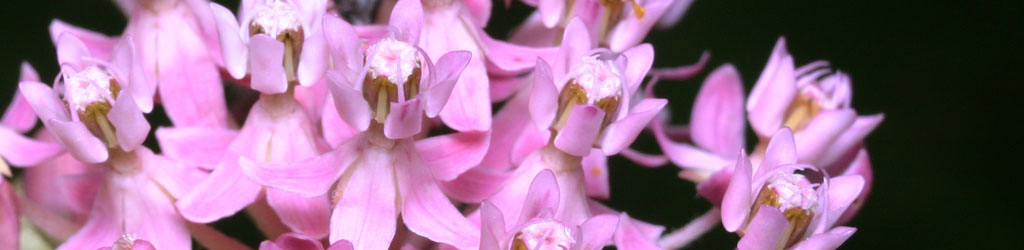
Moving on. While sorting, I found the following little detail, only because I often look at the images at full resolution to examine them for critical sharpness. Here’s the full frame image, from this outing last month, a little contrasting color composition:

You’ve spotted it already, haven’t you? Sure, but only because I told you there was something else to see. And in all seriousness, it’s this kind of thing that helps you find interesting nature subjects – just, you know, if it’s a little more obvious than here.
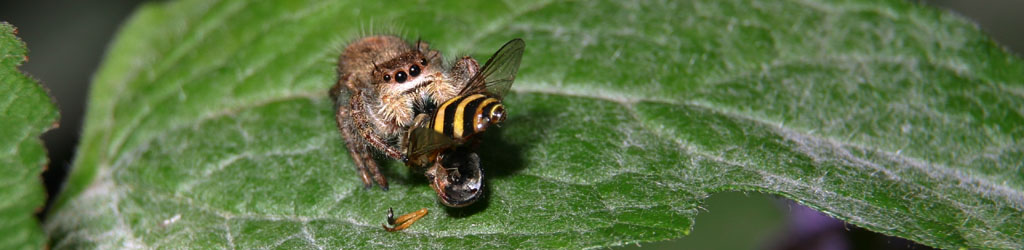
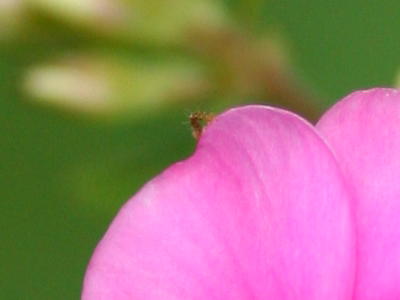 Here’s a better look. No, right there, the little brown thing poking out from behind the purple petals. This is a full resolution inset, what I saw as I checked out the frame for acceptability, and that brown thing is likely a spider knee. I say this not from being anatomically obvious, but because there’s nothing brown that should be cropping up right there, and because the details fit, and because this is the kind of habitat that spiders like, which is illustrated by the image below from the same outing (different patch of flowers though.) It’s entirely possible that the spider saw me coming and slipped out of sight, but remained unaware of how badly its exposed knee gave it away. See, that’s the thing about growing up on hide-n-seek: when we do it, we can learn from it. When most others species do it, losing tends to be a bit final.
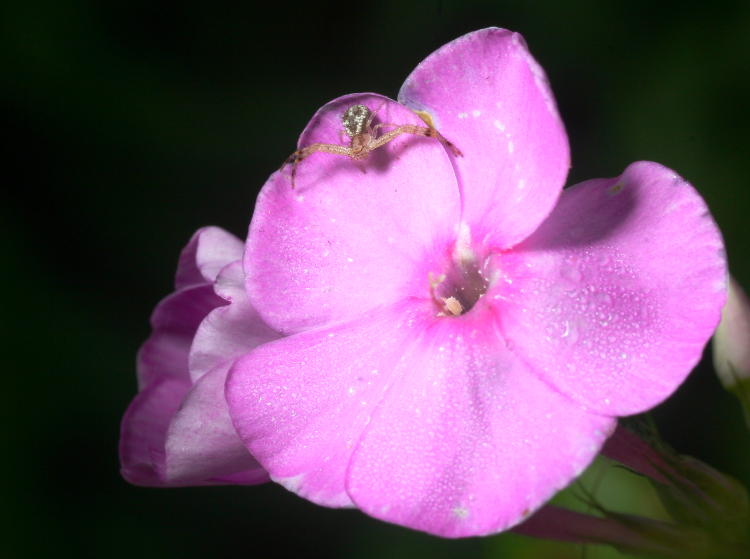
The entire blossom is about the width of your thumb, so no, I don’t feel bad about missing this, and I’ve spotted enough things that might typically have been missed, so I’m ahead of the game. I think – who knows? Perhaps real nature photographers are reading this and scoffing…
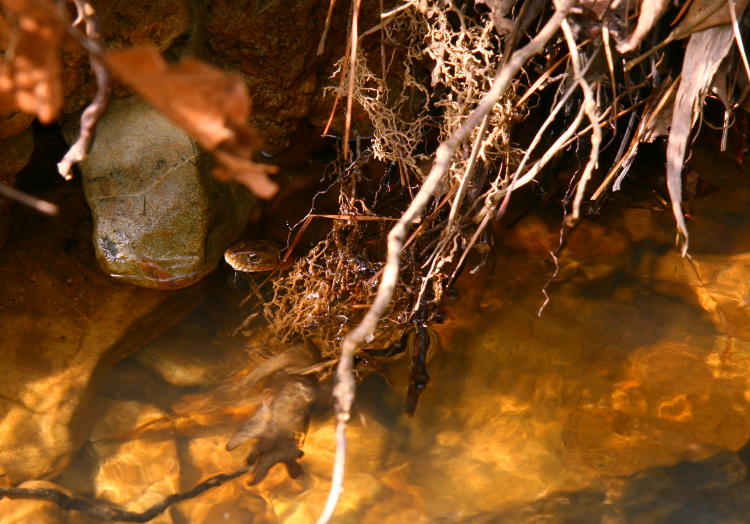
From another outing on the Eno River with the Tardy Mr Bugg, we twice saw the same banded water snake (Nerodia fasciata) hurtle from its basking spot on the roots of a tree on the bank and down into the water. The first time around, I skipped down the small embankment and sought it out, finding it as it peeked from its hiding spot among the roots. Water snakes prefer this kind of habitat, with plenty of hiding spots but easy enough to climb out and bask for warmth, and they camouflage well among the roots. In fact, it saw us before we saw it, and it was its hasty movement that caught our attention. This is also a good illustration of their habits, because snakes cannot hold their breath as long as, for instance, turtles, and when they escape into the water they usually have to surface within two minutes or so, which often isn’t enough time for danger to have moved on, so they usually seek some kind of cover or camouflage to poke their heads up among, within obscuring branches or alongside rocks where they’re not obvious.
I have seen exceptionally few of the banded variety in this region – by far the most prevalent is the northern water snake (Nerodia sipedon,) which can be distinguished from the banded by [I’m not going to tell you because it’s Mr Bugg’s assignment to identify the one in the photos he took.] I would point out that the body of the snake is vaguely visible to the right, curled under the water just under the tips of the roots there, but it’s so distorted by the rippling water that you can’t make much out anyway. This was a moderate-size specimen, by the way, probably about 50cm or so. This one gave me the impression that they’re shyer than the northern water snake, because it sped for cover so quickly, but that could simply be individual variation.
Now let’s go way back, into the dark ages of May of last year, for some images that I didn’t feature then even though I told a story involving them.
I had a borrowed underwater camera and was attempting to do a particular composition, which was shooting right down the inside tube of a curling wave right before it broke, obviously requiring a very specific position and timing. And more so when the waves are small, as they were at North Topsail Beach – but the bonus was, the rising sun was sitting right in position down the tube of the curlers, so I could have this added element. I made a lot of attempts, and not only was I unsuccessful, I ended up losing my glasses in the surf (you may think I was being stupid, and I was, but not as much as you might think, because I could hold the camera down close to knee level where the curlers were without having to put my eye to the viewfinder, so I wasn’t even getting my shoulders wet. Most of the time, anyway.) But this is what I captured while trying, which still has a little bit of interest:

Too soon, not a good curler, but you can see the droplets from the break right at the edge of the frame, while the portion of the swell in the center of the frame hasn’t followed as far. And of course, water drops on the lens don’t help at all…
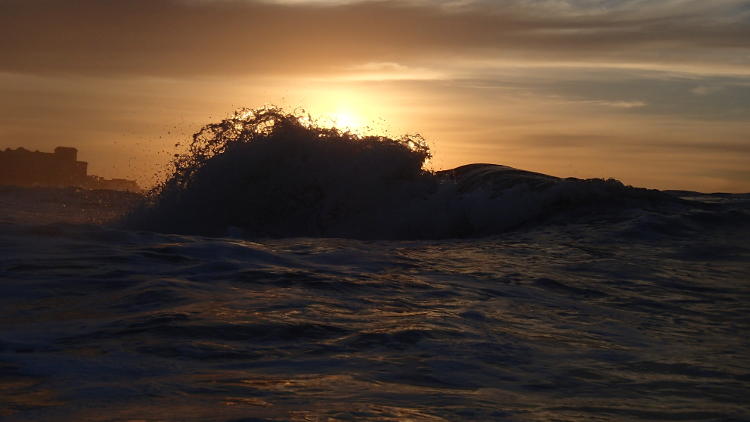
Too distant and too late, but I might still crop in tighter and do something with those airborne drops backlit by the sun. And no, exposure compensation wasn’t an option with this camera, which is why the flash is in use for some of the frames.
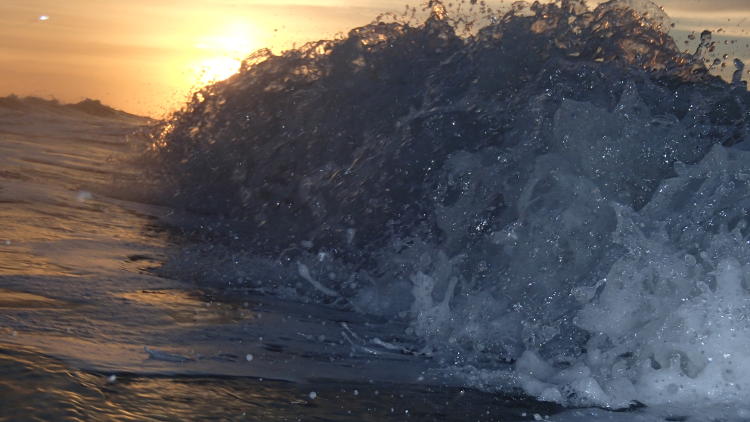
Almost. The timing was only slightly off, the position the closest that I achieved, but the flash did a good job of bringing out some nice foamy details and even a bit of depth. Not at all what I was after, but with a tighter crop it could become a neat abstract.
There were some that were just confusing and scattered, some where the camera was about submerged and mostly what was visible was bubbles. Someday, perhaps, I’ll get what I was after, but I expect it’ll take a lot of tries and more than a few pairs of glasses…
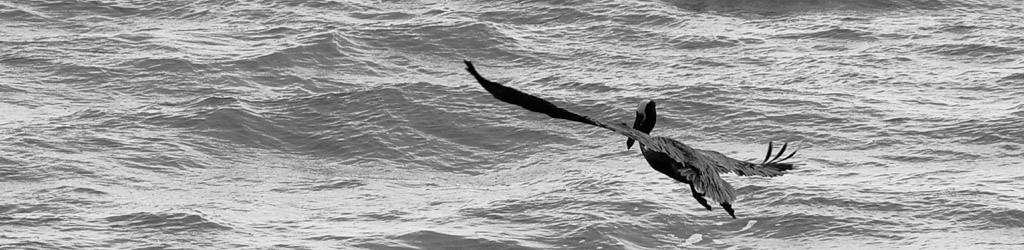
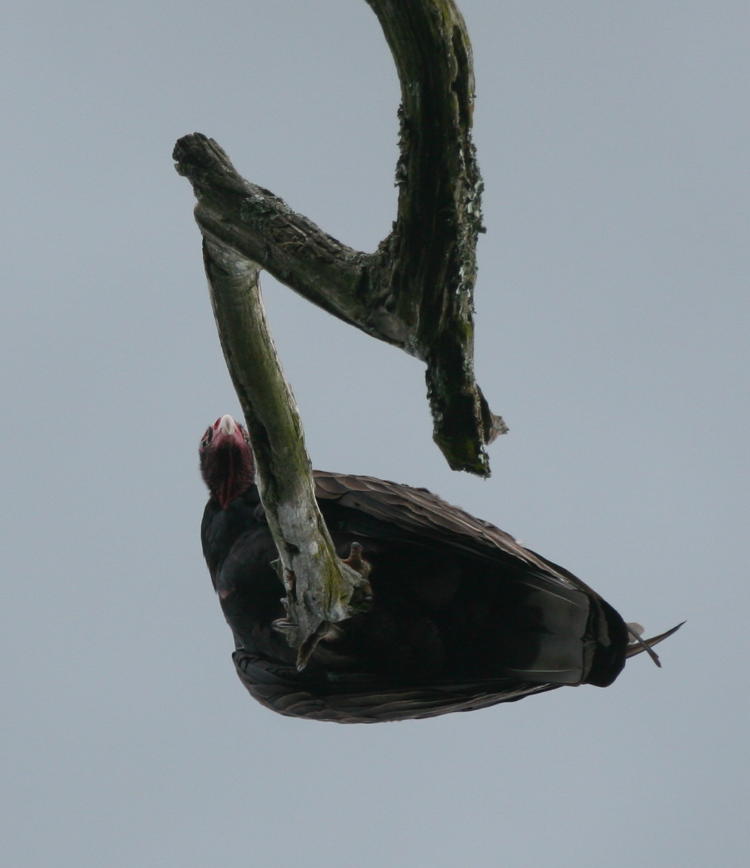
I’ll close with one last image, from the Savannah trip back in September of this year, one that simply didn’t fit in with the post at that time. A few turkey vultures (Cathartes aura) were perched in a dead tree conversing quietly to one another, and I was able to creep in closer to them by moving casually and using nearby trees as a screen. This particular vantage, however, was more than a little dangerous; not only do many birds defecate before taking flight, vultures use vomit as a (very effective) defensive mechanism, so shooting straight up from underneath carries a high level of risk. But that’s me, deep in the face (or, uh, other anatomical parts) of danger to bring you the breathtaking photos. Or at least these.

 If you’re not familiar with the name, Ken Ham is a notorious Young-Earth Creationist, known for his debates with Bill Nye and his cute-as-buttons ark park in Kentucky, where he espouses his ideas about biblical literalism – essentially, the [christian] bible is absolutely true in all regards, even when blatantly contradicting itself. And of course, one of those absolutes is the timeline of creation, establishing that the Earth is only around six thousand years old because that’s all the generations that have been outlined therein. We know this because… because. It says so right there in the bible, and unlike every other book in the world, the bible cannot contain prevarications, myths, or self-serving fables. You may think I’m being snarky, but Ham says as much himself right in his book.
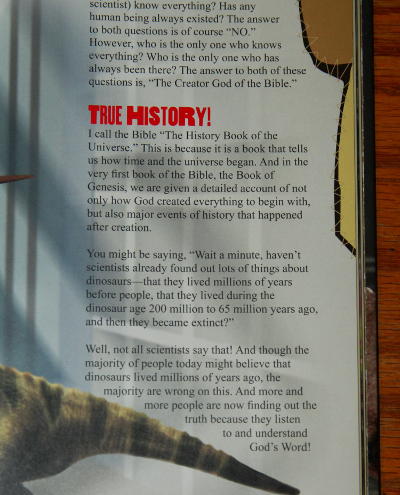 First off, no one is going to mistake this for a book on dinosaurs, despite Ham’s best efforts to list a lot of them. This is evangelical indoctrination, pure and simple, a hamfisted (a ha ha) attempt to use a subject that kids find popular to try and instill his own concept of biblical literalism. We’re not even talking the hoary old ‘Teach the Controversy’ idea, because he does not present controversies, only the idea that scientists are wrong, because bible. When he is presenting the fossil evidence of body types and habitats, for instance, he is content to simply refer to “scientists,” but when it comes to ages and diet, he begins to make the distinctions of “secular scientists” and “creation scientists,” a division to be found among evangelists and nowhere else, since science is not built around ideology, but around the strength of the research. This research is openly dismissed within the book whenever it fails to support any biblical passages, regardless of how much evidence and interconnectedness it demonstrates; Ham even goes so far as to say, multiple times, that secular scientists “guess” at how old things are, completely failing to address the huge body of work that supports the consensus of a 4.5 billion-year-old Earth.
 This is why I never feel particularly threatened by books of this ilk. It is very easy for a questioning child to find all of the flaws in his desperate flailing, and even if their childhood was fully immersed in such selective ‘education,’ interactions with the broader world will soon start to show the myriad problems. As will the progress of (real) science, as his comment that we have never found a dinosaur fossil with feathers was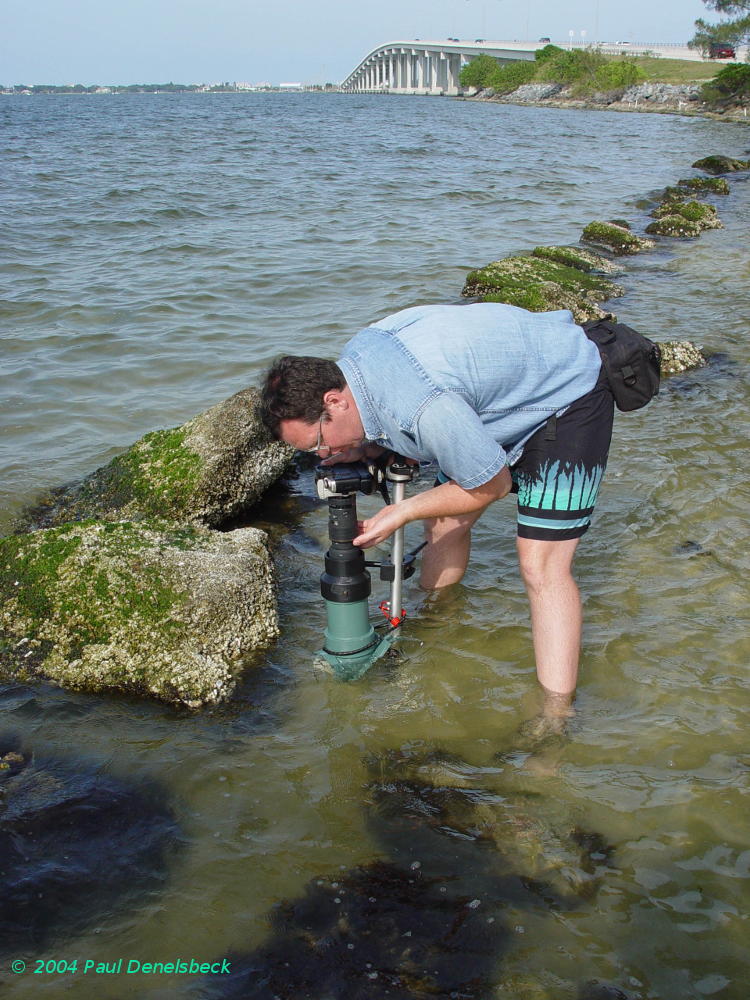
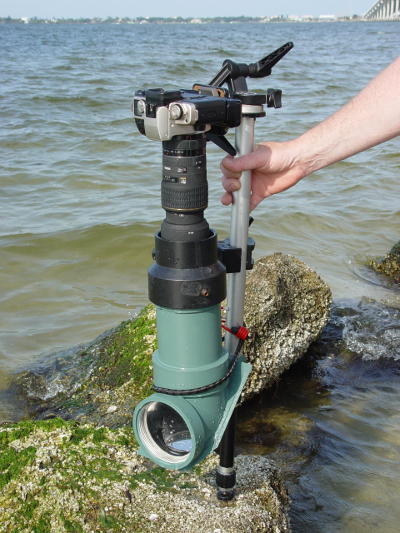 The key portion that promoted the whole thing from an idea to a work-in-progress was a front-silvered mirror, and let me explain. Most mirrors are back-silvered, the reflective surface being on the back side of the glass because it’s delicate and easy to scratch. But doing any photography, especially high-magnification photography, with one of those means there are always secondary ‘ghost’ reflections from the front surface of the glass, so the goal is the make the front surface the most reflective. I thought this was going to be a tricky thing to purchase until I came across replacement side-mirror panels in an auto parts store; the unfinished back was exactly what I was looking for, and it was available in larger pieces for truck mirrors. The remainder is all PVC pipe and a piece of clear acrylic for the viewing window. The elbow is actually a T-joint cut on a precise diagonal and sanded flat for the mirror to mount to, and I painted it all green both to reduce its obvious contrast to any undersea denizens that I got close to, and to cut the glow from reflected light onto the photo subjects and surroundings. On the black collar (a simple reducer) was mounted a 1/4-20 threaded insert for a standard tripod screw, as well as a 3/8-16 threaded stud for a mini ballhead to hold a flash unit, which could be aimed to fire into the water just ahead of the scope. Seen behind the camera is a Manfrotto 3028 head, which as far as I’m concerned is a necessary tripod head for anyone into esoteric photography experiments, since it can get into countless different angles, and was the only one that would accommodate the needs here. All submerged seams were sealed with silicone, and the inside of the whole assembly was painted deep matt black to eradicate internal reflections – before the mirror and viewport were attached, of course. Planning ahead a little can make things much easier.