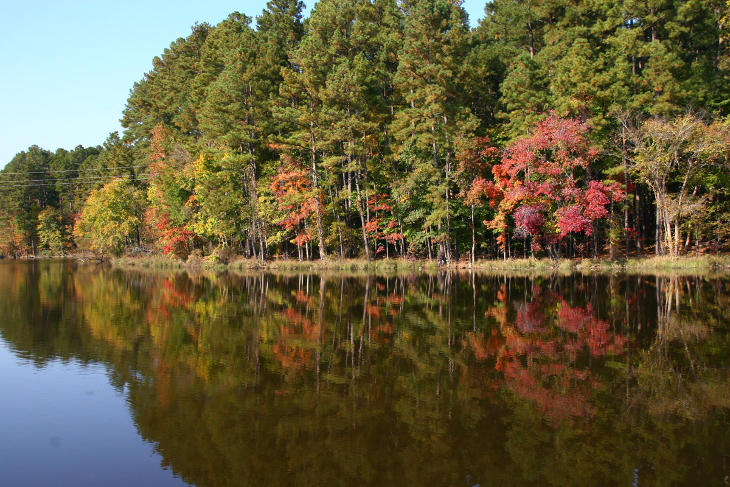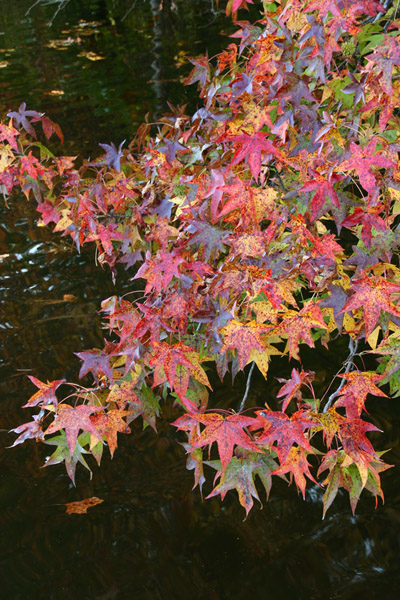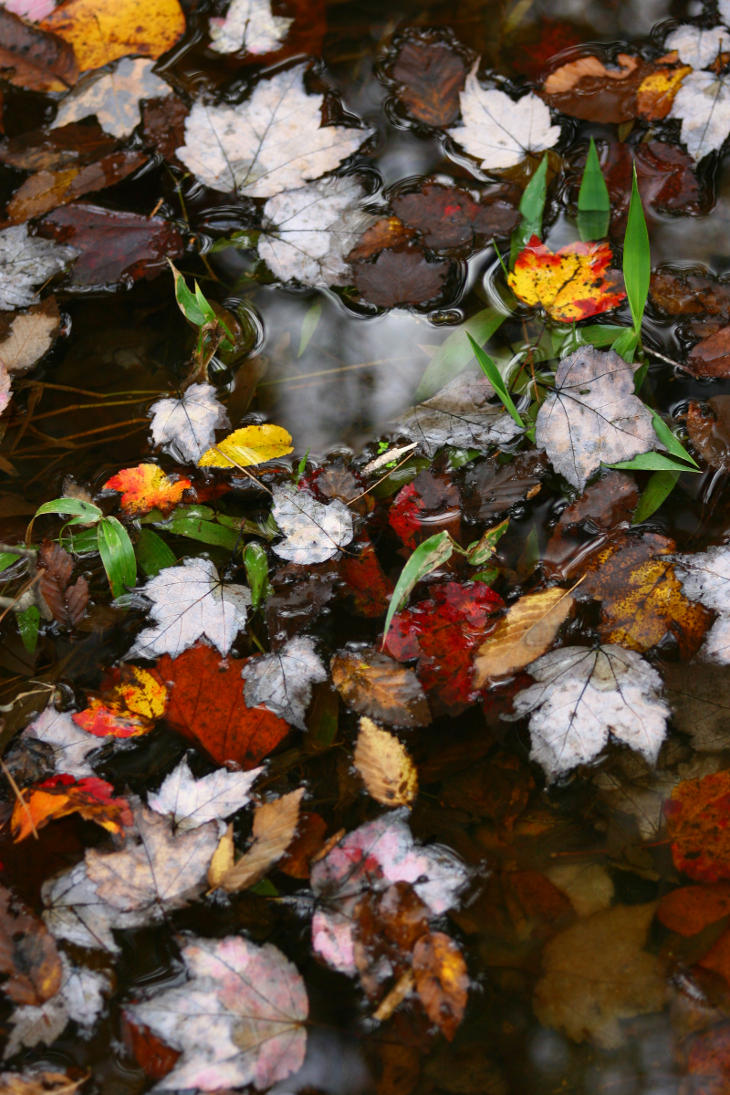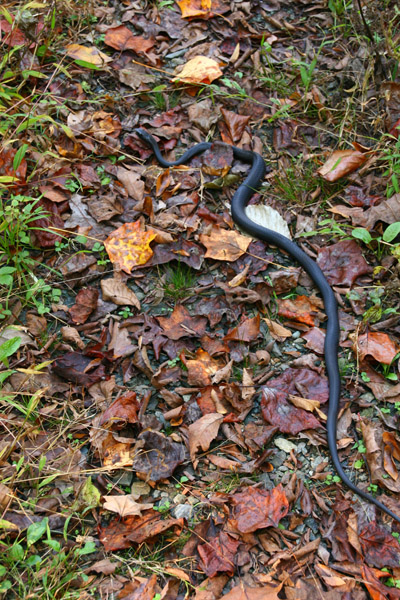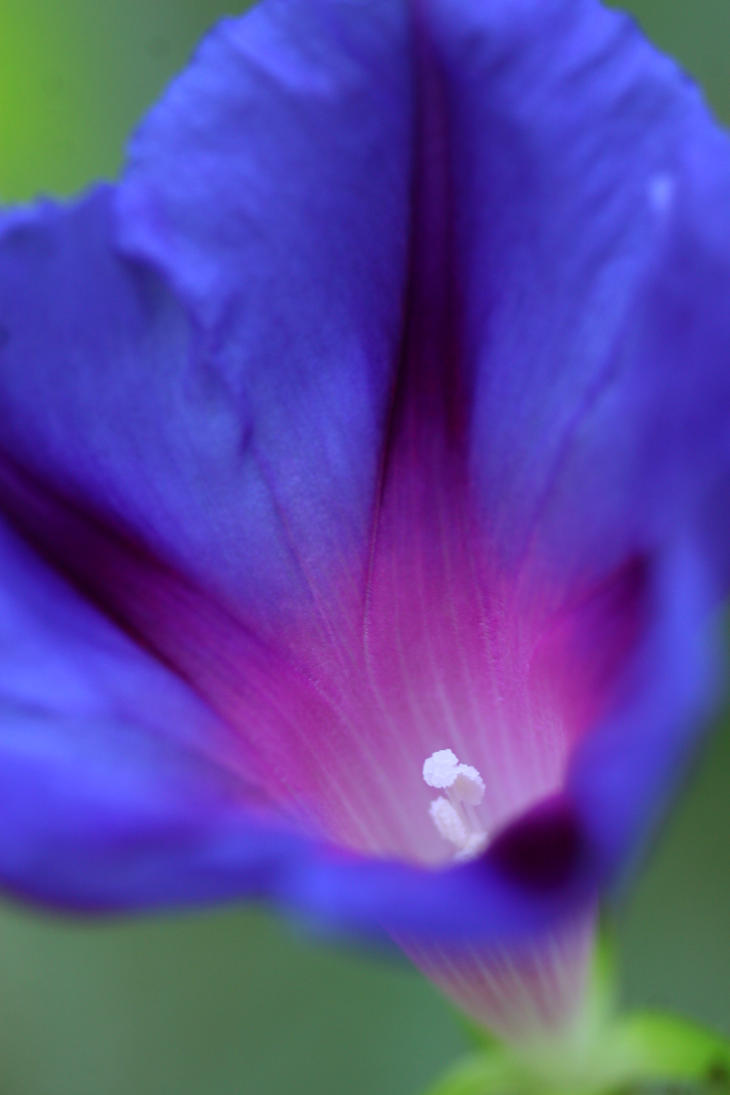





Monday color 32

ripening porcelain berries Ampelopsis brevipedunculata
So, Monday color was originally intended to be only for the winter months because they lacked color and/or subjects to chase. It had come from the overflow of images that I had pre-selected for an end-of-year color post. Since I ended up carrying it through the summer, I figure I’ll just close out the year with it – it has assisted in boosting my post count for the year, as well as providing some updates when I had too few things to write about. However, I may discontinue them come next spring when ‘current’ color pics should be available (especially if I follow through as planned and have a lot more flower species coming up then.)

What we see here are ripening porcelain berries (Ampelopsis brevipedunculata,) a type of grape that has apparently been introduced into the area, possibly by birds. They are often considered “invasive,” a label I pay little attention to since it’s rather arbitrary; apparently, if it was not found in North America before the Europeans landed, and competes better than the species that horticulturists plant on purpose, then it’s invasive. Fully half of the plants you might encounter anyplace in North America are not “native,” and of course food crops have been bred far apart from the way we found them. Meanwhile, loblolly pines spread just as fast and crowd out other species quite readily, not to mention being ugly, but they’re “native” and thus okay, in fact encouraged. People are weird.

Convenient mediocrity

“Convenient mediocrity.” I mentioned it in an earlier post, and while it can be found in use here and there, it is not (yet) a common phrase, even if it is a remarkably common property. What it means (for my purposes here, anyway) is maintaining lowered standards because higher ones take too much effort. More specifically, it means accepting lower quality as long as it’s in a cool, popular format.

I used it in terms of photography, and so we’ll examine that aspect in detail first. Really, not all that long ago when digital wasn’t an option, photographers had a variety of films to choose from, with distinctive color palettes and behaviors, and many of the professionals (and a lot of serious amateurs) would get so anxious about quality that their film would remain in the refrigerator until the day of the shoot, to keep the emulsion from degrading and thus affecting the colors it produced. There were portrait films and scenic films, high and low contrast options, fine grain and coarse, and naturally, a variety of ISO ratings to fit within the lighting conditions. I personally had four different preferred films, and my overall workhorse (Fuji Provia 100F) was usually shot at a third-stop overexposure because that produced the effects I liked. This says nothing about pushing films, varying developers and chemical preferences, filters, and on and on.

And virtually all of that is completely gone now. But digital has not replaced it at all – in fact, digital (despite countless assurances to the contrary in the early days) doesn’t even cover a moderate portion of these traits and behaviors. Digital color is expressed, still, in 32-bit format – each color has a value of 0 through 255, which isn’t a huge range, and has been in use for decades. Meanwhile, the digital sensors within the cameras have a fixed color register to them – they cannot be exchanged like one would exchange films, when switching from scenic photography to a wedding, for instance. The myth still persists that “you can digitally alter the color to your liking,” which is true only insofar as a) you stay within the 32-bit range, and b) the camera captures the color differentiation and details that you needed in the first place. If there were subtleties of foliage, delicate colors of a leaf for instance, that the sensor simply could not distinguish or differentiate, then the only ‘digital’ thing you can do to reproduce them would be to paint them in by hand, because the digital image has nothing to work with. The best example is shadow detail – if the camera didn’t get it, no amount of lightening or contrast adjustment will bring it back.

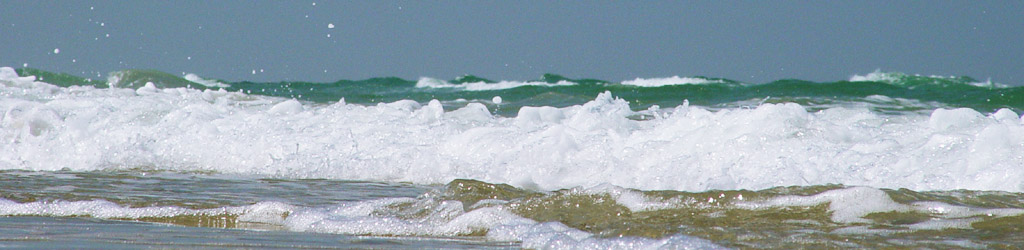
breaker at Nags Head NC
I have yet to see a digital sensor that can render a sky in as rich color as my preferred slide films, noticeable even when it’s been reduced to 32-bit color for digital use. But, producing a deep blue sky means it’s terrible at skin tones. The digital compromise, however, is to become mediocre at both.
32-bit is a rather narrow range, significantly less than any contemporary films. Slide films were made to be viewed with a light source dozens of times brighter than anything a computer monitor can produce, so a much wider range of color intensity is possible. This says nothing of the subtleties of palette, an the idea that the green layer of emulsion, for instance, interacts in different ways with the red and blue layers, giving the ability to selectively produce better foliage images (Fuji Velvia) or, alternately, to bring out much nicer skin tones in portraiture (Fuji NPS/NPH.)

This is the most noticeable hit, to me. I have yet to see a digital sensor that comes even close to a decent portrait film – most skin tones in digital are horrible, and if you want to see the difference, pull up any magazine from the 90s and compare it to any today.

And then there’s resolution. There is no comparison between pixel count and what a film produces, since film grain is variable and, at times, microscopic, not to mention that color films have three layers of grain that produces gradients throughout the image instead of a fixed number of dots. Photographers that wanted the best enlargements used medium or large format films, which (comparatively) shrunk the film grain down for any given enlargement size, since a larger negative/slide meant the image would not have to be enlarged as much.

I don’t mean to harp on this, but it’s necessary to illustrate the change, because while these factors were all in routine use, and even obsessively pursued, by photographers just over a decade ago, they were dismissed almost entirely when digital arrived. Why? Because digital is immediate gratification, even when the results are poor. Plus probably a degree of, “this is new technology and therefore cool.” The only significant advancement was not having to develop the images, and it’s hard to believe that lead time is supposed to be such a huge factor in photography that the decline in quality is justified by the immediacy, but this is assuming that factors are being weighed rationally and objectively. Humans aren’t particularly known for this, even when we believe it’s our strongest quality.

All of this has been referring to the DSLRs, camera bodies ranging from prosumer use to full professional – the idea of a camera phone departs these considerations by miles. Camera phones produce quality just a hair better than the Polaroid cameras that people abandoned in the 80s due to their horrendous results. But, a Polaroid wasn’t able to be held out so easily one-handed to do a poorly-composed and remarkably pointless self-portrait – isn’t technology wonderful?

I’ve ranted about smutphones before, but think about it. A few years back when “land lines” were the norm, we had advertisements about how you could hear a pin drop over a provider’s phone service; now, we’re lucky when we get 80% of the words uttered. I never talk to one of my friends when she’s home, because she has almost no cell service where she fucking lives! Had cell phones come first, we’d be falling all over ourselves when land lines came out, promising no possibility of dropped calls and remarkable clarity – for a third of the monthly fees, too, with no contracts or shenanigans to get you to buy a new phone. Seriously, perspective counts for a lot.

I’m sure you’ve seen the ‘memes’ online about how this little touchscreen phone can do all the jobs of this phone, and that camera, and this video camera, and this calculator, and that tape recorder, and so on – all this individual technology from a few decades ago. And yes, believe me, I don’t knock technology – I was thrilled to get my first TV with a remote. But in reality, a smutphone doesn’t do all of those things. It mimics them, doing each and every task half-ass, but unable to reproduce the quality of any one of them (well, except for the calculator – we’ll give them that.)

What this convenience means, however, is that their usage in all of these manners is frivolous – used because we can, but not because we should. The vast majority of the stuff produced through these phones – and yes, I’m including actual telephone conversations, as well as texts – is mediocre at best, strictly from the standpoint of content. We will never use the words enrich, or enlighten, or inform or educate or much of anything else related, when describing these offerings. At best, we can say they entertain – if our standards of entertainment are remarkably low.

But now, here’s the part I haven’t quite come to terms with. There have always been mediocre efforts out there – the amateur photographers, the people recording their music on cassette recorders, the cheesy home videos done with a few friends [*cough* What? Nothing. I don’t know what you’re talking about.] But at the same time, there remained the professional skills, and equipment, and services – no amount of camcorder-wielding relatives replaced the wedding portrait photographers, nor did they change the equipment that was available. But somehow, a new set of standards has arisen, or indeed befallen, and now it’s next to impossible to pursue the methods that provide the highest quality. Film developing is remarkably hard to accomplish anymore; music cannot be found outside of the dynamic range that MP3s can handle.

I recognize how ‘popular demand’ works, causing labs to close down because no one needs to have film developed anymore. What I don’t understand is how the reduction in quality was somehow justified by the convenience, the reason the labs had to close in the first place. Why is there no demand for portraits that no digital image can touch? Why does my digital voicemail sound worse that the little cassettes I used to use? How come every phone conversation now contains awkward gaps and pauses from transmission delay? This isn’t advancement in any way, and I’m confused as to why so many people think we’ve improved something.

Stick with fashion

one barn spider Araneus cavaticus eating anotherSo, right outside the same porch mentioned in the previous post has been a pair of large orb webs occupied by barn spiders (Araneus cavaticus), both females – it was only one for a few days, then another moved in. And curiously, their webs were almost stacked; while the centers of the orbs were not aligned, the webs themselves overlapped only about 10cm or so apart, while the spiders sat in their alert positions about 30cm offset from each other. Barn spiders tend to rebuild their webs frequently, usually using the same anchor strands, so their positions changed over a period of about a week. I kept thinking I should do a shot that included them both, but couldn’t work out an angle that would work.

Sometime in the last 12 hours, that opportunity passed, along with one of the spiders. I have no idea what transpired, but one of them was proudly displaying its meal of the other. And you thought beauty pageants could get cutthroat…

Competition among individuals of other species can at times be pretty distasteful to us – sure, we might kill our rivals, but not eat them! Almost never, anyway. But behavior is a widely variable thing, dictated by the winning lottery of natural selection. Think about it: each spider is competing for both food and mating privileges, and in one move (well, okay, it might have been quite an altercation) this was eradicated. Spiders have no reasons whatsoever to cooperate, so the only decision about what constitutes “food” is whether it’s too dangerous to tackle.

It can even illustrate a simplified facet of evolution. If one of these spiders was aggressive and ‘cannibalistic’ while the other wasn’t, one of them is far more likely to win that encounter. And now, with the competition gone, the winner stands a much greater chance of passing on her genes. it is entirely possible that this scenario played itself out numerous times in the past history of this species, and so now all of them will view other females only as a tricky-to-obtain collection of calories. Humans are a cooperative species, because it worked better for us in hunting and farming and such, and to foster this we have strong feelings about interactions among our own species; thus we might look upon this behavior within the same species of spider and find it abhorrent. Yet it’s only about what worked best among the available options, and from a survival standpoint, this works well for the spiders. Sometimes we have to ditch the emotional reactions to fathom the functional aspects.

Coming together

When The Girlfriend purchased this house a little over a year ago, it was of course necessary to begin personalizing it, which is one of those things that goes slowly and I don’t think ever really gets ‘finished.’ This means that I often have several projects on hand, either planned or in progress, and sometimes they’re not always known to her until they’re completed.

The house has a decent-sized screened back porch, and almost immediately, we affixed a string of holiday lights along the ceiling edge – I had discovered long ago that multi-colored dim lights are actually very relaxing, and so this provided mood lighting for this space, and we often eat meals out there. After a period of time, The Girlfriend obtained a nice outdoor glass-topped table to replace the small, basic one that we had placed there initially, the only one we had to spare when we moved in. The textured glass gave me an idea, so while she and her daughter were away for another surgery, I arranged a second set of holiday lights under the textured glass surface to surprise them when they returned. I ended up with a lot of the string left over, so I poked it up through the hole in the center of the table (intended for an umbrella) and stuffed it into a mason jar, creating a simple lighted centerpiece.

This went over very well, and even increased the amount of times we ate out there, but The Girlfriend noticed one night that the mason jar could build up quite a lot of heat if the lights were left on for a while, and I figured we needed something ventilated. Brainstorming occurred. Shortly, I located what I was looking for on eBay and ordered it, for far less than I imagined I would have to pay.

vintage but filthy Swallow barn-railroad lanternWhat I found was a vintage barn or railroad lantern, and it arrived in “as found” condition, complete with old spider egg sacs (barely visible to the lower right of the chimney.) It took a while to clean up, and the kerosene had stained the enamel around the base, but I figured that just added to the rustic charm. Despite the grime, it was in good enough condition that I could have filled it and lighted it immediately, and I debated about cleaning it up and reselling it, but I liked the look of it too much. Once cleaned, I removed the wick assembly and drilled a large hole in the bottom of the kerosene tank, then fed the lights up through the bottom and clustered them within the glass chimney. From discussion to result was less than two weeks, and from arrival to display less than two hours.

modified Swallow lantern centerpieceIt looks quite nice in place, and my only regret is that it is not self-contained and running from batteries, with that fill-spout serving as the power switch. Even during the day, it produces a nice effect, but at night it really comes into its own. I know there are some people that think multi-colored lights are garish or old-fashioned; good for them. We’re pleased with the ensemble, and that’s the only criteria we need.

So when I’m not posting as often, occasionally it’s because I’m chasing some other projects – this is just one that I decided to show off. The starbursts in the image below, by the way, are courtesy of a small aperture, in this case f22. It’s a simple trick.

[And if you’re surprised that nothing “buggy” is evident on this porch, well, let’s be realistic: the photography is a pursuit, not a lifestyle, and doesn’t have to be present everywhere. But the metal ants seen earlier are actually out of sight on the porch railing to the right ;-) ]

lantern centerpiece showing night effect

Monday color 31

assassin bug Zelus luridus on pink azalea blossomLooking at how the day is shaping up out there, it seems like this is a pink kind of day, so this image has been specially chosen to fit in with the conditions.

[Which is nonsense. I set up the Monday color posts usually several days in advance, and they’re scheduled to post at 2 AM. I have no idea what Monday is going to bring as I’m typing this.]

Zelus luridus is a fairly common little green assassin bug, and they loved the azalea bushes at the old place – actually, everything loved the azalea bushes. But it was simply a matter of time and patience before I would capture their bright green bodies against the vivid pink of the flowers, despite the fact that they were standing out about as much as any insect could. But c’mon, look at the size of that braincase – we’re not talking geniuses here…

So what do you think? Do you suppose I should have cropped a little tighter on the top right and gotten that tiny splash of green out of there? Did you even notice it? I wonder about these factors sometimes.

Quick! Go here before midnight!

If you were paying close attention, you might have noticed that I have a tendency to post religion-bashing stuff on Sundays, because I’m perverse – we atheists are mean that way. I wasn’t really planning anything of the sort, and have been working on site updates today, but Professor Ceiling Cat has a fun post over at Why Evolution Is True, and you should check it out. Quick, while it’s still Sunday! I might even appear in the comments myself, eventually, to address a couple of points that I haven’t seen anyone else tackle yet.

Basic explanation: after a guest post by Ben Goren elaborating on the problems with theodicy, a commenter by the nym of “Nixak” provided a lengthy response enumerated in six major points. For a brief observation just to include something more than a link, this is yet another example of someone’s personal interpretation being forwarded as if it was orthodoxy. One of the points, believe it or not, is that god does not respond to prayers unless his proper name is used, which apparently not enough people know. I admit, this is the first I’ve heard any argument of this nature outside of comic books – what if you say it backwards? How about three times? I have so many questions…

Anyway, for now, see how well the commenters are handling the points therein. I’ll be back shortly.

Just some casual shooting

monochrome cumulus clouds against branches crepuscualr rays
sun breaking through cloud edgesYes, it’s still been a slow couple of weeks, and I’ve been working on some other projects, so the photography is leaner. Hopefully this is not yet the start of the downward trend that autumn brings.

While out at the nearby pond yesterday, distant rumbles and the evidence of some towering thunderheads carried the threat of a storm, but it failed to actually hit here so I took advantage of the dramatic cloud formations to do a little sky photography. At top, the sun peering past the edge of the cumulus clouds provided both a high-contrast composition and some faint crepuscular rays through the humid haze. When I noticed this, it was half-hidden behind the tree canopy that bordered the pond, so I dodged back and forth a bit until I could line up the clouds with a complementary gap in the trees. I played around with the color channels, but in the end simply converted to greyscale and tweaked the contrast just a tad higher. The one at left, though, needed the odd colors produced by the thin edges. There are electrical wires in the bottom of the original frame, cropped out here – I really hate electrical wires.

The weather might still have been the after-effects of Tropical Storm Erika, which brought some much-needed rain several days back and dropped the temperatures a bit. Not too long after those rains, while things were still dripping, I was poking around and spotted a tiny crab spider lurking in the blossom of a buttonbush (Cephalanthus occidentalis) – the pollinators that I usually see raiding these flowers are many times the size of this spider, so I suspect it was either enthusiastically optimistic or simply biding its time until the right-sized meal came along.

crab spider lurking in buttonbush Cephalanthus occidentalis flower
The adhering drops that can be seen with a close examination may give some indication of size, but another shot may help, especially when I tell you that the blossoms are typically the size of a golf ball, and frequented by bumblebees and swallowtail butterflies. This spider, legs spread as wide as it could reach, couldn’t even span the eyes of a bumblebee, so, yeah…

crab spider on buttonbush Cephalanthus occidentalis blossom
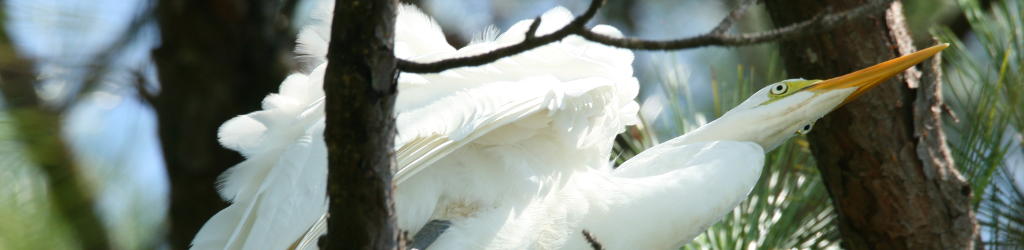
great egret Ardea alba peering past foliageThe storm may also have been responsible for the presence of a great egret (Ardea alba) at the pond these past few days, having been driven out of its normal range by the winds. I was used to seeing them in Florida all over, and along the NC coast, but haven’t seen one in this area in a long time. I’m not sure what the resident great blue heron thinks about this newcomer – it’s been the sole big wader for the entire pond, though I have spotted smaller ones for only a day or so – but the pond is big enough to support them both, and the green herons and others. We’ll just have to see if this one decides to stick around. It seems less wary than the great blue – this image was acquired with some very basic stalking – so if it remains for a bit, I might be able to do a more rounded gallery of images.

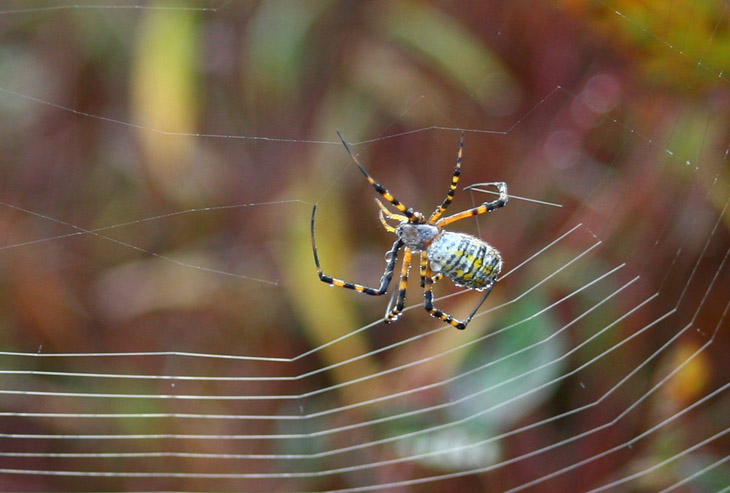
unidentified grasshopper locust in foliageI can’t say if the storms had the slightest to do with these, all I can say is that abruptly, several individuals of this unidentified grasshopper could be found with little effort, when I have been seeing virtually nothing of the sort in the area before. These are big enough to be called ‘locusts,’ better than 5cm in overall body length, and while capable of doing a lot of plant damage, I suspect they won’t last long against the large number of birds and the nearby black-and-yellow argiopes (which have been chowing down on dragonflies and cicadas, and would probably relish the change of diet.)

crab spider on white flowering vineI close with another crab spider, even smaller than the previous, remaining inconspicuous on the underside of a delicate white flower – I haven’t pinned this down for sure, but the flowering vine might be virgin’s bower (Clematis virginiana.) I’m going to have to confirm this because it produces a lot of flowers that we could use around the yard, and thus attract more insects and perhaps hummingbirds. Granted, bigger flowers are more likely to attract the kind of spiders I’d really like to see, but this would be a start, anyway.

Like Flames

It’s been a little while since we’ve had a musical break, and this seems like a good candidate. As I said, my music tastes are unabashedly mired in the 1980s, with the occasional contemporary popping up here and there (Coldplay will probably be along at some point or another,) and so we ride the wayback tortoise to 1987 to check out Berlin’s Like Flames.

Berlin and lead vocalist Terri Nunn got too little attention, as far as I’m concerned. They’re best known for Take My Breath Away, the love theme from the movie Top Gun and quite possibly the only thing to recommend it (I wouldn’t know – I stopped watching after ten minutes of exasperation.) However, that single was not representative of their energy or style, and other releases like No More Words and The Metro give a much better feel for the group. And naturally, this one. Nunn has a marvelous voice, ranging from pleasantly dulcet to a throaty wail, and can rip a lot of feeling out of her lyrics. The video is a product of the 80s as well, so just keep that in mind – they were pretty much all like this.

The lyrics, by the way, can be found here. Since every source presents the same spelling of weak/week, I have to assume they’re that way right from the album, but whether this was intentional or not is up for grabs.

An interesting bit of trivia regarding Terri Nunn is that she auditioned for the role of Princess Leia in Star Wars, which might have been an interesting casting choice (I never quite got behind Carrie Fisher in that part, though I’ve liked her in other roles and appreciate her satirical contributions since.) Nunn, however, might’ve been a bit young for the part, considering that the movie was released ten years before the video shown above.

The band broke up not long after this track was released, so there are too few examples of their work available. If you liked this one, you might try No More Words, The Metro, and Masquerade, all great examples of Berlin’s music. However, Like Flames was later covered by the group Twenty 4 Seven; under no circumstances should you attempt to listen to that version.

Making change

One of the most confusing things to attempt is self-evaluation. It might be easy to think that if there’s one person we’re intimately familiar with, it’s ourselves, but when it comes down to it, we realize how hard objectivity is in such situations. Ego is such a loud voice in our minds, it’s hard to hear the little things which might be much more accurate.

Thus, I cannot honestly say how much of these changes I can take credit for, and how much might have come from outside sources that I have subconsciously discounted, but here it is anyway. There are two major changes in attitude that I have undergone recently, and overall, I credit them to my embrace of critical thinking. If this seems dramatic, it’s because of the recognition that changing one’s mind is sometimes hard, especially when it comes to values and ideologies, or anything that we have a strong opinion of, really. Admitting that we were wrong is difficult enough, but more, I have strong suspicions that we have an inherent function within our minds that promotes a firm stance, avoiding indecision and delays; we like to make our minds up once, and then consider this was adequate thereafter. We all know people that are unbelievably stubborn, and it probably has a lot to do with both of these traits. But don’t ask me where I fall on the spectrum myself.

The first item is space exploration. I was born in the mid-sixties, and grew up in the heyday of the space program, following it avidly. I had the toys, and later the model kits, and in fact there is an unbuilt Apollo upper stages kit, dating from 1971, waiting for me to tackle it in the other room right now. When I lived in Florida, I was only 50 klicks from Cape Canaveral, and local cable TV had a NASA channel which would show live launches and operations, and when things were slow, film clips taken from the ISS as it orbited, a very pleasant visual to unwind with. Unsurprisingly I suppose, I also grew up with National Geographic and Mutual of Omaha’s Wild Kingdom, so exploration is rooted rather deeply within me. However, I suspect it’s rooted deeply in everyone, because we as a species have very strong tendencies to explore, and this is possibly a survival trait that brought us through numerous climate and environmental changes, the same kind that may have hastened the extinction of other species that were ill-equipped to handle the new conditions and had no drive to find other, compatible habitats. This is only speculation – it would be very hard to prove what influenced us thousands to millions of years ago – but the drive to explore is undeniable.

While the examples seemed to have lessened a bit now, there are still plenty of people saying that our future is in space; mankind’s destiny is to expand outward, colonizing other planets, and no small number of people are wondering whatever happened to the moonbases we were promised by this time. If there’s one message that is virtually unchanging, it’s that we will eventually exhaust our resources here on Earth and have to seek more opportunities off planet. And up until only a few years ago, I was right there with them.

But here’s the first factor: space is incredibly, undeniably hostile to us. Those space suits aren’t that bulky for fashion’s sake. Space lacks everything that we need to survive, save for the sun’s radiation, and of that it has too much. No planet within reach has any of the conditions we need, nor could they be added or created without an astounding amount of effort, and even then it would be in little bubbles rather than anything even the size of a small town.

That bit about “within reach” is key, because that’s factor two: getting around inside our solar system takes a lot of energy and time; this is multiplied by thousands to millions when we consider outside of it. Even with theoretical energy sources, traveling to another star system would take many decades, but probably a lot more like centuries. This is where all of the science fiction regarding putting travelers in stasis, or having massive city ships, comes from, as well as all the stuff about wormholes and extra-dimensional space and so on.

Quite a few people would argue that these are hurdles we will overcome eventually – we humans can do a lot if we put our minds to it. We will figure out how to create a small self-sufficient system with lean resources, how to limit population growth on century-ships, and even how to cope with bone-density degradation through weightlessness and not going stir-crazy in a small ship. But the funny thing is, if we solve the first set of problems, we don’t even need to tackle the second, because we won’t need to expand to the stars anyway. The planet we have right here is perfect for us, because we evolved on it, and it’d be a damn sight easier to keep in in working order than to try and recreate it elsewhere when it’s broken. This “can do” attitude is wielded with abandon when it comes to traversing space, but somehow not when it comes to staying home. Interesting, isn’t it?

Don’t get me wrong – I think space exploration is a worthwhile pursuit, and a moon colony would boost this commensurately. But I can no longer consider the idea of humans expanding outward to other planets and/or systems to be even slightly plausible, and I think this is a blind spot that a lot of us have.

The other item that I ended up reconsidering drastically is driverless cars, and so I need to introduce a little background for this as well. I am not at all technophobic, and in fact embrace a lot of the electronic achievements that we’ve been making over the past half-century. But I’m skeptical over the promises that have been made, since most of the pie-in-the-sky predictions have never come to pass, and progress has been significantly slower than we would have liked. But more to the point, humans are a remarkably fast and versatile thinking system, able to absorb and react to unexpected circumstances in milliseconds, and driving is one of those situations where reacting to the unexpected is crucial to avoiding accidents, injuries, and death. Computers haven’t been coming up to speed very well at all in such regards, and the thought of leaving control of a motor vehicle entirely up to a program is worrisome; it doesn’t take much to go wrong, and the frequent updates for any given bit of software does not instill confidence in our abilities to make stable and trustworthy electronic systems.

And with all that said, I am finding myself more and more in favor of driverless cars. The key distinction within is that, while humans can be remarkably adept at handling unexpected situations, this does not mean that we always are. I live in a state where turn signals are somehow considered optional, unnecessary from either a courtesy, safety, or effort standpoint, and the bare ability to remain within the driving lane seems only slightly more important. Pretty much every time I’m on the road now, I see someone doing something stupid (and I imagine that the same might well be said about my driving as well, at least at times – I know from experience that I shouldn’t be in conversation when I’m looking for the next turn.) Driving is less and less considered an activity that requires careful attention and effort, and more a chore that gets in the way of being someplace or doing something else. To say nothing of the impatience and frustration, the teeth-gritting agony of having to slow down and go wide around bicyclists and pedestrians, much less coming to a full stop at intersections.

But there’s something that’s worse, and it’s that we’re a betting species. We play the odds constantly, whether it’s over the chance of a cop actually catching us breaking the speed limit or that there won’t be someone in the oncoming lane right at this very moment. And we’re stupid enough to believe that if it hasn’t happened so far, this trend will continue. Not to mention, I can do something stupid right now because everyone else is supposed to be following the rules – we will count on, actually bet on, other drivers not being as dumb as we are. It sounds ridiculous when it’s phrased this way, but you know how often it really happens because nobody phrases it that way in their head.

And that’s a very important factor, because a driverless car will never try to justify its actions, will never have a line of programming that says, “Just this once.” It won’t get impatient, it won’t drive angry, it won’t fucking hit the road saying, “I’m not that drunk/high/pig ignorant of consequences.” It will never fumble for something that fell under the seat, much less concern itself with texting friends inanely. All of the good driving habits that we have ever been taught will not be things to remember, or stuff used only on the tests and never again thereafter, but part of the program – not rules, but akin to physical laws; there is no option for breaking them.

Moreover, if some of the advances proposed so far come to pass – and there’s no reason to believe they won’t, since they’re not that difficult to accomplish – driverless cars will be far more aware of the surroundings and environment than any human driver. Knowing someone is within the car’s blind spot will be automatic, relayed by short-range IR “radar” or even constant proximity ‘announcements’ from every vehicle; there will be no blind spots. Sudden braking can produce a warning transmitted to every other vehicle in a wide radius behind, and all reaction times to unexpected events will be faster than human and not subject to variation or distraction. Riding in a driverless car may well be quite different from the way we would normally drive, because they will certainly err on the side of caution and won’t take any chances, but who cares? No one would need to be looking at the road anyway.

I’m not unduly optimistic: there will be failures of the system, and accidents, in some cases ones that could have easily been avoided by an alert human driver. But let me suggest an exercise. Right now, within a 30-kilometer radius of where you sit, how many human drivers are doing something incredibly stupid? Or to try a different perspective, how many of the fatal accidents that occur every day have come solely from failure of the mechanical aspect of the vehicles? And of those, how many could have been avoided by the driver utilizing the correct response to the situation? Taking stupid out of the equation will greatly reduce the number of roadway injuries and fatalities that occur. Full stop.

But we have a different perspective on leaving control to machines. If and when a failure occurs, we see it as avoidable, something that humans would not have done, or could have prevented. But that’s true of the vast majority of accidents out there, and not to put too fine a distinction on it, even mechanical failures are mostly human at heart (heh!); improper programming or the failure to anticipate such-and-such situation, poor quality control or inadequate materials for the task. These cars aren’t going to be assembling themselves, even if the factory were completely automated. Yet the idea of relinquishing control is uncomfortable, sometimes galling, and more so if we consider the idea that these lowly machines could do it better than we can.

This is where I credit such changes in attitude to critical thinking. The drive to explore, and the insecurity over relinquishing control, are emotions – traits that worked to help us survive, but not necessarily a rational consideration of the factors involved. “I don’t like it,” isn’t by default a rational response, and in far too many cases it’s just the opposite, a reaction based on thinking biases, or assumptions, or preconceived notions. But critical thinking, and most especially the process of debate, provokes us to examine the responses, to build a case for our standpoints, to know ourselves – at least a little bit.

And there’s another factor. As mentioned above, we don’t like admitting that we’re wrong, and like it even less when someone else does it for us – we see it as losing a competition, as silly as that seems. But we can do it for ourselves, internally, by simply arriving at a better solution; we’re wrong, but we’re also right for correcting ourselves, you know? Much better than someone else beating us to it.

Does that make this post one ridiculously long humble-brag? Probably, though I’d like to think it was still making a point about examining one’s values. But what the hell – you’re the only one reading this anyway ;-)

1 233 234 235 236 237 327