


























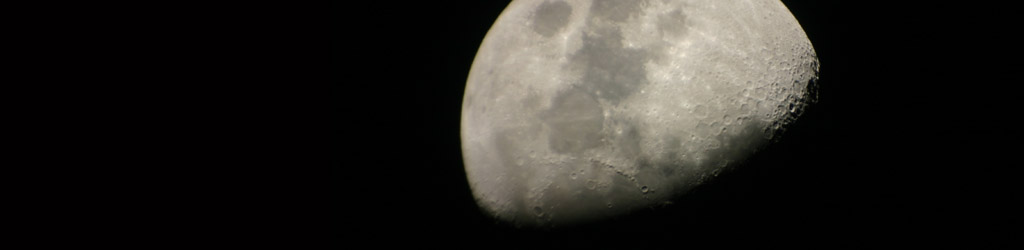















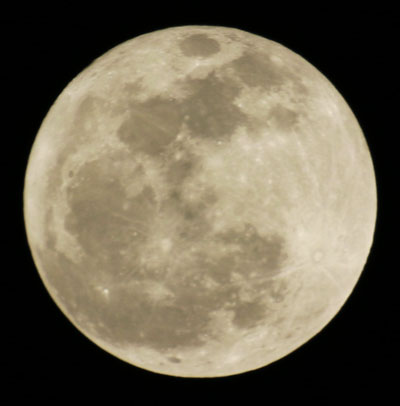
 I amused myself earlier this evening by doing a little astronomical shooting, but in a strictly casual way. I have an 8-inch Galilean telescope which I can use to get fairly decent photos like the one for this post, but it’s packed away and I wasn’t motivated enough to dig it out. Instead, I simply used the 170-500mm zoom lens, both with and without the 2x teleconverter. I found that the teleconverter didn’t provide any edge in these conditions, and simply worked without it.
Later, looking at the details of the lunar surface in this sample from the shoot, I began wondering about Tycho, the remarkably prominent crater seen here at lower right, even visible to the naked eye. The ray pattern of ejecta extends across almost half the diameter of the moon’s surface, and the impact itself had to be devastating. The subtly remarkable trait about it, though, is the direction that it faces. The moon is in what’s called a synchronous rotation, keeping one side (mostly) towards Earth as it orbits. This has resulted in the near side being relatively light on craters, while the far side is absolutely covered with them. The stronger Earth gravity basically captured most of the debris that might have impacted the near side. Tycho, however, marks a distinctive contradiction to this, and presents some indication that the asteroid that caused it passed rather close to Earth.
I started to wonder how it compared with the Chicxulub (“cheek-shoe-lube”) impactor, the asteroid that struck 65 million years ago and was most likely responsible for the extinction of nearly all dinosaurs. That one had produced a debris cloud that extended across much of Earth, and potentially caused catastrophic changes to climate through the suspended atmospheric particles and volcanic aftereffects. Were they similar in size? And how old was Tycho, anyway?
The answer was rather surprising. Tycho is approximately 108 million years old, young for a lunar crater, but much older than Chicxulub at 65 million years. And also much smaller, the crater being slightly less than half the size of Chicxulub’s, or at least what Chicxulub had been before climatological erosion and plate tectonics nearly erased all traces of it. The surprising part is that they both are theorized as being from the same origin, the breakup of an asteroid after a collision in the asteroid belt between Mars and Jupiter, roughly 160 million years ago. The debris from this produced many small asteroids known as the Baptistina family, two of which creating Tycho and Chicxulub after they were ejected from the belt by the impact and captured by Earth/moon gravity, another being the current asteroid 298 Baptistina. So two devastating impacts to neighboring bodies were actually caused by siblings, if the theory is correct.
The wide time lag between the two impacts isn’t anything odd – while we might picture chunks hurtling across space in a direct line towards impact, the reality is that debris and dust tends to be nudged and drifts across space, and may be temporarily captured by planetary gravity in an unstable orbit. Eventually, the gravitational influences of two close bodies produces a combination of pulls that sends the debris into the path of the orbiting planet or moon. In cosmic terms, the 43 million year difference between the two impacts is relatively small.
Tycho, by the way, displays evidence that its impact produced molten rock and deep scarring, while Chicxulub created a region of underground (and underwater, now) caverns called cenotes. You should check out the Wikipedia page on the impact – it was a mess.
Also interesting is that Manicouagan Crater in Quebec (enter “51.374100 N 68.672437 W” in the online mapping site of your choice, like Google Maps or Bing – you’ll probably need to zoom out) is only 70 km (43 mi) in diameter in the visible ring, compared to Tycho’s 85 km (52 mi) and Chicxulub’s 180 km (112 mi). Yet Chicxulub isn’t even visible (21.352998 N 89.100186 W), while Manicouagan, at 215.5 million years several times older than Chicxulub, can easily be made out from space. The secret is the terrain they’re within. Manicouagan sits in the middle of a tectonic plate, one that is very flat and has no mountains to produce lots of water flow – in essence, it is a swampy lowland, so erosion is slow. Cruise around your map and see – there are lots of impact craters of varying ages all throughout the region, including a cool double crater. Chicxulub, meanwhile, sits very close to the boundaries of several tectonic plates and has undergone significant changes in the intervening time – the Central American region is not volcano-riddled for nothing. The surface evidence of the crater has long since been driven away, but the subsurface remnants still exist. Another, even younger one sits under the Chesapeake Bay and may be about the size of Tycho.
While all of these sound like very long times ago, in geological and cosmological terms they’re recent. The ugly truth is, other such impacts could happen at any time, and the asteroids or comets that might cause such a catastrophic impact need only be a few kilometers across (Chicxulub was estimated to be something like 10 km in diameter.) That’s small. Our ability to spot such asteroids isn’t that great right now, which means we may have little warning of one approaching. Regardless, we have virtually no way of doing anything about it anyway. While our space program meanders along begging for table scraps left over from pork-barrel military projects that mostly chase ghosts, we’re gambling that the next big impact won’t happen until we’re ready. But of course, we’re spending billions because we’re terrified of a scattered band of extremists making shoe and underwear bombs. Am I missing something?
 So our next topic of discussion on the subject of composition is “depth” – what it does and how to present it.
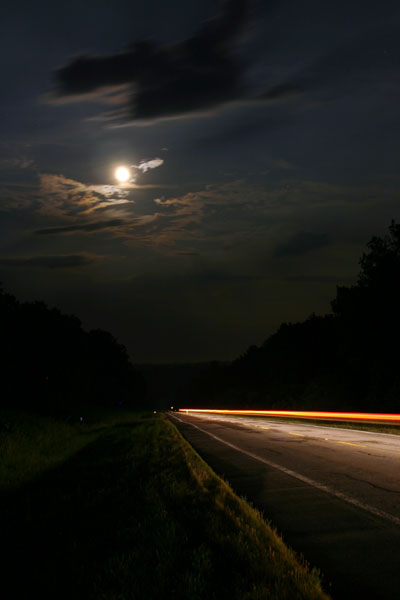 This leads us to another compositional element: leading lines. Our eyes naturally follow implied paths, which curiously could very well be an evolutionary trait, helping us spot the easiest passages and game trails. But in images, it means we track such lines with some expectation of seeing something at the end of them, and as a photographer you can use this trait. Here, I had plenty of positions to take on this road, but I chose this particular side because it placed the moon almost directly above the converging lines of the road and verge, and even has some subtle help from the treelines. Timing it to let a car go past gave greater emphasis to the road and provided some light down there – otherwise, if I’d exposed to let the moon light up the road surface, the moon itself would have been far brighter and glaring. Overall, the subtle message is a destination under a brilliant moon… gosh, look at me, I’m playing around being artsy. You don’t even need a subject at the end of your leading lines, if you want there to be mystery or even the idea of going nowhere, if that’s your message. Just remember that the viewer follows them, so use them judiciously.
 Getting back to depth, there’s a pair of effects illustrated here that can be used as well, in the right conditions. Atmospheric haze increases with distance, so images over a significant distance can show depth if you capture the bluish haze that separates, for instance, distant hills, and you can select light and weather conditions to enhance this, such as early morning as the fog is lifting. Notice how there is a distinct foreground row of trees, with the hill and the peak behind them in a slightly different color due to haze. Additionally, autumn colors not only provide a rich, pleasing palette, but often serve to distinguish individual trees from one another, once again increasing that feeling of depth. Had this image been taken in high summer, the trees would all have been the same color and would blend together, reducing the idea of depth. But here you can almost judge exactly how far away the peak is, can’t you?