












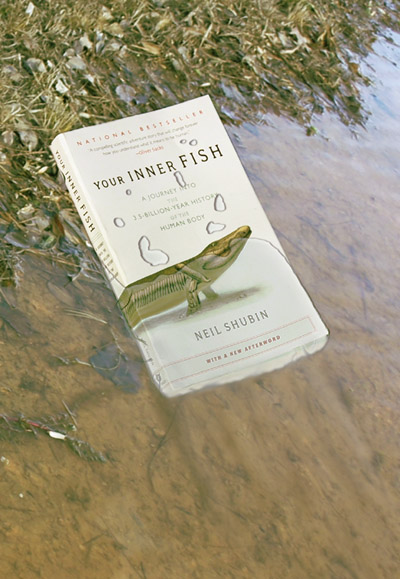
 In a previous review, I talked about a book that dealt with the concerted efforts by creationists to discredit evolution, and the book was specific to the goal, but not aimed towards greater familiarization with evolution itself. Enter Your Inner Fish: A Journey into the 3.5-Billion-Year History of the Human Body by Neil Shubin, which tackles that aspect more specifically.
Shubin opens with some background of fossil hunting, leading quickly into the recent find that his team is best known for: Tiktaalik roseae, a species from 375 million years ago that shows critical evidence of the grand migration of animal life from the seas onto land. Tiktaalik was a targeted find, in that Shubin’s team knew that an intermediary stage between finned animals and ones with supporting limbs (tetrapods) should exist, in a particular timeframe, and likely found in areas that used to be estuaries and rivers. After having found a tantalizing fragment in a road cut in Pennsylvania, they approached the problem systematically, searching for geology that would fit all of their criteria, and mounted several expeditions to a remote spot on Ellesmere Island in Nunavut, a Canadian territory. They found exactly what they were looking for, proof of careful planning and the predictive power of evolutionary development, while also relating just what fossil hunting entails, which includes patience, experience, and a meticulous attention to detail.
But Shubin is at heart an educator, which is more than simply a teacher or professor, and Tiktaalik serves as a springboard for much larger topics. Beginning with the appearance of a new limb form that holds for all mammals today, Shubin lays out an exceptionally detailed account of numerous traits within various species, including humans. He gives a great accounting of the scientific method as hunches and suppositions are subjected to careful testing, as well as building on the findings of countless scientists of the past. Through careful explanations with consideration of layman’s terms over scientific, he provides a wealth of information showing the commonality of many species, leading irresistibly to shared ancestry. The reader learns of the difference between not just the appearance, but the functions, of reptile and mammal teeth, and a key point where the two diverged from the ancestors – and how this can be told from the wear pattern on a solitary tooth. Indeed, anatomy plays a key role in determining the functions of fossilized animals we can never hope to see moving on their own, as bone thicknesses and even the shape of skull fragments tell tales about flexibility, diet, and nerve branch similarity to species currently in existence.
There is a fascinating section on embryology, where the initial development of diverse species such as sharks and hominids, of which humans are classed, bear a striking resemblance. While this is an indication of a common ancestor close to 400 million years ago, Shubin ensures that it’s not left at that. He also talks about genes and how they have almost identical functions in many diverse species, and how this was even discovered. In one experiment by researcher Randy Dahns, a gene called Sonic hedgehog (no, really) was grafted onto a specific section of a skate’s embryo during a key period in its development, resulting in the development of rudimentary digits – fingers – in the skate:
Not only did the rods [finger bones] end up looking different from one another, they responded to Sonic hedgehog, much as fingers do, on the basis of how close they were to the Sonic hedgehog bead; the closer rods developed a different shape from the ones farther away. To top matters off, it was the mouse protein that did the job so effectively in the skates.
The whole section details the specific job that genes play in embryological development, even down to the shape and position of “thumbs,” and most especially how those genes work exactly the same even when transplanted into diverse species. The body plans of nearly all species on the planet use many of the same exact genes to get started. Shubin also returns several times to the enigmatic bones of mammalian ears, which have ancestry in a wide variety of skeletal forms and developed gradually from jaw and skull structures to specialized instruments for wide-frequency hearing, for those species that would most benefit from such.
While the book is certainly not adequate to explain all that we know about evolution, and indeed doesn’t actually talk about the mechanisms of selection, it is overwhelming when presenting the evidence that this has indeed taken place. The reader who comes away from this book unconvinced is only guilty of abject denial. Other readers, without a distinct background in biology, might actually be startled at the number of factors that Shubin relates, tying us together with our distant aquatic ancestors (and further) in appropriate recognition of the title. One missing facet that I would have liked to have seen addressed, personally, is the predictive power of this knowledge, and how it applies to modern medicine and biology to show that it is not merely historical background, but functioning and active science. While this may have been outside of Shubin’s expertise, it would have been a powerful addition to the book.
Because of the amount of information, I wouldn’t recommend this book for adolescent or young-adult readers overall; while adequately illustrated, the text is just a little dense, reflective of the meticulous way that scientific progress is made. This is not to say that the book is hard to read – Shubin couches things in everyday terms, and avoids using scientific jargon where it is unnecessary. At the same time, he provides the subtle message of how science progresses, including the background stories of our previous, now-abandoned theories and how new findings changed them. Besides the evidence for evolution, the reader also receives some indication of how we establish and correct our knowledge base, and how much of this has happened in the past century. We are in a golden age of discovery, and it’s fascinating.
Shubin also touches on a constant mistake of the media, that of referring to fossil species as “links,” missing or otherwise. The fossil record provides only pinpricks of life from any given period, and species do not cleanly develop in a line, but branch off, spread out, and often die off. Tiktaalik, then, might be a direct ancestor, but the probability is exceptionally low. It is instead evidence of species developing a new body plan that allowed life on land to develop, and may simply be one of dozens or hundreds of species that came ashore over a period of thousands to millions of years. That’s part of what the genetic record supports: so many species have such similar backgrounds that the development of weight-supporting limbs, for instance, might have taken place several times due to the same genetic changes, or small variations thereof. It’s a bit as if human descendants in the future, with no knowledge of what we are like now, found chimpanzee, gorilla, orang-utan, and human remains – only one leads to those descendants, but all have much the same structure.
Much of the charm of this book is the ability, within every chapter, to make the reader blink and say, “That’s cool!” It is an excellent example of why science should be more popular in this country, and why it’s so useful. But it’s not simply about popularizing science; it also shows the painstaking research and careful experiments that go into it, and pays homage to the countless people who have contributed, in large or small increments, to what we know today. The reader comes out of it with a wealth of understanding, and a newfound respect for the process and practitioners. Definitely worth the time – it’s a very memorable book.
* * *
No, I did not abuse the book for the illustrating image – this is simply the wonders of Photoshop.
 One key part of decent photographs is having the proper amount of light reach the film or digital sensor. It’s called exposure, and it’s controlled by three things: the shutter speed, the aperture opening within the lens, and the sensitivity of the film/sensor to light, as indicated by the ISO. Today’s automatic cameras have some pretty sophisticated ways of measuring exposure, but there’s still one consideration the photographer has to make, and this is that the camera has no idea what it’s looking at – it simply measures light coming into the camera. If you break down the majority of photographs, you’ll get an average of light reflectivity from them, which unsurprisingly is a middle tone – we are surrounded by subjects that reflect light in moderate levels rather than extremes. Grass and foliage, clothes and buildings and cars, painted rooms and the various bits of furniture and knickknacks within, all have a tendency to be not too bright and not too dark. Mind you, I did say tendency, and in many cases where there are greater extremes, these can balance one another out. The upshot of all this is, even when the light is very bright (outdoors on a sunny day) or very dim (under streetlights at night,) you still tend to have an average middle tone when properly exposed, so when the light comes in to the meter, the camera sets the exposure to bring this light to a medium level. This is usually referred to as “18% grey,” and you can even get pieces of cardboard colored like this to help set exposure in crucial circumstances. If it helps, picture a grey shirt under direct sunlight and under streetlights. Even though the light levels are drastically different, the shirt is still grey and should appear that way in both photos.


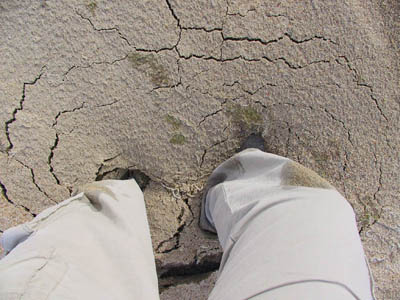 Had I, of course, not had the presence of mind to wallow and flail frantically and gracelessly like the advanced life form that I am, I may well have disappeared beneath the surface, never to be seen again until paleontologists discovered my fossilized remains thousands of years from now, pondering over the strange possessions I had strapped to me, and speculating on the nature of the god “Canon” that was emblazoned on my totems. Either that or they probably would have thought I was just an idiot. Truth be told, though, quicksand is unlikely to result in total submergence, because it does have its own buoyancy, and equilibrium would have been reached long before my head went under, so they would have found only my legs after the rest had been taken away by scavengers.
 My friend, always ready to catch me doing something stupid, provided me with a portrait featuring the Hatteras lighthouse in the background, which I should probably sell to a calendar publisher. But it also serves to show the conditions and the slope, as well as the camera beltpacks that I’d slipped off to retrieve my shoes, visible at right. And to highlight the weirdness of it even more, I’ll say that I was further downslope, just a little ways around the perimeter of the pool, when I got the nice B&W pic.


 The second, very subtle factor, is that the yellow/orange tones contrast nicely with blue skies, making both colors more distinct. In this image, shot towards the sun, the sky has bleached out to white, a standard effect of that viewing angle. The yellows of the snowy branches become very subdued, and you notice the blue of the shadowy snow lower in the photo a lot more. But the photo in the middle of this post was taken only minutes earlier, but facing 180º away. The sky becomes the deepest blue in that direction, and the colors the richest. The sky contrasts nicely with the yellow cast on the snow and it becomes much more vibrant, even though the contrast range (the difference between highlights and shadows) is greater in this image.


