



Rather abruptly, I have a backlog of photos and two video clips to get up here, so I’m going to be working my way through these in the next couple of days, and we’ll see how many other things come up while I’m dealing with these.
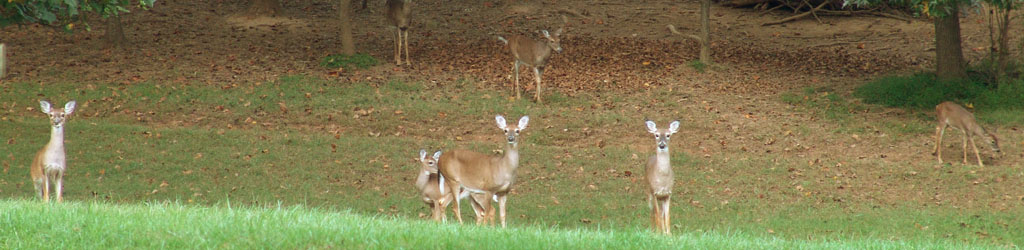
We’ve been having two white-tailed deer does (Odocoileus virginianus) visiting for corn on a regular basis, usually a couple of times a day, and we knew at least one of them was nursing because we happened to catch it once. The neighbor told us that she’d had a doe with two fawns behind her place, but we’d only seen a glimpse of those. Until I looked out back, uh, yesterday now, and found that they’re now being weaned onto solid food.
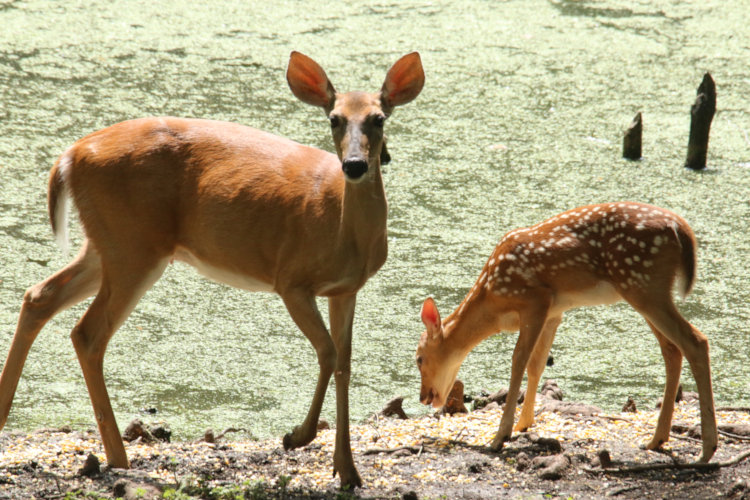
My first look out the window made it clear two fawns were there, but by the time I got The Girlfriend over to the window, much less upstairs to the Pond Overlook Blind (the bathroom) where these were taken from, only one fawn was visible, the other being blocked by a tree. But at least the one was providing a good view.
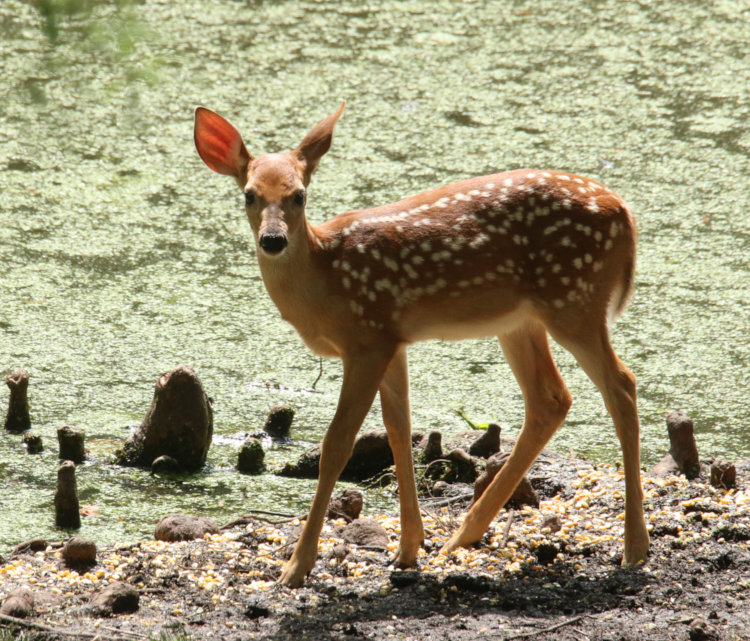
At no point did either of them attempt to nurse, and they seemed quite happy with the corn, so it appears they’re fully weaned, or very close to it. They’re also noticeably larger than newborns, though I have no way of showing this – I knew running down there with a millimeter scale wouldn’t be kosher.
Eventually, I managed a family portrait.
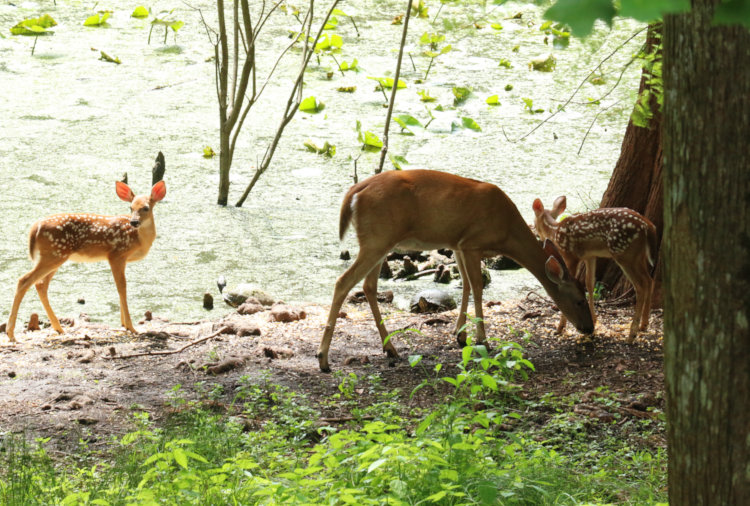
You’d think this would be easy, but really, the doe and the two fawns were all together at once for perhaps ten seconds or so, one of them always wandering off out of sight – you can see the trunk of the American tulip tree to the right, and this serves to block a lot of our view of where wildlife likes to be.
We hadn’t seen them before, and suspected that this was the first time out to feed on the pond edge, but we’re not watching the area 24/7, so it’s possible we missed any previous visits. One thing may have confirmed this was the first though, at least during the day.
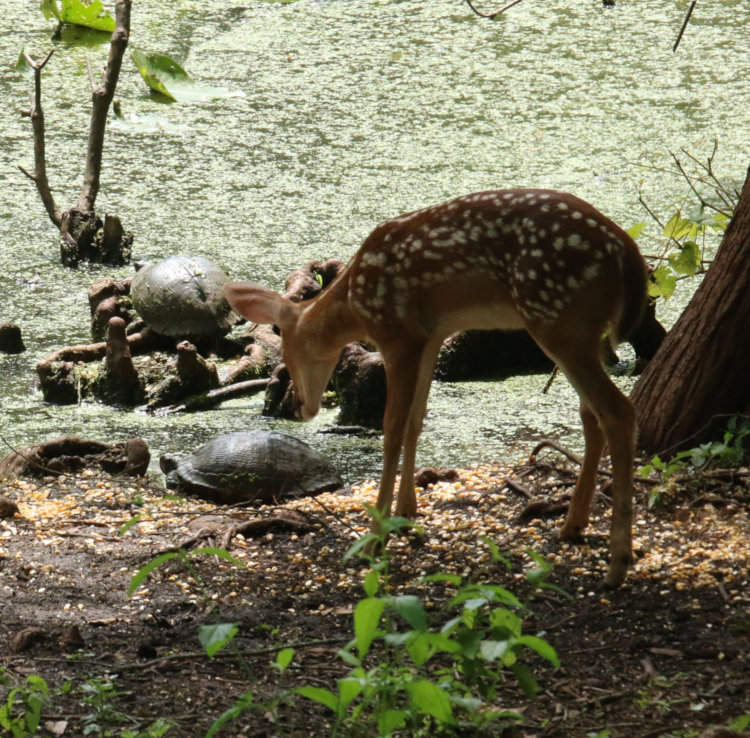
One of the fawns wandered up to one of the yellow-bellied sliders (Trachemys scripta scripta,) which moved, unsure of intentions. The fawn gave a little start and then timidly checked it out, obviously having never seen one before. Since the turtles are almost always on the pond edge during daylight hours, I would have thought the fawns would have already made the discovery should they have been here before.
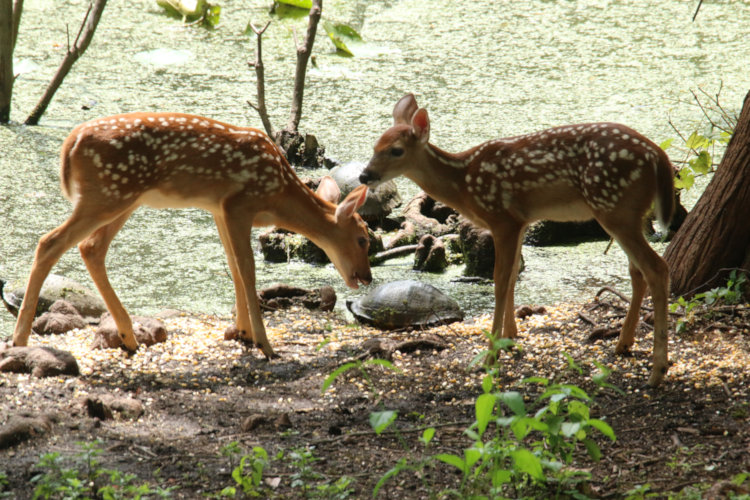
Its sibling was bolder, walking up to the turtle without hesitation, obviously the older (by ten minutes) and wiser of the two. The turtles all ignored them as readily as they did the geese, ducks, and nutrias. Let either of us even appear on the deck, thirty meters away, and the turtles are scrambling for the water fast enough to give a hare pause. We don’t get it.
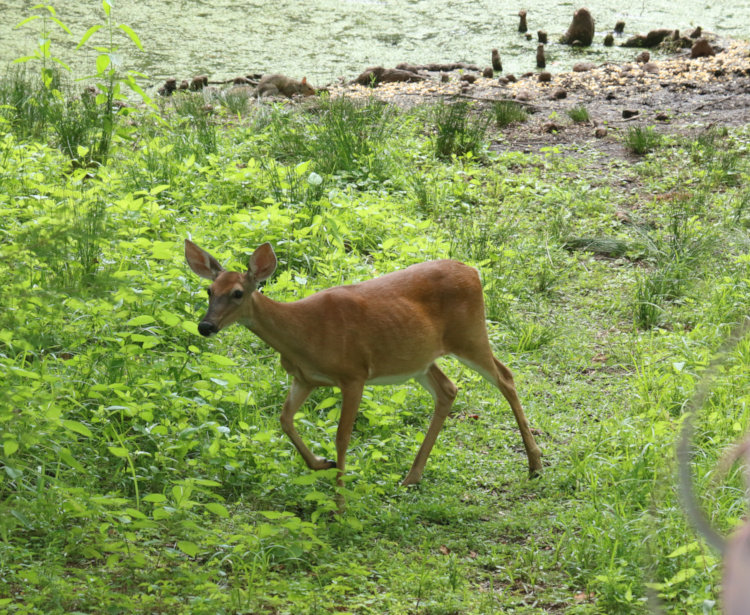
Mom eventually wandered off across the yard, leaving the kids behind rather callously – maybe she was hoping. I expected the fawns to notice after a moment and scamper to catch up, but they were seemingly quite casual about it all; they’d braved turtles after all, so what remained for them to fear? One did eventually notice and move to follow, but without any urgency.
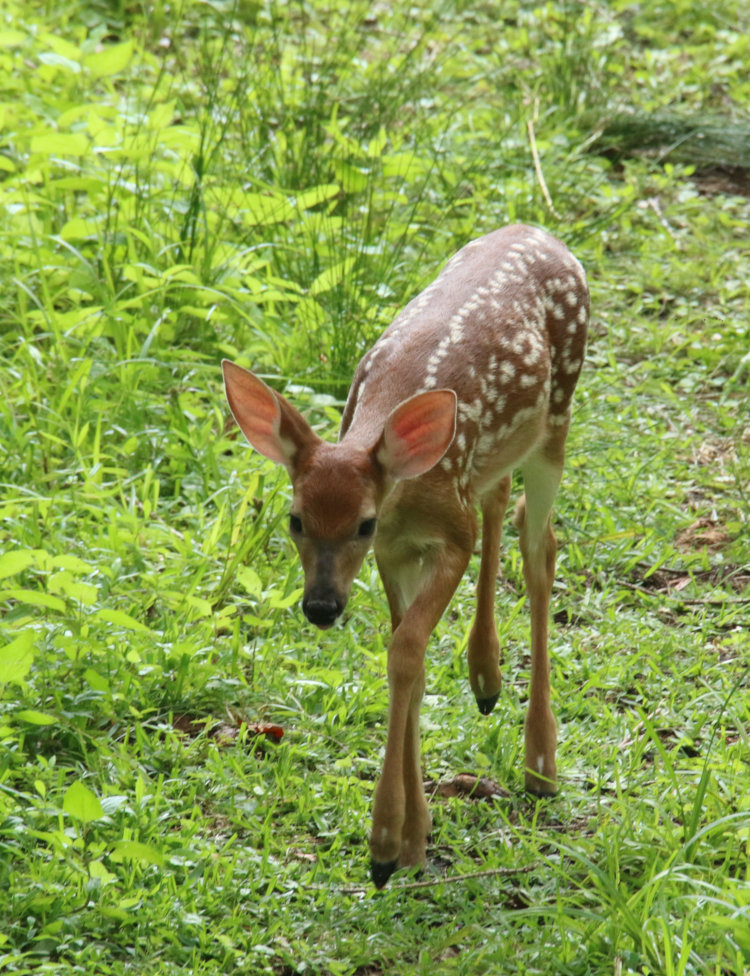
We see here a perfectly clear forehead, probably indicating that this is a young doe; if you recall from the previous encounter (linked above,) the buttons of the antlers show up quite early, even though they won’t be growing for a while yet.
In contrast, we go to a closeup of the other fawn, a little earlier:
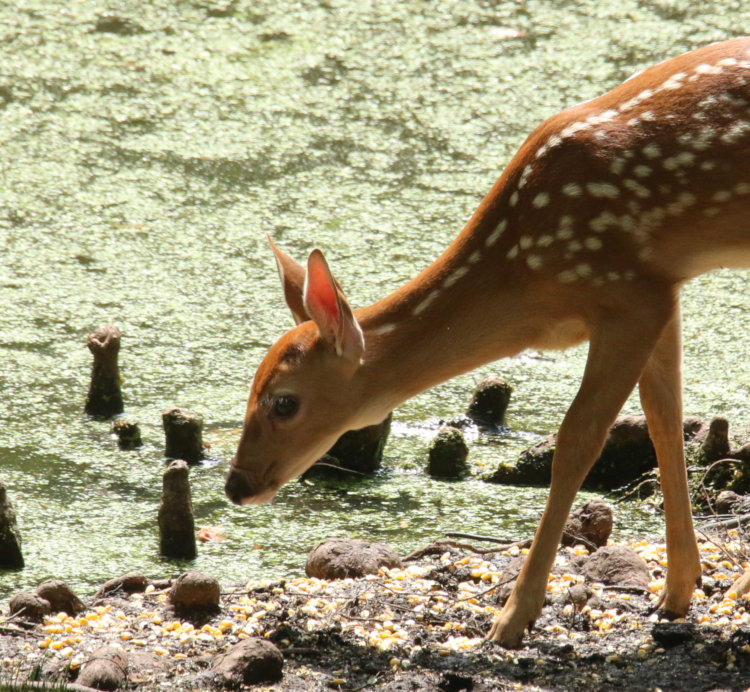
This one shows something right where the antlers would emerge, so it appears we have one of each. They also have faint differences in their patterns, so while they retain their spots at least, we can tell them apart if we look closely.
They seemed quite bold and complacent, until they had moved off towards the edge of the yard, when one of the fawns panicked over something, we never saw or heard what, and bolted off at top speed across the yard away from mom. After a moment, realizing its mistake (or noticing that mom wasn’t following, much less leading the way,) it returned at the same high speed, practically running into the mother’s side in its haste to get close, and then remained shoulder to shoulder – well, belly – for safety. The other fawn wasn’t too far away from all this, and watched in curiosity but wasn’t the slightest bit concerned. Snake, perhaps? That remains my best guess.
There’s still no evidence that the other fawn, the first we saw this year, is out and about feeding on its own, so we’ll see if that appears soon. We’re also closing in on the time that turtle nests should be hatching, so I’ll be doing routine patrols, hoping to find some newborns or even the emergence from the nest. We’ll see…