MMM boy, another Estate Find!

First off, as the title hints, this is the three-thousandth post on the old Walkabout Exercise in Thinly-Veiled Narcissism; I really had planned to do something bigger, but nothing was coming to mind or hand, and now I’ve got this schedule to keep. Note that I formerly had a goal to reach this by the third week in September of last year, because reasons, but we’re way off that mark, aren’t we? Ah, well, we’ll all cope. So it’ll be pretty much a normal Estate Find post, but you can have a soda pop while you’re reading if you like.

This week’s find dates back a few days to the foggy morning featured in the previous post, when I went out looking for fun things to photograph, among them the subject that is about to be featured. I missed a few small songbird photos, mostly due to the light levels being too low for the shutter speed necessary for such targets, and got out about as far as that path would take me, the edge of the bayou-like pond area – beyond that it’s wading, and I don’t presently have the heavy-duty boots or waders that should be used for that at this time of year. On the way back, things were still pretty quiet, until I heard the odd noise, which I initially took for an unknown bird call, being a repetitive rasping squeak. I paused and looked around carefully, determined not to scare it off before I had the chance to photograph it, and eventually determined that it was actually gnawing. Ah, that’s better!

And it was coming, as I slowly determined, from just over the edge of the streambank that forms the back border of the property, just a handful of meters ahead. Listening carefully as I inched forward, I surmised from both the sound and the occasional ripples extending out into the water that the emitter was right there, and eventually got a peek at the top of a head. Figuring that it would bolt the moment I hove into view, I leaned forward with the camera raised and kept firing off frames as I got a glimpse of the eye.

North American beaver Castor canadensis gnawing on wood at stream edge, seen through foliage
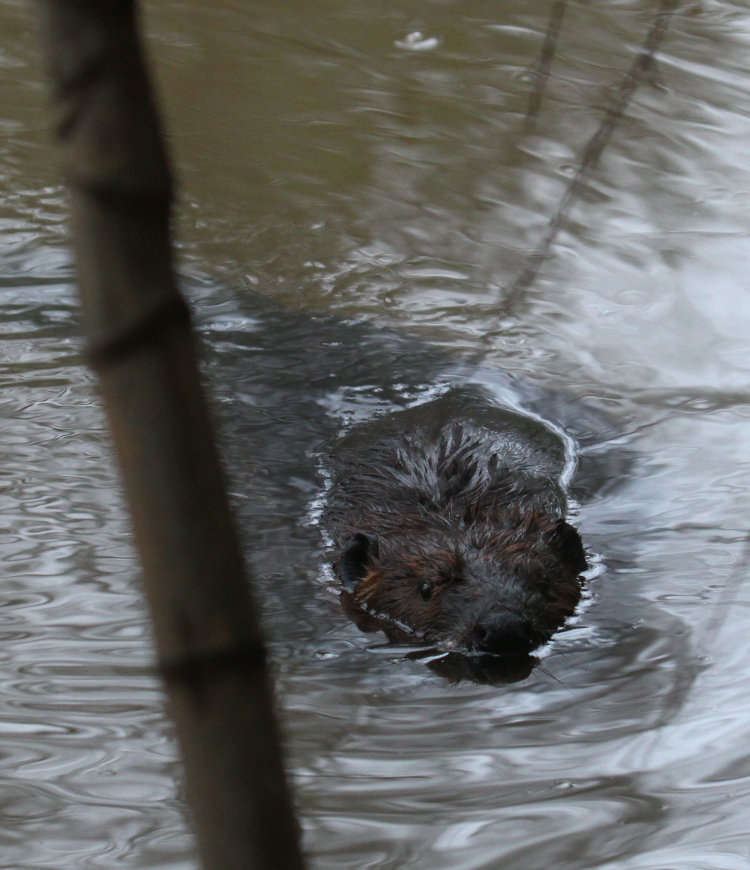
This is a North American beaver (Castor canadensis,) which I knew had a lodge on the property yet hadn’t seen the occupant(s) clearly yet, but it was one of the goals for the morning so I was pleased. And to its credit, the beaver wasn’t too concerned with my proximity.

North American beaver Castor canadensis gnawing on wood at stream edge, seen through foliage
I was able to lean further out and get clearer photos – the beaver had to be aware of my presence, but it was being nicely complacent and I was being as unobtrusive as possible, given the appearance of the long lens and the sound of the shutter.

Eventually, it realized I wasn’t going away and might just pose a threat, and so it swam away from its meal, but not quickly and without diving, instead curving around out in the open where we both had a much better look at each other. I’ve seen this before: beavers can be very curious sometimes, and it still had deep water underneath that it could resort to if needed.

North American beaver Castor canadensis swimming in open water with curiosity
This was a decent-sized adult, so probably in the neighborhood of 10-12 kilos. I had to back the zoom down because it was too close for proper framing, and then I backed it all the way down to 150mm and switched to video.

Yeah, I wasn’t prepared to do video, so unsteady and without the proper mic, but there you go. I’d actually pulled the same stunt before, back in ’91 I believe, with the first beavers that I was witnessing directly – their curiosity gets the better of them, perhaps because the noise is too close to their own gnawing sounds, don’t know for sure. But it worked fine, and as I said in the video, this one closed to about four meters distant.

North American beaver Castor canadensis pausing to consider the noise the photographer was making
Now, you know what’s slightly annoying? I took The Girlfriend out there again the next morning to see what we could see, and the beaver that we barely spotted (same one? Don’t know,) refused to come within fifteen meters and dove twice in alarm, even though we were making less noise and virtually no movement. I have no idea what the difference was.

So, here’s hoping that I can top the previous experiences (and video) of the species this year. It’s at least a convenient location…

Just once, part 6

Mottled sea hare Aplysia fasciata swimming
It’s not particularly surprising that this critter has only been featured once here, since I stumbled across it at the beach along New Topsail Inlet, coastal North Carolina. I’ve been to the inlet itself several times, including one short snorkeling excursion, but it appears that vagaries of currents and conditions drove several examples of this species close to, and onto, shore on one particular day. To the best of my ability to determine, this is a mottled sea hare (Aplysia fasciata,) and if you ask me, “Yeah, but what’s a sea hare?” I’ll simply reply, It’s one of these. Basically, it’s something that Charles Darwin worked up when he was trying to create evolution, about the time his wife had been out of town for a couple of weeks and he was a little distracted.

Mottled sea hare Aplysia fasciata swimming
All right, the Walkabout Fact-checkers are on my case again, so I have to inform you that the above sentence may not be entirely true. But sea hares are gastropods, like slugs and snails, and are specialized for their marine environment despite reminding you of how explicit Hustler magazine was. And it was not little, estimated at 20-22 cm in length. While this one had actually been on-shore when found, I did not know what it was at the time and slid it back into the water with my sandaled foot, so I did not handle it nor examine it for a mouth or tracheal ovipositor or anything – there’s a limit, even for me. I have only rudimentary knowledge of aquatic species and no idea how many things have nasty little defensive mechanisms, though granted this one was more camouflage-colored than many of its cousins the nudibranchs, which are often brightly-colored as an indication that they do indeed possess nasty little defensive mechanisms.

But wait! We have video!

[You can just mute the audio – it’s a smutphone video without external mic or wind protection, so all you’ll hear is thumping anyway.]

So can we expect to see more of these show up in later posts? I wouldn’t be watching anxiously for it; I don’t get out to the beach as often as I should, and don’t see too many aquatic specimens when I do, plus as I said, I think these were extenuating circumstances. Nor am I particularly motivated to chase these as a photographic subject – I think we’ve just about exhausted their potential right here. But, you know, I won’t rule out finding an exciting, agile, and considerably more cuddly example, say, with big eyes and plush fur…

Well, it’s a start

dewdrops underneath feather
We suddenly got a few days of perfect weather, and I managed an outing with the Itinerant Mr Bugg, in search of whatever we could find. I admit I wasn’t expecting much; it’s still winter, even if it’s possible to be out in shorts, and only a few days back we were routinely dropping below freezing at night, so spring isn’t here yet. We ended up hitting three different locations in search of subjects, and eventually brought home enough frames to make it seem like we’d actually been out shooting, but I certainly have very little to add to my stock. The feather picture above is probably my favorite, capturing the odd effects of dew hanging from the underside.

unidentified egg mass in shallow poolSome of the chorus frogs were already sounding off, but in a location where we couldn’t get very close, and all of the pics I shot from the greater distance lack critical sharpness, so I’m not even bothering with those. There were also several masses of eggs to be seen at two of the locations we visited, and I’m inclined to say, from the size of the masses, that they were bullfrog eggs, but I’m not even sure they were frogs. The smallest mass was a little smaller than your fist, while the largest would almost have filled a dinner plate. I may try to stop back and see what seems to develop – not even sure that would work, since I had enough trouble differentiating the tadpoles in my own pond.

American beaver Castor canadensis evidence well above ground level
Al Bugg standing under American beaver Castor canadensis damage on limb over his headAt the first location off of Jordan Lake, I espied some clear evidence of American beaver (Castor canadensis) activity, in the form of clipped off branches 3-4cm thick, showing the distinctive teeth marks. This is not at all uncommon in this region; what got me was where they were, which was 2.5 meters (8 ft) in the air on a sloping limb. Now, beavers can stand upright and even do some limited climbing, which extends their reach much more than the expected half-meter, but this was well outside of even these accomplishments, especially since the base of the trunk was much more vertical. Instead, I’m almost positive this was evidence of the huge difference in water levels from recent rains; I know I’d seen the lake levels much higher earlier, and this would give an indication they were at least two meters higher than what we were seeing the other day. Mr Bugg was kind enough to pose under the limb, and he stands about 180cm – you can just see the two light spots on top of that crossing trunk, directly above his head.

While at the lake, we’d been watching for whatever birds could be seen, but they were remarkably scarce – at best, we saw a handful of gulls and crows. It’s still a little early for the migratory birds to arrive, though perhaps not by much. After leaving the lake and going to the NC Botanical Garden, we started seeing some more songbird activity, which continued when we did a brief tour through the nature trails on the back side. Carolina wrens (Thryothorus ludovicianus) never really leave the area during the winter, but they certainly become a lot more active and vocal in the spring, and one in particular was kind enough to provide some nice poses. As songbirds go, they’re pretty mellow, often allowing a much closer approach than many other species, and will build their nests without concern over their proximity to human activity; under the eaves of a porch is a common location, and I’ve seen them actually raise young in a wreath on a front door. A few years back we put a little box under one corner of our porch roof to encourage their presence, and yesterday I watched one checking it out, so here’s hoping. Meanwhile, let’s take a gander at that cooperative one in the botanical garden.

Carolina wren Thryothorus ludovicianus watching suspiciously
I was creeping closer after this one had chosen its perch and was sounding off vibrantly, and it stopped to peer at me directly. It would be easy to believe it was suspicious of my presence, and might have been, but they’re cooler than that, because in a few seconds…

Carolina wren Thryothorus ludovicianus singing unconcernedly
… it ignored me to continue its territorial calls, which are quite distinctive and pleasant. There’s also another call, which sounds irritated and harsh, but from observation I tend to think it’s more of a courtship thing; it seems to be used most often to draw attention to a likely nesting spot. I’ll see if I can get some audio examples sometime soon.

Carolina wren Thryothorus ludovicianus showing its best side
And as I shifted position slightly, I got a nice profile shot too. This is the Canon 100-300 L, cropped a bit tighter, but the bird was only a handful of meters away regardless – like I said, humans don’t bother them too much. Looking at these now, however, I regret that I didn’t get more typical poses from them, since Carolina wrens have a distinctive body shape and perching behavior that really isn’t shown here. This post has a hint of it, but it still fails to show the cocked-tail position that’s so evocative of the species.

On the nature trails, we saw a trio of downy woodpeckers (Picoides pubescens) in an agitated game of tag way up in the branches over our heads, and managed a few useful frames. I include this view of two of them just for the novelty.

A pair of downy woodpeckers Picoides pubescens in motion
There was a little bit of chattering going on, and I suspect this was courtship behavior, with another male intruding temporarily, but they were far enough away that I couldn’t identify gender until looking at the photos afterward. One soon left the area, but the remaining two flitted about in a relatively small space in very close proximity to one another, and I eventually determined that they were male and female. Generally, when it comes to territory, there is more of a squabble, sometimes with direct contact, but usually with one chasing another off for a notable distance, rather than just dodging around trunks within easy sight of one another.

downy woodpeckers Picoides pubescens in probable courtship
This image was sharper (again, pretty good distance directly overhead,) but doesn’t show one detail as clearly as it should, which is the lack of the red patch on the head of the left bird, indicating it’s a female – only the males have that red. So, yeah, pretty sure this was a first date, or at least flirting.

Unfortunately, most of the birds we saw were determined to be at the wrong light angle, or in very cluttered framing, so it remained hard to get really captivating photos, though the area we were in showed more than passing activity. A red-bellied woodpecker (Melanerpes carolinus) gave me only a few moments in profile against the sky, but on the shadowy side of the trunk of course. And talk about a cluttered frame.

red-bellied woodpecker Melanerpes carolinus not being cooperative
I did slightly better with a male eastern bluebird (Sialia sialis,) who at least got into halfway decent light. The woodpeckers are often seen here year-round, but the bluebirds are definitely migratory, so they’re apparently making their first appearances here. This one perched and marked territory in the wonderfully understated manner of bluebirds, muttering softly as if humming to itself – it often takes sharp ears to pick out their calls, even when you’re looking directly at them.

estern bluebird Sialia sialis marking territory
Yesterday, at the same time that the wren was checking out our porch, a pair of bluebirds was trying to see if the nest box in the front yard was available, but I’m almost positive a flying squirrel had overwintered in it and was probably still in residence, at least if their behavior was any indication. The female had hovered directly outside the box opening for a few seconds without touching down, before the male obtained a perch very close to the opening and sat peering at it for no small amount of time, perhaps trying to embarrass the squirrel into leaving. It didn’t work.

It remains possible, by the way, that the squirrel will raise a brood in that box this spring, and I’m more in favor of that than of the bluebirds doing the same – I’ve got photos of nesting bluebirds. We’ll just have to see what transpires, won’t we?

BIAB: Undercover of the Night

For this installment of the ‘Because it’s a blog,’ topic, I’m not only introducing a song that I like, I’m attempting to figure out why I like it in the first place. If it accomplishes nothing else, it may illustrate why I pay almost no attention to reviews of music and films and such, because of the huge amount of subjectivity within; my perspective is not very likely to be shared at all.

The song is ‘Undercover of the Night,’ a release by The Rolling Stones from the album of the same name; one of those songs that gained a decent level of popularity at the time, but then vanished from play soon afterward. Older readers might remark, “Oh, hell, I haven’t heard that song in years,” while younger ones will likely have never heard it at all. It was released in 1983; news about brutal regimes and civil unrest in various Central and South American countries was fairly common, but the US’ focus was more on the Middle East and Soviet Union, with a lot of meaningless posturing by Reagan – the shitstorm about the Iran-Contra deals, where we were covertly selling weapons to Iran (we had supposedly cut ties after the hostage crisis) and using that money to fund the Contras in Nicaragua, was still a few years from breaking, but the players were all well-known. There has been no point in recent history where world politics has been particularly stable, but in 1983 it was routinely in the news at least.

Personally, I had quit school the year before and was struggling to find decent work in an economically-stagnant region of central New York, in the efforts to get the hell out. My folks were separated, I had no friends in the area save for my brother-in-law, and I was still a bit aimless and bitter following the unexpected death of my brother in 1981. Plenty of the music that I was following was upbeat – as earlier entries might have hinted at, I was delighted that disco had been abandoned in favor of new wave – but there was an underlying cynical aspect of my personality, this suspicion that shit was about to get worse, at least partially inspired by a saber-rattling president that seemed enamored of getting into another war.

‘Undercover of the Night’ played right into that mood in a very curious way. The song breaks with a staccato drum riff, a rattle reminiscent of automatic weapons, and some harsh power chords from a guitar, interspersed with a very expressive bassline that, uncommonly, stood well out from the other instrument tracks. Musically, the sounds are energetic and play well off of one another, the guitars and the drums debating back and forth, dramatic overall but with an ominous undertone that departs from The Stones’ typical fare. As the lyrics roll in, they confirm and elaborate on this mood; the picture painted is one of a desperate environment, but the bigger impact isn’t the conditions as much as the search for escapism. While containing overt sexual aspects, there is no appeal here, not even in a lascivious way – it’s little more than a frantic distraction.

Seemingly out of place is Jagger’s signature “Do do do” bridges, vocally mimicking a guitar riff that seems a little too upbeat in nature, but in context it invokes the attempt to ignore what’s going on outside – again, illustrated well in the video. The entire song, in fact, has a sound to it of a loud nightclub with just a little too much manic energy, an almost-forced air before Jagger intrudes again with the ominous narrative. The audio quality – a little tinny, a little echo-ey – enhances this to no small extent.

Undercover of the Night – The Rolling Stones

I have embedded the video below, that the director (Julien Temple) did an excellent job of illustrating, with its own story and some damn good imagery, even when it’s unclear how many levels there really are. Unfortunately, at the time it was sometimes considered appropriate to add sound effects to the video versions, which detracts significantly as far as I’m concerned – one of the few times you’ll hear me argue against helicopter sounds.

But I still find Richards looking out from the passing government transport one of the more expressive visuals from the era, or indeed any music video. The atmosphere was maintained throughout, with a truly masterful use of lighting – even the one daylight scene was done in a pall of fog or smoke. The girlfriend in the video, by the way (Elpidia Carrillo,) also appeared in Predator four years later on. And if you missed the trembling sheets matching the drum rattle, go back and look for it.

So now, I have an exercise for you, a trivial thing that occurred to me as I was writing this post. Using the audio player and not the video, go back and listen to it again, but imagine it played by a marching band, the horns carrying the treble while the drums get that added boost in bass registers. Granted, some of that guitar work won’t translate well to, like, clarinets, but you can’t have everything.

Believe it or not, the next featured music, whenever it comes, will be a lot more contemporary – not everything that I listen to is better than three decades old. Just most of it…

So did, uh… did jesus really exist?

If you’ve read anything else on this blog, you might think it’s curious (or completely out-of-character) for me to even be asking this question, especially since I’ve been pretty clear about its relative worth. From a strictly historical standpoint, however, it retains a certain mystique, and I’m going to present my own perspective on it. Does it actually make any difference at all? No, because of several factors that will be enumerated below, but… well, let’s go into the details.

We’ll get a couple of things straight right up front. I’m no biblical scholar, not even close; if you’re looking for a detailed and dependable treatment, you’re looking in the wrong place. Second, there are a lot of distinctions to be made, but the foremost among them is that even the proven existence of jesus has no actual bearing on whether he was divine in any way, or any actions or events claimed to be associated; those are all separate factors, and mostly ones that I’m not even going to try to tackle – partially because it would be impossible without huge inferences, but mostly because of the flaws in the entire narrative. And finally, this particular aspect has certainly been approached numerous times by others, but I haven’t bothered to see what they have to say; I’m only vaguely interested in scriptural history, and basically believe that anything derived from it will be trivial and largely worthless. Let’s face it, we’re dealing with a lot of issues these days concerning economy and ethics and cultural interactions, and nothing from any scripture is capable of addressing these in any meaningful way – as demonstrated by the still-significant numbers of religious folk in the world and the very existence of such problems after all these centuries. It’s been the same messages all this time, so something should have worked by now if there was any value whatsoever to be found in them.

But hard as it may be to believe, I think there’s some compelling evidence that the scriptural accounts of jesus were at least based on a real figure, and the evidence that I’ll present for this also argues that he wasn’t terribly divine.

There is little question that, at the time of the events recounted in the gospels, the basic books of the abrahamic religions were at least partially known; the Dead Sea scrolls date from that period and match (with varying degrees of inaccuracy) many of the chapters that would later be adopted into the hebrew bible, the christian bible, and the qur’an. However, at that point they were still scattered and not ‘canonical’ – the decisions as to what books were official scripture for each religion would come later on, and hashed about countless times even after that; there is no rational way to say, “These are official,” if one knows anything at all about scriptural history. What was known at the time, though, would be considered most closely related to judaism, though the emphasis on moses as the key prophet was almost certainly widely varied. Which means that the chroniclers of the gospels could easily have been aware of the various prophesies of the hebrew bible/old testament.

It should also be known that christianity did not arise soon after the gospels appeared. Even as they began to be adopted as a prime influence in religions, there were a lot of splinter factions, including a major schism between a) those that believed that every man had the ‘spark’ or potential pathway to divinity, and b) those that maintained that mortals could not in any way demonstrate divine powers. These would make jesus either a) a true mortal that realized his full potential, or b) an actual resident of the supernatural planes that only appeared on Earth, without any real connections to mortality. You will notice that either can can be supported by the gospels, depending on your interpretation, so no help there (surprise surprise.) It would not be until Constantine I adopted christianity as his state religion that it gained enough momentum to become prominent, and this occurred around 300 CE.

Well known, too, is that none of the gospels were contemporary to the events portrayed therein, the earliest (mark) referring to events several decades afterward and thus preventing it from being written any earlier, while two of the others (matthew and luke) are largely considered to be cribbed from the first, and the fourth (john) has numerous watermarks of being much later, including little resemblance to the earlier books. The evidence indicates that we have no eyewitness accounts of the events, instead being retellings at best; this doesn’t mean the events must be inaccurate, but it greatly increases the probability of such. Many of the details of jesus’ life were presented by later gospels, far removed from when they were supposed to occur, and with this distance comes an even greater probability that they are inaccurate; who was bothering to note the circumstances of his birth, and why did the earlier gospels not have access to these writings? Scholars tend to treat the later gospels as being embellished to a large degree, and I can easily see their point.

So let’s get down to the main narrative. Regardless of being either a chosen mortal, semi-, or completely divine, jesus is presented as the catalyst, the sacrifice for all mankind to ‘save’ us; this aspect is undeniable, and what christianity is based upon, differentiating it from all other religions that emerged from the same initial stories. The death of jesus was prophesized, intended, and completely according to plan – with all of the variations that can be found now (much less throughout history,) this is one aspect upon which there is no disagreement. The value of jesus is almost entirely in the sacrifice, with only an occasional nod towards any bits of wisdom he is said to have voiced.

Curiously, however, most of the narrative fails to reflect this foreknowledge. Instead of reaching a central location in the Roman Empire with a horde of followers and witnesses, he makes his way to an outlying province with a mere handful of disciples. Capable of demonstrating his credentials with supernatural powers regarding healing and wine and fig trees, he somehow remains an insignificant and even secretive figure. Even as his fate is playing out, he is sought after for being abusive to people in the temple, but has to be ‘sold out’ to the Roman soldiers, somehow not even producing enough of a spectacle at the time to warrant his public arrest. For an event that would affect all mankind, it’s remarkably low-key.

[A sideline here to touch on one of the more confusing aspects of the story. Nearly every account, for centuries, has judas betraying jesus by delivering him to the guards for his trial and execution, despite this being the intention all along and, in fact, the event that creates salvation. Jews were persecuted for fucking centuries over the condemnation of jesus by the sanhedrin trial, despite this supposedly fulfilling scriptural prophecy – there isn’t a lot of sense to be found within this. However, the recently rediscovered gospel of judas presents the story in a different light: judas was not a betrayer, but selected by jesus to be the one to deliver him to the guards and fulfill his destiny, making judas the most-favored disciple. This, at least, fits the events and even the dialogue within the gospels a lot closer, though not without other contradictions.]

Even as he is fulfilling his entire purpose and dying on the cross, jesus wails about being forsaken by his father. Witnesses? Barely a handful. His followers prepare him for burial without any recognition that this is not a lasting state, and are openly shocked when he reappears, even requiring proof that it was really him that died. And the gospels vary widely on what he did during his brief return to the mortal sphere before ascending to heaven, but again, eyewitnesses to this singularly most important event in the history of mankind somehow did not make a single mark in the records, even though we have pages of stuff from the empire itself. The gospels, in fact, are the only writings that indicate that this figure even existed, much less performed miracles, and again, they were written decades later and remained obscure long after that. It’s hard to reconcile this with the literally Earth-shaking nature of the event. It is much easier to see their stories as completely fabricated.

However, this has its own issues. A fabricated narrative shouldn’t have as many inconsistencies, but most importantly, it’s a lame story for being an epic, the epic. If it was written long after the time period it portrays, long after anyone ‘who was there’ could still be alive, then the author could play freely with the events without fear of contradiction or reprisal, and the events could be truly astounding, the miracles magnificent in scope instead of just making wedding guests merrier. A contemporary fabrication, however, is open to the damning possibility that no one alive remembers anything of the sort occurring, nor even heard it passed down by relatives – accounts of astounding miracles that supposedly occurred only a few decades back are pretty easy to dismiss. And the story itself is peculiar, and quite disturbing when it comes down to it. We are constantly told that god sent his son to Earth to sacrifice himself, thus saving all of mankind, but from what, exactly? There is no consensus on what this accomplished or changed, and the idea that a being that could create the entire physical world wouldn’t have any reason whatsoever to play games seems to be openly ignored. This god created the planets and mankind, not to mention all of the rules regarding the afterlife, but has to put on a torture-porn martyr play to change them? We can’t ignore the omniscience angle, where knowledge of how and when this would have to take place (as well as the disobedience in eden, as well as the flood, and on and on,) was there right from the beginning, before creation even began. In what way can this even remotely be considered ‘salvation?’ And as a curious side note, abraham was tested by being asked to sacrifice his son, but god went through with it – there are some really odd messages being put forth in here, and more than a little sadistic.

Or, are there? Let’s imagine someone rolling into town and claiming to be divine, charismatically gaining a bunch of followers convinced of this state; this is hardly a stretch even today in the age of reason and science. Eventually he runs afoul of the authorities, who have rather specific rules about religion: believe what you want, but don’t mess with what other people believe, and don’t defy the empire. Given the chance to recant, he defers, and joins the other common criminals in execution. Abruptly, his followers find that he’s just an insignificant mortal after all. They shrug, realize they were wrong and had been played, and move on, wiser for the experience.

Yes, I’m being snide now – we’re all familiar with how denial works. No no, jesus was supposed to die, yeah, that’s the ticket, and by dying, he proved his value and divinity! In fact, one could only be truly devout by believing in him, rather than the large collection of books that preceded him. It is next to impossible to find a religious person who is not absolutely sure that their particular version of religion is correct, regardless of how many splinters there might be – being wrong is simply out of the realm of possibility. The son of god could not die, unless he was supposed to! And if he was supposed to, then it must have accomplished something important.

Bear in mind that this was a tumultuous time for judaism; emperors would occasionally declare themselves a god, which didn’t play well with moses’ decrees and the commandments, and several jewish uprisings took place around that time. The message of jesus could easily be taken to mean that jews did not have to die for their faith, because jesus already had. Historically, judaism had grown to possess much power and authority in the region – until it ran up against the expanding Roman Empire. Over time, it became clear that being the ‘chosen people’ wasn’t enough to win out over Roman rule. And abruptly, we have the sudden change in message from the new testament, which emphasizes peacefulness and judgment in the afterlife, as well as faith being the only thing that was necessary – all qualities that work a lot better against a strong government than the idea of being backed by god. Or evenly openly assisted by god, as many portions of the old testament portray at length.

The later gospels made it a point to tie jesus in with the previous scriptural stories, providing him with a direct-only-not-exactly lineage with david and fitting in with various prophesies; it’s hard not to see these as opportunistic attempts to woo the jews that viewed moses as the last of the prophets because, you know, that’s what was written. Without this legitimacy, jesus was just another street preacher that could not compete against the established religion of the time.

Seen from the standpoint of a created mythology, the tales of jesus are unimpressive, vague on details, and don’t make any sense – even as a moral fable the messages are not just hard to fathom, but remarkably weak in nature. Seen from the standpoint of being accurate accounts of true events – well, they can’t be, because they’re contradictory on far too many details, so something is wrong therein, and there is no way to determine what; it could be all of it. [Note that even if all accounts agreed, this wouldn’t bring them any closer to being true – they could all simply originate from the same source of fabrication.] Moreover, none of them have any outside corroboration or demonstrable evidence, the only things that could assist in authentication. They had remarkably little impact at the time – even the gospels themselves harp constantly about those who do not believe this figure is divine in any way – and the still-present problem that they just make no sense. But seen in the light that someone was trying to capitalize on existing folklore – that fits the evidence rather well, as I see it. There are several other known gospels that never got accepted into the christian canon, and more that were only hinted at, all differing on details; the only consistency seems to be the emphasis on jesus himself. Yet still in a very narrow way, since no outside historical accounts make any mention of him whatsoever. It has all the earmarks of legends built up around a cult following – one with little to show for itself, as well, since it wouldn’t have been hard for someone truly divine to have a hell of a lot more impact. Given, you know, that his dad stopped the entire planet from rotating and moses parted the waters and all that jazz. If we are to believe that the gospels still recount the legends of a divine miracle-worker, then why can’t they agree on the miracles, and why aren’t those miracles carrying their own weight in the legends outside of christianity? However, mythology is easily built around a single common figure – witness all of the emphasis on Christopher Columbus that made it into common knowledge without being true at all, or all of the quotes misattributed to Mark Twain, despite both of these being well within the era of meticulous recordkeeping.

Christians will tirelessly argue that the gospels are distinctive evidence of both existence and divinity, while completely dismissing very similar accounts regarding mohammed and buddha – double-standards are de rigueur among religious folk. There are entire books that try to excuse the countless issues in one way or another – often by claiming metaphorical meaning or by asserting that the message (whatever it is supposed to be) is true even if the gospels have problems. Yet even from an unbiased, objective standpoint, there are numerous other possibilities for how these stories arose, including a cult following of an entirely fabricated legend, including the shaping by unknown events and cultural influences of the time – there is likely no way that any theory regarding the gospels could be raised above a 2% probability. But to me, the explanation that seems to fit the best is the desperate attempt to glorify a rather mundane figure and event, and to do this, you first have to have a figure to build upon. The gospels are curious in that they each pretty distinctly describe their own versions of the myth, but rely on the same figure.

Some more fun reading:

Shredding the Gospels: Contradictions, Errors, Mistakes, Fictions

How accurate are the gospels? (This one recounts the extremely common christian response to debate, which is why there is little reason to even engage in such.)

Changing focus, my own followup to this post based on a paper by Peter Nothnagle that introduces some new factors.


You got… something on your face… right there

tiger longwing Heliconius hecale profile
Part of my routine is photo sorting, which involves examining each image I take for (my standards of) quality, and discarding those which fail to make the grade. One standard is critical sharpness, so images get reviewed at full resolution, which means they’re much larger than the monitor size and I’m only seeing small excerpts at a time.

While doing this for the images taken at the butterfly house recently, I spotted a curious detail on what I believe to be a tiger longwing (Heliconius hecale,) but there’s a few species that could possibly fit this color pattern so I stand to be corrected. In the profile perspective above it can just barely be made out, but let’s go in closer to see it a little better.

tiger longwing Heliconius hecale with encrusted proboscisIt’s a good thing that butterflies don’t have their mothers around when they reach this phase, because that’s a sight sure to make mom whip out her handkerchief and start scrubbing away while her kid squirms and grimaces – I’ll let you try to imagine an insect with its compound eyes squinted shut. I can only assume this is some coating from the interior of a flower bloom, because I’ve never seen a butterfly that liked eating paste, but I’m not a lepidopterist either. It does make me question what purpose this would serve, and if it’s possible for that stuff to get into the tip of the siphon proboscis and block it, effectively preventing the butterfly from eating. And now we come to the mental image of a butterfly blowing its nose.

I’ve seen that eye pattern in several species, and while I think it’s a ‘false pupil‘ effect, it might also signify ommatidia that have different purposes, like seeing more into the ultra-violet spectrum. Then again, that white stuff might be cocaine – it does come from poppies, after all. This would also explain why butterflies cannot fly in a straight line.

We return (reluctantly I admit) to being serious for a moment, to talk about the cropping of the closeup here. There are a lot of different ways to crop the image and see the crucial detail, and a lot of ways that make it awkward. The one I chose makes use of the corners, places the crucial bit in that ‘thirds‘ region, and portrays a subtle diagonal emphasis right across the image. The first crop I tried was a bit too wide and the facet I was illustrating thus smaller and harder to see. I won’t say this is the ‘perfect’ way of doing it – I don’t believe there’s such a thing anyway – but it’s what worked for me, and considerably better than many choices. Little decisions like this can help your images more than you might think.

Whence it comes, prithee?

I’m skipping a lot of backstory here, because after a lot of typing I realized it doesn’t add anything useful. So, short version: at a recent science-versus-religion debate, some triumphant creationists were invited to pose questions to all those who believe in evolution. I have long ago blocked the site that posted them for a puerile editorial that demonstrated pretty much no standards at all, and have found the questions reprinted on another site that consists solely of reposted content without attribution – they’re not getting any links either. If you like, however, Jerry Coyne (or is it Professor Ceiling Cat? I’m never quite sure) at Why Evolution Is True has featured a few of the images and a link to the originator. I say images because, somehow, it has become internet vogue to take photos of someone holding their handwritten message on a pad, perhaps the most inefficient use of bandwidth ever conceived.

I’m just going to re-type a few of the questions, sparing you the experience of seeing the self-assured visages of the people repeating them. And I say “repeat” because they’re the same damn questions issued ad nauseum from religious folk [spelling and punctuation as in the original, as far as I can reproduce by typing]:

Does not the Second law of thermodynamics disprove Evolution?

If the Big Bang Theory is true and taught as science along with evolution, why do the laws of thermodynamics debunk said theories?

There is no inbetween… the only one found has been Lucy and there are only a few pieces of the hundreds neccessary for an “official proof”

If evolution is a Theory (like creationism or the Bible) why then is Evolution taught as fact.

Because science by definition is a “theory” – not testable, obsevvable, nor repeatable’ Why do you object to creationism or intelligent design being taught in school?

What mechanism has science discovered that evidences an increase of genetic information seen in any genetic mutation or evolutionary process?

Why have we found only 1 “Lucy”, when we have found more than 1 of everything else?

Relating to the big bang theory…. Where did the exploding Star come from?

And of course:

If we come from monkeys then why are there still monkeys?

I’m not going to bother answering these – there is such a thing as an exercise in futility. That’s part of my point, really – these have been answered millions of times over the years. What I want to know is, where, exactly, do religious folk keep getting them?

The same vapid ‘zingers,’ over and over again. Do preachers stand up on Sundays and send these out to their flock? Is it some facet of homeschooling? Do they come from religious tracts? Are they from little word-of-mouth discussions going around during church picnics? Seriously, how do these keep getting hammered into the minds of creationists?

I’m not asking how they stay there – creationists have to cherish and nurture their self-indulgent belief systems, and a sound bite, however inaccurate or nonsensical, is clearly enough. But there’s a concerted effort to introduce these sound bites, and I’ve never seen it happening, I only see the results.

It’s an interesting thing, you must admit. With the internet these days, a lot of total nonsense gets quashed quickly – make a Facebook post about Mars being the size of a full moon in the sky and see what happens. How long does it take to find out a celebrity death rumor is false? No, this isn’t the normal kind of disinformation that goes around.

Which of course raises the question of whether those promoting it know it’s horseshit. I can’t believe that the same questions could keep going around for decades, never being corrected, always avoiding an intelligent response. So, is it a matter of abject denial, the purposeful ignoring of the corrections to coddle ideas that creationists like better? This seems bizarre, because these aren’t just ideas, but consistently used as debate points – they’re intended to wield against others. Wouldn’t you think that getting trounced in an argument would make someone at least a bit hesitant to keep forwarding that particular point to anyone else?

The other option is even more interesting, because it means that whoever keeps promoting this shit to creationists knows that it’s ignorant, and yet keeps repeating it – playing religious folk for utter fools. Speculation as to why they might do this is left as an exercise, but I think it’s safe to say that it has little to do with being “good,” or at least any functional definition of such.

Now, a couple of observations. First, so many religious folk think these are powerful arguments – as if, in the decades that the laws of thermodynamics and natural selection have existed, no one working in the fields has ever heard such arguments, much less thought of them on their own. To them, it seems plausible that we could actually have departments in universities, research labs, biological firms – I mean, seriously, vast areas of education and study – that operate despite these flaws, knowingly or unknowingly… but some little local church has tumbled to the Truth™. Of course, anyone that knows what the Second Law actually says, that has even a cursory education in evolution, easily sees where the flaws actually lie, and knows that whoever is using these arguments has no idea what they really mean (especially since the First Law trashes all gods.) This means that they’re just a fantastic way of making religion look stupid.

And that’s observation two. Regardless of whether any religious person actually uses these arguments personally or not, the bare fact that they’re still out there, still being perpetuated, makes all members of that religion look ignorant. Sure, this sounds like I’m being unfair, painting everyone with the same brush and all that, but let’s back up a second. First off, we’re not talking about just me, but anyone who might hear these arguments – expecting perfect objectivity from everyone is too naïve to even bother with (not to mention rather two-faced when the subject is religion.) More to the point, though, is that in most fields, great pains are taken to distance the reputable areas from the fringe elements, or even between fundamental disagreements. New classifications come up routinely to distinguish differences in approach or schools of thought.

Not so with religious folk, who like big umbrellas to make their numbers sound impressive. You will rarely hear any religious person openly denigrating such idiotic arguments, or even making the effort to correct them politely, since this implies a lack of solidarity – all religious people must be right (you think I’m overstating the case, but such arguments are used constantly.) While any atheistic or even secular article will provoke a shitstorm of religious responses (always including at least one of the arguments quoted above,) not even a tiny fraction of such effort is expended to correct a “fellow christian.” Obviously, the important point is that no one criticizes religion – but it’s quite all right to make it look ignorant.

So, for all the religious folk out there who wonder why they’re not getting respect, well, look to your spokespeople – the dividing lines are where you decide to place them.

Bridges peak in the middle

There is a common confusion among humans between doing something that is fun and doing something that it useful. Put as directly as that, it seems silly – “I can tell the difference between fixing my flat tire and putting plastic wrap across the toilet seat” – but it’s a bit more subtle than all that. As my example, I’m going to use a current internet “fad” (which may be gone by the time I post): Randall Munroe’s “Up-goer Five” exercise.

In short, Randall Munroe of xkcd wrote about how the Saturn Five rocket boosters worked using only the thousand most common words in the English language. This led Theo Sanderson (among others, I believe) to make a text editor that would flag any words that did not fit into this criteria, which led to others describing their careers, research, or simply common scientific principles in the same manner. It becomes clear, very quickly, that a thousand words (or ten-hundred if you prefer, since “thousand” doesn’t even make the cut) is remarkably limiting.

Now, some things to consider. The thousand-word cutoff is arbitrary, a nice round number yet not representative of much, since just about anyone’s vocabulary surpasses this number before they hit kindergarten. So reducing any explanation down to this level doesn’t really have a target audience. Second, in order to do this, one must simplify the subject described to the point where it has little, if any, meaning whatsoever. Some of them may seem descriptive, provided we already know what is being described, but presented to anyone who does not (and needs that thousand-word simplification to begin with,) they accomplish, well, probably not a damn thing. Take Jaime Sterns’ entry:

I use very strong light of different colors to study how the smallest pieces of stuff stick together and change one another. My focus right now is to understand new kinds of stuff that might be used to make a space car go when it’s in space, so we can make better, safer, space-car-go-stuff for less money.

Or maybe Jennifer Wang’s:

In my job I take care of flies and try to make them different by putting something into flies that are not babies yet to make the babies different from their parents. I also watch boy flies try to do it with girl flies to see if they really like to do it or they like boys flies more. This happens when they can’t smell something the girl flies have that makes them want to do it with girl flies or something the boy flies have that makes them not want to do it with boy flies.

Ask yourself in what way these descriptions can help anyone understand what it is the writer is actually doing. While you’re at it, you can edit your own block of text to field the inevitable questions of why colored light shows how things stick together, and precisely what “do it with” means to boy and girl flies…

Am I missing the point? Is this all supposed to be just fun? Perhaps, though it’s a lot of trouble to go through to produce something just for giggles. The moment anyone attempts to justify these efforts as something more than amusing, however, the problems arise. There is already a well known, and significant, problem in science journalism where research and new discoveries are presented in over-simplified, misleading, and often wildly inaccurate manners. I feel safe in saying most people in the US think “cancer” is a specific form of illness, rather than a very broad term like “bacteria” – otherwise we wouldn’t see so many mentions of “the search for a cure for cancer.” Dumbing science down rarely leads to greater understanding, because few fields of science are able to be described in so simple a manner – that’s kind of why PhDs take more than an afternoon seminar to obtain.

Is there a real need to reach a greater audience in scientific topics? Absolutely. Does this audience need something limited to the most common words in English? Absolutely not – no one does, really. While many topics will benefit from the removal of ‘jargon’ and words that are very specific to their field, there is a difference between climbing down to an audience, and reaching down to bring them up to your own level. In fact, it’s even misleading to use “up” and “down” in this manner, and this might even be part of the problem – the goal is translation, using a language that the audience understands. And online, there’s little reason to remove many of the specific terms at all, since it’s remarkably easy to link sources that provide greater explanation as needed, and those who have no need for those links do not have to wade through a word-salad targeted at elementary-school levels.

Moreover, this approach is quite likely to breed the highest level of understanding. Those interested in the subject can easily pursue it in greater detail, and let’s be real: you only need to hear the definition of any given term once. We have such words specifically to streamline communication, and everyone can benefit from the expansion of their vocabulary. Not to mention, they become more common the more we use them.

There is a final perspective to consider. Anyone involved in communicating science to an audience not conversant within the field needs to know how to reach them, which is a skill all its own – and they need to learn how to bridge this gap. It’s safe to say that no one will ever have to explain a DDOS attack to pre-schoolers, but knowing the different approaches to reach both high-school grads and the elderly can have distinct applications. Anyone that wants a fun exercise that may also lead someplace could be spending their time pursuing those goals, and accomplish more for it. Bridges are not intended for one-way traffic, and it’s even possible to meet someone in the middle.

Breaking with tradition

[Originally, I wrote most of these thoughts as a separate article to try and get published, but since the concept of actually getting paid to write has vanished anymore (I knew I should have gone into throwing balls around,) I might as well at least make it public. Granted, a blog is a version of “public” much like the notice of intended demolition of Arthur Dent’s house, but anyway…]

Let’s talk about tradition. Such a simple word, but almost amazing in what it can convey. In virtually every usage, it conjures up an aura of respectability, of culture. Practices handed down through generations, techniques or languages or clothing or entertainment preserved, sometimes painstakingly, from older origins. Just uttering the word in response to a question is almost always a perfectly sufficient answer: “Why? It’s tradition, of course!” Even religion pales before the explanatory power of the word, and in many cases, relies on it. How many words can you think of that communicate so well and require no further support?

But here’s the funny part of it all: ask someone why. Why is “tradition” so complete an answer? Why do we hold the concept of tradition up so highly? And do you get slightly uncomfortable even asking that question? If you imagine asking that of some friend or family member, does their potential response make you cringe? I think most of us would have little difficulty finding someone who might respond rather sharply to such a question. And that, in and of itself, should make us more aware of the power of the word.

Merriam-Webster has this to offer as the primary definition of tradition:

…an inherited, established, or customary pattern of thought, action, or behavior (as a religious practice or a social custom).

That sounds almost too simple to invoke the response in ourselves that it usually does. Tradition is respect for our forebears, and recognition of our cultures. It is preservation of rituals, and continuation of the “line” (whatever that line may be). It is the bearing of the torch, the survival of something we identify with. Well, now, that’s all right then – survival is important, the prime goal of life itself. No wonder it’s such a powerful word.

Until, of course, you compare this concept against the things we normally associate with tradition. Turkey dinners for the holidays? Well, now, I suppose survival isn’t really in question there – soylent green could work as well (perhaps that’s a bad example when we’re talking about survival). Wedding ceremonies? But more and more people are participating in less traditional ceremonies these days, sometimes none at all. Cultural dress or dance? Can we honestly say dancing or neckties or frills have anything to do with survival? From a practical standpoint, is there much of anything in traditional practices that would be detrimental if we ceased to observe it?

Sure, there’s an argument for preserving a culture. Tradition is what keeps alive many of the facets that define a culture to begin with. But again, is this more the power of the word than the importance of the culture or practice? We know rain dances are just a reflection of culture rather than a method to ensure adequate sustenance for crops. If we’ve never seen a rain dance, are the chances high that we will be at a disadvantage because of it? If we no longer know how to properly dye the family colors, can we reasonably say that the world is poorer for it? Those colors could be considered a representation of the family heritage, a coat of arms if you will, or they could simply have been the hue of ochre that came from the local clay. Had the family been given the choices we have now, maybe they wouldn’t have chosen those colors at all.

Looking still deeper, in many cases tradition is a matter of belonging, of marking the distinction of a particular group of people. Our family, our tribe or village, our land, our country – sometimes these are kept alive simply through the traditions that have been passed along, and often these traditions are the last remaining distinctions long after the other boundaries have vanished – “this is the way we did it in the old country.”

But there are two interesting factors behind this idea. The first is that, things change, for good or bad. It could be argued in many ways, but one is that change occurs because the “old ways” are no longer functional, needed, or wanted. Tradition, in such cases, is a resistance to change, but it may be against the tide. Respect for the old ways is not necessarily a bad thing, but perhaps respect for ways should be tempered by recognizing which ways are respectable in the first place. “Tradition” isn’t particularly meaningful in and of itself – there is a difference between a song that records the history of a culture, and a song that speaks simply of lost loves, or even holes in buckets.

The second interesting factor behind the community idea of traditions is that “community” not only speaks of togetherness, but of separation at the same time: those who are not part of the community. The second message behind, “We are the ones who wear the blue and black,” is, “…and you are the ones who do not.” This may seem to be a dramatic take on tradition, but family colors were exactly the way that clans told one another apart on the battlefield. Often, this idea has become lost in time, and the tradition does not recognizably reflect its bloody origins anymore. But in such a case, what is the tradition we’re keeping alive in the first place?

Right now, numerous cultures embrace traditions that, from an outsider’s standpoint, may be anything from ludicrous to abusive, even self-destructive. Respect for tradition, in such cases, may be radically misplaced – “tradition” is hardly an adequate argument for racism, mutilation, poverty, poor health, or countless other detrimental effects. Some cultural ideas do indeed deserve to die out and vanish in the mists of time – change can be for the better. But we can’t see this if we are swayed by the power of a word without wondering what lies behind it.

I had a little more to the article than this, but this point allows me to go on to the thought that stirred this post in the first place. Over at Choice in Dying, Eric MacDonald has a recent post regarding the definition of “New Atheism,” (well, kind of – Eric doesn’t stay to narrow topics,) and within, he talks about examining the histories of scripture and its foundations as divine inspiration:

And then he goes on to quote Irenaeus to the effect that the church did not create the canon; it was instead acknowledged, conserved, and received — as though, in other words, from the very hand of God himself.

But this, quite evidently, simply will not do. We still go back and back, and when we get to the end of a chain of traditions, we find someone with a pen! A human being, just like you and me! So the church, just like the Muslim authorities, took some human writings, no matter how fenced round with sanctity, and then elevated these writings to a stature they simply do not and cannot possess.

Which is where the two ideas came together. The original scribes almost certainly did not run out of their house waving a manuscript wildly and claiming god gave them this great idea for a book. Instead, older writings were selected by church authorities as reflecting divine inspiration (while, as Eric points out, others were not, in a rather arbitrary manner.) But the acceptance of such scripture by the general public, then as it certainly is now, relies on this value of tradition. The strong drive to elevate and indeed revere older sources of wisdom is precisely what gives them value and authenticity.

This idea is supported in three ways. The first is, this is exactly why religion remains active today. Virtually no one chooses their religion, or is ever convinced by reading scripture that it must be accurate – the amount of excuses for the inaccuracies is evidence of that. Instead, people (usually in childhood) are told that scripture reflects the will of the supreme being, and of course, they get to see the elaborate support structure that has grown up around it, the reverence that others place upon it. With no small number of older artifacts and icons, as well. Which is more compelling and interesting: a nice new modern church, or an old church with ridiculously outdated architecture? You know what I mean: the traditional style.

The second way that this is supported is with the histories of the texts themselves. Most of the abrahamic scriptures consist of retelling – almost none of them are contemporary, and even those portions claimed to be from disciples, for instance, show signs of having been written long after the events they relate. The most powerful stories are all historical, in that they do not tell what happened “today,” but many years (centuries!) previously. In fact, the explanation for the age of these stories is often that they were retold with perfect accuracy as oral tradition. This is plainly ludicrous, but such is handwaved away by saying that this tradition was important (which somehow makes it superhuman, it seems.)

And finally, there’s this nasty little fact that many facets of religious scripture have close counterparts in previously existing religions, such as the moses and bullrushes story and several different versions of resurrections. The date of christmas and most of the traditional practices thereof predate christianity (scriptural details point to a spring birth for jesus,) but they were co-opted precisely because they were already traditional. It was easier to morph the whole belief structure into a characterization of previous beliefs than it was to instill a new structure against the power of tradition.

Isn’t that almost frightening? Tradition isn’t just a word, it’s a wickedly motivating force. It raises the question as to whether this is a powerful cultural thing, perhaps one of the most powerful considering how many cultures it spans, or if there’s some kind of internal drive to respect older knowledge over seeking newer knowledge. Is it possible (or even worth speculating on) that there’s some form of evolved mental trait that causes us to fall for the concept of tradition? Tradition itself is difficult to justify rationally, and in all of the history I just outlined above, cultures have changed drastically, but tradition itself remains. It’s something to think about.

[Update: I did, actually – see the expansion of this speculation in the next post.]