



Sorting finds n+13

Gotta bunch this time around, and it’s going to be herp-heavy, which means we’re classing together species that barely have any relation to one another scientifically, but they seem kind of the same; this means frogs, lizards, and turtles. We’ll try to space them out a bit.

This one should have been in the last post, but I forgot about it until I’d already posted and didn’t feel like going back to edit.

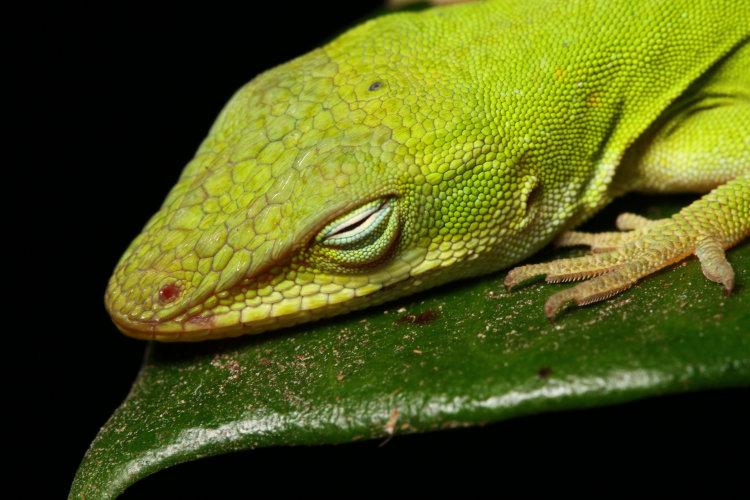
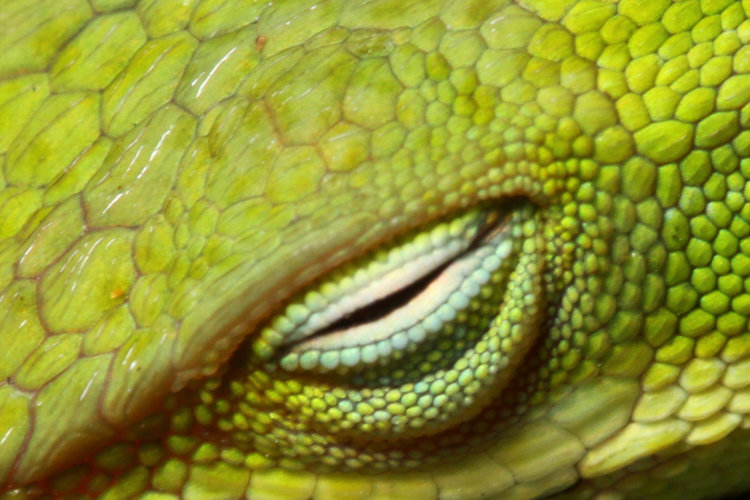
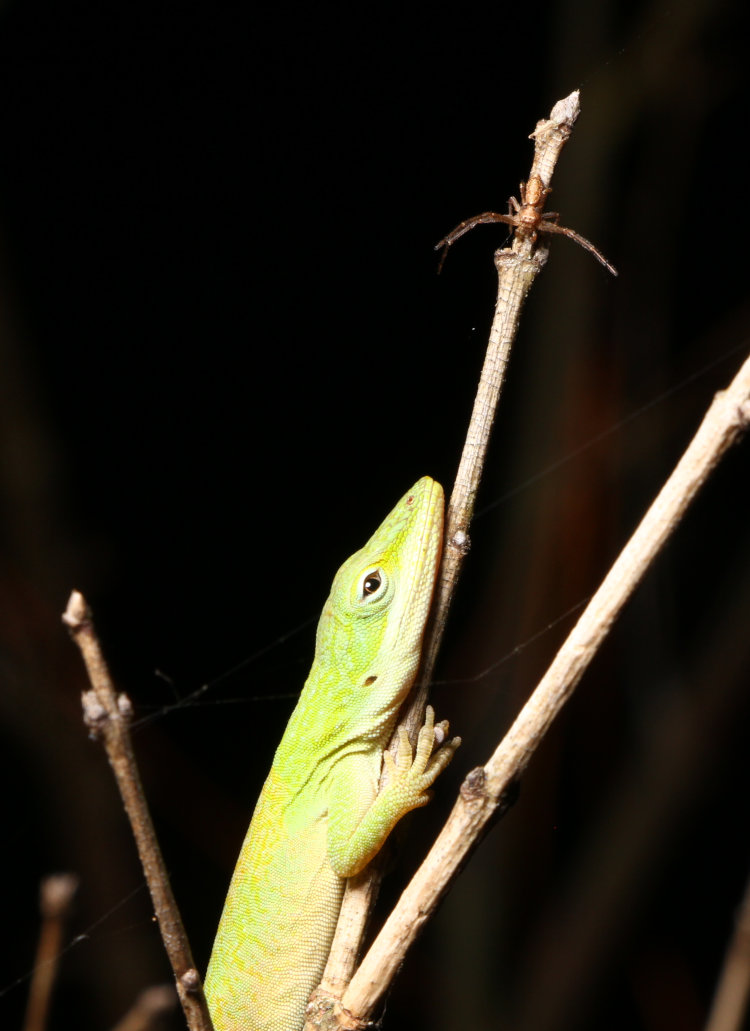
juvenile Carolina anole Anolis carolinensis sleeping in Japanese maple, beginning to molt and looking desiccated
Another newborn Carolina anole (Anolis carolinensis) sleeping on the Japanese maple, but the light angle was hardly flattering and it looks barely this side of starving. In my experience, they often look like this soon after hatching (or first appearing in public, anyway,) but they rally quickly. The white around the eyes and chin also indicates that this one was beginning to molt, which only added to the decrepit appearance. You get the impression the twig that it clutches is providing the bare amount of warmth that the lizard possesses – or at least, you do now.

direct portrait of nutria Myocastor coypus showing orange teeth and white whiskers
I should have included this one with the post at the time that it was taken, but one of the nutria provided a nice head-on portrait showing the orange teeth and that Lorax mustache. The orange is confined solely to the front surfaces, by the way, and is the hardest portion of the teeth, allowing them to wear down into chisel shapes as the softer enamel behind it grinds down faster.

juvenile Carolina anole Anolis carolinensis with dewdrop adhering to front toes
Don’t know how I missed this on the initial unloading, but this anole seems to be sporting an ostentatious engagement ring, or maybe some kind of foot piercing. Note that very little dew is visible anywhere else, on the lizard or the leaves, so it obtained this droplet from some obscure nook. Is Sauron looking back at us?

[Makes me wonder if Sauron could actually look away from the Palantirs, or if he was forced to see what they displayed. If so, you could have a world of fun setting up things to unveil to him.

“Hey, Saurpuss, lookit this!”

Gauggh! You filthy bastard hobbits!”

Come to think of it, this may explain a lot…]

unidentified snails possibly engaging in courtship
So, the sex life of gastropods is quite funky, with different species engaging in it differently. While leopard slugs simply wrap genitals, others actually launch a small dart from their bodies, attached to a membrane or mucus ‘line,’ and reel one another in (most species are hermaphroditic, to make things even more interesting.) But finding two of them in close proximity at least suggested that this is what I was witnessing. And then we go in closer:

tiny third unidentified snail among two much larger ones, potentially engaged in courtship
Not only is there a third, much smaller one in the middle there, but there is a line visibly connecting the two larger ones. So, was this what was happening? I have nothing further since there was no movement at all as I watched and I had other reasons not to stick around observing.. Not that anyone really needs a reason regardless.

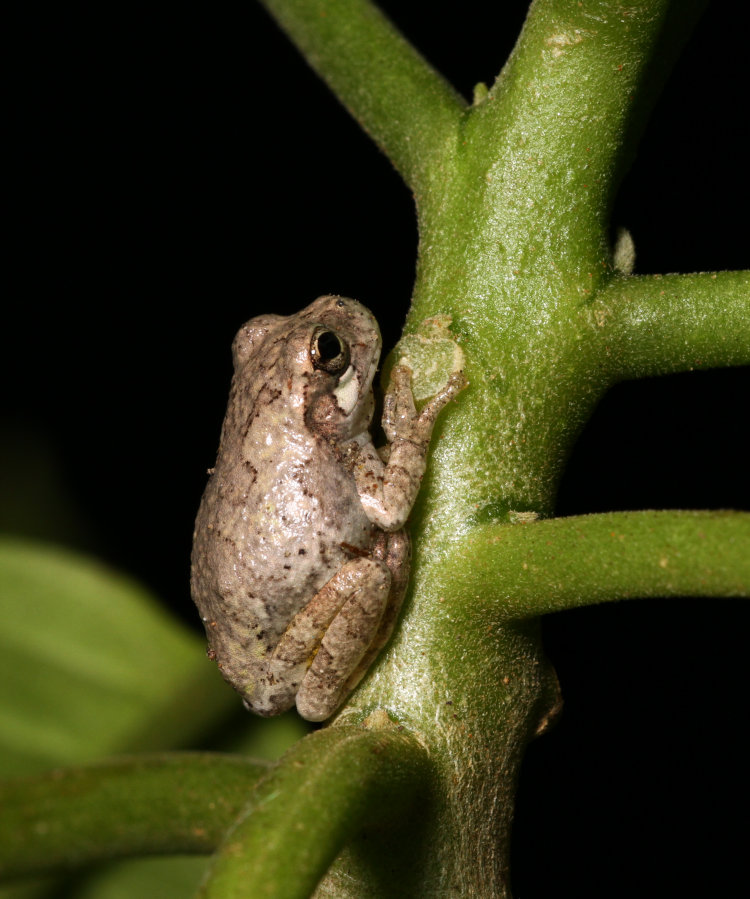
juvenile green treefrog Dryophytes cinereus perched on almond tree early one morning
Early one morning, a juvenile green treefrog (Dryophytes cinereus) was perched on the almond tree, peeking up from its nook in the folded leaves, and so I got a little fartsy with it. I had the opportunity for several different approaches and poses. while the frog viewed my presence with a little anxiety and shifted around a bit.

juvenile green treefrog Dryophytes cinereus perched on almond leaf with dew underneath
A close crop of this one showed the dew adhering to the undersides of the leaf, though it was on top too. Plus we can see from the shadow that the frog is flashing us the peace sign, which doesn’t seem to fit the discomfort displayed, but perhaps this means something entirely different to treefrogs…

juvenile Carolina anole Anolis carolinensis sleeping vertically on hairy-stem spiderwort Tradescantia hirsuticaulis leaf
Still being fartsy now, but back to the anoles. The composition was entirely up to the anole, perching on the leaf of a hairy-stem spiderwort (Tradescantia hirsuticaulis) – the little touch of blue from the flower bud helps. Now if the lizard had only kept its tail straight, it would have been perfect. Well, okay, there’s no such thing, but better, anyway.

[Since I routinely see anoles clinging in precarious positions while fast asleep, I have to assume that their muscles lock into place during unconsciousness, which seems odd at first, but how many species actually go as limp as we do? It might even be that there’s no such thing as ‘relaxed’ muscles to them, and the muscles must be told by the brain to move, otherwise they’re ‘locked.’ Hmmm…]

While we’re being fartsy…

orange jewelweed Impatiens capensis blossom and leaves, sporting dew on tips
I saw orange jewelweed (Impatiens capensis) in the yard last year but didn’t take advantage of it, so I’m making up for it as we enter flowering season again for the species. I’ve seen several different plants that sport dewdrops right on the leap tips or, as here, at specific points, but I’m not even sure this is dew – perhaps it’s simply exuded by the leaves themselves? There’s probably a botanical term for this behavior, but I’m not looking it up. You’ll notice that the trumpet/cone shape of the blossom isn’t a continuation of the stem like most flowers, but hangs from it supported in the middle. Weird.

Back to the anoles and their muscle control…

juvenile green anole Anolis carolinensis sleeping vertically head-down with one foreleg suspended in midair
Easy to see that the hindlegs are doing the work, but this one didn’t even bother with one foreleg, leaving it just hanging in space. We need a better angle:

juvenile Carolina anole Anolis carolinensis sleeping with one leg hanging in space
I had to go with a different angle to get adequate flash illumination, and honestly, I can’t recall which orientation the anole had chosen – I think this is the most accurate. And that foreleg is just sticking out there.

trio of yellow-bellied sliders Trachemys scripta scripta barely catching sunlight on old snag while covered in duckweed
As spring foliage kicked back in, the turtles lost a lot of the perches that they used to sun themselves upon, but three yellow-bellied sliders (Trachemys scripta scripta) were making the most of this snag. You can see that the duckweed has completely taken over the pond, but there’s a small advantage to this too: it doesn’t flow right back into place quickly at all, so it leaves paths through the water when it’s disturbed, cluing me in as to who’s been visiting and where they’ve been going.

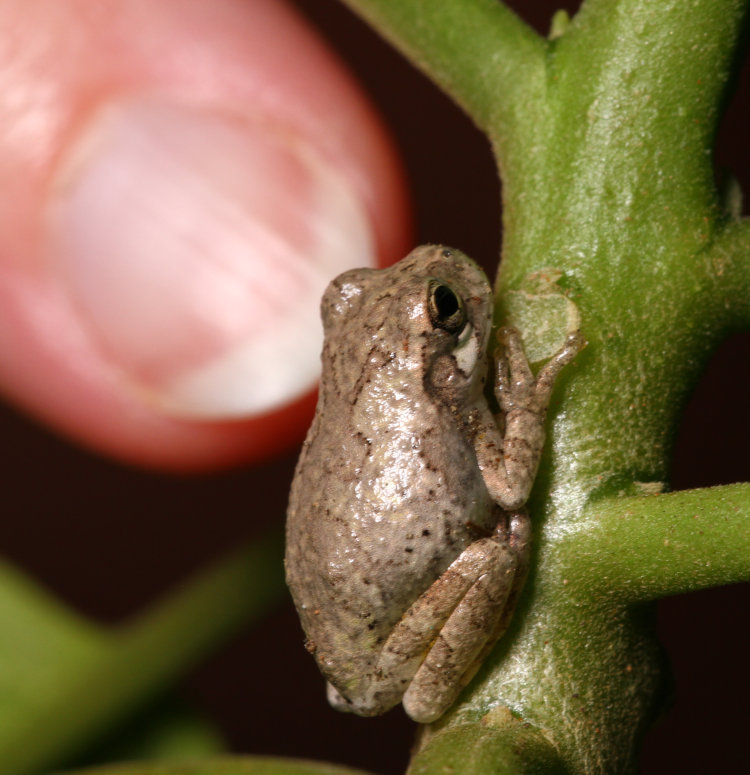
minuscule juvenile green treefrog Dryophytes cinereus perched on bullrush lead and looking skyward
This cute juvenile green treefrog is perched on the leaf of a bullrush, to provide a little scale, but what it’s observing overhead was lost to me; it might simply be peeing discreetly I guess. The angle and flash show off the translucent skin well though.

And finally,

detailed splash from fish reentering water after jumping
Back on the morning that I was chasing pics of fish jumping, I mistimed this one, which is a shame because it was reasonably close and focus was bang-on. But the splash looked nice, and closes out the collection on another fartsy note. Not a pleasant note, perhaps, or a skilled one, but a note – we’ll leave it at that.

Little things for now

Just a couple of pics for the time being – I’m in the middle of sorting and some sorting finds will be along when I finish, so right now, we have a couple of recent discoveries for giggles.

First off, last night the five bebby anoles that could be found on the Japanese maple nearest the door to Walkabout Studios could be captured in a single frame:

five juvenile Carolina anoles Anolls carolinensis sleeping in leaves of Japanese maple
Can you find them all? You remember that they turn much paler when they sleep at night, right?

Another little discovery, mostly because I saw something too dissimilar from the rest, which was this dark grey ‘leaf’ dangling from one of the sicklepod (Senna obtusifolia) plants:

chrysalis of unknown butterfly, possibly American snout Libytheana carinenta, attached to branch of sicklepod Senna obtusifolia
This is cropped a little wider to show scale, but you can still see the web strand anchoring it to the branch in the middle. The details seem to indicate that this is actually a chrysalis, supported by the view when we go in closer:

chrysalis of unknown butterfly, possibly American snout Libytheana carinenta, attached to sicklepod Senna obtusifolia branch
The segmented abdomen (attached to the stem,) the wings, and the antennae are all distinct enough, but that’s an awfully pointy head, isn’t it? This might have given me pause if I hadn’t seen a species that seemed to match, almost exactly five years ago:

American snout butterfly Libytheana carinenta apparently finding Buggato's hat interesting
This is, I’m almost certain, an American snout butterfly (Libytheana carinenta,) and both that snout and the wings seem like a pretty good match to me. I’m trying to monitor the chrysalis to see if I can capture it while emerging, but I can’t sit there all day long, much less for the several days that this might take to finally occur. So, you may see it, you may not – that’s all I can say.

No, that’s never “all I can say” – we both know better. Meanwhile, the sorting finds will be along soon enough.

Estate Find XXXVI.V

We have a late Find entry, which I’m rushing out to make it still within the confines of Friday (I have a half hour.)

very pregnant Chinese mantis Tenodera sinensis perched on water reed
After watching the hatching taking place many moons ago, I saw no signs of any Chinese mantids (Tenodera sinensis) at all, except for the adult that suddenly appeared on the liriope, and I suspected that one had come from elsewhere. Tonight I found this mama, obviously ready to drop an egg sac, and I’m going to keep checking on her to see if I can witness this (and by that, I mean photograph, natch.)

I have to note that this is full-frame, and hardly the limits of closeup ability for this lens (the Canon 18-135mm STM.) We need scale, however, and I gotcha.

very pregnant Chinese mantis Tenodera sinensis with author's hand for scale
Yes, she’s a right thick one, and it’s impressive seeing how much they can grow in a season, since she’s a measured 100mm in length (I went back out to check,) while the newborns might top 12mm. She spooked while i was doing this, and I had to convince her to get back into the open, since the foliage there was dense enough for her to disappear easily, and then I’d never see the egg sac being deposited.

During the same session, I also found this one.

adult female Carolina mantis Stagmomantis carolina on rain barrel
This is the other common species around here, a Carolina mantis (Stagmomantis carolina,) not exactly providing the natural background by perching on the rain barrel. Less than half the length of the Chinese, this is nevertheless an adult, though not obviously pregnant. Another view:

adult female Carolina mantis Stagmomantis carolina showing short wings and grey/brown color pattern
The urban camouflage is strictly within this species, which can also be green. The short wings denotes this as a female.

Now, I tried to coax this one into my hand for scale pics, but she was having none of that, perhaps aware that I’d been messing with the septic system earlier today (even though I did thoroughly wash my hands.) She quickly leapt away, at least making a more natural background by landing in the grass, and after assuring herself that she’d escaped, she wasted absolutely no time in ridding her feet of that icky human ichor.

adult female Carolina mantis Stagmomantis carolina cleaning her feet after having touched the author's hand
You’d think that perhaps it might be healthier to use something other than her mouth, especially with the rain barrel right there, but what can I say?

Five minutes til midnight – gotta hit ‘Post’…

Estate Find XXXVI

I apologize, but there’s no Estate Find this week – I’ve spent the past two days doing almost nothing but dealing with contractors, after an extended weekend with guests over. While I did indeed go out a few times trying to find something, I was interrupted/cut short twice and found nothing new the other times.

It do be like this sometimes; despite your best efforts, you don’t produce anything of interest, and this can be made worse by insisting on something new. I’ve done extended outings like that, numerous times, and have also done sessions where almost none of the images that I did take were worth keeping. While it’s not a bad idea to have goals and to push yourself to produce something of interest, sometimes you simply have to let it go, since you can’t make the wildlife and conditions around you bend to your will.

Still, I won’t just leave it at that, so we’ll have a faintly fartsy pic from weeks ago, when The Girlfriend’s trumpet flowers (Brugmansia) were blooming.

trio of trumpet flowers Brugmansia blooms at night
Man, those are over two months old, dating from June 27th! But the lighting gives a reasonably accurate impression I think, because these open fully and look best at night, attempting to attract some nocturnal pollinator that doesn’t actually live in this area, since these were imported (long ago) from South America and are actually extinct in the regions where they evolved – which isn’t to say that they aren’t thriving in areas where they were introduced. Still, whatever pollinator they evolved to attract ain’t coming…

We can go further back into the folder, too.

unidentified juvenile frog, possibly barking treefrog Dryophytes gratiosus, perched on leaf
This dates back from May 2021, and wasn’t used then partially because I could never identify it. It’s perhaps even smaller than the impression given here, since it measured (if I remember accurately) somewhere between 15 and 20mm in length, and is likely a juvenile, perhaps only recently emerged from tadpoledom. As such, it probably doesn’t have its adult coloration in place, but it looks closest to a barking treefrog, especially those ringed spots. However, I never found any other evidence of the species in that region (this being where we used to live,) though they supposedly could be found in there. I’m just taking the opportunity to clean out a couple of older pics from the blog folder.

What the hell – let’s get rid of the oldest.

chimpanzee Pan troglodyte looking pensiveI don’t recall what the original purpose of this image was supposed to be, though the contemplative nature of it is obvious. It dates back from 2006, which predates the blog itself, and while it obviously got into this folder later than that, the program that I used for editing wrote the original ‘Date Taken’ as the ‘Date Modified,’ so I can offer nothing further. Those that maintain that I’m looking more and more like this as time goes by are ignoring that fact that the chimp has more hair on top (that’s considerably less grey) and does not have eyebrows sprouting wild and unruly hairs that resemble kudzu in more ways than one. The ears are a dead match though.

Anyway, better luck next week, and naturally I will present things here at other times as I find them, plus the occasional semi-philosophical post and some utter nonsense thrown in for seasoning. Don’t give up on me yet (he says to a nonexistent audience…)

Crikey stroppin’ beeah!

Today, so my calendar informs me, is National Wildlife Day, which is actually different from World Wildlife Day, found on March 3rd and yet somehow not on my calendar. In fact, this is only a National Wildlife Day, since it also falls in February – perhaps it depends on what nation we’re talking about (I seem to recall different hemispheres celebrating this on different days, early spring for either.) This one was created in honor of Steve Irwin, which means we celebrate it surrounded by a major camera and lighting team, animal wranglers, and controlled sets, running around pretending we’re in “the wild” while affecting a ridiculously stereotypical dialect and handling animals in a disrespectful and hazardous manner. Bonus points if you somehow manage not to be seen as an irretrievable assclown while doing so.

[As you might surmise, I’m not a fan of nature shows that aren’t the least bit natural, especially ones that foster (heh!) bad habits and entirely incorrect ideas about naturalism and zoology. The bare fact that most of them are like this doesn’t help at all, but for giggles, pay attention to the camera angles and ideal lighting to see how much staging is actually taking place. Now, at the risk of sounding like a hypocrite, I will readily admit that I resort to natural-looking sets on occasion, and of course I’m often controlling the lighting, but I never represent these as ‘natural’ and the purpose is almost always illustration, not ‘documentary.’ To say nothing of the large percentage of subjects that are actually captured in completely uncontrolled conditions.]

All that aside, feel free to celebrate this as you see fit; mere observation works just fine, and will tell you a hell of a lot more than trying to have any kind of encounter. Go someplace where the chances of seeing something are greatly increased: even just the local park, but national parks, wildlife refuges, forests, lakeshores… any natural area is usually capable of displaying some kind of wildlife, especially if we loosen our concept of what ‘wildlife’ is. It’s easy to get into the mindset that this means lions and camels and narwhals, but really, just think about the more common species in your area that you’re never actually seen – even for me, this is a long list. Don’t target anything, don’t have goals, just keep your eyes and ears open.

I have a few pics to throw up, not actually from today – I may get out a little later on and see what I can see, though I have several other things that have to be taken care of. It’s not like this isn’t a regular practice anyway…

juvenile green treefrog Dryophytes cinereus hiding deep within leaves of calla lilies Zantedeschia aetheopica
A few days back on the 1st I found this particular subject, though this is purposefully shot wide to give context and perspective. Can you spot what I was seeing among these calla lilies (Zantedeschia aetheopica)? Granted, I suspected such a thing was there and was specifically looking for it.

We’ll go in a lot closer.

juvenile green treefrog Dryophytes cinereus nestled between leaves of calla lily Zantedeschia aetheopica during daylight
Naturally, it’s a juvenile green treefrog (Dryophytes conereus,) sequestered during the day before going out to hunt at night – there are almost as many of these around as there are the Carolina anoles, and that’s saying something. This was shot ambient light in open shade, and suffered a little for it, but I did do a quick scale shot too.

juvenile green treefrog Dryophytes cinereus nestled between leaves of calla lily Zantedeschia aetheopica, with author's finger alongside for scale
Eentsy little thing, but it had found a perfectly-sized spot within the leaves, perpetually shaded and so cooler during the day.

We had guests over for the holiday weekend (no, not this one, but Labor Day,) and went down to the waterfront to find that some species of fish was jumping from the water constantly and exuberantly, very similar to what we’d seen previously at North Topsail Beach and potentially the same species. I had not taken my camera on that outing, but I returned for sunrise the following day (this would be the 2nd,) and managed to snag a few shots of them in midair.

pair of fish, possibly mullets, jumping simultaneously from water
I got several photos, but most of them at a moderate distance at odd angles, and I was only working with the 18-135mm, so a positive ID was never pinned down (especially when the closest shot, here, was only seeing their bellies.) Nonetheless, based on both appearance and behavior, I suspect these are mullet; the average length seemed to be on the order of 25-30cm. But some of them were dependable enough that I could actually compose a few frames.

single fish, possibly mullet, leaping from water in front of cluster of sailboats
The sunrise was unimpressive, being far too clear and thus blinding almost from the moment of appearance, and none of the fish were cooperative enough to jump in front of it before the sun was too bright to make a decent pic. But this one works halfway decently, at least. If I were so inclined, I’d wax enthusiastically about the mood of rebellion and contrariness displayed by facing opposite the boats, but there’s such a thing as trying too hard…

And then, yesterday.

adult North American raccoon Procyon lotor foraging during afternoon on pond edge
Right where the nutria (well, and everything else) regularly forage, we found this adult North American raccoon (Procyon lotor,) in mid-afternoon, of all times. I was able to slip out onto the deck for a clearer view but did not otherwise push it; not only can raccoons be remarkably defensive, seeing one during the day is one of those warning signs of distemper or rabies, though no other evidence of this was forthcoming – both illnesses often display symptoms of sluggishness or being in a daze, aimless wandering and long pauses in confusion. Far more likely was that I spook it off by trying to get closer, so I maintained a little distance while this one was quite busy with its harvesting of already-harvested corn.

adult North American raccoon Procyon lotor foraging for corn on pond edge
I couldn’t be certain while looking through the viewfinder, but I fired off the frames when it seemed likely anyway, and did indeed get the catchlights in the raccoon’s eyes, which is almost a necessity for this species; otherwise the entire mask is simply a band of black most times. It didn’t want to sit up and give me a better pose, but you take what you can get (when you don’t have an entire crew and animal wranglers setting up your shots, I mean.)

So, go see what you can find – still plenty of time left in the day, and I’ll provide a written excuse for you to celebrate this tomorrow if you need it.

Jiskaske nou rankontre ankò, August!

Squeaking in under the wire with this one, getting out two specially-produced abstract images to see August on its way (since I found absolutely nothing during my normal perambulations.) Will this make them better, or worse than normal? Who’s judging? Who’s reading?

Anyway, what I produced after a little playing around a short while ago:

closeup of top panel of Minox subminiature camera
A handful of people might recognize this, since it contains just enough context, and a few more may be able to make a decent guess based on the progression of the numbers visible on the dial, especially the red dot by the ‘100.’ The dot denotes the highest setting that flash synchronization could be achieved, a trait of older cameras. This is the top panel of a Minox subminiature camera, often called a spy camera though it’s a lot more likely that actual spies used cameras that didn’t look like cameras, so this is more of a spy wannabe camera. I’m slowly collecting some of these, simply because I like them.

And another, more recognizable but likely more fartistic too.

collection of small freshwater snail shells
The sharp-eyed or those familiar with macro work will spot the traits here, knowing this was fairly high magnification and so the smaller white shell is really small. These were all from Cayuga Lake in central New York, several years back – such shells would shift around the lake bottom depending on vagaries of winds and currents, and while I was there a small cove was littered with a thick carpet of these, but clear of them when I returned a few years later. Species? Not even gonna try.

So we’ll send August on its way and soon see what September has to offer, shall we? I mean, I don’t think we have much choice…

Estate Find XXXV

It was looking like I was going to have to punt the Find again, with nothing much to show for this week, but I went out late Thursday night and found something better than what I had lined up. It’s not fascinating or exciting, but it’s the kind of thing that makes a nature photographer (zoologist/biologist/naturalist/creepy hermit) go, “Aha! Now I know what to be looking for.”

Be warned, however, some of these images are graphic.

bald cypress Taxodium distichum trunk showing heavy bark stripping from North American beaver
Gruesome thing to find in the headlamp, no? Especially deep (well, not that deep) in the woods at night. Yet it’s only resin, an indication that the damage to the bark of this bald cypress (Taxodium distichum) was recent. And, fairly, extensive, since it reached roughly a meter off the ground.

author's hand to show height of damage to bald cypress Taxodium distichum from North American beaver
I was out there alone, so I had to put my own hand into the shot, and couldn’t pose next to it for relative scale. What this indicates though is how big the critter that did it would have to be, which makes this likely from either a nutria, beaver, or bear. Chiplike teeth marks on other trunks nearby (there were several showing this damage) largely ruled out bear, and with seeing the nutria so recently (actually, daily now) and not far from this – fifty meters or less – one would be inclined to favor those as the culprit. There were two bits that were contra-indicators, though. The first was, this is quite close to the beaver lodge and alongside the creek that they favor, and second, I heard the distinct ka-thunk! of one diving only a few minutes before this, right near the lodge – nutria will splash, but they don’t slap the water with a flat tail to make that sound.

damage to bald cypress Taxodium distichum from North American beaver
I’d been out a few times before and hadn’t seen nor heard any signs of the beavers at all, even when I felt that if they’d had young, those would have been out of the lodge by now. And there were signs that they’d had young, since I found scraps of cow lilies on the crossover paths from our pond to the creek, and the only reason for them to be carrying food back at this time of year would be to feed young. Since it had been so quiet with no further signs, however (even the cow lilies have bounced back almost entirely,) I had callously discarded them as a potential photo subject in favor of other things, though I’d wondered if they had moved on or even run afoul of some predator. These pics makes it clear that there is still notable activity, so I have to go back to plans of staking them out, or at least checking a lot more often.

Funny, too, I might have missed this entirely by day, since I would have been relying on the indirect light filtering through the dense canopy, which would not have illuminated this as distinctly as the headlamp aiming right where I was facing. But yeah, I need to be getting my butt up before sunrise and checking out the area more often to see what I can see – I’m not a morning person, as you might have guessed from all of the night pics, so switching over takes a little effort, which I’ll be happy to expend if enough people encourage me. Not that I’m hinting or anything.

For giggles, though, I’ll include what was slotted to be the Estate Find, should I not have found anything else last night. Otherwise it would just go in a separate post anyway.

sunspots late afternoon August 27 2025
I’m still checking out the sun when I think of it, and this past Wednesday, some significant activity had sprung up when all had been quiet before. According to two apps on my smutphone, though, this hasn’t so far resulted in any increase in potential auroral activity, not that I would likely see anything at this latitude, anyway. Compare this to August 4th, however:

minimal sunspot activity from August 4 2025
Barely anything registering there at all, though one day in between there was so little I could pick out only two faint specks.

So, this post could have been worse – at least the bark pics were actually on Walkabout Estates Plus, and not 151 million kilometers above it…

Banana (spider) for scale

While I was out last night photographing the Estate Find, I grabbed two other images of opportunity and I’ll throw them up now.

I’ve mentioned the explosion of golden silk orbweavers (Trichonephila clavipes) on the property, but they’re getting big now, and I needed an illustration of this. It worked out fairly well, all things considered, and you can see why they’re also referred to as ‘banana spiders.’

adult female golden silk orbweaver Trichonephila clavipes in web with author's hand behind for scale
Yes, that’s my own hand in the pic, just a little behind the spider so only slightly misleading as to scale. I’d wanted to get this for a while now, and this particular specimen was low enough and within reach, while also being huge. What also worked out well is that there was a large gap through the orb web to the right, likely courtesy of some bird, that I could reach through to put my hand back there. That helped, since the web is nearly a meter across the orb portion, much more if you count all of the anchoring strands. Still, it was close, and the spider jerked in alarm at one point, ensuring that I did too; the arachnophobia that I grew up with is greatly reduced but still not entirely gone, especially when we’re talking this big. This is a female, and if the girth is any indication (not that I’m saying anything,) she’s likely to produce an egg sac soon.

Now, see the brown and white vertical oblong shape, out of focus to the top left? That’s a male in the web (yes, that small,) somehow not cognizant of the fact that he’s way too late to this party. I had to check something on my return, too, since I’d read that there is another spider that often shares the web to steal food, a ‘kleptoparasite,’ but this is not one of them. I’ll have to keep my eyes open since they’re actually pretty cool looking.

For comparison, one of the many newborn Carolina anoles (Anolis carolinensis) that litter the property, taken only minutes afterward.

newborn Carolina anole Anolis carolinensis sleeping on weed with author's hand behind for scale
Yes, not only could the spider take the lizard easily, it might not amount to much more than a snack. Yet the T. clavipes are plainly after insects, albeit large ones, stringing their webs between trees and often sitting quite high in the air. The anoles are unlikely to ever come within range.

Now comes the uneducated speculation, since I started wondering what might prey on the spiders and realized a couple of things. Both the brilliant coloration, which isn’t going to blend in with anything (especially out in the open as they so often are,) and the color of the silk itself would seem to indicate that they evolved to be seen, and the coloration may also be an indication of aposematism, the ‘keepaway’ warning to other species. Typically, this is coupled with some means of discouraging predators, often through being unpalatable, but also through active means; the predator makes the attempt, finds out that this is a bad idea, and remembers the species thereafter because they’re so distinctly-colored. Yes, this means that not only does at least one member of the aposematic species often have to be sacrificed to protect others, but that the predators have to learn this behavior for themselves (since I’ve found no mention of anything inherently/genetically knowing that keepaway colors are bad.) It seems remarkably inefficient, but still better than nothing.

All that said, there’s no mention anyplace that I’ve found that golden silk orbweavers have these colors for such a purpose, and a lot of birds eat spiders – seems like these would be easy pickings. I need to look further into this…

Still here, really

These long empty stretches keep happening, and probably will, since there are plenty of other things going on here that need my attention, so the posts get neglected. Plus, those same things keep me from finding new images or topics. So, we’ll have just a couple of sideline pics gathered here and there just to prove I’m not dead. But also consider, I could be resorting to AI to generate posts to keep on a better schedule (that’s AI, not Al, me,) but none of us want that, do we? Actually, has anyone but advertisers or cheapskate corporations asked for anything like that?

Continuing to our questionable and hardly exciting content.

likely eastern amberwing Perithemis tenera perched on almond tree
While I was examining the almond tree for lizards, this dragonfly was insistent on hanging around, probably trying to get attention, and like a little bitch I complied. This is probably an eastern amberwing (Perithemis tenera) because of the uniformly tinted wings – most others close to this appearance only have a portion of the wings with color. More, I just liked the pose, as trite as it is.

newly adult Carolina mantis Stagmomantis carolina on Japanese maple tree
While doing the evening rounds, I discovered that the Carolina mantis (Stagmomantis carolina) on the largest Japanese maple tree, one that I’d been spotting from time to time, had recently molted into its final instar, adult form, as evidenced by the wings (even though they look inadequate.) Carolina mantids are much smaller than their Chinese counterparts, so this one was a third the mass or less than the mantis featured in the previous post. It was also much more reluctant to walk on my hand for scale, so this was the only place that I got it to hold still enough. The dark spot on the wing is not a natural marking, but more likely evidence of an injury that occurred before the molt – it has a near-matching one directly opposite, only more noticeable.

golden silk orbweaver Trichonephila clavipes in center of web casting its shadow on window
This little lady has been guarding the living room window against encroaching insects for a couple of weeks now, and judging from the size, not doing as well as its relatives down along the pond, it must be admitted. This is, again, a golden silk orbweaver (Trichonephila clavipes,) catching the morning sun. What I like about this is the eye-bending nature of it, since the shadow is against the glass which sits between us and the spider with its the web. The web is bright enough to cut through the shadow, though, so it makes it appear as if the shadow is somehow behind it. I have seen these webs with very uniform spacing among the circling strands, some of them almost appearing like train tracks, but this one here isn’t evidence of meticulous care, is it? This is probably grounds for Weaving Under the Influence…

And finally,

pair of newborn Carolina anoles Anolis carolinensis sleeping across one another
The Japanese maple nearest Walkabout Studios routinely features four juvenile Carolina anoles (Anolis carolinensis) each night, though two nights ago when this was taken, it had bumped to five. These two aren’t doing anything nasty, they just happened to take up sleeping positions like this – normally they all find their own leaves with at least a moderate amount of personal space. Earlier that same day, I think, I’d witnessed one just a hair larger/older than these suddenly jump across to a butterfly bush and begin displaying its dewlap, flushing another unseen one from the area, so even this young, they can start getting territorial (and I’m really sorry I didn’t catch it on video, but I didn’t even have the camera in hand.) So does that mean these are opposite sexes, or perhaps siblings and thus not territorial? I can’t even speculate – I’ve said before, I just takes the picchers, someone else has to explain the behavior.

By the way, this particular night I didn’t take the time to get an anole count, even though it looked promising. However, the previous night I’d managed to bump it all the way up to 39! That’s quite a few bebby lizards – there’s got to be be some way to monetize them…

This could be easier

For the past several weeks, I’ve been getting messages in the WordPress dashboard about my site’s PHP version being beyond security updates, and that I should switch to a newer one. No sweat; the host has this easily accessible and lists numerous versions I can switch to. Only, the moment I do, any of them, the blog site goes down.

This is generally an indication that something on the site, usually a plugin, is incompatible with the version of PHP that I switched to. Okay, a little sweat now; this requires either a) checking the plugin/site compatibility with another plugin specific to that purpose, or b) disabling plugins until the site loads properly again, or c) both. Right in the warning that WordPress provides is a link to a compatibility checker, one that I already have installed.

Only thing is, this one is not anywhere near current, only checking up to three versions past the latest version of PHP. Guys, why are you recommending this damn thing? Nonetheless, I tried it out, identified two likely culprits, and disabled them. No go – the site still doesn’t load.

Ah, but you can get error logs with some editing of the wp-config file, which is easily done in a text editor! So, download the current version, edit that, re-upload it, and voila! All the errors displayed. Unfortunately, they display right inline with the site content itself, making it look shitty, but they can be copied from there. Those identified a couple of other plugins which might be the culprits, so I disabled them too. Still not loading properly.

Throughout all of this, I’m switching back and forth between versions, reloading pages, and then reversing what I’ve done. Did I mention backups? Yes, the entire WP database has been backed up right before I start, and the wp-config file as well.

Mind you, I’ve been updating the plugins and the main WordPress files routinely, so everything is ‘current’ as far as it can be. Now, this doesn’t apply to plugins that are no longer being supported or updated, which you would think the compatibility checker would flag. But just in case, I disabled all of the older ones that got flagged or indicated, one way or another. Still no go. Then I added a new plugin that would tell me when all of the other plugins were last updated, found all of the old ones, and deleted them. And the site still won’t load once PHP has been updated.

[Small sidetrack here: While I’m quite fond of open-source software because it’s almost always written better than what the large companies offer as well as the creators often being responsive to improvement suggestions, the major downside is, there is no motivation to maintain it – quite often, such projects are simply abandoned after a while. If you’re lucky, someone else has stepped in and created a new and improved version when this happens, but not always, and even then, you have to install the new version and get used to all of its quirks. This describes damn near all of the extras that can be added to WordPress, as well as numerous Linux/Ubuntu offerings and the firmware versions available for 3D printers. Still, it remains better than subscription bullshit.]

While doing this, I got a message at the top of the page while checking out the custom sidebar entries, the space over there to the left that has all of the extra doodads that I’ve added to make the site less boring – I mean, c’mon, what would it be like with only the posts? This message suggested making a change to a menu that was ostensibly linked within (basic html,) except it wasn’t, and I couldn’t locate that menu. Eventually, I think I found what it was referring to and disabled that function. Nada.

So at this point, the sidebar has been decimated, without allowing the upgrade to actually take place, which means I’m worse off than I started. And now I think I’m done. This kind of shit always takes so fucking long and rarely results in any improvement. While PHP might not be the most secure version that it could be, there is nothing on the site that actually needs security anyway: no payment portals, no personal information, no access to anything – just posts (and, in the main site, photos,) all of which are readily accessible anyway because that’s what the fucking site was designed for.

I was thinking this was related to a holiday, but if it is, I’m not going to observe it anyway. I’ll try to throw up another post shortly, though – I’d already written most of it before I decided to tackle this dumbass project, so it’ll offset this a little.

1 12 13 14 15 16 329