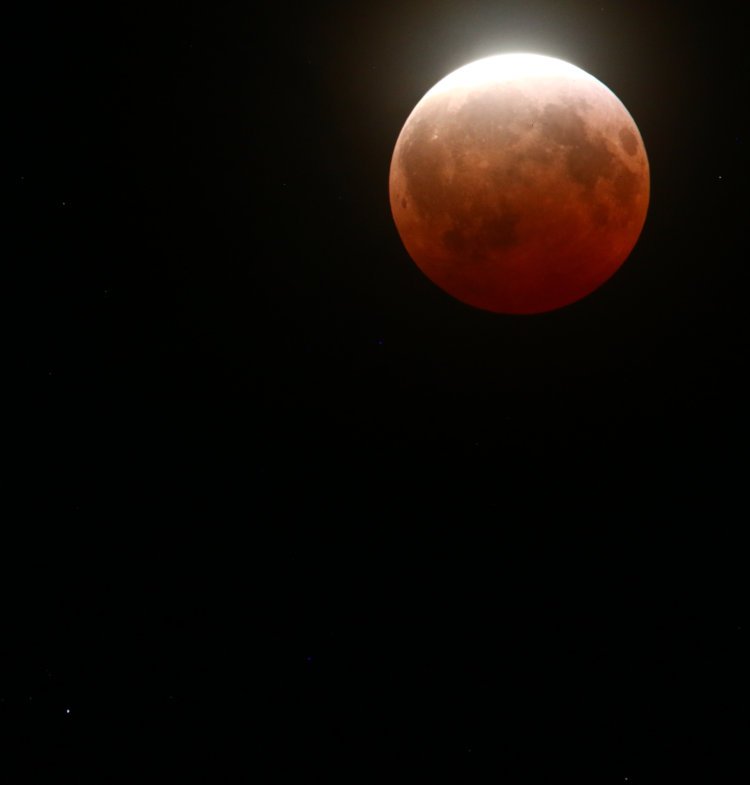
One of the things that I urge any serious, or even remotely serious, photographer to try is film developing. It’s a lot easier than it seems, takes minimal equipment, and is immensely gratifying. Except, there’s a caveat to all that, or perhaps several. Monochrome negative (print) developing is easy; color negative is three times as involved, and color positive (slide) more so, and I have not as yet tackled them.
Also, getting a print at the end requires an enlarger, probably the most expensive bit of equipment, and the space to set it up within, and for trays, et cetera. We’ll get to this in another post. But failing that, you’d probably want a film scanner to digitize the negatives you’ve produced, a different expense. Either of these can be had for relatively low costs, especially compared to what they used to be, but it still begins to add up.
Still, let’s outline the basics.
Equipment for basic B&W/monochrome negative developing.
Developing Tank
Film Reel(s)
Clothespins or clips (hanging film to dry)
A completely light-free area (more on this below)
High-visibility thermometer
Chemicals for basic B&W/monochrome film developing.
Developer
Stop Bath
Fixer
Helpful additions
Hypo Clearing Agent
Wetting Solution
A light-free area. There are a number of ways to accomplish this, but first, understand what you actually need. This is to get the film from the film can onto the film reel, and then insert the reel into the developing tank. The tank is light-tight, so from that point on, everything can be done in normal lighting. While you can certainly make a room (closet, bathroom, whatever) light-free, you can also use something called a changing bag, just a light-tight large bag with sleeves that you put the film can, reel, and tank into, insert your arms within, and then do the film loading. Should you want to make prints, the light-tight room becomes necessary because you’re not putting an enlarger in such a bag.
Light proofing a room isn’t hard, this can usually be done with meticulous application of weather-stripping, you just have to find all the cracks. The guide is, put a white sheet of paper on the counter or floor and remain in your sealed room for ten minutes in the dark. If you can see any leaks in that time, or see the paper, it should be better than that.
Film has to be loaded in total darkness, but this takes only a few minutes once you’re used to it. Printing can be done under an approved safelight, since print paper is far less sensitive to light, but minimizing exposure is best all around.
Loading film.
The whole idea is, allowing chemicals to get to all surfaces of the film evenly while taking up the least amount of space. Film reels hold the film in a spiral with space between the layers. Patterson or self-loading reels are highly recommended, and can usually be found used easily. Again, all this is done in total darkness, so the best thing to do is get a couple of old rolls of film that can be trashed, and practice in daylight until you’re comfortable with what you’re doing. With a self-loading reel, insert the end of the film into the reel for several centimeters, then, ‘walk’ the film further in by grasping the sides of the reel and alternating twisting motions – a 36-exposure roll will take less than a minute. Once you hit the end of the roll, cut the film free from the film can, and walk it another couple of centimeters until the end is firmly within the reel. Place this into the developing tank, cap it properly, and you’re done – the tank can be removed from the bag and brought out into the light.
With old, wire reels, you have to pinch the sides of the film gently to bow it, making it narrower, and insert this into the reel down near the middle to clip it to the beginning of the spiral, then gently wind the film onto the spiral runners of the reel while still keeping it bowed – as it is released, it goes to full width between the runners and stays in place. This is tricky and takes practice. Once loaded, if the film is kinked or gets out of line, this can be felt by running your fingers all along the outsides of the reels, feeling for any edges of the film; if it is properly loaded, nothing will be sticking out of the reel sides. Then just place this in the developing tank, cap it properly, and you can do the rest in the light.
If you pinch the film too hard, or bend it while messing about (easy to do within a changing bag,) you’ll get a ‘ghost’ on the negative from the film base getting clouded at the bend/kink. Also, if you allow the film to touch itself during the developing phase, it will have uneven patches, so loading should be done carefully.
Chemical prep.
It’s best to have some thick opaque bottles or jugs to store the chemicals within, and know that they have a relatively short shelf life. Old chemicals will do a poorer job, or barely work at all, so it’s not a bad idea to have several rolls of film ready and develop them all at once – they can be stored in a fridge or freezer (tightly bagged against moisture) to keep the emulsion from degrading.
Mix the chemicals according to directions, and note that the best results are obtained at certain chemical temperatures. B&W is less sensitive than color film, but maintaining that temperature helps a lot – using a water bath to place the chemical jugs into works fine, just monitor the temperature. Some chemicals can be re-used (stop bath, developer to an extent,) and some can’t (most kinds of fixer, hypo-clearing agent.) Keep these in mind as you do the developing.
Let’s go!
Developer removes the unexposed portions of the emulsion, leaving the exposed portions attached to the film base. The films almost always provide guidelines as to developing times, so use these – the developer is crucial, the others less so. Start your timer and pour the developer into the light-trapped fill spout of the developing tank. Gently agitate it for the first minute – don’t shake it; bubbles are a bad idea. Usually just swirling is fine, but some tanks have an agitator to do this with. Tap the tank firmly at the end of this agitation to dislodge any bubbles from the film surface.
Following that, agitate for about ten seconds every minute during the developing time. As the timer runs out, dump the chemicals out of the light-trapped spout back into your container and immediately go to the stop bath.
Stop bath neutralizes the developer and prevents any residual from continuing to act on the film emulsion. Pour this in and agitate the entire time, usually 30 seconds, no more than a minute (unless otherwise indicated.) Most stop baths available are bright orange, ‘indicator’ chemicals that will turn blue when they have been contaminated by too much developer, so when you pour it back out of the tank at the end of the cycle, do so into a container where you can examine it before putting it back into the storage jug.
Fixer removes any residual unexposed emulsion and locks the exposed emulsion to the film base. While under-fixing will let the negative degrade over time, over-fixing can produce a haze or color cast. Pretty much, you’ll do the same process as the developer: agitate one minute, then ten seconds every minute, with taps to prevent clinging bubbles.
Wash under running water for at least a full minute – you can do this with the lid of the tank off now, since light won’t affect the remaining processes. If you have hypo-clearing agent, which removes residual fixer, you would empty the tank of water and pour this in now according to directions – this greatly reduces wash time. If you do not, continue washing for five minutes.
Rinse out hypo-clearing agent if necessary, fill tank with water, and add a few drops of wetting solution. All this does is reduce the surface tension of water so it drains off the negative in sheets rather than forming drops – keeps the negative clearer. Agitate gently in this for a minute.
Take the film reel from the tank, attach the outside end of the film to a clip, and gently unwind the entire roll from the reel. This is the part where you see all the individual frames for the first time. Hang the film vertically to dry for at least a half-hour – a shower stall is usually a good place, but someplace with minimal dust so it doesn’t adhere to the wet surface.
Once dry at the bottom, you’re done! If the chemicals are already mixed, this takes about an hour all told. Now you can scan the film, or cut it into lengths to sleeve it, or go straight to the enlarger to make prints.
But a warning: Once you see how easy it is, and watch the photos that you not only took, but developed yourself roll off of the reel, you’re liable to be hooked. I have had darkrooms set up in four different places that I’ve lived over the years, and other projects have prevented me from getting the fifth one set up here just yet. It’s coming.
Really and for true, it’s the last day of the month – I checked three times. I spent almost as much time on that as I did trying to render those characters in the title. Which is much more than I spent shooting abstract images this month, a time period best defined as, “almost nothing,” so we’re going with images from last month that are also sorting finds. Such as:
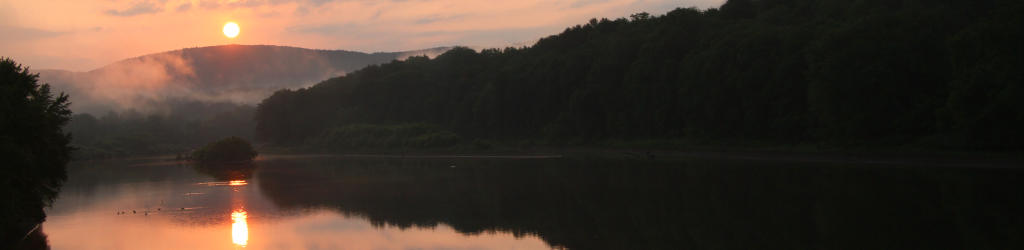
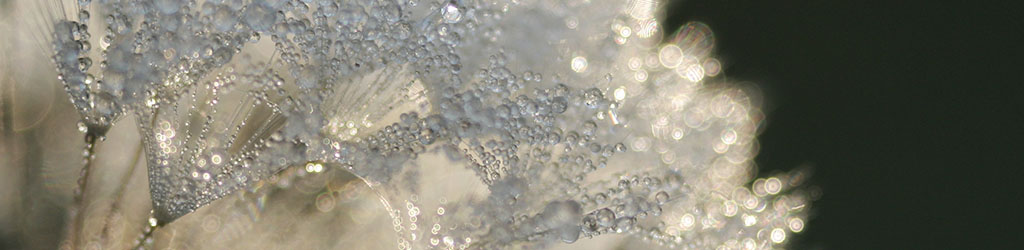
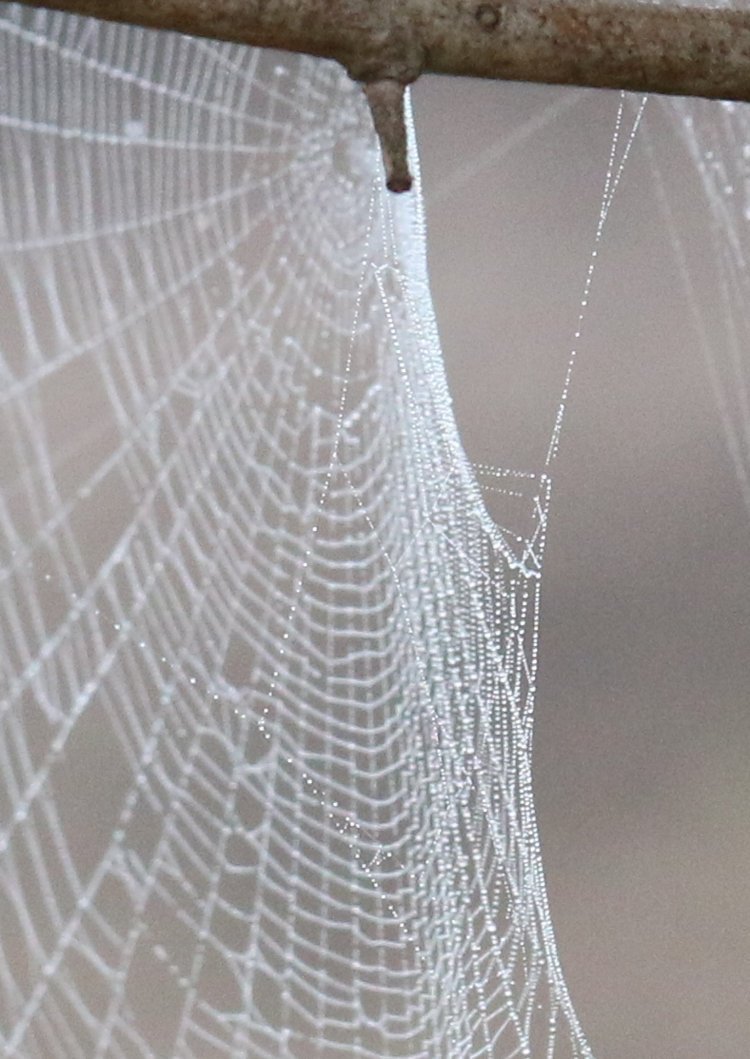
Is it still fog when it collects onto a surface, or does it become mist? Or dew? What’s the correct terminology here – it’s important. When you figure it out, apply it to this, which is [moisture adhering to a spiderweb in larger droplets], magnified a bit and with selective focus. This was taken on the foggy morning outing on Jordan Lake, and while the overall frame didn’t work, this cropped portion does. I think. Your call.
And while we’re at it…
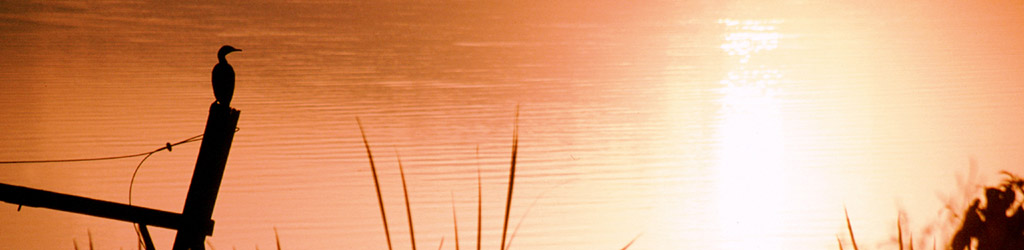
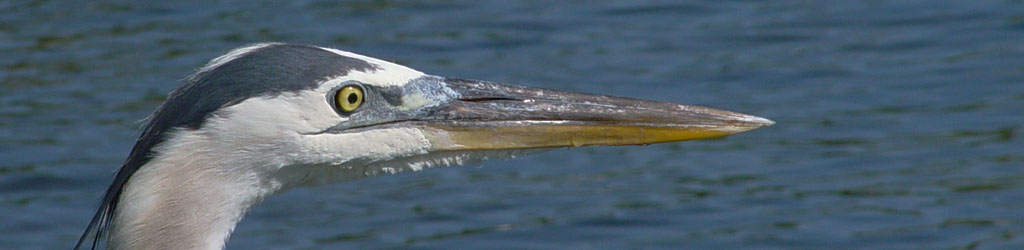
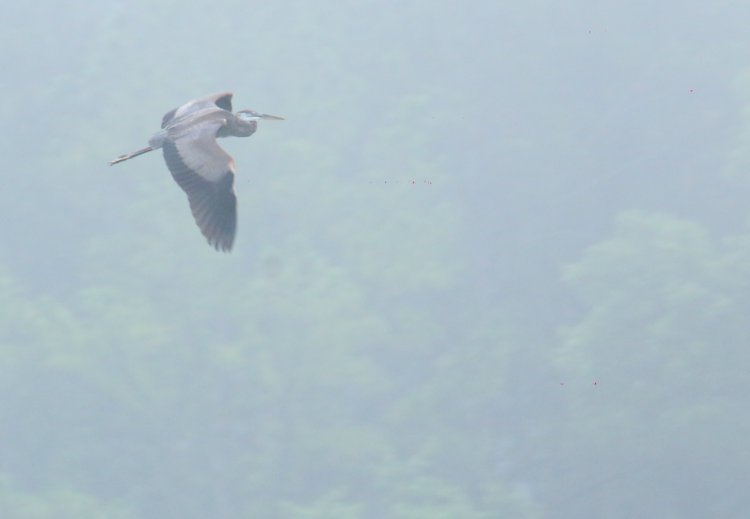
This is definitely fog – unless it’s a ground-level cloud. Or really fine mist. But the different amounts of it between the heron and the background provided an impressionistic air to the scene – unless it’s neo-classical. Or hyper-surrealist. It’s an air, anyway. A very moist air.
There will be more images before we abandon the month completely – ah, but how many more? I was about to say, not enough to beat August 2021’s record of 102, but you know what? We’re much further along than I thought, presently at 101 right now, so…
I really, really wonder* who comes up with these holidays. I mean, seriously – this one is far too much of a FaceBlerk kind of thing, and I don’t blame anyone for ignoring it, because it accomplishes nothing**. That said, I’m in the rare position to address/celebrate it, so we’ll grudgingly recognize What Were You Doing A Decade Ago? Because exactly a decade ago***, I was obtaining this shot:
I was down at Falls of the Neuse, the head of the Neuse River just north of Raleigh where it exited Falls Lake – initially, I believe, it had actually done so as a waterfall, or at least a cascade, since the rock face was still there, but now it is a controlled water source, which means it exits the lake through a dam spillway that, on occasion, is opened quite far to manage the excess water and thus the river erodes the hell out of the banks immediately downstream. Seriously, I’ve seen more than a few trees that simply lost all their supporting soil and toppled into the water in the nearly three decades that I’ve been visiting.
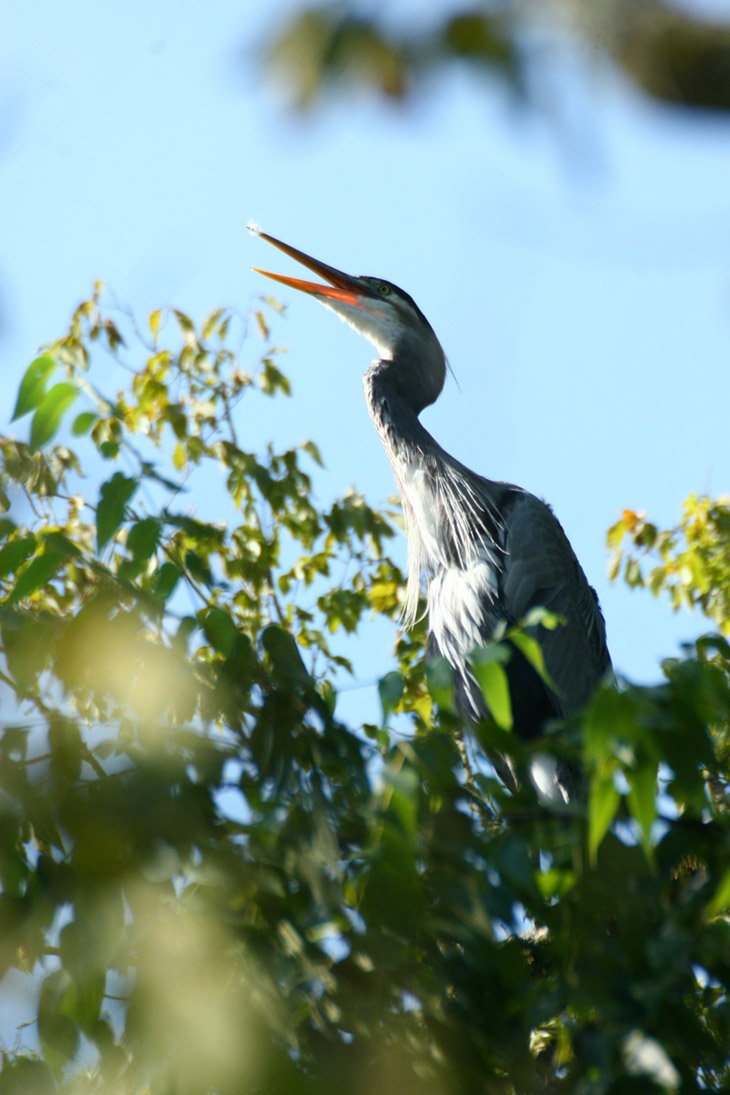
Anyway, it was an extremely hot day, and this poor great blue heron was feeling it. The bird isn’t calling, or even swallowing a fish, but simply sitting motionless in a treetop, panting. I had lined up this photo for a post to be made soon afterward, but that never happened, and so it’s been sitting in the blog folder since that time. When the holiday reared its ugly head, I was set to ignore it and then thought****, Why not check just to see if you have something that fits the bill? Behold and lo, I actually had something. What are the chances?
This was not, by the way, the oldest image in the folder – and neither is this (it’s close,) but I figure, while I’m here…
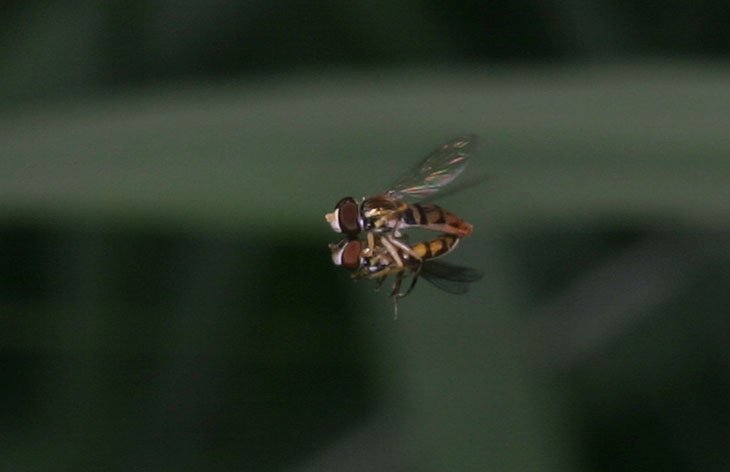
Just a grab shot of a pair of unidentified hoverflies, partially because they were engaged (well, beyond engaged I guess) in the naughty-naughty not just right out in the open, which would have horrified most of middle America, but in midair like total perverts. And also because I actually got a sharp-ish photo of a pair of flies hovering. These guys are typically no more than 15mm in length, usually less, though I admit I neglected any attempt to get a more specific measurement – I was far more slack in my youth. And young I was, this being thirteen years ago instead. That’s the era of the old Canon DReb! Well, okay, it was well after the era of the first generation of Digital Rebel, but that was when I was using one.
I briefly went into BugGuide to try and identify the species, but got guides such as this:
T4 with two pale oblique stripes in exotica and obliqua (completely dark in Fazia micrura); male obliqua has pale crescent-shaped band on third abdominal tergite; in female exotica the band is only slightly curved and is flattened along base
… and you know, I’m not gonna go nuts just for this holiday, of which this image doesn’t even qualify anyway. They’re Syrphidae – be happy with that.
So, what were you doing a decade ago?
. * No I don’t
** Unlike most of the other holidays found herein
*** Seriously – I set this to post exactly on the time from the EXIF info of the image, because I’m me. So as long as you’re right on top of the new posts appearing…
**** No I didn’t
*+ It is absolutely, patently untrue that I make up holidays as excuses to dump old photos and run up the upload count for the month, and I deeply resemble resent the implication…
We had that tiny fragment of a solar eclipse two weeks ago, and true to form (in this case, orbital mechanics, though what they’re doing up there is anyone’s guess,) about ten hours ago we had a partial lunar eclipse. The weather forecast had called for rain developing in the evening and continuing on through into today, and before the penumbral portion was even due to start, we were socked in here starting to feel some light rain. I resolved to check periodically just to make sure we didn’t have a break in the clouds.
Peak was supposed to occur right around midnight, and at 11:45-ish (or 23:45-ish if you prefer) I went out and actually saw the moon: partially shrouded in clouds and thus quite indistinct, but it was there. Moreover, I could see a star far off to the west, which meant a complete break in the clouds could be coming, so I set up to keep an eye on things. As it got closer, there were patches of actual brightness, which a longer exposure brought out.
It went in and out, disappearing entirely just as I got the camera set up but returning for brief peeks – I would have done video but the light was too sparse and, if I got anything, it would have been grainy as hell. The clouds weren’t moving fast at all, but they were moving, and soon enough, things cleared enough for some decent pics.
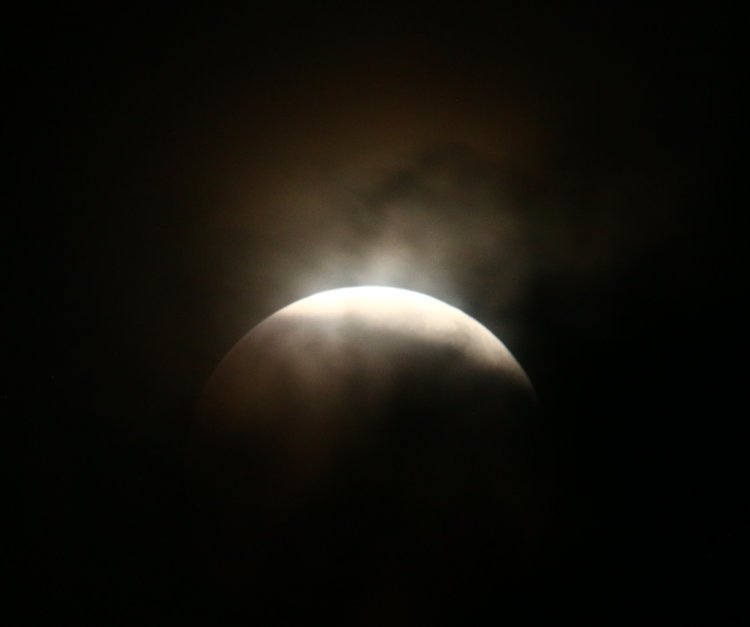
This is roughly 13 minutes before peak, with the shadow appearing to move right to left – it wouldn’t get a lot more noticeable than this. But I was bracketing exposures for different effect, as well as tweaking focus because all I could clearly see in the viewfinder was the bright portion and that was inadequate for the job. A longer exposure brought up an additional detail though:
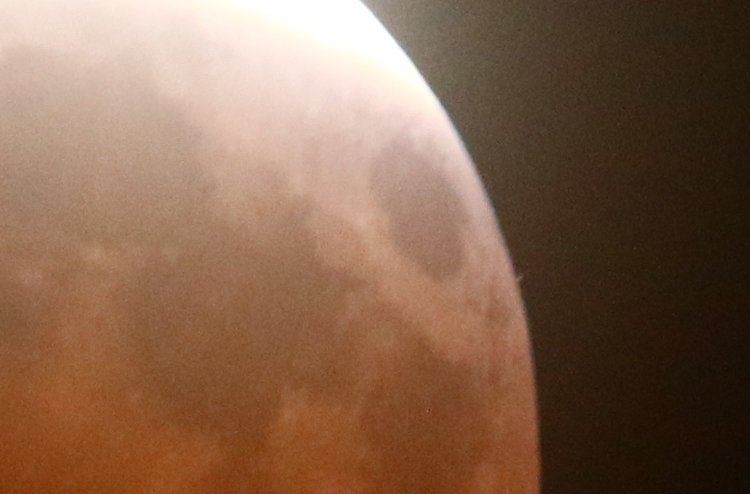
See it there to the right? I actually spotted this in a preview (“chimped”) image as I was checking focus, and re-aimed the camera to ensure myself that it appeared in the same place and was thus up there and not in the camera, i.e., sensor noise. But no, subsequent checks in Stellarium show this is actually a star, HIP 110580 to be exact (or HD 212396, or SAO 165042, depending on what catalog you prefer,) a 7th magnitude star in the constellation Aquarius. While the moon appears to move left to right in the sky, it does so slower than the stars do, so this one would have popped out from behind the moon, oh, let’s see… according to Stellarium, about 14 minutes before. In fact, there it is:
I didn’t think to check the motion until writing this post, and on finding that it appeared while I was firing off frames and not while the moon was obscured by clouds as I thought, I had to go back and re-examine my images – this is a full-resolution inset, and you can see the grain of ISO 1600 far too clearly. I even have a frame just as it broke the limb of the moon, but since it’s only a bump in a grainy photo you wouldn’t believe me anyway.
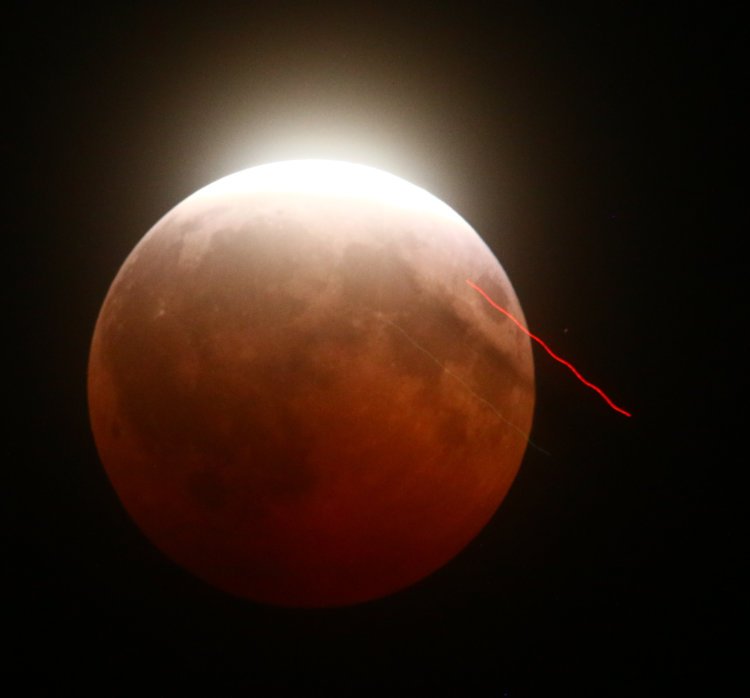
The Girlfriend came out to check things as it neared peak, and she was the one who spotted the plane approaching, so full credit to her, because I would have missed these:
We both had little warning, so no time to adjust from the settings I was using at the time, and so I simply fired off a few frames as it passed. Now, I’ve watched countless times as planes approach the moon, and catching one actually crossing in front is extremely rare, since the moon is a ridiculously small target in the sky – usually they pass close and that’s the best you get. Here, at 0.4 second shutter speed, I was only going to catch the movement delineated by the navigation lights, and a faint shadow from the body blocking the moon through portions of the exposure. The wobbly lines, however, are courtesy of camera shake, all from the vibration of the shutter and the mirror initially slapping up. The following frame captured some more.
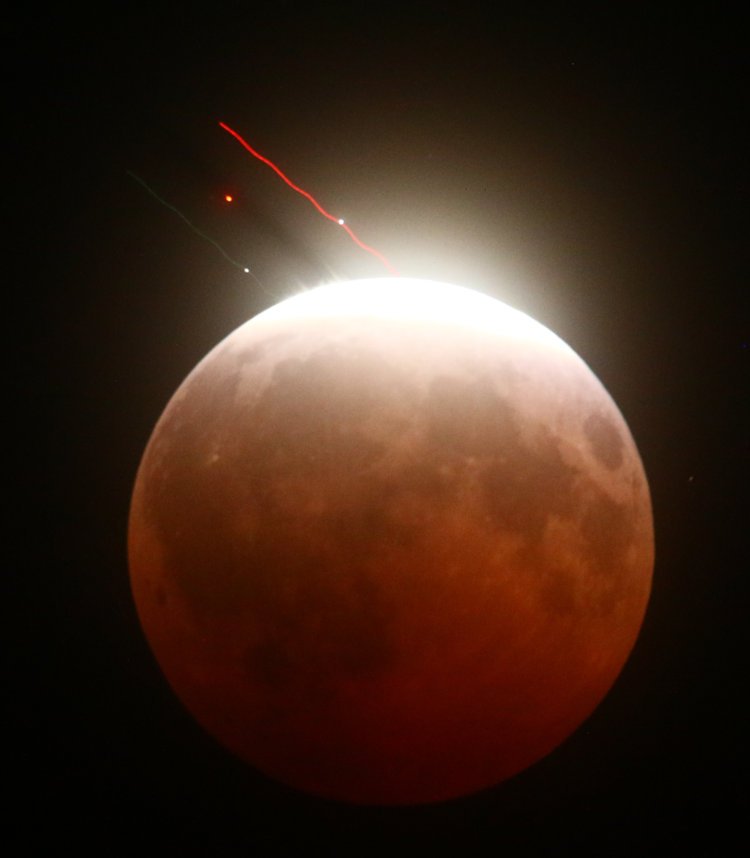
Now, we can see that the white paint used to make this image wasn’t quite dry yet and smeared with the plane’s passing. Well, okay, you’re actually seeing the contrails of the plane distorting the moon’s light at the edge – and something else. See the faint shadow between the nav lights? That’s the body of the plane blocking the atmospheric haze lit up by the moon, indicating that the humidity hadn’t totally cleared and that glare wasn’t solely in-camera. I was a little surprised when I realized that I’d actually caught this.
Now, could I have captured the plane sharply against the eclipse, like, properly outlined? Ye-ess, perhaps, but let’s lay it out. The shutter speed would have had to have been 1/100 second or faster (probably faster to get it really sharp,) which was 5 1/3 stops lower exposure than this. The aperture was already at maximum for the Tamron 150-600 lens (f6.3,) and ISO at 1600. What I might have gotten would only have been the sunlit sliver of the moon, and dimly at that, so only a portion of the plane anyway, and only if I nailed tripping the shutter at exactly the right moment. Getting the plane outlined against the reddish earthshine portion of the moon, sharply, would have required a camera and lens far in excess of the capabilities of mine.
Anyway, we’ll visit probably the sharpest image that I got of the eclipse.
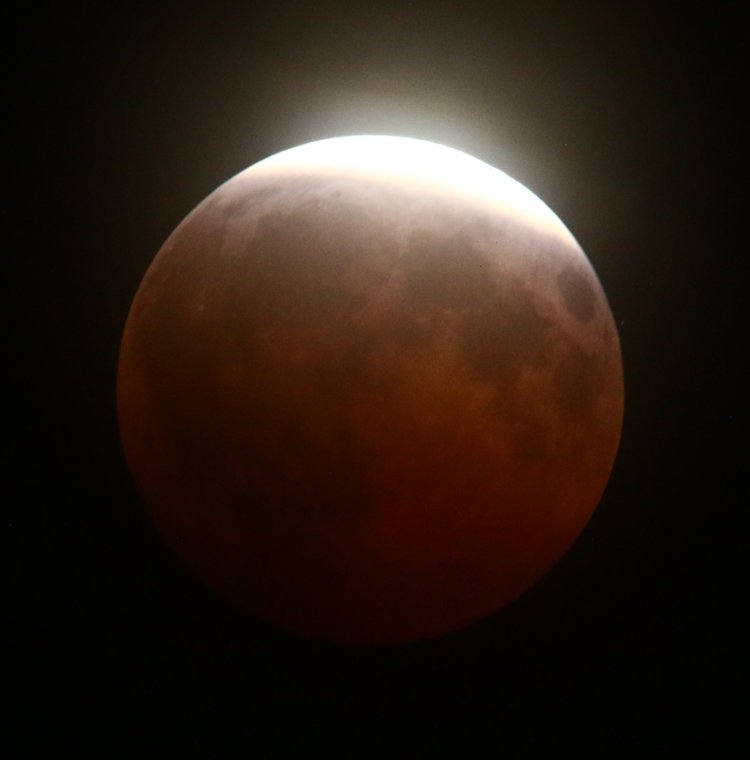
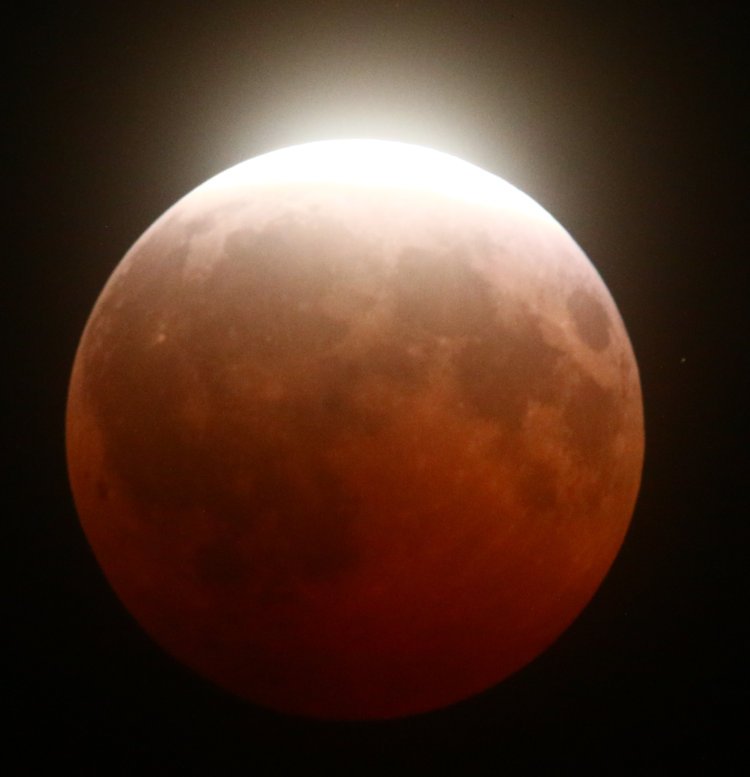
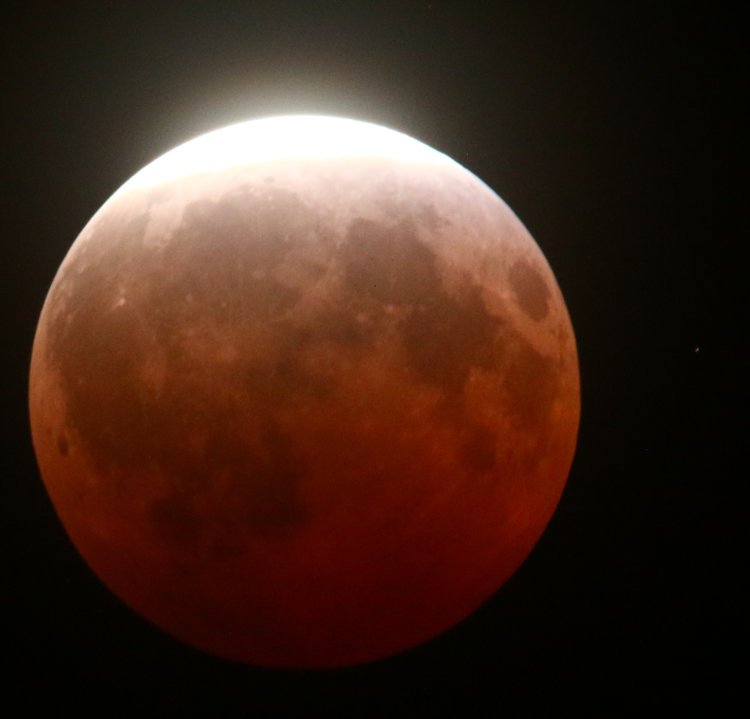
This is about six minutes past peak, and you can see that the moon’s yarmulke is sliding off to the left now. Tycho doesn’t quite show up, but Copernicus does, as does Aristarchus (of course – that always shows, being the brightest part of the visible moon.) To the naked eye, the outline of the moon was dimly visible with just a faint hint of this color – it looks much better in pics.
The Girlfriend, looking through binoculars, pointed out that another star was visible, much brighter than HIP 110580, so I reframed to capture that one too.
That would be HIP 111123A (HD 213320, SAO 165134,) also known as 57 Aquarius or σ Aqr, actually a double star with a combined magnitude of 5, thus visible unaided on a clear night, but would have been obscured by the moon’s glare on either side of this eclipse. I didn’t hang around out there to confirm this, or to even get further shots of the eclipse fading, because peak is far more interesting, plus I was tired. Overall, though, more success than I was expecting, and a nice follow-up to the fragment of solar eclipse a fortnight previously. I’m good with it.
Just (finally) got through a major sorting session, so naturally it’s time for the found images that I should have featured back when I obtained them. We have a theme for some of these, only obvious because I was going through so many images at once.
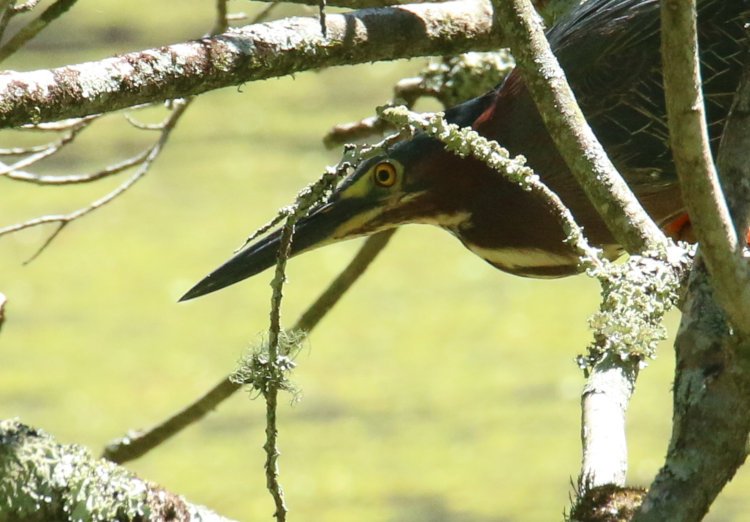
Back when doing the green heron (Butorides virescens) sessions, I snagged it peering past a lichen-covered branch, through (like most of these) it probably wasn’t even looking at me, but we’re going with that impression because we’re silly humans. The next one, however, almost certainly was peeking at me, based on behavior and conditions.
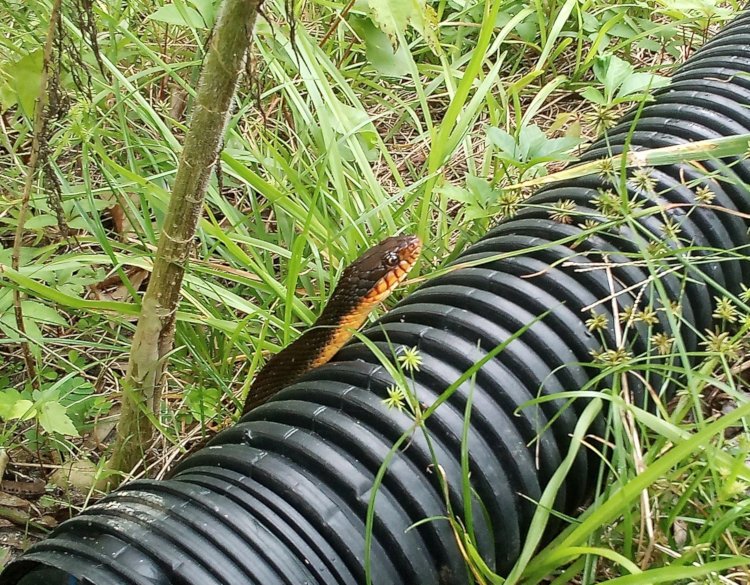
This probably shouldn’t count, since it was taken with an (urk!) smutphone, but it was what I had at the time. Opening the garage door one day, I found this red-bellied water snake (Nerodia erythrogaster) watching carefully from a behind a drainage pipe only a short distance away. Since we’d found one inside the garage, twice, a few weeks before this, we’re surmising it was the same one all times, using the garage as a lair of sorts. It’s not that the garage is particularly holey, just that every time the door is open for more than a minute, some lizard runs in, much like a cat that’s been barred from a room and therefore thinks that it’s the most fascinating place in the universe, and instead of running back outside when we try to chase it out, instead finds the most inaccessible spot to secrete itself into. So we’ve taken to leaving the door open a few centimeters to allow egress for these little bastards, and apparently the snakes have taken this as an invitation – well, this, and the fact that there’s always a little bit of corn available, since that’s where we store the duck/et al food, and so mice are scarfing that up. Circle of life and all that. Notably, only a meter from this very spot and less than a week earlier, I’d found an eastern racer also hanging out – only briefly, since it shot off as soon as I drew a little closer, but nothing in hand to get pics with.
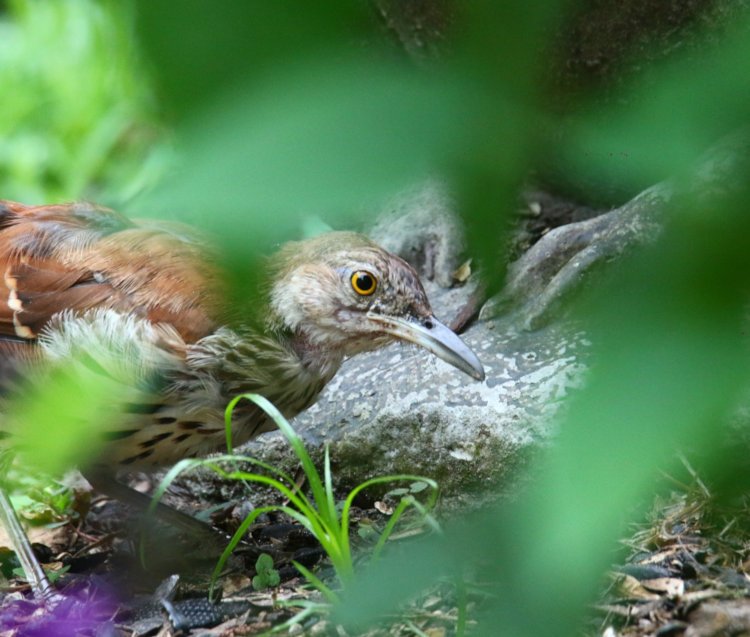
While doing the hummingbird session, a juvenile brown thrasher (Toxostoma rufum) started foraging under the bird feeders, though they would do that even if the feeders weren’t there – the species hunts for grubs and insects in leaf litter, rather than seeking seeds. But the foreground leaves made for a nice framing element.
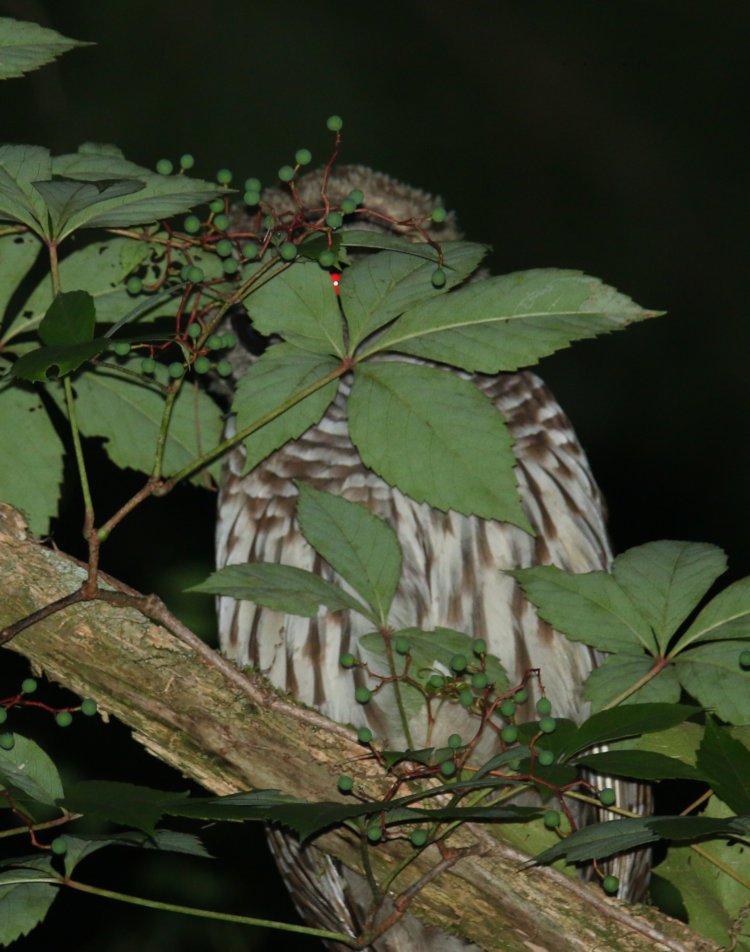
One lone berry getting fully ripe like that is odd, but it’s not a berry of course, just the barred owl’s eye reflecting the flash. Their pupils are so big, and their corneas so reflective, that it’s easy to get this brilliant a reflection even when they’re not looking anywhere near the camera.
By the way, just a few days after the latest of those linked pics, The Girlfriend and I were down at the pond edge distributing corn after nightfall, and as we turned to head back to the house, I caught a glimpse of something flashing through the trees. Sure enough, it was our juvenile friend, who had landed in the lowest branches of a very close tree and sat watching us as we passed, perhaps eight meters away. Silent this time, no calls for food, but there was no doubt it knew we were there since we weren’t silent, plus owls have badass hearing. No idea why it chose to land so obviously close, but it clearly chose to. That was the last we saw of the juveniles, though; bear in mind that most of the times when we did, it was simply because one or both were calling and drew our attention, so once they grew out of the begging stage, they could easily be close by and we’d never know it. Except for two nights ago, when someone hooted very distinctly right out front, less than 20 meters off, but I never caught sight of that one before it moved on.
Some non-spying entries.
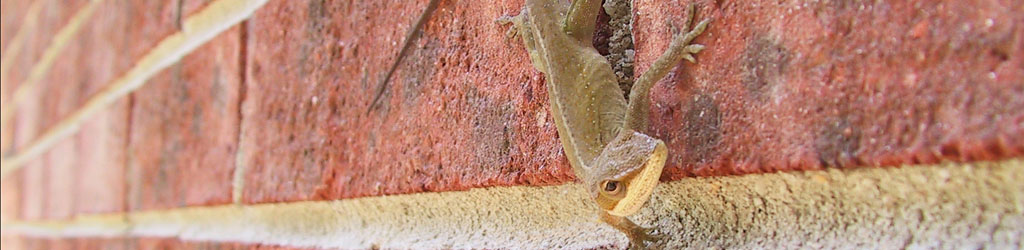
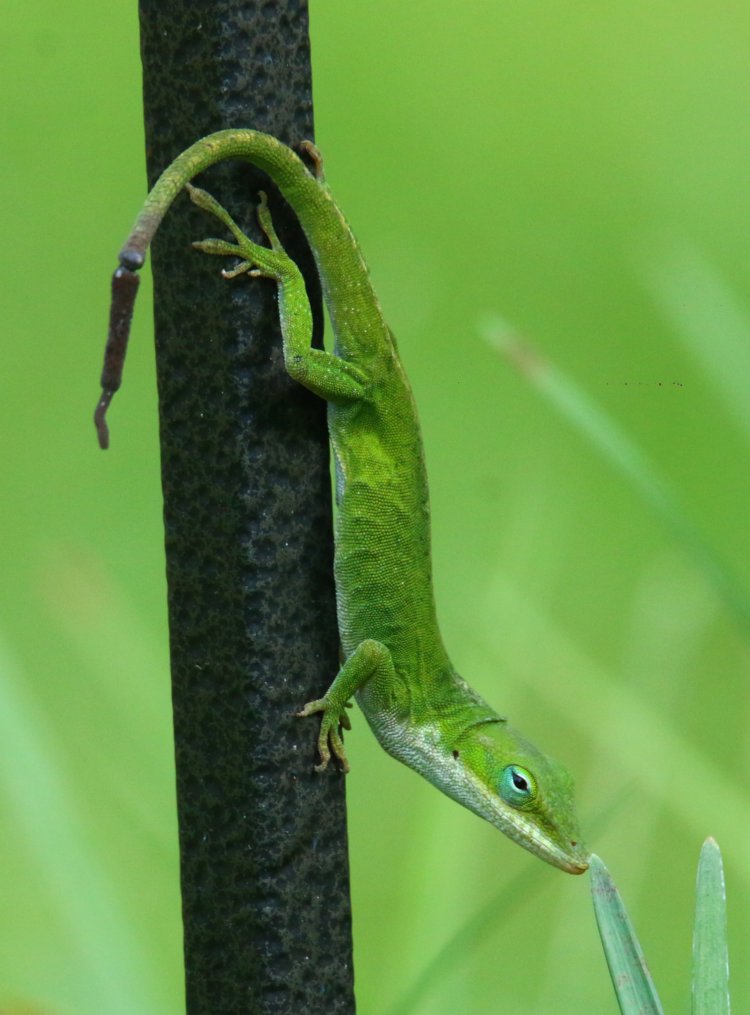
The only Carolina anole I can dependably identify, solely because of that tail – what, exactly, has happened to it, I can’t say, but she appears to be coping just fine. And I know it’s a female because I’ve seen her both ready to lay eggs and starting the process over. She lives in the liriope out front, and I often find her sleeping on the star jasmine overnight.
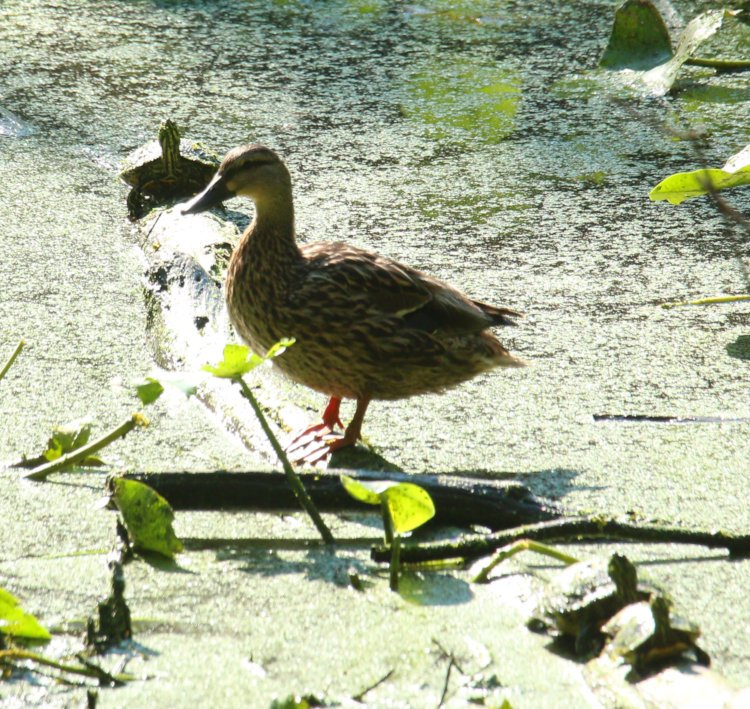
When the pond level dropped, it re-exposed a log that the turtles had been using to sun themselves on, and the ducks also took advantage of it from time to time, though the number of ducks visiting has greatly diminished right now. The Girlfriend spotted this one, and despite the distance, was alerted to it not being a wood duck because the proportions were wrong – as you can see here, it has a pretty thick body for a smaller head, yet distinctive bill. Those proportions, more than anything else, made me peg this as a juvenile American black duck (Anas rubripes,) which have been entirely absent from the pond since about the beginning of the year. It’s funny how we have guest appearances from several different species, but only a few decide to make it a habit.
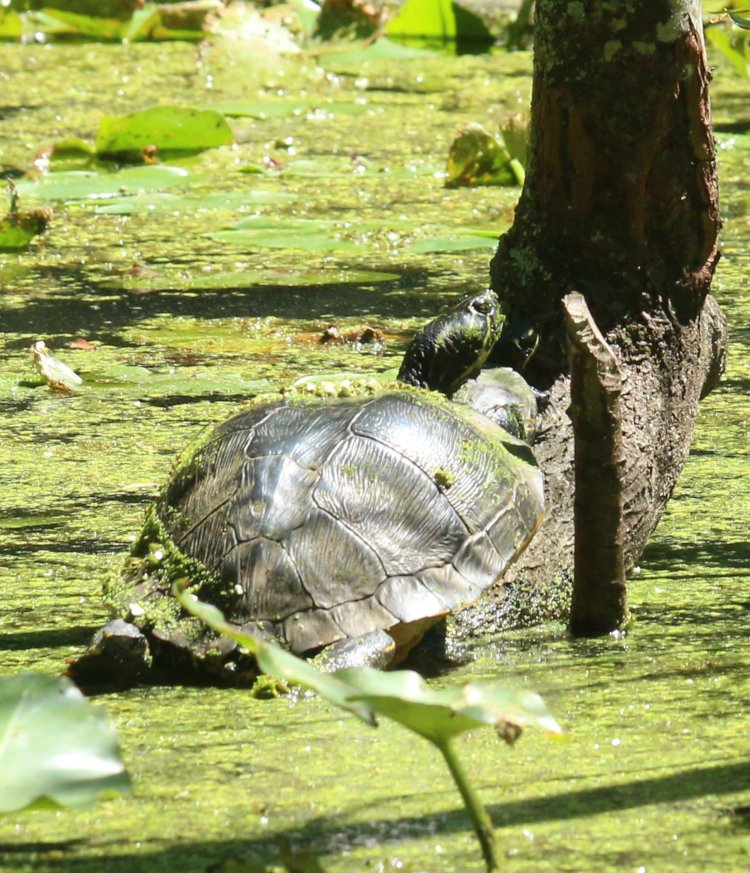
During the first green heron session, I took the opportunity to snag a yellow-bellied slider sunning itself on Turtle Island, though at that time, the water level was so high that it was nothing more than tree trunks sprouting from the surface. Still, room enough for one – actually, two, if you look closely. I like how the light angle made the most out of the textures of the carapace.
And finally,
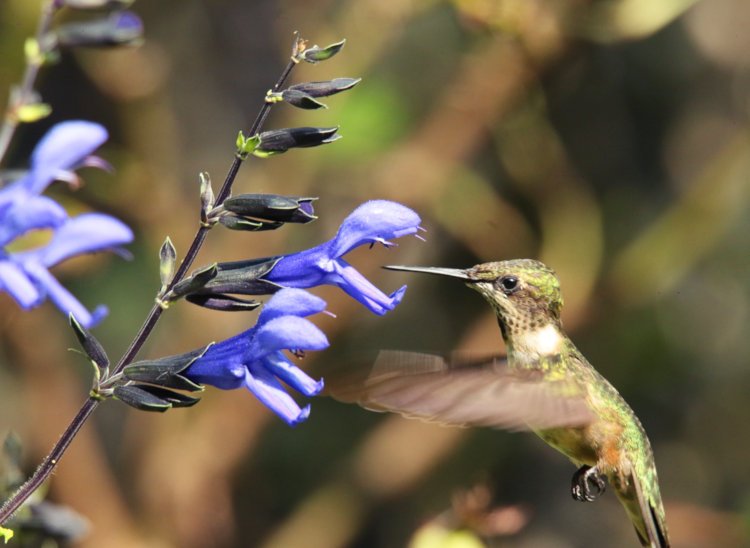
I sort all of the images into appropriately-named folders, so I can search through all the Birds, for example (six folders and counting, since they get cut off at about 4,000 images to make searching slightly faster,) but of course some of the images have multiple subjects. Thus, the images get duplicated into multiple folders so they can be found depending on which subject I might be after. This is one example, obviously – it can show off either the hummingbird or the salvia blossoms, but both work together for a decent composition; I’m just not going to get that specific with the folder names. This was a distinct rarity, too: getting strong profiles of both the hummer and the flowers, in the same plane of sharp focus, with the light working beneficially. I could have done without the complicated background, but not without trimming a lot of rose bushes, or at least setting up a shade to keep the bright sunlight off of them and make them more muted. That’s more environmental staging than I’m going to engage in, however, especially since this was a grab shot while the greater percentage of activity was on the purple salvia instead.
Now, I have to go into sorting the video clips, which takes a hell of a lot longer. And there’s still a massive video project that I’ve been putting off because of the word, “massive.” Work is never done…
Actually, it’s nice not to have all of the color coming up in May. A few of these I grabbed in passing, and a few I specifically set out the other morning to immortalize.
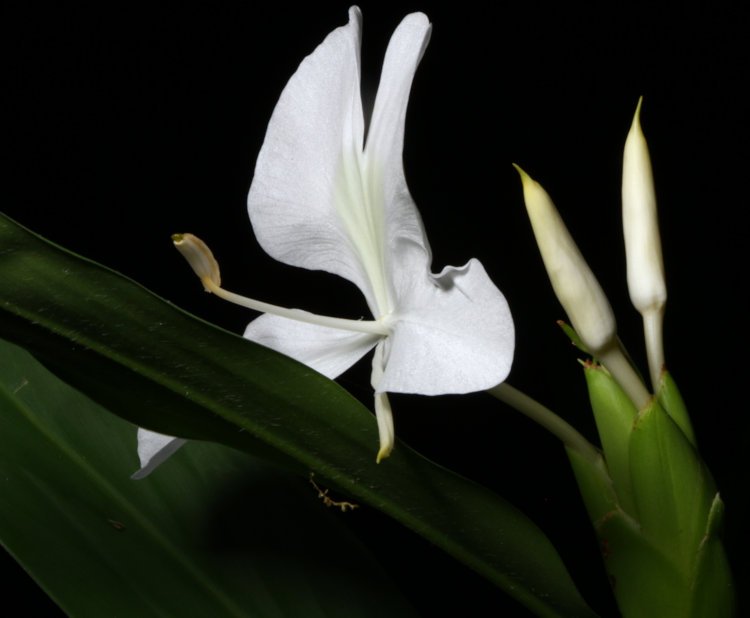
We’ll start with the ginger lily (Hedychium coronarium,) which we obtained years ago in an effort to make more of a habitat for the Carolina anoles, something that now sounds amusing when I say it.
Back then, which was at the old place, we didn’t have too many anoles, but they gained a foothold much faster than the ginger lilies did. When we moved, I was planning to leave the lilies behind, but The Girlfriend transplanted them into pots one weekend and so we brought them along, and this marks the first that they’ve actually bloomed. Are the anoles taking notice of this created habitat? Not sure – they’re too busy running around the entire rest of the property to notice, it seems…
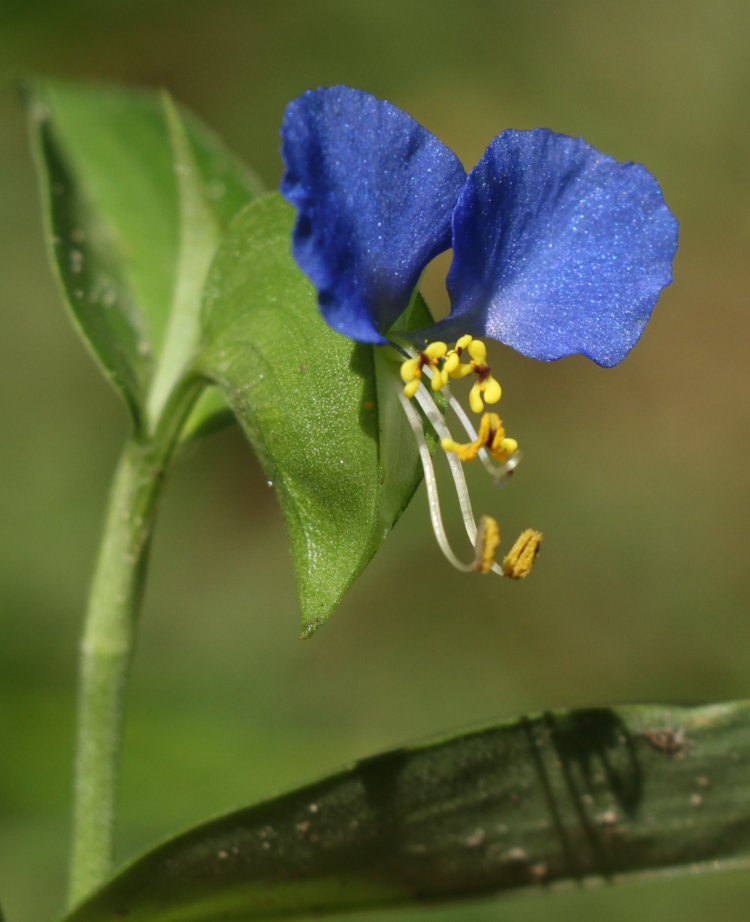
I think I’ve only photographed these once or twice before, and seen them just a few more times than that. This is an Asiatic dayflower (Commelina communis,) which blooms briefly in a very narrow time frame, not just of the day, but of the year as well, and I have a couple of stray plants right by the outside door to Deep 13 (otherwise known as Walkabout Studios or even The Shithole, but that’s just because of the clutter.) I made an earlier attempt to get this, but didn’t like the composition, and by the time I re-embarked on the arduous trek back to it, it had closed up for the day. So this was obtained the next morning – luckily it was still blooming. Cool-looking, quite small flowers, roughly 30mm across the widest point.
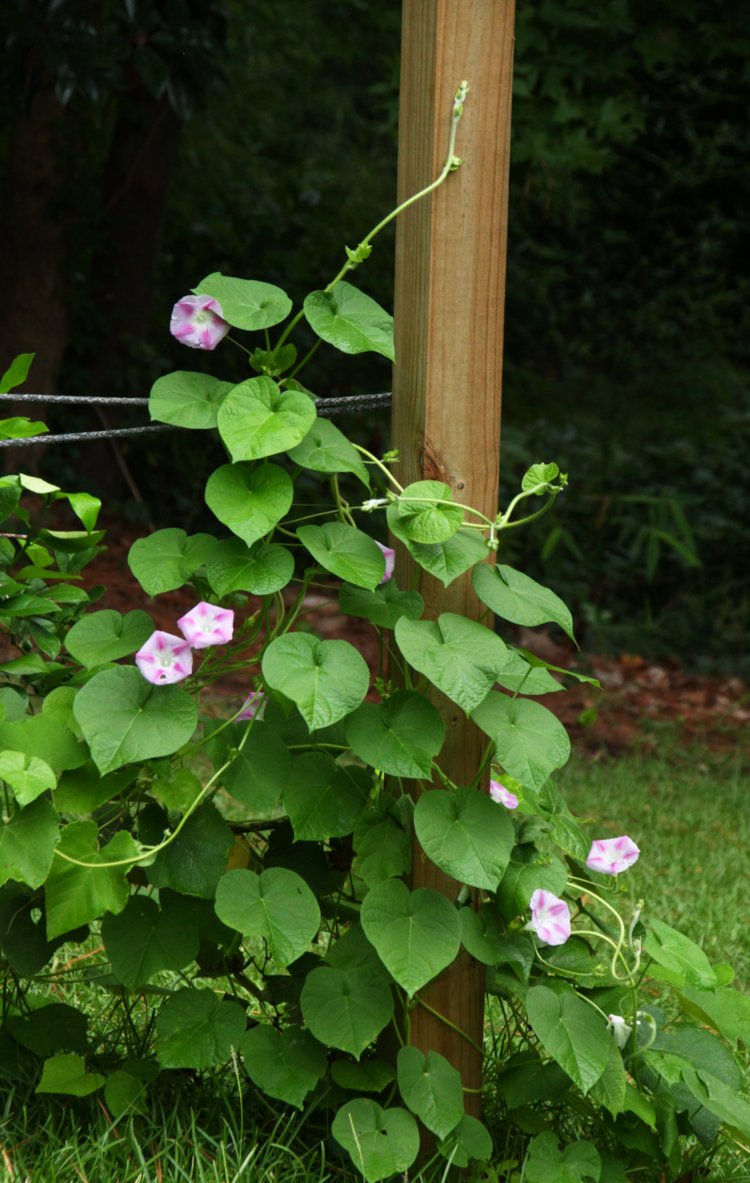
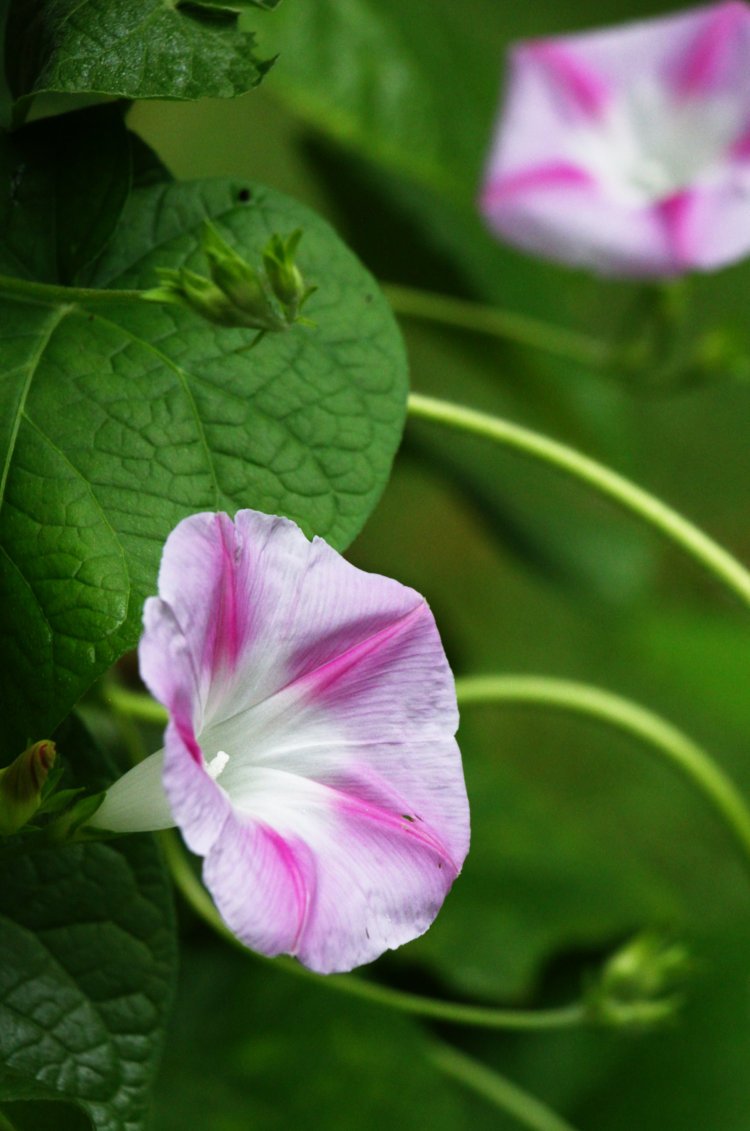
On a whim late this spring, I distributed the seeds of several wildflower species in different locations, and the morning glories (genus Convolvulaceae) are the only ones that appear to have germinated, which is actually ahead of the game for me and wildflowers. One batch has enthusiastically taken to the grape arbor.
They all seem to be the same color, which is amusing because, when I purchase the seeds, I always make sure I have a blue variety in there. Naturally, the best display is in the morning, which is amazing that they adapted to their name in that way. A closer look:
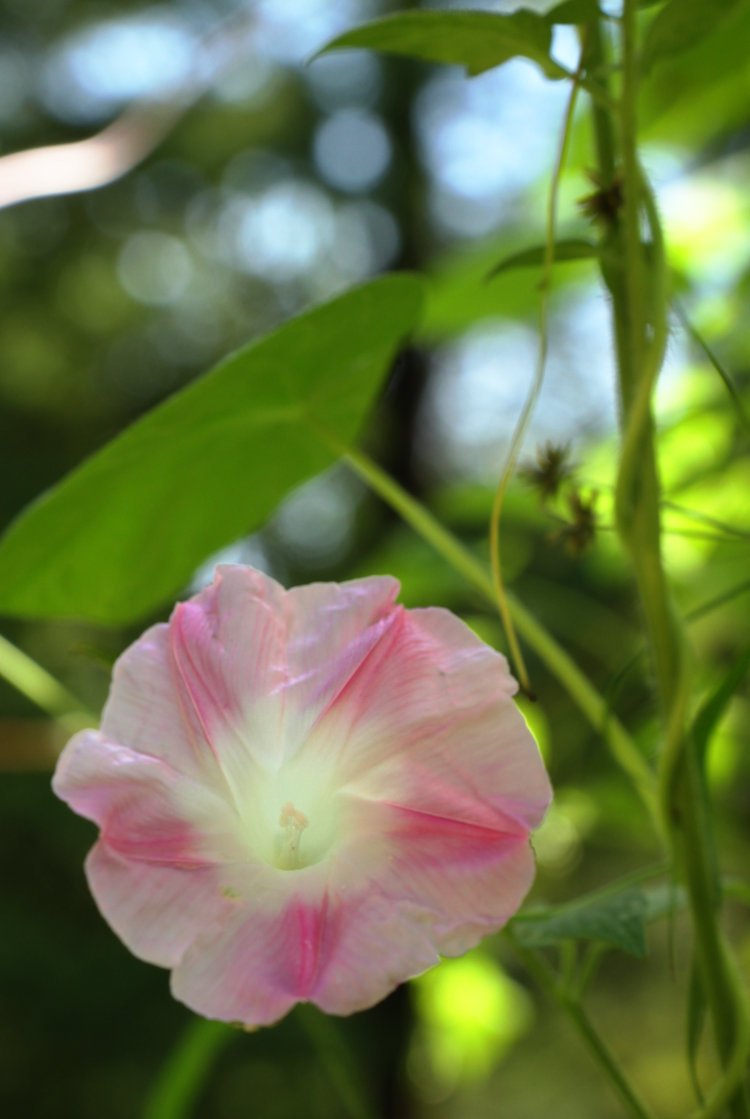
By the time the sun reaches this spot, the blossoms are already starting to close up for the heat of the day, so we virtually always have these in muted light. The patch down near the Asiatic dayflowers is another matter.
Others on the same plant were already curling up, but this one was shaded by its own leaves and thus wasn’t vampiring away just yet, but to get this, I had to lie flat on the ground to shoot upwards, making sure to get a bit of sky in there. I like the way the light worked throughout, with a bit of a glow right in the center of the blossom.
Back to blue? Back to blue.
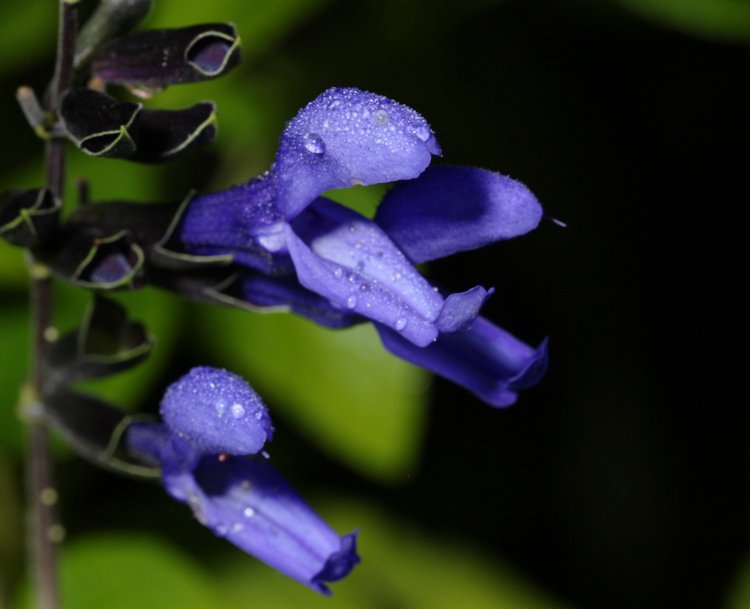
We’ve seen these in the hummingbird post, but this is a closer look before the overnight mist/dew had fully cleared, done with the macro flash rig instead of direct sunlight. This is a slight tweak to bring the blues back to the proper hue, but less editing was necessary than with the lobelias.
And the purples, while I’m at it.
This also had a slight tweak in color, but to know if it’s truly a close match, I’d have to load the images onto my smutphone to go out and see them side-by-side. But I captured the mix of dew and pollen on the petals anyway.
Now we have an olllddd one, dating from twelve years ago, that I thought I’d featured then but cannot confirm. So, here’s the deal: I attempt to feature the proper scientific names of just about every species I display here, and many I know I’ve featured before – but this doesn’t mean I can find them easily. The tags for the common and scientific names aren’t linked, if I can even remember the common name or a portion thereof. So while trying to recall the Asiatic dayflower, I was searching online under what I thought was a common name, and turned up many other things because I was remembering wrong. One of those, however, I recognized as having been photographed before and never identified. That was these:
Only thing was, once I dug out this image, I discovered that I had not run across the proper identification, since what I found was subtly different. So I did another couple of searches, eventually landing on the correct one: this is a Clerodendrum trichotomum, commonly known as a harlequin glorybower, glorytree or, for reasons lost to all rational consideration, a peanut butter tree – I’m sticking with the first. I got this image in passing in a park well away from here, and should have done a better job since I haven’t seen them since – they’re an ornamental from south Asia.
Back to blue? Back to blue.
The girlfriend got a couple of blue hydrangea bushes this spring to get established, and this one appears to be settling in quite well. Of course, the color of hydrangea blossoms is dependent on the pH of the soil, so this is at least leaning in the right direction, but she’s hoping to have them even more blue. This variety is an ‘Endless Summer’ hydrangea (Hydrangea macrophylla ‘Bailmer’,) and still pretty small as yet.
And finally,
It was seven years ago today that we brought Monsta home, otherwise known as Beebeek, Beekers, Squeakers – anything but her christened name of, ‘Taz;‘ pet-owners know what we’re talking about. Here she is about an hour ago, trying to be cute to convince us that her name is undeserved – don’t buy it. She’s gotten to be a little pudge, since she’s too food-oriented and if she hears either of the others eating, she thinks she’s missing out. Later on in the year, we’ll revisit the anniversary of the other Boogs…
A couple of follow-ups to previous posts, because I know you’ve been dangling anxiously…
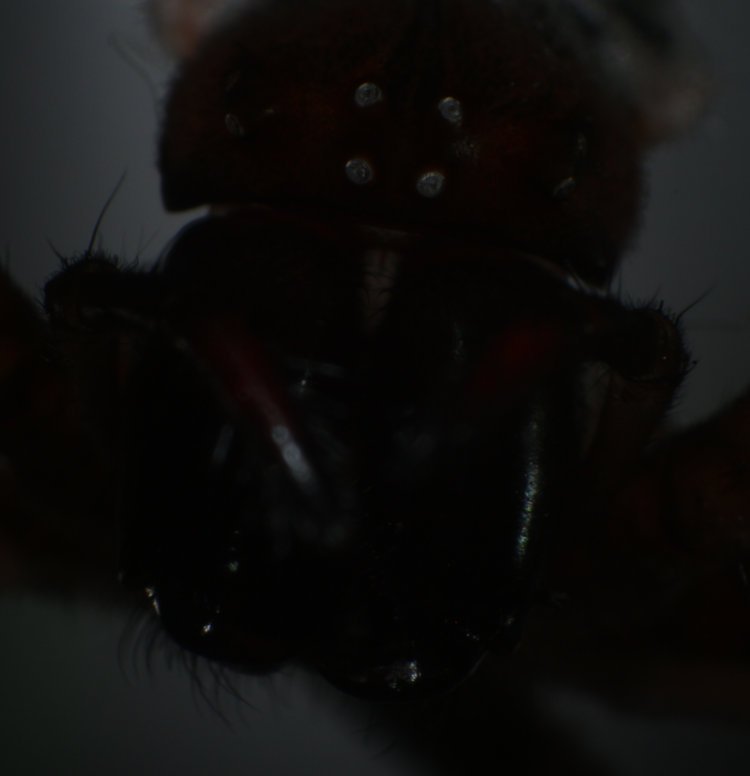
Two days ago, I saw a vehicle that would haul that tankah I mentioned in passing that I should have backlit the empty eye sockets of the molted exoskeleton of a golden silk orbweaver, because of course I should. Late that evening, I found in sorting that one of the images where the flash was aimed much too high bounced light from the background through those very eye sockets, so I had inadvertently (no, really) achieved this goal anyway. Even better, the very muted light probably did a better job than I would’ve intentionally, because this is much more subtle and mysterious.
I think I might have to load this into a projector for Halloween…
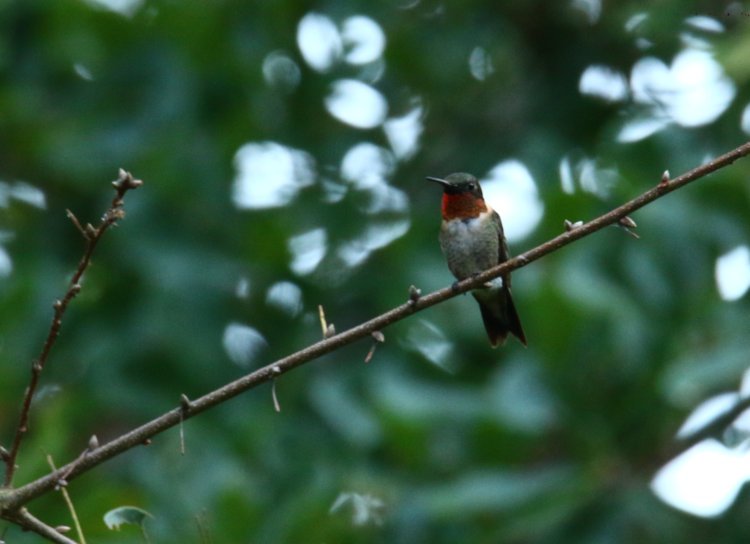
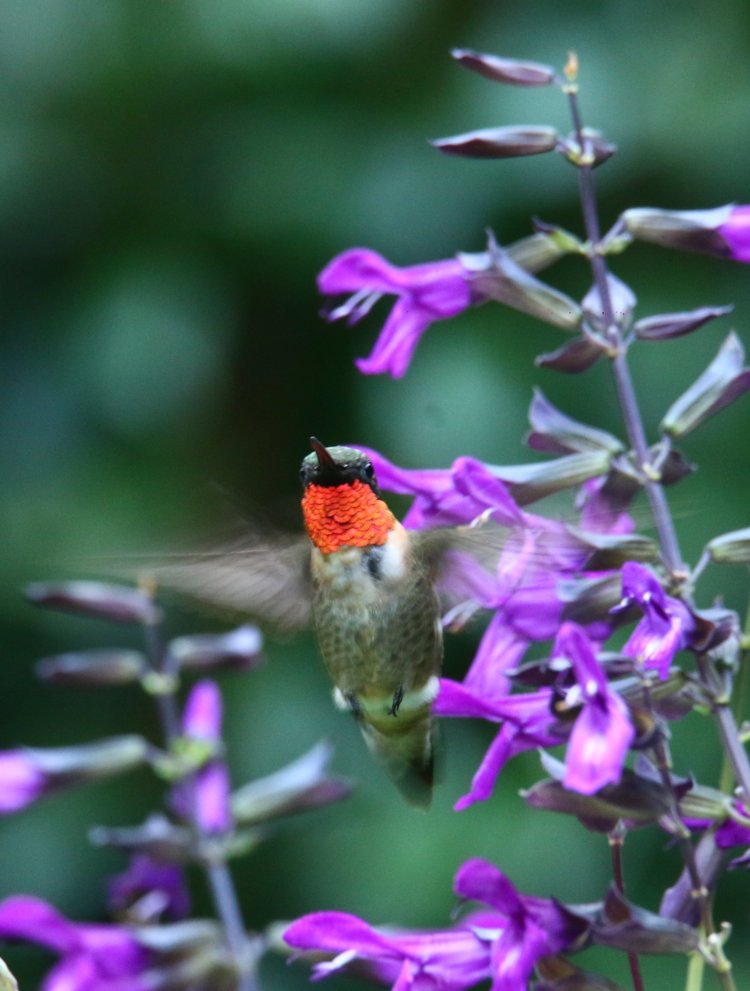
Further back, I had been on a quest to capture decent images of the ruby-throated hummingbirds, and lamented that I could never get the light right on the males to showcase their namesake red breast/throat feathers. Which I did manage, in the next two days.
This isn’t bad, but hardly what I was after – I just took the opportunity to snag the shot while this possessive male was maintaining a vigil over both a feeder and one of the salvia plants, because they seem to have little better to do with their time than waste energy protecting their ample food supplies. I did a little better, a little later.
Not just caught in a hover, but at the right angle to bring out the iridescence of those feathers, about as much as possible in this light, and even get the individual feathers standing out a little. I’m still after better pics, but at least we get some of the red.
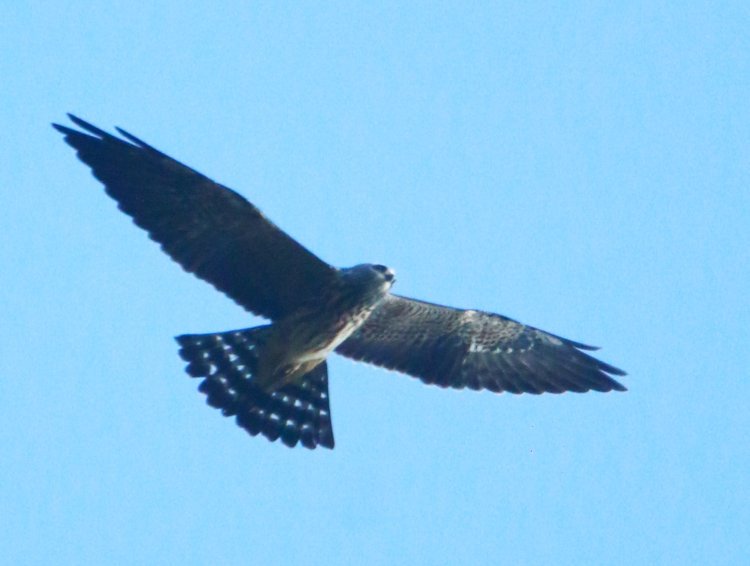
While pursuing the hummingbird pics, I caught something wheeling overhead and fired off a couple of quick frames – could definitely have been sharper, but it confirmed something regardless.
This is another Mississippi kite, but notably, this is juvenile coloration, which means we did actually have a nest not terribly far away. Chances are, it was in a neighbor’s yard someplace, so getting pics next spring would probably require their permission at least (the neighbors’ – nobody cares about what the birds think,) so we’ll see if such a thing comes to pass.
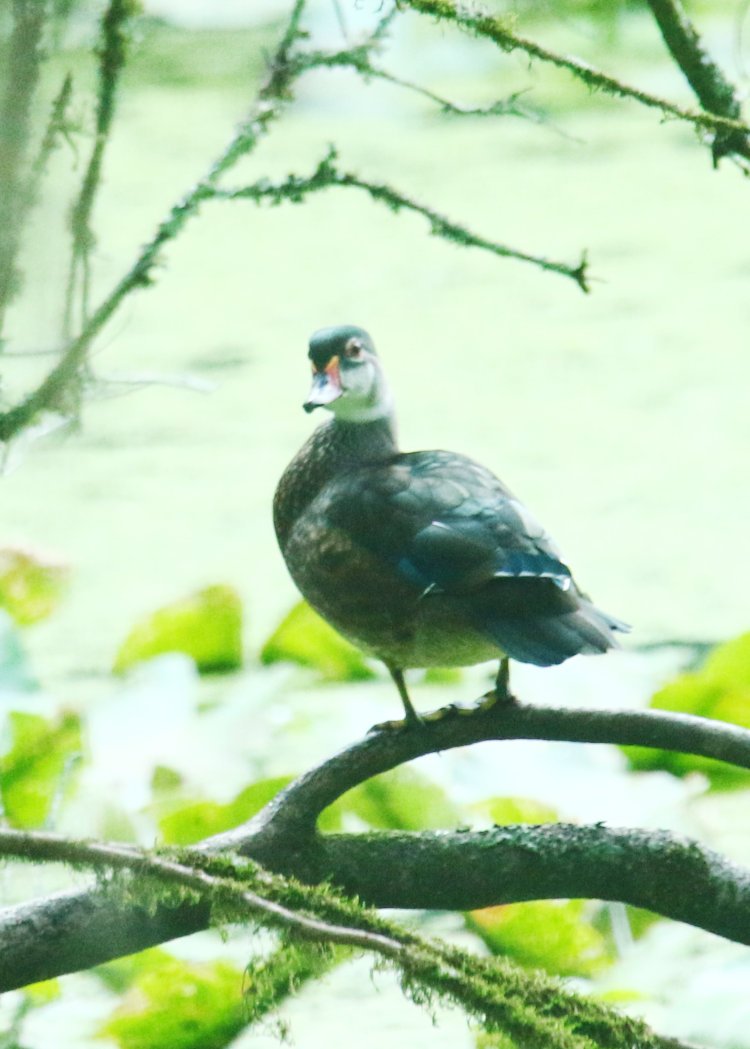
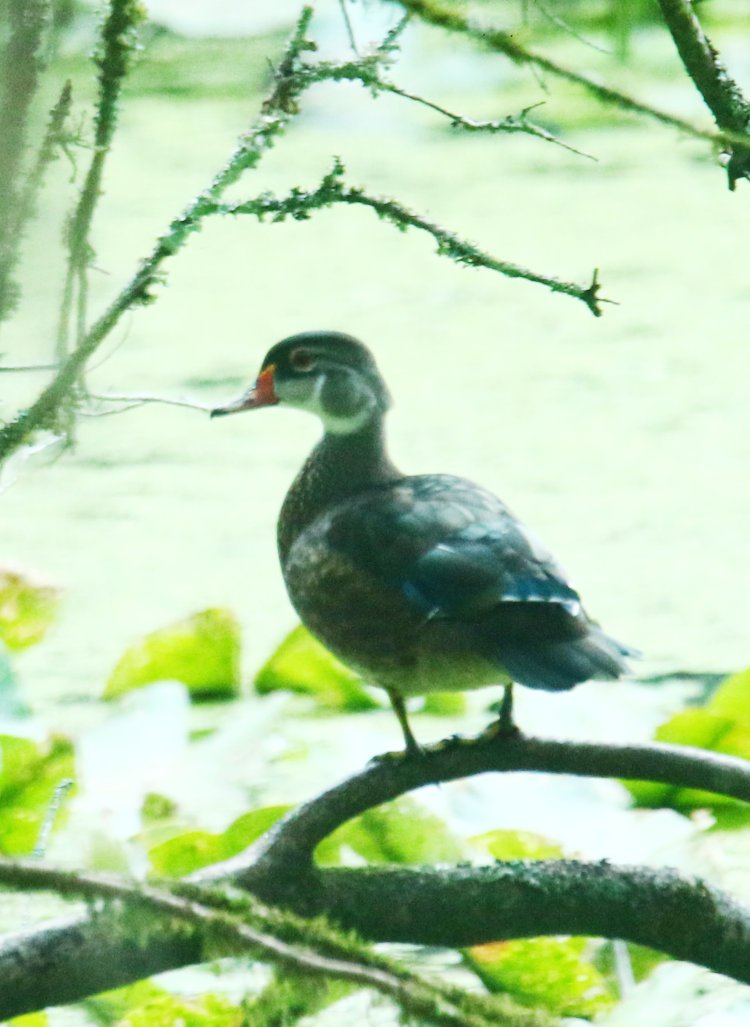
And speaking of juveniles, we’ve had a lone juvenile male wood duck making the occasional visit, and their plumage at this stage deserves a gander (sorry.)
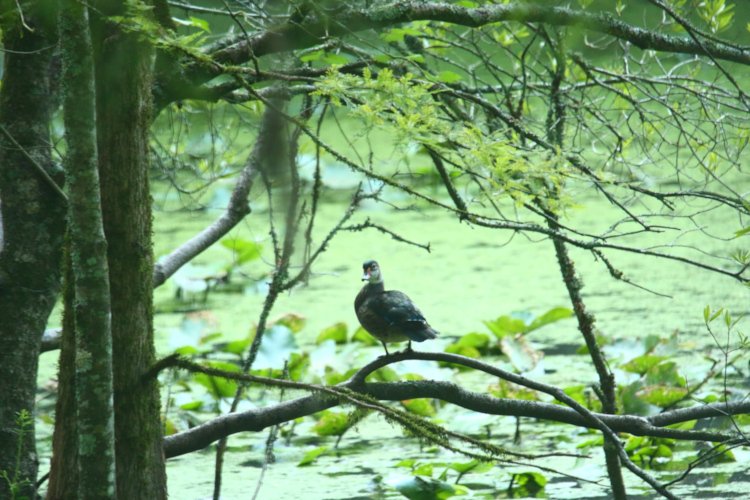
Now, the wood ducks have all but left the pond, perhaps partially because of the water level having dropped, but more, we think, because this is what they do in late summer; the same thing happened last year without any drop in the water, and it seems the waterfowl just scamper off at this time and return in the winter because we distribute corn and that’s dependable food. This one male, however, makes the occasional visit and seems to hang out for a while, in this case in the tree on Duck Island. This was not just shot in the morning in weak light, but through a downstairs window since opening the door or window would have spooked it off.
This shows the nice mid-point between the muted brown coloration of the later adolescent ducklings and the brilliant plumage of the adult males – more on the head than anything, since the body feathers haven’t changed much yet. Wood ducks are virtually always in at least pairs, but usually groups, especially when they come here to feed, so why this individual has been alone so many times (we’re assuming it’s the same one, anyway,) we can’t say.
This is full-frame at 600mm, to give you a faint idea of the range involved; I roughly measured it at 36 meters, meaning the coloration isn’t distinguishable to the naked eye unless the light is perfect.
“Naked eye” – this phrase annoys me, but as yet I haven’t determined one that works better.
The pond levels, by the way, have bounced around quite a bit since that drastic drop, coming back up to high level after some fierce rains but then slowly subsiding back down again. With the latest rains, however, it has been holding steady back where it had been all last year, so we’re hoping things have stabilized again. Still no clue what caused this, still haven’t been able to kayak down to check out the area. Well, technically we could have several times, but only if we wanted to pass out from the heat, so I suppose that counts as “not.” Good to see it back, though.
I was very close to doing this as a podcast or video post, and eventually realized it was far easier to type it out and use illustrations than it was to try and juggle the recording and screen capture processes, so here we have it – I would apologize to those who hate facing a wall of text but unless you have an actual, physical handicap, go fuck yourself and deal with reading. If you do have a physical handicap, contact me and I’ll be glad to record it.
My recording purposes have been primarily for three reasons: podcasts, capturing interesting sounds from nature, and voiceovers to interesting videos from nature, with a couple of game demos in there. It’s rarely scripted even slightly now, the closest I’m coming is to demonstrate a particular technique, like the previous Tip Jar and several before that. I’ve done scripted stuff, and this tends to come off sounding a little pompous and unrealistic to me, so I’ve been avoiding it. But this also means that I flub a lot, change pitch and tempo, and other things I shouldn’t be doing, so some of this is to correct for these (rather than, as I should be doing, start learning how to speak for recording, which I do recommend even when I’m not jumping on that task myself.)
Equipment.
Use a good microphone. Listen, I feel ya, mics are expensive, often for no good reason – I can’t fathom how a microphone could cost more than I paid for my first car, or any camera that I’ve purchased. It’s a ripoff, pure and simple, but – the benefit from a clean mic is significant, so finding that balance point, or that sudden bargain, is useful. I am presently using a Sampson G-Track that I picked up used for just within my stingey budget, and the background hiss and noise is virtually nonexistent; it makes editing significantly easier.
Use a pop filter. Condenser mics are notorious for capturing those little sudden puffs of air when we make “P” and “B” sounds and similar, exactly what the word “pop” produces, and these can come through as louder thumps in the recording. A pop filter is simply a nylon screen in front of the mic that breaks up the force of this pop, and it works wonders. They’re easy enough to find cheap, and easy to make, but having it mounted directly to the mic is easiest.
Use a wind filter. Just like the ‘pop’ sounds we make, wind outdoors (or even under a fan) can make rumbles come up in audio, and the solution to this is a plush, furry cover to the mic, which does the same breaking down of the wind force, just more so. They’re easy enough to make it you (like I do) balk at paying a ridiculous price for a bit of synthetic fur, or (like I do) have mics for which no one ever made a wind filter in that size. Often called, “dead cats” in the biz, just so you know. They help a lot, and I always recommend using one for any outdoor recording – even those gentle, unnoticed breezes can ruin a recording.
Seriously, you can just order a faux fur scarf from Temu and open the stitching, re-sew it in the size you need – it’s just a tube of ideal fabric, and many times cheaper than trying to buy the raw fur/fabric. Works great! Try not to ever use on-camera mics. They’re notorious for being not very good in quality, and almost always prone to wind noise. If you have the external mic port, use it.
Room acoustics. There’s no real need for a ‘studio’ or acoustic baffles or tile, but carpet helps reduce room echo tremendously, as does clutter – just breaking up the path that sound can bounce back from the walls will make an audible difference. Sometimes a quarter-turn in the direction you’re facing can alter the sound quality notably. Also, just hanging a blanket from the ceiling as a backdrop can chop off room acoustics. Experiment.
Find the right position for your mic, and yourself. Do a session or three of just experimenting with where the mic sits, how you should be sitting or standing, chin up or down, direct or indirect, and so on. In my experience, leaning back is bad for multiple reasons, even when I’d rather be comfortable, and having the mic a little above my mouth and facing down produces the best sound – you may not see this much, because it blocks the speaker’s voice, but if you see studio and voiceover recording, it’s used more often there.
I have terrible sinuses and my voice quality (I use that term very loosely) changes significantly on different days. I usually try to pick a ‘good’ day, get some hot tea to clear sinuses and nasal drip, and ensure the air passages are as good as they can get. I have some recordings done during a post-nasal drip and seriously, you don’t want to hear them.
Habits.
Silence. Record 6-8 seconds of total silence at the beginning. You will use this in post below, and it’s extremely helpful. It also lets you pause and mentally prepare to start speaking. If the room acoustics or background noise change suddenly (like the HVAC unit kicking in,) pause again and get a new patch of ‘silence’ for the background noise level with this change.
However, if you are doing a screen-capture to demonstrate something on the computer, start the screen-capture process first. Then begin your recording through Audacity/et al, and what I recommend is be producing some steady sound (hum, whatever) as you click the Record button. What this does is give you both an audible and visual cue to sync the video and audio together, because you’ll have video of the recording starting through the capture software. Later on (after audio editing, to a degree anyway,) you’ll line up the audio and video tracks using this point at the beginning, which can be deleted once the two are linked.
Slow down. Even if you’re trying to fit within a specific time frame, such as having 8.2 seconds of video space to fit in with, trying to talk fast rarely helps, and usually just slurs words together – it often takes training or at least practice to speak both fast and clearly. If you don’t have those time constraints, just ease up and relax a bit, you’ll sound better. Also, long pauses are not anything to worry about, because these can be removed.
Immediately redo a flub. If you stumble or stutter, or mispronounce a word, or what-have-you, just pause, exhale once, and speak your line again. Go back as far as you need to if you need to redo a sentence or two, or even if you realize you’re talking too fast or saying, “um” too much – I have a bad habit (well, one of many) of running “um” directly into the next words so even editing those out doesn’t sound right.
If you’re doing a screen-capture demo and recording audio as well as video, be aware of what was happening onscreen as you pause to repeat a line, since both will have to be edited out together – try to avoid sudden screen jumps and such. If you’re doing voiceover while viewing an already-edited video, as I do fairly frequently, go ahead and back up the video to a ‘clean’ point before you even started that sentence and say it again in sync.
Be aware of volume. I’m notoriously bad about changing volume, either with sudden louder portions or simply getting caught up in what I’m doing and not paying attention to how loud or quiet I’m getting. While these can be corrected in post (covered below,) it’s a hell of a lot easier not to have to – it’s part of the proper speaking habits I’ve never developed, and why I recommend developing them.
All of these make the next part a lot easier, which is why I’ve led off with them.
Editing.
Everything here is using Audacity, which is a free, open source audio editor that does so much you should be donating to them (yes, I am.) Other editing programs are similar in may ways, but I can’t address particulars.
Most of the below has come from this page, so full credit to them, but I’ve added a couple of bits from my own experience. So here’s the overall process, which is easier than it initially sounds.
Save the original recording. You may need it again, even though Audacity automatically saves all edits when you save the project, and can be reversed to the start – you may not want to go back through thirty edits.
By the way, using a ‘lossless’ format like AIFF, FLAC, or WAV to save recordings avoids the problems with truncated dynamic range that MP3 and such produce. These may make very large files, but if you’re doing voiceover for video, this will get reduced in size when you render the video into the final format.
Start with Noise Reduction. Multi-step portion here, but once you’ve done it a couple of times it’s automatic in your head.
1 – Select the silence that you recorded at the beginning. Make sure you have no extraneous clicks or bumps in your selection – it should be the flattest waveform you can find.
2 – Go to Effect/Noise Removal and Repair/Noise Reduction…, and click on the Get Noise Profile button. This saved your silence as a baseline.
3 – Select the entire recording now. (See note below.)
4 – Go back into Effect/Noise Removal and Repair/Noise Reduction…, and this time, we can hit Apply. This may take several seconds, depending on the length of the recording. Initial settings may take some experimentation – I am using Noise Reduction (dB): 15, Sensitivity: 5.51, Frequency smoothing (bands): 5, and make sure Noise: Reduce is checked and not Residue. Audacity will save these settings so they’re the same every time you open it, thus you won’t need to keep notes on this, though you may need to change them with a different mic.
That’s it. Listen to the recording, and the background hiss should be so reduced that you should barely be able to tell when it even starts. What this is doing is subtracting the background frequencies you selected from the entire recording, and it works best with the cleanest recordings.
Initially, however, you may want to change these settings – this should only have to be done once per mic or room setup. Once you get the initial noise level, instead of selecting the entire recording for the second step, select just a small patch in the middle someplace, that has typical vocals and at least a brief patch of silence. Use the Preview button to test your settings here (it only runs for six seconds,) and once you’re happy, note these settings, back out without applying it and re-select the entire recording, then apply those settings. The more background noise or hiss there is, the worse the results may have warble or truncated effects, so you may want to reduce the sensitivity or the noise reduction level, and have a little hiss rather than sound like you’re talking partially underwater.
The biggest alteration to the above. If the room acoustics changed during recording, as noted above, select the Noise Profile for the first, and then select only the portion of the recording before the background noise changed, and Apply to that. Then, select the new ‘silent’ section from after the background noise changed, and apply that to only the portion that has that background. If you do not do this here, before anything else, you will have a hard time getting rid of it later – voice of experience here.
Moving on.
My mic only records on one stereo channel, leaving the other blank. If this is the case, right-click over in that space at the left of the track and select, Split Stereo Track. All alterations below should be done solely on the track that has recording – having a silent track in there can alter the effects, so this works better.
Select the entire track for these.
Initial Normalize. Go into Effect/Volume and Compression/Normalize, and make sure Remove DC Offset is checked, then set Normalize Peak Amplitude to 0.0 dB. You may see a jump in the waveform. you may not – all this is doing is increasing the volume so the highest points hit the upper limit of the recording – it helps with the next step.
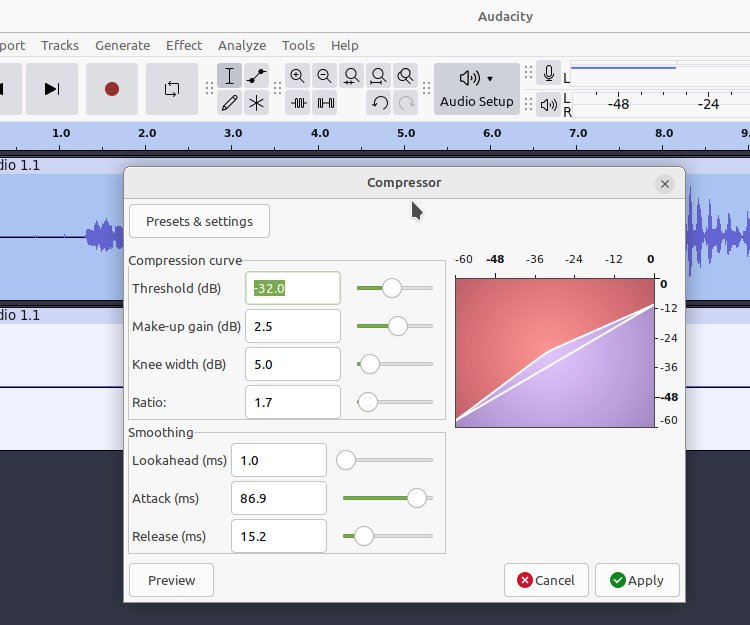
Compress. I need this seriously, because as I said, I tend to wander a bit too much in my volume, and what this does is even things out a bit. Go into Effect/Volume and Compression/Compressor… – you will get a graph and variety of settings. You may be fine with the default, or you may (like me) have to change them to be more aggressive – these are my settings:
What this does is to bring up the lower patches and reduce the higher patches, making the recording more evenly-toned throughout. Again, not a bad place to pick a small patch, one with a varied waveform, and Preview it, but like before, note the settings and deselect that small patch to select the entire recording/track to apply those settings to. This is one you may revisit from time to time to improve it, because the changes are subtle and may only show well in certain sections.
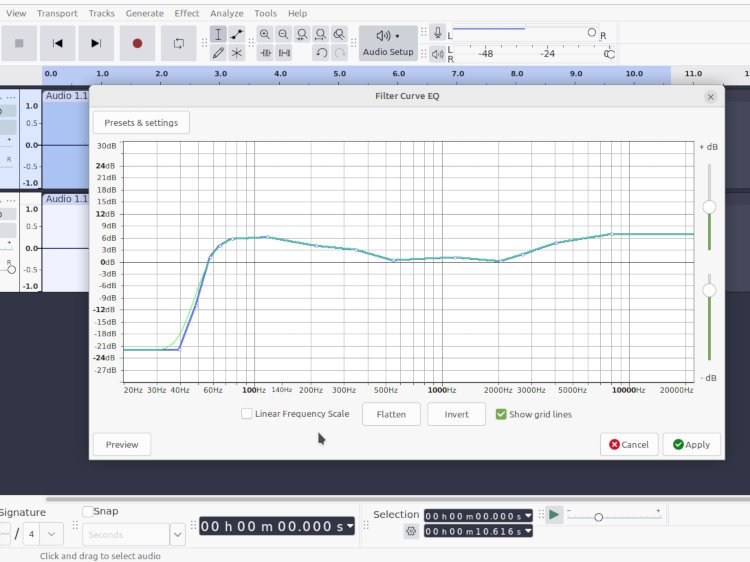
Tweak your vocals. This is very subjective, and what I provide is only a starting point. We’re going to apply some specific pitch changes to make us sound a little better – calm down, I said a little, nothing’s going to make me sound like James Earl Jones no matter what, Audacity isn’t that good. So go into Effect/EQ and Filters/Filter Curve EQ, and you’ll get a graph, or even a flat line. Mine, after much tweaking, looks like this:
This curve cuts out the lowest background noise (the left side at and below 60Hz,) a slight curving lift between 60 and 500Hz to improve the bass tones, then a slight increase up to 8000Hz to not let things get too muddy and low-toned. Your best results, however, may only slightly resemble this, if at all – it depends on your voice, and to a lesser extent your mic and acoustics.
You can see that the average of the curve falls above the centerline – this makes the volume jump a bit higher, and you will see the waveform get broader as you apply it. You can alter the curve here to be more centered, or not worry about it, because the next step will correct things.
Second Normalize. Same as the Initial Normalize, only this time you’ll change Peak Amplitude (dB) to -2.0 or thereabouts – experiment. What this means is, the loudest portion of your recording, the uppermost peaks of that waveform, will fall 2 decibels below the upper limits for recording, which is generally a good range for voice. If you’re a very animated speaker, this might cause the waveform and volume to drop notably because your peaks are so high, in which case you might want more aggressive Compressor settings.
Export this as a lossless format. This helps with the next step, or more specifically, where the next step has some issues. I usually call mine something like, “Voiceover-pregate.wav.”
Apply Noise Gate. I definitely need this, because I’m a breathy speaker and too many of my inhalations come up on the audio, not to mention lip sounds and all that. Noise Gate drops out anything that falls below a very low volume threshold, and can wipe these out entirely – I used to have to manually remove these, and that took ages.
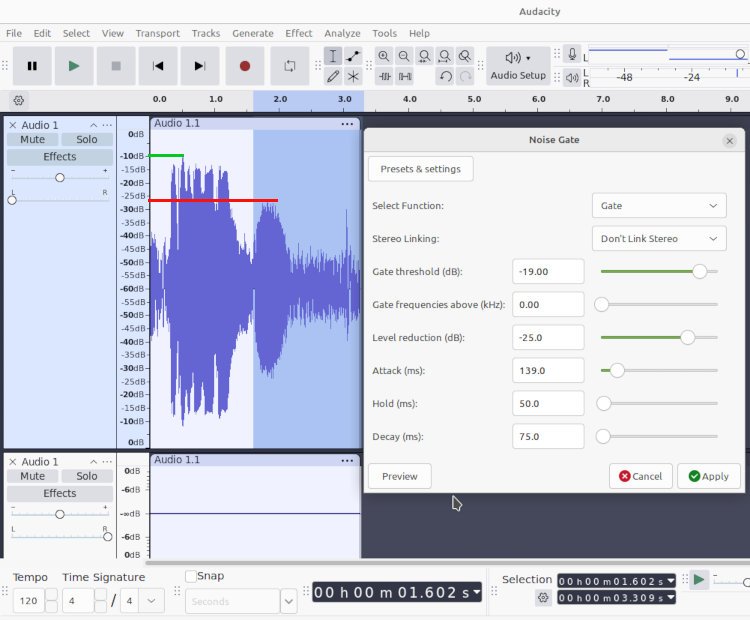
But it’s slightly tricky to get set, initially. Once you do, you should need only very minor tweaks for any application, if at all. So here’s the rundown, with an illustration:
1 – Select a portion of the audio with the worst low-threshold noise you can find. In the case of the illustration, it’s the part selected in medium-blue, an intentional loud inhalation.
2 – Right click on the decibel range bar immediately left of the waveform, and select ‘Logarithmic (dB)’. You can grab the bottom of the whole track window to expand it for more detail, as I have here. The peak of the selected portion of the waveform reaches roughly -27 dB (red line) – this is our guide. You can see also that the speech outside of the selection is much louder, reaching about -10 db (green line.)
3 – Open Effect/Noise Removal and Repair/Noise Gate… – you’ll get a window like that shown here. The key is the Gate Threshold, here at -19 dB – a little louder than the peak of my noisy inhalation, but lower than the speech. This means that everything in the wave form below -19 dB (greater negative number) will be wiped. Level Reduction is actually greater than the threshold, so it should produce silence.
Attack, Hold, and Decay all relate to how soon and how long this reduction will take place – mine could probably stand some tweaking because of the next bit, but this is where it stands now.
4 – Preview the result, and if happy with it, apply these settings to the entire track.
Again, these settings will remain, so from here on out you can just apply the Noise Gate without changing anything, as long as your recording is reasonably consistent.
Now, your audio should be crisp and clean overall, but still might need a few cleaned up parts here and there, especially deleting out the “ums” and flurbles. Still leave the stereo channels separated, if you had to in the first place.
If syncing with video or anything else, it’s important not to delete any portion of the track until it’s linked to the video and can be deleted together – otherwise you’ll spend a ridiculous amount of time trying to sync up separate sections of audio and video. Instead, select the offending section and either go into Effect/Volume and Compression/Amplify… and choose an adequate negative number (I usually use -14 dB,) or choose Generate/Silence… instead – it will automatically be set to the length of your selection. If you have any background noise for either of these, the dropout will be noticeable though, so hopefully you don’t.
Also, if you have any hard peaks in your speech that you’d like to reduce, select those peaks and Effect/Volume and Compression/Amplify… to a setting of -2 to -3 dB, enough to reduce the harshness but not go too quiet. The same can be done in reverse if you start mumbling too much.
The Noise Gate may have a detrimental effect, though, in that it drops off “S” and sometimes “TH” sounds at the ends of sentences, where my settings may need further tweaking. This, however, is where that “-pregate” file you exported right before doing the Noise Gate step now comes in, in that you can go into that file and find the matching portion with the esses intact, and simply cut-and-paste it in. To me, it happens perhaps three or four times a session, so not a big deal, but it does sound so much better than abruptly truncated words.
Re-recording. On occasion, you may find that you completely screwed up something: used the wrong name or term, mispronounced a word consistently, totally forgot to tell listeners not to pull the pin just yet – whatever. And so, for clarity’s sake, you decide to re-record that section to patch in seamlessly. Hopefully, you’re better than I am, because my voice changes tone to a ridiculous amount depending on far too many factors, so even an hour later when I start to re-record something, I don’t sound the same at all and patching that in has a distinct audible jump – it’s not ‘seamless,’ in other words. Even when I’m listening to exactly what I sounded like, I have trouble reproducing this.
You can open as many Audacity windows as you like, so you can re-record while still having your original open. Then pick the whole sentence that you need to correct (or a significant portion thereof,) start recording with that silence at the beginning, and re-record that sentence several times over, making whatever subtle changes you like. Because your original was buried in the ‘flow’ of what you were saying, even an entire sentence re-recorded may have a different cadence or timbre to it, and I know I’m bad about exhaling right at the end of the re-recorded sentence and this changes the tone at the end.
Unfortunately, now you’ll have to redo all of those compression and equalizing things above for this new recording just to have it sounding almost exactly alike, but seriously, once you’re used to it the whole process takes a minute or so. Then pick the best version of what you re-recorded, and simply cut and paste it over the offending section of the original. It’s not uncommon for volume to be different between the two, but this is easy enough to correct. No problem.
A note about audio/video syncing. If you’re doing this on a track where it’s crucial to sync precisely to the video, you’ll likely notice that the re-recorded section is trivially (or not) different in length than the original, which will make syncing less precise. If you watch and see the waveform jump in either direction just as you paste, you can potentially cut it or add silence to it to bring things close – usually, a fraction of a second isn’t noticeable. The worst part is if you have to significantly increase the length of what you’re correcting, in which case you may be playing around with lengthening the video with a freeze frame or something to fill in the gap.
Once you have the audio track down to where you want it, if needed, copy this over to the separate, blank stereo track by selecting the entirety of both – they should then match up perfectly. Test it of course, then right-click in that blank portion to the left to select Make Stereo Track.
You can now export the audio in the way you need it – an MP3 or whatever for podcasts or uploads, or a lossless format to add to the video edit, whatever. Unless you want…
Music. I usually do a quick opening and closing music clip to video, at least, and a lot of people recommend/insist upon background music throughout the entire recording, though I consider this extraneous and usually unnecessary, and very often annoying – consider that your listeners may not like the piece you chose and don’t want to keep hearing it. Either way, this is easy to accomplish.
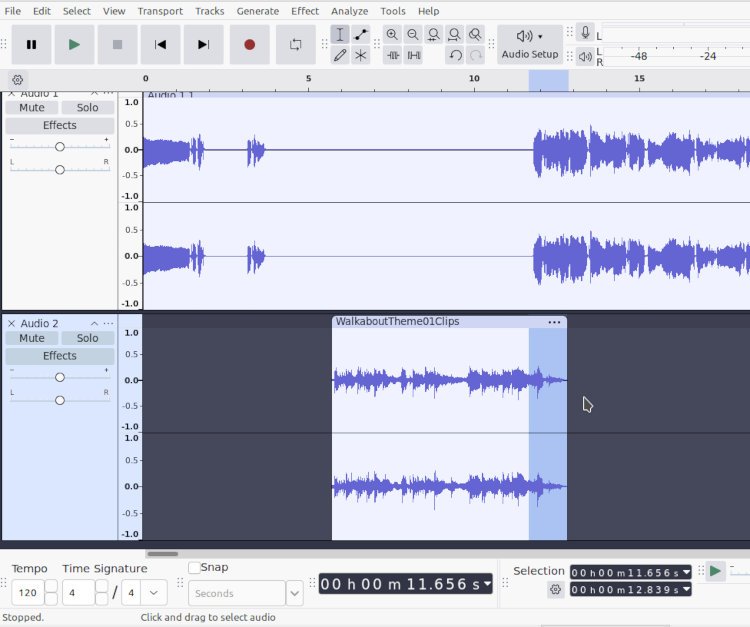
In Audacity, click on Tracks/Add New/Stereo Track – you’ll see it pop in underneath your current one. Then in a separate window, select your music tracks and copy them, then paste these into the new blank stereo track below your original recording – you will likely have to play a bit to line things up the way you want them, by either cutting or Generating Silence as needed on either track. If desired, do your fading in and/or out by selecting the end portions (however long you want the fade to take) and using Effect/Fading/Fade In (or Out – you’ll figure it out.) I like having the fade out cross over into the beginning of the vocals, as shown below.
Now, you’ll notice that the original, top tracks start with something in there, a waveform right off the bat, and the inserted music intro comes in after that in the gap of silence. That beginning is the hum I produced as I started the recording, to sync to the video track I was recording at the same time, and it remains in place now so the audio and video can be synced, whereupon both will be cut out of the final project and the audio will start with the music (and the video with my title card fading in simultaneously.)
Also, it’s usually not a bad idea to keep the music down in volume so you don’t assault your listeners, and you can easily adjust that now.
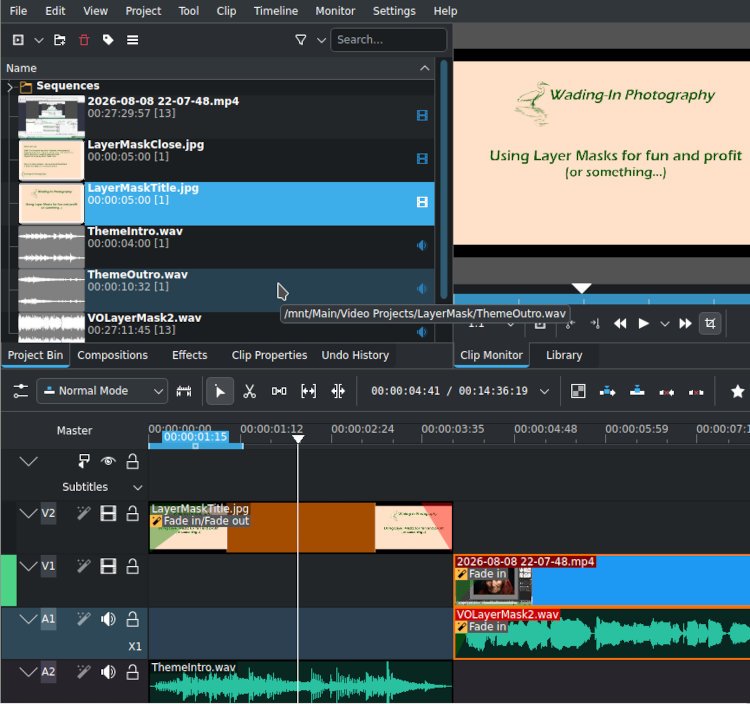
Syncing audio and video. I won’t go into too much detail here since your video editor may be different and this is long enough. With most non-linear video editing suites, however, you can line up things together fairly easily. For simple voiceovers, I’ll cut the audio tracks as needed and simply slide them along the timeline to line them up – these have been recorded after I already edited the video tracks to what I wanted. Volume levels may require adjustments depending on what was captured with the video and whether you want it or not – I have changed them in specific places at times to highlight the sounds a species might make. While I endeavor not to have too much “dead air,” the silences where I’m not talking and little else is coming through the video, sometimes this works as ambience because it really was this quiet, and you don’t need to hear me blathering nonstop.
For syncing to a screen capture, however, that opening noise is used to sync to the visual start of the recording, and then both audio and video are ‘grouped together,’ so that all edits are done to both simultaneously – this is where your flubs and “ums” can get cut, while everything before and after still matches together. This may produce jumps in the video, which is why I say to be aware of what you were doing onscreen when you misspoke, so you can back up and hopefully have a near-perfect match in video.
In this example, actually from the previous Tip Jar, you can see that I instead imported the opening musical introduction separately – that’s the A2 track at bottom, synced with the faded in/out still of the title card, track V2. Then the voiceover track (A1) is aligned with the screen capture track (V1,) where both can be edited together and still maintain perfect (ahem) synchronization.
There you have it. This is by no means ‘complete,’ but it holds most of the tips that I can provide towards getting better audio recordings for your purposes, and you can now see why I balked at tackling this in video. Hopefully, this provides something (preferably a lot) that you can use, and will improve your own recordings notably. Good luck!
So, we’re all already familiar with the sorting finds, the images that I come across when sorting all of the recent photos into the appropriate folders that I then realize I should feature in a post; you may wonder why I didn’t do this initially upon unloading the memory cards, but I either found something else that had a higher priority, or was too busy at the time, or simply hadn’t looked closely enough at certain images to recognize the merit that they had. But whatever, stop sidetracking me.
In this case, we’re featuring a couple of images captured while doing the sorting, a first I believe. Last night I was deep into the overdue task and happened to glance down to find the office/studio/lair chair was in imminent danger of rolling over my next subject. This is not, in and of itself, a rarity – having a basement office with an outside door in an older house means critters, mostly arthropods but occasionally not, are frequent visitors. This one, however, seemed slightly misshapen, and upon capturing it I confirmed why.
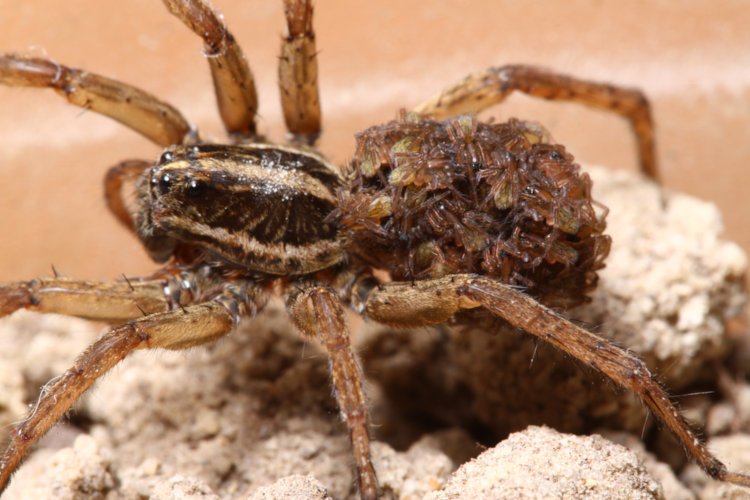
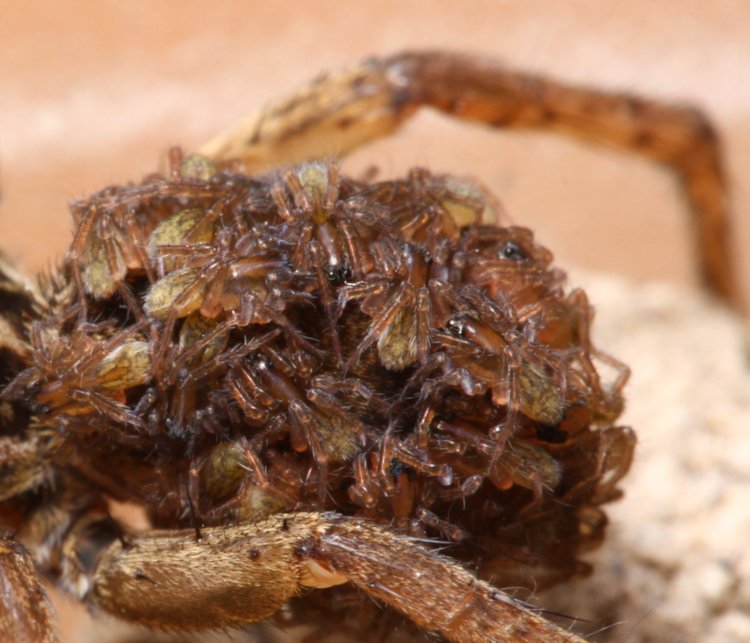
Yep, a wolf spider mama taking the young out for their first real adventure, trying to get rolled or stepped on. She was easy to capture and get into the pan I use for such ‘studio’ shots, but far less cooperative in staying away from the edges so it looked more natural – she was even more averse to the leaves I provided that would have made an even better setting. I am lucky in that the ridge on the side of the planter tray that I used, combined with the color of the table thereon showing through the translucent plastic, actually appears more like brickwork than anything else. Plus short depth-of-field, of course. Let’s get creepier.
She was moving a little sluggishly for the species, perhaps because of the young, but it meant I could focus better on her and the bebbehs, and she only shifted immediately after I achieved sharp focus about five times, which is ahead of the game for such sessions. None of the young-uns showed the slightest inclination to even twitch a leg.
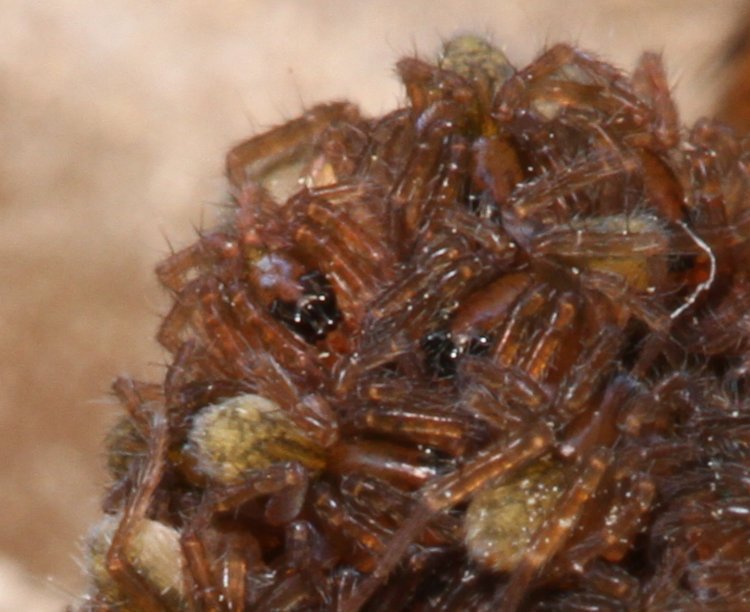
These were with the 180mm macro, but I switched to the reversed 28-105 to try and get closer, without the best results.
The dark patches in there are the ‘faces’ of two of the newborns – you can see that they typically use their legs to hide their identities, which makes me realize: eight eyes, eight legs, so they can still play peekaboo. Evolution is amazing. Focus could have been better of course, but part of the problem was, achieving truly close focus means having the lens very close to the subject, and the edges of the planter tray were actually interfering. Also, the range of sharpest focus is within a millimeter, and since I was shooting handheld (albeit propped on the table where I could,) this mean sharp focus was more a matter of timing my trivial swaying in and out of that range, with more misses than hits. But why weren’t you using a tripod and a macro slider? you ask, a trifle impertinently, but I’ll patiently explain that such things are nigh worthless with living subjects, since they require said subjects to remain cooperatively in one place while all this is set up – good luck with that. Generally, you have between two and ten seconds to pin down sharp focus before your subject buggers off to a different position, and you will then spend that same timeframe trying to get everything lined up again, even with a tray like this that you can slide around. This was not my first spider rodeo…
While I was doing this, I decided to tackle a subject that had been waiting for a couple of days, so I deposited mama and the fry back outside and turned to this one. The other night, as I approached a golden silk orbweaver (Trichonephila clavipes) in her web, I was observing some odd movements and, even as I suspected I knew what was happening, I saw her free her recently molted exoskeleton from the web and drop it – timing was just a little off on that one. However, I collected the exoskeleton and brought it in for a macro session, but then didn’t tackle it for a few days. This seemed to be a good time.
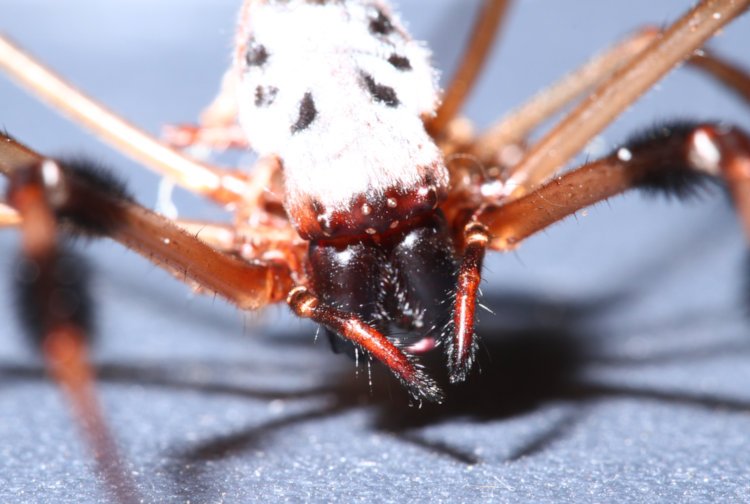
This was one of the initial shots with the 180mm macro, a little blown out but it got light down to the eyes and chelicerae like I was after. However, I needed to be closer and more detailed, so it was back to the reversed 28-105.
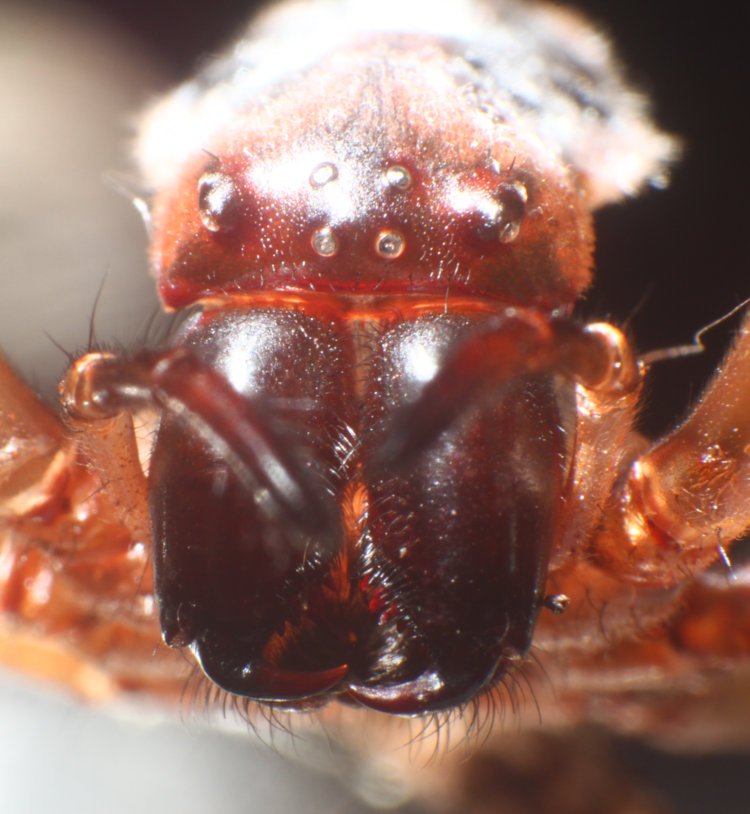
This took several tries to get right, because I was trying to get both the eyes and the chelicerae in the same plane of focus – imagine trying this with a living subject that prefers to hang vertically. But you can easily see the eye arrangement, with the four outer eyes facing sideways on little eyebumps. I should have been creative and gotten some light source down under and behind the cephalothorax to shine up through the eyes – maybe next time. But since I also got those fangs in focus, I’m good with this. So you know, the space between the topmost eyes and the bottom of the chelicerae measures a whopping 5.4 mm – try getting that precise measurement with a living subject. I also must note that this is only about half of full adult size for the species, female anyway. We don’t seem to have quite as many on the property as we did last year, but how many do you really need? Okay then.
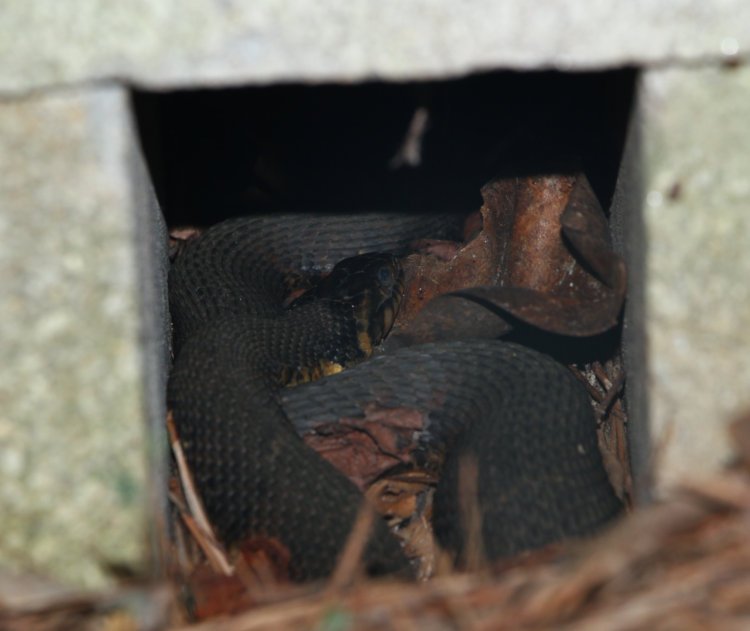
Went out to the car in the evening, just as it was getting fully dark, and on my return, right alongside the front door, I heard a sharp rustle in the leaves underneath the camellia flanking the door. I took out my pocket flashlight and tried tracking the noisemaker, going around the bush carefully since this was too reminiscent of an earlier encounter. Finally spotted a toad, figured that was the culprit (and this is very typical – several toads frequent the front area,) until I saw the thick dark body of a snake alongside the house. The snake realized it was busted and broke for cover exceedingly quickly, so I only got a glimpse of the head, but the size and darkness of the body and what markings I’d seen struck me more of a cottonmouth than anything else.
Now, the property here is ideal for the species, which is quite venomous, but I had yet to spot one at all – plenty of other species, including three different (harmless) types of water snakes, but not a cottonmouth. I was determined to try and prove this, because I’ve never even seen one in the wild, but some caution was needed of course, especially given that I was barefoot. In short order, I determined that it had gone to ground in the gap between the bricks that supported the rain barrel, so I put on some boots as a modicum of protection and gathered up the camera. Which, naturally, wanted to fog up immediately since it remains that kind of weather. Thus, my initial pics weren’t conclusive – or actually, they were, but not until closely examined.
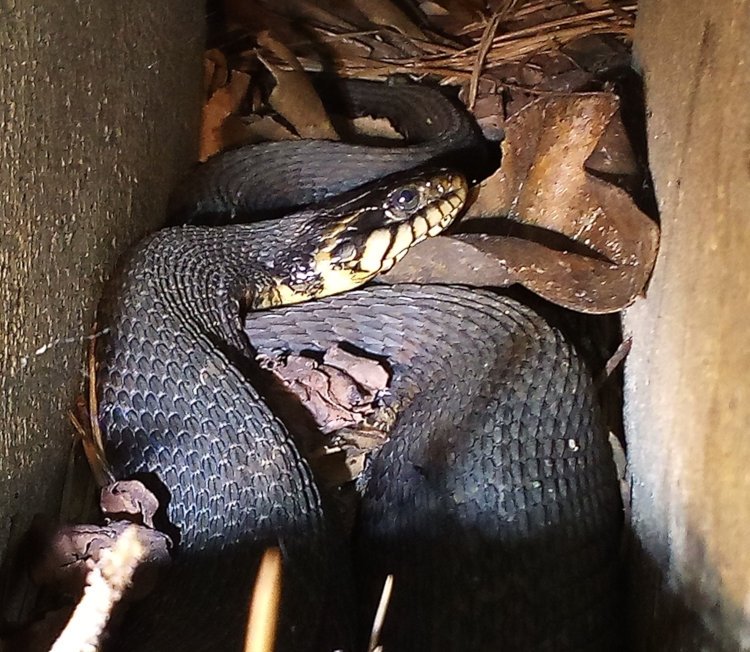
The head is turned away, though the on-camera flash illuminated it well enough – the macro flash rig I had attached just wouldn’t get into the narrow angle needed to shine into the hollow. In a short while, however, the snake had turned its head to see what I was doing better, and this time I used the (urk) smutphone, because the illuminating LED sits right alongside the lens. Since all I have on my cheapass little phone is a wider-angle lens, this meant I had to get damn close to the opening, far too close for safety, but by this point I had seen enough.
Smoother, less-angular head, distinct vertical stripes on upper and lower jaws, and round pupils instead of slitted – all traits that eliminate cottonmouth as an ID. Instead, this is another species of water snake, most likely a northern water snake (Nerodia sipedon,) though the details I’d need to see to confirm that – whether the bands near the tail are solid or broken – are hidden. No way to show scale for these, but the body was quite thick, and I got the impression it had either eaten recently or was perhaps pregnant. This is also quite dark for the species, with minimal distinctions in the markings – not out of line for the wide variations that occur, but more in line with the coloration of cottonmouths; it looked almost solid black at first, and a detail that registered in passing but only subconsciously, it looked very matte and dull, due to the rough scales. This immediately distinguished it from the other two black species in the area (eastern racer and eastern rat snake,) which both look slimmer and smoother/shinier. I also don’t think I’ve seen the black variant of the rat snake in this region – they’ve all been the grey variant.
Anyway, a false alarm, which is both good and bad. Bad in that I still haven’t actually seen a cottonmouth, much less photographed one, but also good in that a snake that was right alongside the front door was not actually venomous. It also reminded me that I get complacent at times, and need to remain alert for such potential hazards.