
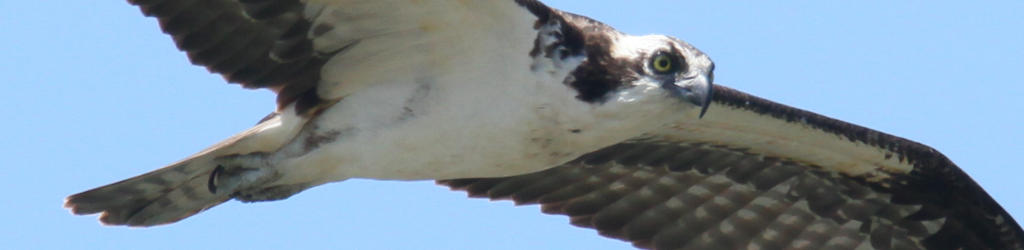
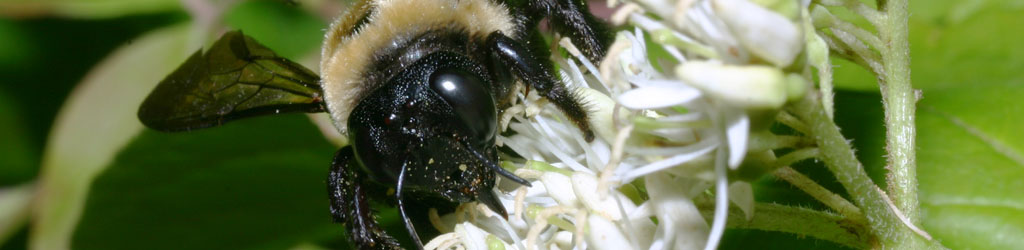
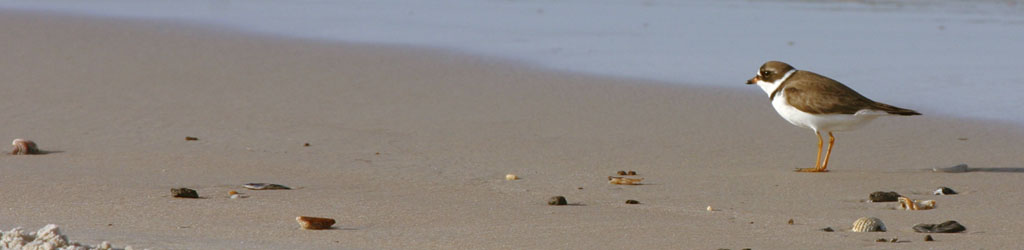
Just (finally) got through a major sorting session, so naturally it’s time for the found images that I should have featured back when I obtained them. We have a theme for some of these, only obvious because I was going through so many images at once.
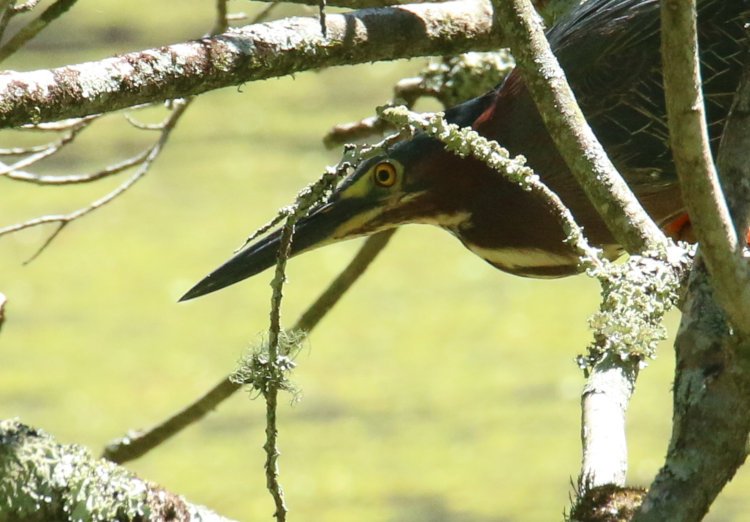
Back when doing the green heron (Butorides virescens) sessions, I snagged it peering past a lichen-covered branch, through (like most of these) it probably wasn’t even looking at me, but we’re going with that impression because we’re silly humans. The next one, however, almost certainly was peeking at me, based on behavior and conditions.
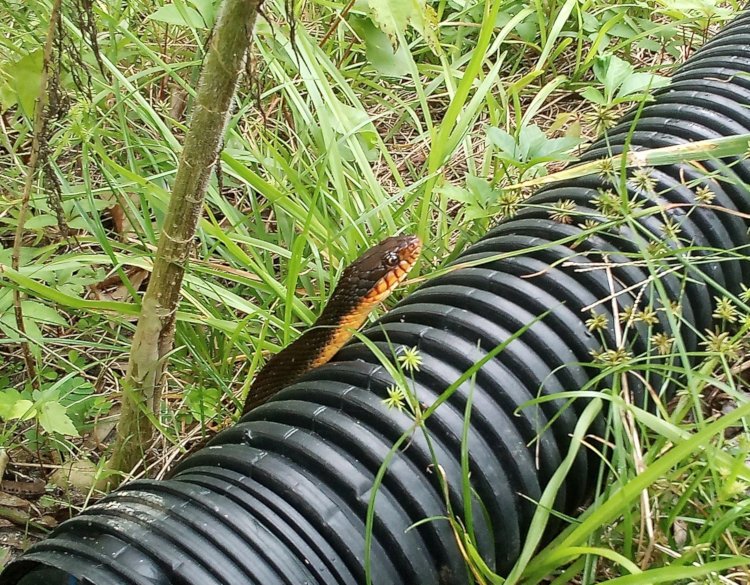
This probably shouldn’t count, since it was taken with an (urk!) smutphone, but it was what I had at the time. Opening the garage door one day, I found this red-bellied water snake (Nerodia erythrogaster) watching carefully from a behind a drainage pipe only a short distance away. Since we’d found one inside the garage, twice, a few weeks before this, we’re surmising it was the same one all times, using the garage as a lair of sorts. It’s not that the garage is particularly holey, just that every time the door is open for more than a minute, some lizard runs in, much like a cat that’s been barred from a room and therefore thinks that it’s the most fascinating place in the universe, and instead of running back outside when we try to chase it out, instead finds the most inaccessible spot to secrete itself into. So we’ve taken to leaving the door open a few centimeters to allow egress for these little bastards, and apparently the snakes have taken this as an invitation – well, this, and the fact that there’s always a little bit of corn available, since that’s where we store the duck/et al food, and so mice are scarfing that up. Circle of life and all that. Notably, only a meter from this very spot and less than a week earlier, I’d found an eastern racer also hanging out – only briefly, since it shot off as soon as I drew a little closer, but nothing in hand to get pics with.
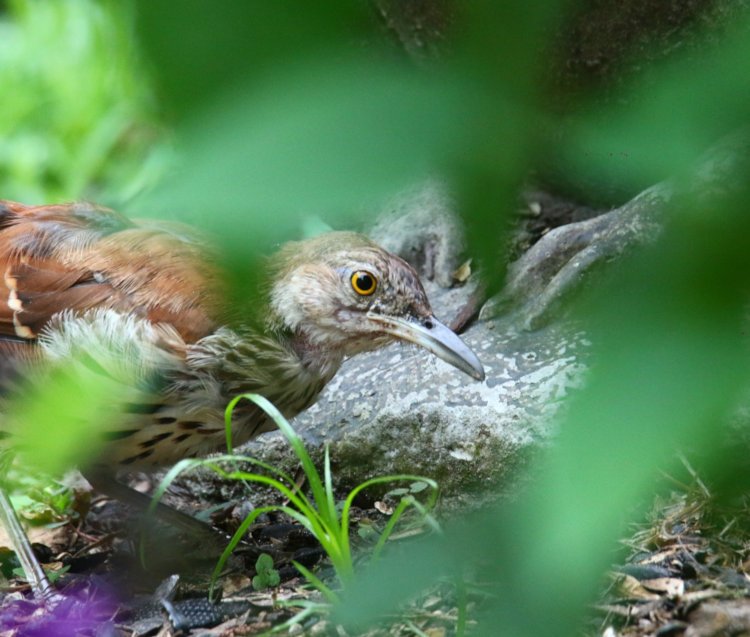
While doing the hummingbird session, a juvenile brown thrasher (Toxostoma rufum) started foraging under the bird feeders, though they would do that even if the feeders weren’t there – the species hunts for grubs and insects in leaf litter, rather than seeking seeds. But the foreground leaves made for a nice framing element.
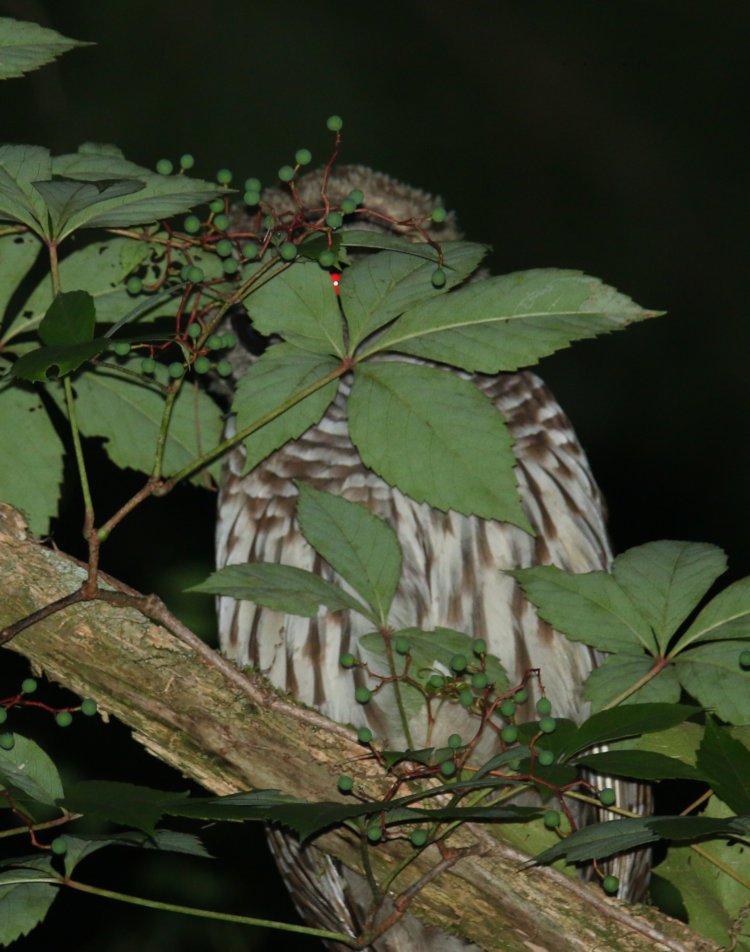
One lone berry getting fully ripe like that is odd, but it’s not a berry of course, just the barred owl’s eye reflecting the flash. Their pupils are so big, and their corneas so reflective, that it’s easy to get this brilliant a reflection even when they’re not looking anywhere near the camera.
By the way, just a few days after the latest of those linked pics, The Girlfriend and I were down at the pond edge distributing corn after nightfall, and as we turned to head back to the house, I caught a glimpse of something flashing through the trees. Sure enough, it was our juvenile friend, who had landed in the lowest branches of a very close tree and sat watching us as we passed, perhaps eight meters away. Silent this time, no calls for food, but there was no doubt it knew we were there since we weren’t silent, plus owls have badass hearing. No idea why it chose to land so obviously close, but it clearly chose to. That was the last we saw of the juveniles, though; bear in mind that most of the times when we did, it was simply because one or both were calling and drew our attention, so once they grew out of the begging stage, they could easily be close by and we’d never know it. Except for two nights ago, when someone hooted very distinctly right out front, less than 20 meters off, but I never caught sight of that one before it moved on.
Some non-spying entries.
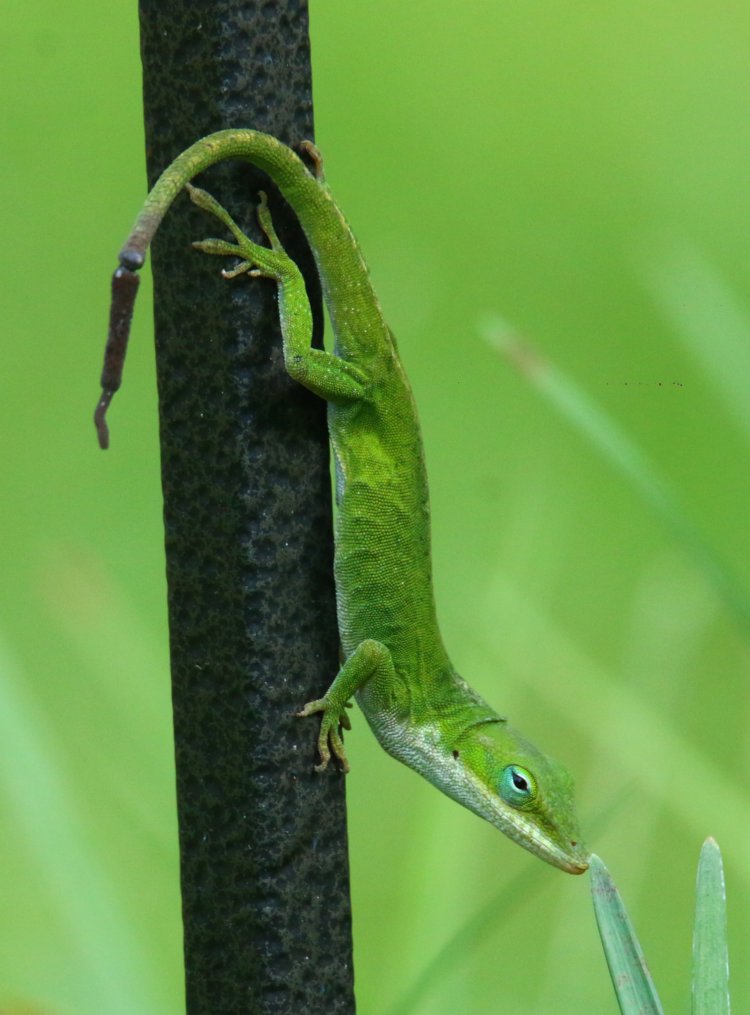
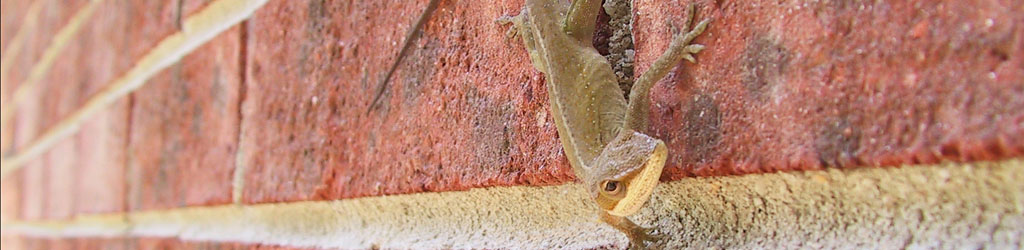
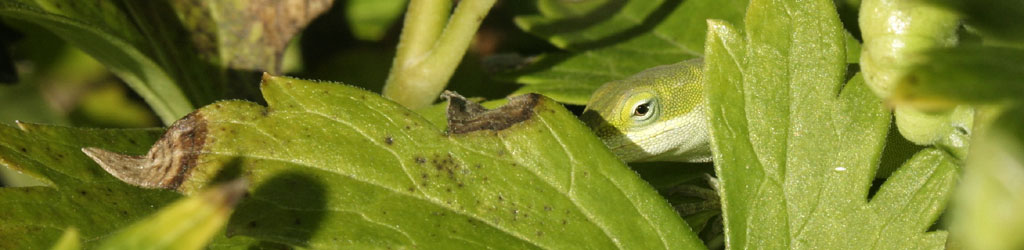
The only Carolina anole I can dependably identify, solely because of that tail – what, exactly, has happened to it, I can’t say, but she appears to be coping just fine. And I know it’s a female because I’ve seen her both ready to lay eggs and starting the process over. She lives in the liriope out front, and I often find her sleeping on the star jasmine overnight.
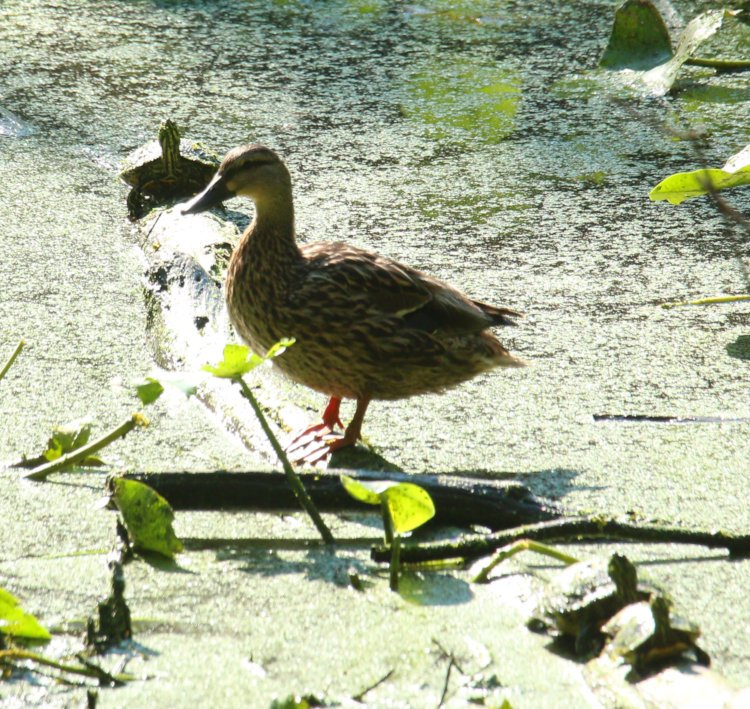
When the pond level dropped, it re-exposed a log that the turtles had been using to sun themselves on, and the ducks also took advantage of it from time to time, though the number of ducks visiting has greatly diminished right now. The Girlfriend spotted this one, and despite the distance, was alerted to it not being a wood duck because the proportions were wrong – as you can see here, it has a pretty thick body for a smaller head, yet distinctive bill. Those proportions, more than anything else, made me peg this as a juvenile American black duck (Anas rubripes,) which have been entirely absent from the pond since about the beginning of the year. It’s funny how we have guest appearances from several different species, but only a few decide to make it a habit.
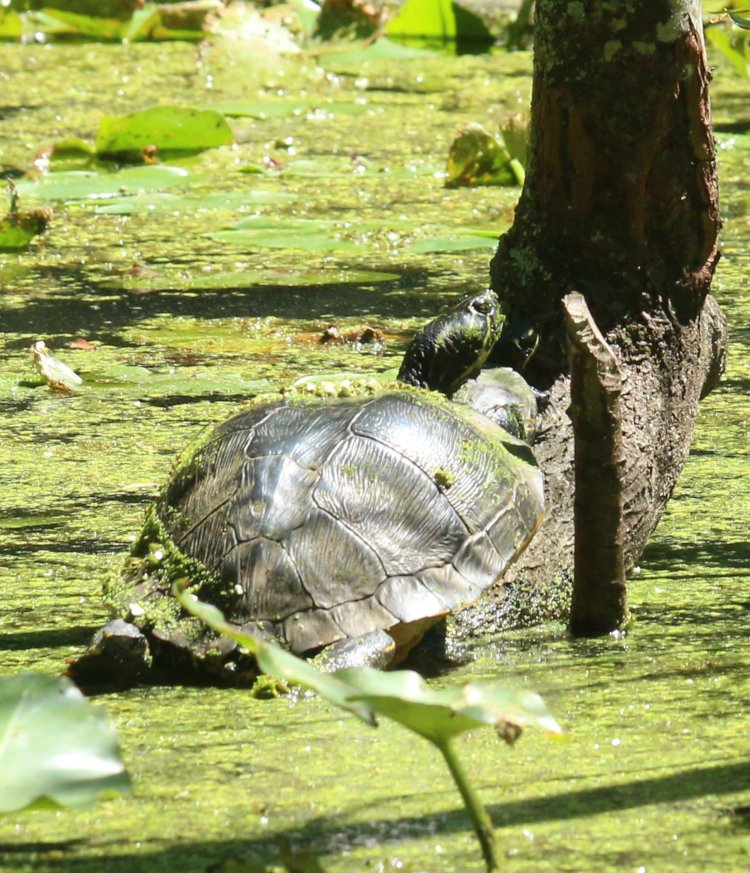
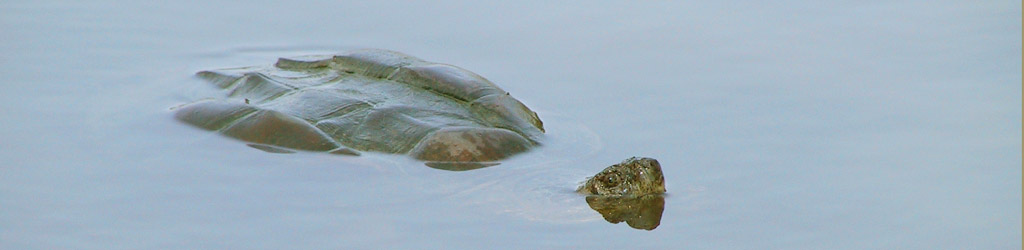
During the first green heron session, I took the opportunity to snag a yellow-bellied slider sunning itself on Turtle Island, though at that time, the water level was so high that it was nothing more than tree trunks sprouting from the surface. Still, room enough for one – actually, two, if you look closely. I like how the light angle made the most out of the textures of the carapace.
And finally,
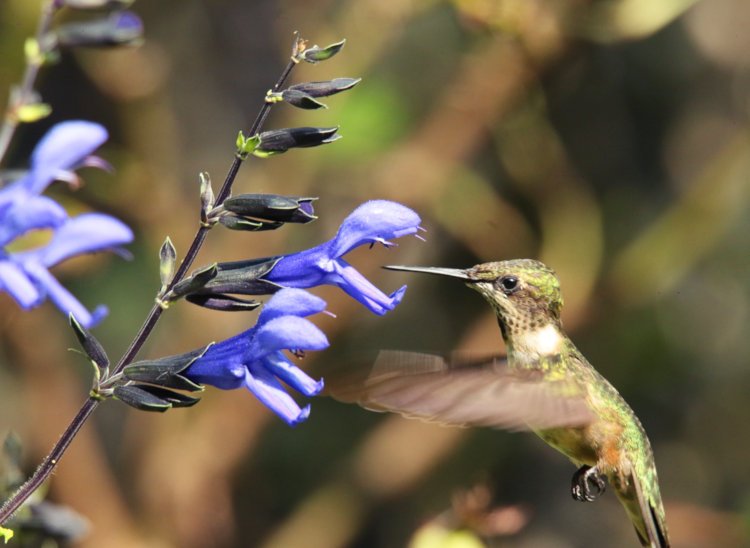
I sort all of the images into appropriately-named folders, so I can search through all the Birds, for example (six folders and counting, since they get cut off at about 4,000 images to make searching slightly faster,) but of course some of the images have multiple subjects. Thus, the images get duplicated into multiple folders so they can be found depending on which subject I might be after. This is one example, obviously – it can show off either the hummingbird or the salvia blossoms, but both work together for a decent composition; I’m just not going to get that specific with the folder names. This was a distinct rarity, too: getting strong profiles of both the hummer and the flowers, in the same plane of sharp focus, with the light working beneficially. I could have done without the complicated background, but not without trimming a lot of rose bushes, or at least setting up a shade to keep the bright sunlight off of them and make them more muted. That’s more environmental staging than I’m going to engage in, however, especially since this was a grab shot while the greater percentage of activity was on the purple salvia instead.
Now, I have to go into sorting the video clips, which takes a hell of a lot longer. And there’s still a massive video project that I’ve been putting off because of the word, “massive.” Work is never done…