
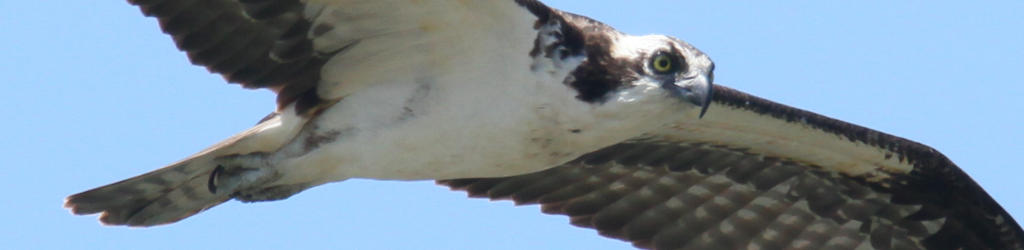
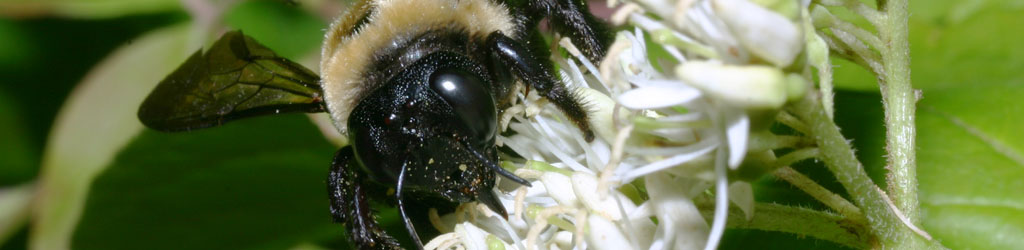
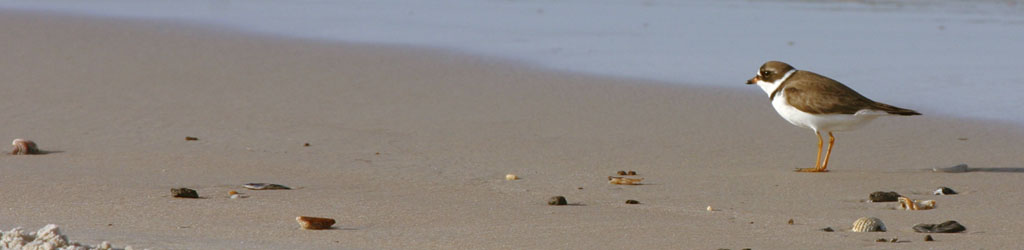
Considering that I made this trip a week ago, I think I’ve stalled long enough on getting the pics up, but there are enough to split into two posts, so here’s the first. We’ll see how many weeks it takes me to get to the second…
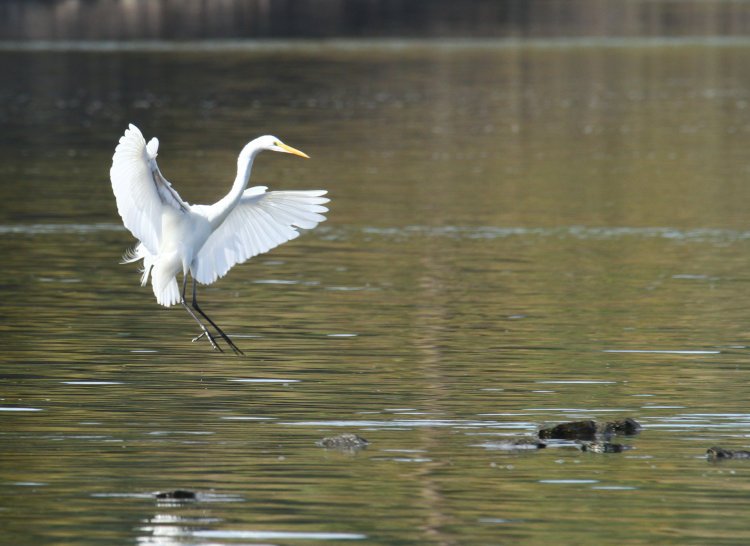
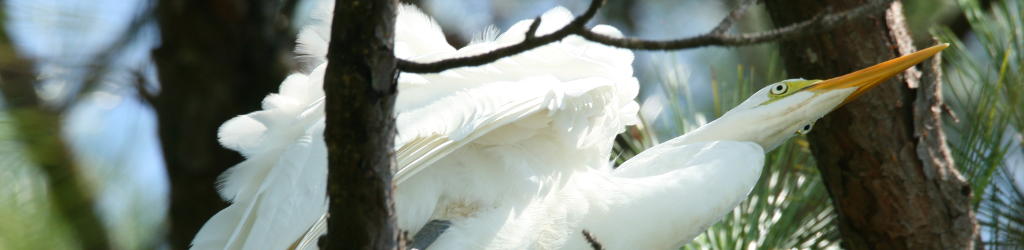
Finding myself back in the area on errands, I arranged to meet up with the Inimitable Mr Bugg again and do a trip down to Jordan Lake to see what was happening – which, overall, wasn’t a lot, but a few performers gave us something to shoot. Here, a great egret (Ardea alba) takes advantage of the lower lake levels to come in for a landing on some rocks just being exposed. I was attempting to stay on my toes with the exposure compensation, since just about every direction that I faced required some adjustment, yet this one remained dialed brighter for different conditions, the water reflecting the sky – when things start happening you don’t always have time to tweak settings. Thus, the egret is a little blown out in the highlights, but the pose is nice.
A nearby great blue heron (Ardea herodias) took exception to this, however.
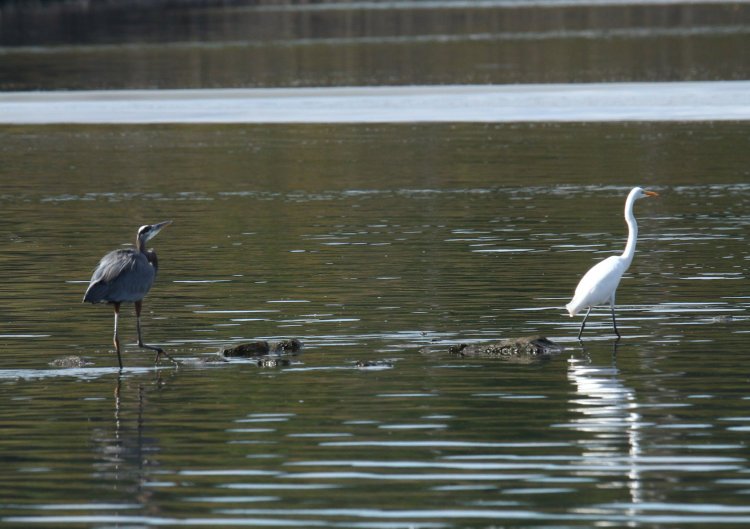
Having already been present in the same shallow patch just a little ways off, the heron felt that the egret was encroaching on its stake of fish, and began stalking purposefully in that direction as the egret wandered casually. Usually, when fishing, herons and egrets stand motionless or, at best, take elaborately casual steps, endeavoring not to scare their prey, but the motion of the heron was too deliberate and quicker, straight towards the egret, so I stayed on them.
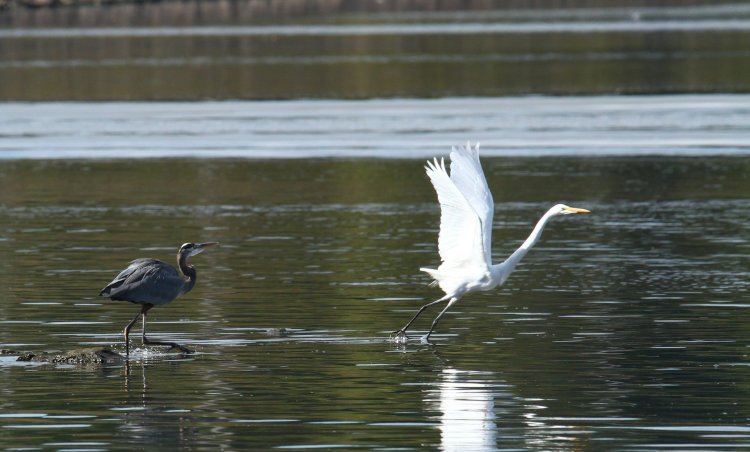
It took only moments, as the heron quickened its pace and the egret realized its peril. “Peril” is really too strong a word, since such disputes will only escalate into croaking and flapping, maybe a bare peck or two, but allow me my drama, and I’m pleased I got a frame that shows the dynamics of both of them.
The egret circled around and came back past, still desiring to use the shallows, just further away from the heron, though it hardly looks that way in this frame:
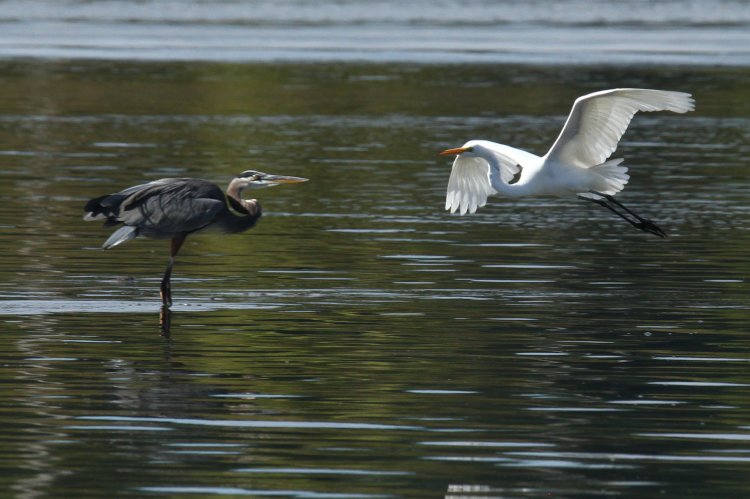
Looking as it it simply wanted a flying start to really enter into the fray, the egret is instead much closer now, bypassing the heron to find a safer spot just far enough off – telephoto compression hides the lateral distance between them. Amusingly, this all took place in silence, which is odd because herons usually need little encouragement to voice their displeasure in guttural croaks.
Earlier, I caught what was perhaps the same heron as it speared into the water after a snack.
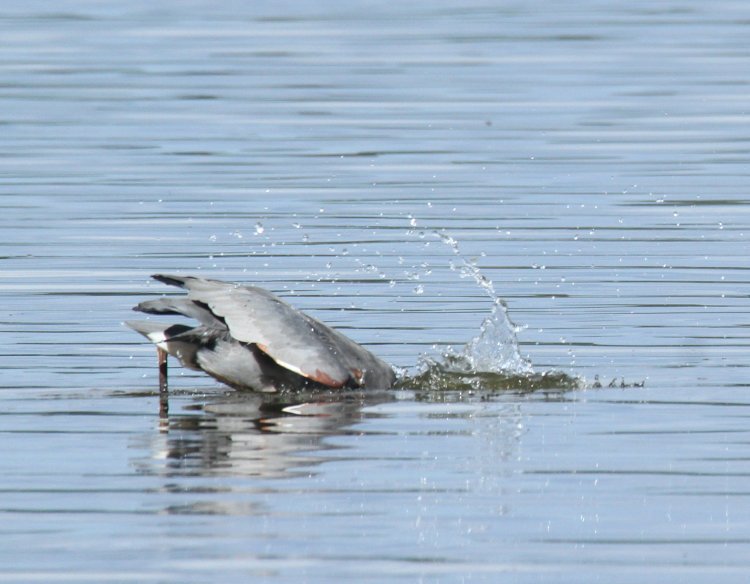
This is what the exposure compensation was adjusted for, and I actually got two frames of the splash itself, choosing this one because of the expressive water drops. You can also see a leg out back, indicating that the heron had stepped forward into the strike, which was for nought since it re-emerged without a fish. In my experience, this happens roughly half of the time, and what successful strikes we did witness that afternoon were of tiny little minnows. They’re arguing over buffets like this?
The ospreys (Pandion haliaetus) were just barely present – we saw three, I think, but one did indeed cruise past and enter a stoop after a fish. While the autofocus was being far too spastic that day, often selecting the water in the background to focus upon and not the bird right smack in the focusing point (I have yet to determine why this might have been,) at least this time it remained tight on the osprey, as this crop shows:
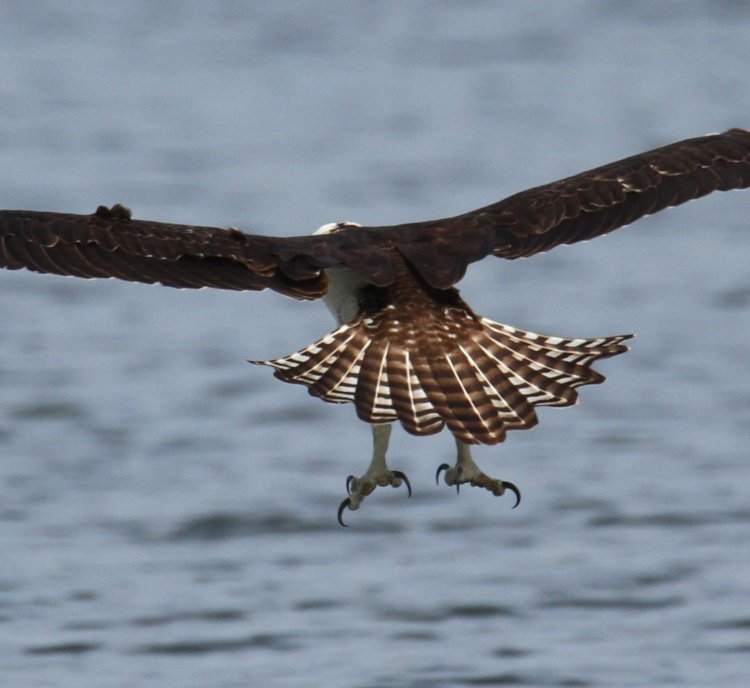
I thought I had a decent chance of capturing the moment of splash down this time, something I’ve long been after in a detailed, sharp frame – those talons are down and ready. The fish, however, was a spoilsport and apparently moved out of range, since the osprey aborted its approach only a second or so before it would have completed the dive.
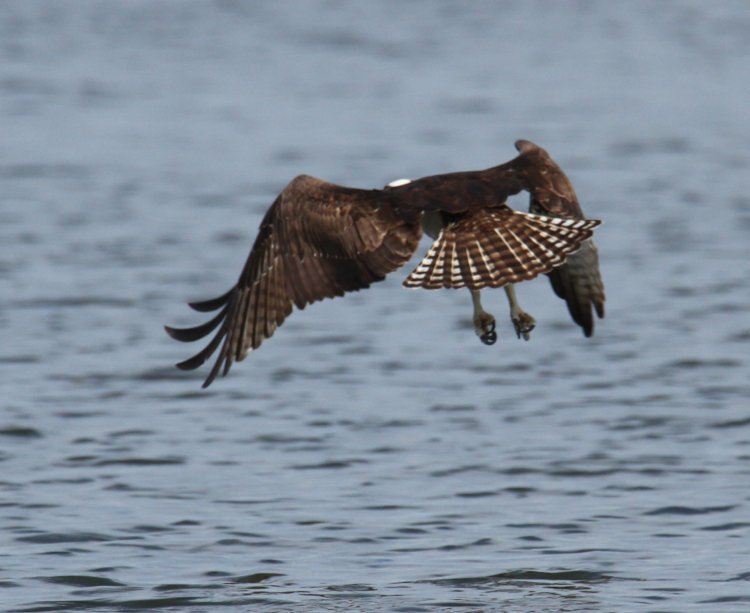
I left enough of the water in the cropped frame here to show that the osprey was less than a meter up as it began flapping for altitude again. [Sigh.] Still trying…
A few double-crested cormorants (Nannopterum auritum) were present, mostly just seen floating in the water or occasionally resurfacing after doing their fishing below the surface – cormorants are excellent swimmers and usually chase their prey in its own environment rather than doing momentary entries like the sissy herons and osprey. However, I tracked one on approach as it conveniently faced more into the camera.
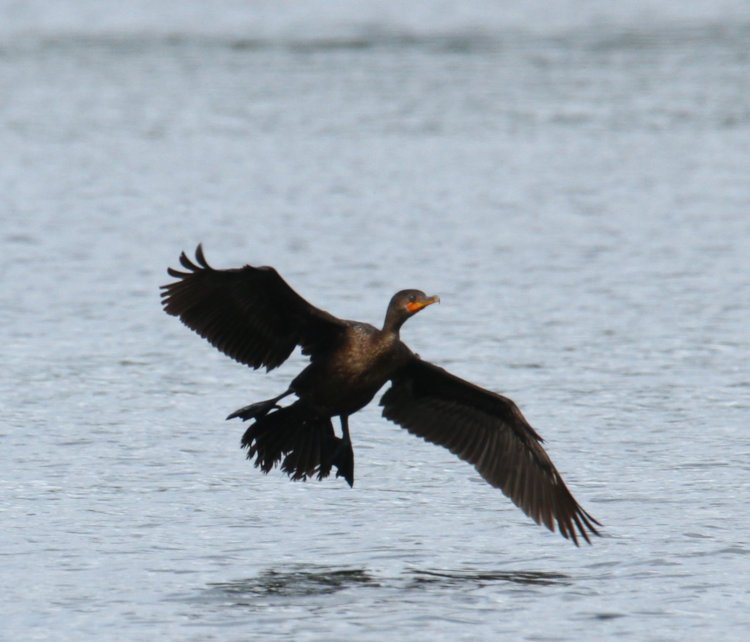
The brown head and neck indicate this is a female, while the extended tail and feet are shedding its speed prior to contacting the water only centimeters under one wingtip – cormorants are reasonably fast flyers so this is necessary. But that tail looks ragged as hell, doesn’t it?
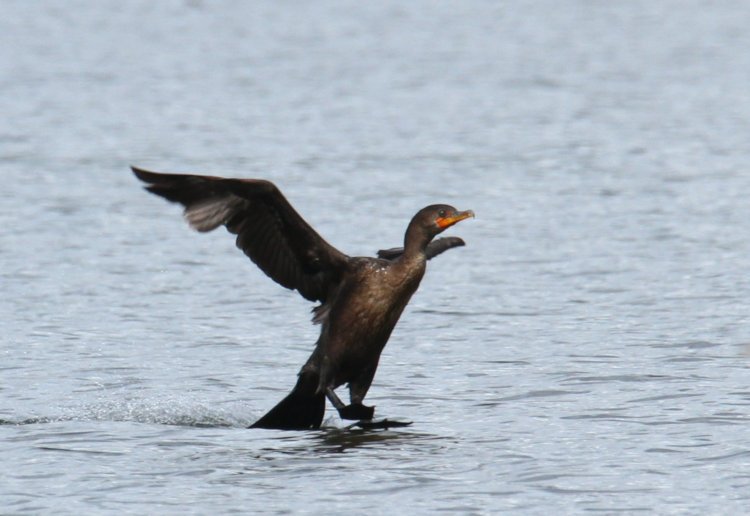
Ah – that explains it. Unlike ducks which usually water-ski on their webbed feet to slow down, cormorants apparently rely on their tails more to arrest their forward motion, and this is the first I’ve witnessed a touchdown in adequate detail – that tail is digging pretty deep. Cormorants, by the way, are roughly the same mass as a mallard but perhaps a bit lankier.
We close with a long shot of an osprey that had captured a fish.
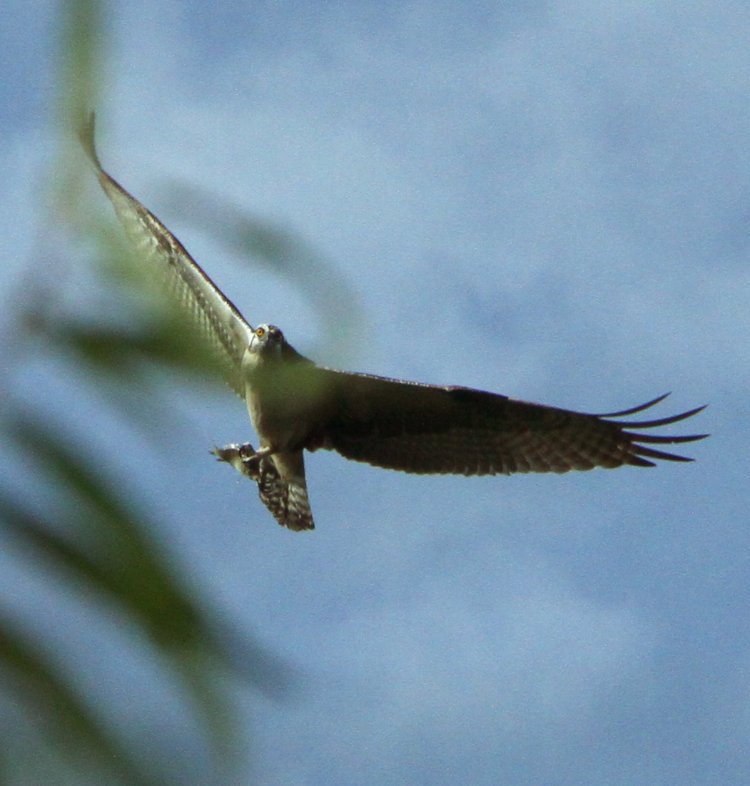
This was quite some ways off and small in the frame, cropped tightly here because I liked how the eyes came clearly through the intervening foliage, seemingly looking right into the camera. At that distance, the osprey could have been looking anywhere in our general direction, though its eyesight is good enough that it certainly knew we were there. Nice angle for the lowering sunlight, shame it was so far away.
To follow: the fartsy portrait shots, but I’ll intersperse some of the other things that I’ve been capturing in there.