More luck than normal

great egret Ardea alba in reed bed in middle distance
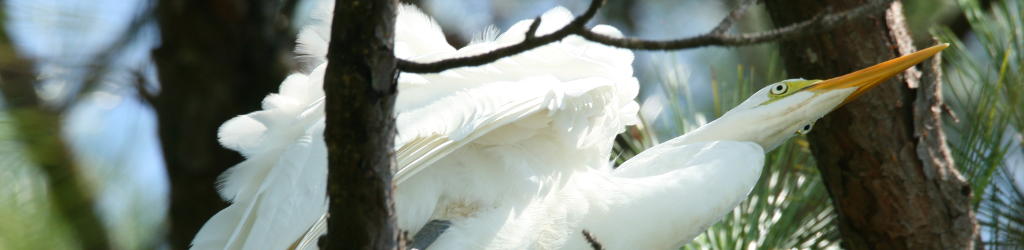
It had been a while since I’d spent any time at all at the nearby pond, so the other afternoon I wandered over to see what could be found. Right off the bat, I could see a great egret (Ardea alba) hanging out at the nearest edge, about where the green herons had been hunting earlier. Pausing well back where I wouldn’t spook it, I affixed the long lens and began working my way closer, getting photos as I went.

Amusingly, my caution was not terribly necessary, because this was easily the most mellow egret that I’ve come across, and I couldn’t say why. I never pushed my luck during the initial stalking session, because once you’ve gone too far, you don’t have anything to shoot as the egret flies off. But as it slipped into deeper cover under the trees during its perambulations, eliminating any clear view, I fired off a couple of frames as I continued along the pond shore in pursuit of other subjects.

great egret Ardea alba portrait under tree overhang
I looped around the pond, and noticed on the return leg that the egret had flown off across the water from its original position and was now in my path again, standing on the open shore. However, someone was walking along in front of me, and I was convinced that they’d spook the egret off again, because that’s generally the pattern; even as they notice and marvel at the wildlife, they still scare it off.

Just not this time. The egret paid no heed to the man walking a few meters past, and remained in place as I myself approached. Mellow.

mellow great egret Ardea alba on pond shore
Even better, it began stalking the minnows in the shallows as I watched. Except… the autofocus kept wandering to the background, so I quickly shut it off, but that meant trying to lock onto a bobbing egret head as it hunted, which is tricky. I did what I could, but on returning and unloading the card, I found too few images were passing muster.

great egret Ardea alba with recent wriggling capture
Sure, I got a few useful images, but they were mostly of the portrait kind, and not the action that I was hoping to get. Or the fish was barely identifiable as a fish. This was annoying, since it’s rare to get the opportunity to be as close as this, where I should have been able to nail feather detail as well as the fish itself, and not get it.
great egret Ardea alba with tiny fish
But I took the opportunity for the portraits, anyway.

great egret Ardea alba stalking alongside pond
The sky was clear and reflecting in the water, the view was largely unobstructed, and the backgrounds pleasant and usually uncluttered. It could have been worse, and usually is.

great egret Ardea alba head against pond background
(Mostly, I’m just taking the opportunity to post the better shots, since the narrative is composed of, well, more fishing.)

Occasionally, it was working.

great egret Ardea alba with capture
Okay, now seriously, this was a roller coaster when I was reviewing and editing the shots. “Ah, nice, but the fish isn’t too visible.”

Then…

great egret Ardea alba portrait
“Great! Look at those sharp eyes, and right before it plunged into the water after a fish, annnddd…”

great egret Ardea alba out of focus“… shit, missed the tracking.” Generally, there are only a few seconds before the egret will gulp down a fish this size, and trying to track focus with a moving head is challenging – too challenging, it seems, at least for this session. Too often, you may come out with the impression (or at least I do) that you’re bringing home some really slick images, and then find out that something wasn’t quite right and you’re not even going to retain them in your stock folders.

That was Friday. Saturday I had a short period of time before I had to be into work, and made another circuit of the pond, but was seeing no sign of the egret. While the species appears at the pond, off and on, they never seem to reside for more than a couple of days, and we’re approaching migration season; the green heron brood that I was tracking earlier all seem to have moved on now. Saturday’s attempt was with The Girlfriend, and we stopped to talk to a neighbor while out there, until I was about out of time, so we finished the circuit quickly. And naturally, as we rounded the far end under the copse of trees there, the egret was waiting for us, again, far closer to the edge and every person strolling past (there are quite a few, especially since March) than most egrets ever allow. I had time for a couple of quick frames, but not at all for standing and watching for more fishing behavior.

great egret Ardea alba hanging out in shadows
Sunday wasn’t gonna happen, so the next time that I could make a pass was Monday morning, sunny and pleasant, and sure enough, the egret was waiting right where I’d first seen it two days previously, posing like an old hand.

great egret Ardea alba posed on old snag with reflection
I casually slipped in close, less than ten meters off, and sat down in easy view, ready for all fishing behavior and maybe even shooting some video. The sun was the right angle, the wind was calm… and the egret wasn’t doing nothing.

great egret Ardea alba scratching neck
Well, I mean, sure, preening, scratching, sunbathing, but not stalking a damn thing, nor even appearing to be interested in the water.

great egret Ardea alba preening
At least it wasn’t bothered by me sitting right there, also in plain sight. My allergies started playing up and I ended up having to sneeze violently, twice, and all I earned from the egret was a brief inspection to assure it that I wasn’t getting ready to attack. I was starting to get the impression that if I’d brought along some goldfish crackers, I could have hand-fed the damn bird.

great egret Ardea alba scratching chin
Don’t get the idea that it was constantly involved in its grooming – there were more occasions when it was staring off into space, or checking out the sky overhead, but there are only so many photos you can get of that. But I did catch it peering intently between its legs, perhaps suddenly realizing that they bent backwards and so weren’t knees, but ankles.

great egret Ardea alba looking between its legs
[This is true, by the way; birds essentially walk on tiptoe, and the knees are buried up inside the feathers.]

Eventually, it wandered again under the cover of the nearby trees, well shielded from easy sight, and I started walking on around the pond again. Between the three sessions, I have a bunch of other subjects, but they’ll come in later posts.

The Girlfriend had again joined me by this point, and we rounded the pond again, only to find the egret now standing immediately before us. I was starting to wonder if there were two, but this was never confirmed and each time the behavior was just as easygoing, so I’m presuming it was only one. That kept appearing ahead of us on our path. Yeah, you figure it out.

extreme closeup of great egret Ardea alba showing sunlight refracting through cornea onto cheek
We’re talking about five meters distant, and not only unconcerned about my standing there, it actually drew closer instead of moving away, allowing me to do not just extreme portraits, but to capture the cornea acting like a lens and shining sunlight on its own cheek. But as it started actively hunting, I decided to switch to video instead, and captured some behavior that we’d first seen three days previously.


First off, yes, next time I’ll try to have the tripod with me, but bear in mind, as close as I was, setting up such a thing may well have spooked the bird off. I wasn’t using the external monitor, so it meant not just hand-holding a heavy super-telephoto lens (it weighs 2 kg all by itself,) but out away from my face since I had to use the LCD on the back to frame and focus. You try it.
The loud bird that you hear in the background is a red-shouldered hawk, fairly common around the pond and not a threat to egrets, but they still check the sky when such things sound off. Don’t ask me to identify the fish – all I can tell you is that it’s the kind with fins.

Meanwhile, that wriggling, which if you watch seems mostly confined to the neck – I don’t know what that’s about, and have never seen it before from any waders. Bitterns, I’ve seen something like that, but only when their head was raised straight up and they were trying to look like reeds swaying in the breeze. And cats – seen that from cats. But not herons or egrets. I initially suspected it might be from seating its feet firmly in the mud for a stable strike, but the legs appear motionless and even the body is very constrained. So, until further notice, I’ll have to tell you that I don’t know. But I’m glad to catch it on video. And also glad to actually snag what I intended to with any given session. That doesn’t happen often.

Because Tuesday follows Monday

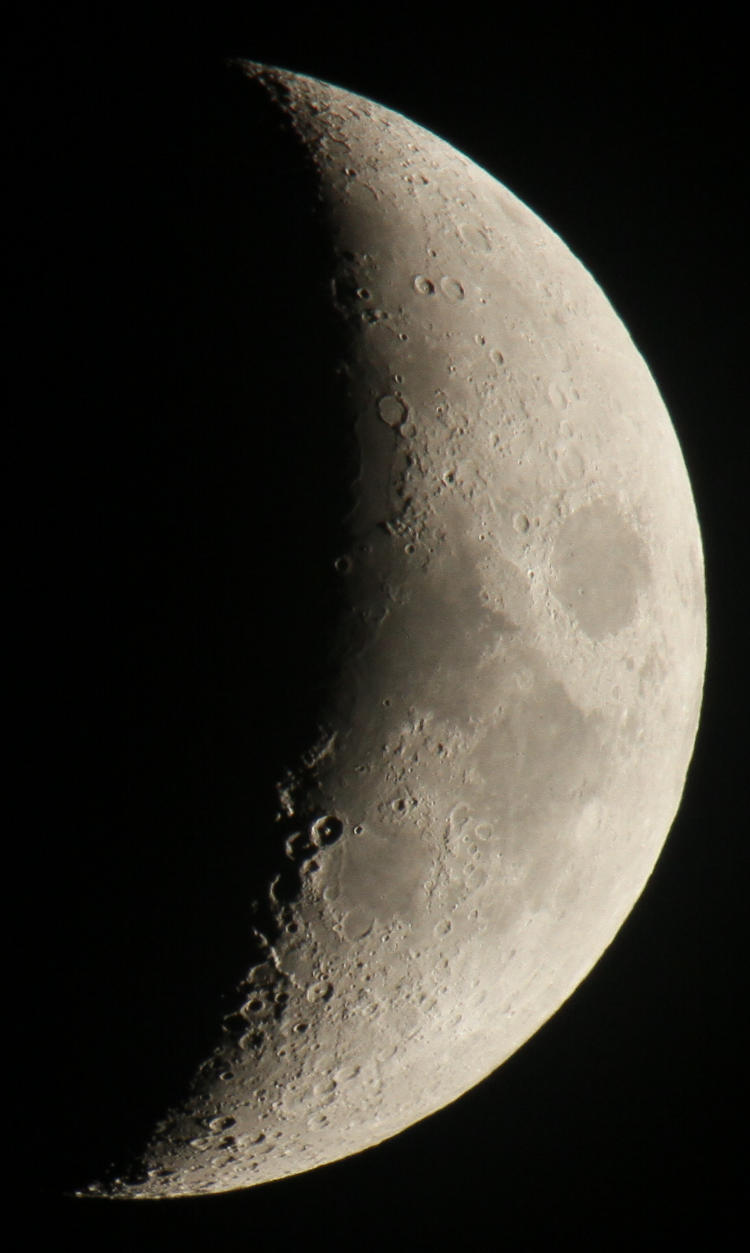
animation of difference between 2:02 AM and 11:07 PM moon phases and librationBack indeed, with the animated gif (pronounced, “GAL-eh-fray”) that I wanted to include, because it shows better this way. I tweaked the colors to come close to matching, and while it might seem that I didn’t line them up well enough, I think we’re actually seeing the libration between the two shooting sessions, the wobble that the moon performs as it orbits the Earth and revolves; it’s not perfectly locked to facing exactly the same way, and changes during the month. This might be a little excessive for just a day (actually, 2:02 AM to 11:07 PM,) so, yeah, alignment may be off a bit too.

[A note: The moon follows the path of the ecliptic across the sky, with the illuminated portion facing the sun of course, while we face any damn way. I made the attempt to correct for the angle difference between the first and second sessions, but it wasn’t going to be perfect, so it took aligning the two moon photos in size and rotation to make a near-match – and this is not easy nor fun. I have to admit, Photoshop makes it easier than GIMP, but I was logged into Linux this time, so…]

I also did a little research, because that speck that crossed in front of the moon had me intrigued. And still does, because so far, I’ve found no matching satellite. Stellarium allowed me to roll back to the time period, but showed nothing – which may have been because the magnitude of the satellite fell outside of its parameters. I know I looked carefully after it passed, trying to see if I could make out any glowing/reflective points in the darkness along its path, but with the glare of the moon, it could easily have been missed – or simply too dim to see regardless, except for a very long exposure.

Meanwhile, Heavens Above didn’t tag anything either, though again, they seem to drop out any falling at less than 5 magnitude, and they don’t roll back in time very well. I checked their list of visible passes for anything, and nothing fell within that time period.

If it was a plane, it was very high, because it was a mere speck against the moon even at 600mm. If it was a bird – well, it almost certainly wasn’t a bird, because it was moving too fast for the altitude it likely would have been to be that small.

I’m kind of irked that I missed it, convinced that I would have had a photo had I been faster on the reflexes, but there’s also the naked fact that I was shooting with mirror lockup to reduce camera vibration, so I would have had to have triggered the shutter twice before it vanished, plus doing it that way would have negated the purpose of mirror lockup to begin with. So chances are I wouldn’t have caught anything no matter what, unless I already knew it was coming. Which, someday with the ISS, may happen. That’s very tricky, because the path on Earth where you can see the ISS in front of the moon is fairly narrow, and most sources don’t plot positions that precisely.

[Another note: both the mirror slapping out of the way, and the shutter slapping open, introduce vibration into the camera – minimal, but at high magnifications and especially at longer exposures, this can affect sharpness because the camera is moving during the exposure. Thus, mirror lockup is a custom function to move the mirror out of the way before tripping the shutter, preferably a few seconds before, so the vibrations have a chance to die down, and I usually use it on astrophotography, as I was for both sessions. As well as the remote release, so I wasn’t even handling the camera. The shutter vibrations really don’t have a solution, but at least for the moon, the exposure period is short enough that the impact is trivial – not so much for some other, dim subjects.]

Now I’ve gone and set a precedent for the month, and might have to see how many other moon photos I end up with. Rest assured though, I have some other subjects to mess with in the meantime.

Because it’s Monday (part two, fer sure)

waning gibbous moon before Monday ends
As threatened, I have the next phase of the moon, appearing on the same day as the previous phase, being shot at a little after 11 pm. You can compare it to the previous post to see the reduced amount of light, but, given that it was lower on the horizon and the atmospheric conditions were different, there’s a different color cast. Plus I think I may have had saturation settings a little higher this time, from the day’s shooting.
Regrettably, I missed something by a mere second, since as I was redoing focus, something passed in front of the moon, a dark spot that crossed the face in perhaps a second. Satellite? High-flying bird? Lost quadcopter? Don’t know yet, but I triggered the shutter just a hair too late. Stay tuned, because this post isn’t done yet – more will be along after the deadline. Not to mention at least two other posts based on photography within the past three days, with video even. Busy busy busy.

Because it’s Monday (part one, maybe)

waning gibbous moon
While the sky was cloudy earlier in the evening of the 4th, it (mostly) cleared to allow a couple of moon shot experiments, and I thought I’d throw one up here… with the possibility of a follow-up later on. It’s quarter to three AM right now on the morning of the 5th, the moon riding very high, but it will set about 10:30 AM and rise again about 9 PM, allowing another chance before the day is out to see the progression of the phase, in this case waning from full a couple of days ago. So if the sky is clear, I might be back.

Now, a couple of notes. You may recall from a previous post the mention of the brightest spot on the near side of the moon, which is Aristarchus; it was visible then in the earthshine, and here as the bright spot straight to the left. In the crescent photos of that post, the crater Grimaldi sat right on the terminator, but here it is clearly visible as the dark spot in the brighter region that sits lower left. You might even notice that you can just barely see a couple of bumps on the outline of the moon, again, the most distinctive perhaps being just beyond Grimaldi at lower left. To the best that I can determine, these are the peaks of the Montes Cordillera range that forms the rim of Mare Orientale, out of sight around the edge of the moon.

The above image showing the whole moon (what we can see of it) is a little less than full resolution, so for giggles, I did a cropped, full-res version of the terminator, to show the best detail that I’ve captured with the Tamron 150-600 lens.

full resolution crop of same image
All those details to the right, along the terminator, have the highest contrast and thus are what I use to adjust sharp focus upon; autofocus isn’t trustworthy for this, and in fact, manual focus leaves a lot to be desired, so I usually shoot several frames, readjusting focus for each, because that perfect spot is impossible to determine in the viewfinder. And while it’s also impossible to demonstrate the view accurately here, given the huge variation in monitor sizes that anyone might be using to see this post, I’ll make the attempt anyway.

full-frame verion of same moon image
This is the entire frame of the same images above, and this is roughly as big as it looks in the viewfinder of the camera. So those details to the right are the ones I’m attempting to get the sharpest to know that I have the best focus. Yeah, sometimes they’re good, for the image used in this post, and sometimes not so good – I have multiple attempts from this morning, all within a few minutes, and plenty of near-misses.

mars theough the Tamron 150-600 lens, full resolutionWhile I was out there, I re-aimed the tripod just a little and captured another subject: Mars. A few days ago it was riding close to the full moon, but I was too tired to do a session then. Here, I was lucky to get just the barest hint of color variation from the disc, but this is full resolution and as good as it’s gonna get without a telescope. Eventually, I’ll get that together, and maybe then we’ll see something more.

Thin but long

I don’t watch a lot of movies, for various reasons, but one side effect of this is that I’m not influenced by the common associations created by such. I’m not spooked by dark, quiet forests at night, and I find nothing at all mysterious or foreboding about fog; it’s pretty damn cool, in fact. I’m still watching for conditions that I got one night decades ago, when we had a very thick low-lying fog on a night of a full moon, which illuminated the fog into a movie set. I was walking through a field and couldn’t see what was more that five meters away through the glow. Wonderful experience, with little chance of getting lost since the field was bordered by country roads and a treeline, so our human inability to walk a straight line without visual cues wasn’t much of an issue (plus it’s probably a lot better when you have a few meters visibility rather than totally blindfolded,) so when I emerged onto the road I wasn’t where I’d aimed to be but not horrendously far off either.

distant shadow through fog over Jordan Lake
So when we had a nice fog over Jordan lake during a “sunrise” outing, it didn’t ruin anything nor make things spooky at all, it just reduced sight distance and added a different mood to the photos. The fog wasn’t terribly thick but it was persistent, lasting for hours after sunrise (thus the title – why? What did you think it meant?), so just to illustrate, I did a few frames of a distant subject. Unless you were looking hard initially, you might never have realized it was there, since the image above is at 600mm, and the horizon line was pretty indistinct. 45 minutes later it was now noticeable.

distant island seen through fog on Jordan Lake
Now distinct enough not to be mysterious, it was 80 minutes after sunrise, and not even the sun was visible. It’s worth noting that, while I estimated the island as being better than a kilometer off, it was actually 2.5 – not exactly close. Another 45 minutes, and now the fog was just a haze over the horizon, with more detail to be seen.

Island on Jordan Lake shrouded by thin fog
I like how the background horizon, the far shore of the lake, gains definition as we go along. At this point, the sun made its first appearance, but only fleetingly for a while, sometimes so briefly it was difficult to focus upon (autofocus was out entirely, too little contrast for the sensor to define, so manual it was.)

sun seen through slight break in foggy morning
But while all this was going on, the visibility in the immediate surroundings was only slightly reduced, so not much of an impediment to photography. Had the fall colors been more advanced, it could have made for some much better landscapes, but we still have about a month to go on that end.

Shoreline of Jordan Lake with thin fog
The birds were still present and active – not remarkably so, but there were some opportunities to snag a few photos here and there. The herons and egrets were maintaining their distance, so it was the osprey that formed the primary subjects of the early morning.

osprey Pandion haliaetus hunting in morning fog
There are a couple of different approaches to nature photography. Ours is to go out in potentially productive areas and see what can be found, anywhere, and I often espouse this approach because, on the whole, it nets you a lot more photos for any given outing, plus it provides more variety. But there are two specific detriments to doing this: it requires a lot more lens changing (which, in the field, introduces more dust and junk into the camera and lenses,) and it means you’re trying to look everywhere instead of watching one area intently for all activity – which, admittedly, can be very boring if your chosen subject is scarce. The ‘everything’ approach meant, in this case, that we didn’t see the osprey (Pandion haliaetus) until it was just completing its dive after prey, and could only catch it as it lifted off with a fish.

Slightly luckier the next time around, but only slightly. We were watching this osprey as it wheeled and started its dive, but the distance was greater and I, for one, hadn’t dialed the exposure compensation back in for aerial shots, allowing the sky to set the ‘mid-range’ exposure which was a little darker than ideal, so the following shot has been tweaked a little in brightness and contrast to show the details I’m illustrating.

osprey Pandion haliaetus beginning its dive after a fish
same image but full frame as capturedWhat I’m showing above are the ruffled feathers, at the forward wing edges and the base of the tail, which indicate that the osprey has stopped soaring and has angled the wings to ‘stall,’ eliminating nearly all lift to simply drop from the sky – it will realign the wings in the stoop to aim precisely (or pull out as needed if the fish disappears.) Video still remains a possibility, but that will almost certainly be from a tripod and will take place on a much clearer day than this one.

Meanwhile, at left is what the original, full-frame image looked like, so you know both the exposure and the amount of enlargement to see the details; this is at 550mm focal length, so the osprey was fairly distant.

Worse, however, was that as it completed its dive, it dropped behind a tiny tree from my perspective, so even as I tracked it (and the autofocus did its random thing and failed to at times,) I couldn’t catch the impact with the water. So what I was left with was the eventual departure of the osprey as it went someplace to consume its meal. But you gotta like those visible fins at least.

osprey Pandion haliaetus departing with fish
The next photos are just a few that I got of other subjects while the fog was denser, and the first was confusing even to me after I unloaded the memory card, until I looked close and remembered what I’d been shooting at the time.

great blue heron Ardea herodias launching from buoy and heading straight into camera
great egrets Ardea alba mirroring one another as they fly low over Jordan LakeWe never see them from this perspective, and the fog reduced the resolution and contrast a bit to make it harder, but above is a great blue heron (Ardea herodias) that has just launched from that marker buoy and is flying directly towards the camera – you can just see the head, appearing tiny from this angle, but those wings look great, even if they appear to have armbands. The splash came from the wingtips, I believe, during the first flap, but on occasion you’ll see a fish jump as a low-flying bird passes over, not to try and eat the bird, but because they mistake it for a much-closer insect. Still pretty sure it was the wings though.

At right is a pair of great egrets (Ardea alba) that had this nice mirror image thing at the moment that I tripped the shutter, but alas, autofocus hadn’t locked onto them and the shutter speed was still a little slow from the low light, so this is as large as it’s worth displaying here. It gets better.

We left that area pretty much the same time as the fog was clearing, so we had much better light for the next ones, only a kilometer away on another portion of the same lake. We got glimpses of osprey and great blue herons, not well enough to produce decent photos, but some black vultures (Coragyps atratus) were working over a very old fish carcass within easy view so, hey…

black vulture Coragyps atratus displaying wings as photographer draws close
We got treated to this raised wings display as we drew closer, instead of the bird flying off, and I’m not sure if it was intended as a threat display or to mark dibs on the carcass. The sun, now bright, was shining off of the water directly behind the vulture, so while I’d remembered the exposure compensation, there’s only so much it could do, especially with an all-black bird. But at least I captured some facial details.

A little later on as we switched position and got slightly better lighting, another pair joined the first and did the same display; if it was a threat, the first wasn’t impressed. One of the new ones did eventually get a quick snack from the fish, but there were no squabbles.

trio of black vultures Coragyps atratus, two displaying while one eats
Who knows, this could simply be how vultures provide fine dining ambience, their equivalent of some tableside music as two vultures share the same strand of intestines.

No, I’m not sorry I put that image in your head. You know I enjoy doing this.

But a tad earlier, as I was demonstrating using a tree for cover as a method to stalk closer to a subject, the first one gave a great expression just as I was ducking back behind the tree, so we have half a frame, but still a cool one.

black vulture Coragyps atratus appearing to exclaim when seeing the photographer
Again, not sure if this was a reaction to seeing me closer or simply a yawn, but I wish I’d gotten a clearer shot if it. The raised feathers on the back of the head provide this startled impression, though they’re always like that. And feel free to tell everyone that you’ve now seen a vulture’s brown eye…

Moving on.

unidentified mushroom growing directly from bark of healthy tree
Buggato has this habit of claiming possession of photo subjects, so just to annoy him I claimed this mushroom as mine, because I liked how it sprouted directly from the bark of a healthy tree, all alone. Again, this was almost directly into the sun, so my left hand is blocking the light from hitting the lens. Disrespectfully, Mr Bugg still attempted to photograph it, but knew better than to post it on his blog. Not to mention that I know he didn’t get the best angles on it.

unidentified mushroom growing directly from bark of healthy tree
The sunlight was directly illuminating the far side of the cap, which provided both backlighting and a halo for the details on the shadowed side. freehand at f4 with the Mamiya 80mm macro, the depth-of-field was very short but the edge is sharp, so it works for me.

The birds weren’t doing any hunting on this side, and we’d exhausted the possibilities of the vultures (not a long list, there,) so we started stalking a slightly distant great egret along the shoreline. We had much better luck than anticipated.

great egret Ardea alba grooming
We had mixed light as we approached, the now-bright sun was sidelighting the egret, who watched us during our slow casual stalking but wasn’t terribly concerned. It ambled up and down its perch, occasionally giving us great light angles, and flew off once (predictably) but (unpredictably) didn’t go five meters to another perch, hardly an escape from us.

great egret Ardea alba looking mellow
This was pretty unprecedented, since the egrets and the herons, in this area at least, like to maintain a little safe distance and generally you can’t approach within fifteen meters, but at our closest we got to about seven, I think. A few days later I did even better, but that’s a topic for another post.

And to show how stressed and anxious it was over our presence, we have this image of it industriously scratching its neck.

closeup of great egret Ardea alba scratching its neck
Of course, this might simply have been a signal to the bodyguards (birdyguards) to close in on the subjects getting too close – I didn’t think of this at the time, or check for laser dots.

But that was the last of the birds and we still had a little time left, so we began exploring the wildflowers near the parking lot (we were close to one of the boat ramp areas on the lake.) This netted another variety of subjects in just a few minutes.

feeding and harassing common buckeye butterfly Junonia coenia on unidentified yellow flowers
The pollinators were having a field day (er, well, yeah) on the late wildflowers, none more noticeable than the common buckeyes (Junonia coenia.) One in particular was perched firmly on a single blossom, appearing to feed but I couldn’t be sure, while another repeatedly circled it and dodged in; I just fired off a sequence of frames.

feeding and harassing common buckeyes Junonia coenia
What the purpose of this was, I couldn’t say – seems kind of late in the season for mating behavior, but it’s also late for flowers, so who knows? I just takes them, as I may have said before. But the buckeyes certainly have nice color patterns, with some subtle blues/lavenders in there, provided you can get them to hold still long enough to catch them with their wings down.

The patch was also laden with juvenile green treefrogs. Mr Bugg was still calling out dibs on subjects, so I was polite and did not make claims of any kind on the frogs, but he still hasn’t posted any – maybe he’s going to do a comprehensive gallery later on. So I’ll go with just a couple that I caught.

juvenile green treefrog Hyla cinerea perched on flower vine
Without looking close, this one might escape attention as simply a leaf or a burl, but of course, nature photographers would recognize it instantly. I tried shifting the vine that was casting the shadow on its back, but the vine was firmly anchored to neighboring plants and I was disturbing too much, plus Buggato was coming over and I didn’t want to, you know, chase off the subject before he could get it, so I let it be. The thicket was too dense to get around to a portrait angle, but I had better luck with the next one.

juvenile green treefrog Hyla cinerea perched on small branch in front of unidentified yellow flower
All that we saw were juveniles, about half of adult length, so definitely this year’s brood. They don’t like getting too hot and you can see the slitted pupil on this one, but until just over an hour before the whole region was fogged in, albeit lightly, so they likely hadn’t found the need to seek shadows then, and hadn’t yet been aroused to it. Within an hour, I’m betting there would have been none in plain sight.

So, not too shabby for a single session, with a nice mix of conditions. And it means I’m almost caught up; I have a handful of photos from yesterday to feature, but that won’t happen until late tonight at least, more likely tomorrow afternoon – who knows what I might add before then? Might never actually catch up…

Accomplishments and not

Tallying up the posts and uploaded images for the month of September, I find that not only did I set a record for the year-to-date for images posted (127,) but it would only take seven more to beat the total for any year that I’ve been posting: last year was the record-holder with 747, and I am presently at 741… with six images lined up to be included in this post ;-). And that’s with only one decent trip this year, so it’s mostly local photos. I can live with that. As an amusing side note, you can see where I was not quite six years ago with this post.

Actual posts is another matter. I’m presently at 166 posts, with the record being 218. That’s 52 more in the next three months to tie; attainable, and within the average per month this year, but we’re also entering the slow months. Also, I’m aware that this kind of goal hovering over my head may be encouragement towards more frivolous, throwaway posts (not that I’m necessarily averse to those,) and don’t want to inflate the numbers with dross just to reach an arbitrary total, part of the reason this post is doing double-duty, as it were.

Because it’s also a follow-up, taking note of what I didn’t accomplish this year, which was catching certain behaviors from the mantids. It’s been a long-term goal to capture both mating and egg-laying behavior, since I’ve largely documented all else, but these have been eluding me (save for a single image of each from several years back,) and this year was no exception. I thought I was getting ironically lucky when, on the same day that the last update was posted, I found a female Carolina mantis (Stagmomantis carolina) with an enormously swollen abdomen, indicative of laying eggs very soon. But something was amiss.

adult female Carolina mantis Stagmomantis carolina with ruptured abdomen
Appearing a little over my head at night after a rain, I thought something didn’t look quite right, but it took an examination of the photos to see the details clearly – I have others that show it even better, but they’re kinda graphic. Her abdomen is ruptured laterally, seemingly along a segment line, and I couldn’t begin to tell you how or why. She ended up dying right there after a day, which is a shame because she certainly looked ready to place the egg sac.

A couple weeks later, I found a Chinese mantis (Tenodera sinensis) within two meters of the same spot, this time on the Japanese maple.

adult female Chinese mantis Tenodera sinensis appearing ready to lay eggs
This one was during a rain, but also looking about ready to throw down some sac, as they say (no one says that.) I didn’t want to disturb her and either delay the process or convince her the location was unsafe, so I attempted to monitor her with quick periodic checks. Throughout the night she made no actions at all save to shift position slightly, and by morning she was nowhere to be seen. This is the same Japanese maple mentioned in that linked post, bearing an egg sac from last year as well as having hosted a transplanted one of my own; I photographed newborns emerging from the latter, but didn’t even know about the former until well after hatching season. Regardless, she may have returned to the tree because that’s where she was born, if mantids actually do that. Or it may simply be it’s a very dense plant with ideal branches for such.

That density may have worked against me, because after another few days, I found a mantis atop it again, this one looking much thinner.

adult Chinese mantis Tenodera sinensis on Japanese maple
Was it the same one, post-partum? I have no way of knowing, except that the tree (and really, the entire property within my examination) has been largely devoid of mantids, so the timing is suspicious, to say the least. And when I first found her in this trim state, she was about 20cm from the previous year’s egg sac. But I’ve examined the tree carefully, multiple times over because I knew I’d be making this post, and have not (yet) found a new sac anywhere – this may not mean much, because as I said, the foliage is dense, so dense that individual branches can barely be made out even when standing right next to the tree. Which stands all of 1.5 meters tall and 2 across, give or take, so it’s not like any portion is out of reach. At some point, I’ll crawl underneath to frame the entire canopy against the bright sky and see if I can spot anything that way.

But since she was handy, and I wasn’t likely to disturb anything…

Chinese mantis Tenodera sinensis portrait
I did a few quick portraits – again, trying not to spook her too much even though she wasn’t going to be depositing any eggs soon. This one shows the entire frame, no cropping, just resized to fit the blog. The next one is going to be a full-resolution inset of the same, because if the Mamiya 80mm macro is going to capture this detail, by dog I’m going to show it off.

full-resolution inset of same frame, showing eye facets
How about that, hah? Hah? You want tiny little compound eye facets, I’m gonna give you tiny little compound eye facets. This is with the increased megapixels of the Canon 7D that I picked up some months back, but as I’ve said before, they’re not going to help you unless you have the lens to resolve that much, and the Mamiya certainly does. Plus we get to see the ‘fuzziness’ of the false pupil, which is actually an artifact of seeing the individual ommatidia at certain angles. But I have more frames, from the same brief session, that illustrate this curious trait pretty well.

two frame sof adult Chinese mantis Tenodera sinensis showing how false pupil moves with head angle
Taken only moments apart, the mantis tipped her head slightly differently for each, and the false pupil shifted in such a way as to imply direction of gaze, even though with compound eyes, the mantis can see in a buttload of directions at once. However, the eyes are optimized for binocular, depth-perceiving vision as well, to help them track and seize prey, so mantids will indeed turn their head to line up this ideal field of view.

So that’s where the mantis saga stands – I haven’t found this one for a few days now. I suppose there’s still a chance that I might see some late activity, but I’m not holding my breath, and am resolved to picking this up again next spring. I did at least get some distinct video and super-detailed hatching shots this year, so progress is being made. And, you know, if someone wants to pay for such images, I’ll be happy to devote more time and effort into the pursuit, and probably spark a bit more success…

One last

As if we didn’t have enough images this month…

reflecting eyes of young white-tailed deer Odocoileus virginianus showing deep in shadows of night
Back from one of my night exploring sessions at the nearby pond, the headlamp picked out some eyes watching me from the middle distance, so I removed the macro softbox from the flash unit, boosted to full power, and aimed into the darkness. The resulting photo here, provided your monitor is adjusted right (and you’re not using your goddamn smutphone) shows slightly more detail than I could make out myself. I liked the image, but never included it in a post until now. One last for September.

On this date 40

bald cypress Taxodium distichum in Jones Lake, NC
Just a few this week, perhaps a harbinger of the slowing shooting season, perhaps just a fluke – I haven’t looked through following weeks in the database to see how the numbers are going. First up is this bald cypress tree (Taxodium distichum) in Jones Lake near Elizabethtown, NC, from 2006. This was taken with the Canon Pro90 IS and shows the lower quality of the camera, but I had the film camera with me too and might have this on slide, though an initial search didn’t turn up anything.

Jones Lake fills one of the enigmatic ‘Carolina Bays’ along the coast – you can go here for a link that explains those, as well as a different version of this scene.

We don’t see enough gastropods – let’s have some gastropods from 2012.

unidentified snail cruising over eggs likely of leopard slug Limax maximus
Despite impressions, this snail has not hatched from these eggs – yes, they’re eggs – and is in fact way older than newborn. I just happened to catch it as I was checking on the development of the eggs, and later on found them hatching, so I’m almost positive they’re the eggs of the huge and disturbing leopard slug (Limax maximus.) Even though they look barely developed, really, not a whole lot more development is going to take place in there before hatching – slugs are never much more than early fetuses anyway, so we’re talking a faint color change and that’s about all, externally. No chance to feel the babies kicking, though you might feel them oozing, I guess…

Moving on, far too late.

fairy shrimp order Anostraca
While attempting to hatch out some triops in 2014, which are damn cool little crustaceans, I eventually produced a few of these, which I suspected were brine shrimp but had a reader (seriously, there was one at one time) inform me were fairy shrimp instead, Order Anostraca. A little dark field photography in the macro aquarium netted some frames of their water ballet.

That’ll do for now. Join us next week for more creepy photos which prove that at no time was I capable of taking pleasant subjects!

September: OK to delete?

American sweetgum Liquidambar styraciflua leaf under water's surface
You know, I had a month-end abstract all picked out, but then I realized that it looked way too similar to one of the On This Date images that I also had lined up, and switched to another. But that one, which is the one above, was kinda weak, so we’re going to have two.

Anyway, the one above is just a leaf (from an American sweetgum, Liquidambar styraciflua, if you must know) that was just waterlogged enough to be submerged, but had not yet sunk to the bottom of the lake. The weak colors combined with the ripples of the water fit the bill, though not exactly showing off the color capabilities of your screen.

To make up for this, we have the second, ushering September on its way with low and high saturation, recommended by four out of five dentists.

autumn crocus Colchicum autumnale closeup
This is a crop from a larger image, mostly taken to record the flowers which The Girlfriend was interested in, especially since they were blooming vigorously at this time of year. And why not? They were autumn crocuses (Colchicum autumnale,) so when else would they bloom? Sheesh…

“Aw, c’mon, Al,” you say, “more water drops on flowers? What does the word ‘rut’ mean to you?” But I’m a nature photographer, so the word rut definitely has a different meaning that what you’re intending here, though I get it anyway. The month-end stuff was supposed to make me think about chasing abstract images as I toddled along, but it hasn’t exactly been happening that way. Maybe I have to devote a week to really aiming for such things…

A bit of lag

Right at the moment, I seem to be posting about photos and sessions from several days before; in this case, from last Thursday, even though I’ve already done another outing today, um, yesterday – whatever. I’ll let Buggato take the lead on that one, while my own images will show up here eventually.

seashore-mallow Kosteletzkya virginica bloom not long after a rain
So once the rainy weather had cleared on the 24th, The Girlfriend and I did a quick visit to the NC Botanical Gardens, just to see what was happening. The sky remained mostly overcast, so the light was muted, but it also remained cooler and was pretty comfortable, a big change from nearly the entire summer’s heat. This year seemed to be given over to the reptiles and amphibians within the gardens, well demonstrated by this visit as well. Among the first of the notable subjects was a Carolina anole (Anolis carolinensis) – but it took me a moment to be sure that was what I was seeing.

very dark Carolina anole Anolis carolinensis perched on quartzite boulder
First of, it was the darkest I’d ever seen one, and I knew they could get very deep brown, but this one appeared (perhaps because of the muted light) to be close to solid black. Actually, not quite solid, because it had a large bright path on its forehead, which was also confusing, but as I drew in closer it was revealed to be a patch of molted skin that had not fully detached yet. Having decided to perch on a boulder of quartzite, the palest rock in the region and almost like marble, it wasn’t exactly blending in. I spooked it as I tried to go in closer, but as we were leaving I made another pass through the area and found it again, this time being able to get much closer. It seemed to be brighter now, but again, maybe just from the lighting.

Carolina anole Anolis carolinensis showing retained patch of skin on forehead
I had affixed the macro flash rig by this time, so I could produce much better results. And you deserve a closer look at this same frame.

inset of previous image showing skin details
A hard shake of the head, a swipe with a foreleg, or just rubbing it on a handy surface would probably have dislodged that skin, and we’d do it in a heartbeat, but the lizard didn’t seem fazed, perhaps because it wasn’t obstructing vision nor even attached enough to itch. Other small flakes can be seen on the cheeks – anoles don’t shed like snakes, all in one piece, but bits at a time. Now have I mentioned that I love this lens? I mean, within the past five posts?

In multiple locations, we spotted more of the anoles, the typical coloration this time, both adult and very young, less than half adult size (which means they could have perched comfortably on your little finger.) I inadvertently spooked one in plain sight as I reached for a ripening passion fruit, annoying myself, but was still able to capture images as it peered at me from semi-concealment.

juvenile carolina anole Anolis carolinensis looking out from cover of leaves
Any expression of irritation or disdain that you’re seeing from the anole is strictly imaginary. Probably. But I still felt chastened.

And then, the frogs.

juvenile Copes grey treefrog Hyla chrysoscelis on leaf of ginger plant
We saw a horde of tiny treefrogs all over the place, if we looked carefully, because they were all about fingernail sized, if not smaller; I’m almost certain they were all, like this, Copes grey treefrogs (Hyla chrysoscelis.) That’s a largish flower bloom in the photo, but not that big, though we have better scale shots to come. Seriously, the frogs were to be found everywhere.

juvenile Copes grey treefrog Hyla chrysoscelis on top of pitcher plant
This is one atop a pitcher plant, which required an awkward and taxing position to obtain this portrait angle – seriously, I have a pulled muscle in my side that isn’t recovering because I keep doing things like this, but you know, fame and fortune and other imaginary benefits…

It would be easy to believe these represent different species, but no, the white spot under and behind the eye is a telltale of the grey treefrog, and the Copes subspecies is the only one we seem to have in the area; they’re just capable of color variations, but I don’t know if this is genetic, environmental, or controlled. The green hue is nicer, though.

juvenile Copes grey treefrog Hyla chrysoscelis on end of average terracotta brick
Probably about fifty or more meters away on the other side of a building was where we found this one, so I’m not crediting these to all one hatching, though that’s not impossible, especially with hitchhiking on plants that the gardeners were moving around. But I want you to know that this one is sitting on the end of a typical terracotta building brick, so picture that in your mind as we go closer.

closeup of same juvenile Copes grey treefrog Hyla chrysoscelis
This lens is kickin’, lemme tell you. Though I said that we’d have better scale shots, didn’t I? As this one decided to hop out of such an exposed location, The Girlfriend was able to slip her hand in unnoticed.

juvenile Copes grey treefrog Hyla chrysoscelis on leaf with The Girlfriend's fingers behind for scale
Is that adequate to convey the size? Sometimes it helps a lot to have assistants. Hmm, that could be where the word comes from, now that I think about it…

I was not neglecting the insects on this trip, though they were less numerous, believe it or not.

eastern carpenter bee Xylocopa virginica motionless on unidentified white flowers
In the previous post, we had a southern carpenter bee snoozing in the pollen; this time it’s an eastern carpenter bee (Xylocopa virginica) that’s fallen asleep on the job, even though it was mid-afternoon at the time. I can relate; it makes perfect sense to grab some sleep in the afternoon, so you can devote late night hours to sitting up and writing overdue posts. Though don’t ask me what a carpenter bee has to write about, since I have a hard enough time determining what I have to write about.

[“Yeah, Al, tell us something we don’t know,” I hear ya, shut up anyway.]

Some distance away but potentially on the same species of flower, since I can’t be assed to look them up this late at night, we had some decidedly unsleepy wasps.

thin-waisted wasps Eremnophila aureonotata copulating right there in public where anyone could see
There is apparently only one species of thin-waisted wasp throughout this side of North American at least, and it’s Eremnophila aureonotata, so identifying these was easier than expected. They’re also known for aardvarking on flower clusters so, you know, change it up a little, guys. Also helping the identification was, in the words of BugGuide.net, “silvery patches on the sides of the thorax (pronotal lobes and mesopleura) and next to the propodeal spiracle and petiole socket.” Ah, yes, the old petiole socket, yes indeed…

I continue my quest for mantids either mating or laying eggs, but have been finding few at all, much less engaging in such behavior (flowers clusters or no.) In fact, it took quite a while before I even spotted one in the gardens, peering at me from moderate concealment.

adult likely male Chinese mantis Tenodera sinensis half-hidden
From the size and girth, I’m guessing this was a male, so fairly unlikely, in my professional opinion, to be laying eggs anytime soon. After a while, we found another on a sign – it’s presently an annual event called Sculpture in the Garden, so there are sculptures and descriptive plaques scattered throughout the grounds. This mantis, likely also a male, wasn’t looking all that tip-top, since something had taken away nearly all of its wings and elytra.

likely male adult Chinese mantis Tenodera sinensis with damaged wings
Would this make a difference to a female? Had it already? Do mantids have ‘marital aids’ that could conceal this? The questions abound.

Elsewhere could be found, in a very restricted area, a large number of stink bug nymphs, in varying instar stages but most resembling this one.

stink bug nymph possibly green stink bug Chinavia hilaris
Some posts back, I obtained photos of green stink bugs (Chinavia hilaris) hatching, and it appears this is what they look like as 2nd or 3rd instar nymphs, but I’m not going to bet the farm on it, because I have no idea how many other species might also look like this. And I checked, but I didn’t find any evidence of the egg cluster nearby. I thought I should feature a later stage anyway, this one being about six to eight (certainly not seven) times the length of the newborns, not far from adult size though the wings haven’t developed yet.

We just had a lynx spider, but you can never have too many lynx spiders, I always say, if by ‘always’ you mean, ‘never before in my life have I said that and I’m unlikely to make a habit of it now.’

green lynx spider Peucetia viridans on pitcher plant with prey
On one species of pitcher plant, a green lynx spider (Peucetia viridans) sat consuming some prey. On a previous visit we’d seen another on the same kind of plants, and in fact, I’ve seen them there quite often, despite the fact that they certainly don’t blend in at all – just goes to show you how stupid flies are I guess. Worse, though, is that the spiders are taking advantage of the pitcher plants’ native appeal to insects and using that for their own purposes, exploiting the pitcher plants to deprive them of food instead of, you know, evolving their own attractive abilities (like, start with losing the spikes, guys.) Thus it remains possible* that the brilliant red-and-white coloration of the pitcher plants is in response to this, drawing the attention of birds to the bright green tasty morsel so they can keep their hard-earned meals to themselves; we’ll know if the plants start developing, say, blinking lights or the appearance of bird seed or something. Nature is weird.

We’ll close with a ripe hearts-a-bustin’ (Euonymus americanus) seed pod seen from below, another awkwardly-obtained shot, but colorful, you gotta admit. I probably should have saved this for the winter months when we’ll need more color, but naaahhh

hearts-a-bustin' Euonymus americanus open seed pod as seen from underneath
* Less than 0.0001% likelihood, honestly

1 134 135 136 137 138 323