

There’s a reason it’s called a “conclusion”

I’ve had this subject sitting in the folder for some time, waiting for the right mood to tackle it, and diving down a rabbit hole earlier prompted me to give it the full treatment. Okay, that was all rather vague, wasn’t it?

The thing that provoked this was running across a reference to James Earl Ray, the man who assassinated Martin Luther King Jr, and realizing that I knew very little about the situation, so I did a quick check to fill in my knowledge. Or intended to, anyway – it appears that, like the Kennedy assassination, there are more than a few conspiracy wild-ass-guesses floating around out there. No, I am not using the word “theory” because it in no way applies, to either situation; a theory is a potential explanation that fits all of the known facts and usually serves to predict further findings, and nothing that I have come across, in either of the named situations and countless other ‘conspiracies’ as well, even comes close to such a thing.

For brevity, here’s the basics: while all evidence points to Ray working alone as a disgruntled and openly racist lifetime loser, one with a superb track record of being a criminal dipshit mind you, King’s family is insistent that he didn’t actually pull the trigger, and was not working alone. Interesting enough, of course, and worthy of looking into. Except, no source that I have yet located managed to produce anything more than hearsay and witness statements from decades after the killing – ones, moreover, that suddenly sprung up when it appeared that media would pay good money for a new spin on the story. The real guilt, according to the King family, lies with the FBI, that masterminded a program of discrediting and even extortion over King, and eventually manipulated the events to unfold as they did.

There are numerous problems with this, among them the great remove in time from the actual events, the wildly variable stories from all of the supposed eyewitnesses and players, and the bare fact that no incriminating physical evidence of any kind seems to have been presented at all. I could go into it in more detail, but before I did that I’d want to do a lot more research than a couple of hours worth of second-hand accounts; right now I’m concentrating on a different aspect, because it seems distinctly relevant in this case as well as plenty of others. In fact, it seems a key factor in just about every claim of conspiracy that exists (which is why the subject has been awaiting my writeup.)

In short, an awful lot of people seem to settle on the idea of a ‘conspiracy,’ and then go about trying to find evidence for it, or factors that support it. Just stating it this way makes it obvious, I suspect, but somehow it’s not that obvious to the myriad people that engage in it constantly. I’ve seen it often enough to know that, all too frequently, there’s a fixation on the idea itself, way out of proportion to the evidence that suggested it in the first place, and this fixation is the impetus to keep pursuing it and finding ‘clues’ that, objectively, aren’t very supportive of the WAG and could easily be explained in other, mundane ways.

Moreover, when faced with a lack of supporting evidence in a certain quarter, evidence that should certainly be present if the conspiracy really did exist, the ubiquitous response is that the conspirators destroyed or covered up the evidence. This is nothing more than a feeble excuse; while it remains possible, it goes without saying that there is no evidence of such actions either, and being ‘possible’ isn’t something to pin any kind of investigation on. As I am fond of pointing out to people, it is also possible that there was no evidence to destroy in the first place, because no conspiracy actually happened. Ya gotta do better than that.

And it’s not just conspiracies that rely on this, but far too many esoteric, supernatural, mystical, paranormal, and suchlike ‘explanations’ rely almost entirely on such a feeble tactic. If you’re dedicated to finding support, you’ll be able to drum it up out of the weirdest and most unrelated events. “I heard strange creaking noises from my house! It must be a ghost! I wonder if someone died here?” Well, depending on the age of the house, the chances are halfway decent that someone did, because people do die – it’s a habit. If we extend the criteria to the plot of land throughout history, then the chances become virtually guaranteed, and if we relax them even more to count people that lived there even if they died elsewhere – in a hospital, for instance (which should be rights be the most haunted edifices ever,) then we sure gots that evidence that we was after.

It seems to be a combination of confirmation bias, where we pay attention to the factors that support a viewpoint and ignore all of those that fail to, and a very relaxed set of standards for evidence. Starting from a premise and working backward to find the ‘clues,’ especially when we have a very loose idea of what should constitute a clue in the first place, will virtually always yield results, but that’s hardly how an effective investigation should be run. There are always lots of possibilities, and all of them should be weighed without bias or preference, just to begin with. And anything considered ‘evidence’ should, of course, have a distinct connection to the premise. But the part that’s most frequently missed is something that the majority of people have no exposure to unless they’re actually working a degree program in college: how many other ways can a result be produced? The suspect may claim someone else was involved because there’s a sinister cabal – or because he’s an inveterate liar who doesn’t want to be executed. Or because it’s simply amusing. Scientific studies, and proper investigations, will attempt to account for as many scenarios that thwart the premise as possible, not just producing positive evidence but ruling out alternate explanations. Which is often a pretty tall order, and certainly not half as affirming as simply finding support for one’s favored conspiracy. However, if there really is a conspiracy, then it should be able to stand up to such exacting scrutiny, and if it can’t, then there’s no reason to be supportive of it in the first place.

That line about affirmation, above, has a lot more impact than many people give it credit for, because the more we like any potential explanation, the more weight we give to anything that could support it, and the less likely we are to recognize flaws or alternatives. This occurs so frequently that there’s actually a little proverb within scientific circles: if you get the results you were expecting, be very suspicious. What this says is, you’re too likely to be missing something, or not testing rigorously enough. And it’s easy to see how this is almost diametrically opposed to most conspiracy enthusiasts, who can find support in a total lack of evidence…

There’s another common trait that should be telling all by itself, but somehow gets overlooked constantly. Almost every time that some conspiracy is claimed, there is a plethora of supposed culprits or parties, a wide variety that no one can ever seem to agree on. Now, it is the discovery of a potentially guilty party other than the original suspect that should suggest ‘conspiracy’ in the first place – the concept of a conspiracy should not precede who is actually conspiring. You’d think a huge disagreement on explanations would be pretty damning to the whole idea, but apparently not. It suggests rather strongly that it’s the idea that’s so compelling, and not any evidence itself.

Along similar lines, there’s the common practice of nothing ever weakening the idea of the conspiracy, no matter how many dead-ends spring up, and this is a very common trait among UFO proponents and anti-vaxxers as well. Each and every bit of ‘evidence’ that turns out to be wrong, or failing to support the premise, should by all rights weaken the case, but conspiracy enthusiasts rarely ever seem to doubt themselves or the premise, and simply move on to the next possibility, and even when all of their stated reasons have died out, they will usually remain adamant that there’s something else remaining to be found (or, like anti-vaxxers, fall back on idiotic little proverbs and egregious misunderstandings of chemistry.)

The solution is simple: favor any given scenario only after the bulk of the evidence is pointing in that direction. Start out with no preconceptions. Question everything, including your own motives/desires and whether you were rigorous enough in considering alternatives. And remember (as so many forget,) that the goal is to produce an explanation that could, for instance, stand up in court, rather than creating the plot of a novel or proving one’s own cleverness.

And if it helps, know that virtually no conspiracy claims have ever proven viable. Which is a pretty shitty track record.

*     *     *     *

An additional word about the Martin Luther King/James Earl Ray case that I started out with. There is more than ample evidence that Ray operated alone and without assistance or guidance, and no investigations have turned up anything to the contrary, save for some distant ‘eyewitness’ testimony, which wasn’t even detailed enough to merit criminal court attention. None of those eyewitnesses ever produced even a shred of physical evidence backing their claims, and weren’t even consistent in those claims. Not only is eyewitness testimony about the weakest that can be admitted, there’s also the distinct motivation of getting paid handsomely for just the kind of stories that conspiracy enthusiasts so dearly love in the first place. It’s a lot like psychics and astrologers, really: people will pay good money to be told what they want to hear.

King’s relatives had some reasoning behind suspecting the FBI, true enough: there has been ample evidence that the FBI had an active campaign of discrediting King and trying to reduce his influence, mostly due to Hoover’s policies, but some consideration can be given to the idea that race riots were a distinct possibility. This is not to excuse such actions, merely in recognition of motivations. However, the very same documents that outlined these activities failed to make any mention whatsoever of assassination, or indeed any other machinations. Assuming that “if they did this, they certainly could do that” is a common fallacy, known as the slippery slope argument; it’s the same as arguing that, because you lied to your parents about which friend you were out with, you could also be lying about your lack of involvement in child pornography. When it comes to accusations of assassination, it would help tremendously to have just a little bit better evidence than inferences…

I could certainly talk at length about suspected motivations behind the King family and their pursuit of this premise, but that has little merit and no educational or professional support, and proves nothing anyway. The point is, without some really solid evidence, as well as some damn good explanations for all of Ray’s actions and statements, there remains no rationale behind their support of this premise; anyone may view various details with suspicion, but to go beyond that should, reasonably, require a lot more supporting evidence than has ever been presented. And it is exactly that kind of evidence that should be well in hand (as well as the rigorous attempts to rule out alternatives) before anyone even utters the word, “conspiracy.”
Storytime 10

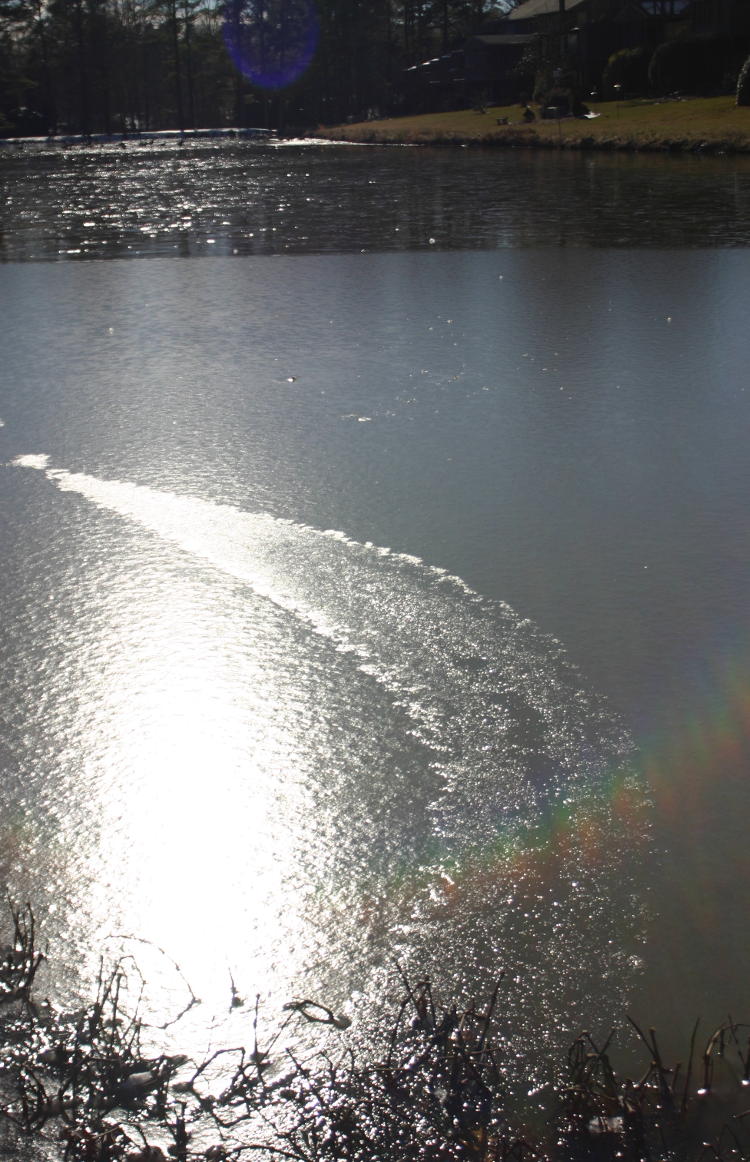
trail in ice of waterfowl takeoff
I’ve always liked this image, or to be more specific, the series of images that I have of this particular scene – I took several, because the sunlight and reflections were an integral part and I was trying for the best effect, so I have multiple angles. Just glancing at it without paying too much attention to the details, it would be easy to believe this was the wake of a boat on a lake, seen from a significant rise above the water, but a longer examination soon disproves that. This is solid ice, during one of several winter storms from the 2013/2014 winter season, but when it was created it wasn’t quite as solid. As the temperatures dropped and the water began turning to slush, some variety of waterfowl (I’m guessing a duck from the curve, since heavier geese usually go straight) performed a typical running takeoff from the water. What would normally have been a fast-disappearing wake instead retained its shape due to the slush, and soon froze completely over to preserve the action, as it were.

As we know from last year, the birds will still swim a bit as the water starts to coagulate, but at some point in time will abandon the water and stick to the land, so this occurred in that period before it solidified too far. Seen from other angles, the surface was fluid enough to smooth back down followed the bird’s passage and present a nice sheet, but the evidence remained in the different colors/densities within the ice – what I imagine to be a fairly narrow time frame. I considered it a neat little find.

As for the rainbow band in there, I’m not quite sure what caused that. I’m fairly certain it’s an artifact of shooting towards the sun, because of that blue ghost above it, but this kind of refraction isn’t common – I suspect it comes from getting just the right light angle on the edge of the lens. It’s a nice accent, though.

Well, that took far longer than it should’ve

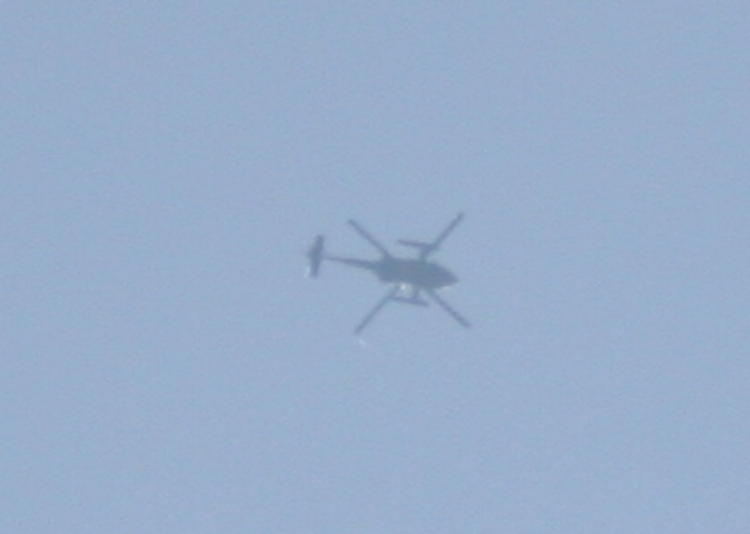
Every once in a while I run across a short series of images in my Miscellaneous folder that make me pause, or at least they did. I’ve mentioned at least once before that I’m a helicopter enthusiast, actually falling just shy of ‘fanatic’ – I can usually identify the common models in the area at a glance, and can even tell a few just by sound. So spotting this one passing way overhead a few years back, I fired off several frames for a closer examination when I got home. And that was where it all started.

unidentified helicopter passing overhead
Before I go any farther, I’d just like to point out that this is a tight crop, about half of full resolution, from the original frame, itself taken with the 80mm macro so representing a slight telephoto view, maybe about 2x magnification; by naked eye it was pretty small. This is the full frame.

same image uncropped
So it wasn’t until I unloaded the memory card at home that I got the best look at it, which started the mystery that lasted nearly five years. Because I did not recognize the model seen here. Moreover, trying to find it proved to be more than a little difficult. Most helicopter photos are from the side, profile, so some of the details that will be seen from underneath are not readily visible. What was throwing me off was the tailplane, which appears right at the very end of the tail boom (rare in itself) and those large appendages to either side of the body, which are not landing skids. The other details that I was trying to match up were the four-bladed main rotor and the very abrupt end to the main fuselage, with a narrow tail boom.

I’m embarrassed to think that it took this long, and any of the more knowledgeable helicopter people out there might be shaking their heads, but there was one particular detail that stuck in my mind, up until I got a closer look at the top-down view. Very few helicopters of any kind have large appendages like that out to the side, including a fully-armed military model – having something out that far is a weight-and-balance issue, so most times armaments are kept close to the fuselage. There’s one notable exception, and that’s the UH-60 ‘Blackhawk’ and its variants – long-range models may have sponsons with big external fuel tanks, but space inside the sponsons, between the tanks and fuselage, for arms as needed. I ruled this out quickly because the UH-60 has a very thick tail boom tapering back from the fuselage.

Australian Army Black Hawk Zhu-2.jpg
By Duan Zhu – http://www.airliners.net/photo/Australia—Army/Sikorsky-(Hawker-de/1839548/L/, CC BY 3.0, Link

And so I searched through countless images, occasionally having a moment of inspiration before another image search dashed it – the tailplane was too far forward or noticeably swept, the main rotor had five or more blades, and so on. Seriously, I tackled this at least three separate times, including tonight.

Until, suspicious, I did another search on the UH-60, which I’m pretty damn familiar with. And discovered that the thick, tapering tail boom was as seen from the side – from underneath, it was much, much narrower, as little as a third the size in horizontal cross-section as vertical. And in fact, there are those damn sponsons and tanks.

US Army UH-60 Black Hawk.jpg
By U.S. Navy photo by Chief Mass Communications Specialist Greg Bingaman – http://www.northcom.mil/Images/Images_2007/index.html, Public Domain, Link

The other thing that was getting me was mistaking the flare of the turbine exhaust treatments (heat suppressors, mostly) with the abrupt end of the fuselage, a blunt hindbody (a ha ha, “hind,” get it? Oh never mind) which usually spells a cargo door, such as the various medevac models used by the hospitals around here. In vertical silhouette like this, I was reminded of the BO-105, with some possibility of the BK-117 and EC-145 (all closely related,) but it wasn’t really the fuselage that I was looking at. Plus the tailplanes were either too far forward, too small, or swept a bit. And let me tell you, I looked at the MD-900 (no taper to tail boom and notable extension past tailplane,) and SA-330, AS-332, and AS-532 (all variants of same base model, with one-sided tailplane,) and so on and so on, immediately ruling out quite a few more from knowing that the number of rotor blades or the tail configuration were wrong. So it galls me a bit that I recognized certain details right off the damn bat but made a mistake over how the tail boom appeared.

Worse, I have an unbuilt model kit of that very helicopter sitting on a shelf just a few meters away – had I gotten around to building it, I might have had enough familiarity with that body shape. Ah well.

Odd memories, part 21

This one still kinda startles me a little, but at the same time, it’s strangely vindicating.

Back in the early nineties, I had been working for a humane society for a couple of years at the most, and had gotten involved in wildlife rehabilitation and advice (as I’ve mentioned before, several times.) Back then I was quasi-knowledgeable about wildlife, but most of it really came from the people I worked with and the networking that I was doing – it was simply the nature of the job. And one aspect, that I kind of fell into (because I’d expressed a mild interest and no one else was doing it,) was getting involved in what we called the Beaver Project.

Yeah yeah, snicker all you want, get it out of your system. Where I lived and at that moment in time, there was a fair amount of activity from North American beavers (Castor canadensis.) My first encounter, which might have even occurred before I began working for the humane society, came one afternoon as I was walking along the banks of the creek that ran behind the apartment complex. Hearing some soft noises in the tall grasses, I crept stealthily closer, and happened upon simply the largest beaver I have seen in my life, easily three times the size of what most people imagine them to be (I was later to find out that they can continue to grow all of their lives, so this was likely an elderly specimen.) Memory is, of course, a volatile and untrustworthy thing, but I would estimate its weight at better than 18 kg (40 lbs) and overall length better than a meter (don’t even make me translate that for you.) Its head looked almost as big around as mine, and there I was, perhaps four meters from it. It soon became aware of my presence, which provoked the abrupt and alarming momentary pause in its mastication of some vegetable matter, ensuring that I wasn’t about to scold it or anything, before it resumed its meal without twitching from the spot. Eventually, as I watched, it turned casually and ambled down into the water, clearly not at all impressed with my hulking presence (which at that time scarcely massed three times its own.) I was to later learn that beavers, overall, are pretty damn mellow unless provoked, which is usually accomplished by dogs. People they generally don’t give a damn about.

Anyway, in the humane society, the purpose of the project was to inform people about how to help prevent beaver damage to their trees, try to alleviate flooding by beaver dams, and deal with a lot of public ire and misinformation. This was my first experience with the angry homeowner and the bandwagon effect – once an article ran in the paper, there would be countless “me toos” that escalated in scale until it was a positive epidemic, and of course it all came down to the humane society to do something about it because it was obviously our fault that the dam things existed here in the first place. Now, there was no epidemic, and for the most part only passing activity in a few select areas, and I know this because I’d been out to examine numerous reports and complaints. Mostly, it was people that had lost an expensive exotic sapling that they’d had planted while purchasing property on the edge of a lake or waterway – again, this must have been our fault. I have very little patience for such idiocy, really; if you want a natural vista or landscape or whatever, it comes with animals, because that’s where they fucking live. You can eliminate this entirely by living in a seventh-floor walkup in NYC if it bothers you that badly.

Before I oversell this injustice, let me clarify by saying that a lot of it was our doing – specifically, advocating for humane control methods and not trapping. A little background is in order. North Carolina is still largely backwater (No! Really?) and hunting and trapping gets a lot more attention than humane management or even just ignoring the critters in the state; the NC Wildlife Resource Commission was started entirely to maintain game lands and still keeps this as a primary focus, only reluctantly embracing the idea that maybe not everyone wanted to shoot something. And there was a peculiar law on the books: while beavers could be snare-trapped (usually by a barbaric little Spanish Inquisition castoff,) they could not be relocated, so even if you live-captured them in a humane trap, you weren’t allowed to release them again somewhere else, even onto parks or reserves or game land. The idea, so I was told, was that you were simply relocating the problem. Which is true enough, except for the bare fact that it if wasn’t homeowners’ land it wasn’t a problem anymore. But yeah.

At some point in there, we were contacted by a homeowner in Norfolk, Virginia, a few hours away by car. It seems that the same thing was happening there: an expensive plot of land newly-given over to housing, on the edge of a Norfolk River tributary, was seeing beaver damage and many of the homeowners were up in arms, demanding that the city do something about it. It became quite contentious, with advocates on both sides going at it hammer-and-tongs, and finally the city council decided to hold a hearing where everyone could present their case and they would make a decision. The reason we were contacted? We had an active humane program regarding beavers, and so they wanted someone from our organization to come speak at the hearing.

Now, let me paint the picture. I had been providing advice over the phone, and had helped with a couple of our public programs, which meant a total of 30 attendees or so. That, and a couple of school plays, rounded out my public speaking experience. But I imagined it was a relatively routine thing and, since there was presently no one else in the program that was available or experienced enough, our director encouraged me to go. The humane society had a vehicle that I could use, the homeowner who contacted us would put me up for the night, and so, when the time came, off I went.

There had been no time to plan much, and I intended to get as much information from my host as I could so I could address things directly. Meanwhile, I found out that the little meeting I had imagined was nowhere near accurate: there would be perhaps a few hundred people in a large auditorium, and the major TV news crews would be present. We would have five minutes to speak, no questions or back-and-forth, from a podium standing in front of the raised dais where the twelve council members sat. If you’re picturing this medieval judgment tribunal situation thing, I can say there were no robes and the scene wasn’t lit by guttering torches, but otherwise that’s accurate. Nothing like getting thrown into the deep end. I had, at my host’s urging, brought along a dress jacket at least, something suitable to be buried within.

Did I mention that I did not, in fact, have my speech written out? I had a lot of notes and odd-and-ends, and my own basic experience on hand, but nothing was rehearsed and I had no idea how long my scribbled notes would actually run when spoken. I was lucky enough, however, to be the second-to-last to speak, which allowed me to hear all of the cases being made before me, and so I was in the enviable position of being able to rebut these directly, and I actually wrote the entire speech up to a few minutes before I was to go on. When called upon, I stepped smartly to the podium, activating (so I thought) the microcassette recorder in my pocket to save my stuttering and rambling for all eternity.

And… it went without a hitch. For anyone that has actually listened to my podcasts, this is probably impossible to believe, but it’s true nonetheless. I might have stumbled over a word or two, but considerably less than some of the speakers, and nothing untoward or even memorable. I was still young and hardly an imposing specimen of any kind, much less what you’d expect from “an expert,” but it went amazingly well. I finished with about fifteen seconds to spare in my five-minute allotment, and regained my seat over a hearty thumbs-up from my host.

The last speaker was someone from a nationwide animal advocacy group based in DC (no, not PETA, or even in the same ludicrous ballpark – PETA really is a bunch of dipshits); someone with a hell of a lot more experience in the matters than I had, and well-used to public speaking. After we all finished, the council adjourned for a brief deliberation, while some of the speakers (including my host, but thankfully not including me – I have a face for radio) provided interviews for the TV crews. Not too long afterward, a couple of the council members approached the last speaker and I and asked if we’d be available to attend a small private meeting the following morning. We weren’t in a position to say no, really, after the effort we’d done to be there that night in the first place, so we agreed. I made the stupid mistake of confirming that I did have a place to stay, which meant I spent the night in my host’s spare bedroom rather than in a lovely downtown Norfolk hotel. Idiot.

The meeting the next morning was basically to reassure the council that trapping was pointless, and not something that the city needed to be spending its money on (especially since that trappers would have been charging $50 a head, and there was no assurance that this would actually accomplish anything nor that it would not be an ongoing expense – if you have a habitat, animals will use it, and the possibility of beaver populations perpetually coming down from further up the tributary was distinct enough.) The council elected to leave the matter up to the individual homeowners as, “what to expect when you live on the waterfront.” I have to say, it felt pretty damn vindicating.

After that, the guy from the nationwide organization and I had breakfast together, comparing notes and experiences, and he admitted that he was faintly chagrined to have to follow me, because I said virtually everything that he’d had planned. Which was great to hear, you betcha, but not terribly surprising; the information remains the same, and I pointed out that hearing two disparate sources reiterating the same info may likely have cemented the council’s decision, since most of the other speakers varied wildly on both expectations and the heinous damage that they claimed was being done. But overall, I still look back on this episode with a little disbelief – there were plenty of ways how, and plenty of reasons why, my speech could have gone awry, and it was by far the most public thing that I’ve done, even today. And yet, it helped with matters since, because I knew that I handled that well enough and so taking control of a wedding party or jumping onstage during a technical glitch stirred nothing in me more than a momentary nervousness.

By the way, somehow I never did trigger the cassette recorder when I thought I did, so I didn’t have any record of how it went other than my scribbled notes. Ah well.

Now, since I’m on the subject, I have to add part two.

Sometime after that, we’d received several complaints about flooding and so on along another creek in the area, one that we knew had the occasional mid-size beaver dam on it, because that was one of the projects I’d worked on; there are numerous methods of trying to ensure that beavers do not stop up too much of the water flow, all of them labor-intensive and none of them particularly effective – beavers detect water flow and try to stop it, because deep water is protection and access to their food plants. Wanting to determine the extent of the damming and the actual population of the rodents, we figured the best bet was to check out as much of the creek as possible, and this meant kayaking it. I’d done more than a passing amount of kayaking on our homebuilt models while back in NY, but did not possess one here, and so had to rent a whitewater performance kayak from the neighboring town. This craft was a far cry from what I was used to, which was a multi-person open-topped model where you could carry a small amount of cargo; instead, this was a seed-shaped needle of a craft with one of those skirts that you wrap around your waist and snap over the lip of the single-opening itself, to keep water out. This was the kind that you can eskimo-roll, a term that still exists even while “Eskimo” is being considered racist. Anyway, I had no idea how to, um, “E-word-roll” a kayak and wasn’t about to try it.

I want you to bear in mind that this was in February, so the water was still quite cold and not something that you wanted to splash about in. I endeavored to get into the kayak without setting foot in the water, finding in the process that these sport models are very laterally unstable, and also that the foot pegs pushed me up onto the seat back. This isn’t as egregious as it sounds, because the seat back rose all of six centimeters, I believe, but it was still uncomfortable. I pushed away from shore into the middle of the creek and started to turn.

Really unstable. Almost immediately the kayak decided on its own that we should E-word-roll, and turned turtle in a flash. I was in about a meter of water, not really the depth that you would make the attempt even if you were so inclined, and all I pictured was getting upside down without any knowledge of how to right myself and getting trapped within the kayak. Before I got fully horizontal on my way over, I’d slammed one paddle tip into the bottom, in an attempt to halt my inversion, and kicked madly out of the kayak and skirt. While this was happening I know I was uttering some desperate, unmanly, and extremely unintelligible sounds, even worse than when someone fishes their phone out of the toilet. It was over in seconds of course, and the water wasn’t remotely deep enough to pose a hazard even if I couldn’t swim (which I could,) but now I was soaked to the skin in 5°c weather.

Annnnddd that was it, wasn’t it? I’d have to go home and change, and still wasn’t sure how to handle this unstable piece of shit, and should probably just give it up and settle for hiking the creek edges as far as I could, some other day. As I mentally planned all of this, I got pissed off, and noticed that the wet clothes weren’t bothering me as much as I thought they would (though soaked, it was still a winter jacket, and of course a good mad-on does wonders for body temperature.) And at some point, while thinking about throwing the kayak back on top of the car, I noticed that the foot pegs were adjustable and set for someone about a meter shorter than I was. Eventually, I decided to give it another go.

Let me tell you, in those itty-bitty performance kayaks, center of gravity is important, and readjusting the pegs so I could sit in the seat improved the stability quite a bit – it was still quite tippy if I leaned at all, but manageable with just a little presence of mind. And so, I completed my mission, or what I could of it anyway, which was enough to answer all of the questions that I had. Because the dams that I encountered were feeble little things that didn’t raise the water level 30cm, while the water was perpetually stained orange from the ubiquitous Carolina clay, indicative of extensive runoff from areas where all the topsoil had been removed – the flooding wasn’t coming from the beaver activity, but from improper stormwater management from the nearby road construction efforts. Far too much of my journey was spent out of the kayak anyway, dragging it over snags and shallow areas because the creek wasn’t capable of supporting a single kayak’s passage, much less flooding out someone’s property, and a rise of a couple of handspans would have completely swamped the minimal beaver dams that I did encounter – the population couldn’t have been more than a dozen or so in a kilometer stretch. Certainly not an epidemic.

And the following year, I had the bandwagon effect confirmed, because then the papers had moved on to other topics and, while the beaver populations appeared unchanged from the year before, we received about 10% of the calls that we had previously. People are weird.

Some winter progress

Okay, here’s the backstory. For some time now, I’ve been thinking of noodling around with photomicrography – photography through a microscope, you know, serious macro work. This requires having a microscope – surprise surprise – and I’ve been watching for one for years, since I wasn’t going to drop the serious money for a new one for something that I might not get into all that much. The local college surplus store had a few at one point several years ago, right at the edge of my price range, and I dithered and lost out, since they all went within two days. Since then, I never saw a decent microscope for sale anywhere.

Then not quite a year ago, I happened across one in a thrift store, complete except for the lighting unit, a serious four-objective binocular lab scope from Bausch & Lomb, which means price range new would be in the $500-$1000 range. Price on this unit? Eleven bucks. I actually went to check out with some trepidation, thinking they were gonna catch their mistake or even accuse me of switching price tags, but I walked out the door at that price. I can live with that.

Replacement light sources get expensive too, and I wasn’t finding a match anywhere, but we’re at this really cool point in tech now, and I simply fitted an LED light source. First unit burnt out within five minutes during the initial experiments, telling me that a heat sink is necessary immediately, but it was too bright anyway. Second unit was meticulously constructed to fit into the microscope housing with a generous heat sink, even feeding into the metal body of the scope – snazzy little job if I say so myself.

Finally, the other night I fired it up and started playing, finding that it was working just ducky. Then I couldn’t find the camera adapter that I’d purchased some time back. Located it the next morning, and later on tried again. I’m clearly going to need some slide cover slips and perhaps a top light source as well (the only one right now is the standard bottom light,) but you might start seeing more stuff like this (only better):


These came from a couple of different sessions as I experimented, just noodling around right at the moment, but proof of concept and all that rot. I also have to do a meticulous cleaning of the lenses all through. At some point, I’m going to figure out how to get a measuring scale in there – I imagine that they can be purchased someplace, and that they’re not cheap.

The other thing that appears in the middle clip is, I believe, a molted exoskeleton from another unidentified arthropod, found floating on the water sample – I included it as another subject to practice on, but did not explain this in the audio. All of these are from water drops merely resting on a slide, no cover slips or preparations or anything.

By the way, you can compare this with my results from using a bellows unit in place of a standard lens, several years back – daphnia come in a variety of sizes so I cannot say these are a direct comparison.

What prompted all of this was searching for something to photograph during the lean months, and doing a little poking around in the backyard pond. I turned up an egg case of some kind on the underside of a floating leaf, suspecting that they were snail eggs but honestly not sure. The remaining photos are all more-or-less ‘routine’ macro, taken with the reversed Sigma 28-105.

unidentified aquatic eggs from underside of leaf
The entire blob was about 10mm in length, so you can figure out from there how small the eggs were. I include a detail inset from the same frame so you can see those eggs as well as we’re able right now (save for attempting to slice open the blob and get an individual egg on a slide, which i considered more likely to fail than succeed, but I also thought about getting some hatching sequences and so wanted to leave the blob undisturbed.)

unidentified eggs in detail
There! That’s certainly… multicellular. If you can identify the species from those misshapen blobs, let me know – I think someone scrambled those eggs in the shell, myself.

After taking these, I returned the leaf to a small bucket where I could monitor things, but was unable to check back as routinely as I would have liked, and it appears they all hatched out in the interim. I still suspect snails, given how many are in the pond itself, but haven’t ruled out other things like that wormlike something that appeared first in the video.

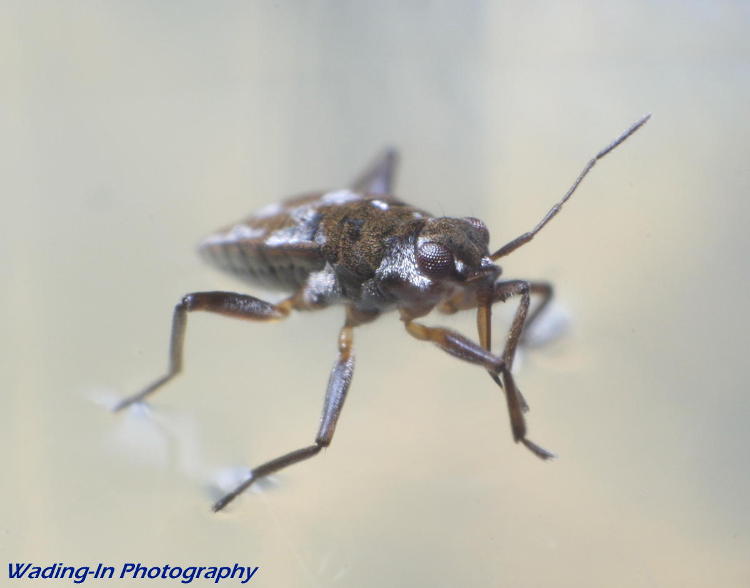
One of the water samples that I gathered had a ride-along, a small insect that perched nonchalantly on the water surface and made no attempt to leave the 20ml sample jar that I was using, so I did a few shots of that one while it was being so cooperative.

smaller water strider genus Microvelia cleaning proboscis
I had no idea how to start looking for identification images, knowing this was not a truly aquatic bug, just one that was at home on the surface, so I uploaded the images to BugGuide.net, always a useful resource. But as I did so, I was looking at the anatomy again and realized it was like a short, squater version of a common water strider. In moments, I’d confirmed that this was indeed what it was, though not an immature nymph as I’d suspected from the lack of wings or elytra. The subsequent reply from BugGuide’s volunteers reinforced this discovery: it’s from the genus Microvelia. In this image it is cleaning its proboscis – striders are predatory hemipterans.

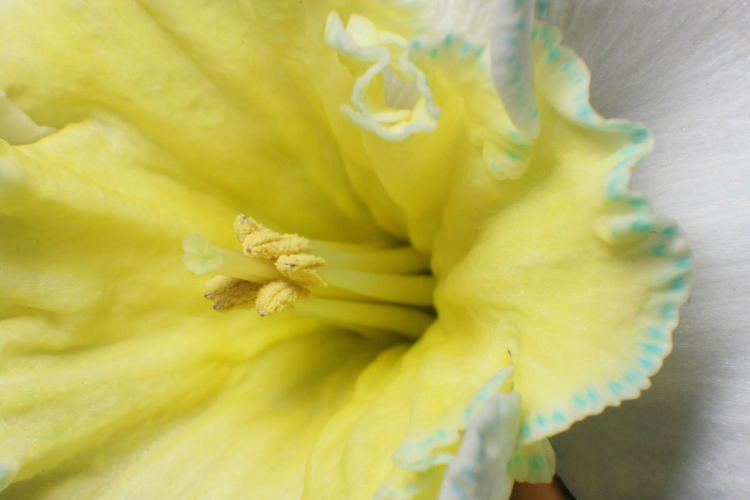
The very first things to appear, usually well before winter has gasped its last, are of course the daffodils, and there are only so many ways you can photograph them, but then again, what else is there? So when The Girlfriend had cut a few to put in a vase, I borrowed them one night to at least keep my hand in with the macro rig – I was beginning to think I’d forget what I was doing.

center of daffodil blossom
No no, of course that’s not where I stopped. Please.

stigma and anthers of daffodil
Nothing like a straight-up-the-middle shot, eh? That stigma all moist and receptive, surrounded by eager ‘one-eyed’ anthers crowding around. I’ll let you pick your own appropriate soundtrack music…

I remembered something from my childhood, one of those elementary school experiments that are supposed to show – something, who knows what – but mostly just look cool. One of those things that you read or hear about, but never actually try, you know? So, given that I’m in my mid-fifties now, I figured it was time to get to this long-neglected task, and cut a new flower to put in its own vase on my desk, adding a few drops of food coloring to its water.

The idea is that the flower draws up the water for a few days and the food coloring stains its petals, creating unnatural hues in the blossoms (it supposedly also works with celery.) My plan was to get it fairly unique in color and then sneak it into The Girlfriend’s own vase and see how long it took her to notice. But perhaps daffodils are the wrong choice for this, because while some coloration did indeed occur, it was to a very limited extent before the flower dried up, too subtle to be of any real use. Ah well.

daffodil fed by colored water
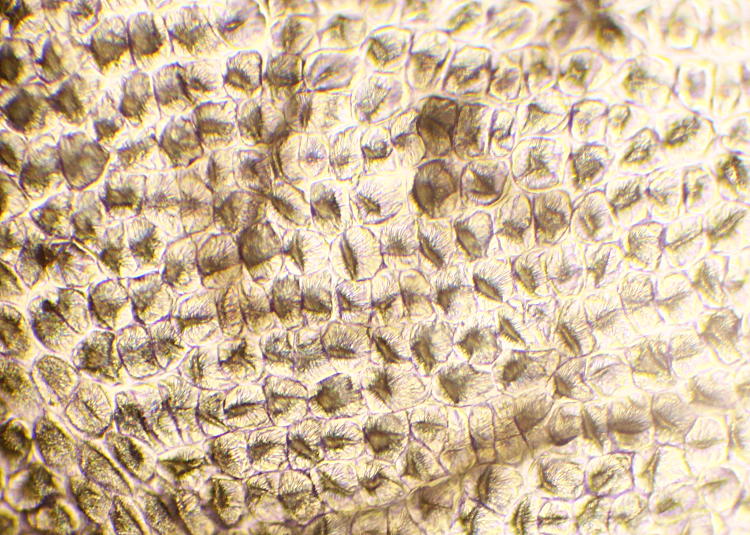
Given those, you should now know what the end of the month abstract image was; as the flower started to dry out, I took a section of a petal to pop under the microscope, naturally picking a portion that was showing the color. And it might be showing some evidence of this, if you look closely at the image at that link – there are faint hints of cyan here and there, but that could also just be refraction of the light too. Still, I’m just getting started, so we’ll see what kind of funky stuff I can dig up later on.

Storytime 9

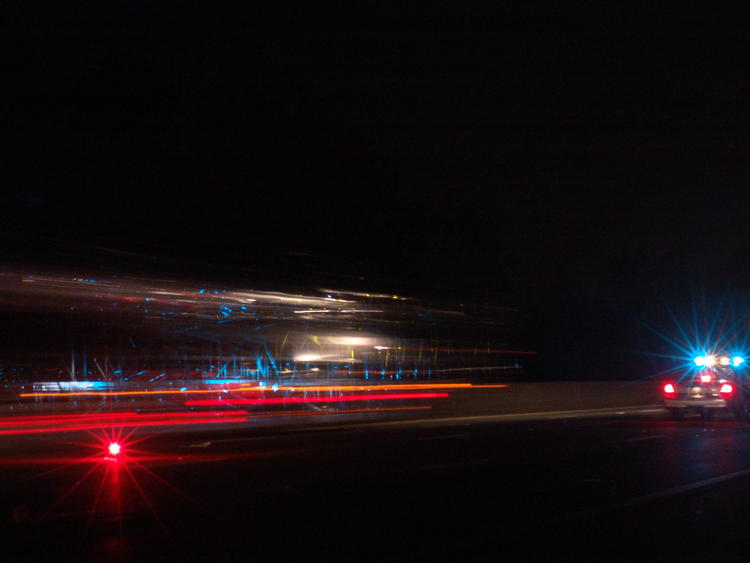
stupid driver
Some 14 years back while house-sitting for some friends who lived near the interstate, I went out for a walk one evening and noticed, off in the distance, a collection of flashing lights from emergency vehicles. At this point I was still largely shooting film, but my friend had left behind his Sony F-828, an upgrade from the F-717 that I’d used for a while in Florida, so I gathered that up with a tripod and hiked down towards the lights to see what was happening, with the thought that maybe I’d get something I’d long been after, which was a time-exposure with passing emergency vehicles in the frame.

Long story short: the accident looked minor, with not even an ambulance visible and just one disabled vehicle (looked like a spin-out, which people tend to forget is extremely easy to accomplish at highway speeds.) However, to allow access from both fire and wrecker vehicles, one lane of the interstate had been closed off with flares. The visibility of this extended for perhaps a thousand meters – I’d been that far away when I first spotted it, I believe.

I set the tripod up on the shoulder well away from the emergency vehicles themselves, but still within the region of lane closure and away from the road surface, so I was clearly not in anyone’s way, nor at risk myself. Well, much risk.

I was reminded how stupid people can be when, almost right alongside me, I heard a desperate squeal of brakes and locked tires and looked up to see a pickup truck fishtail to a halt within the closed lane. Either the idiot had approached the traffic ahead of him at way too high a speed, or had figured he’d duck into the ’empty’ lane to go around all those slowpokes. While he wasn’t too close to rear-ending a police cruiser, he also wasn’t far enough from it (again, highway speeds,) and somehow did not register the road flares that, really, couldn’t be missed unless you were unfathomably stupid. I quickly spun the camera around on the tripod and fired off a shot, so that’s what you see in the frame up there: the pickup is still rocking, with one of the road flares visible just beyond its rear tire, while a rig passes by in the correct lane. The blue ripples are reflections from the side of the trailer of the police cruiser not far out of the frame, strobes active (as they had been for the previous twenty minutes at least.) In fact, you can see a faint haze above the trailer itself, at the right end of the streak from the running lights, which may very well be the smoke from the idiot’s burned tires – I know I could both see it and smell it when I was there.

How close did he come? Well, here’s another shot that was a tad wider (shorter focal length) from the same position:

time exposure of car carrier passing police cruiser at night
There’s the flare, and the police cruiser that was outside the previous frame. The other thing you’re seeing is a car carrier rig, illuminated by the blinking lights as it passed – cool effect. The flare looks closer or brighter than in the first photo, but I think that’s only because it wasn’t partially blocked by the idiot’s tire here – both exposures were only one second long.

A quick note about how hard it is to express field of view and focal length. Back in the day, as they say, it used to be relatively easy; with 35mm film cameras, each 50mm of focal length was about 1x magnification, so a 50mm lens was ‘normal,’ about what you’d see in person, while 100mm was 2x and so on. Everyone knew a 28mm lens produced a nice wide-angle shot. Then came digital, with much smaller sensors and commensurately shorter focal lengths, so this rule disappeared, and no guideline could be used among the different cameras. Eventually, the “35mm equivalent” started being used, and the Sony F-828 actually had such markings on the barrel of the zoom lens. Except, what’s saved in the EXIF info of the file isn’t the equivalent, it’s the actual focal length, so as I see that the top photo was shot at 37.7mm focal length and the middle one at 26.2mm, some translation is in order. It took a little research and a couple of quick calculations, but the equivalent is, top to bottom, roughly 100mm and 150mm – both short telephoto, meaning I was farther away than the photos make it appear, but not hugely.

I’ll close with one more, which only vaguely fulfilled my goals for that evening. As the wrecker pulled away with the accident vehicle (the original one,) I was prepared, up on the slope and dragging the shutter as it pulled into the lane. Interesting, but not quite what I was after – which I have yet to accomplish, but seriously, it’s not like I go out and try several times a year.

time-exposure of wrecker leaving with accident vehicle

February has left the building

I'm not telling you
Well, not yet it hasn’t, but within a day it will – it is, naturally, the end of the month abstract. Once more, I’m not revealing what this is (though someone will likely know,) and all I’m going to say instead is that it is topical, very current, and a hint of things to come.

Oh, yeah, and this image has undergone a little sharpening, because it needed it. I’m in largely uncharted territory here (for me at least.)

Always the best for the readers

Except, in this case, it would be viewers. Yes, that means a video is coming up, but wait! Hold your horses, it’s not one of my videos, so you don’t have to leave. In the interests of providing to you nothing but the best factual sources, carefully examined for useful and accurate information, I happily sponsor the latest offering from Ze Frank or zefrank or whatever (who I’m beginning to suspect is not actually French) – in this case, True Facts: The Lemur:


The Duke Lemur Center mentioned within has appeared here before, or at least a tiny portion of one of their fences as well as an even tinier portion of one of their residents, and sits only a handful of kilometers from Walkabout Studios (I love saying that – rather overblown description of my crowded desk in a shared home office, but hey…) I imagine that their tour requests have multiplied significantly since this video posted, which is a shame, because that was one of the things on my list of spring possibilities and now it might be hard to get to. Thanks, Ze Frank!

Either way, I’ll do a vaguely-related post soon, since I already have most of it planned and about half of the photos edited. Starting to get a little posting momentum going here, so be patient.

Meanwhile, you can always adopt a lemur, but I do have to warn you, this is misleading: you don’t actually get to take the lemur home, and you sure as hell aren’t allowed to use it for dance or singing lessons or teach it anti-vaccination horseshit. Yet your donation supports the research done at the Center and their outside efforts, which is pretty cool all the same, so have at it – there are other options available too. I don’t care that you’re a freaking Heels fan, do it anyway.

ring-tailed lemur Lemur catta portraitOf course, I have to close with my favorite lemur photo (among those taken by me, anyway,) which also appeared in the recent exhibit. This did not come from the Duke Lemur Center, but from nearby Museum of Life & Science – probably directly-related anyway due to their proximity. I think the ring-tailed lemurs get far too much attention, given how many species there are, but this was what presented the best opportunity so far. We’ll see if I can rectify that soon.
By the way, if you’re embedding YouTube videos, you can remove little bits from the URL like, you know, “autoplay;” and have mercy on everyone. Little tip from your Uncle Al. No, this doesn’t mean that I just adopted you – relax.

Storytime 8

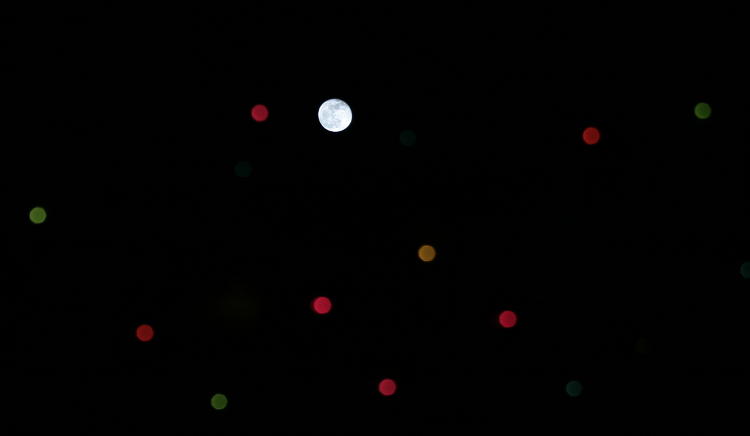
moon alongside defocused christmas lights
First off, I’m going to refer you to this post just for trivia’s sake, because the image above was shot the same night. While I wrote that I wasn’t shooting the full moon, that wasn’t actually true – I was just illustrating shooting by the full moon for that post.

But before that happened, I fired off a few shots at home, aiming up alongside the holiday lights still strung along the rail of my second-story balcony. I suspect I wasn’t bothering with the tripod at that point, because this image shows the hallmark of shooting with a wide-open aperture: all of those defocused lights are round in shape. If the f-stop was smaller, they’d be in the shape of the aperture itself, and I have a few examples of those. With a very small aperture, you can render bright points of light as starbursts, but only if they’re in focus, and even with the increased depth-of-field, I wasn’t getting the moon and my balcony rail (only a few meters away) in the same focus. I had the choice of going with starbursts and an unfocused moon, or a sharp moon and round unfocused lights, so here we are.

Given that this was taken nine years ago, I had to rely on memory, and was pretty confident that the lights had been wrapped around the top rail – which meant that the moon appearing almost between some of the lights indicated that it was just above the rail itself (perspective-wise, anyway – again, going from memory, but I’m also pretty confident the moon remained 385,000 km away, and this is supported by its size in the frame.) Curious, I threw the Curves way off the scale in GIMP with the hopes of rendering ever-so-faint evidence of the railing in the image. Result: no evidence – just not enough light captured during the exposure.

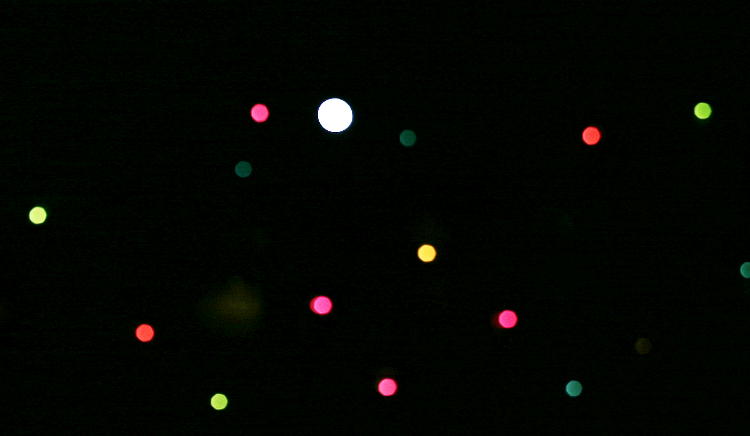
What I did bring up, however, were a few more lights (and some unexplained blotches, very faint evidence of some kind of reflected light or cloud.)

same image with light levels boosted signficantly
I took it a lot farther than this just to see what appeared, but backed it off because this was sufficient to illustrate the missing lights. It seems the blue bulbs (and I’ve seen this before) are a lot lower in light output than the others and thus don’t expose as brightly. Which is curious, because they’re all the same kind of filament and wattage, so the difference remains in the glass tint. I have a vague suspicion some of the output borders on the near-ultraviolet and gets filtered out by the camera and lens coatings, but that’s just idle speculation, and something that I have no way of testing. Well, okay, no easy way of testing – I suppose I could rig up several strands of nothing but blue bulbs, here in the office where I park my ass all winter, and see if I get a tan…

Tell me what you’re doing about it

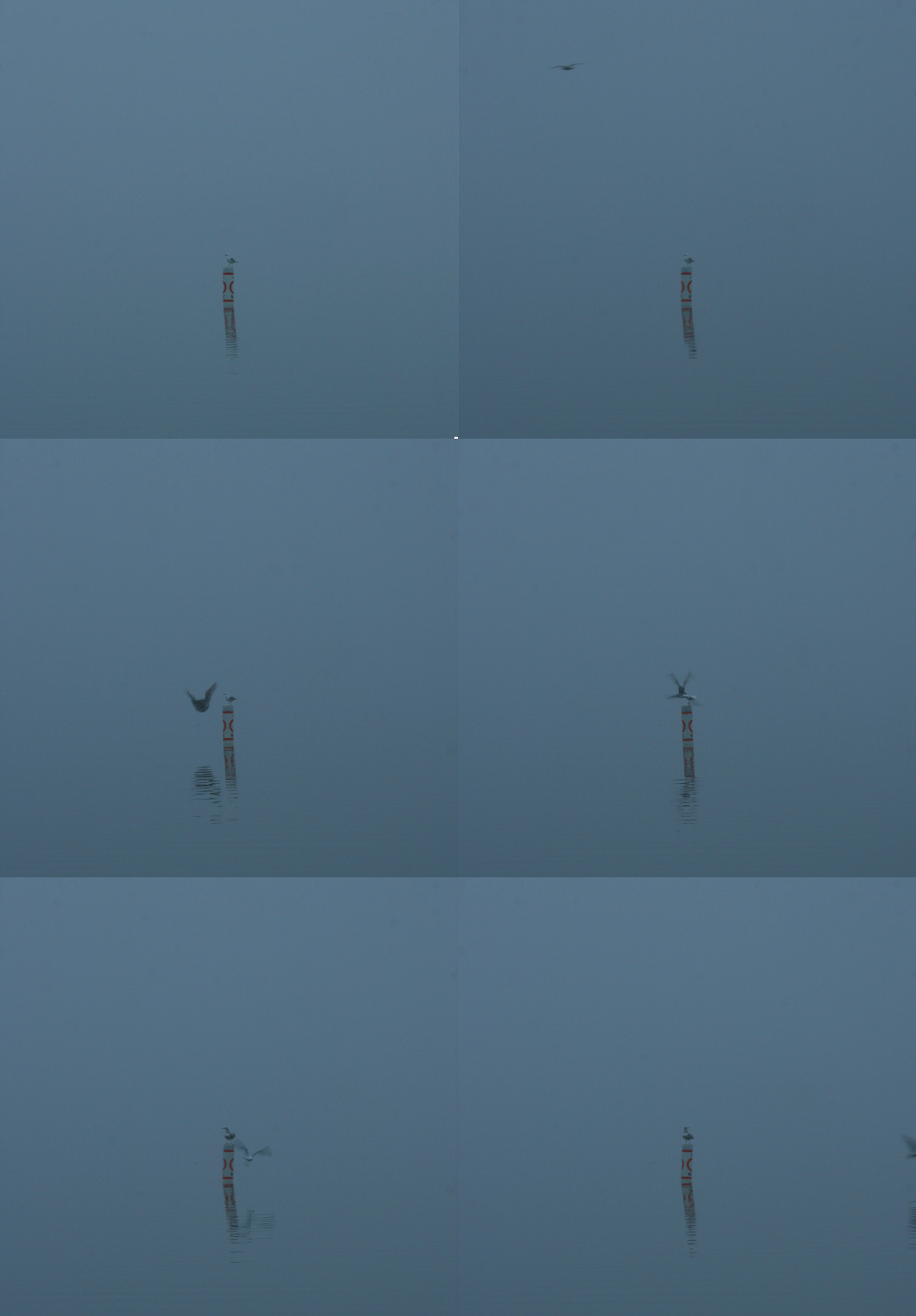
Today, February 21st, is Get Around To Doing Something Because It’s Been A Year And There’s Nothing To Shoot Anyway Day and so, prompted by this, I put together this little animated gif (pronounced “gyl-EN-haylll”) of fifteen frames that I shot a year ago. As you undoubtedly recall, that day opened quite foggy and I went down to the lake to take advantage of it. In the middle distance out there sat a depth marker in the water, serving as a perch for a seagull because of course – before humans came along to put lots of poles and buoys in the water, seagulls were stronger since they had to fly farther between perches, so that’s even more blame we can shoulder. I had the longer lens on to do esoteric abstract compositions, and as I was shooting, another gull came in and usurped this primo spot and I simply fired off a sequence. I kept looking at them and thinking I should do an animation, but knew that would be a little time-consuming, between ensuring that the frames lined up reasonably well and touching out all the dust on the sensor because it becomes really damn noticeable in plain grey situations.

[My shooting habits are largely responsible for this dust, because most of my lens changes take place out in the field in less that optimal conditions, plus my main body doesn’t have one of those ultrasonic dust-clearing functions. I need to clean the sensors more often, but it’s slightly tricky and stands a distinct possibility of damaging the sensor if I’m not careful, so I tend to put it off more often than I should.]

But enough stalling.

animated sequence of gulls disputing perch
If you look close, you can see the perched gull following the intruder – I could have shown this in better detail but it would have made the image that much bigger, and with the fog and shutter speed and distance it wouldn’t have added much anyway. Personally, I have my doubts that the second gull even needed a perch, and only wanted to demonstrate its dominance (read: assholiness) to that insolent, lazy gull on the marker.

You may have noticed the distinct color cast, significantly different from the photos shown last year, and that’s because I was shooting these in Sunlight white balance, essentially no correction – the light really was that blue, I just tweaked the others for an effect that looked more normal to us (because our eyes and/or brains automatically compensate for color casts, at least to a degree.) The weather conditions right now are vaguely threatening more fog, but they’re also threatening a thunderstorm, so if the next post doesn’t contain lightning photos, it either didn’t happen, or the conditions didn’t permit being out there doing time exposures, or I was too tired and slept through it.

[Such excuses could really apply to everything here, couldn’t they? “I was going to go out and shoot some photos of California condors, but the weather never got nice enough, and they don’t live around here, and I don’t know how to use a camera anyway.” It’s like deflecting all the blame away. I should try this more often.]

Enough about me. Tell us in the comments what you’re doing for the holiday!

1 174 175 176 177 178 329