




I’m sorry, I’ve been doing a string of religious posts recently, and it’s because every time I turn around something else stirs some thoughts that I want to pass along. I’m trying to space them out with items of other interest, but because I know not everyone here necessarily wants to see me pick on religion all the time, I will break the post up between the teaser and the meat. Below, I’m going to approach the question of, basically, “Isn’t trusting science a form of faith?”
Yeah, that’s about right
Scenes From A Multiverse shows how parallelism works:

Of course, the deity in an alternate universe like Aetherea IV might actually have a history of answering prayer, in which case such advice might be worth something. But in this one, even if anyone really believes in their deity, are they fulfilling their requirements for good works by chanting? I’m just wondering.
Yeah, I’m sure the whole mind-meld-with-the-maker thing is real convincing, but no one can argue that money (and hard work if there’s the opportunity) are effective, can they?
Ask me, and tell me
Two quick notes here. The first: I added a new standing page at top, “Ask An Atheist,” dedicated to fielding any questions anyone wants to throw specifically at an atheist. Credit to Hemant Mehta at Friendly Atheist for the idea. I’m game to just about anything – fire away!
Second, I noticed that my spam filter had improperly tagged a comment, and I’m not sure how often this happens. This site still gets plenty of spam, so I’ve been leaving the task to a common program, but it’s as dumb as most programs are. I only exclude spam or obvious trolls – I don’t censor comments, and feel that open exchange is very important. If your comment doesn’t appear within a day, let me know. If it was intentional, I’ll explain why – chances are it wasn’t. I honestly don’t like the idea that someone may be commenting, regardless of agreement or lack thereof, and not showing up.
Get familiar with it!

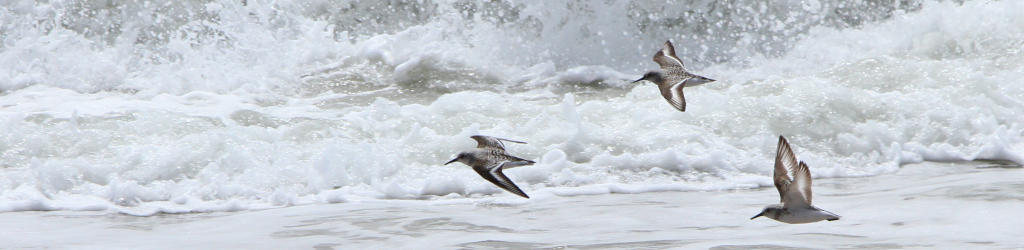
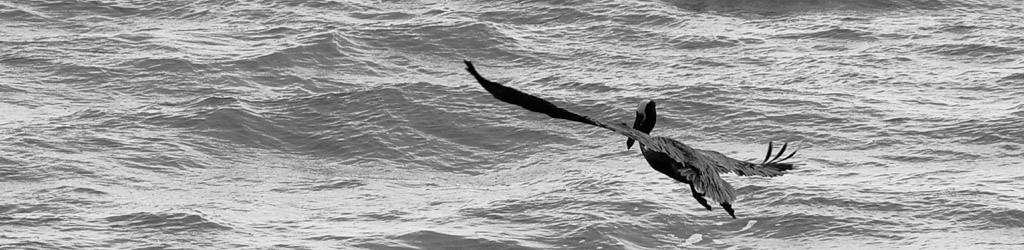
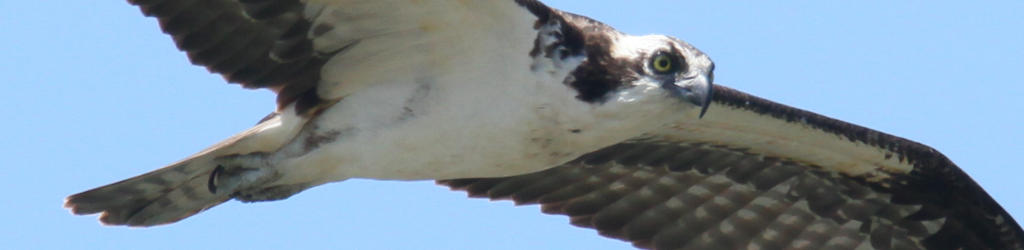
While I mentioned this before, people might still be surprised to know how often I turn the autofocus off when shooting pics. There are a couple of reasons for that. Mostly, it’s when I’m trying something like catching birds in midair, where they represent too small a target for the autofocus area within the camera to obtain enough contrast, so the focus winds the entire length of its travel and back again, throwing everything in the viewfinder so far out of focus that following a moving bird becomes impossible, and when it finally returns to a point that’s close enough to try and re-center the bird, the bird is nowhere to be seen. I can certainly miss the mark with manual focus, especially when (like my subjects above) the birds are changing altitude constantly and thus require perpetual corrections. But it still remains better than losing them entirely.
Then there’s the fact that autofocus is not always precise, and may be missing the subject I’m really after or simply not locking in tight enough. Autofocus works on contrast within the selected focus point, and requires a certain amount of light. Without enough light or adequate contrast, it can be balky or simply wrong.
The point is, know what your camera can do, and when it is unlikely to produce the results you want with automatic settings. I mentioned overriding the exposure settings and the color balance in previous posts, and to do these when your subject presents itself, you need to be familiar with just how to do it – preferably, by feel without even taking your eye away from the viewfinder. Digging out your manual simply means you’re not going to get the shot, so by all means, sit down with it ahead of time and go through it. It might seem tedious, but once you use some setting to your advantage, you’ll get the value of it immediately.
 Another good habit is to check your settings routinely. Most especially when you turn the camera on, but also periodically when shooting. It’s very easy to change a setting accidentally, or on purpose and forget that you’ve done so. The time to find out is not after you’ve uploaded a busy photo session to your computer. Check mode switch, ISO, exposure settings, color settings, contrast settings – whatever you actually mess with. And one I was reminded of today: the diopter correction on the viewfinder, if you have one. This is often a little dial or slide switch right alongside the viewfinder window, which changes the focus distance in the viewfinder for your eyesight. Manual focus is really hard when the viewfinder isn’t showing you the clearest image.
Can you instantly shut off the autofocus and find the manual focus ring on your lens? If not, learn how now. When the subject is too crowded or too low in contrast for the autofocus to snag, or the light too low to produce decent results, or the teleconverter or extension tube reduces the light so that the autofocus doesn’t receive enough to work, you need to take over, and quickly, while your subject and composition are as you want them. It should be second-nature to you if you’re serious about getting the best shots that you can. It’s such a simple thing, not something to miss pics over.
And the same goes for exposure compensation. Against a bright sky, the camera will almost certainly select the wrong exposure, making things too dark because it’s programmed to expose for a midtone. And in fact, two of the cameras I’ve used have been slightly off for ideal exposure anyway, so my “neutral” setting is actually 1/3 stop overexposed anyway – with sky colors like above and below, I add an additional 2/3 to one full stop, and with overcast I often go as much as two stops over. While this blows the clouds out unnaturally white, it brightens a bird subject that is receiving too little ambient light because the clouds aren’t letting through enough to bounce from the surrounding air and surfaces.
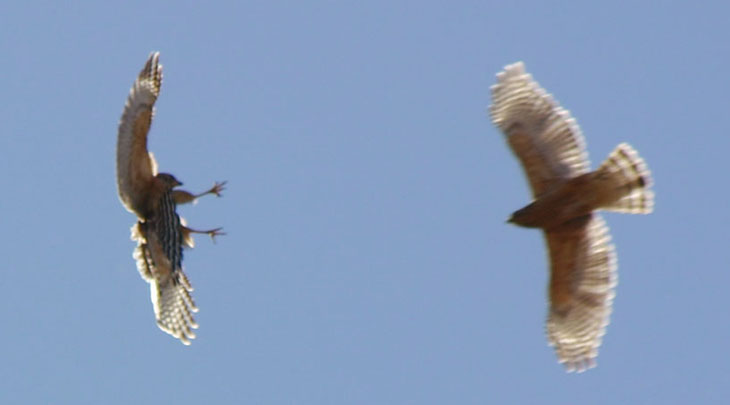
So get that manual out, memorize those controls, close your eyes and practice. When the moment comes, it might just be that edge that you need. The pic below, while not as sharp as it could be, is also better than missing the shot entirely as these two red-shouldered hawks dueled over mating rights.
Missing the forest: religious violence
In the latest issue of Skeptic magazine (Vol 16 No 2), there’s an article by Benjamin Grant Purzycki and Kyle Gibson regarding religious violence, which raises the question: does religion cause violence, or are we mistaking correlation for causation? This is an exceptionally intriguing question. Confusing correlation for causation is one of the fallacies with which skeptics are usually quite familiar, having to correct it all the time when discussing such subjects as alternative medicine. Skeptics are not immune to blind spots, however, and pointing out where such exists is a valuable lesson and a great example of holding honesty and fairness above agendas. Moreover, I have argued myself that religious wars can often be shown to have the same motives as any other wars, such as resource control and power structure. So I read the article eagerly to see just what kind of study had been done.
Observe!
I’m quick to tell anyone who wants to listen that the key to decent photography is composition. Technical proficiency certainly helps, but no one ever looks at a photo and says, “Wow, what a great use of exposure!” It’s what is in the photo that counts, and this can actually excuse some technical faults.
 But when the question is finding good nature and wildlife subjects to photograph, the key is to observe. And this doesn’t mean simply looking carefully around you, nor only at what makes a good image. It also includes noting and interpreting behavior, such as seeing signs that wildlife might use this area at other times, or knowing that the bird call you’re hearing is an alarm call in response to some threat – maybe you, in which case other wildlife in the area may now be alerted to your presence; or maybe something else, indicating that you may have an opportunity to catch the sudden appearance of a hawk or fox. It can also mean knowing what type of animal favors the particular habitat that you’re within, so you know what you’re even looking for. This can take a bit of practice, mostly to attune yourself to the sights and sounds that we rarely pay attention to, but it will almost certainly pay off.
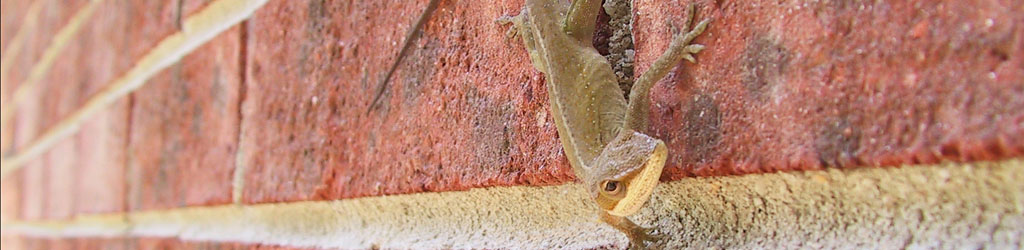
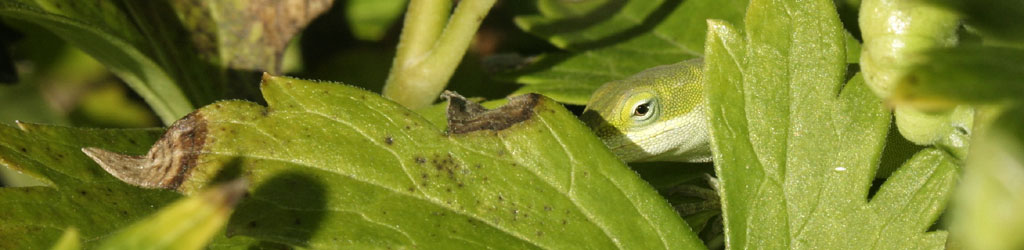
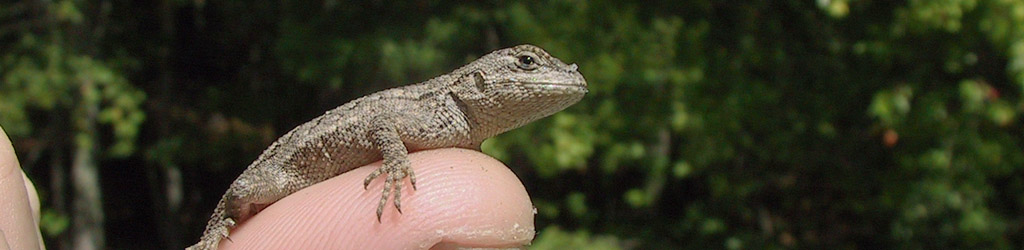
This recent post is a good example, as is this much older one. And so is the photo at left. Busy looking for insect subjects, I would have missed this well-camouflaged green anole (Anolis carolinensis) if it hadn’t made an incautious move and attracted my attention. Both peripheral vision and the very quiet rustle changed my focus, allowing me to get several poses as it alternated between staying motionless and darting to a safer spot. And as I talked about here, a small shift in my own position caused the paler, brightly-lit leaves in the background to fall behind its head, providing a significant amount of contrast to highlight the lizard’s presence in the frame.
I make a point about macro (closeup) work: you can always find a subject, and usually it takes nothing more than sitting on the ground and paying attention. So much goes on around us at a level we don’t see unless we try, but it’s only through habit that we tune out other levels of activity. And it also applies to other forms of wildlife too. Animals are usually very symmetrical in shape, far more so than foliage and rocks, so being aware of patterns can help you spot critters quickly. Simply taking the time to try this can work well by itself, too. Remaining still and quiet means you don’t alert anything else to your presence, and it may feel safe to venture out where you can see it. Find a nice spot, get comfortable, and wait. What might have initially appeared to be a quiet landscape will usually reveal itself to be a world of activity.
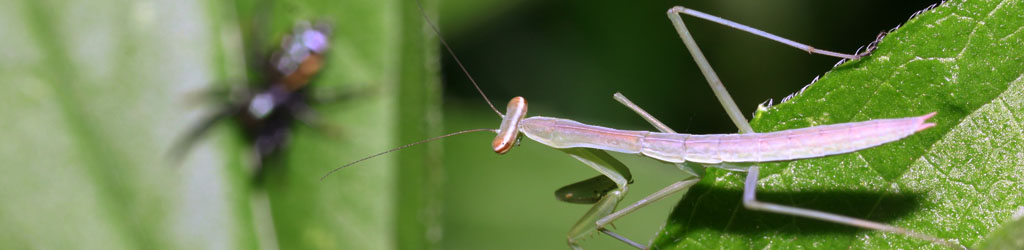
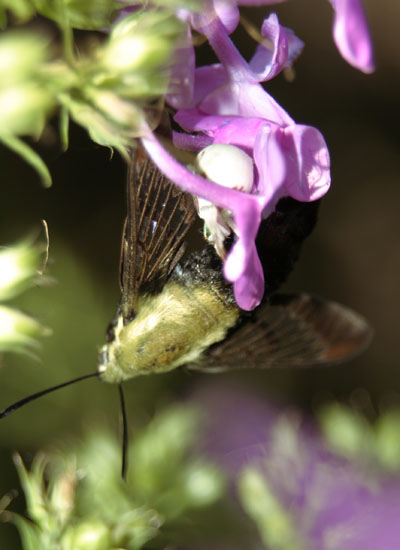 At right, a peek at the critter that was hinted at. The strange position of the common clearwing, or hummingbird, moth (Hemaris thysbe) was indication of something amiss, since these are active moths and aren’t ever seen alighting on a surface during the day, much less hanging down from flowers. Leaning around the edge provided me an obscured view of the culprit, which appears to be a goldenrod crab spider (Misumena vatia) – that’s the bulbous white blob alongside the lavender flower’s petals, with a few legs just barely visible gripping the moth. Whether the spider captured the moth on its visit to the flower or not, I can’t say – it’s typical behavior for the spider, but the moths don’t generally get that close to the flower, so I suspect an ambush at night, when the moths probably hide under leaves for shelter. Either way, it’s an impressive catch for the spider – less so for me, since this was the only angle I could achieve.
A decent knowledge of habits, calls, and habitats certainly takes time, though it can help a lot. Most of my own knowledge, however, came from the interest (meaning reading) and the time I’ve spent observing. So as spring approaches and while we’re in National Wildlife Week, get out there! It’s also a great way to forget about the petty human influences with which we concern ourselves too damn much.
Hummer cam!
Did I excite the wrong kind of people with that title? Ah, well, too bad. Courtesy yet again of Jerry Coyne at Why Evolution Is True comes this live hummingbird webcam, and she has zeh babbies right now! That makes a nice subject for me to kick off National Wildlife Week.
You can get more of the details at the host website right here, including clips and stills, and details about the birds, which are Allen’s hummingbirds (Selasphorus sasin).
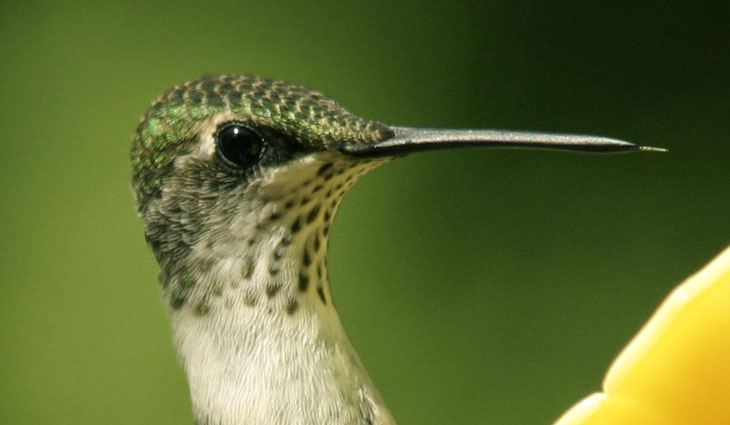
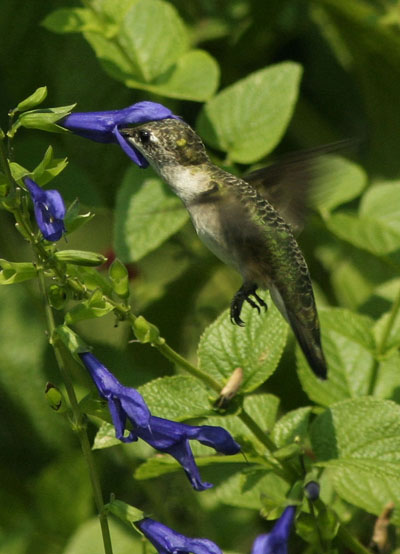 Last summer I did a lot of photography of the ruby-throated hummingbirds (Archilochus colubris) locally, both at my own basic feeder and at the nearby botanical garden, which produced the photo at right, probably the best shot all year, because it’s perfectly natural (I really don’t like feeder shots; they have less marketability.) If you’re going to tell me you can’t get shots like this, guess again. This one was taken with the camera handheld, a Canon Digital Rebel (300D) with a Canon 75-300 f4.5-5.6 Image-Stabilized lens, at a distance of about 5-6 meters. I had been seeing the hummers visiting in the past few trips, and waited until the day was right for light angle and brightness, to allow the fastest shutter speeds. The camera was set for TV mode (shutter priority, Canon still uses the outmoded abbreviations, but with your camera it may simply be “S” mode) and I chose 1/800 second shutter speed – in this mode, the camera then sets the appropriate aperture. I also selected ISO 400 to achieve a decent balance between light sensitivity and detail. Any higher and the image quality would have dropped too far for a decent enlargement. The lens was manually focused, believe it or not – hummers move too fast to trust the autofocus staying locked, and it doesn’t take but a fraction of a second to get the hummer away from the focus-sensitive area in the viewfinder and cause the lens to start racking back and forth along its full travel, making it impossible to find the bird again (because, of course, it’s moved on while this was happening.) This image is a tighter crop on the original, and I produced lots of images where focus wasn’t bang on, so this is where digital helps a lot – I can throw out dozens of images without grumbling about wasted slide film.
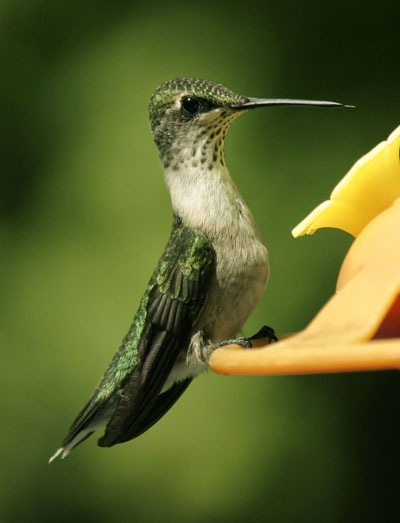 Naturally, I got much closer shots at the feeder, too. Hummingbirds get used to human presence very quickly, and you can usually take a seat quite close to the feeder and just be patient – they’ll get used to you. It helps to keep the camera raised close to your face, which may get tiring, but means you have only minimal movement to get the shot, which spooks them less. This particular frame was one of the few where my friend stayed put. I had many opportunities where the bird was perched on the feeder, but took off at the sound of the camera, and it’s truly astonishing just how fast they can move. When you trip the shutter on an SLR camera, a couple of things happen first. The reflex mirror, which lets you see the image in the viewfinder, flips out of the way (that’s why the viewfinder goes black) and the aperture closes down from maximum – these produce the first aspect of that double-click. Then the shutter opens, but in that fraction of a second, the birds were alerted by the noise and had almost always lifted off the perch, giving me a pose I hadn’t expected. This is potentially why they get used to people so fast: we’re far too slow and clumsy for them to care.
So get out there and at the very least, spot some wildlife behavior, observe something new that you never have before, and even get a few pics. I’ll keep posting some tips and observations as we go along.
Yes, okay, even though none of my readers ever clue me in to good subjects to feature, I’ll still let you have a closer look at my patient model. I’m that kind of guy…
That was easy
All right, let me throw a couple of questions at you – don’t worry, I grade leniently. This is just an exercise.
The US, like most countries with significant vehicle ownership, has speed limits on virtually all of its roads, and while I’m trying to go metric myself, I’d confuse people by switching the examples – 65 miles per hour on many interstate highways, 30 mph in residential zones, that kind of thing.
So if I were to ask you why, would you have difficulty with it? Why bother limiting the speed someone can drive? I doubt anyone would need to think hard about it, really – reaction times, impact forces, traction, braking distances, vehicle control… it’s all physics, with a handful of human limitations thrown in. Some readers could probably even calculate the forces involved and the traction values of tires when cold or hot.
Now, the follow-up question: what part of scripture did those come from? I don’t care what source you use, bible, torah, qur’an, dianetics, just let me know what section.
Why are you looking at me like that? I have been assured, countless times, that all laws are based on scripture. I’m just having a hard time finding what parts things like speed limits, contractual obligations, and mandatory insurance comes from.
Yes, I’m being snarky, but I think it’s actually long overdue. The question of moral guidance is one of the biggest things underlying religious devotion and “faith” anymore – it’s certainly the thing that is almost universally agreed upon regarding the value of religion. And of course, it is the thing that atheists lack, if you ask the people championing faith. It is, in fact, the most damning trait of atheism, the reason behind the disapproval and ostracism. Without scripture for guidance, humans might do anything.
It’s actually kind of hypocritical, when you think about it. Humans are supposed to be distinctly better than the other animals, made in god’s image and all that hoohah – but we’re too simple-minded to handle social interactions without special guidance? Like someone couldn’t figure out what works best in a cooperative society without a simplistic set of basic rules? I suppose that’s why greek and roman societies, the entirety of freaking Asia, Native Americans, and countless African cultures all just ate one another and flung shit around until the judeo-christian-islamic influence set them on track, right? I mean, it’s not like the Roman Empire had the most powerful civilization in the world before it had even heard of moses or anything.
In fact, it’s a fairly safe bet that standards of social conduct had existed long before any scripture was ever recorded, or even related as spoken stories. The basic concepts have been repeated time and again in wildly disparate cultures, and it’s not like it takes a lot of brainpower to come up with, “Don’t kill, don’t steal.” While we sometimes think of primitive cultures as having the brains of small children, this reflects much more our own ignorance than theirs. Hell, animals were being domesticated, and grains cross-bred for better yields, before the first written records of which we have any evidence.
So can we determine morals on our own, without even a starter culture like sourdough bread? Of course we can. Nearly all of our morals and ethics involve social interaction, the notable exception being animal welfare. It’s fairly easy to determine what will work best for humans collectively, and what the difference is between short-term and long-term benefits. Just like those speed limits, we can figure out some fairly intricate things on our own.
Moreover, when we stop relying on ancient and sophomoric forms of guidance like scripture, we can actually make some decent advances – you know, like women’s rights, abolishing slavery and racial discrimination, setting great standards for child welfare… all of which we developed and refined despite the scriptural influence which contradicted them. Some of these we can actually thank science for, by showing us that despite differences in physical appearance, people are otherwise the same, so making a distinction about deserving different rights wasn’t supportable by physiology, mental acuity, or even being a separate species. While this should have been obvious all along, people had preconceived notions about such affairs – due to the influences of scripture claiming divine provenance. To be fair, there were further influences, such as the hubris of “civilized” society exploring the newly-available continents and finding the cultures there “primitive” because they did not have weapons of metal and engage in nice, civilized witch hunts and wars over religious homelands. Though even that’s debatable, since much of what was used to judge “savagery” was whether those heathens even knew who god was, or had some silly little gods of their own.
I just find this disconnect over morals to be amazing, myself. We’re playing with physics at a scale so infinitesimal we can only infer the properties, and judging the ages and sizes of distant stars on the color and intensity of the light that we receive. We’ve plotted genomes and traced genetic heritage, including using it to solve crimes now, and plot the exact centimeters that the continents move per year – from orbit several hundred kilometers above the planet. But determining what is morally good for our species is something we need help doing? Who thinks up this shit?
I don’t need to tell you, do I?
Try this: determine what kind of changes need to be made to laws based on what functions best for society as a whole, not what some old books say. Refer to the human beings around us right now, without trying to justify some internal prejudice. Concentrate on whether actual repercussions or negative connotations really do exist anyplace other than in the mind before worrying about what something can do to “family values” (and while we’re at that, whether “family values” is simply a blatantly manipulative but meaningless concept anyway.)
Sure, there’s ambiguity – ethics are not going to be about distinctly measurable traits. It’s like the old saw about how many grains of sand make a pile. Nice conundrum, until you realize that no one ever needed to know this. People get hung up on the idea of what’s “best,” of determining absolute criteria when considering moral code, when instead all they really need is what’s “better.”
There’s a deeper side, too. We’re seeing some pretty backwards and ridiculous things sprouting up in the news, with many countries trying to become theocracies, governed by religious law rather than secular. And of course, simply saying that has many people wringing their hands about secular law being immoral. But the religious laws we’re seeing, such as stoning women for adultery (somehow not the men – silly immoral me, I thought it took two,) and forcing subjugation and all sorts of fun and games like that, aren’t very moral, are they? In fact, let me be blunt and say that they’re fucked up beyond all measure. I hope that didn’t come off too shrill.
Only, we’re not in a position to judge when we make claims that we’re a christian nation, or that our moral guidance comes from scripture – so does theirs. We really don’t have a leg to stand on if we want to try and convince others to change, unless we fully support rational, thoughtful, social laws and ethical guidance, rather than religious. Otherwise we’re being blatantly hypocritical, or insisting that our god trumps theirs. That’s kind of how so many conflicts started in the first place. And if we want to set an example of how well rational law works for a country, we have to stop whining about gay marriage and religious right. But that’s not quite enough, though – we have to make it clear that it is whining, and speak up about it every time some politician starts pandering to religious fervor. Or, simply take away their ability to play the religious card in the first place, by not dancing to that piper’s tune.
Seriously, the next time you hear someone avow as to how the US is a “christian nation,” demand to know why they want to insult us in this way. We’re nowhere near that backward and feeble-minded. And we can be even better.
A better cause
I’m usually far more behind current events than most people, because I got tired of having my intelligence insulted routinely by the feeble excuse for news reporting in this country and thus pay no attention to it. But the news about the earthquake off Japan is everywhere, and no matter how prepared you might try to be for things like that, there’s no way to eliminate the effect of tectonic plates shifting suddenly and shockwave-driven tsunamis coming ashore.
The New York Times has a page of updates, video, and contact info that they’re maintaining, and I’m sure there are countless other sources of news out there too.
With this in mind, I’ve changed my earlier plea. While Skepticon is still a great cause, there are more important ones, and I’ve included a link to Non-Believers Giving Aid in the sidebar and immediately below. Non-Believers Giving Aid is a partnership of the Richard Dawkins Foundation for Reason and Science and Doctors Without Borders/Médecins Sans Frontières (MSF) to provide emergency relief funds and materials to areas of desperate need throughout the world. RDF receives none of this – every penny goes on to MSF. Skip lunch today and lend a hand.
Or chose your own particular charitable institution – just select one that ensures that more than 75% of your donation actually provides assistance.

Thanks!
Book Review: Why Evolution Is True
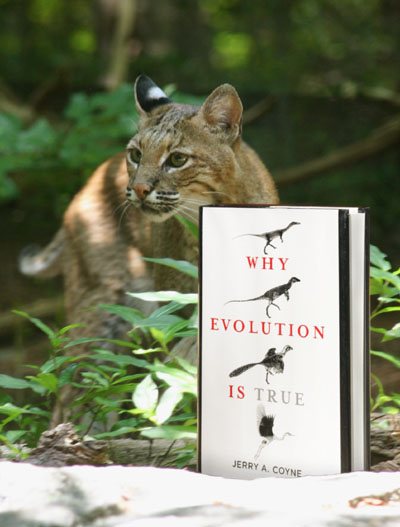 I know it might seem like I have a theme going, but it’s unintentional; the book lineup just kind of fell together. Nonetheless, the progression is actually interesting. Previously, I reviewed Why Evolution Works (and Creationism Fails), which was tailored to addressing the attacks on evolution by creationists, thus not a reference suited towards a full explanation of the evolutionary process. This was followed by Your Inner Fish, which gave a tremendous amount of evidence that we know evolution has occurred (and the fascinating details therein,) but didn’t address how the selection process works. Stepping up to the plate now is Jerry A. Coyne’s Why Evolution Is True, which details both the evidence and the process, and points out how creationism fails to explain the evidence while it’s doing so.
If you’re familiar with Coyne’s website of the same name as the book, you know his writing is readable, direct, and smooth – he doesn’t write for fellow scientists, but for the general public, and does a good job of it. The book is no different, and is easily grasped by adolescents and onward. Like his colleague Neil Shubin (they both teach at the University of Chicago,) Coyne is an educator, and aims for as broad an audience as possible without excluding anyone. Briefly, I caught some sections early on where just a little biological jargon slips in without explanation, but this occurs only once and doesn’t detract significantly from the passages – otherwise he manages to reach practically all readers and keep them interested with direct prose and excellent flow.
Coyne is careful to detail the genetic processes themselves, which provide the primary function of evolutionary change and speciation, showing how such variations crop up in individuals, and how these incorporate into an entire species. He also addresses the timelines, and how long changes can take, showing that we have had more than enough time to see the changes that we have. And he shows the various selection processes themselves, explaining how different factors produce change in different ways. His explanation of sexual selection and the production of traits that should be detrimental to survival, such as flamboyant peacock tails, shows why it still makes sense, highlighting the undirected and goal-bereft process that yet provides benefit to the species. He makes it clear that selection produces “better,” not “best,” and relates only to passing genetic traits to offspring, not necessarily living to a ripe old age.
The book is honest, and admits to a few areas where the information we have about certain factors is sparse and speculative, and even debated among biologists. Yet it shows how these factors don’t affect the Theory of Natural Selection in any way – details about how a result is reached do not mean that the result is not plainly visible. Coyne is exceptionally fair, and shows that the scientific process is careful to avoid assumptions, instead making inferences of what might be expected, then testing them to see if they hold up. He never asks the reader to take his word, but provides plenty of endnotes referring to specific studies on what he presents. While natural speciation takes far longer than we have been observing, we can see every factor required for it to take place, and have reproduced most of them in labs. We also have the distinct fossil evidence that upholds the suppositions without any contradiction, and experiments that show how the processes result in benefit to species. Through breeding programs, we knew long before Darwin came along that species are changeable – Darwin simple showed that it takes place on its own, and we’ve been finding further evidence for this ever since. Throughout it all, without engaging in digs or insults, Coyne shows how creationism provides no explanation whatsoever for most of the factors that biologists deal with routinely. Essentially, all of the evidence points to natural selection, repeatedly and testably, and nothing else has come close to explaining why we see all of the facts that we do. Indeed, the traits of countless species show that “design” isn’t really a word that can sanely apply, any more than most rivers can be said to travel “directly” to the sea. The fascinating part of evolution is how, through very simple environmental influences, species can nonetheless achieve a high degree of specific functionality. It’s slow, it’s haphazard, and it can result in complete dead-ends, but it still accomplishes a stunning amount.
Coyne saves the most contentious for last, dealing with human evolution in the final chapters. Scientifically, this isn’t contentious at all – such things come only from selfish emotions. We have a hard time simply accepting plain facts about ourselves when it comes to trashing some cherished belief, which is pathetic for a species claiming such high ground, really. Yet the evidence for human evolution is not lacking any more than the others. Coyne, again, is careful to state things very honestly, showing that the oft-quoted genetic similarity to chimpanzees of 98.5% doesn’t mean what we may think; genes produce proteins during fetal development, and such proteins shape the way we develop. Like a road map, one small turn can deviate from a path significantly. He also points out that the fossil record of hominids, our various ancestral species that split from chimpanzees roughly seven million years ago, does not present a distinct line. Fossil records are dots in history, and indicate an unknown number of branches and subspecies – indeed, we should not expect to find a nice progressive lineage, due to the specific conditions needed for fossilization and the low likelihood of the resulting fossils surviving intact to present day. There is no “line” running from Australopithecus afarensis through Homo habilis to Homo sapiens, and we cannot be sure that this is direct ancestry; but we can be sure that all are related, as they show development of distinct traits in stages leading up to modern humans, exactly as natural selection predicts. No other species possesses the traits that develop, nor do they fit the timeline. “Lucy” may be a distant grandmother or just an aunt, but is certainly one or the other.
I know from his website that Coyne isn’t terribly fond of evolutionary psychology, though he keeps this hidden when addressing it in the book. The reason for his skepticism, I believe, is that specific suppositions within are extremely untestable, and far too open to speculation without any ability to confirm. Evolutionary psychology postulates that much of our behavior stems from selected traits for survival in our ancestral species, which, overall, is a reasonable assumption and explains a lot about ourselves. As he puts it:
If we take the beginning of “civilization” at about 4000 BC, when there were complex societies both urban and agricultural, then only six thousand years have passed until now. This represents only one-thousandth of the total time that the human lineage has been isolated from that of chimpanzees. Like icing on a cake, roughly 250 generations of civilized society lie atop 300,000 generations during which we may have been hunter-gatherers living in small social groups.
Thus, we can fully expect to have some psychological or emotional traits induced by past pressures, which have not vanished under the extremely brief time that we’ve spent as we picture ourselves, the “rational human being.” I highlight this because it goes a long ways in explaining facets of our behavior, such as competitiveness and aggression, and can help us to understand that our motives may not solely be the rational thought processes that we believe. We know that various subconscious factors are at work in our psyche, we just cannot establish how and why they developed, buried as they are in non-fossilizing soft tissues of past brains.
Coyne presents a book for the public understanding of evolution, and takes pains to show not only that biologists (and the vast majority of other scientists) do not question it, but that we’ve established excellent reasons why not. Unlike the dogma it is often portrayed as, natural selection withstands every test we’ve thrown at it and grows stronger constantly with new information. I am not personally fond of using “truth” because it is a horribly abused word, but Coyne’s title is apt. Evolution is True, and it’s about time we accepted that and adapt to it.