While I pick on religion a lot in this blog, this is reflecting what I see as a greater need at this point in time; in contrast, a few years back I was quite active on UFO and paranormal forums, and have dueled over topics such as health foods, astrology, and alternative medicine. They all fall under the big umbrella of critical thinking, or to be more precise, they’re all wet precisely because they don’t.
The thing is, we as a species are notoriously bad about rational thought, and fool ourselves in so many myriad ways that at times it seems this defines us more than our intelligence does. Worse than this, however, is the open defiance of this concept, this curious failure of humans to recognize it when we are wrong, or to even consider the possibility. All of those topics I mentioned above, and many more besides (politics comes to mind,) are prey to this – it’s probably safe to say there isn’t a facet of human culture that is not. Which is why I promote critical thinking, and the foremost part of this is adopting the premise that we can always be wrong.
Looking back, one thing in particular helped this aspect along, for me. In the early 1980s there was a magazine called, “Science 80,” only it reflected what year it was actually issued within, thus “Science 81” and “Science 82” as it went along, not the best of naming moves. It’s defunct now, and I cannot locate this particular article to provide credit, but it dealt with suggestibility and implanted memories. It featured a college study of eyewitnesses to a supposed crime, actually staged, with the criteria that a stolen item was described by the “victim” and later recounted to security guards by the eyewitnesses. The details provided about the item, in some cases quite specific, didn’t actually relate to the item the eyewitnesses saw – they had actually not seen an item at all, because there was nothing stolen. All details were supplied by the “victim,” or in some cases just imagined.
There have been a lot of studies about this, really, and it boils down to one very simple idea: our memories are not like recordings, able to be played back with fidelity, but extremely malleable instead. We can actually respond to suggestibility on an astounding level, and worse, have no way of differentiating this. There’s at least one study now that indicates how memory may be a single-use kind of thing, and we retain memories because every time we play them back in our minds, we rebuild them into a new memory. That one, of course, may have attendant details from the rebuilding. A good example is how we remember movie quotes, and the number of them that are simply wrong (“Luke, I am your father,” and “Play it again, Sam,” being two of the most quoted that never actually appeared in the movies.)
We also have a nasty tendency to color our experiences in terms of expectations, assigning traits or categories that are not supported by what we’ve actually sensed. Sometimes, this is influenced by something that we’ve never encountered ourselves, but have only heard about. It becomes pathetically easy to obtain ghost encounters from virtually any building or locale, but the darker and older, the better. All you need is to create a reputation with a few stories. I don’t think I’m surprising anyone by saying that every odd sound or visual phenomenon instantly becomes a ghost in such circumstances, but perhaps many don’t realize this is not something experienced only by those obsessed with ghosts – it’s something we can all be haunted by (a ha ha.)
And then, there’s the common experience of déjà vu [or just deja vu if the accents didn’t render], the distinctive feeling that we’re actually encountering a repeat performance, or a precognitive memory of what’s happening to us at a particular moment. Those that have experienced it usually find it very compelling, and I can vouch for that, but notably, it hasn’t been shown to be actually precognitive in any way. In other words, no one seems to have ever documented it, providing a written account that existed before the experienced event. Instead, it always seems to be this odd feeling of memory just as the event occurs. What this suggests, and studies have supported this, is that the feeling of this being a memory is the defining trait, not the actual existence of the memory. We get a stray feeling of, “Oh, yeah, I remember this!” but not because we actually do remember, but simply because the emotional response typically associated with memories triggered improperly – a false alarm.
The same can be said for many of those great ideas we have just before awakening, which fade away too quickly for us to remember them. Some of the people who have successfully retained them find they’re total nonsense in the light of full consciousness – it wasn’t the idea, it was the eureka emotion all by itself. Who can’t remember a dream, perhaps a lot of them, where emotional properties were assigned to items or events that didn’t seem the least related?
If we consider our minds as this great device for thought and experience, and that memories are indelible records of experience, we’re quite simply mistaken – this has been evidenced and indeed proven, time and time again. But many people never realize this. In fact, in discussions of UFO and paranormal events, the biggest influence by far is not eyewitness accounts, but the weight given to them. Even raising the question of whether the witness actually saw what they believe they did is usually considered impugning the witness, and can immediately get someone labeled a debunker, or closed-minded. The irony, that this failure to recognize the possibility of human error is more closed-minded than considering the possibility, is not lost on those urging critical examination.
The aspect of suggestibility is not only known to courts of law, in some cases it is actively promoted. Attorneys have their clients rehearse their stories over and over again, and this is not because their memory is so indelible. As it says in the study linked above and again right here (at the very least, read the first few pages,) even the careful use of certain words can influence the impression people have of events – smashed instead of bumped being their example when referring to a car accident. Often, this isn’t even intended, but a by-product of both popular opinion and media influence. In a high profile story in The New Yorker magazine, a father of three was convicted of arson and first-degree murder, partially on the testimony of neighbor eyewitnesses to the fire. But the neighbors’ testimonies changed drastically after news reports that the investigators were considering arson as a cause – before that, they had maintained that the suspect showed no indications of unexpected or remorseless behavior. And while such effects are well-known to courts, eyewitness testimony is still treated as much more trustworthy than it should be, because humans relate to the emotional aspect of the witness’ account, with little recognition paid to the fallibility. Since attorneys can benefit from this, they’re not going to be the ones who draw attention to the undeniably damaging aspects of it.
Only a few decades ago, there began a dramatic upsurge in repressed memory therapy, the practice of interviewing and sometimes hypnotizing patients to discover memories, almost always of childhood sexual abuse, that the patient had supposedly suppressed in horror and loathing. Hyped by the media and promoted by all those people who delight in scandal, it became a highly-regarded practice until a few huge settlements on mistaken cases brought attention to the well-known fact that hypnosis actually increases suggestibility, and therapists can influence a patient’s story. Far from revealing hidden records of past events, such therapy can be a fantastic tool for implanting false memories. Is it any surprise that certain therapists were known for their specialization in repressed memories? Is it a greater surprise that a very large number of their patients demonstrated, to the therapists, unmistakable evidence of past abuse, so much so that one made the astounding claim that repressed memories were present in up to 60% of sexual abuse cases? The fields of psychiatry and psychology routinely deal with mental health issues from the inability to forget traumatic experiences, but somehow this trait seemed to reverse when it came to repressed memory therapies. Eventually, the practice started receiving the critical examination that it should have had in the first place, but not before tremendous amounts of damage were done in pursuit of ephemeral “memories” treated as if they had the strength of physical evidence.
Exactly the same thing was at work in alien “abduction” cases, with a few prominent therapists promoting the practice while – and I know you’re going to be shocked at this – offering their services to help reveal such repressed memories. In abduction cases, the repression was supposedly induced by the aliens rather than the patient, but the gist is the same. For both childhood abuse and alien abductions, however, one very distinctive trait is that corroboration, in the form of physical evidence, other witnesses, and such, is virtually impossible. One should certainly be suspicious of therapies touted with a high degree of accuracy that cannot possibly offer any way of determining such.
I want to take a moment here to point out something. In many of these cases, perhaps most, the therapists were not actually trying to create false memories, and honestly believed they were helping their patients. What might have been at work is a combination of things. One simply being pride, in that the therapists felt vindicated and supported by the “positive” results of their therapy, and stayed with methods that seemed to work most effectively. The other is related; as trained professionals (most of them, anyway,) they may have felt they were aware of and unable to fall for the trap of leading the patient along. The possibility of the false positive wasn’t controlled for.
This really means that it’s up to us. We’re not perfect beings, and our senses and our minds are not infallible – in fact, they are prone to errors, so many that we cannot even be aware of where they might be influenced. We need to recognize this, and in fact remain suspicious of our very abilities to experience what goes on around us. It sounds a bit like I’m following the old Descartes argument here: “How can we be sure of anything?” But that’s ridiculously extreme, and like much of philosophy actually leads nowhere – what can you do with that? What I’m saying is that we can be fooled in many ways, so making some effort to support our conclusions is not only useful, it’s practically a necessity. Along with always bearing in mind that we still might not be right after that. Being wrong is okay, and in fact unavoidable. Refusing to realize this and/or correct ourselves is not. There’s an old saying regarding scientific research, to wit, that one needs to be even more suspicious of findings that support a favored theory, because we want to see this too much, and can easily miss the findings that contradict it. In skeptical circles, this is called confirmation bias – counting the “hits,” the positive evidence, and ignoring the “misses.”
Worse, this isn’t helped by belief in religious creation – it can be actively harmed by it. Feeling that humans are “chosen” creatures designed by a perfect deity doesn’t leave a lot of room to feel that we can make mistakes, despite the glaringly obvious evidence that we can. But recognizing that evolution shapes life largely by trial-and-error, and that humans are a product of utilizing old functions in new ways (a work in progress, if you will) allows that we may not always operate the way we’d prefer. It is, perhaps, a nod to the functionality of this process that we can recognize fallibility for what it is, rather than either being oblivious of it, or denying it because we’d rather not believe it’s true.
This might be unnecessary to point out, but convincing people of this when engaging in critical examination of certain topics is remarkably hard to do. People don’t like admitting that they’re wrong. Amusingly, it could be an example of that imperfect job that evolution does. Being wrong is certainly a good thing to avoid, for obvious reasons. But the emotional reaction within us that helps us avoid this isn’t specific enough – it doesn’t differentiate enough between trying to be right, or simply not admitting that we’re wrong. Too often, if no one actually catches us in a mistake, this is sufficient. It shouldn’t be, and we need to pay attention to those circumstances when we’re, in effect, in denial about actually being wrong, and concentrate instead on ensuring that we’re as correct as we can be. This is not the same as winning an argument, by the way, a mistake made far too often.
For skeptics active in debate, however, there’s another aspect to be considered right alongside this. That emotional drive against being wrong means that, even if we have produced an unshakable and irrefutable argument, our “opponent” (for want of a better word) is highly unlikely to concede – we’re not going to see a clear victory. The admission of being wrong is almost certainly going to be a private one, sparing the embarrassment of public recognition. We cannot, and should not, expect to see someone change their mind. Our only goal should be to present the most cogent arguments that we can, and leave it be. Let the seed grow. It can be frustrating, to be sure, but it also leads to a better process: simply presenting the case and stepping away, without the emotional investment of seeking a resolution or victory.
Of course, considering ourselves skeptics and critical-thinkers doesn’t absolve us of error-prone traits, either, and like some of the therapists outlined above, may cause us to drop our guards and feel we’re not likely to be caught. In fact, it’s probably safe to say that all of us are wrong, in one way or another, every day. It’s unavoidable. But the distaste we feel over this thought should be channeled towards correcting our mistakes, instead of avoiding recognition of them.
And by all means, don’t take my word for it. There are a lot of resources available to examine these topics in much more detail, and I encourage you to check them out on your own.
Potentially Related Posts:


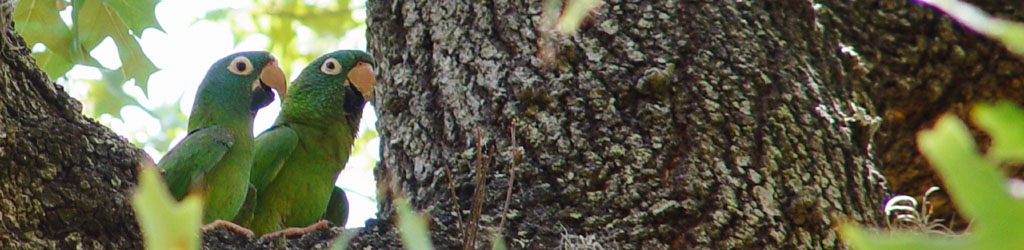

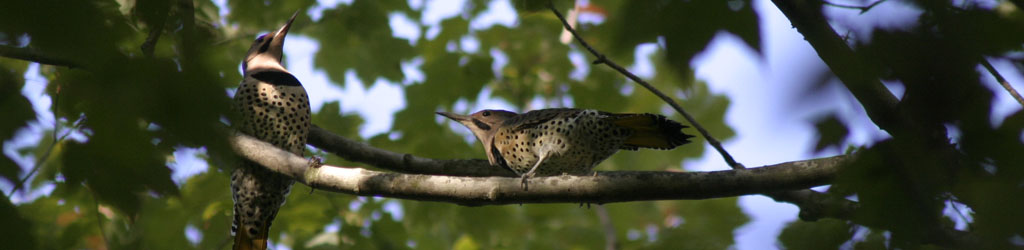














 This pattern told me what was happening, confirmed after a shift in my position revealed the female in the fork, maintaining and rearranging the new nest as the male brought home materials. The location was excellent from their standpoint, but less so from this nature photographer’s, for exactly the same reason: it was extremely difficult to see. Hampered slightly by the garden trails I was requested to keep to, I had a difficult time getting any vantage that allowed a clear look past obscuring branches and foliage, but she obliged enough to sit up a little higher and appease the paparazzi, so I didn’t have to fetch a ladder or helicopter. Since she barely moved from position, I suspect she was either laying or already in possession of their eggs. For any birder seeking to spot nests, this is perhaps one of the easiest birds to choose, because their wings make a distinctive corduroy-like “wheep”ing sound that makes them effortless to follow. They’re also relatively slow fliers and fairly plump, which is why some people refer to them as “Accipiter Food” – accipiters being the birds-of-prey in North America that catch other birds on the wing. One could be blind and snag a mourning dove…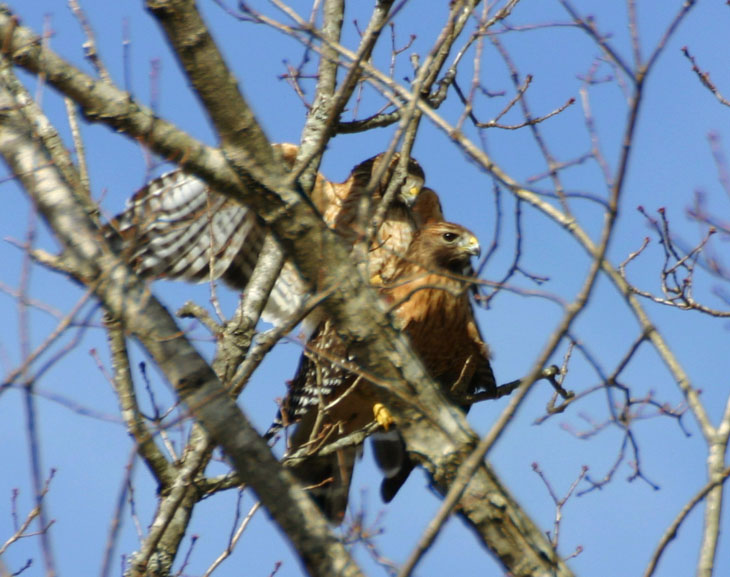
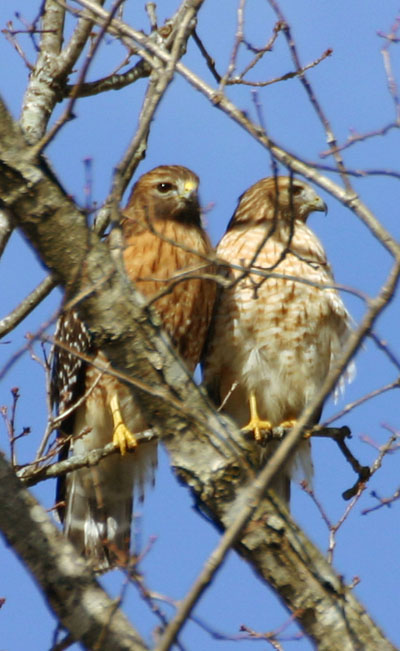 Afterward, they perched together, and I’d like to anthropomorphize even more and claim that this is the equivalent of small talk, but more likely, they were watching the nearby crows who had worked themselves into apoplexy (as crows are wont) because of the hawks’ proximity. This area is highly competitive, with songbirds, crows, and raptors all using it for nesting and food, and none of them liking the others nearby. The crows are the most obnoxious, often ganging up to harass other birds they consider a threat, but the raptors can usually hold their own. With the frequent displays of territorial and mating calls, from both the red-shouldered and red-tailed hawks, the crows have been maintaining a constant presence, only not too close – don’t piss off a hawk during Singles’ Night. About the only ones not appearing to react to others are the woodpeckers, who have been continually going about their business while all of this goes on, sometimes noisily, around them.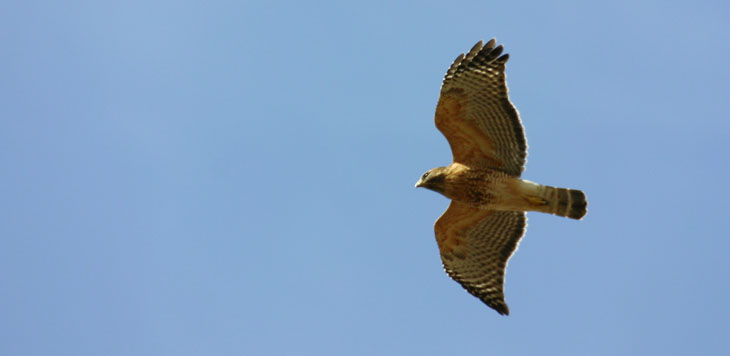
 So, one of the images in my slide collection is seen, full-frame, at left – this is the small cascade of a feeder stream that leads into Window Falls at Hanging Rock State Park, North Carolina. And yes, it appears I didn’t concentrate on keeping the camera level.
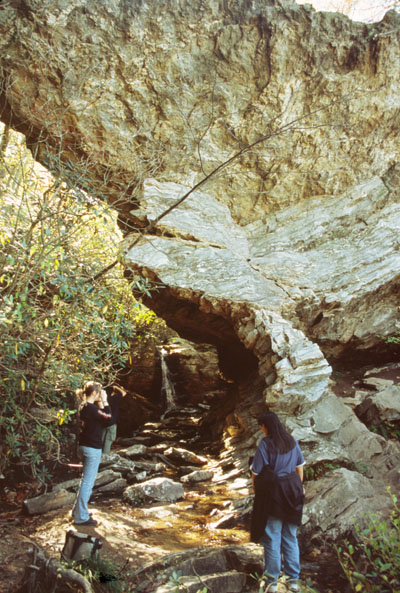 Or maybe not. The women (I don’t know them) aren’t really supporting either angle, and when I tried tilting the image to see which angle looks most accurate, either one works. The woman on the left has her back arched, possibly against leaning forward, while the woman on the right could be leaning to see around the outcropping. The rock strata makes things even worse. The foliage seems to be supporting the original angle from above, but since this is a mountaintop, it could be leaning over from winds and erosion at the edge of this cut. While the top image was definitely taken on a tripod, this one was likely shot freehand candidly. This image was really no help at all. Maybe gravity is all messed up – I seem to recall this happening in various places around the world…
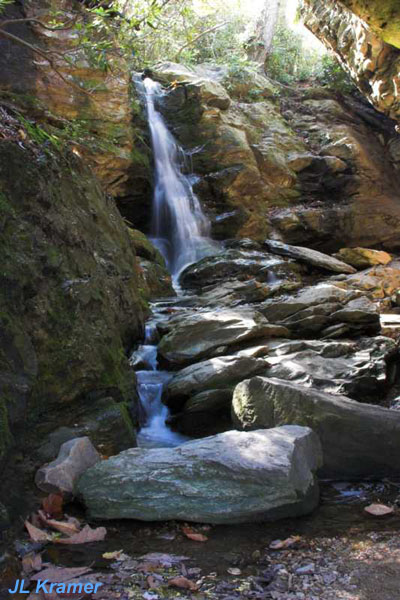 UPDATE: He bit ;-). JL Kramer was also present for this trip, and took his own pics of the same cascade, seen here at left. We see that I did indeed have the camera tilted, just not half as much as it appears. Kramer’s photo matches the angle that I have in the second pic (but has a much nicer composition than my first – the foreground rock is a great element,) so it appears I wasn’t meticulous about leveling the camera. I’m not terribly surprised – there was nothing to align it against or with nearby, but still…
 But we’ve had a couple of lovely days here recently, and while the grass is still brown and trees have not started to bud, I’ve been able to find some nice signs of “spring,” especially if I kept my sights low – in this case, down at the ground at the macro scale. While one of my two lens issues will soon be resolved, I decided to try another avenue for closeup and macro work. The 80mm macro lens for the Mamiya medium format camera isn’t intended to be used on any Canon EOS cameras, but mating together a body cap for the EOS and a rear lens cap for the Mamiya makes them fit together just fine, and the Mamiya has a auto/manual aperture switch that overcomes the lack of aperture control from the EOS system. Exposure is far from automatic, but this is simply one example of what can be accomplished if you’re willing to experiment. Both the flowers above and at right are barely visible while standing directly over them, measuring less than a centimeter at most. I don’t even know where to begin to look these up, so if anyone wants to chime in and tell me what these are, I’d be more than happy.
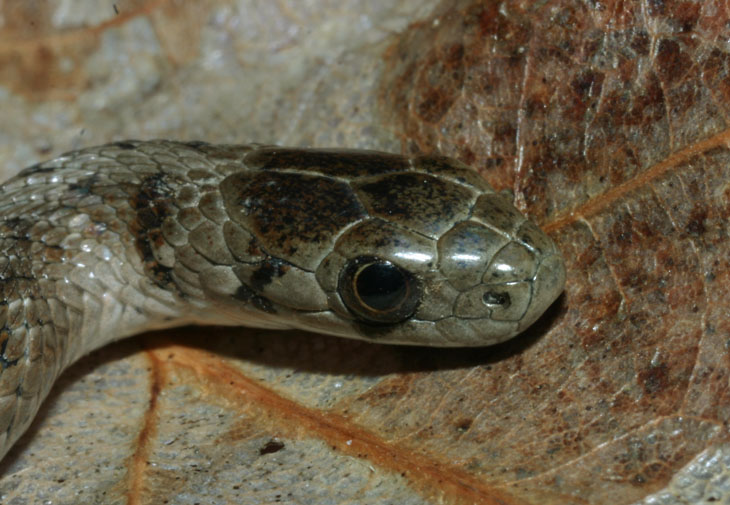
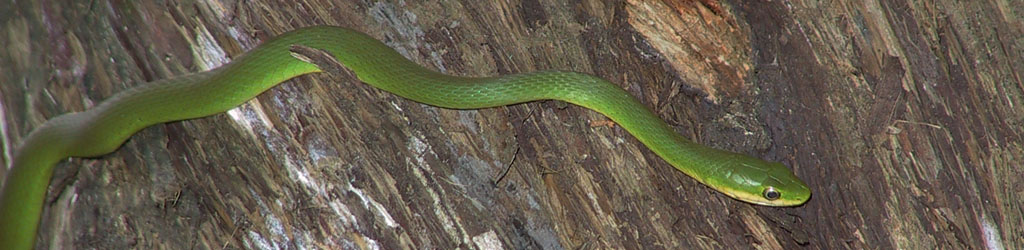
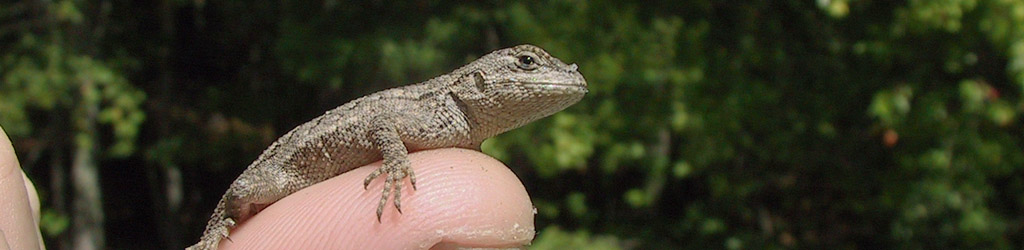
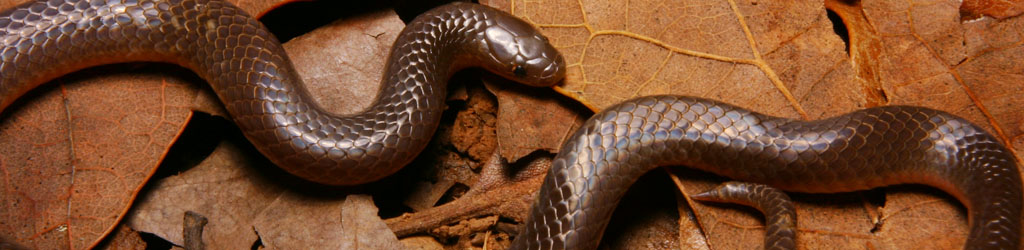
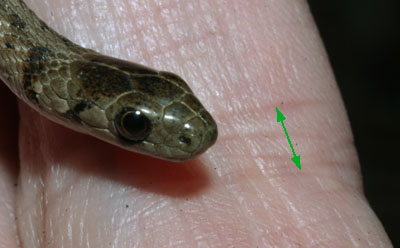 If it helps, here’s another view of my model, clasped gently in my left hand while the right juggled the camera. My little finger is the background (looking disturbingly aged from this close,) and the green line spanning the crease of the first joint is a measured 4mm – an average pencil measures 7mm. Even if these snakes were venomous, there wouldn’t be anything they could actually bite except maybe your earlobe. Since their diet is grubs and worms, it’s safe to say there isn’t any other species that pales at the sight of a brown snake, so it’s embarrassing that too many people freak out at the mere sight of a snake and feel inclined to kill them. It’s like being scared of fish.
 Those little pixels just barely visible now provide an impression of what they really are: a couple of men on a scaffolding on the side of the building (doing what, I’m not really sure, but better them than me.) Now do you get an idea of the scale? The blue starfield portion of the American flag painted on the side of the building is the size of a basketball court; each stripe is the width of an average road lane. The VAB stands 160 meters (526 feet) tall, not quite half the height of the Empire State Building, but four times the volume. Even more interesting, it is 55 meters (180 feet) higher than the highest ground elevation in Florida – yes, the state is very flat; swamps don’t tend to pile up very high.
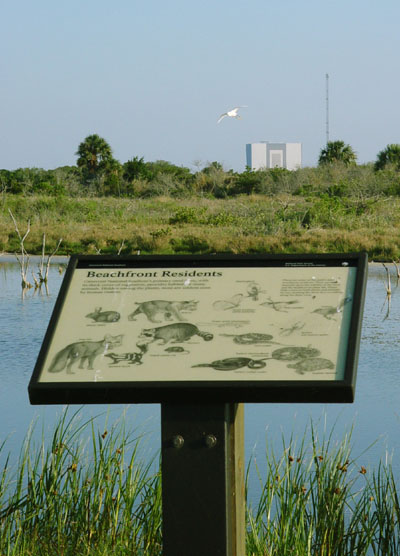 The northern part of the island that holds the Cape is Merritt Island Wildlife Refuge,