




Don’t they say, “Never assume you know the answer to something that hasn’t been tried”? (And where should the question mark go in that sentence? Do I have it right? Or should I have rephrased it so it wasn’t even an issue?) (And who’s “they”? Or is that, “Who’s they?” Fucking quotes, man…) So while I can easily say, “It’s just superstition, don’t bother,” am I not performing due diligence by resorting to that? I’m no scientist (duh!) but I try to behave like one where it’s important.
With that lede out of the way and You The Reader inescapably intrigued, I’ll say that, two nights ago as I was looking over the black knight butterfly bush by the light of the headlamp, I came across several crab spiders, but remarked internally that I have never yet seen something here that I used to see every year at the old place, and that was, the jagged ambush bugs that also adored the butterfly bushes. I idly put this down to subtle differences in the environment, but only idly, because that didn’t necessarily make sense: the genus is present throughout the US. And then last night, just 24 hours (give or take) past wondering about that, I find this:
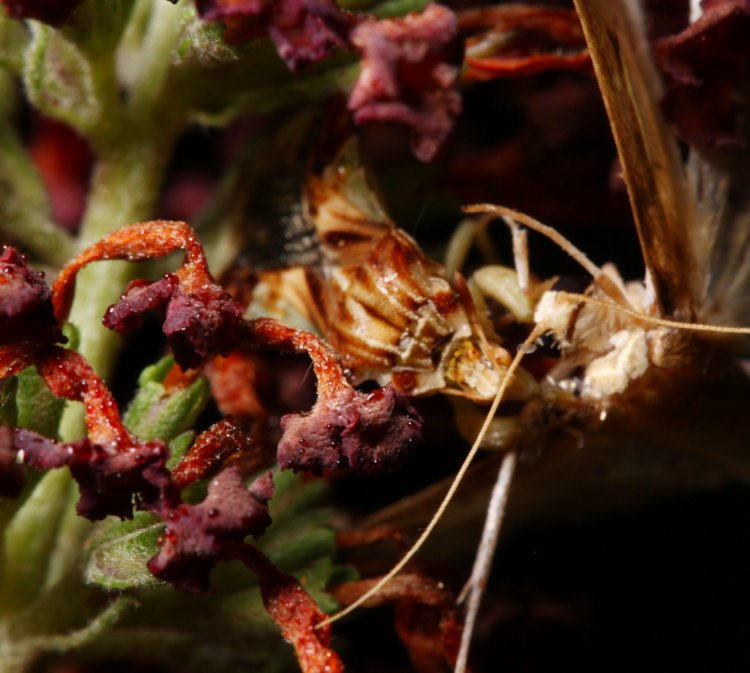
The crumpled and unmoving butterfly was the giveaway, because as you can see, the jagged ambush bug (Genus Phymata) is hard to distinguish even this close, though it’s center-frame. Seen from above its back, the head sits just behind that long-thin butterfly antenna, the body extending to the left and slightly upwards. The coloration is blending in with the reddish dead blossoms of the bush pretty damn well, even though being on one of the more active, healthy clusters would provide more concealment. I’ve seen this a lot: ambush bugs tend to stay on a cluster until it’s quite dead, one of the reasons that I always drop the severed clusters underneath when I’m dead-heading the bushes, because I’m almost guaranteed to clip one that’s still occupied, by either an ambush bug or a crab spider, and this makes it a little easier for them to climb back up and find a new spot.
A little closer now:
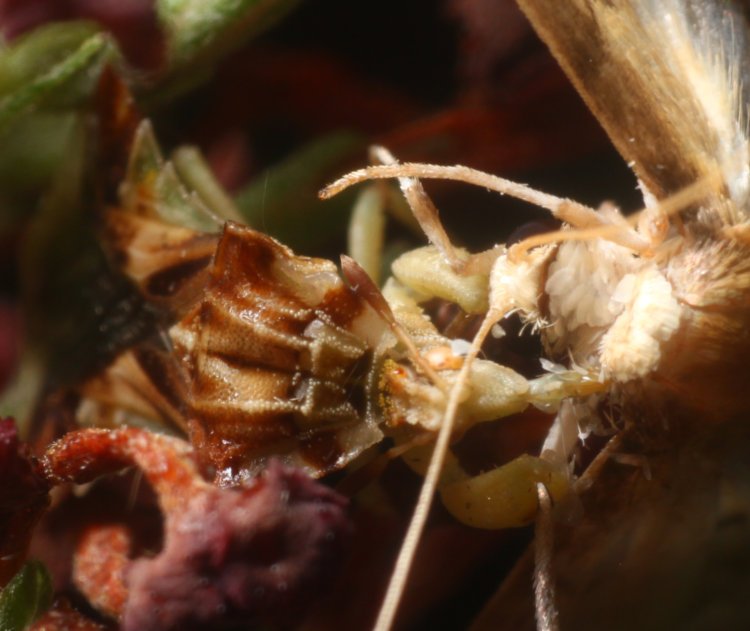
Yeah, it’s a little soft, but there are mitigating thingies. Ambush bugs are small, never getting longer than 15mm, so I had to be close to get this. But the cluster was actually a little above eye level on a long stalk, so it moved at the slightest provocation, which did not combine well with my holding a heavy rig up high with nothing to brace against, and I normally sway a little regardless – it was all a matter of trying to time when the combined swaying reached tight focus. Add in, even late at night, both the viewfinder and my glasses fogged almost immediately, and so within a couple of seconds I couldn’t see clearly enough to tell anyway, and had to pause to clear both. I was just after a couple of illustrations; I didn’t want to set up a tripod, branch anchor, and fan just to get a few frames of a subject I’ve done before anyway. I’m whining again, aren’t I?
But getting back to the title and opening statements, I might have to do some experiments on wondering about subjects that I haven’t spotted, and seeing if this influences finding them soon afterward. I’d probably need to ensure I’m wearing my lucky socks though.
[So you know, I haven’t worn socks in months, and even sandals have been avoided in favor of bare feet for the past several weeks – it’s been too hot to even consider them. I actually limit the amount of time I’m out in ‘public’ because I have to have footwear, which really does get uncomfortable fairly quickly.]
While out there, I decided to chase another subject I’d found earlier, one of the larger crab spiders I’ve seen, though on the dog fennel and not the butterfly bush.
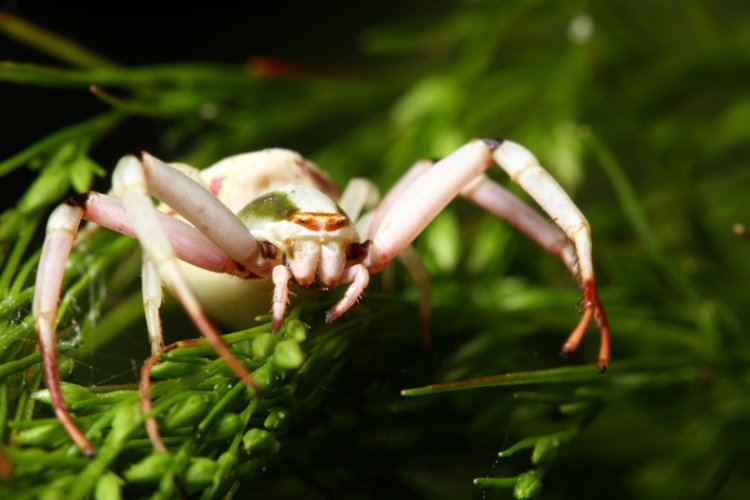
Now, “larger” is relative, since she wasn’t large enough to cover my thumbnail, but for crab spiders (Family Thomisidae,) this is pretty big – most times, they run from 2-6mm in body length, but this one was pushing 10. I would suspect she’s gonna drop an egg sac soon.
That was full-frame, by the way. Let’s go in closer, since even with the conditions described (moaned about) above, I managed a reasonably sharp frame.
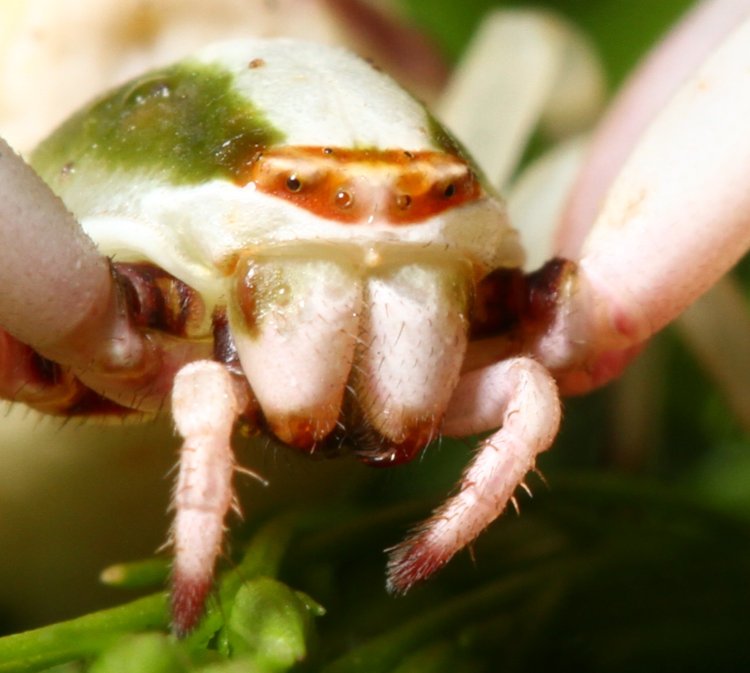
So here’s the deal: BugGuide gives an identifying characteristic of Genus Mecaphesa as the anterior lateral (front outside) eyes being slightly larger than the median (inside,) which is clear here – but also list the species as normally ‘hairy’ which this isn’t, really; see the other illustrating images at that link. This is part of the fun of trying to provide accurate identification – there’s more work that goes into these posts than you might suspect. Yeah, I know, “And this is still what we get,” I hear you, shut up.
One last, because I was there and I want to.
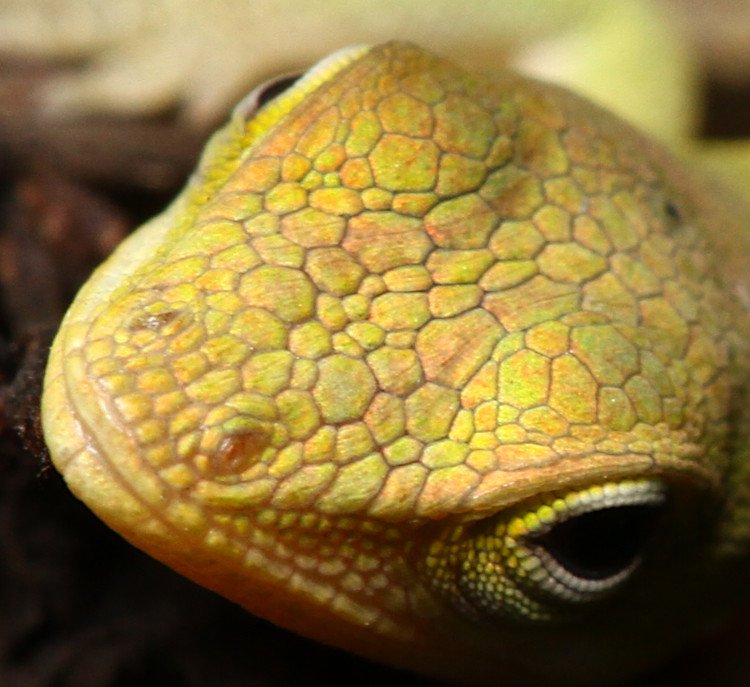
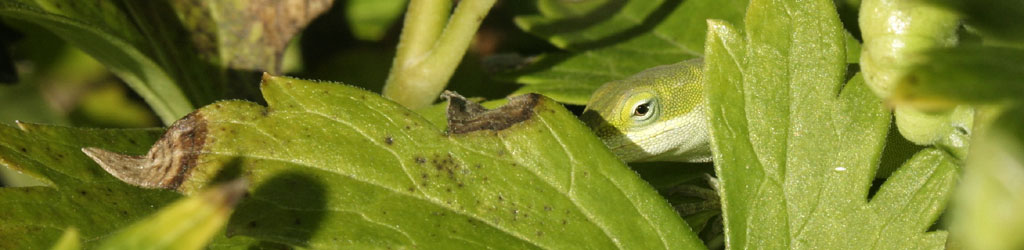
This tiny juvenile Carolina anole (Anolis carolinensis) was snoozing on a mint plant when I went in close, and cropped even closer for this – the head is literally smaller than my pinky nail. Calling it “green” isn’t doing justice to this palette – I personally wouldn’t even attempt to paint this accurately. You know, that’s why I’m a photographer…