
























Guten tag

I like this title, because if you try to pronounce it correctly, you’re mispronouncing it. Which is because it’s time (finally!) for the annual tag roundup! Tags are those little reference words at the bottom of the post to help you know what the content is and save you the trouble of actually reading the post, unless you have a poster of a certain nature, in which case they are also snotty commentary on the content, or highly questionable humor, or some obscure reference that only thirteen people in the world (none of them readers of course) would recognize. And each year, we choose a small selection of the tags that have only appeared once and recognize why they have only appeared once. It’s also a subtle (not really) way of drawing people back into older posts. With that warning being all that’s required by law, let’s plunge ahead, shall we?

probably get hit by a meteorite – The law of averages needs better enforcement, I’m thinking.

it’s not just a phase mom – The family photos that soon get hidden away.

Spanish moss? How dated! – Some redecorating did indeed take place, and we’re fine with that.

right on prom night – Seriously, don’t pick at them.

fussy fussy fussy – along with, “need more spiders,” and, “or maybe slugs.” Perhaps a little forewarning is in order. And a slick watermark.

really really questionable definition of humor – Along with, “samson was a fat fuck.” I blame my parents…

hopped up on corn dust – Some have to ham it up for the camera. Not me, of course…

yes that was on purpose – Okay, probably not subtle at all.

licking her will get you nowhere – Also, “or Out of Africa.” I’ve nothing to add here.

the water was cold – Excuses, excuses.

awwww – It says quite a bit, I think, that such a tag has only appeared once, but I’ll try to remedy that.

Hey Sailor – Also, “booty call.” Worse than trying to study in college with a ‘popular’ roommate…

I just don’t choose to – I mean, give me a real challenge…

puppy dog eyes – You should know by now this is a setup.

do you recognize this skin? – As well as, “you silly man.” Listen, you’re not going to get better warnings than these.

just the one taking the pictures – It’s journalism

chili I could see – I mean, sure, even if we’re only talking about what provoked it…

but the brow’s about right – I’m not that limp-wristed, though. Not that there’s anything wrong with that…

Unimportus bloggeri – Or perhaps, Daguerrotypus creeperi. I don’t know, have at it…

Now, we take a look at the ‘special’ holidays that we all celebrated this year (right?)

Lock Teasers Day, January 9th
If It Goes Another Day You’re A Worthless Excuse For An Amateur Naturalist, February 18th
Make Noticeable Progress on a Project Day, March 29th
Overcome Absurd Obstacles Day, April 24th
Dumfroot Spaglokkit, the inventor of shutter lag, May 25th
Is that…? No… Is It? Day, June 18th
Create Meaningless Content Day, July 29th
Now You Know It Could Be Worse Day, September 24th
International Enough is Enough Day, October 27th
Harvest The First Of The Citrus From The Greenhouse Day, November 16th (you should know that we still haven’t picked the last yet.)
Question The Value Of One’s Own Judgment Day, December 29th

What, no August? No, no holiday for August last year, strange as that may seem. Perhaps there will be two this year…

Meanwhile, if you want to check out the previous tag roundups, well, they’d be found here:

2015: Tagged
2016: Tagged again
2017: Papa’s got a brand new tag
2018: So what did 2017 hold?
2019: Do not read tag under penalty of law
2020: Tagginses! We hates it forever!
2021: Tag ’em and bag ’em
2022: I don’t mean to tag, but…
2023: Tag me with a spoon
2024: You’re a Grand Ol’ Tag
2025: Something tagged this way comes

Man, I’m glad I can just copy and paste most of that from the previous year…
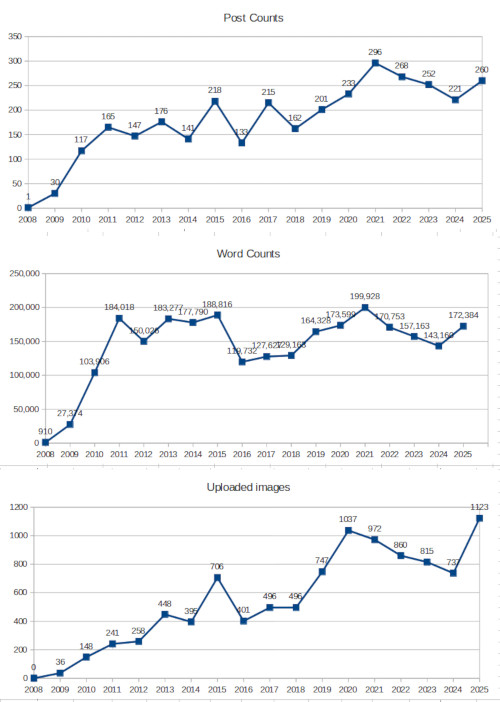
site statistics for 2025We brought the site stats up much, much better in 2025, with a post count of 260 (coming in third behind 2021 and 2022,) and a word count of 172,384, about average, bringing the total for the life of the blog up to 2,573,954.

But the image count was a new record at 1,123, beating out 2021’s total by 86 images, and I can confidently say the credit for this is due to Walkabout Estates Plus itself, brimming with photo subjects as it is. We did no special trips last year at all, being too busy with both selling the previous Walkabout Manor and doing work on the current one, so the vast majority of those images was within walking distance of the door. May had a total of 171 images uploaded by itself, though this still didn’t beat October 2020’s record for a month at 192.

Also worthy of noting was video uploads, coming in at 35 for last year alone, thanks to mostly the wood ducks and the nutrias. It was never my intention to branch out into videography seriously, because it’s more of an investment in time and equipment and so on – I just want to be able to capture behavior when it seems appropriate, but the opportunities have abounded this year, so here we are.

2025 was also a year of remarkable progress, especially when I look at posts from the beginning of the year. Then, I was speculating about whether I’d have to build a blind to even see the wood ducks from a distance, and whether or not they’d have the faintest interest in the nest box we constructed, as well as how much effort it would take to get better shots or video of the beavers, the first of which I’d captured in February. The year closed with not just evidence of the nest box in use, but multiple broods of wood ducks coming up into the yard, and beavers coming virtually right to my feet – as well as the discovery of nutrias visiting, then expanding to a brood of five young (and two adults) making themselves at home with inordinate boldness. Not to mention a snake battle to the death literally, actually, at my feet…

mother wood duck Aix sponsa on Turtle Island with at least nine of her brood of ducklings
It is safe to say, I am in my element, and I’m incredibly lucky to have The Girlfriend, who shares in (most of) my enthusiasm for all the critters to be found – as well as making the move to the new Walkabout Estates even possible, it must be said. 2026 is also off to a fierce start – I have umpteen video clips to edit together into a coherent whole, and keep adding to them, so those will be along eventually.

All in all, I can’t complain, and can’t feel like I’ve been slack. As always, we’ll see what the future holds.

Not exactly annual

Kinda far from it, actually, but nonetheless, we have the return of Beware of Strangers Baring Gifs Day, with another fine selection of animated foibles, curiosities, and giggles. Once again, these were collected from various places online (mostly theChive.com) that were never the originator in the first place, so I can’t give credit where it is due unless any of the creators contact me. Now that MP4s are largely supplanting gifs (pronounced, “GON-door-kolls-for-æd“,) most of these won’t autoplay, or at least I’m not going to spend the time trying to figure out how to do it. You can handle it, I’m sure.

Instant regret. And a cleaning job.

gif of cat making mistake

This primate (I’m not exactly sure what species) is distinctly unimpressed with your stereotyping.


I would totally do this.


Actually, I would totally fuck this up. I just want to learn to do this…

Spoiling the mood in a hurry.


Nothing to add at all.


This guy’s got it going on.


The perfect setup – this guy will never have a bigger victory.


Rally drivers are a special breed.


When I first saw this, one person quipped, “It must be a school crossing.” Bravo.


I love it when people add their own touches to existing gifs/videos, especially when they’re this well executed.


“Hey, man, you headed south?”


This is how you forfeit your entire flying career.


Heyo! Fuckfuckfuckfuckfuckfuck!”


Just happy to be included.


Beagles, man.


Needed one here.


Mistake


Pull over if you’re getting tired (it can be contagious.)


Ominous (and too damn close.)


What. The. Hell?


The faces.


The face.


Seriously, his expression kills me.

Valuable lesson.


I’m going to use this opportunity to feature my own odd memory. I was probably about 10 years old, and my family was visiting somebody with a horse farm next door. I was warned about the electric fence and respected that, but bored while their conversation went on interminably, I plucked a long blade of grass, bent into an inverted V, and dropped this from a safe distance onto the fencing. Of course nothing happened, and I chided myself for expecting anything else – naturally it wouldn’t be so powerful to do anything like burning through the grass. I went to pluck the blade off, which was enough to ground it. In my spasms as the appreciable current coursed through my body, I saw the grass glow orange where it contacted the fence and burn clean through. Son of a bitch…

So well staged.


Another great combination.


It’s silly and juvenile to assign human expressions to other animals.


So helpful.


Annnddd wait for it…


I think that’ll carry us for at least another year. Cheers!

Walkabout recommends: The Hudsucker Proxy

Despite being a Coen Brothers film, with writing and direction assistance by Sam Raimi, I’ve found very few people familiar with this one, and it’s a shame because this is a great little story on its own, even if it doesn’t quite measure up to the more popular films that they’ve made. This also came out in 1994, at roughly the same time as Forrest Gump, which naturally eclipsed most other films that year, yet they have some distinct similarities between them and, for my money, this one has a better story and is more charming than Forrest Gump, with better characters and performances by far.

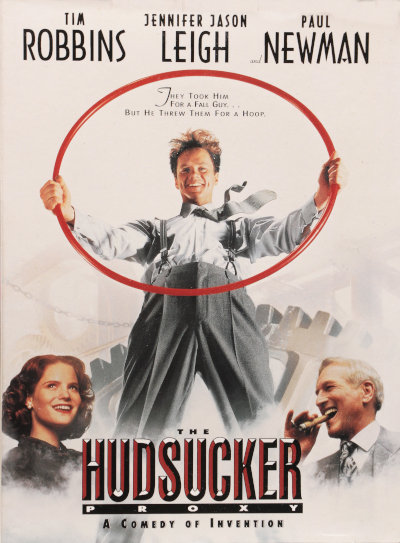
Cover art for 'The Hudsucker Proxy'The Hudsucker Proxy takes place in December 1958 in New York City, and bears the style and feel of the “rags to riches” films of that time period. Even better, it replicates many of the classic characters of the era, with no bad performances from anyone; Jennifer Jason Leigh as the fast-talking, streetwise journalist Amy Archer is simply fantastic, and listening to her rip off her dialogue (damn near monologues, most of the time) is delightful. Tim Robbins plays the lead as Norville Barnes, a naïve Muncieite newly arrived in the city and hoping that his new idea (“You know… for kids”) will propel him to success. Robbins has the face and voice for parts like this, but makes his transition to self-confident executive without quite leaving behind the naïvete, and he handles this adeptly. Paul Newman serves as the cynical and conniving Sidney J. Mussberger, the newly-appointed head of Hudsucker Industries who has to find a way for the board of directors to maintain controlling shares, and selects Barnes to fulfill this plot.
Story-wise, the film is decent, though variations of such plotlines abound. It becomes quite surreal at times, and it’s easy to forget that the film opened with a narration, and by the end we’re reminded that this is being recounted by a character within, so the more unlikely aspects are perhaps a factor of overzealous storytelling. Visually however, the Coen Brothers have recreated the era supremely well, with a nod towards exaggeration to enhance the aspects, from the Brazil-like mailroom to the towering wall of filing drawers in the executive antechambers. Mussberger’s massive and empty office speaks of excess without purpose, or even comfort, while the newsroom where Archer works is the classic beehive of typewriters and cigar smoke. There’s even the spinning overlaid text gimmick to illustrate Barnes’ overwhelming disillusion while seeking employment, but the montage of the manufacturing process is so period-perfect, visually and musically, that it’s almost startling. Cinephiles (of which I am not) are likely to see homages to other films and directors within – some of them seem to jump out at times.

There are also little hints of the hands of Fate, evinced by the windblown newspaper page that dances down the sidewalk to embrace Barnes’ legs – masterfully staged, that – and the ‘dingus’ that rolls away to fall at the feet of a particular little boy (one that possesses a hell of a lot more talent than I myself had at that age, since I could never get them to work at all.)

The music cannot be ignored, since it is perfectly matched to the era as well as the plot and visuals – one could listen to the soundtrack (or simply the end credits pieces) and know, within a decade, what period the film is placed within. Moreover, some of the themes toy with us, suggesting certain songs while still being original works for the movie, so full credit to composer Carter Burwell.

Both The Hudsucker Proxy and Forrest Gump have their oblivious main characters successfully wending their way among those more savvy, though Barnes is simply naïve and not mentally challenged, and both have the characters responsible for real-world accomplishments, in Hudsucker to a lesser (and more believable) extent. The humor here is more apparent though, not wry tongue-in-cheek commentary but a lovely satire of both the 1950s and the films therein, as befits the Coen Brothers. It’s immersive while at the same time a send-up, and vaguely reminiscent of certain Looney Tunes cartoons from the same era.

Where the movie shines the brightest is the dialogue, however, and it’s handled better than anything that Tarantino has produced. Quite a few interchanges are relentless, never mugging for the humor but snapping in the next gag without respite, and the best among them is Leigh, effortlessly spouting three times the verbiage of an ordinary conversation as her no-nonsense journalist, while still masking a level of insecurity, her voice at times reminiscent of Judy Garland. Watching Robbin’s character cut through this façade, wholly unintentionally, is certainly fun. The best achievement, though, comes from their first meeting at a lunch counter, entirely and dramatically narrated by two cynical cab drivers observing from across the diner. This simple variation is far more effective than filming the interaction ‘straight’ and highlights the absurd nature of Archer’s machinations recounted through the patois of the boroughs.

The casting is also flawless, right down to the two-second character appearances, but without subtleties, dancing on the line between character and caricature (also a Coen Brothers trademark); within a line or two, you know all you need to know about just about everyone in the film. Is this heavy-handed, or an aspect of the story being recounted from memory? I’m not sure it matters at all, since we’re not here to solve a mystery or fathom some deeper insights, we’re just along for the ride – the film is about entertainment, not introspection. And this is where it departs radically from Forrest Gump, because we’re not going to contemplate Barnes’ life or how major events surrounded him, we’re just going to see where his glass ceiling lies.

Will the city mold or break Barnes? Will Archer gain what she needs with her big story? Will Mussberger thank his tailor? It’s worth the 111 minutes of your time, not necessarily to find out, but just to see it play through.

No more nights like that

You certainly recall a few months back when I awoke quite anxious that my business cards needed updating, and I’m happy to report that this has now been taken care of.

This takes a surprisingly long time, even longer this time around. Part of that is, I have multiple designs for the cards, all example photos of mine, so I don’t change one, I change several. And part of it is due to routine graphics issues.

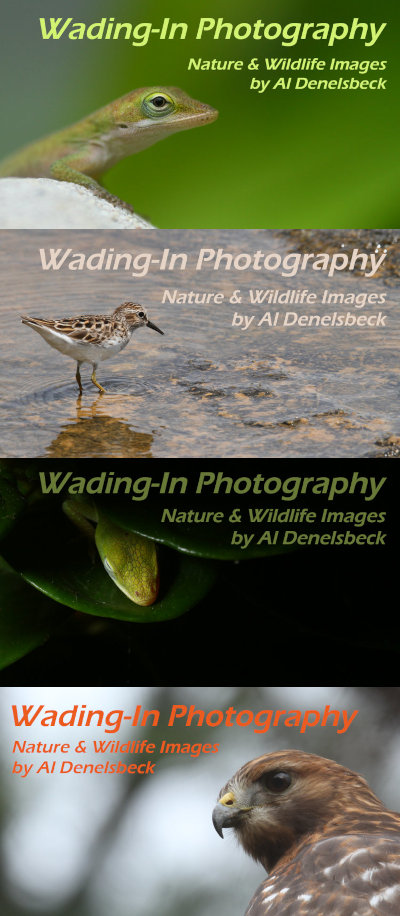
example business cardsIt’s actually been a while since I’ve changed them, and the last versions were done in Photoshop. I’m now using GIMP, which opens Photoshop files just fine, and have even loaded the obscure font that I like to use (Eras Demi ITC.) Except that Photoshop never could render that font in italics, so I had to copy it over from MS Word, and that disagrees with GIMP on what the ‘proper’ slant for italics is supposed to be (why is that, anyway?) Whatever – it meant I couldn’t just change the address, I had to retype everything. This also meant that I had to pick the font size that worked best too.

While doing all this, I decided that some of the older designs needed updating, especially with more current photos, and so I designed seven more, some of which are seen at right. Those were all easy, since the original photos all had not just adequate blank space, but low contrast and relatively smooth backgrounds that wouldn’t interfere with the laid-in text. Naturally, I’m aiming for complementary colors, and so I often try a couple different ones to see what stands out best. For most of the designs, this was a simple issue, and I’d like to think my choices are aesthetically pleasing, especially for the second anole image, the one that’s mostly black; the font color is actually a dark olive, but it seems to work well against the image itself, maintaining the ‘muted light’ and letting the anole head take precedence.

Now, how well does any of this work? Does it make the slightest bit of difference, and if so, how slight? Probably not much at all, but I do at least get compliments on my cards, so there’s that. Would any design, or other aspect, lead to more sales in some way? Not very likely, but at least they’re not boring or too simple. Though someone might say I’m too fussy I suppose…

[By the way, the actual cards have more info than this, but I tend to leave a lot of personal info offline so it’s not readily available to snooping assholes, in case this hasn’t been obvious.]

Occasionally, my choices have led to more difficulties, however.

two examples of cards with more cluttered backgroundsThe top one, for instance, had more contrast, a bit of clutter from the branches, and necessitated laying in a drop-shadow behind the text to delineate the edges more – I’m still not entirely sold on this one, but I’ll probably print it anyway. The bottom one is fine, but I made a small change: the background to the right, where the text goes, has been dodged a bit, lightened from the original image to let the text stand out better – you can compare it to the left side, behind the woodpecker, to see how it originally looked. It’s very subtle and doesn’t look altered at all, so it works for me.

[You may or may not have noticed, but there is definitely a tendency for subjects to be oriented to the left side and looking right, leaving the text over on the right side. I can’t say for sure if this reflects simply my choices for card images or if I really do shoot the original photos more that way; possibly a little of both, because it seems more pleasing to me like this. There’s probably something psychological to be found underlying this, and if I get really bored I’ll attempt to figure out what it is. Feel free to speculate.]

And a few times, I have to abandon my selections.

rejected card design with red-headed woodpeckers
Now, I really wanted to use this design, because it shows behavior and seems to me to speak more of “active nature photography” or something like that. I mean, I really do shoot a lot of nature portraiture, but I’d like to have more behavior photos. This one, however, just couldn’t be made to work: the details and contrast of the trunk simply interfered with the text and made it hard to read, regardless of the color choice – you can see that the trunk transitions between light grey and deeper shadow, with lots of fine dark details. It would have taken too much alteration to eliminate that; I’d already dropped one previous card design for exactly that reason, because I don’t think images that look too edited send the right message. There’s also the fact that the woodpeckers crowd towards the center more, but I couldn’t frame them better for the card proportions – it’s already against the left side of the original frame, and cropping tighter would trim off portions of the adult woodpecker. Some choices simply won’t work.

I admit we’re a bit heavy on birds in this post, but there’s more variety when the other designs are included; these are just some of the new ones. Still, a mammal card would be nice, but my stock is notably low on good mammal pics – they tend to be more nocturnal around here and thus harder to get. Yet, prompted by these thoughts just now, I started rooting through my beaver stock, and so far haven’t found anything that would work. They either suffer from poor lighting (see above about nocturnal) or too much clutter from the surroundings. I’ll keep looking, though. I’m not going to resort to deer, since everyone has deer pics – it almost suggests that I’m not very good if all if I have to feature those.

[Leave it alone.]

So, yeah, you might think it’d be simple, but it takes a bit of thought and effort to master a new set of business cards. Or at least it does for me…

Walkabout recommends: Hogfather

This has actually been recommended before, at about this time of year, and I’m a little remiss in not making this a full post, especially two weeks ago or more to give people a chance to get it on their own. You can get it rushed to you in time for the new year, at least.

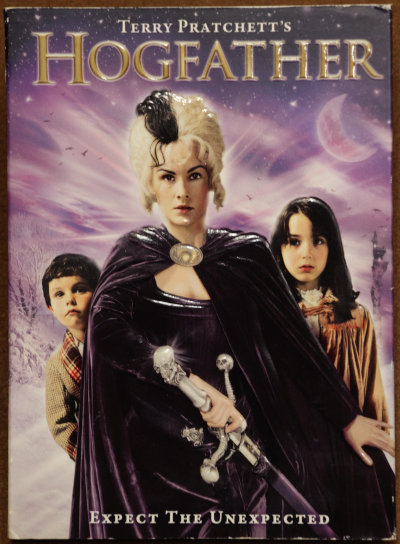
cover of Hogfather DVDThe movie in question is Hogfather, based on the novel of the same name by Terry Pratchett, an entry in the Discworld series. Now, this is a tall order in itself, since Pratchett’s writing doesn’t lend itself to easily making the jump over into screenplays, but one can be excused for being more worried that this was a serialization, of sorts, airing as a two-part episode on BBC television. I have to say, for converting a novel into film, this falls only behind Lord of the Rings in visualization, effort, and accuracy, while having a tiny fraction of the budget. Full credit goes to director Vadim Jean, but close on his heels is casting director Emma Style for putting together a fine collection of actors that fulfill their parts wonderfully. Getting Joss Ackland for Mustrum Ridcully (Archchancellor of Unseen University) was excellent, but Michelle Dockery (Downton Abbey) as Susan and Marc Warren as the quintessentially creepy Teatime are near-perfect for their parts. Perhaps the only weakness in the cast is Corporal Nobby Nobbs, because Pratchett’s vague descriptions of him are bound to provide the readers’ own views that are next-to-impossible to fulfill anyway, though Nicolas Tennant nonetheless does an entertaining version.
The reason that I say this is so late is that the Discworld has its own counterparts of our culture, and the Discworld counterpart to our christmas is Hogswatch, presided over by a jolly fat man in a red suit (driving a sleigh pulled by four boars,) the Hogfather. Only, there is a plot afoot to eradicate the Hogfather, which may have dire consequences for all of the Discworld. Now, the Hogfather is an anthropomorphic personification, in essence, imagination made real, just like the Tooth Fairy, the Soul Cake Duck, and Death itself, so one might ask how you could potentially eradicate such a ‘being,’ and Pratchett does a marvelous job of addressing this while opening up much bigger and more philosophical subjects such as the nature of belief. The film progresses through the gradual reveal of the plot machinations, and those with a short attention span might find themselves too confused too often, but patience is a keyword, because it all becomes not just clear in the end, but also an examination of human nature and cultural heritage. Don’t let me give the wrong impression, though, because the story remains paramount and its progression holds our attention while presenting us with the various parallel aspects of the Discworld.

There are two main caveats. The first is the runtime, which clocks in all told at 3 hours and 9 minutes, though it is helpfully broken into two parts and thus may be watched in two sittings as preferred – on DVD or streaming, of course, this may be broken down further. The second caveat is that it was produced in England and, despite this being a fictional universe, the dialect and patois are distinctly British – this is not out of place, given how Ankh-Morpork, the city where most of the story takes place, is remarkably similar to Victorian London, but it does present some challenges from the dialogue at times, perhaps most so from Ridcully (Ackland.)

Michelle Dockery’s portrayal of Susan is exemplary, gradually revealing the special properties that she is disinclined to acknowledge herself, but from her first appearance she displays her critical thinking abilities and no-nonsense approach to matters. Her involvement in the whole affair is perhaps not quite as reluctant as she maintains, and this does eventually bring her into contact with Death – though, not in the manner that you might imagine, and she has her own way of addressing such. Death (voiced wonderfully by Ian Richardson) plays a large and important role in this film, though not very often in fulfillment of its own duties.

The faculty of Unseen University (the Discworld’s premier college of wizardry) also plays a large role, especially when more personifications start to appear, and while Hogfather falls before the other novel in the series that I’ve reviewed, this one served as an integral aspect of the development of the faculty that culminated in that later novel. As I recall, there was more involvement of the wizards in the book than in this film adaptation, which could have been more entertaining it itself, but may also have been sidetracking a little too much, not to mention adding to an already appreciable runtime. ‘Hex’ is nicely depicted though, and there are a few easter eggs here and there for those who are paying attention. It was years before I discovered that Mr Sideney (Nigel Planer) was one of the main actors from The Young Ones. Pratchett himself makes a cameo appearance at the end, as well as being an integral part of the screenplay and production. Meanwhile, listen carefully to Teatime’s holiday wishes right at the end of Part One, and pay attention to the curtains near the very end of the film.

The special effects are not up to par with many other films of the era (this was produced in 2006, after all,) but are not bad in any way, especially for a made-for-TV film; I found the weakest aspect to be the sound effects, yet not in any way distracting. I would have liked a little more variety in the music as well, since the main ‘theme’ of the film repeats quite often, through the DVD menus as well, and it can stay in your head for days. On the other hand, the children that appear are more accurate than nearly every holiday movie out there, and two of the little girls in the department store are adorable, though your grandmother may not agree. In fact, the department store is likely my favorite scene throughout the film (well, scenes, since it is broken up among concurrent plot developments.)

Pratchett’s wry observations of culture and human nature come through from time to time, as evidenced by Death’s manservant Albert reminiscing about his underprivileged childhood, longing for an elaborate rocking horse in a store window:

Albert: Yes, I would have killed for that horse. But you know what? I still hung up my stocking on Hogswatch Eve. And you know why? ‘Cause I… had… hope. Yep. And the next morning, our dad had put in my stocking a little wooden horse that he carved his very own self.

Death: AH, AND THAT WAS WORTH MORE THAN ALL THE EXPENSIVE TOY HORSES IN THE WORLD.

Albert: No, ’cause you’re a selfish little bugger when you’re only seven. It’s only grownups that think like that.

Yet the real strength of Hogfather, and the reason why I’m glad this one of Pratchett’s novels was chosen for this treatment (a few others came along later, probably based on the response to this,) is that underneath it all, it examines how humans take our world around us and turn it into something else. I’ve posted about this before, but we have the tendency to almost dismiss what is in favor of what seems better to us, to the point that the facts of the matter can often be considered rude or ‘unfeeling.’ There are so many aspects of how we live in a fantasy and assiduously avoid reality that it’s almost disturbing, and while the story doesn’t decry this per se, it nonetheless hints at how often it occurs, and that it’s a facet of human nature. For better or for worse? Well, that depends on the ultimate effect, doesn’t it?

Hogfather has been a holiday staple in our household for years now, much better than much of the schmaltz that many people want to consider their holiday tradition, and perhaps you won’t adopt it in the same manner, but it’s at least worth a viewing to see an alternate depiction as well as a suspenseful crime story. And it’s a good introduction to the Discworld series of books, as well.

I’m not ready for this

We’re once more into the nonsense blog trivia that would interest, oh, perhaps 1.29% of the population, but you did catch the ‘blog’ part, right? Good.

Today marks the 57th anniversary of the first flight of the Northrop HL-10 lifting body, and I’d intended to have a project done by now, but failed in that regard. So consider this a prelude for when it is done.

The HL-10 was one of three lifting body aircraft developed by NASA as a precursor to the space shuttle program, and my favorite based solely on its appearance. A lifting body is an aircraft without wings, deriving lift instead from the shape of the fuselage, surprise surprise. The thought was to have a craft at the head of a rocket, but wings at the front of a rocket introduce difficult stability issues, so, no wings. The program was successful to a degree, but other issues meant that the thoughts turned to more conventional designs and moving the craft alongside the rockets rather than atop them.

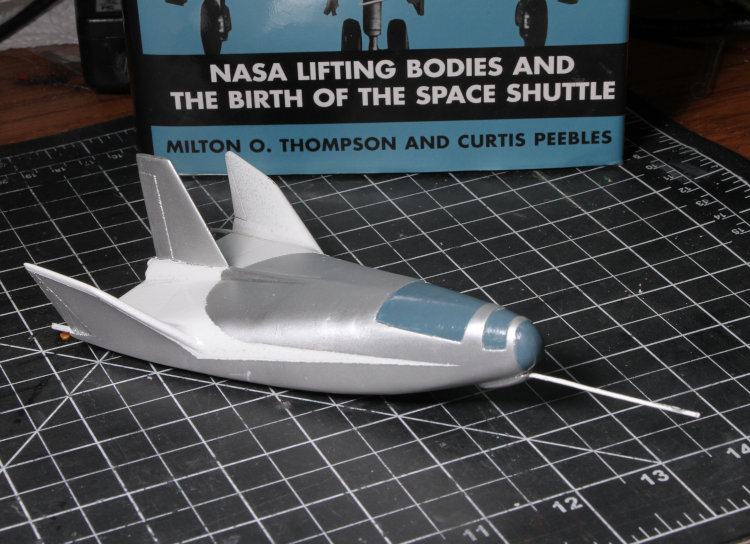
I’ve had the goal – obsession, really – of obtaining or producing a model of the HL-10, but the only production model was long out of production and expensive when found, not to mention a smaller scale than I wanted. I was slowly learning how to model it in software, which was going to be an absolute bitch due to the very fuselage shape that it relied on to function, when I came across this model from robert-ho and snatched it up. It was slightly off in scale and lacked some crucial details on those fins, which I clumsily remedied, and I produced a basic 3D print of the model:

3D printed model of the HL-10 lifting body, design by robert-ho
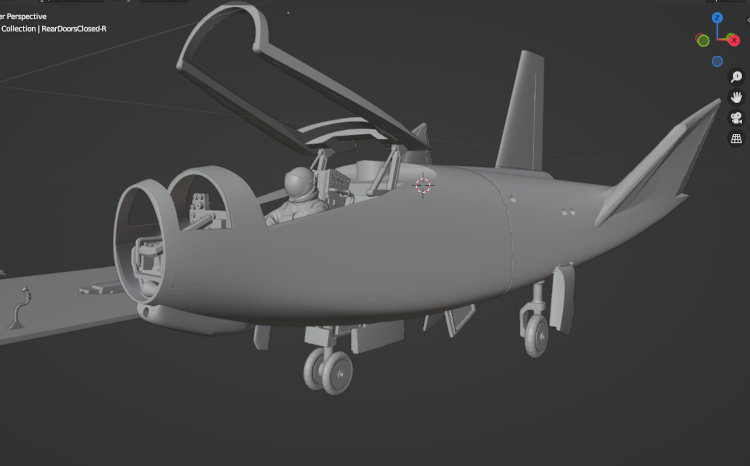
Which is great and all, but only the outer shell without much in the way of further details. Still, it got me past the difficult part, which was accurately modeling that esoteric body shape. Then I thought, I wonder if I could add in the details and make a decent static display model? A few weeks worth of work in Blender (a 3D modeling and animation program) followed.

modified design of robert-ho's HL-10 computer model
I readily admit to cheating a lot in here: the pilot figure, seat, controls, and landing gear were cribbed from other 3D models and modified to work. The pilot’s arms were especially tricky, since you don’t simply ‘reposition’ parts of a model without lots of issues.

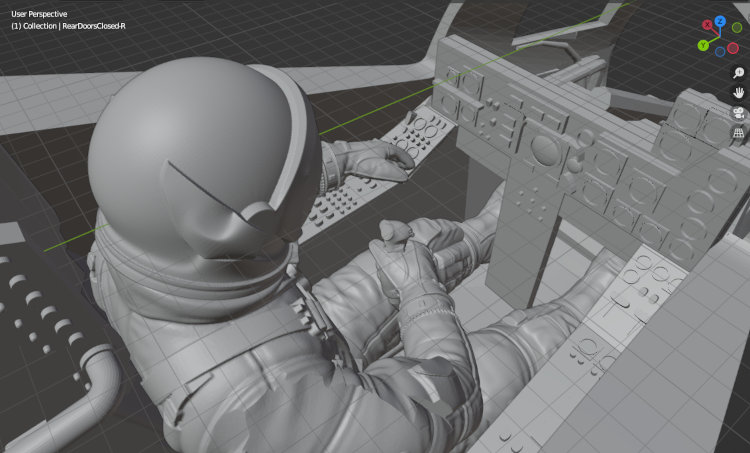
More difficult, however, was designing the interior, since few photos exist and the details in the nose ahead of the pilot are especially vague. But this does mean that the only people who can point out how wrong my stuff is are those that have seen the real thing in person. [The actual aircraft, of which there was only one, sits on a pole at Edwards Air Force Base in California, but raised and positioned in such a way that these details are not visible.]

interior detail of redesigned version of robert-ho's HL-10 model
All of the details in those panels, however, are all mine, as well as the greeblies ahead of them (that you can’t see much of here.) The intention was to produce a reasonably-accurate display model, able to be assembled in flight display or open-cockpit on the apron, as it were, and I finished this well before the move. I knew that 3D-printing this without major headaches would require an SLA/resin printer, which I did not have, and therefore shelved the idea for later.

About two weeks ago, with the printer now in my possession, I started the test prints to determine where the problems might lie, and was pleasantly surprised to find that the raw cockpit area with all of the attached greeblies ahead went through the slicing program without any issues whatsoever – it would just be a print of several hours.

[A side note: taking a 3D computer model and prepping it for a printer is called ‘slicing,’ and it’s naturally different for FDM/filament printers and SLA/resin printers, both with their own quirks in what’s going to present problems.]

I did do test prints of pilot, seat, canopy, and control panels, discovering as I did so that the pilot and seat and even the thin canopy worked just fine, but the panels were too thin to print well – not a hard thing to fix. But then I got into other projects and never got back to tweaking the design to reflect this, nor in testing out the other details like the landing gear and doors. So here we are. There’s also the issue of the cockpit glass, where two of the pieces could easily be flexible clear plastic from just about any packaging, but the frontmost dome is going to take some problem-solving – it will not print with clarity through any 3D printer, and might have to be vacuum-formed. With this in mind, I did create a printable mold for it, but do not possess or have access to a vacuum-forming jig. Even if I’d been on the ball in printing what I have, this dome would still have required more time.

But, it’ll be done one day, and I’ll show it to you. I will also likely be contacting the original designer to see if he’s interested in the modifications, since I cannot upload anything that I’ve done without his permissions, it being a derivative work. While many designs in the 3D community are open to ‘remixes,’ provided the original designer is credited, others are available only for purchase, like the original that this is based upon, and I’m totally cool with people getting paid for their work. This means I can show you what I was working on here, but not the files to actually print it. At least not yet.

Walkabout recommends: 1941

All right, it’s time to get controversial, because the movie we’re recommending here is widely regarded as a flop, a failure, unfunny, and on and on; moreover, it’s by Steven Spielberg, which makes it almost personally offensive to many people. Yet I have to say, I saw it when it first came out in 1979, and have watched it frequently ever since, and I have never seen the slightest justification of these views. Star Wars did not hold up half as well for me as the years wore on, but this one does. To a very large extent, far too many people are influenced by what critics say, and I’m convinced that a large amount of the ill-will this movie engenders is exactly because of this, repeated ad nauseum, and I’d be fine if I could see any of the points that the nay-sayers try to make, but I can’t.

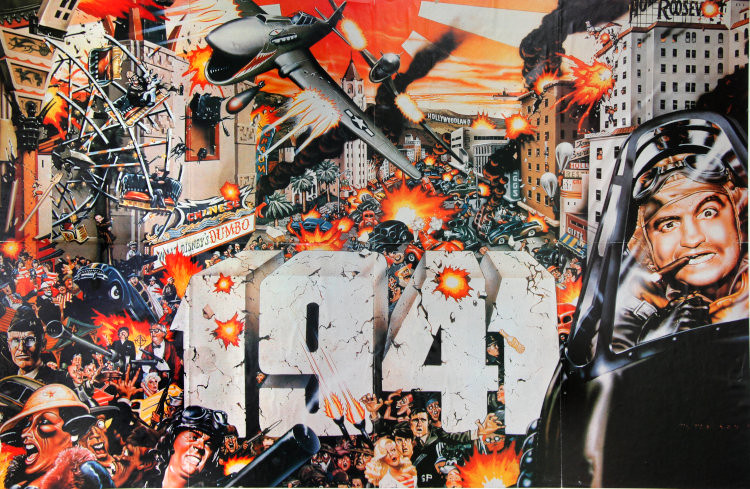
original promotional foldout poster for the movie 1941
The movie is 1941, a comedy starring a ridiculously large cast of notable actors; top billing is held by John Belushi and Dan Aykroyd of course, fresh from their Saturday Night Live days but before The Blues Brothers came out, though included within the cast are Robert Stack, Ned Beatty, Nancy Allen, Treat Williams, Dianne Kay, Warren Oates, Frank McRae, John Candy, Eddie Deezen, and many more… and then we have Slim Pickens, Toshirô Mifune, and Christopher Lee in there! And I can’t say that any one of them gave a bad performance – granted, it’s comedy, so believable characters aren’t the byword here. The style is just this side of slapstick, yet there is no mugging, no playing to the camera/audience, no tongue-in-cheek asides – the situations and dialogue are definitely warped, but the delivery is perfectly serious and deadpan.

The movie is set in the Los Angeles/Hollywood area just a few days after the bombing of Pearl Harbor, as war tensions were quickly giving way to paranoia. The residents are split between preparing for war, possibly an attack on the US mainland, and going on about their lives as before – some more than others. But a series of events begins to escalate the tension, and imaginations start running wilder, and this all builds towards a culmination where no one within really has any idea what’s actually happening. And here, writers Robert Zemeckis and Bob Gale demonstrate a lot of effort, because many of the factors within the film are historical; they are based on true events, though these were spaced out much more than the film portrays. Racial bias was very distinct in those days, and the riots between servicemen and Latin ‘zoot suiters’ were actual events, while anti-aircraft emplacements were strewn along the California coastline… and Hollywood really was originally named, “Hollywoodland.” Most notable, however, were two actual events from February 1942, on successive nights even: a Japanese sub shelling an oil refinery on the coastal town of Ellwood, California, and the following night, the infamous “Battle of Los Angeles;” it is quite clear that Zemeckis and Gale modeled much of the movie, and the entire third act, on these two bits of history (right down to the reports of a plane crashing on the streets of Hollywood.) Unfortunately, neither event is very well known and thus the comparison, and the fact that the movie is far less fictional than it first appears, often goes unnoticed.

This is an aspect of the movie that deserves some attention: almost none of the actions by most of the characters are out of the realm of human behavior – impulsive or compulsive, certainly, but it’s more the consequences that get out of hand rather than anyone directly producing the wayward results. It’s only Wild Bill Kelso (John Belushi) and General Maddox (Warren Oates) that are truly unhinged, and Maddox only has an effect when he comes in trivial contact with Kelso. Everyone else merely suffers from bad judgment or bad timing – it’s the confluence of events that causes the denouement to be so chaotic, while the individual factors therein can easily happen – and often have (see the link for the Battle of Los Angeles again.)

Despite being based on actual events, more or less, there is only one character that is named and based on a real person: General Joseph Stillwell, played by Robert Stack. And despite his out-of-character delight at the movie Dumbo, he is the lone rational player in the entire ensemble, repeatedly steering the others within his influence back on track almost effortlessly. This is exemplified when speaking to an officer over the phone regarding the air raid that was taking place:

Stillwell: Has anyone in your command seen these Zeros?

Officer: No sir – but we’re shooting at them.

Stillwell: Now I want you to think about something: Bombs! I don’t hear any bombs! If they’re up there, if they came all the way from Asia, don’t you think they’d bring a few bombs along?

Officer: I don’t know, sir, but…

Stillwell: But nothing! You can’t have an air raid without bombs!

This minor exchange is the epitome of critical thinking – not even intended as amusing, but still a favorite of mine just for that.

[The actual Stillwell, it must be noted, had nothing to do with units in or around southern California.]

As mentioned earlier, this film also possesses what is likely my favorite soundtrack of any movie, adeptly composed by none other than John Williams, and yes, it’s even better than the Star Wars films, because those stood alone. Here, Williams had to incorporate the feel and sounds of the era, from the tensions of post-Pearl-Harbor California past the triumphant military themes to the Big Band dance competition, and the choreography of the dance/chase/fight scene is exemplary. At the same time, numerous shots and framings are intentionally reminiscent of the popular films from that time period; as the hero and ingenue kiss atop the tank, the turret spins them around as the camera crane pulls up for the long shot.

The film was intended as a spectacle, as the movie poster implies, yet this was well before CGI, so the effects are all practical, large sets and models for much of it, and well done overall. Sure, the sharp-eyed IMDB fanatic will pick out small issues here and there, but there is little to take one out of the moment, and wherever possible, real vehicles and life-size sets are used – and, destroyed (it’s a war movie, after all.) And yet for all that, Spielberg, Zemeckis, and Gale included a specific, small detail: despite lots of destruction, no one dies or is even injured, save for perhaps The Dummy. At the very end, two of the characters that were ‘lost at sea’ can be found at the edge of the scene.

There are additional small easter eggs. Not only is the opening sequence a satire of Jaws (which Spielberg needed no permission to do,) it uses the same actress; the same can be said for the gas station and the proprietor, both originally appearing in one of Spielberg’s first films, Duel. Wally (Bobby DiCicco) is ‘beckoned’ to take command of the tank crew by Sgt Tree (Dan Aykroyd) in a direct homage to the 1956 version of Moby Dick. I was even suspicious that the line from Herbie (Eddie Deezen,) “Safety bar? We don’t need no safety bar!” was intended to refer to The Treasure of the Sierra Madre and contacted Eddie Deezen about this, who graciously replied and admitted that he didn’t know, and that I should ask Bob Gale; I could find no way to do so and determine this for sure.

Admittedly, some of the humor is contrived, such as when the tank turns too early and crashes through two factories in appropriate succession, but even then, the effort that went into the throwaway gag is enormous, entertaining to watch just because of the staging. I also find myself hard-pressed to find a comedy movie from any era that is not contrived; bear in mind that Airplane! came out only a year later. But in comparison to offerings like American Pie and even Dumb and Dumber? Neither of those can hold a candle to this film, and both had multiple sequels. What gives?

Perhaps the biggest shortcoming of the movie is that there is no character for the viewer to identify with, no real hero or island in the sea of chaos, though Stillwell comes closest – he does little, but avoids getting roped into the morass through sound judgment at least. And at the same time, there are no real villains; the two prime candidates aren’t actually dangerous enough to count. So the emotional involvement of the viewer is only to be entertained by the events and satirical aspects – which the film has in abundance. It is better written and better produced, many times over, than the vast majority of comedies from the past two decades, but… one of the things that it lacks is strong, repeatable quotes, which perhaps prevents it from entering into the meme consciousness like other films.

All that said, if you haven’t seen it, give it a shot. And if you have, re-watch it with a fresh perspective. I will refund you your wasted time if you still find it lackluster. But if you consider it a bomb, well, that issue’s all your own.

What game shall we play?

This is part two of the sordid mess; part one can be found here.

So with the design of the deck largely locked down, we had two main challenges, which don’t seem like they should be hard: creating games for the deck, and finding a name for it. Dan Palmer already had a few games past the conceptual stage and started play-testing a couple, but such things need refinement to find any issues, and they also need to be written out in clear form, easy to interpret and explain to the other players. If you’ve never tried this, I call tell you that it’s a lot harder than it seems, and writing clear, concise game rules is a skill that neither of us are adept at. I was probably a bit of a thorn in Dan’s side, in that I’m not fond of learning games through instructions in the first place, I don’t know why, and I kept kicking things back to him with various comments about reducing text and clarifying goals. I won’t say that, at this point, we have the rules where they ‘should’ be (whatever definition of that applies,) but they’re better than the first drafts for sure.

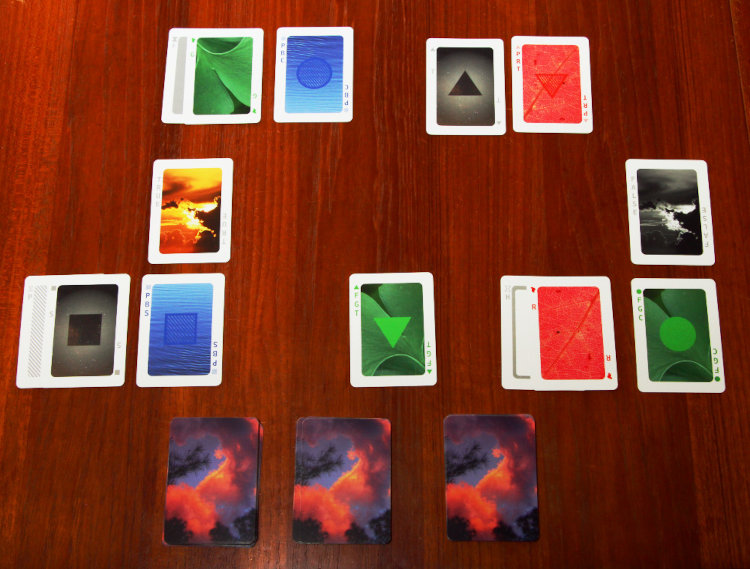
example layout of Gnomon playing card deck
There’s also play-testing, and this was problematic for both of us. I have extremely limited access to people who want to try card games, and in nine months managed two or three sessions of a round or two each, plus my playing alone as multiple players, and that was it. Dan had an advantage while college was in session in that he was connected to a group of gamers and could occasionally get a game into play, and in fact it was because of this that we received our first real encouragement. Some weeks after a test round, Dan was contacted by one of the players asking him where he’d gotten the deck, since the player had been all over the internet trying to get his own copy and had come up blank; no surprise, since it wasn’t in production yet. But it was great to hear both that he wanted one, and that he thought it was actually a professional product.

Which kind of segues into the second aspect, which was what to name it. There are a lot of considerations here, among them that it be unique and not already copyrighted (or too close to something that was,) that it not have undue associations, and that it described the deck in a useful and preferably clever manner. This went on for a surprisingly long time, but it’s where I get to relate the amusing interchange that took place over the course of several weeks.

Having noticed that all of Dan’s games (there were now several) began with the letter ‘C,’ I impishly suggested that we name it “C-Word.”

“I’m not naming the deck, ‘C-Word,'” Dan maintained strenuously.

“No, but we call it, ‘Seaward,’ instead – that’s not dirty,” I protested.

“But then we have to explain what it means,” Dan returned, “otherwise it makes no sense.”

“So we give the meaning someplace in the rulebook. After all, the games do all start with ‘C,'” I maintained.

“I’m not naming the deck, ‘Seaward,'” Dan semi-repeated [this is all paraphrased of course, but you get the gist.]

Nonetheless, I continued to refer to it as the Seaward deck, even giving that name to the resource folder on my computer. Dan on the other hand, at a loss when he needed to refer to it, simply began calling it the, “Benels Deck,” a play on my last name, so much so that his play-testing group started referring to it that way. There wasn’t a chance that we’d keep this of course, since it failed to meet any of the criteria save for being unique. Plus I’d had enough wordplay on my name in school (imagine that,) even though this was innocuous.

We rejected a couple of inside jokes, and I recall at one point suggesting “Sea Urchin” – it was an animal with nine unique letters, which references the categories within the deck, plus it worked “sea” back in there. This was quashed quickly when we found it was already an entry in Urban Dictionary – not copyrighted, but the association wasn’t ideal. We also both had a go at using the first letters of all of the categories within the deck: R, G, B, F, P, H, C, S, T. You’ll notice a shortage of vowels in there, so obviously we couldn’t use just those letters (unless we went with Welsh,) but they never produced a useful, even made up, name anyway.

It was getting down to the wire: the conference was in a few weeks, and we wanted to have a reference to some of the games available as a link; we ended up producing a temporary sub-domain just to have some stuff handy for the people who were reading the paper before the conference. I should explain in better detail: Dan had written a paper on the dimensions and possibilities of the deck for this year’s Bridges Conference on mathematical connections in art, music, architecture, and culture. He had attended last year’s and felt this would be a good fit. The paper was accepted, and the comments on it were encouraging, but this meant that we had to be more prepared than we were, and this is part of the fun of game design. You might have a good idea, but what do you do with it? Crowd-funding? Gain the interest of a major production company? Market it yourself (e.g., Etsy)? People expect games to have rulebooks and promotional materials and slick little boxes and even, hard as it may be to believe, names, and we had none of that.

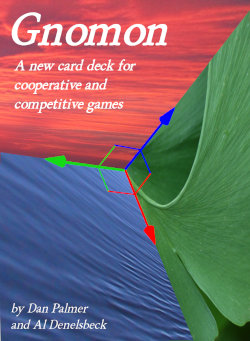
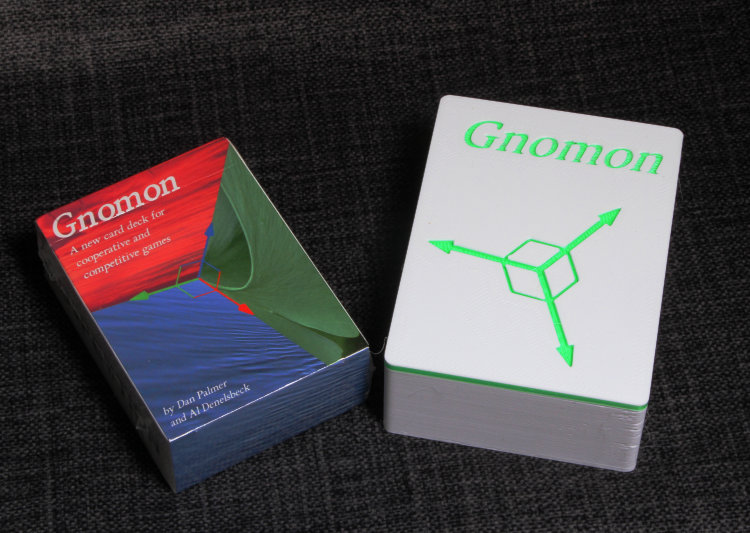
first box cover of Gnomon playing card deckIn the eleventh hour, Dan suggested “Gnomon” as the name choice, and it stuck. A gnomon is a three-dimensional representation, both as a shaft or column rising from a plane (which is why the shadow-casting piece of a sundial is named that,) and as the pointer within 3D software that helps represent and indicate the third dimension within the confines of a computer screen. Moreover, it wasn’t taken by anyone including web domains, had no bad associations that we ever found, and was unique. Within two days, we had the domain secured and the graphics of the tuck box for the new decks designed and ready to print. This was less than a month before the conference and we needed two weeks lead time to get a new run of cards printed.
Meanwhile, I was amusing myself by attempting some video, primarily of a play-through of one of the games, as a demo and proof-of-concept. It wouldn’t be for the conference, but successful videos would serve as promotional material, be available to help explain the rules, and would be necessary if we were to go the crowd-funding route. Even setting this up was a little tricky, since the camera had to have a clear and focused view of the entire playing field, and the lighting had to be adequate and even enough while not throwing glare from the surfaces of the cards; thankfully I had a heavy-duty lightstand and lateral arm to suspend the camera directly over the playing surface. It became clear, as suspected, that one-camera, one-take wasn’t going to work; we’d need close-ups from time to time, and separate audio voiceover was going to be a lot cleaner and smoother (especially when I was forgetting how certain rules went as I was dealing in front of the camera.)

test video still from play-through of Double Elimination game for the Gnomon playing card deck
Meanwhile, the new order of card decks with the tuck boxes had arrived, and they looked great – one could, if they squinted, almost believe that we knew what we were doing. And so they were available at the conference, for both demonstrations and sales, of which we made a few. Unfortunately, due to demands on time for both Dan and I, further progress is stalled for the moment – I expect to be able to do more after September at least, but for Dan it will be when he can squeak out a few minutes amongst other tasks. Still, we’re this far along and it isn’t going to stop now. Look for Gnomon at your local game retailer, oh, say, this time next year? Perfect for christmas buying, or all those people you know whose birthday is in September. And if you want one sooner, contact us.

Gnomon card deck and 3D-printed hard case
Gnomon deck in its new tuck box, with a custom 3D-printed hard case

Shall we play a game?

I could easily have been doing this as installments over the past, like, year and a half, but if I’d started, the gods of fate probably would have caused it all to peter out quickly. So we’ll have a couple of posts now, after things have played out a bit.

Starting premise: my friend Dan Palmer started talking to me about a new playing card deck that he was creating, similar to one we’d worked on a decade before; he gets the concept down, but it’s up to me (if I choose to do so, which is of course a given,) to do the graphics work. Up front, it all seems simple, but the finer details soon reveal that a lot of thought has to go into things.

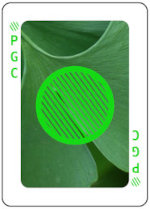
Gnomon deck PGC cardTo begin with, we needed background images which in essence were the three primary colors, Red, Green, and Blue, and ideally would be apparent what they were when examined, but not distracting and mostly just being a background color. Within these criteria, however, they could not clash with or disguise the symbols which would lay over top of them, also in those primary colors, which meant that whatever we chose for ‘Blue’ could not be too close to the 16-bit RGB value of 0,0,255, because the symbol would disappear against the background if this was too close. They also could not have any shapes within that might be mistaken for shapes of the symbols and thus make it confusing in any way what the card represented. This might seem like we’re being nit-picky, but it’s easy enough to glance too quickly at a card and make a mistake when you’re involved in playing a game. Not too long into the design process, we realized that the RGB value for Green (0,255,0) was actually too bright to be used, and switched to 20,217,20 instead. The background color decisions kicked back and forth for a short while, and in fact, we ended up switching the Red image after the first test printing of the deck.
Then came the fun of representing two characteristics of the card symbols. One set was Filled (solid,) Partial, and Hollow (outline,) and we played with Partial for a while before settling on a simple diagonal line pattern – easy to be told at a glance even at a distance, difficult to mistake for any other. Note, too, that each of the characteristics had to begin with a unique letter, because they would be represented by such in the card margins and, again, couldn’t be mistaken for any other.

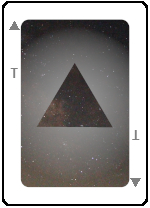
Gnomon deck Triangle cardAlso needed were cards to represent shapes of the symbols without any color at all, trickier that it sounds at first. So, a grey Circle, right? No, because that appears to be a Filled Circle, or even a Hollow one, so we needed a circle without any internal pattern. Eventually, we settled on a curious gradient shadow around the outside of the shape, over top of a starfield background, kind of doubling down on the ‘void’ concept. Because I do things like this, the center of the starfield image is actually the ‘center’ of the Milky Way, or at least the direction that it lies in Sagittarius.

Worst of all were the images to represent True and False, and I’ve even posted about this before. To date, we still haven’t really settled on how to visually represent these without resorting to tired cliches, and without having any misleading shapes or colors in there. For instance, in the running were solar and lunar eclipse photos, but they’re both circular and, in the case of the lunar eclipse, red. At one point I found an image of a nearby tree during a heavy snowstorm and thought the opposite would be in full leaf in high summer (we’ll let you figure out which one would be True,) but searching through my image folders, I found I didn’t have any such matching shot. No problem – it was summer, so I’d go get it right away. Only the tree was dying now and looked terrible. Scratch that.

[What we’re using now is an abstract cloud shot, mostly yellow, and its monochrome counterpart – we have yet to find or create images that seem to indicate “True” and “False” on appearance alone, but that’s why the margins have it spelled out.]

back image of Gnomon playing card deckAmong all of this sits what every designer and commissioned artist has to accommodate: the desires of the client. I submitted countless images for just about every aspect before we settled on what’s in use now, generally starting off with three or four choices but, for some, this went on for a while. Specifically, the image for the card backs was a challenge, since it had to be abstract and non-oriented, not easy to mistake for any of the face images, and not dominated by any one color. Eventually we settled on a sunset clouds grab shot that I actually obtained one evening while the selection process was ongoing. “Green,” however, was intentional manipulation, since Dan is a big fan of ginkgos and I knew he wouldn’t reject that one.
There was one mistake that we made, somewhat unavoidable in the circumstances. We’d done an initial printing of a few decks, and even a couple of very large, demo decks. But then I changed the background image for Red, and it looked fine on both of our monitors, so we sent it off for a larger quantity printing right before the conference. Only to find that the printing wasn’t quite in agreement with what we saw onscreen, which happens fairly often – you should always have proofs done for print jobs, but we were getting these done online, overseas I believe, and there wasn’t time for a proof and then a large order. So the red symbols don’t stand out well enough against the red background – they’re visible, but the contrast is low enough that from a distance they’re far less distinct. Now, we have redundancies built right into the deck: the cards all have identifiers right in the margins as seen above, so gameplay is only slightly hampered, but they could have been better.

There’s still more to the saga (sordid story, tale of horror,) but that will wait for another post. Once again, you can go to the site that we set up for the deck, but it’s terrible right now – we needed it for the conference and didn’t have time to do a full treatment, and still don’t. But it will give you a good idea at least.

Zero for five

For the past several days, I’ve been far, far away (well, about 150 minutes anyway,) attending a conference, something that’s been building for a while now. I do have to say, it went quite well, and if things go as hoped, this is only the start.

I’ve hinted at this before, and intend to go into it in detail in a few posts (from my own perspective, of course,) but the gist of it is, my friend Dan Palmer created a new playing card deck, and I was enlisted to do the graphics end of it, contributing snarky comments, rejected names, and bothersome questions pro bono. Along the way, Dan wrote a paper on the physics of the deck and submitted it for consideration of the Bridges 2024 Conference on mathematical connections in art, music, architecture, and culture, for which it was accepted and he was invited to give a short presentation there. I was invited along even though I’m inept on all five counts – I think I was the court jester or something.

The comments on the paper were distinctly encouraging, and the subsequent presentation on it went over quite well. The follow-up to this was having a table at the conference’s Family Day at the Science Museum of Virginia, right in the opening rotunda, which meant lots of people going past to see what was happening, and more than a few stopping by (and playing a round!) out of interest. Out of the four-hour session therein, there were only three periods when no one was at the table, and all of them lasted less than five minutes. Not only that, but we had people of all ages there – Dan has several games already developed for the deck and they range in difficulty and, most especially, between cooperative and competitive aspects. We have a basic website for it that we made sure we had available for the conference, and this can be found here – it’s terrible right now due mostly to time constraints, but it will be changing rapidly.

We weren’t really set up to do this properly, but we did get an offhand video of Dan’s presentation, which he has graciously allowed to be public, so I include it here – it’s only ten minutes, but it goes into how the relationships of the new deck work. Dan, literally, was working on new games overnight while we were at this conference, because that’s Dan.

The Mathematics and Design of a New Deck of Playing Cards from Al Denelsbeck on Vimeo.

We have to give credit to the organizers of the conference, which had widely varied subjects and presentations, along with some fantastic art, and ensured that everything went extremely well despite Richmond’s attempts to discourage car travel. We also have to thank all of the volunteers that showed for Family Day, including the two that assisted us, Noelle and Charlie (I hope I have those spelled right – I didn’t think to check.)

More will be along – we’re going in several directions right now, above and beyond our regular pursuits, so they’ll sneak in here and there – but the response so far has been gratifying. And if you want to know more, you know how to reach me.

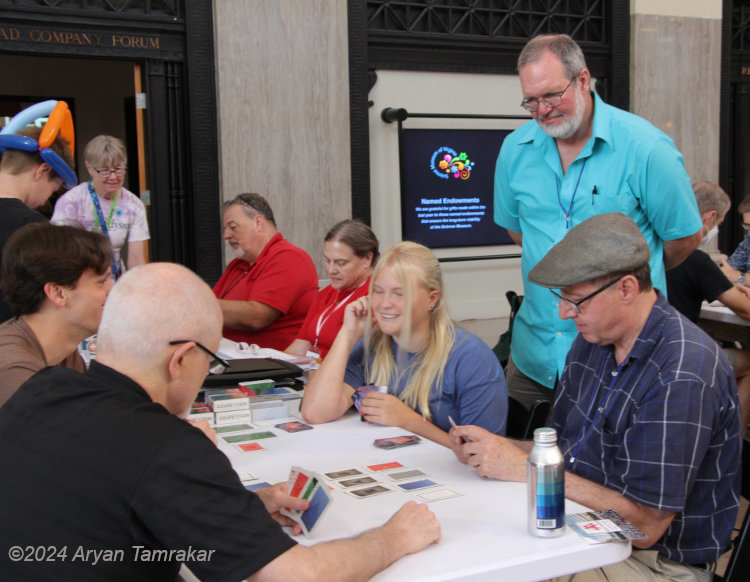
Dan Palmer and Al Denelsbeck at Family Day of the Bridges 2024 Conference, Richmond, Virginia
Dan Palmer (front, dark blue) and Al Denelsbeck (standing back) at the Family Day table for the Bridges 2024 Conference at the Science Museum of Virginia in Richmond; Glenn Hurlbert, one of the Chairs and organizers of the conference this year, is seated in the foreground in black.
1 2 3 28