It’s been a long time since the last ‘Just because’ post, and I am truly ashamed. Or something. I am truly something…
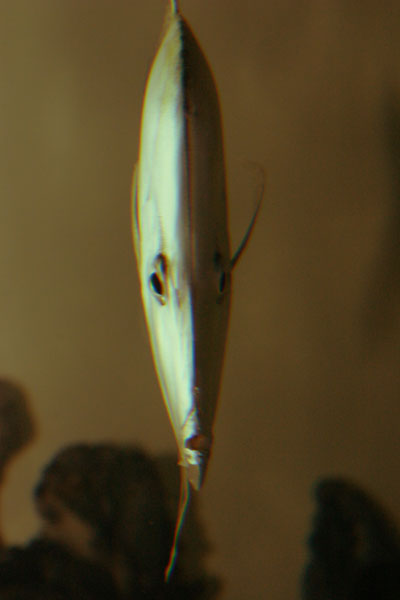
This one has been kicking around in my blog images folder for a long time. It had been sized this way for a particular post, and I can’t even remember which one now, or what it was intended to illustrate. Other than, of course, being weird-looking as hell. And that’s the interesting bit, because this is not edited or distorted or anything – it’s simply a face-on portrait of some unknown fish species, shot in an aquarium. It gains an edge to its surreality by the contrast in lighting on the sides, but that’s about it.
While our pareidolia can detect faces from some pretty farfetched subjects, there is also an aspect where faces that aren’t quite right can be disturbing – many people find that the attempts to make dolls and robots seem lifelike produces seriously creepy results. I think this one falls someplace in the middle: quite far from what we’d expect a face to look like, yet realistic enough in the eyes and mouth to trigger the shivers in some. It has this distinctly disillusioned expression, as if discovering that there are no snickerdoodles left in the jar after all. I’ve always liked it for those aspects, even when there are too few uses for it.
I actually took all of these photos before I shot the fossil rock for the previous post, but I intentionally posted them in this order to break things up a bit. It probably doesn’t help, but I get credit for the effort, right?
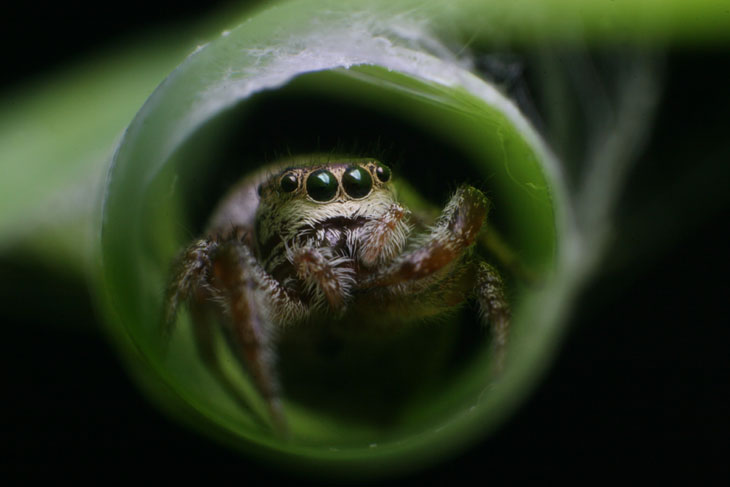
After the heavy rains Monday night and Tuesday morning, I went out to do a walk-through of the yard, and one of the first things I noticed was what you see here, a leaf of a sea oat plant (I believe, anyway) that had been rolled into this shape. I am quite sure that this had happened within the past several hours because it had not been this way when I went past earlier – the plant has been playing host to a few resident insects so I’m pretty familiar with it. Several different arthropods will do things of this nature, for differing reasons, but this one wasn’t hard to figure out at all, only requiring a peek down the end of the tube.
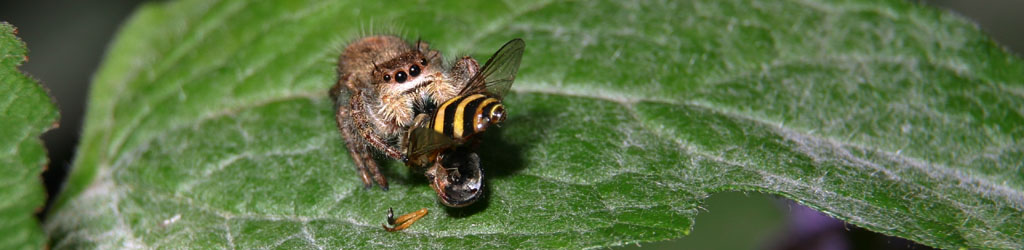
A jumping spider (unknown species, family Salticidae) had created a shelter by attaching webbing to the edges of the leaf and pulling it into this shape. Curiously, I’d seen this particular one less than two meters away the night before, recognizing from her swollen abdomen that she would be laying eggs soon. Naturally, I wish I’d been able to watch her make this shelter; this would require a lot of time spent simply following a spider around on her perambulations, with the very real possibility that she never would have started construction with the threat of a nature photographer hovering about. Plus I’m not sure I have the patience.
But since this is on a potted plant, I can probably follow along with progress from this point on, watching for the egg sac to appear and seeing how long it takes for them to hatch. The adult is in the range of a centimeter in length, so the newly-hatched young are going to be tiny. If it works out I will, of course, fill the blog full of more icky pictures.
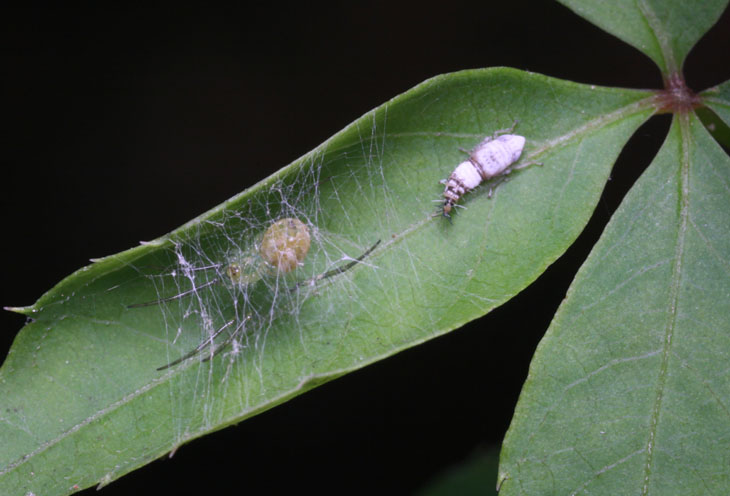
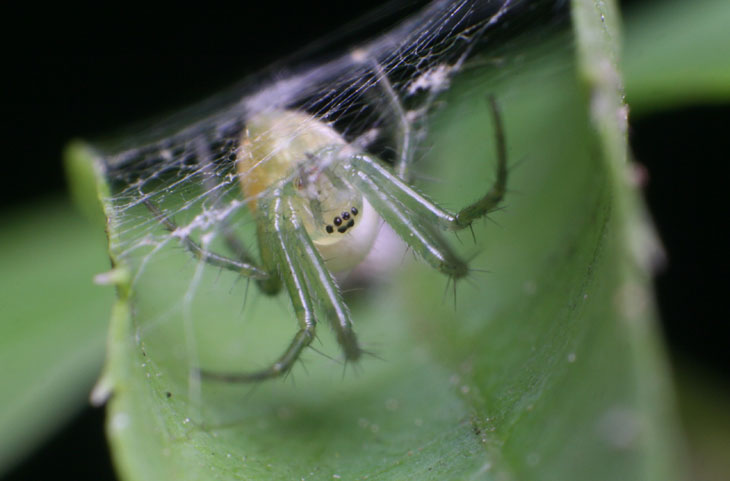
On a Virginia creeper vine (Parthenocissus quinquefolia) along the fence I found another shelter, this one not quite as concealing – and a close companion. The spider is most likely genus Mangora, though which species has yet to be determined (it’s very reluctant to give me a good look at identifying characteristics.) I know this will be a shock to you, but I went in for the portrait shot like I did with the jumping spider.
Going out later at night to try and gain more identifying characteristics, I discovered this one dangling from a short length of web beneath this shelter leaf, right alongside its newly-molted exoskeleton. Unfortunately, in setting up a light to be able to focus usefully, the spider panicked, dislodging the molted skin and scrambling back up to the shelter again.
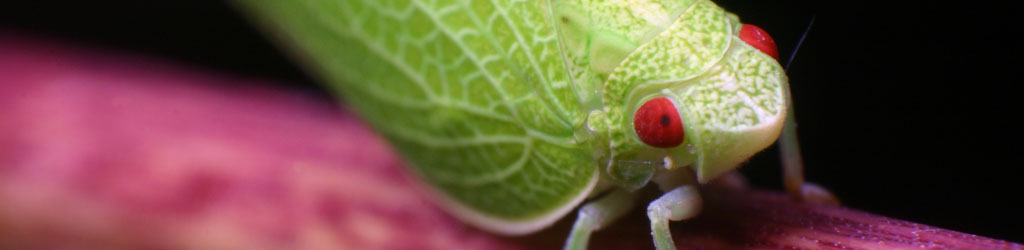
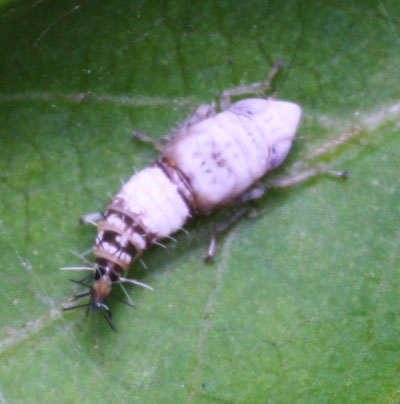
What I took to be a lacewing nymph nearby was, on close examination, a disguised leafhopper nymph, possibly a sharpshooter of some type. The tail is to the lower left, but I had taken this for the head, and it was contributing to this impression by waggling it slowly back and forth like a caterpillar foraging. When I looked at the images I’d gotten (this is a crop of the other photo further up) and realized I should get more detailed shots, the bugger had wandered off and was nowhere to be found on the vine or fence. You’d think it was sooo much to ask for a little cooperation…
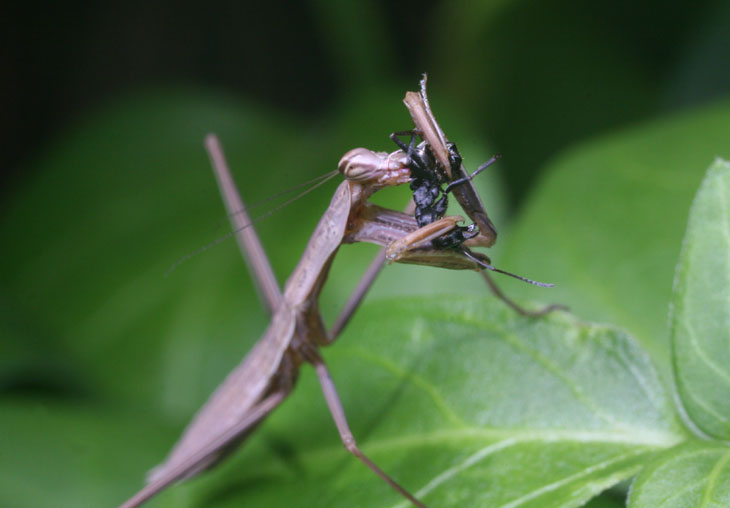
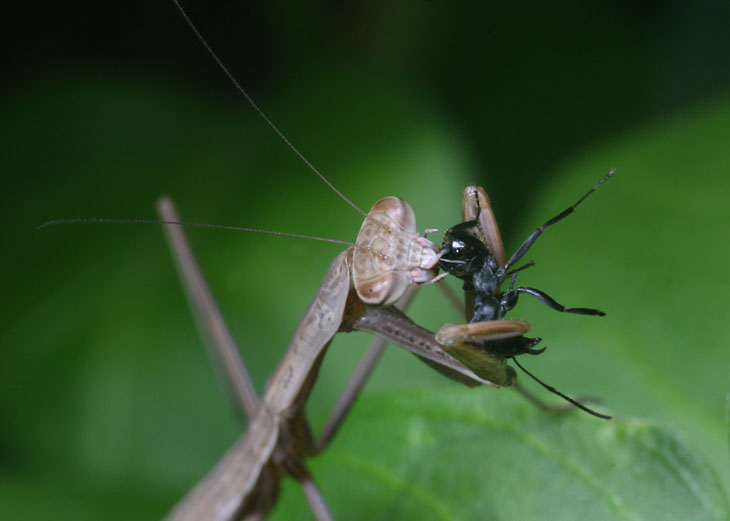
As usual, I’m keeping close tabs on the various mantids around the yard – the count had been up to five, though two have moved to different locations now and one, a tiny specimen that I suspect is a different species, hasn’t been seen for a few days. I suppose I could rename this blog to something mantis-related, seeing as how the tags of “Chinese mantis” and “Tenodera aridifolia sinensis” (the scientific name) are the most-used on the blog, but then I couldn’t feature treefrogs and religion-bashing. Better keep it the way it is. But anyway, after getting all of these shots I wandered out front to check on the mantids, without any intention of photos since I have a million. But one of them was in possession of a newly-captured black ant, still struggling in its clutches, so naturally…
When it saw me, the mantis scrambled for cover, but not very far, and as I leaned in closer it ignored me in favor of its meal, so yeah, the mantids are cool at least. The mantis was completely unconcerned with dispatching its meal before starting in, so the ant was struggling throughout this whole photo sequence.
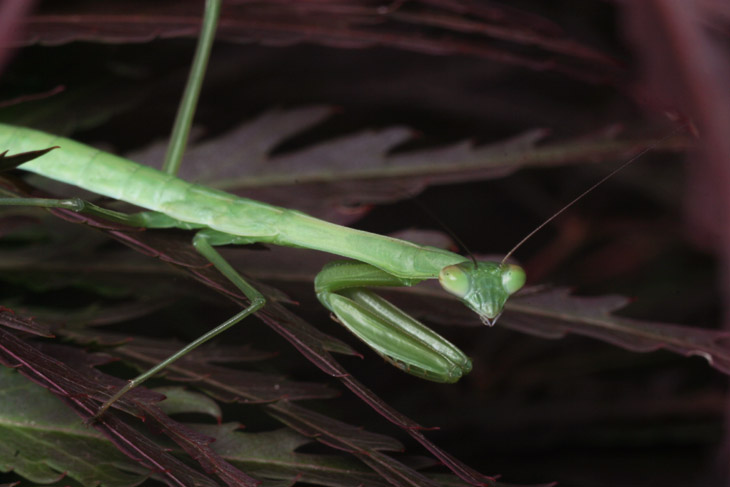
I have yet to determine what governs the coloration of mantises. This one had been hanging out on the Japanese maple tree, which is deep reddish brown right now, before moving to the phlox underneath that you see here. It has remained this tan color for at least one molt, probably more. Another on the same tree, slightly bigger than this one, has remained a brilliant green, well able to blend in with the phlox but so far never seen on it at all. Well, here – why describe it when I can illustrate it?
I used to think that they’d change color at molting to something that blended better, but the evidence is pretty strongly against this in my experience, so feel free to enlighten me.
Now let’s get back to the slaughter.
I got just enough frames for good detail, then left my subjects in peace (or pieces as the case may be.) I know that things tend to whittle down the mantis numbers routinely, and of course last year a stupid deer blithely dispatched my last subject, so I’m just going to keep an eye on things as they go along. Such is wildlife.
So, in the recent trip to New York (the state, not the city,) the schedule was tight and there were several obligations, so I had only tentative plans to get out to a couple of areas to do some exploring and/or photography, and they never came to pass. One of those plans was fossil hunting, since there are several areas close to where I was that were surprisingly easy to find fossils within.
However, when out with family on Owasco Lake, there was a channel bordered by huge stones piled up for erosion control, and my brother and I entertained ourselves by skimming over those to see what could be found, my brother taking the time to point out to my nieces and their kids how to spot likely fossil-bearing stone. I came up with a moderate-sized rock with an interesting pattern, a long narrow band crossing the surface with a distinctive difference in coloration and texture. On turning the stone over, I found a matching band of white crystal, and so, with a couple of heavy whacks against a big rock, I managed to split the stone open along the fossil which passed clean through it, revealing a probably-coral growth that had crystallized into something resembling white quartz, but with a couple of tiny patches of purple which put me in mind of amethyst – I’m not at all into geology or crystals, so these are only impressions. The half bearing the fossil had broken as well, and so one half went to my niece, and I kept the other. Unfortunately my niece got distracted and mislaid hers within the hour, so I gave her mine.
The following day at Cayuga lake, I was poking along a shoreline made up of more erosion control, only older and more haphazard, this being done by a homeowner quite a few decades ago to form the base of a dock. I was barely trying, but abruptly spotted a stone simply oozing (okay, wrong word) with fossils, about 15 cm across. The image here is not exactly where I found it, being a handful of meters to one side, but shows the conditions. The stones used were very likely all locally found, but not necessarily evidence of local geology; the Finger Lakes are glacially-cut, and some of the stones to be found in the area had been carried a long way by the glaciers. So while any rock found in situ, or at least near a matching rock face that it broke away from, will be from a rough time period, this cannot be considered indicative of anything loose, especially something that is noticeably different in makeup from other rock in the vicinity. The bedrock in that area of NY is from the border of the Devonian and Silurian periods, somewhere around 416 million years old, but the glaciers cut through much, much later than that. I made sure to take my find along with me, which got the attention of TSA because there’s no doubt it was noticeably opaque to X-rays – in fact, I would have liked to have seen what they came up with.
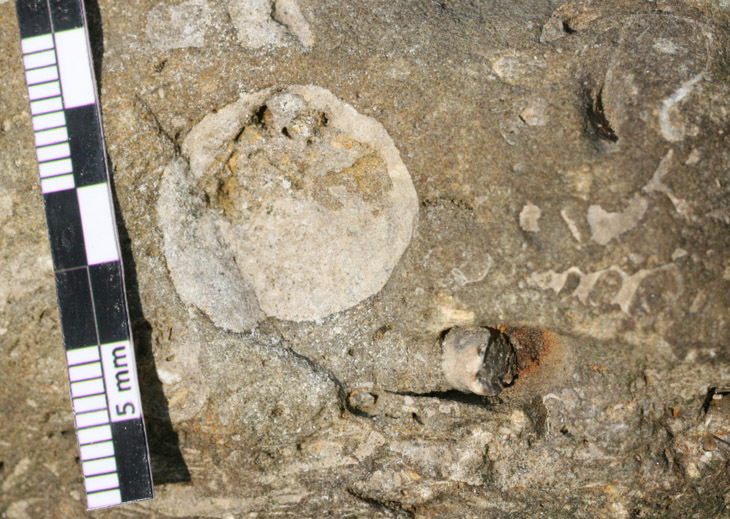
Seriously, it looks like some kind of tribal paint all over the surface, haphazard and with little cohesion, but a closer look starts to reveal the actual structure to be found.
That one in the center is pretty obviously a spiral shell cut through the middle, too uniform to lend weight to anything else, but those surrounding it are a bit harder to fathom. These are in line with the time period of Central NY bedrock, where much of the sea life was not too developed yet and land life was only simple plants and the first terrestrial arthropods – we’re talking waaayyy before the dinosaurs, and even well before Tiktaalik. Here are a couple of links for Silurian (older) and Devonian periods. However, shellfish of this nature have existed ever since those periods as well, and their durable calcium shells are quite commonly preserved, so I can offer no confidence in the age of this rock.
When examining the fossils above, I thought I had an inkling of what they were, but now realize that I was wrong. I had suspected they were cross-sections of either the typical spiral “snail” shell or the conical kind, but neither of those would produce such shapes, so I’m presently stymied. And all bets are off for the examples to the right. Yes, I’ve already considered trying to free them from the matrix they’re within, but this may take some time; it’s definitely stone, the consistency of concrete, and isn’t going to come away easily. Telling, perhaps, is the stone visible in the middle of the rings above. While almost certainly just in shallow troughs, it hasn’t fallen free on its own, even through all of the erosion that has produced the cross-sections in the first place.
Your guess is as good as mine in these cases, probably better. There are a lot of not-quite-random shapes to be found in this one stone.
This one has a crucial detail, I believe. See the rod-like fossil to the right, with the rust stain? That very likely is rust, and is one of the ways to spot fossils in the first place. Iron is a great element in a bloodstream, and so living organisms tend to collect it in greater concentrations than average, and it remains trapped within the rock until exposed millions of years later. This is one of two such stains visible on my find.
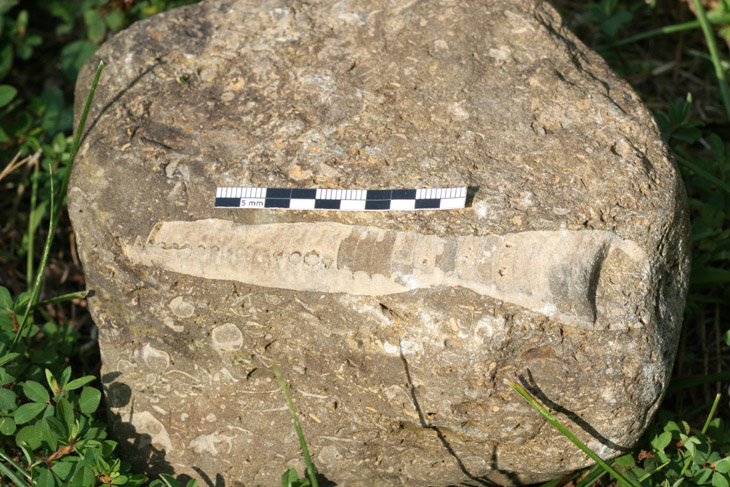
But the coolest part came when I turned the stone over.
No, it’s definitely not a snake, and probably not anything closely resembling one either. My first guess is a type of coral, but perhaps a plant stem. While nearly all of the fossil traces to be found on this specimen are even with the surface, wearing down in equal amounts from erosion, there are still some ideas to be gleaned from examination and considering things in three dimensions.
For instance, there appears to be some sort of internal structure revealed in patches to be found in those segments, but it may not go very deep within, since the neighboring portions look like the structures might have already eroded away. If we assume (perhaps rashly) a uniform thickness of the organism, the places where it gets narrow probably means it curves deeper within the stone there. I initially thought that the shape of the worn-away segments just right of center gives some indication that the segments are convex, each bowed out, which is why the stone has that little curved shape along the bottom (from our perspective) of each segment; the problem with that is, such a shape is not reflected along the body of the whole organism, where it should also have shown. Along the top, there is a suggestion of some notch or indent in each. I am interpreting it that the stone also fills the hollow ‘body’ of the organism, largely because the segments still have very distinct separations, which shouldn’t be there if, for instance, the organism simply lies deeper within the stone and hasn’t been revealed yet in those sections. Of course, I could be entirely wrong; this isn’t exactly my area of expertise (nothing is, when it comes down to that.)
If I ever sit down to start digging it away with dental picks and actually make any progress, I’ll come back and show off what I found. In the meantime, if anyone finds a good resource on identifying such things (or personally knows a lot more about this than I,) feel free to chime in.
This is one example of matching light to your subject. I often recommend that, when the light is bright and high-contrast, photographers should seek low-contrast subjects, and this is an example of the opposite: a high-contrast subject shot in low-contrast, near overcast lighting. The shadows are kept under control, but more importantly, the highlights don’t get too strong and start to wash out the colors, or worse, bleach out entirely to white. Delicate textures and contours can be seen easily, and all of the different colors still fall in the middle registers, being rich without fading towards white.
Shooting at f4 helped keep the two lower blossoms isolated in focus from background leaves, but the natural white edges of the primrose petals helped delineate them as well. Though it’s not like they would have gotten lost against the background colors otherwise…
You know, there are a lot of misconceptions about animal psychology and behavior out there, and they’re all over the map. I’m going to address a few of the more prevalent ones here, with the hopes of at least promoting a little more perspective and forethought among the topics.
Let’s get one thing out of the way right from the start: “animal” is a simple but broad definition that, yes, includes humans – not to be flippant, but we are not vegetables or minerals. More on this shortly.
Curiously, our own behavioral traits bear a lot of responsibility for these misconceptions, in two different directions too. The first is the egotistical aspect, hinted at above. We place ourselves quite high in importance, which is a useful survival trait, and not only separate ourselves from other species, but from other humans on remarkably arbitrary criteria. We look at other species that cannot talk or build bicycles and find them “lower,” unworthy of our awesome status. We are the only species with “culture” and behavioral standards (or so we often believe,) and thus, when we see critters that mate right out in public or won’t say, “Bless you,” when we sneeze, we find them savage and unworthy. Therefore, calling someone an animal is usually an insult to varying degrees, except for those overheated occasions when it’s a naughty compliment (lots of psychological angles on that alone, but we’ll leave them for another post.)
Yet a lot of our own behavior is cultural, which only exists because we’re inordinately focused on what other people think. Saying, “Bless you,” is remarkably stupid, for countless reasons, but it’s not hard to find those who agonize over the necessity of it following a sneeze – because they think everyone else expects it, and this is pertinent somehow. Not exactly an example of higher intellect, though. And there are other cultural influences as well, such as the religious angle that mankind was created with a special status, a separation from “the animals” [get used to a lot of sarcasm-quotes in this post] and of course the special intentions and attentions from the creator. Much of the resistance to evolution in this country focuses on this perspective and the distaste this fosters for those lower life forms. But we are not in any way distinctive in terms of life on this planet – while we have traits that are unique to our species, so does every other species. From an ecological standpoint, if a species is surviving, it has the necessary traits and behaviors for its niche in the system. And for all our vaunted intellect, we’re in a constant battle with microorganisms – seriously, viruses! Not even able to move on their own, yet capable of killing us by co-opting our own cells against us. Let’s not let our egos carry us away.
I feel the need to mention that nothing we do on this planet is “unnatural,” either – we weren’t introduced here by aliens or whatever. Having distaste over pollution and industrialization is fine, commendable really, but this doesn’t make them any less a part of the ecosystem than the devastation wrought by “pest” insects. It would be nice if that intellect we treasure made us capable of preventing the bits we find distasteful, handling our garbage and overcrowding in much better ways, but we’re also pretty focused on convenience, for all the importance that has…
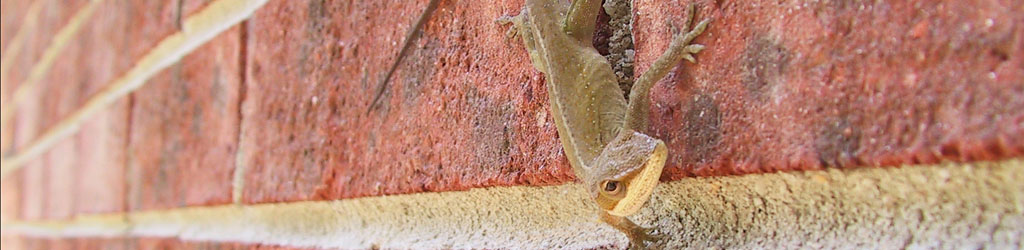
While my previous use of this image implied an introspective air, this green anole is not only well aware of my presence, it had dashed to this area for safety and was examining other routes of escape at this moment And then we have the other behavioral trait that leads to so many instances of misconceptions and bizarre expectations, and that’s the assumption that other species actually think like we do. This appears everywhere, from those who get frustrated because their dogs are not following instructions to those who find some spiritual bond with dolphins or whatever. Let’s be direct: there are no other species that think like we do, and no reason for them to do so. They have their own demands for survival, their own behavioral traits to assist with this. There are, in some cases, analogs of human ideas. Singular examples of two different species might become “friends,” or at least, enjoy and prefer one another’s company. Dogs can display recognition of particular words. Yet it’s important to realize that not everything is as we interpret it; dogs are far more likely to respond not to words, but to their delivery, the apparent emotions behind them, and the patterns of our own behavior, since dogs are far more attuned to behavior than speech, which they have no use for nor the areas of the brain necessary to comprehend them. Their environment, bred into them for millions of years, embraces pack behavior above all else, which requires reading the unspoken cues from others within the pack, but with thousands of years of human-directed breeding, this is often packaged with herding instincts, or chasing down particular prey, or aggressive defense of a territory. While we might gauge behavior from a standpoint of abstracts and language, dogs will usually gauge their behavior on pack dynamics and whether some action warrants a specific response. Part of the difficulty is, we honestly don’t know, and it’s only through some esoteric tricks that we can have any inkling.
Look at it this way. A significant amount of human interaction can revolve around not knowing whether someone’s comment was innocent or snarky, an unthinking rejoinder or a calculated slight; we spend a lot of time “reading between the lines” to try and correctly interpret words that we have firm definitions for. Step into another culture, and we may provoke grave offense from being unaware that showing the sole of our foot to someone is insulting there, which bears just as much fault from the people within that culture not understanding that we don’t interpret the gesture in that manner. To think that we can confidently interpret the thought processes of other species is being remarkably naïve.
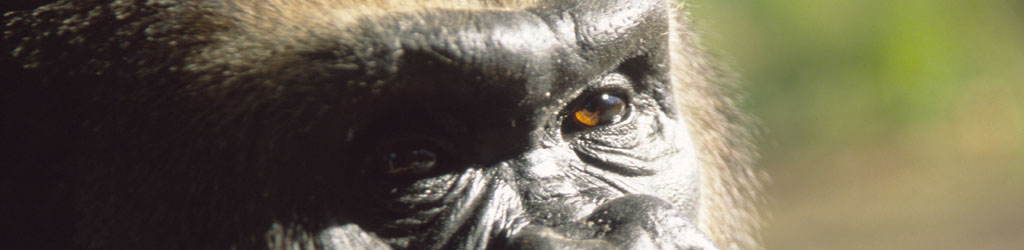
Moreover, the vast majority of it is simply wishful thinking. While we might like to believe that Koko the gorilla recognized Robin Williams’ unique traits enough to actually be sad at his passing, some critical examination is definitely called for. A lot of species might have recognition of positive interactions with another species, or just individuals therein, and this may truly result in some regret when the interaction ends. Is it safe to call this “friendship,” or any analog thereof? That’s probably jumping the gun by a significant margin, especially considering all of the implications and assumptions that the term fosters within us. And did Koko place Robin Williams higher in “esteem” than anyone else that engaged in tickle bouts with her? How often does it occur to anyone to even wonder about that? We cannot, in good science or good conscience, view this interaction through the perspective that we view interactions within our own species. Hell, even a human toddler informed of “bedtime” may erupt into an end-of-the-world tantrum, all out of proportion to the nature of the offense – we may be used to it, but not really understand it (or some other behaviors as well,) and this is our own species.
From my years working in animal shelters, I had plenty of exposure to feral cats – domestic cat breeds that had adapted to living on their own in “the wild.” I had a basic guideline measurement for kittens: if they’d reached four months of age without human interaction, they were highly unlikely to tame down to being a house pet. At all. In fact, two of my former pets were cats specifically on this border, who I’d taken home and fostered to try and get them used to people. One took to me well but remained wary enough of strangers that I didn’t believe she would ever get adopted when brought back into the shelter; the other remained somewhat spastic her entire life – 16 years, and still capable of hissing at me in alarm if I walked into the room suddenly (but otherwise normally affectionate.) Bear in mind these are a species that has been domesticated for thousands of years – it doesn’t hold a candle to the millions of years of developing survival traits, and is testament to the idea that acceptance of humans is likely more conditioning since birth than an actual trait the species possesses.
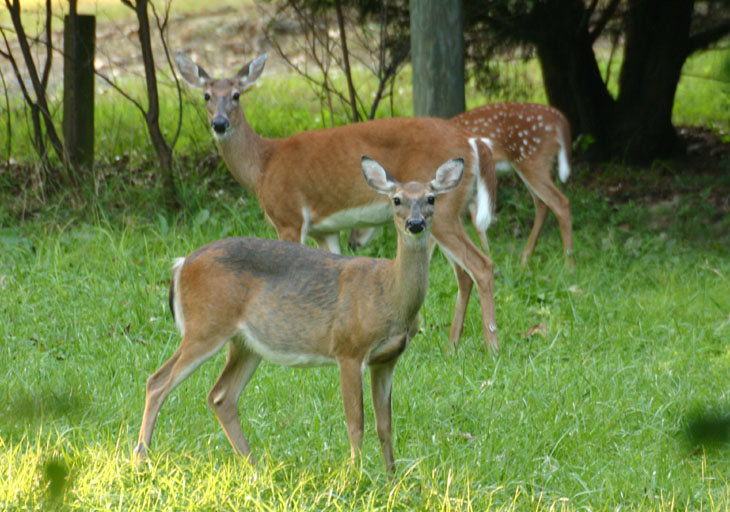
Most other species, of course, have no such conditioning, much less the domestication. They live in environments where danger is frequent, and their interactions among their own kind is geared towards that which is specific to their niche in the ecosystem. Humans have tribes, and require a cohesiveness for cooperative functions such as hunting, harvesting, and maintaining large scale shelters, which now extends to grocery stores and maintained roads. We might feel a parallel with the herding behavior of deer, but these are only weakly related; deer have specific ideas of who belongs in the herd and what behavior is acceptable therein. They also have specific ideas of defense, used against dogs and coyotes and wolves and even other deer, and are quite capable of wielding these whenever they feel it’s necessary – and unless we’ve spent a lot of time observing deer (while asking, like Koko above, exactly what we’re observing,) we can never be sure when we’re crossing the line until the attack comes. That’s not really a good time to find out.
We can’t, naturally, use our own judgment as to what will trigger defensive behavior, because we inhabit different environments with different demands. The concept of “too close” depends on how fast the threatened species can run, which escape route is the best, and wildly variable factors such as whether young are involved or whether it’s mating season. These might seem obvious – we’ve all seen nature documentaries, and know not to mess with bear cubs and all that – but one of the biggest stumbling blocks is never having the presence of mind to even think about it. Far too often, we can see some species and think, “Awwwwww,” reacting to appearance without engaging in rational examination. We believe that approaching a trapped or injured animal will be viewed with appreciation because we’re only trying to help it, and somehow the animal will not feel extra-threatened because it is far more vulnerable. We examine wildlife with the assurance that “it doesn’t look angry,” without having the faintest idea what angry looks like. Also quite often, we figure that we’ve gotten this far and nothing bad has happened, so it must be okay to go further. Just thinking about that for a moment reveals the absurdity of the conclusion, but it takes that moment of thought.
Worse, far worse, are the claims of “spirituality,” and “connection,” and any related ideas where humans somehow have a bond or mystical attachment with any other species. Addressing the mindset which leads to such conclusions would take far more effort than I’m going to put into it here, and far more experience in psycho-analysis than I have, so let’s just put it simply: it’s horseshit. We’ve been studying animal behavior for a long time, and have determined some very nuanced aspects, and nothing whatsoever has come up to support some paranormal method of bonding or communicating with any other species, even as we have discovered how many species can detect magnetic lines and just how sensitive their olfactory receptors can be. Evidence of how often humans can misinterpret awe and desire as something transcendent, however, we have abundant examples of, millions. The problem with such egotistical beliefs is that they provoke people into ignoring everything that rational thought can tell them, every advantage that big elaborate brains can provide, in favor of some base emotional prod that only spells misappplied survival instincts. But if it helps, had humans or our ancestors ever developed the sense of bonding with any species in order to approach it safely, it would have eliminated the need for hunting with weapons – at least until the same species evolved away from believing that shit.
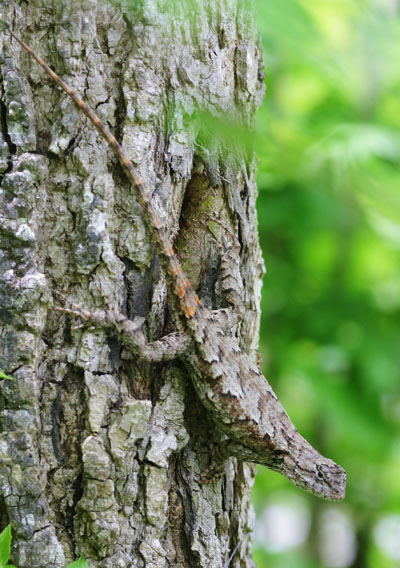
This Eastern fence lizard isn’t motionless because it doesn’t see me as a threat, but because it’s camouflaged, and many predatory animals are attuned to movementAt the risk of selling a lot of species short, here’s a basic guideline to follow: assume the worst, and credit any species only with base instincts. There are three main survival factors, and these carry all the way ‘up’ to us: finding food, escaping predation, and reproducing. Even as we watch cats play, we can recognize that the very same actions are reflected in hunting; we can watch dogs play and realize, with a sharp eye, that they’re determining where they fall in this new pack that’s been developed within the dog park. Any and every wild species that we encounter is going to consider us a threat, mostly through long experience. I may be castigated for making such blanket statements, and I’m well aware that there are exceptions; the point is, exceptions are rare, and counting on them is stupid. By starting with low and simple expectations, we are more likely to build up to an accurate evaluation of species reactions and/or intellect than if we start from our human assumptions. The birds that come to our feeders probably do not recognize us as harmless – they may simply weigh the availability of easy food against the (so far) low level of threat that we’ve displayed. The deer wandering through a residential neighborhood are not “cool” with humans; they’ve simply adapted to a new set of circumstances through necessity. In no way should these be interpreted to mean that there is no longer a line to cross, that the point of a dangerous defensive response has disappeared – it has merely shifted, and can shift back again much easier because the evolutionary path that established it over thousands of years has greater influence than a few weeks of experience. It is safe to say we will witness the most adaptation from mammals, and considerably less from birds and reptiles, simply from the hugely different structure of their brains and the nature of their decision-making processes. Insects are, by extension, a complete write-off; expect no conditioning or behavioral changes of any kind (being an arthropod photographer kinda made me throw this in – I doubt anyone is bonding with bugs.)
From a photography or even naturalism standpoint, understanding the different perspective that animals will have on any given situation is important, yet difficult. While there are tricks to help improve results, they remain only tricks, and do not provide a lot in the way of understanding the behavior of any species (especially when the “personality” of any individual is as variable as humans can be, even when some overall traits can be found within a particular species.) Scientists like Jane Goodall do not spend decades in careful observation because fathoming animal behavior is a quick and easy skill to develop.
Notably, the awe we may feel, the kinship, the connection, should immediately be considered suspect, rather than believed or indulged. Humans have no reason nor useful function in possessing such a bond, nor does any species have a reason to possess one in return (and as a moment’s thought will demonstrate, it would probably be extremely detrimental to most – while a bond with any particular individual might be beneficial, bonding with our gun-happy neighbors is not.) The species that have become domesticated have done so over thousands of years and, in most cases, can switch back very quickly – witness the feral cat, dog, horse, and pig populations that can be found in various locations on the planet.
And for those on the other side of the coin, that feel that “animal instinct” is somehow a derogatory term, recognize that evolution tends to be pretty efficient. Every species alive right now has what it takes to survive within the ecosystem, even when it may not last much longer for a few of them. While no other species but us can play with smutphones, they don’t waste ridiculous amounts of resources in producing and maintaining these toys either, much less provoke the mass extinctions that we do. Those with insecurity issues might feel the need to sneer down upon other species, but the rest of us can accept the life on this planet as it is – perhaps with a little extra effort and examination.
Every once in a while someone remarks about how many frames I take, or why it might be necessary to take more than one of any given subject, or most especially, whether they should be doing this. It all depends on what one wants to get out of their photography, and what their end purposes are, but the answer is, “Yes.”
Took care of that one easily. Next post.
Okay, sorry, let’s look at it in detail. First off, there’s always the possibility that autofocus wandered to the wrong point, or with moving subjects, you captured a frame where things simply didn’t look optimum. Then, there’s the idea that subtle changes in position (especially in macro work) can produce subtle but notable changes in the framing and background. Also to be considered are things like minor differences in lighting, perhaps from changing the strobe angle, or maybe because the clouds are shifting or the shadows are being thrown differently across your subject by waving branches. And then there’s the simple possibility that what you originally envisioned doesn’t illustrate your idea as well as you liked. Let’s take a look at a few images I shot last night to see what I mean.
This newly-budding cherry tomato, still retaining the flower petals that provoked its development, appears pretty much exactly as I wanted it to, even capturing a faint sheen of dew across the surface. The light angle is not quite direct (see highlights on leaf, and shadows to right,) but shows everything well and produces no shadows that hide the detail I wanted to display. Yet, the first frame I took was slightly out of focus, because this is a tiny subject and I cannot stand absolutely still, so I swayed ever-so-slightly out of position as I tripped the shutter – with high magnification, this can be movement as insignificant as a millimeter or less. Even looking at the camera’s LCD as I went along wasn’t enough to tell me that the focus wasn’t bang on. But then we come to the possibility that the image isn’t even illustrating the idea that I had as well as it could have. This is much more crucial when you might be working to someone else’s ideas, such as shooting for a publication of some kind. In many cases this can be demanding, because an editor may not want the black background, or needs a horizontal format, or something that gives a better impression of scale or stages of development.
So then you might take a few different approaches, notably if you have options available to you. While I wasn’t going to get a better background last night, there being nothing close enough nor tall enough (this plant is actually over my head) to fill in for that darkness, I could have shot the same scene in daylight conditions to change the whole appearance. You might have noticed that the light angle changed by reversing the strobe, and that the one tomato from the previous image is now almost hidden away down in the corner, receiving a much less useful light angle and position in the frame. Yet, the context is more complete, a better sense of scale has (possibly, anyway) been produced, and more stages of tomato development are displayed in one image. Also, rather than being a mere illustration, a more artistic air has been produced, slightly more dynamic – some people might even find this a worthwhile art print (yeah, there’s no accounting for taste.)
One thing that I missed is how some of the petals are cut off slightly by the frame edges. This is the entire image frame, so I screwed up slightly; I could have shot a little wider and had open space all around, and even shooting a bit wider than that would have given me options to crop as needed. This is something I often tell my students: shoot a bit wider than necessary (in other words, from farther away, or with the subject a little smaller in the frame if that helps.) You can always crop tighter if the image calls for it, but adding in the extra space is a lot of Photoshop work that you don’t want to do. Also, this can help in getting ‘routine size’ prints done, especially for portraits and weddings and so on. The standard image frame for most cameras is a 2×3 ratio, which translates to, for instance, 8×12 inches. But finding a place that routinely prints at 8×12 inches can be difficult, and finding a wood or metal frame to display the prints harder still – the standard yet remains 8×10 inches, which would cut off a significant portion of the long aspect. This image, for instance, just couldn’t be cropped down to that effectively – luckily, I can choose my aspect ratio for the blog without worrying about standards (but you already knew about my lack of standards.)
Now let’s take a look at how subtle changes in position work. This mantis was perched on a pokeweed plant, and I purposefully positioned myself to capture the budding flowers in the background as a framing element. Take a look at how the flowers offset the mantis, and how much of the underlying leaf is shown, and even how the antenna appears in the frame. I didn’t even change the lighting, nor shoot any horizontal formats for this, but still have a variety of appearances to choose from. Chances are there’s one you like better than the others, and it might not be the one that I like. While most of the blog and site reflect my own preferences, if you’re looking to sell your images, it’s better if you meet with your client’s preferences instead, and this might mean several different options. These are very subtle changes compared to what could have been done easily, but they illustrate how much of a difference such subtle changes produce.
When using film, this could mean firing off half a roll or more on one subject, not counting the frames that were misses and simply discarded – but one sale offsets that easily. With digital of course, this becomes far less of an issue, or so it seems – the primary difference is storage space on hard drives (yes, plural – you are maintaining routine backups, right?) However, the upfront cost of digital bodies has to be factored in too, especially if the photographer is one who feels obligated to keep chasing every new upgrade that comes along – pointlessly, in my opinion. And the truth is, people often hose around the frames with digital, secure in the knowledge that “it doesn’t cost anything.” There’s nothing terribly wrong with this, though to excess it shortens the life of the camera body, but it may end up working better if you’re selective about making the image right the first time rather than counting on ‘the odds’ to produce a right one from a batch. With fleeting subjects, this increases your chances of having a useful image before the subject changes or vanishes.
So, yes, this means there’s a balance point, which is true for most of photography, and you’ll have to find that which works best for you. While you have to gauge your habits to your intended usage, my primary advice, is, take enough frames to get the shot you want, and most especially, to make the sale you’re after. And, ‘too many’ remains better than, ‘not enough.’
The purpose of these weekly posts was to present a splash of color, originally in the winter when such was scarce, but either way just as a cheery visual thing. I’m not sure how well this works when the color is from a cluster of tiny spiderlings, but if you haven’t determined this about me by now, well, it’s par for the course.
I haven’t identified these, but they look to me like a type of orb weaver – there’s a species that’s very common around here that I’ve photographed countless times, but it seems I’ve never posted a photo of such so I can’t point you to what I suspect the adults look like. That’s okay – you wouldn’t have gone there anyway.
It was an interesting sight when I found it while on a hike, a ball of yellow suspended in midair among the leaves. Without the macro lighting rig, I shot a few frames freehand in natural light and got a few keepers, so, lucky you.
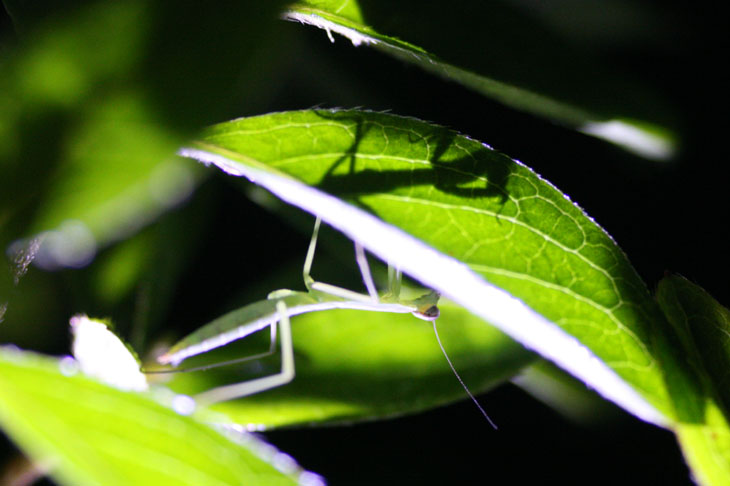
After the rains, I went out to try a few artistic photos with the water drops on the plants, but was having issues with the on-camera light I use to focus, cutting those plans short. I still had a headlamp, but it doesn’t aim well past the camera, especially not down right in front of the lens where it’s necessary for tight macro work. But while checking on the little mantis that has taken up residence on the new azalea bush, I found I could prop it up in the lower branches and, at times, aim it where it was needed to focus. I could also get a few frames solely by the light of the headlamp, without using the camera strobe attachment at all.
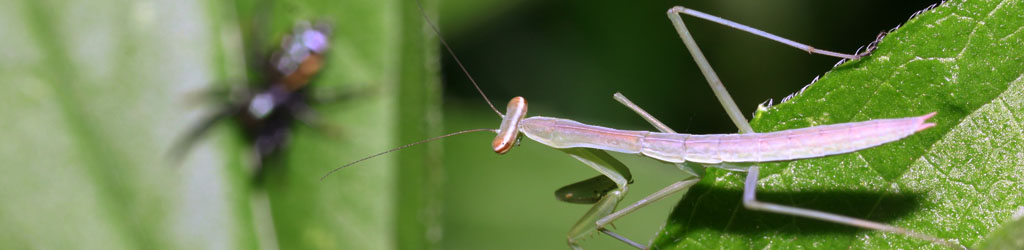
By the way, it’s shot at 1/60 second, f4, ISO 1600 to accomplish this, while the others to follow, using the strobe-and-softbox, are at 1/200 second, f16, ISO 250 – the strobe puts out a lot more light (as in, there is 8.4 stops difference between the settings, meaning the strobe puts out better than 400 times the light of the headlamp, at least at the distances used.) This image gives a faint indication of scale, but to be more specific, the mantis is about 18mm long, and 2mm across the eyes – still quite small. And while it was moving around quite a bit in the immediate vicinity, it largely (okay, smally) stayed in the light beam so I could get some decent photos while sitting in our front yard just after midnight.
This one has me a little curious. Earlier, it had made motions of this kind, but it was drinking the raindrops from its forelegs. At this size I couldn’t make out the details while behind the camera, and I thought it was only cleaning a foreleg, but it looks as if there’s something else in there. I cannot vouch for whether it stumbled across a stray insect part and had a quick snack, or if that’s a mantis tongue-equivalent getting into those crevices – I’m going with the former because it’s safer. Either one seems a little odd while it was very much aware of my presence.
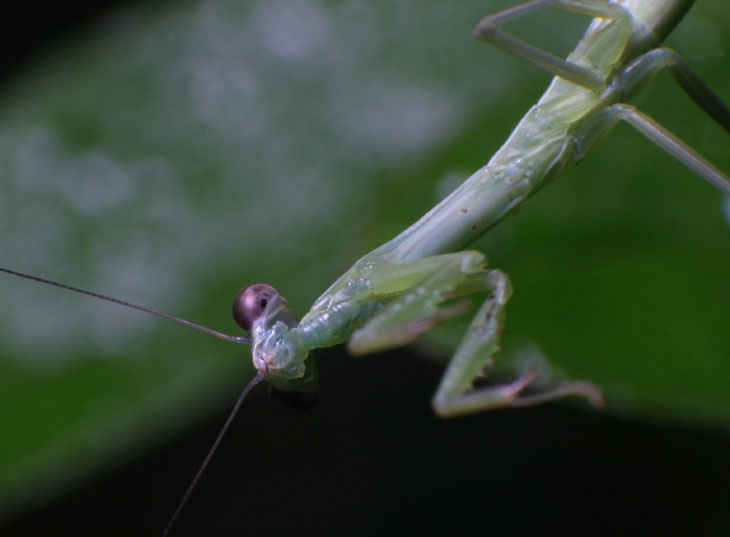
So aware, in fact, that at one point it made a spirited attempt to actually jump onto the camera – I’m not even sure if it made it, to be honest, because this carried it out of the light cast by the propped-up headlamp, and I had to carefully shift my grip on the camera, wary of crushing a minuscule arthropod, to retrieve the light for a detailed examination. I eventually discovered it back on the azalea, on much lower leaves, so whether it missed, or made it but soon jumped back off again, I cannot say. Cooperatively, though, the little spud went right back to the same location (the place I’ve always seen it so far) to pose for more photos. The image above is the first I think I’ve ever obtained on the underside of a mantis chin – not a pose they adopt often when people be around. Looking at this, I feel I should have shifted position ever-so-slightly to place the leaf entirely behind the head of the mantis, giving a much better outline, but recall that I was composing my shots by the same lighting seen in the first pic, and only the strobe going off provided this present light quality, so I’m not sure how well I could have done it anyway. The on-camera light aims from the same position as the strobe for a good reason – it’s too bad it was being balky.
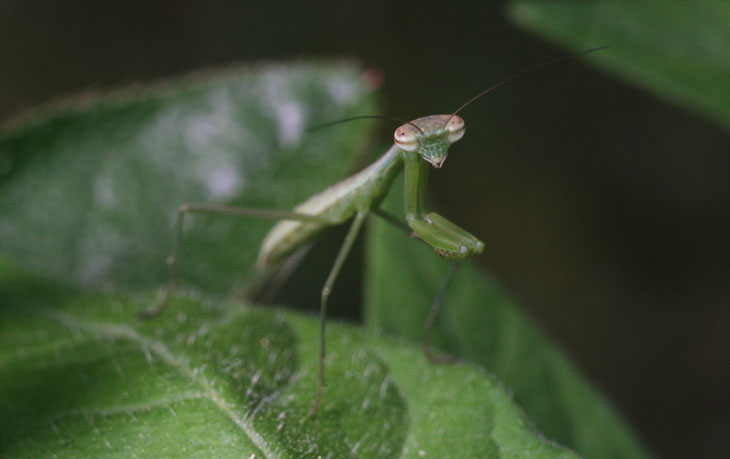
This one remains my favorite, left as I shot it while the mantis hung from the underside of the leaf. Remember, 2mm across those eyes. At such a high magnification the depth-of-field is incredibly short, even at f16 – note how even the shoulder is out of focus. So the mantis was very accommodating in posing with the forelegs and the antennae in the focal plane enough to remain usefully sharp. That’s an experienced model, that is – a natural. No I am not providing contact info – find your own cover model for the arthropod equivalent of Maxim magazine. I’m not completely stupid.
We have a weird culture. The makers of edible, spray-on decorative food dyes in silver color are seeing a huge upsurge in sales right now, sure to come again around the end of October, for reasons that few could possibly have predicted. There’s nothing further I can add to this.
If you have no idea what I’m talking about, that’s okay – I’ll forgive you, eventually.
Just a handful of recent images, some from before the trip, some from after – no real theme or coherence here, sorry. Above, a newly-emerged adult decim periodical cicada (Magicicada septendecim) poses on a leaf of The Girlfriend’s badly-damaged rose bush before heading out into the big bright world. Curiously, this was two weeks ago, which is early for cicadas, but more curiously, this was less than two meters from where I’d reburied the one I found in January. Same one? I have no way of knowing. This one, if I have the identification right, is a 17-year variety, spending nearly all of that underground attached to tree roots – unless, of course, they’re disturbed by someone doing yard work.
By the way, that rose bush is proving problematic. At the old place, I had mistakenly killed off a rose that The Girlfriend really liked, and vowed to replace it with a similar species (one that smelled lemony was the prime criteria.) The Younger Sprog found this one last year and I reimbursed her for it, but it was transplanted late and didn’t thrive. This year it got an early start and seemed to be doing well, only to get attacked by inchworms that decimated the leaves in two days. We all did routine worm patrols and stopped the damage, and it was recovering nicely, producing two new blooms. Then, apparently, a deer nibbled both of those off the other night, without touching anything else in the yard. Just to be perverse.
Last year, on two occasions, I’d found the shed skin of a smaller snake at the base of another rose bush alongside the mailboxes, but never got even a glimpse of the owner. Early this spring I found another shed skin, suspecting a garter snake from the size. I knew it wasn’t a venomous copperhead from the skin on the tail, and I’ll let you in on a little trick. On all non-venomous snakes in North America, the belly scales cross the entire belly, one scale across like a tank tread, down to the cloaca opening, after which they split into two staggered scales, providing a faintly braided look. The venomous snakes, however, retain the single crosswise scale down to the tail tip (or the rattle, if such a species, in which case the skin stops abruptly as if cut off.) But one morning, I spotted the owner sitting on the mailbox post soaking up the sun placidly.
This is a prairie kingsnake, perhaps about 30cm (12 inches) long and the diameter of your finger – those diamond-shaped markings are a dead giveaway, though as they get bigger the markings may split up more. Completely harmless of course, unless you’re a rodent or another snake, which is their primary diet. This one is not yet big enough to take down any of the moles that are tearing up the yard, but it is still encouraged to remain for that purpose.
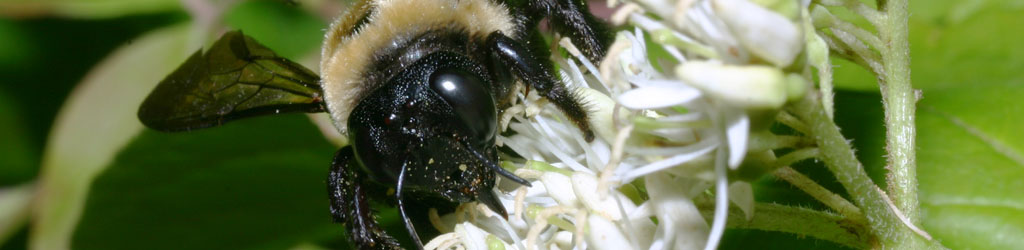
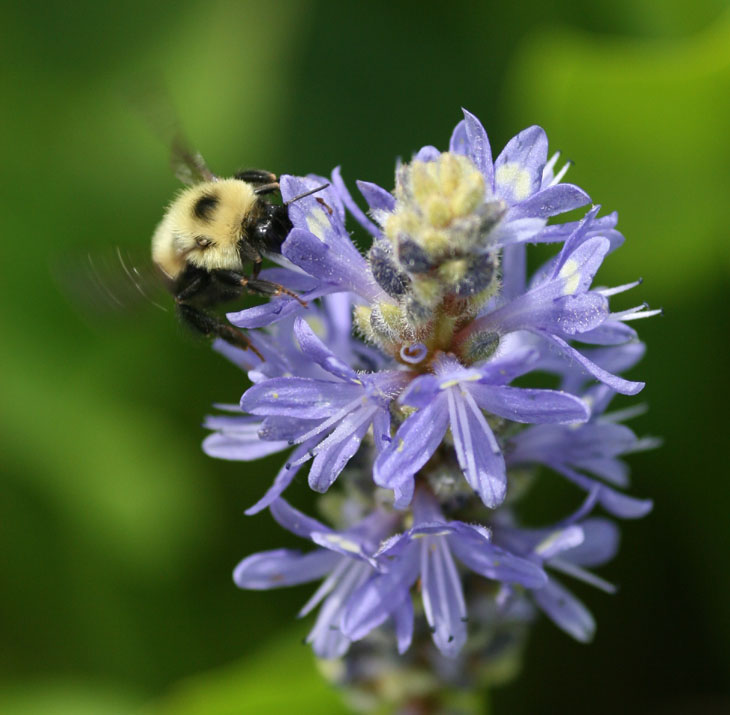
I did a quick trip down to the nearby pond this morning, collecting some water (and whatever little critters it might possess) and checking out the spring progress. The pickerel weed is coming along, almost big enough to start making the green treefrogs feel at home, though I spotted none yet. But the new blooms were out and the bumblebees were visiting.
The bees were active enough to make nailing focus quite tricky, and I have a lot of images to throw out, but managed a couple of interesting keepers. I like the blur of the wings on this one.
Once back home, I started getting a bit of yard work done, which meant encountering several different arthropod species. I get the impression the cold winter slowed down the emergence of the insects this spring, but more are showing up every day. While doing some closeups of assassin bugs, I spotted this black ant industriously carting a dead leafhopper through the pine straw, apparently trying very hard not to ever come into the open where photographing them would have been easier, but somehow I snagged this image as they made a brief appearance in the light again.
Back when I transplanted one of the new azalea bushes, the composted soil that we use sprouted, as usual, something else – it’s been largely pumpkins this year because we all did jack-o-lanterns last year, and now I know better than the let the seeds go into the compost. Anyway, I was about to remove the unwanted plant from right alongside the azalea when this little dude leapt away from my hand. It seemed more than happy with the new plant, so I opted to let them both remain.
The Girlfriend has been trying to find the calla lilies that she likes, and we finally located a pair this past weekend. I had transplanted them into pots until we decide where they will go in the yard, and in going past one of them today, I spotted a little white jumping spider doing a patrol of the plant. The contrast was great against the large leaves, but my patience paid off even more, because eventually it jumped across to the deep maroon blossoms and provided this alert pose.
In fact, I suspect the little arachnid was sizing up the gap between itself and the camera – they often do this, sometimes not at all bothered by this huge unfamiliar shape looming close, and I’ve seen the behavior they exhibit when getting ready to leap to a new location. This one made several jumps across the plant, eventually finding its way down to the planter and then across to my leg. I haven’t shaved in a while, and it seemed to find the experience distasteful, because it soon returned to the planter again. Yes, I’m embarrassed.
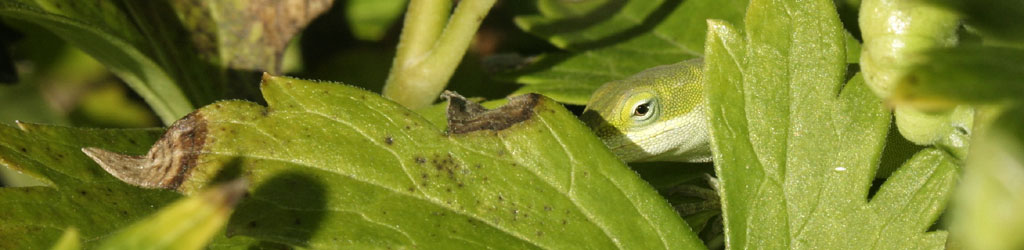
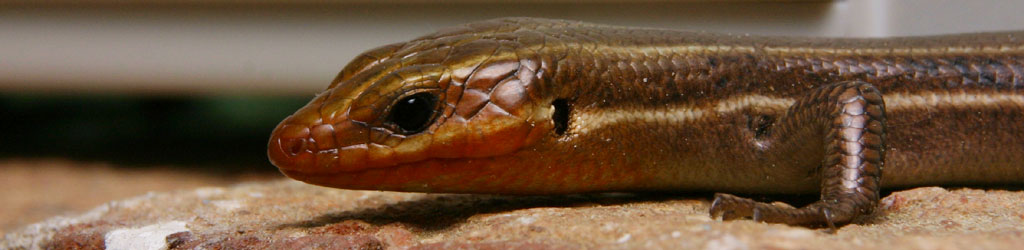
And finally, I close with a photo from the botanical garden a few days back, a green anole that had been trying to drink from one of the ponds there until my approach spooked it. I closed in on it while it sat among the leaves and obtained a nice portrait, cropped tighter here to show off the detail of the scales. I don’t know why, but I like the mosaic texture of lizard skin. The head, by the way, is probably about 15mm in length, smaller than the end joint of your little finger – macro work is fun.

 It’s been a long time since the last ‘Just because’ post, and I am truly ashamed. Or something. I am truly something…
 After the heavy rains Monday night and Tuesday morning, I went out to do a walk-through of the yard, and one of the first things I noticed was what you see here, a leaf of a sea oat plant (I believe, anyway) that had been rolled into this shape. I am quite sure that this had happened within the past several hours because it had not been this way when I went past earlier – the plant has been playing host to a few resident insects so I’m pretty familiar with it. Several different arthropods will do things of this nature, for differing reasons, but this one wasn’t hard to figure out at all, only requiring a peek down the end of the tube.
 What I took to be a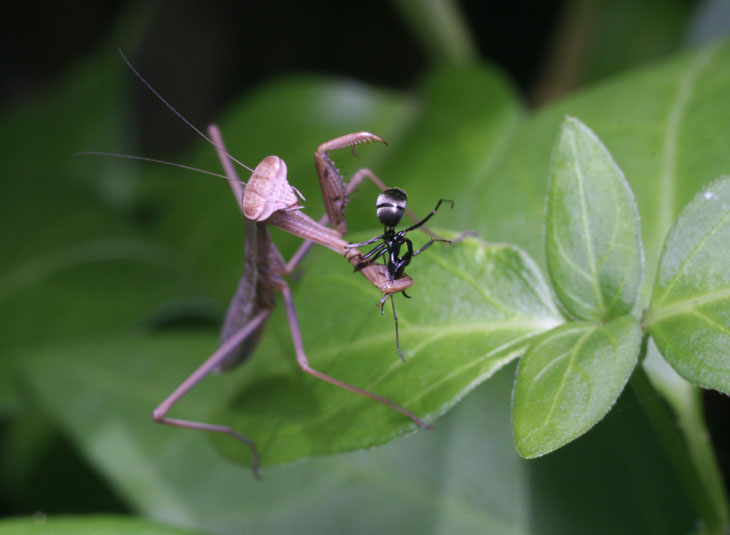
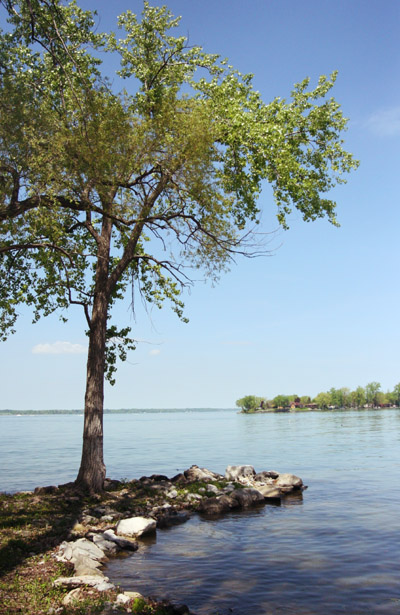 The following day at Cayuga lake, I was poking along a shoreline made up of more erosion control, only older and more haphazard, this being done by a homeowner quite a few decades ago to form the base of a dock. I was barely trying, but abruptly spotted a stone simply oozing (okay, wrong word) with fossils, about 15 cm across. The image here is not exactly where I found it, being a handful of meters to one side, but shows the conditions. The stones used were very likely all locally found, but not necessarily evidence of local geology; the Finger Lakes are glacially-cut, and some of the stones to be found in the area had been carried a long way by the glaciers. So while any rock found in situ, or at least near a matching rock face that it broke away from, will be from a rough time period, this cannot be considered indicative of anything loose, especially something that is noticeably different in makeup from other rock in the vicinity. The bedrock in that area of NY is from the border of the Devonian and Silurian periods, somewhere around 416 million years old, but the glaciers cut through much, much later than that. I made sure to take my find along with me, which got the attention of TSA because there’s no doubt it was noticeably opaque to X-rays – in fact, I would have liked to have seen what they came up with.
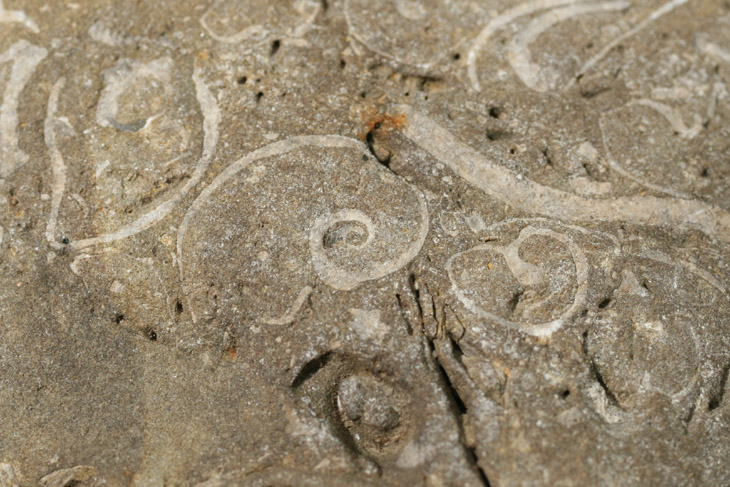
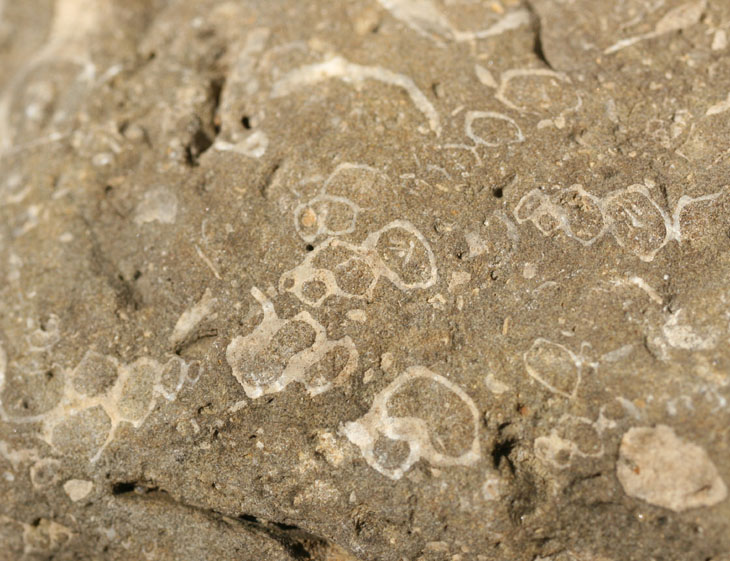
 When examining the fossils above, I thought I had an inkling of what they were, but now realize that I was wrong. I had suspected they were cross-sections of either the typical spiral “snail” shell or the conical kind, but neither of those would produce such shapes, so I’m presently stymied. And all bets are off for the examples to the right. Yes, I’ve already considered trying to free them from the matrix they’re within, but this may take some time; it’s definitely stone, the consistency of concrete, and isn’t going to come away easily. Telling, perhaps, is the stone visible in the middle of the rings above. While almost certainly just in shallow troughs, it hasn’t fallen free on its own, even through all of the erosion that has produced the cross-sections in the first place.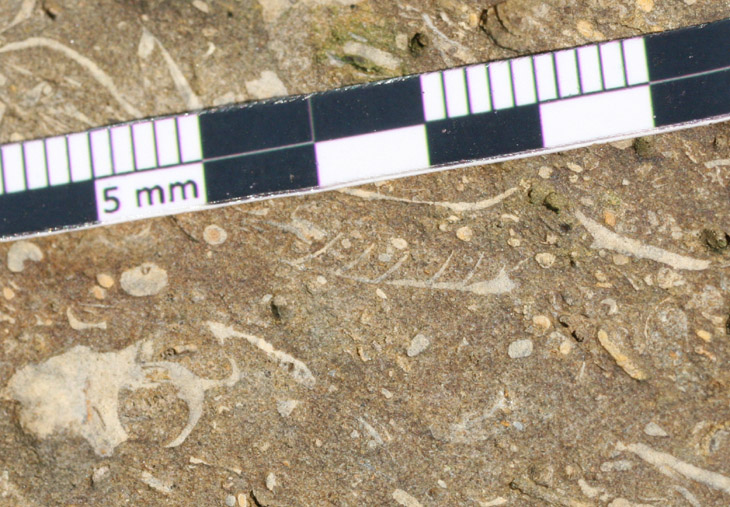

 This is one example of matching light to your subject. I often recommend that, when the light is bright and high-contrast, photographers should seek low-contrast subjects, and this is an example of the opposite: a high-contrast subject shot in low-contrast, near overcast lighting. The shadows are kept under control, but more importantly, the highlights don’t get too strong and start to wash out the colors, or worse, bleach out entirely to white. Delicate textures and contours can be seen easily, and all of the different colors still fall in the middle registers, being rich without fading towards white.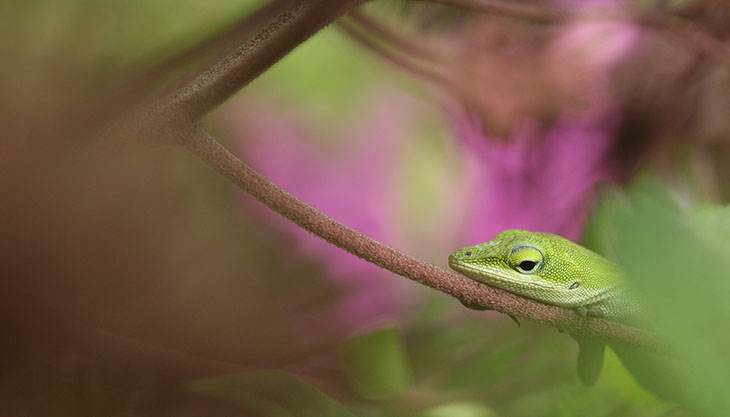
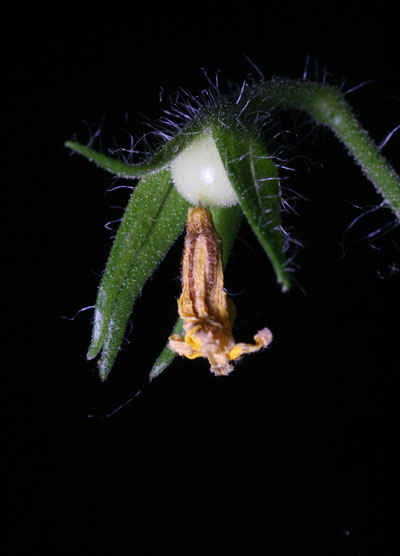 Okay, sorry, let’s look at it in detail. First off, there’s always the possibility that autofocus wandered to the wrong point, or with moving subjects, you captured a frame where things simply didn’t look optimum. Then, there’s the idea that subtle changes in position (especially in macro work) can produce subtle but notable changes in the framing and background. Also to be considered are things like minor differences in lighting, perhaps from changing the strobe angle, or maybe because the clouds are shifting or the shadows are being thrown differently across your subject by waving branches. And then there’s the simple possibility that what you originally envisioned doesn’t illustrate your idea as well as you liked. Let’s take a look at a few images I shot last night to see what I mean.
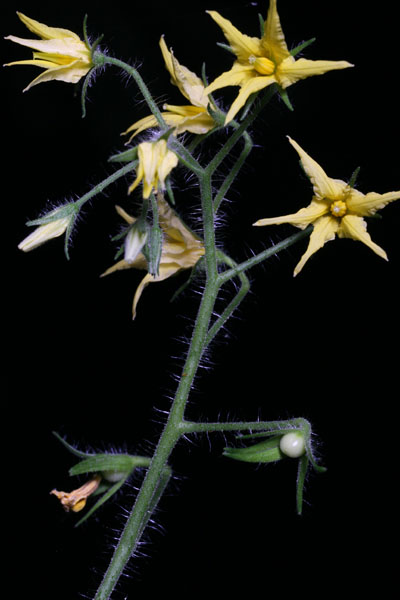 So then you might take a few different approaches, notably if you have options available to you. While I wasn’t going to get a better background last night, there being nothing close enough nor tall enough (this plant is actually over my head) to fill in for that darkness, I could have shot the same scene in daylight conditions to change the whole appearance. You might have noticed that the light angle changed by reversing the strobe, and that the one tomato from the previous image is now almost hidden away down in the corner, receiving a much less useful light angle and position in the frame. Yet, the context is more complete, a better sense of scale has (possibly, anyway) been produced, and more stages of tomato development are displayed in one image. Also, rather than being a mere illustration, a more artistic air has been produced, slightly more dynamic – some people might even find this a worthwhile art print (yeah, there’s no accounting for taste.)
 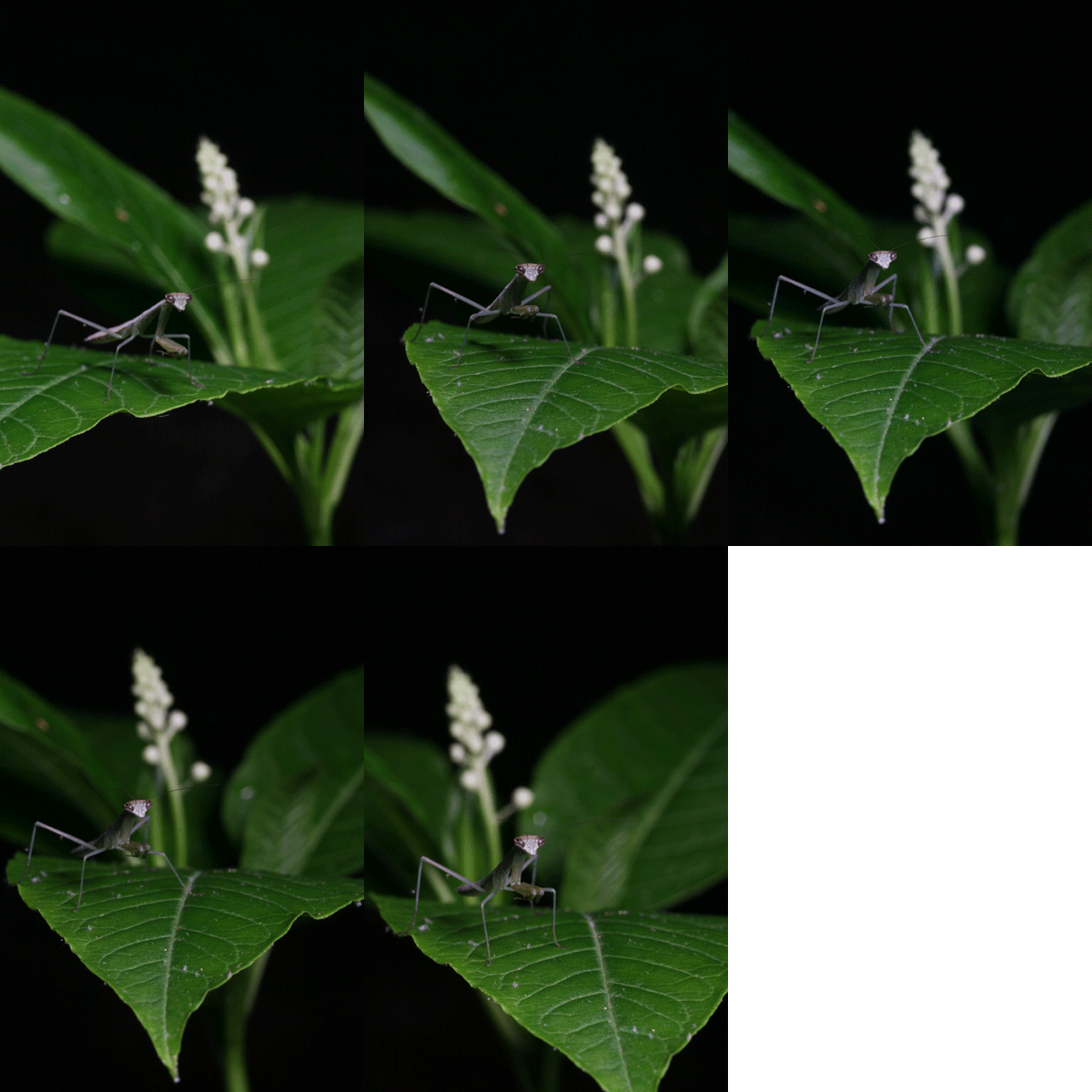 Now let’s take a look at how subtle changes in position work. This mantis was perched on a pokeweed plant, and I purposefully positioned myself to capture the budding flowers in the background as a framing element. Take a look at how the flowers offset the mantis, and how much of the underlying leaf is shown, and even how the antenna appears in the frame. I didn’t even change the lighting, nor shoot any horizontal formats for this, but still have a variety of appearances to choose from. Chances are there’s one you like better than the others, and it might not be the one that I like. While most of the blog and site reflect my own preferences, if you’re looking to sell your images, it’s better if you meet with your client’s preferences instead, and this might mean several different options. These are very subtle changes compared to what could have been done easily, but they illustrate how much of a difference such subtle changes produce.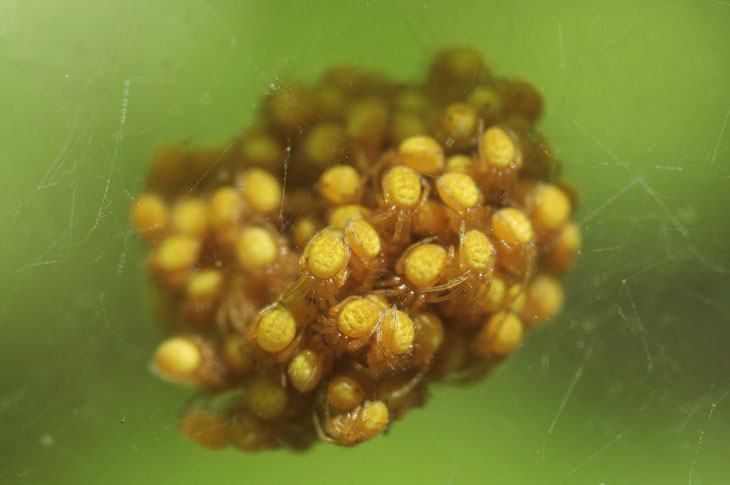

 This one remains my favorite, left as I shot it while the mantis hung from the underside of the leaf. Remember, 2mm across those eyes. At such a high magnification the depth-of-field is incredibly short, even at f16 – note how even the shoulder is out of focus. So the mantis was very accommodating in posing with the forelegs and the antennae in the focal plane enough to remain usefully sharp. That’s an experienced model, that is – a natural. No I am not providing contact info – find your own cover model for the arthropod equivalent of Maxim magazine. I’m not completely stupid.



 In fact, I suspect the little arachnid was sizing up the gap between itself and the camera – they often do this, sometimes not at all bothered by this huge unfamiliar shape looming close, and I’ve seen the behavior they exhibit when getting ready to leap to a new location. This one made several jumps across the plant, eventually finding its way down to the planter and then across to my leg. I haven’t shaved in a while, and it seemed to find the experience distasteful, because it soon returned to the planter again. Yes, I’m embarrassed.