So not only is today the summer solstice, but also World Humanist Day – which is, admittedly, an odd thing. Not in that I believe we shouldn’t bother with it, but in the implication that there’s only one day to consider or celebrate humanism. It’s like having a National Don’t Set Your Neighbor On Fire Day; it’s something that we shouldn’t need because it’s automatic. But perhaps the main idea is a day to promote the awareness of humanism, and if so, I can handle that.
Secular humanism is the ideology that we can determine effective moral, ethical, and social guidance without resorting to any religious, supernatural, or spiritual influence. While it is often confused with atheism, there’s a distinctive difference: it’s possible to be an atheist and not give a damn about social welfare. This attitude is remarkably rare, however, so the crossover between the two is common, but this distinction still appears in odd ways. Religious folk desperate for a way not to lose another argument will often point to the dictionary definition of atheism, as if this renders all socially-based arguments from an atheist null and void – apparently there’s a belief that a label must be exact or it’s irrelevant. I’m quite direct in calling myself an atheist, even though ‘secular humanist’ is far more accurate (and ‘critical-thinker’ even more so); besides the fact that far fewer people even know what the term means, calling myself a secular humanist sounds both pretentious and like I’m shying away from the negativity of the word ‘atheist.’ It’s my small way of saying, “Fuck your feeble preconceptions.”
The first usage of the term, according to Merriam Webster, appears to be from 1933 – surprisingly recent, given the long history of the overall concept, which can be traced back for thousands of years. In fact, the actual origins of it may predate every form of religion on the planet. But let’s start from the other end.
We are assured, so often that it’s practically a cultural assumption (at least in the US,) that religion is the source of all morality, and even forms the basis of all laws. When it is pointed out that scripture is remarkably weak on countless concepts of morality, and outright contradictory to others, it is usually asserted that the gist of scripture leads the way – laying the foundation, if you will. There are so many ways that this fails I can’t possibly enumerate them all, but I can provide a representative few. Women’s rights not only lack the barest hints of either existing or being recommended, abrahamic scripture is very distinct in considering women both chattel and unimportant beyond the baby-making angle, something that still exists in countless sects today. Such a basic thing as equality among humans is directly denied, from the sins and low origins of other ‘races’ (there’s just one race, which explains why we can interbreed) to structures like caste systems and chosen people. Followers are openly instructed to beat children and stone heathens and pillage wantonly among the lesser folk. And should anyone wish to claim that these were radical misinterpretations of what scripture really says, we need look only at the long history of holy wars, religious persecution, and declared privilege to determine that the true message was lost on so many people that it defines the most inept body of law in the universe – in fact, actively and repeatedly achieving exactly the opposite of moral guidance. Hiding behind “the fallibility of man” is a feeble excuse; this supposed guidance was directed at us, created to be this way. The message that can be taken from this is that we are intended to run rampant – if we bother to accept such nonsense assertions.
This also means (and this is not an atheist manipulation, but a direct assurance from countless religious folk) that without religious guidance we will descend into self-absorbed, nihilistic behavior, often compared to the “beasts” (another factor in decrying evolution, by the way.) I’ll take a moment to point out that the social structure of many “beasts” is superior to our own quite often, especially when it comes to slaughtering members of the same species. Yet what especially needs to be noted is that every culture developed their own moral guidelines, remarkably similar in more ways than religions have ever managed, and the further any culture gets from reliance on religious authority, the higher its social standards and general well-being. There’s even a study that religion and racism are closely tied. True, this does not mean that religion causes racism, and I’ll be direct: religion is very often just one manifestation of class consciousness, racism being another. But since we’re talking about the moral imperative of religion, we should expect to see much lower levels of racism and higher levels of social harmony. It becomes obvious when one bothers to check: religion isn’t providing much of a guidance.
The question of where moral behavior does come from was the topic of my first “But How?” post – we’ve always had it. It’s the benchmark of a social species, and as such, found in far more than just Homo sapiens. Species that gain a benefit from any kind of group behavior must have cooperative functions, and even see social interaction in a positive light. This is such a fundamental trait that even some species of insect, like ants and bees, possess it; it boggles the mind to think that we would need to learn such behavior.
 And yet, there’s the negative behavior above to consider – just as obviously, the internal guidance wasn’t working too well in the bad cases throughout history. Mostly, this is because it’s not the sole behavioral trait we possess; competition is also pretty strong, and since these are in conflict, there must be some ‘criteria’ for when one or the other is to take precedent. I put ‘criteria’ in quotes because the word implies a much more elaborate structure than what our brains would actually possess. We have strong familial bonds, protecting our spouse and offspring, and these get weaker with the ‘tribe’ and vanish entirely against any perceived threat. So there’s quite a bit of subjectivity about our in-groups and how we interpret anyone as “fer us or agin’ us.” We know that it’s good behavior to favor our in-group against any outsiders, but the method of determining where these lines are is vague. Most religions are remarkably adept at drawing lines, relying on such manipulative concepts as the perfection of the self (“saved,” “chosen,”) the idea of ultimate authority, and of course ideas such as there being One True Religion™ – no need to prove any value or superiority, just proclaim it. Very self-indulgent, but hardly a guideline for moral behavior. As a species, we’re not very good at distinguishing the desire for social cohesion and the desire to feed our egos (another nail in the coffin of the “designed” idea.) Our penchant for drug addiction makes it clear that it’s too often the good feelings that count, not necessarily how we achieve them.
Any immaterial justification for any behavior is going to fare as badly – it’s far too easy to create something that supports our pre-existing views without fulfilling any other function. See if you ever run across someone who announces a spiritual property or “way of knowing” that they themselves do not possess or that fails to boost their ego – good luck with that. But various scholars and philosophers throughout the ages have argued that morality really should be about more than indulgence, one set of guidelines able to apply to everyone without drawing lines. Crazy talk. Even a cursory examination of our Constitution reveals (to those not scared of the idea) a basic principle of equality, fairness, and the reduction of privilege, though it was soon realized that they didn’t specify the dismissal of religious authority within our government, correcting this with the First Amendment. And of course, this whole idea forms the backbone of secular humanism.
It’s not hard to find people claiming that the goal of secular humanism is to eradicate religion – only religious people though, imagine that; I always thought honesty was one of those important things to them, but whatever. Secular humanism, however, only affects religious privilege over others – it destroys pedestals to bring everyone to ground level. No secular humanist would be any more valued or privileged than any member of any religion, and no less answerable for their actions either. Decrying this can only come from someone with something to lose from it, angry that they would be considered as morally responsible as everyone else. A whole orchestra of the world’s tiniest violins has sprung to life…
It could be argued that, if we are born with a socio-moral objective, there is little point to humanism. It could also be argued that humanism is simply attempting to do the same thing as religion – there have even been attempts to have it declared a religion, though what purpose this would serve is unclear, except for leverage in the weird legal system we have over where religions can and cannot appear. So we’ll take a look at both of these, in reverse order.
The definition of religion has always been up for grabs, though legally it is specific enough to rule out humanism, and of course the bare meaning of the word “secular” also puts the kibosh on the religion angle. There seems to be some difficulty with telling the difference between a religion and an ideology; humanism is an ideology, which means it forms an underlying approach or attitude towards decisions and actions. Every form of government is an ideology, as are cultural standards for schooling.
Tackling the former argument about not needing an ideology for social and moral structure, the points above should have made it clear that we have tendencies towards social cohesion, but a hell of a lot of ways in which we get confused, sidetracked, or deeply involved with disguising indulgence as morality. While better than nothing (especially the nothing that the religious insist we would have without their stalwart help,) it’s still a lot worse than we can imagine. Evolution doesn’t always produce strict behavior, but nudges in useful directions – and there are a lot of nudges for a lot of different circumstances in our complicated lives. Not to mention, if we were as dependent on our rational minds as we like to think we are, drug addiction and sexual affairs and arguing over music wouldn’t actually occur at all, much less all the fun we tend to have over how to define and regulate moral behavior. We really do need something that we all find as agreeable and functional as possible, that we can resort to when there are doubts. Hold that thought, because we’re going to come back to it.
Secular humanism, for the most part, isn’t about creating rules, or dictating behavior. It’s about producing a perspective, an underlying concept of what a goal should be, that gives structure to rules and decisions. Someone driving in a residential area does not need a speed limit sign to infer that the limit is probably much lower than the freeway – traffic is thicker, more opportunities for people to pull slowly out into the road, and bicycles and children are far more prevalent. The structure behind all this is, “It’s far more hazardous so stopping distance and reaction time are far more important.” I feel safe in saying most drivers understand this perfectly well – but a few too many think that it somehow doesn’t apply to them, or that a temporary exemption just for them should exist because it’s inconvenient otherwise. Self-indulgence; it’s not that it makes sense, it’s that we’re a species that is adept at manipulating things to our individual advantage. This perspective, this glaring realization of how egotistical we can be, is but one aspect of humanism.
Most notably, secular humanism eliminates (or at least greatly reduces) any reliance on broad labels, pronouncements, or assertions. Good and evil are not properties, but indefinable abstracts; there is no action (much less person) that can be said to be universally good – there is always some way in which someone will fail to benefit from it. Decisions based on the promises of post-mortem states are ludicrous when we have real-world, demonstrable, and above all dependable consequences that are easy to see. Morality is solely about other people, how we interact and the importance of functioning socially – otherwise why would anyone care in the slightest? To make any claim (as many religious folk indeed do) that morality is only about how one appeases their deity not only makes it a pointless concept to promote, it inevitably produces exactly the hedonistic nihilism that is supposed to be so horrifying. “I am good, you are not; since you’re going to hell anyway, let me hasten the process.” Lest anyone thinks this is a straw man representation of religious viewpoints, let me remind people how often phrases such as, “Kill them all and let god sort it out,” are still heard, and how angry evangelists tend to be, and that religion has been used as a justification/motivation for war for nearly all of written history (how many religions specifically chronicle the wars they’re most proud of?) If we think this isn’t accurate anymore and such historical behavior is behind us, it is only because of the secular influences that our culture has been promoting, and increasing.
We can look at scriptural exhortations to stone women who talk without men’s permission and say, “Damn, that’s stupid!” – because it makes no sense. We can create laws against driving while intoxicated, not because there is the faintest religious backing for it in any way whatsoever, but because we know what the consequences are, and find it remarkably unfair that someone far removed from the complete idiocy of alcohol can still come to harm because of it. We can contemplate laws restricting same-sex marriage and say, “Hold on a second – isn’t this creating a double-standard, where a legal practice somehow becomes illegal based entirely on who engages in it?” (Note that I said we can, not necessarily that we do.) And this means we can pause for a second and realize that laws are to prevent harm, not to reinforce someone’s pointless prejudices. That’s secular humanism; guiding our decisions through the application of objective, rational perspective and observable consequences.
Yes, this does mean that secular humanism can actually be pursued by religious folk, as well – and it is, more often than we might think. The laws in this country regarding freedom of speech and freedom of religion, including the ones protecting religious observances as special cases (look up animal sacrifice under santeria, and how kosher foods are classified,) demonstrate that secularity is not anti-religious. And I’ll openly admit that there is a difference between what someone wants to use as their personal worldview, and what they should be pursuing as standards for everyone. Religion is stupid, self-indulgent, petty, and dangerous – it is the dumbest thing any culture can ever embrace. For the record. Yet, making a law against it would be both pointless and oppressive. It’s up to people to make the decision on their own, and my part, placing value in fairness and reason, is to make the case about how stupid religion is, trusting in people to have working brains. If I cannot plead my case convincingly, perhaps it’s not strong enough.
[For anyone who reads that and smugly assures themselves that I haven’t convinced them to give up religion, that’s quite all right; the ball’s now in their court to try and convince me to take it up ;-)]
 Above all, humanism recognizes that the primary focus is the human race, and not whatever subgroup anyone places themselves within. Distinctions about nationality, or skin tone, or sexual preferences, or what is eaten for breakfast, are only methods of feeding ego, of drawing lines that place us on the good side. Don’t get me wrong; lines are undoubtedly beneficial, when drawn in a functional way, such as between the greater populace and rapists. Humanism uses social interaction, and empathy, and a generous helping of demonstrable consequences as its primary guide. It helps reduce the emotional influences upon what we do, especially regarding others, and substitutes careful consideration instead. True, one can argue that empathy is an emotional influence (especially if their goal is to challenge anything they don’t like rather than fairly consider it) – but empathy, or what it produces, is also a considered response: we rely on social interaction as a species, which requires fairness, trust, and mutual benefit. That’s why we developed it.
The only people who argue against these standards, don’t; they inevitably misrepresent humanism in fatuous and wildly creative ways, mostly to (and I hate to sound like a broken record here) feed their own ego and maintain their own privilege. It’s pathetic, and ironically, it’s exactly what those standards are intended to move mankind away from, and in doing so, ahead. We already know selfishness isn’t very beneficial – we just need better skills at recognizing it.
And with that, we return to the comment made above about a system that we can resort to when there are doubts. Because another aspect of secular humanism, also represented quite well in critical thinking, is the ability to evaluate our social structure objectively – to actually have doubts. It’s very easy to think in terms paraphrased as, “I’m happy with it, so what more is needed?” Obviously, this is hardly a functioning method of defining morality – which makes it all the more astounding how often it appears in cultures. There remains no small number of people who believe that a majority vote defines the ‘best’ approach to laws and governing, never comprehending what laws and government are actually for. Or those who believe that a right is something that should apply to one group of people and not another. Both of these fall under a concept called, ‘the tyranny of the masses,’ other times simply referred to as, ‘mob rule.’ There are enough historical examples of how this leads to bigger and nastier mobs that it’s pointless to reiterate here, except to say that less attention should be paid to the culminating events and more to the underlying attitudes that fostered them – treat the illness before it irreparably damages the body.
It’s entirely possible there is, or will be, some better method of approaching social and moral structure – though it’s hard to imagine how, to be honest. What has been demonstrated throughout history is that secular humanism far exceeds any other approach we’ve tried, and provides the structure for the greatest benefit and the highest function. So on World Humanist Day let’s at least recognize what it’s accomplished for us so far, and consider what it may yet accomplish in the future.
Potentially Related Posts:












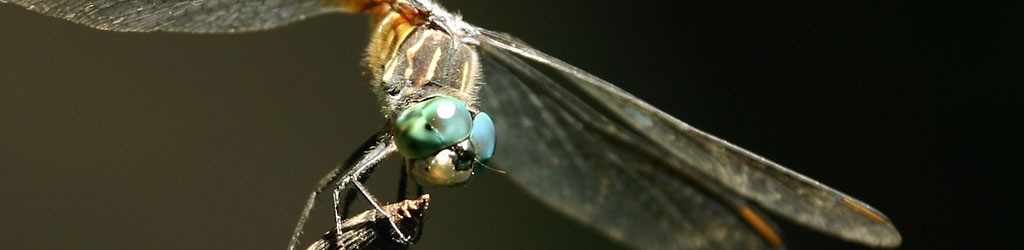













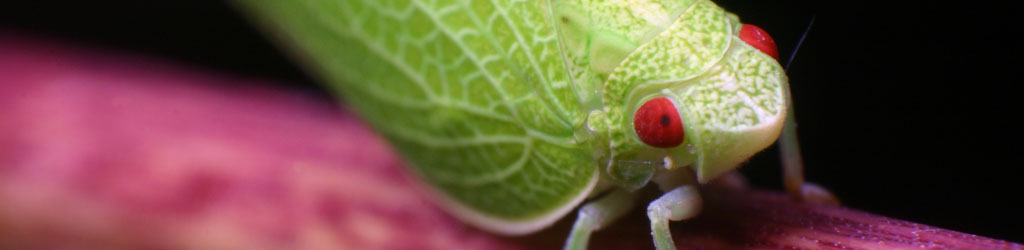





















 On Saturday, I was chasing bug pics when I got an expected call to meet with friends, and snagged one frame of some amorous flies on the parsley flowers before I had to put down the camera (sacrilege I know) and head off. I couldn’t see these eyes in the viewfinder (for the reason illustrated at right,) so the surprise came much later when I unloaded the memory card.
 Ah, but we are aware that we’re thinking! This is the self-awareness, sentience, supercool bit! So, let’s try an exercise: what are we unaware of? Take your time. Self-awareness is the same kind of nonsense as the Weak Anthropic Principle, which says that we exist in a universe that has the conditions for our existence; we will not see a universe in which we cannot exist, and we have no awareness of how much we’re unaware. Another species observing us might find it amusing how unaware we are, such as our inability to see infra-red, or why we’re entertained by skateboards, or why we feel better about ourselves when someone else demonstrates that they’re lesser in some way (as if this was an accomplishment for us.) And as near as we can tell, all of our decisions are biased by unconscious traits, past experiences, personal preferences, and even physical condition of the body – we may not even be able to fulfill the idea of ‘
 This process is better approached from the other side, which is to view any such experience critically from the start, and try to see if it can clear the “fake/hoax/wishful thinking” bar, but either way requires the same methodology. The tests are simple, even though they might have a wide variety among them: recounting solid information not available through any other means (such as words or objects hidden someplace,) retention of all aspects of the mind/soul after brain damage, even a religious experience with a high degree of ‘accuracy’ from someone who has no interest in that religion. It seems reasonable to expect that transcendent experiences should demonstrate something not just miraculous, but with evidence on a greater scale than personal emotions, yet even the rather mundane experiences don’t hold up to examination, and often the only thing we can use for judgment is whether or not we should take someone at their word. And we must realize that having such an experience makes someone special, which is more than enough motivation to misinterpret some sensory input, much less perpetrate a hoax, so the standards to judge such things should always take this into account.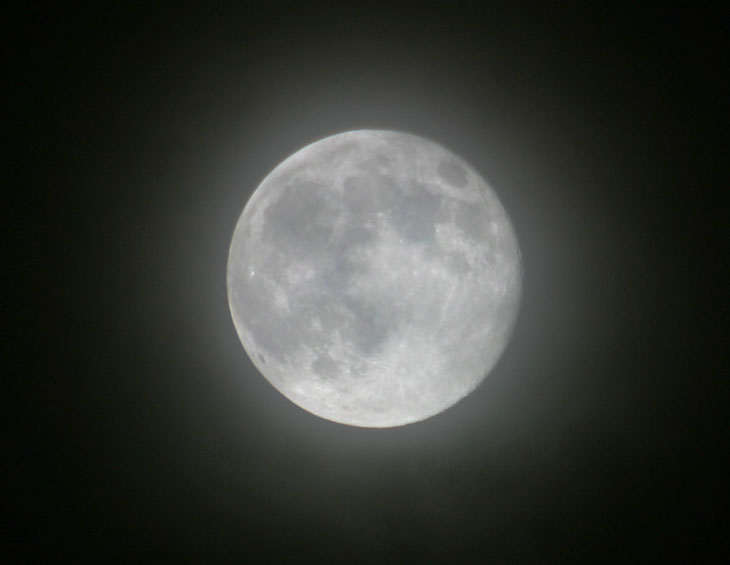
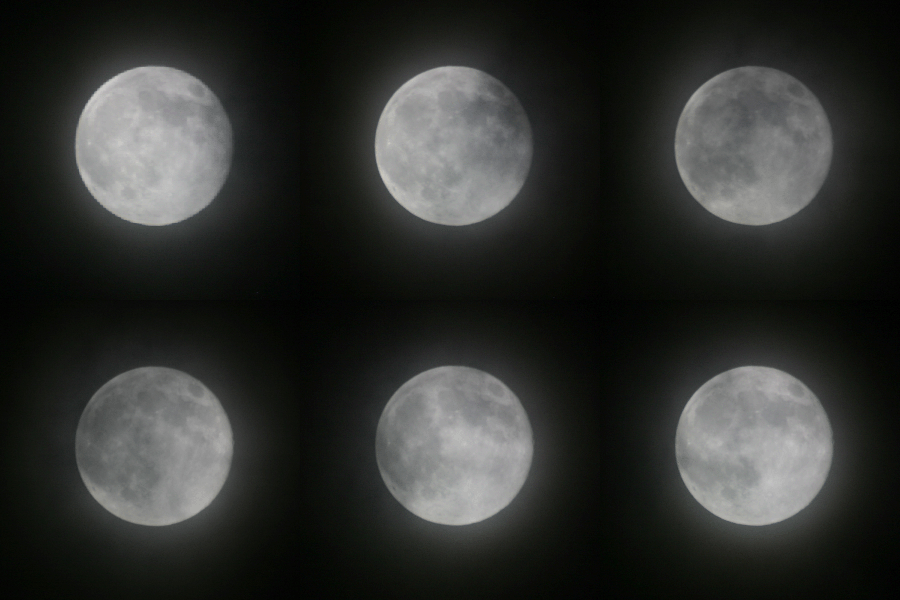 But while I was at it, I did a few sequences that showed the movement of the clouds, and combined these into an animated gif (pronounced “jiggawatt.”) The shots also showed the movement of the moon across the frame, as well as some tripod wiggle since I wasn’t shooting with a remote release, but I re-centered the moon in editing. Mostly, anyway – if you watch close you can see a twitch where I didn’t do the best job.










 Anyway, you may virtually join me in this non-celebration of our species’ peculiar obsession over evenly-divisible numbers from a base-10 system, even though the image I’m showing to the left doesn’t count (“count,” a ha ha, you missed it didn’t you?) but I still like the perspective better than the above. What the two shots illustrates, though, is how with such a short range of sharp focus, trying to get as much of your subject within that range means some selective shooting angles (such as the full profile approach at top) or deciding on exactly which anatomical feature should get the attention – unless you have a very good reason otherwise, it should be the eyes, just to provide a hint. The sneaky bit that can come into play is finding a way to have both the eyes and some select other feature in the same plane, such as the forelegs here (I admit this time it was more chance than design, since insects are abysmally bad at taking pose advice. But never admit that. The blind luck in getting decent images, I mean – you can admit to the intransigence of arthropods to your heart’s content. It’s a lot of fun.)
 I’m starting with an image largely unrelated to the post topic, simply because I like it better. I did get a few dewy morning photos of the plant I’m about to mention, but this one’s much stronger, and it does illustrate the conditions nicely. Just don’t call it