Using the moon

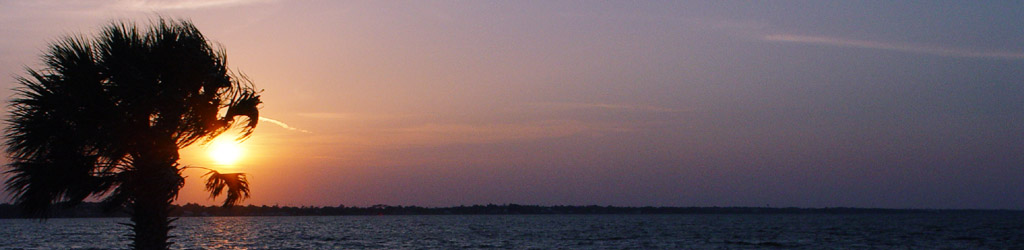
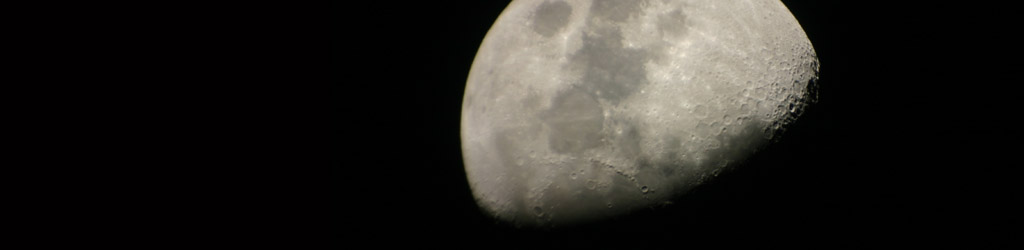
So, I should be catching up with writing some posts that have images awaiting usage, or editing video, or cleaning up Walkabout Studios, or any number of other things, but instead I went out last night to use the bright moonlight for some experiments. Which turned out okay, really, and that’s better than a lot of experiments that I do, one of which is another waiting post.

The back forty of Walkabout Estates is almost entirely shrouded by trees, with only a patch near the house and over the deck that gets open sky, and that faces between straight up and a little north, so not too much direct sunlight or moonlight there either, especially as we close in on the winter months and the sun and moon get lower. The main pond gets a fair amount or sunlight, but for only half of the day, well after sunrise and into mid-afternoon before the trees again throw a lot of shade; however, many of these are the cypress which will lose their leaves/needles/whatevers pretty soon and so the light will get better. The time was right to use the moonlight on the pond, though.

portion of main pond at Walkabout Estates by moonlight
Yes, that’s all moonlight – this is 115 seconds at f8, ISO 800, and you’re looking at diminutive Duck Island to the left, with the ‘apron’ where the ducks, turtles, and nutria come onshore at lower right. At center, that little patch of brighter water separate from the main body is the channel down to The Bayou, the lower pond. Everything remains shrouded in duckweed, but the yellow cow lilies that once formed a low forest across the water have been decimated again by the beavers, I believe, though the lateness of the season may also be a contributing factor. What has me curious is that the shadowed side of the trees on Duck Island have a notable amount of light showing on them, and I’m not sure what this is from – it might be reflected moonlight from the water’s surface. Weird, anyway.

I changed perspective and focal length a little, and added an element:

time exposure of main pond of Walkabout Estates by moonlight, with author intruding into frame
I framed for both the moon and the single strand of Spanish moss that hangs down all by itself, though it was more centered than I intended (it’s really, really hard to tell when peering at the viewfinder image by moonlight, or even with the assistance of the headlamp.) I stood in the frame for about 90 seconds out of the 120, right where all the critters come ashore, and had enough of a dark background (and the lighter shirt of course) that virtually no ghostly effect took place even though I wasn’t in the frame for 1/4 of the exposure time. But this gives an idea of how far offshore Duck Island lies, and how small it really is.

I moved over a bit and aimed about 90° to the right to catch a different portion, having to change exposure significantly to do so.

time exposure of Turtle Island and portion of night sky by moonlight
Turtle Island wasn’t quite catching direct moonlight, but it’s those pale trunks visible in the center; this is now 26 seconds at f3.5, ISO 1600, done this way to prevent having star trails from a longer exposure. There are some details at the top that we need to see better:

inset of previous image, showing most of constellation Cassiopeia and a faint hint of M31 Andromeda galaxy.
I could see that the ‘M’ shape of constellation Cassiopeia was peeking almost perfectly from the branches and framed to capture that, even though a lot of the fainter stars came up brighter and made the main stars less prominent, but also captured something that I use Cassiopeia to find: M31, the Andromeda galaxy, is that fuzzy object off of the branch tips to upper right. I didn’t really expect to capture that, but I’ll take it. One of these days, I’ll manage to get it in much greater detail, but this is not bad at all for 26 seconds at freaking 10mm focal length, as wide as I can achieve with my current lens lineup.

And one more.

time exposure of back yard of Walkabout estates by moonlight
This is looking in the same direction as the first two images, just a lot further back into the yard; the thin trees of Duck Island can be found peeking between the cypress trunks just left of center. I wanted the wider angle to pick up the shadows of the trunks by moonlight, but the direct light was a little too obscured. The glow to the right, however, is where the streetlamp on the corner peeks into the backyard past the house, about the only place it does, though it shows really well in the front yard. It has a faintly ominous quality to it that I might have to play with some more.

So not bad for a few minutes of playing around, but if I’m going to do landscapes by moonlight, I need to find a more scenic spot. I imagine I can dig something up…

Estate Find XXXX

I had a couple of returning subjects that I could have used, and plans to try for something early this morning (about a half-hour from when this actually posts) that may or may not pan out, but I came across this one last night and knew I had my weekly subject.

First off, this was a weekly subject from last year, only back then I was doing the critters that I’d only ever photographed once, and what I’d featured had been taken 14 years before that.

unknown mantis fly probably Mantispidae
That’s the shot from 2010, one of two frames that I got before it flew off. It was a shame, because they’re cool-looking little insects, but I’d never even spotted one since. Until last night, when after a couple of terrible frames in situ, I snagged it in a film can (ask your grandfather what that is) and brought it in for a studio session.

unidentified mantisfly Mantispidae, possibly green mantidfly Zeugomantispa minuta, perched on frost aster Symphyotrichum pilosum flowers
This is a mantisfly or mantidfly, most likely a green mantidfly (Zeugomantispa minuta,) perched on a sprig of frost aster (Symphyotrichum pilosum) that I plucked for something to be perched upon. You can see where it got its name from, since it looks like a cross between a lacewing and a praying mantis, but those mantis forelegs are not an indication of any relation to mantids; this is a member of the lacewing family, and the forelegs are simply convergent evolution. We’ll see them better in a minute.

unidentified mantisfly Mantispidae, possibly green mantidfly Zeugomantispa minuta, perched on frost aster Symphyotrichum pilosum flowers
It’s also about lacewing size, a measured 12mm in body length, and I was lucky to realize what it was, since this means those forelegs require a very close observation to spot. It was dangling from a short stretch of spiderweb, and I thought that it had been captured, but it appeared to be there by choice and was not trapped at all. I’ve since found out that part of its chief diet is spider eggs, so likely it had actually discovered an egg sac suspended between branches and was polishing off the contents.

unidentified mantisfly Mantispidae, possibly green mantidfly Zeugomantispa minuta, perched on frost aster Symphyotrichum pilosum flowers
The fartsy shot with an open blossom – I just wish I hadn’t had that stray petal peeking in at the upper corner, but when you’re trying for sharp focus on something this size, you (or at least, I) don’t always notice everything.

These were all shot in the bathroom, since it’s a small space with very few hiding places, so if my subject here decided to fly off, the chances of locating it again were several dozen times higher than in the main part of Walkabout Studios. One of my prints serves as the backdrop, too far out of focus to do anything but provide appropriate color, and the sprig of frost aster is held in a clamp so I could rotate it as needed as the mantidfly wandered about. My model was very well-behaved, to its credit, except for failing to extend those forelegs for a better view – while in the studio, at least. Still, I could go in close.

closeup of unidentified mantisfly Mantispidae, possibly green mantidfly Zeugomantispa minuta
Now here’s the curious bit: Unlike the others, this frame was shot with the reversed 28-105, same rough f-stop, same lighting source, but the distinct colors of the eyes somehow got very muted, and I don’t understand why this is. The 28-105 allows me to get much higher magnification, but it’s not a dedicated macro and is, as I said, being used backwards, so there’s some optical effect going on here – I just don’t know what. Compare it to the Sigma 180mm macro, which didn’t get in as tight, but produced a distinctly different effect with the eyes.

closeup of unidentified mantisfly Mantispidae, possibly green mantidfly Zeugomantispa minuta
Now, this might be due to the much-greater working distance, which also applied to the flash softbox, but I can tell you that that starry, multi-colored effect was clearly visible to the naked eye. You can also see that the forelegs fold differently than a praying mantis, backwards and folding the same way for both joints rather than forward and reversing, ‘zig-zag’ like a mantis. The antennae are also surprisingly short.

By the way, the property here at Walkabout Estates Plus has seen a surge of blue mistflowers, and I plucked a sprig to use as the perch, thinking the pale blue-lavender color would make for great contrast to set off the mantidfly. Said mantidfly was having none of this, though, and when I attempted to coax it from the film can onto the flowers, it resolutely refused to even set foot on them and remained on the film can. Thankfully I had better luck with the frost aster, but what the issue was, I have no idea. Perhaps it just felt those clashed too much…

I kept the camera in hand when I released my subject and, sure enough, the mantidfly extended its forelegs a few times, so I snagged a couple of frames of that.

unidentified mantisfly Mantispidae, possibly green mantidfly Zeugomantispa minuta, extending foreleg after release
You get a glimpse of the serrated, ‘toothy’ edges, but then, here they seem to fold like the legs of the praying mantids. I went back and looked at the other images, and they definitely look to be folded differently. The best I can conclude is the articulation of those forelegs is astounding – makes me wish I’d been set up to do video, but out in the field this is extremely tricky at macro magnifications, and as I said, in the studio the mantidfly wasn’t showing off at all. Now it seems I have a new goal…

Follow not my lead

I’ve had the reminder popping up for over a week that today is International Podcast Day, and so I have for you… no podcast. Yes, yes, I can hear your sigh of relief from here. I’d strongly considered one, and had a couple of topics to talk about, but the time just wasn’t there to accomplish this. What I did accomplish was important, though, and more people will benefit from it (The Girlfriend and I) than will listen to my podcasts anyway…

However, I still have a few that I can recommend, so feel free to check them out. I find podcasts are a great thing to have on while I’m sorting photos, or working on 3D designs, or trying to fix some damn thing at my desk, and this is from some old Boomer/Gen X’er (the demarcations vary) that hasn’t bothered to stream things through my smutphone or into the car or whatever, so I’m sure you can find other activities that benefit from listening to podcasts. I provide links below, but you might also find them through your own preferred Hep Cat services.

So, Walkabout recommends, in no particular order:

The Geologic Podcast: George Hrab talks about music, odd animals, religious morons, Yes, listener questions, Yes, the gig culture, good news, and Yes. Just not geology. You’ll get it eventually.

Skeptoid: Brian Dunning’s critical analysis ‘cast eviscerates countless claims, rumors, beliefs, and broadly-accepted ‘facts’ in a meticulous and well-researched manner. The episodes and shorter than most and even have transcripts. You will learn something.

Smartless: Sean Hayes, Jason Bateman, and Will Arnett all rip on one another while interviewing their guest hosts. Good dynamic between the three and great voices for a podcast, but the first of those with interminable interruptions by sponsored messages, recorded by the trio for authenticity or some such shit like that.

Fly on the Wall: David Spade and Dana Carvey also interviewing guest hosts in between recording ads. A little too much “remember being on SNL?” but still quite entertaining.

Conan O’Brien Needs a Friend: Great dynamics between Conan and his cohosts Sona Movsesian and Matt Gourley, and a good lineup of guests. Still a lot of ads, but there are definitely times when you can hear them not taking these duties too seriously. The interview with Flula Borg (I have no idea who this is) is easily the funniest podcast that I’ve heard.

Good Hang: Amy Poehler and whoever happens to be handy, I think, interview guest hosts. I’m not too deep into this one yet, since I recently discovered it, but what I’ve heard has been good.

Ones I should be listening to (that I simply haven’t gotten around to):

The Skeptics’ Guide to the Universe

Cognitive Dissonance

And naturally, my own. I haven’t been doing them much recently, but that gap has been taken up more with video – both of which require too much editing time.

By the way, it’s easy to do web searches for podcasts featuring your preferred content or topics, and many many times better than any half-ass videos featured on whatever social media horseshit that still exists, so have at it!

Was that a September, or what?

Somehow, these months keep ending, which someone should be looking into – I’m sure this isn’t a good thing. But while it’s happening, we’ll at least keep noting this occurrence (until we don’t, anyway) with the month-end abstract. The first was not actually intended to be an abstract as such, but it worked out quite well as one, plus it looks cool. Or at least I think so, which tells you more than you ever need to know about me.

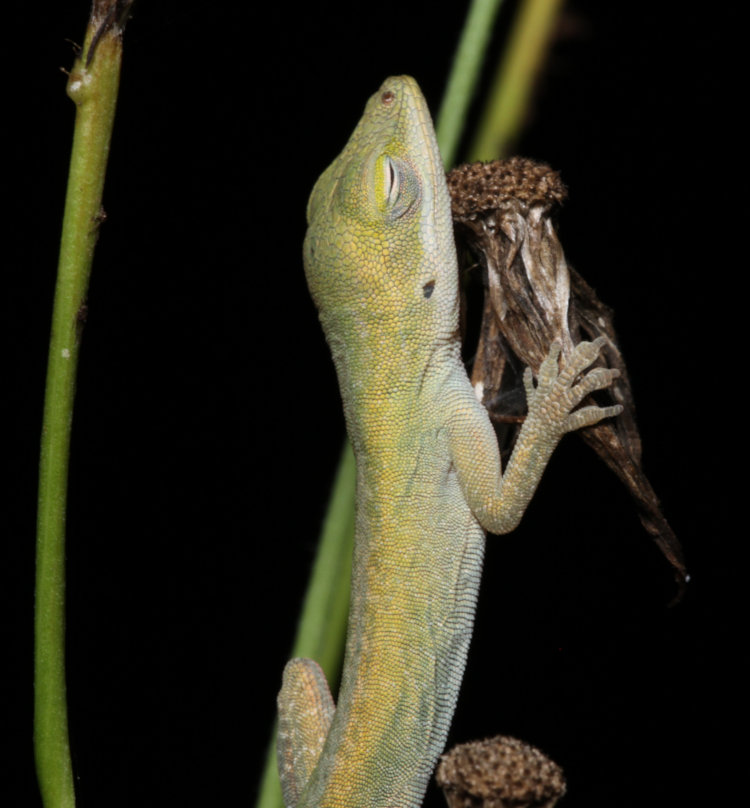
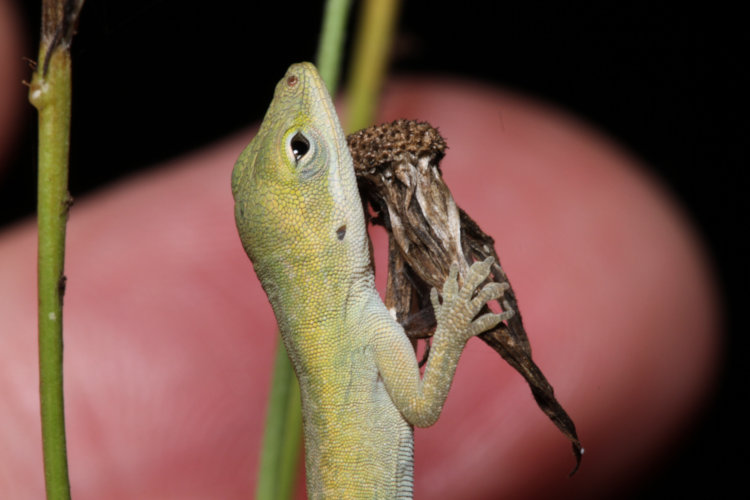
closeup of feet of Carolina anole Anolis carolinensis sleeping vertically on twig
This was, naturally, while messing about with the new(ish) Sigma 180mm macro, and hopefully I don’t need to tell you what this is; it’s not like I’ve featured much else for the past few weeks. What I do need to tell you is how small this is, the frame spanning about 20-22mm vertically – that’s less than an inch for all the Murrikins that can’t handle metric. Meanwhile, just soak in all that scaly detail.

The second entry is the most recent, taken just before my self-imposed deadline for the abstract posts, which means this is actually posting late (not like anyone is sitting there refreshing the page at 1 AM in anticipation, but if you’re gonna set a schedule, you keep to it, right?)

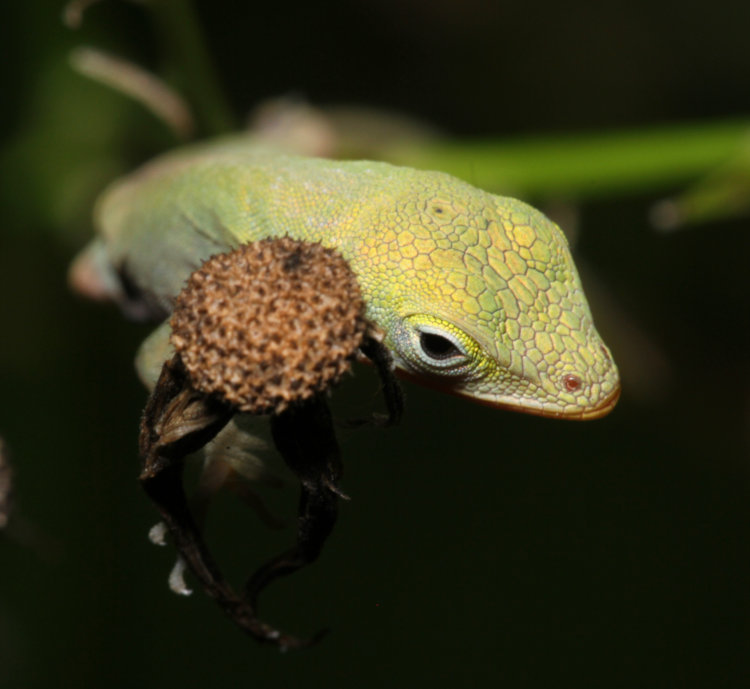
green treefrog Dryophytes cinereus perched on gazing ball being cheeky
I don’t have to tell anyone what this is, either, and it’s more of a portrait than an abstract, except for the context. I’ve had a crystal ‘gazing ball’ for some time now, intending to use it when the landscapes or macro subjects were right, and decided to do some experiments tonight/this morning. This was an exercise in frustrations all by itself, which I’ll get into later, but while attempting to get a minuscule green treefrog (Dryophytes cinereus) to remain posed within the field of view of the ball, instead the little bugger leapt away everywhere, including onto the ball itself, and then had the nerve to wave at me cheekily while doing so.

That’s what fits the bill for the end of the month, anyway. I’ll be back later on with a few more pics, and to go into greater detail regarding these experiments. Just you wait.

Estate Find XXXIX (is late)

Actually, I was rather committed to not even having an Estate Find this week, both from not finding anything new and from having far too many other things taking up my time, but we’re pulling this one out in the last minute, kinda – it was shot in the early evening as we were rearranging things in the yard.

very young Copes grey treefrog Dryophytes chrysoscelis perched on stem of Brugmansia plant
Okay, sure, it’s simply a Copes grey treefrog (Dryophytes chrysoscelis) perched on the stem of one of the trumpet flowers (Brugmansia.) Big fat hairy deal. Except that it’s not any of those, but quite tiny – it unfortunately moved from its much more photogenic locale, nestled in like a bud at the base of the leaves, while I was getting the camera. However, I had The Girlfriend available to help provide scale:

very young Copes grey treefrog Dryophytes chrysoscelis perched on stem of Brugmansia plant, with fingernail for scale
Her finger is even smaller than mine, and we discussed how to determine that scale, but suffice to say, this is tiny, able to be mistaken for a small leaf or even a blob of mud easily.

Now, the other news, directly related, is that this was shot with a whole new (to me) macro lens, specifically the Sigma 180mm Macro f3.5 APO – a much longer reach, a little brighter view, and Sigma’s Hypersonic Motor focusing. This is a significant step up, operation-wise, from the Mamiya 80mm f4 macro (intended for the M645 line of cameras) that I’d been using before, something that I’d switched to many moons ago when my previous macro lens conked out, and stayed with because it was the sharpest damn lens I’d ever used. That one, however, began to suffer from severe stiffness in the focusing ring, and my attempts to correct this (over many months of messing about) were unsuccessful. All of the examples of the same model that I’d been finding available were either in rough shape with fungus or lens separation internally, or suffered from the same stiffness problem. So this was The Girlfriend’s present to me, and I’m hashing it out.

The biggest difference is, a much, much greater working distance to achieve the same magnification, which is nice. The HSM focusing is slick (the Mamiya was strictly manual since it dated from the 70s,) if a little twitchy, but that has a lot to do with the longer focal length and wider aperture, both of which reduce the depth-of-field when focusing – this means that it’s very easy to sway out of sharpest focus, which the autofocus has to keep up with. Even if I go manual, which will still occur (I just don’t know how often,) I have to work on being absolutely steady or, like always, tripping the shutter just as I drift into the ideal sharpness zone. There will be a learning curve, certainly.

It’s also heavy, twice the length of the Mamiya and a little greater in girth. I mean, who doesn’t want that, but it certainly drags on the arm when out wandering around, and I’ll be designing new grips for it.

The tests have been quite revealing, as well.

closeup of Carolina anole Anolis carolinensis to test Sigma 180 macro
One of the first test images taken, this is full frame, and of one of the little juvenile Carolina anoles (Anolis carolinensis) that have been so handy recently. Now let’s crop in tight:

tight crop of closeup of Carolina anole Anolis carolinensis to test Sigma 180 macro
This is at half-resolution, and you can see that even at f16, the edges of the eye are wandering slightly out of focus, but the detail on the scales atop the head is pretty damn good. Moreover, the color rendition seems somehow much more nuanced, potentially due to the advances in modern lens glass and design – I’m not 100% sure that I’m truly seeing this or if it’s simply an artifact of the camera settings and lighting, so more tests will be in order. You’ll be seeing more as we go along.

I have another example, but it’s not from this lens and so isn’t an example of that, but the new macro softbox instead:

softbox test of Carolina anole Anolis carolinensis and unidentified crab spider sleeping on dead twig
That’s with the exact same settings that I’d been using for years, and it’s actually too bright, meaning the softbox is doing a much better job of transmitting light. Actually, checking the EXIF info, the aperture is 1/3 stop smaller than my routine settings, so it’s even more light than I thought. I’ve been stopping down from the former f16 to f/22 at least, which helps increase depth-of-field.

[There’s a limit to this, however, which is discussed and illustrated towards the bottom of this page. Long story short: stopping down too far starts to soften the image again through diffraction around the edges of the aperture blades, so there’s always a limit, and you should experiment carefully to know how far you can go with your own lens. It’s usually safe to say that using the smallest aperture of the lens will actually work against you, though.]

Anyway, we have an Estate Find after all, and a little news, and more experiments and examples to come. Cool, right?

Not exactly annual

Kinda far from it, actually, but nonetheless, we have the return of Beware of Strangers Baring Gifs Day, with another fine selection of animated foibles, curiosities, and giggles. Once again, these were collected from various places online (mostly theChive.com) that were never the originator in the first place, so I can’t give credit where it is due unless any of the creators contact me. Now that MP4s are largely supplanting gifs (pronounced, “GON-door-kolls-for-æd“,) most of these won’t autoplay, or at least I’m not going to spend the time trying to figure out how to do it. You can handle it, I’m sure.

Instant regret. And a cleaning job.

gif of cat making mistake

This primate (I’m not exactly sure what species) is distinctly unimpressed with your stereotyping.


I would totally do this.


Actually, I would totally fuck this up. I just want to learn to do this…

Spoiling the mood in a hurry.


Nothing to add at all.


This guy’s got it going on.


The perfect setup – this guy will never have a bigger victory.


Rally drivers are a special breed.


When I first saw this, one person quipped, “It must be a school crossing.” Bravo.


I love it when people add their own touches to existing gifs/videos, especially when they’re this well executed.


“Hey, man, you headed south?”


This is how you forfeit your entire flying career.


Heyo! Fuckfuckfuckfuckfuckfuck!”


Just happy to be included.


Beagles, man.


Needed one here.


Mistake


Pull over if you’re getting tired (it can be contagious.)


Ominous (and too damn close.)


What. The. Hell?


The faces.


The face.


Seriously, his expression kills me.

Valuable lesson.


I’m going to use this opportunity to feature my own odd memory. I was probably about 10 years old, and my family was visiting somebody with a horse farm next door. I was warned about the electric fence and respected that, but bored while their conversation went on interminably, I plucked a long blade of grass, bent into an inverted V, and dropped this from a safe distance onto the fencing. Of course nothing happened, and I chided myself for expecting anything else – naturally it wouldn’t be so powerful to do anything like burning through the grass. I went to pluck the blade off, which was enough to ground it. In my spasms as the appreciable current coursed through my body, I saw the grass glow orange where it contacted the fence and burn clean through. Son of a bitch…

So well staged.


Another great combination.


It’s silly and juvenile to assign human expressions to other animals.


So helpful.


Annnddd wait for it…


I think that’ll carry us for at least another year. Cheers!

To make you appreciate what you have

It’s easy to take things for granted, so from time to time, it’s actually good for people to suffer a little just so they understand that their life isn’t normally bad at all, which is what today’s holiday is all about, since this is Now You Know It Could Be Worse Day. And humanitarian that I am, I’m prepared (well, not exactly, since this should have posted hours ago,) to help you fully appreciate what you have, because it’s time to inflict a little pain. Nothing nasty, no no, just a little groan-invoking, that low-grade headache that won’t go away fast enough, and all you have to do it sit back and let it happen. Well, after you hit ‘Play’ anyway…

Now, if that wasn’t enough to make you really happy with your life, I’m also prepared to come back and tell you all the fun that I had making this, because I’m that kind of guy. One way or another, you’ll learn to embrace life without, well, my help.

And not that I’d ever be the target of such inquiries, but this might well be enough to prevent you from asking about someone’s creative processes ever again. Just Mr. Magnanimous, aren’t I?

The previous version, by the way.

The video with the voiceover assistance of the grey treefrogs, which might also serve the same purpose as this one, depending on how you feel about snakes.

Walkabout recommends: The Hudsucker Proxy

Despite being a Coen Brothers film, with writing and direction assistance by Sam Raimi, I’ve found very few people familiar with this one, and it’s a shame because this is a great little story on its own, even if it doesn’t quite measure up to the more popular films that they’ve made. This also came out in 1994, at roughly the same time as Forrest Gump, which naturally eclipsed most other films that year, yet they have some distinct similarities between them and, for my money, this one has a better story and is more charming than Forrest Gump, with better characters and performances by far.

Cover art for 'The Hudsucker Proxy'The Hudsucker Proxy takes place in December 1958 in New York City, and bears the style and feel of the “rags to riches” films of that time period. Even better, it replicates many of the classic characters of the era, with no bad performances from anyone; Jennifer Jason Leigh as the fast-talking, streetwise journalist Amy Archer is simply fantastic, and listening to her rip off her dialogue (damn near monologues, most of the time) is delightful. Tim Robbins plays the lead as Norville Barnes, a naïve Muncieite newly arrived in the city and hoping that his new idea (“You know… for kids”) will propel him to success. Robbins has the face and voice for parts like this, but makes his transition to self-confident executive without quite leaving behind the naïvete, and he handles this adeptly. Paul Newman serves as the cynical and conniving Sidney J. Mussberger, the newly-appointed head of Hudsucker Industries who has to find a way for the board of directors to maintain controlling shares, and selects Barnes to fulfill this plot.

Story-wise, the film is decent, though variations of such plotlines abound. It becomes quite surreal at times, and it’s easy to forget that the film opened with a narration, and by the end we’re reminded that this is being recounted by a character within, so the more unlikely aspects are perhaps a factor of overzealous storytelling. Visually however, the Coen Brothers have recreated the era supremely well, with a nod towards exaggeration to enhance the aspects, from the Brazil-like mailroom to the towering wall of filing drawers in the executive antechambers. Mussberger’s massive and empty office speaks of excess without purpose, or even comfort, while the newsroom where Archer works is the classic beehive of typewriters and cigar smoke. There’s even the spinning overlaid text gimmick to illustrate Barnes’ overwhelming disillusion while seeking employment, but the montage of the manufacturing process is so period-perfect, visually and musically, that it’s almost startling. Cinephiles (of which I am not) are likely to see homages to other films and directors within – some of them seem to jump out at times.

There are also little hints of the hands of Fate, evinced by the windblown newspaper page that dances down the sidewalk to embrace Barnes’ legs – masterfully staged, that – and the ‘dingus’ that rolls away to fall at the feet of a particular little boy (one that possesses a hell of a lot more talent than I myself had at that age, since I could never get them to work at all.)

The music cannot be ignored, since it is perfectly matched to the era as well as the plot and visuals – one could listen to the soundtrack (or simply the end credits pieces) and know, within a decade, what period the film is placed within. Moreover, some of the themes toy with us, suggesting certain songs while still being original works for the movie, so full credit to composer Carter Burwell.

Both The Hudsucker Proxy and Forrest Gump have their oblivious main characters successfully wending their way among those more savvy, though Barnes is simply naïve and not mentally challenged, and both have the characters responsible for real-world accomplishments, in Hudsucker to a lesser (and more believable) extent. The humor here is more apparent though, not wry tongue-in-cheek commentary but a lovely satire of both the 1950s and the films therein, as befits the Coen Brothers. It’s immersive while at the same time a send-up, and vaguely reminiscent of certain Looney Tunes cartoons from the same era.

Where the movie shines the brightest is the dialogue, however, and it’s handled better than anything that Tarantino has produced. Quite a few interchanges are relentless, never mugging for the humor but snapping in the next gag without respite, and the best among them is Leigh, effortlessly spouting three times the verbiage of an ordinary conversation as her no-nonsense journalist, while still masking a level of insecurity, her voice at times reminiscent of Judy Garland. Watching Robbin’s character cut through this façade, wholly unintentionally, is certainly fun. The best achievement, though, comes from their first meeting at a lunch counter, entirely and dramatically narrated by two cynical cab drivers observing from across the diner. This simple variation is far more effective than filming the interaction ‘straight’ and highlights the absurd nature of Archer’s machinations recounted through the patois of the boroughs.

The casting is also flawless, right down to the two-second character appearances, but without subtleties, dancing on the line between character and caricature (also a Coen Brothers trademark); within a line or two, you know all you need to know about just about everyone in the film. Is this heavy-handed, or an aspect of the story being recounted from memory? I’m not sure it matters at all, since we’re not here to solve a mystery or fathom some deeper insights, we’re just along for the ride – the film is about entertainment, not introspection. And this is where it departs radically from Forrest Gump, because we’re not going to contemplate Barnes’ life or how major events surrounded him, we’re just going to see where his glass ceiling lies.

Will the city mold or break Barnes? Will Archer gain what she needs with her big story? Will Mussberger thank his tailor? It’s worth the 111 minutes of your time, not necessarily to find out, but just to see it play through.

Topic swap

There’s little doubt that I go through long periods where I’m photographing the same kinds of subjects – usually not intentionally, except insofar that I’m not making a specific effort to get more variety in. It’s been bugs, and frogs, and birds, and even aquatic macro at times; just recently it’s been the lizards and occasional other denizens of the property after nightfall, and this was partially because that was when I had the time and inclination to chase some pics. So today, when a red-shouldered hawk (Buteo lineatus) landed on a nearby dead branch and was calling enthusiastically, I took advantage of it. Full credit to the bird for staying put long enough for me to get the camera and long lens.

likely female red-shouldered hawk Buteo lineatus preening while perched on dead branch
Last winter we had a pair visiting regularly, at least one of which was routinely hunting right in the front yard, and they even began a nest in a tree in the back yard. But then shortly before laying season they abandoned it, and appeared to have picked a spot a few hundred meters further south out of sight to nest. All summer, it’s been largely quiet with only occasional visits, but now they appear to be starting up again. This one took a short break from its calling to try to clean out some old feathers, none too efficiently.

likely female red-shouldered hawk Buteo lineatus calling from perch on dead branch
The angle that I had was too close to directly into the light – this is over-exposed a full 2 stops over what the camera was metering for, which was the sky itself, the hawk being too small in the frame to affect exposure sufficiently (these are also cropped, of course.) You can see the stray feather still sitting there against the wing. These images also told me (again, not that I needed any reminder) not to base exposure compensation on what the LCD showed in the preview, because they looked too dark there, but I knew more than 2 stops would be excessive.

I was hearing another red-shoulder in the distance, which is not unusual since they routinely mark territory, but after a few minutes it started coming within a hundred meters. Rather than taking flight to challenge an interloper, this one remained in place but continued calling, the calls getting softer and more half-hearted, almost muttering, when the other drew close. As suspected, that one was the Significant Other, and soon came in for a landing.

likely male red-shouldered hawk Buteo lineatus coming in to land next to female on dead branch
Telephoto compression makes them look about ready to collide here, but there’s still a decent separation between them. I’m kind of lucky autofocus tracked as well as it did, because I shifted over to catch the new one approaching but didn’t frame well enough until he was quite close to the original – my view was largely blocked by trees in that direction.

likely male red-shouldered hawk Buteo lineatus taking perch on dead branch above female
And touchdown – yes, the first hawk probably really is ducking just to avoid getting slapped with wings or tail.

likely male red-shouldered hawk Buteo lineatus still calling as it gets settled above female on dead branch
Next frame in the sequence as I held the shutter down – you can see the new one is already sounding off again, even though the reunion meant that they both got a lot quieter and stuck to minor vocalizations from this point on.

pair of red-shouldered hawks Buteo lineatus perched together and surveying surroundings
I did get a nice portrait of the two of them, and this image shows the size difference well enough; it’s likely the female down below, the first one spotted, since they’re typically a little larger than the males for most raptors.

Now, is this the same pair that we observed through the winter? Can’t say for sure. Even if it is, I’m not even sure that they raised any young, but given their penchant for remaining a little further south until now, when the young should be off on their own and even chased away from the territory, there’s the tiniest indication, but that’s all; we never saw any sign of child-rearing or obvious juveniles.

Since they were staying put, and because we’ve had a history of the winter pair not being too disturbed by people nearby, I started moving across the yard to see if I could get a view from the sunny side. This required getting a bit closer, and before I managed to bring the branch back into view past the intervening trees, they took flight again – this could have been my doing, or it might simply have been when they decided to stop sitting around. They circled out over the pond a couple of times and gradually moved further off, and while I fired off several frames as they circled, autofocus wasn’t locking on very well, so this is the only truly sharp frame that I got:

red-shouldered hawk Buteo lineatus sounding off again as it circles in flight
Yep – sounding off again; red-shouldered hawks can be damn noisy raptors.

So, we’ll see what happens from here. While we were sorry to see the nest get abandoned in the early spring, soon afterword the wood ducks started descending on the yard in large numbers, which was a more than decent tradeoff. Back in May, one red-shoulder returned to the yard for a few days, apparently hunting the wood ducks, and actually killed one not too long after we knew it was hunting here.

red-shouldered hawk Buteo lineatus on ground after killing female wood duck
You can’t see its prey here, but we confirmed it was a female wood duck after I spooked it off – it later returned to take the carcass away. Naturally, this did not go over well with The Girlfriend, who took to clapping together a couple of wood blocks every time she heard a hawk nearby, a sound loud and sharp enough to keep them from the immediate area. The wood ducks, for their part, got a lot more wary, and we started putting corn down only at the very edge of the yard near the water, reasoning that the ducks could get over water much quicker and the hawk was less likely to try and snag one there, being unable to ground their capture (wood ducks are too large for a red-shouldered hawk to easily kill and carry off while in flight.) There were no other losses to our knowledge, but now we’ll have to see what happens.

[So okay, balance of nature and this is how things go, even hawks have to eat, but we were also creating a feeding station in the yard, so we were implicit in making the ducks more of a target. And yes, we like the ducks better – sorry, professional detachment doesn’t go that far. Sue us.]

Estate Find XXXVIII (XXXIIX)

Again, a slow week, so we have an intruder right into Walkabout Studios/Deep 13, which happens far too often, really. Some of them seem to sneak past the weather-stripping, and some are waiting just outside the door at night for me to open it, though why this seems such a magical place to them, I can’t say. They’re always captured and returned outside, but occasionally they are forced to do a photo session first, and this one was peculiar enough to merit that treatment.

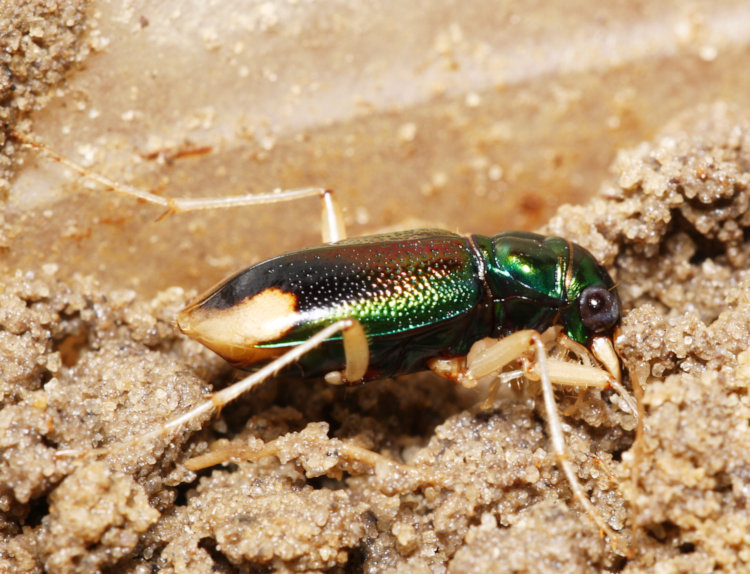
species of false bombardier beetle Galerita
Despite never having seen the like before, I thought it looked a bit familiar, but I was also handling it with care since those are keepaway colors. The head, especially, stirred some distant memories, but it was of a species that I hadn’t identified then, either.

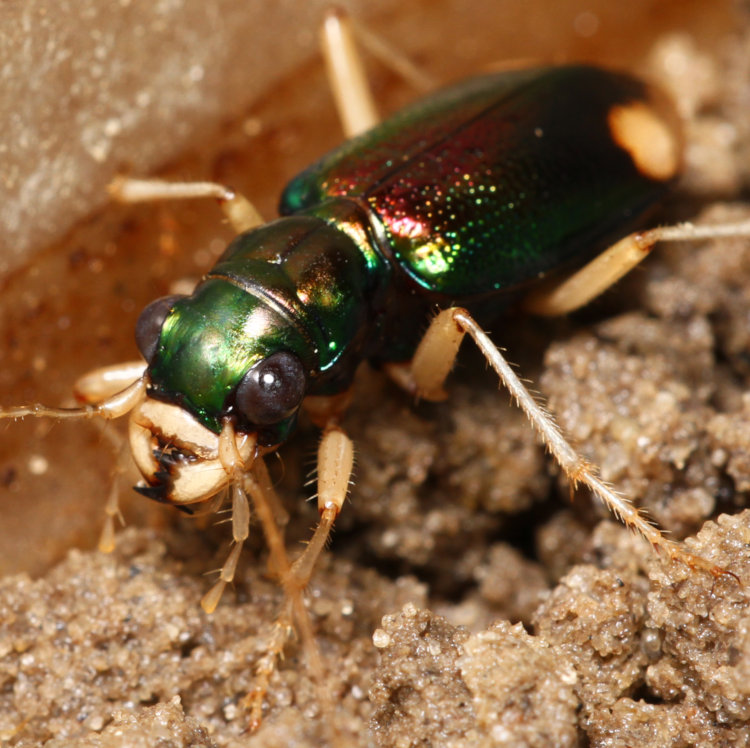
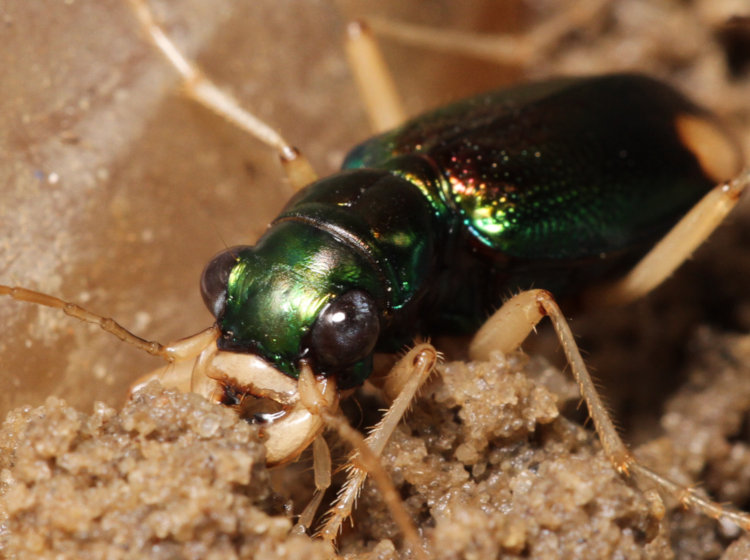
closeup of head of false bombardier beetle Galerita
The overall length was… well, the main part of the body was about 25mm, but it had two long whiplike appendages on the hind end that extended this for another 8-10mm.

I did an image search thing, then double-checked through BugGuide.net, and it appears this is one species of false bombardier beetle (Genus Galerita.) I’m familiar to a degree with bombardier beetles, despite never having seen one in person, since they’re an interesting species that I would love to capture someday – but very carefully, since their defense mechanism is quite exuberant and effective. This, however, did not seem right at all, save for the color pattern – the head is not a match, though it appears other species in the same Genus have closer matches.

What it most appeared like, the thing that sparked the memory, was this, from seven years ago:

unidentified aquatic larva
As you may notice, though, this is aquatic, and there’s no mention that the larval stages of Galerita spend any time in the water. But the shape of the head, the segmented body, and the pairs of legs confined to different segments is otherwise quite a close match. I’m no closer to identifying this one now than I was then, but they certainly seem related, if distantly. The heads are close, but have distinctive differences:

unidentified larva portrait
Most especially, my recent capture has a schnozz that this one lacks, but even the cluster of just a handful of ommatidia (eyes) is almost identical. Some centipedes have similar heads, but not as close as these two.

But really, that’s it this week. Almost had a meadow vole for you, but it was too quick to get under cover, and everything else you’ve seen before. I’ve been more buried in projects – need to go explore more.

1 5 6 7 8 9 323